Getting Feel for BRF+
Dhivya Baskaran
Agenda
 Introduction
 Prerequisites & Release
 BRMS
 Agility Vs Automation
 BRF Vs BRF+
 Summary
Introduction
What?
 BRF+ is a rule management engine in the ABAP environment.
It describes operations, definitions and constraints that apply to organization.
BRF+ UI consists of a workbench that enables you to maintain your business rules.
The workbench provides access to all the BRFplus objects available in a system.
Why?
Business Rule is a statement which defines or constraints aspects of business.
Aims at empowerment of business users change and organize business rules
directly.
How?
Transaction code : BRF+ / BRFPlus / FDT_Workbench.
Prerequisites & History
 Role : SAP_BC_FDT_ADMINISTRATOR
 BRFplus first was shipped in SAP NetWeaver 7.0 (also known as NW 2004s). These
shipments had many limitations, for instance, there were no user interface. There
was no documentation available and some incompatible changes were needed.
 With enhancement package 1 on either NW 700 or NW 710 BRFplus has its first
full shipment, including user interface and some further previously undisclosed
objects and features.
 SAP NetWeaver 7.0 EHP2 is the first release with a complete and unrestricted
shipment of BRFplus. It can be used for use cases of any degree of complexity.
BRMS
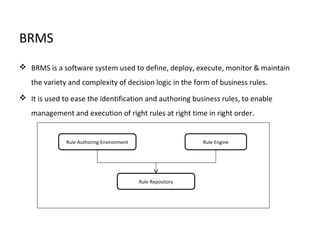
 BRMS is a software system used to define, deploy, execute, monitor & maintain
the variety and complexity of decision logic in the form of business rules.
 It is used to ease the identification and authoring business rules, to enable
management and execution of right rules at right time in right order.
Rule Authoring Environment
Rule Repository
Rule Engine
BRMS Contd..
 Rule Authoring Environment
– Definition and maintenance of business rules.
– Set of user interface tools.
 Rule Repository
– Allow the storage of business rules separate from application code.
– Captures business rules and business vocabulary created in the rules authoring environment.
Backbone of rule authoring environment.
– Contains the complete life cycle of rules.
– Some rule repository can tightly integrate with other technologies like BPM, ERP applications to
reduce cost, integration complexity & time-to-value.
 Rule Engine
– Execute business rules upon invocation by application code.
– Heart of BRMS.
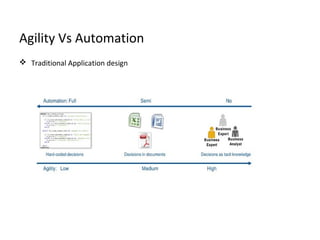
Agility Vs Automation
 Traditional Application design
BRF Vs BRF+
Concepts BRF BRF+
User
Interface
Dynpro WebDynpro ABAP
Rule
Execution
Interpretation Code generation and interpretation
Context and
Result
Context access by
nested expressions
Direct context access
Persistence
Layer
DB tables with
delivery class E;
client-dependent,
manual transport
recording; no reuse
DB tables with delivery classes S,C, and
A; local and non-local, client-dependent
and cross-client, manual and automatic
transport recording; reuse possible
Data Types Elementary types Elementary, structure and table types,
support of deeply nested types
API Mixture of UI and
Backend in the API
Decoupling of UI and backend logic by
clearly defined API
Summary
 Business User Empowerment
 Rapid Time-to-Value
 Zero Administration
 Agile and maintainable systems
 Automation of key business decisions
 Central management of business rules
 Visibility, accountability and error-free business
Thank you

Getting feel for BRF+

  • 1.
    Getting Feel forBRF+ Dhivya Baskaran
  • 2.
    Agenda  Introduction  Prerequisites& Release  BRMS  Agility Vs Automation  BRF Vs BRF+  Summary
  • 3.
    Introduction What?  BRF+ isa rule management engine in the ABAP environment. It describes operations, definitions and constraints that apply to organization. BRF+ UI consists of a workbench that enables you to maintain your business rules. The workbench provides access to all the BRFplus objects available in a system. Why? Business Rule is a statement which defines or constraints aspects of business. Aims at empowerment of business users change and organize business rules directly. How? Transaction code : BRF+ / BRFPlus / FDT_Workbench.
  • 4.
    Prerequisites & History Role : SAP_BC_FDT_ADMINISTRATOR  BRFplus first was shipped in SAP NetWeaver 7.0 (also known as NW 2004s). These shipments had many limitations, for instance, there were no user interface. There was no documentation available and some incompatible changes were needed.  With enhancement package 1 on either NW 700 or NW 710 BRFplus has its first full shipment, including user interface and some further previously undisclosed objects and features.  SAP NetWeaver 7.0 EHP2 is the first release with a complete and unrestricted shipment of BRFplus. It can be used for use cases of any degree of complexity.
  • 5.
    BRMS  BRMS isa software system used to define, deploy, execute, monitor & maintain the variety and complexity of decision logic in the form of business rules.  It is used to ease the identification and authoring business rules, to enable management and execution of right rules at right time in right order. Rule Authoring Environment Rule Repository Rule Engine
  • 6.
    BRMS Contd..  RuleAuthoring Environment – Definition and maintenance of business rules. – Set of user interface tools.  Rule Repository – Allow the storage of business rules separate from application code. – Captures business rules and business vocabulary created in the rules authoring environment. Backbone of rule authoring environment. – Contains the complete life cycle of rules. – Some rule repository can tightly integrate with other technologies like BPM, ERP applications to reduce cost, integration complexity & time-to-value.  Rule Engine – Execute business rules upon invocation by application code. – Heart of BRMS.
  • 7.
    Agility Vs Automation Traditional Application design
  • 8.
    BRF Vs BRF+ ConceptsBRF BRF+ User Interface Dynpro WebDynpro ABAP Rule Execution Interpretation Code generation and interpretation Context and Result Context access by nested expressions Direct context access Persistence Layer DB tables with delivery class E; client-dependent, manual transport recording; no reuse DB tables with delivery classes S,C, and A; local and non-local, client-dependent and cross-client, manual and automatic transport recording; reuse possible Data Types Elementary types Elementary, structure and table types, support of deeply nested types API Mixture of UI and Backend in the API Decoupling of UI and backend logic by clearly defined API
  • 9.
    Summary  Business UserEmpowerment  Rapid Time-to-Value  Zero Administration  Agile and maintainable systems  Automation of key business decisions  Central management of business rules  Visibility, accountability and error-free business
  • 10.