Nugroho Gito
Software Architect, IBM Indonesia
ngito@id.ibm.com
Role of IT Architect
Software Architect Community
Jakarta Meetup @ Gojek HQ, 30 Sept 2017
IT Architect Definition
3
Role of an IT Architect
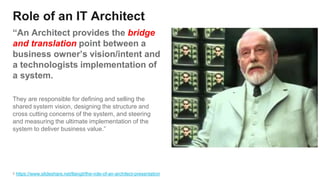
“An Architect provides the bridge
and translation point between a
business owner’s vision/intent and
a technologists implementation of
a system.
They are responsible for defining and selling the
shared system vision, designing the structure and
cross cutting concerns of the system, and steering
and measuring the ultimate implementation of the
system to deliver business value.”
https://www.slideshare.net/llangit/the-role-of-an-architect-presentation
4
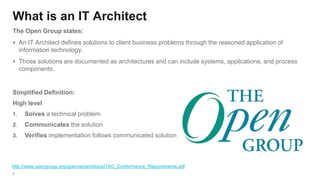
What is an IT Architect
The Open Group states:
▪ An IT Architect defines solutions to client business problems through the reasoned application of
information technology.
▪ Those solutions are documented as architectures and can include systems, applications, and process
components.
http://www.opengroup.org/openca/cert/docs/ITAC_Conformance_Requirements.pdf
Simplified Definition:
High level
1. Solves a technical problem
2. Communicates the solution
3. Verifies implementation follows communicated solution
5
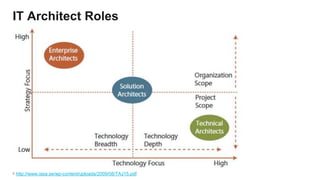
IT Architect Roles
http://www.iasa.se/wp-content/uploads/2009/08/TAJ15.pdf
6
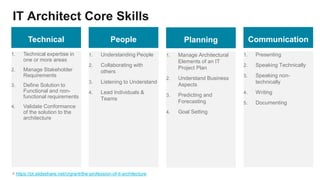
IT Architect Core Skills
https://pt.slideshare.net/crgrant/the-profession-of-it-architecture
Technical
1. Understanding People
2. Collaborating with
others
3. Listening to Understand
4. Lead Individuals &
Teams
People
1. Manage Architectural
Elements of an IT
Project Plan
2. Understand Business
Aspects
3. Predicting and
Forecasting
4. Goal Setting
Planning
1. Presenting
2. Speaking Technically
3. Speaking non-
technically
4. Writing
5. Documenting
Communication
1. Technical expertise in
one or more areas
2. Manage Stakeholder
Requirements
3. Define Solution to
Functional and non-
functional requirements
4. Validate Conformance
of the solution to the
architecture
7
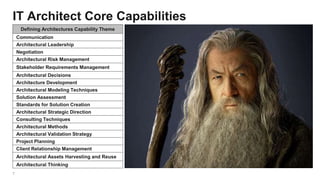
IT Architect Core Capabilities
Defining Architectures Capability Theme
Communication
Architectural Leadership
Negotiation
Architectural Risk Management
Stakeholder Requirements Management
Architectural Decisions
Architecture Development
Architectural Modeling Techniques
Solution Assessment
Standards for Solution Creation
Architectural Strategic Direction
Consulting Techniques
Architectural Methods
Architectural Validation Strategy
Project Planning
Client Relationship Management
Architectural Assets Harvesting and Reuse
Architectural Thinking
8
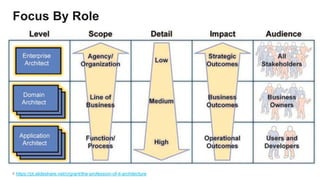
Focus By Role
https://pt.slideshare.net/crgrant/the-profession-of-it-architecture
Framework & Methods
11
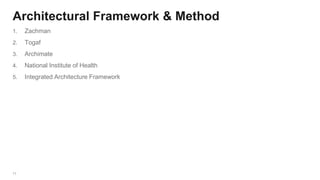
Architectural Framework & Method
1. Zachman
2. Togaf
3. Archimate
4. National Institute of Health
5. Integrated Architecture Framework
12
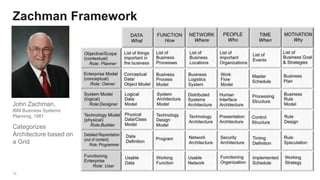
Zachman Framework
John Zachman,
IBM Business Systems
Planning, 1981
Categorizes
Architecture based on
a Grid
13
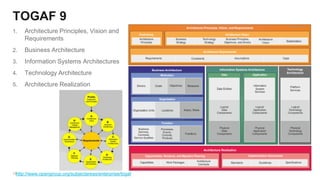
TOGAF 9
1. Architecture Principles, Vision and
Requirements
2. Business Architecture
3. Information Systems Architectures
4. Technology Architecture
5. Architecture Realization
http://www.opengroup.org/subjectareas/enterprise/togaf
IT Architect Career Path
16
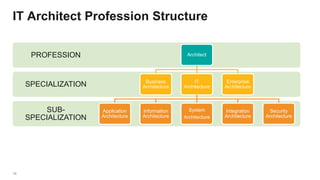
SUB-
SPECIALIZATION
SPECIALIZATION
PROFESSION Architect
Business
Architecture
IT
Architecture
Application
Architecture
Information
Architecture
System
Architecture
Integration
Architecture
Security
Architecture
Enterprise
Architecture
IT Architect Profession Structure
17
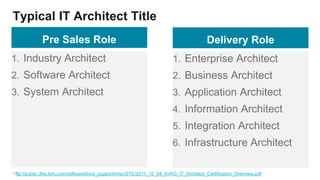
Typical IT Architect Title
ftp://public.dhe.ibm.com/software/tivoli_support/misc/STE/2011_10_04_AVKS_IT_Architect_Certification_Overview.pdf
1. Industry Architect
2. Software Architect
3. System Architect
Pre Sales Role
1. Enterprise Architect
2. Business Architect
3. Application Architect
4. Information Architect
5. Integration Architect
6. Infrastructure Architect
Delivery Role
18
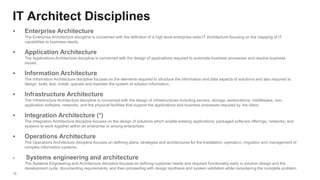
IT Architect Disciplines
▪ Enterprise Architecture
The Enterprise Architecture discipline is concerned with the definition of a high level enterprise-wide IT Architecture focusing on the mapping of IT
capabilities to business needs.
▪ Application Architecture
The Applications Architecture discipline is concerned with the design of applications required to automate business processes and resolve business
issues.
▪ Information Architecture
The Information Architecture discipline focuses on the elements required to structure the information and data aspects of solutions and also required to
design, build, test, install, operate and maintain the system of solution information.
▪ Infrastructure Architecture
The Infrastructure Architecture discipline is concerned with the design of infrastructures including servers, storage, workstations, middleware, non-
application software, networks, and the physical facilities that support the applications and business processes required by the client.
▪ Integration Architecture (*)
The Integration Architecture discipline focuses on the design of solutions which enable existing applications, packaged software offerings, networks, and
systems to work together within an enterprise or among enterprises.
▪ Operations Architecture
The Operations Architecture discipline focuses on defining plans, strategies and architectures for the installation, operation, migration and management of
complex information systems.
▪ Systems engineering and architecture
The Systems Engineering and Architecture discipline focuses on defining customer needs and required functionality early in solution design and the
development cycle, documenting requirements, and then proceeding with design synthesis and system validation while considering the complete problem.
20
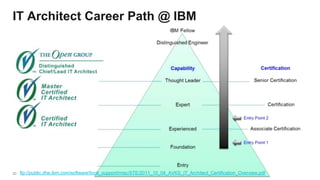
IT Architect Career Path @ IBM
ftp://public.dhe.ibm.com/software/tivoli_support/misc/STE/2011_10_04_AVKS_IT_Architect_Certification_Overview.pdf
21
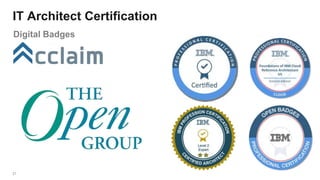
IT Architect Certification
Digital Badges
Technology Stack
24
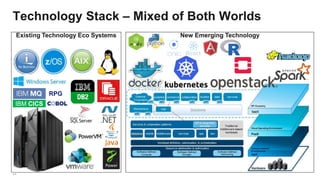
Technology Stack – Mixed of Both Worlds
Existing Technology Eco Systems New Emerging Technology
IBM CICS
RPG
Industry Challenges
26
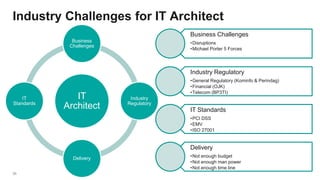
Industry Challenges for IT Architect
IT
Architect
Business
Challenges
Industry
Regulatory
Delivery
IT
Standards
Business Challenges
•Disruptions
•Michael Porter 5 Forces
Industry Regulatory
•General Regulatory (Kominfo & Perindag)
•Financial (OJK)
•Telecom (BP3TI)
IT Standards
•PCI DSS
•EMV
•ISO 27001
Delivery
•Not enough budget
•Not enough man power
•Not enough time line
Thank You

IT Architect Profession

  • 1.
    Nugroho Gito Software Architect,IBM Indonesia ngito@id.ibm.com Role of IT Architect Software Architect Community Jakarta Meetup @ Gojek HQ, 30 Sept 2017
  • 2.
  • 3.
    3 Role of anIT Architect “An Architect provides the bridge and translation point between a business owner’s vision/intent and a technologists implementation of a system. They are responsible for defining and selling the shared system vision, designing the structure and cross cutting concerns of the system, and steering and measuring the ultimate implementation of the system to deliver business value.” https://www.slideshare.net/llangit/the-role-of-an-architect-presentation
  • 4.
    4 What is anIT Architect The Open Group states: ▪ An IT Architect defines solutions to client business problems through the reasoned application of information technology. ▪ Those solutions are documented as architectures and can include systems, applications, and process components. http://www.opengroup.org/openca/cert/docs/ITAC_Conformance_Requirements.pdf Simplified Definition: High level 1. Solves a technical problem 2. Communicates the solution 3. Verifies implementation follows communicated solution
  • 5.
  • 6.
    6 IT Architect CoreSkills https://pt.slideshare.net/crgrant/the-profession-of-it-architecture Technical 1. Understanding People 2. Collaborating with others 3. Listening to Understand 4. Lead Individuals & Teams People 1. Manage Architectural Elements of an IT Project Plan 2. Understand Business Aspects 3. Predicting and Forecasting 4. Goal Setting Planning 1. Presenting 2. Speaking Technically 3. Speaking non- technically 4. Writing 5. Documenting Communication 1. Technical expertise in one or more areas 2. Manage Stakeholder Requirements 3. Define Solution to Functional and non- functional requirements 4. Validate Conformance of the solution to the architecture
  • 7.
    7 IT Architect CoreCapabilities Defining Architectures Capability Theme Communication Architectural Leadership Negotiation Architectural Risk Management Stakeholder Requirements Management Architectural Decisions Architecture Development Architectural Modeling Techniques Solution Assessment Standards for Solution Creation Architectural Strategic Direction Consulting Techniques Architectural Methods Architectural Validation Strategy Project Planning Client Relationship Management Architectural Assets Harvesting and Reuse Architectural Thinking
  • 8.
  • 9.
  • 10.
    11 Architectural Framework &Method 1. Zachman 2. Togaf 3. Archimate 4. National Institute of Health 5. Integrated Architecture Framework
  • 11.
    12 Zachman Framework John Zachman, IBMBusiness Systems Planning, 1981 Categorizes Architecture based on a Grid
  • 12.
    13 TOGAF 9 1. ArchitecturePrinciples, Vision and Requirements 2. Business Architecture 3. Information Systems Architectures 4. Technology Architecture 5. Architecture Realization http://www.opengroup.org/subjectareas/enterprise/togaf
  • 13.
  • 14.
  • 15.
    17 Typical IT ArchitectTitle ftp://public.dhe.ibm.com/software/tivoli_support/misc/STE/2011_10_04_AVKS_IT_Architect_Certification_Overview.pdf 1. Industry Architect 2. Software Architect 3. System Architect Pre Sales Role 1. Enterprise Architect 2. Business Architect 3. Application Architect 4. Information Architect 5. Integration Architect 6. Infrastructure Architect Delivery Role
  • 16.
    18 IT Architect Disciplines ▪Enterprise Architecture The Enterprise Architecture discipline is concerned with the definition of a high level enterprise-wide IT Architecture focusing on the mapping of IT capabilities to business needs. ▪ Application Architecture The Applications Architecture discipline is concerned with the design of applications required to automate business processes and resolve business issues. ▪ Information Architecture The Information Architecture discipline focuses on the elements required to structure the information and data aspects of solutions and also required to design, build, test, install, operate and maintain the system of solution information. ▪ Infrastructure Architecture The Infrastructure Architecture discipline is concerned with the design of infrastructures including servers, storage, workstations, middleware, non- application software, networks, and the physical facilities that support the applications and business processes required by the client. ▪ Integration Architecture (*) The Integration Architecture discipline focuses on the design of solutions which enable existing applications, packaged software offerings, networks, and systems to work together within an enterprise or among enterprises. ▪ Operations Architecture The Operations Architecture discipline focuses on defining plans, strategies and architectures for the installation, operation, migration and management of complex information systems. ▪ Systems engineering and architecture The Systems Engineering and Architecture discipline focuses on defining customer needs and required functionality early in solution design and the development cycle, documenting requirements, and then proceeding with design synthesis and system validation while considering the complete problem.
  • 17.
    20 IT Architect CareerPath @ IBM ftp://public.dhe.ibm.com/software/tivoli_support/misc/STE/2011_10_04_AVKS_IT_Architect_Certification_Overview.pdf
  • 18.
  • 19.
  • 20.
    24 Technology Stack –Mixed of Both Worlds Existing Technology Eco Systems New Emerging Technology IBM CICS RPG
  • 21.
  • 22.
    26 Industry Challenges forIT Architect IT Architect Business Challenges Industry Regulatory Delivery IT Standards Business Challenges •Disruptions •Michael Porter 5 Forces Industry Regulatory •General Regulatory (Kominfo & Perindag) •Financial (OJK) •Telecom (BP3TI) IT Standards •PCI DSS •EMV •ISO 27001 Delivery •Not enough budget •Not enough man power •Not enough time line
  • 23.