“Fast-paced and
frequent action”
‚The conflict
between the
main characters
is mental and
emotional as
‚Primary mood:
‘fearful
excitement’‛
“Ordinary citizens
accidentally drawn to
danger”
‚Resourceful
heroes who
must thwart the
actions of more
powerful and
better equipped
villains‛
‚Characters who
switch sides or
who cannot be
trusted‛
‚The use of a
staircase as a
motif for
impending
danger or
suspense‛
‚Fast-paced and
frequent action‛
The frequent visions of Rupert’s
create a non-linear narrative that
jumps from the visions back to the
session in the doctor’s office. The
murder scene is a particularly
strong representation of this fast-
paced and frequent action. We
regularly jump back to the tense
office scene while the hypnotist
mysteriously injects his patient.
‚Fast-paced and
frequent action‛
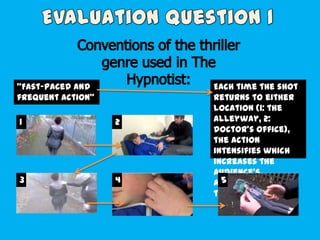
Each time the shot
returns to either
location (1: the
alleyway, 2:
doctor’s office),
the action
intensifies which
increases the
audience’s
anticipation for
the next shot.
1
3
2
4 5
‚Fast-paced and
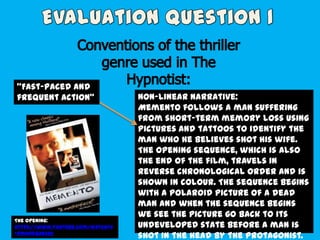
frequent action‛ Non-linear narrative:
Memento follows a man suffering
from short-term memory loss using
pictures and tattoos to identify the
man who he believes shot his wife.
The opening sequence, which is also
the end of the film, travels in
reverse chronological order and is
shown in colour. The sequence begins
with a Polaroid picture of a dead
man and when the sequence begins
we see the picture go back to its
undeveloped state before a man is
shot in the head by the protagonist.
The opening:
https://www.youtube.com/watch?v
=RmK0eQ2GC6U
Although this is not achieved in the
opening, the two main characters create
the basis for this thriller convention to
unravel in the remainder of the film’s
plot. The character of ‚Rupert‛ is
vulnerable in comparison to the
antagonist doctor who has the power of
his medical knowledge. He uses this to
manipulate his patients into carrying out
violent crimes. However, by seeing that
Rupert is capable of being equally strong
and powerful suggests that he can be
resourceful in the remainder of the film.
‚Resourceful
heroes who
must thwart the
actions of more
powerful and
better equipped
villains‛
The plot would continue by following up
on more of the doctor’s patients who have
also committed murder. The audience will
discover that the doctor is behind each and
every murder that will result in his victims
Each of Dr. J. Smith’s patients are
‚ordinary‛ however by chance (by being
advised to choose his services) they fall
victim to become murderers through his
mental influence. We gain the sense of the
ordinary through Rupert’s genuine
confusion and disorientation which
clarifies that he was not intended to
become a murderer.
‚Ordinary
citizens
accidentally
drawn to
danger‛
This thriller convention is used in
North by Northwest and Source Code.
Cary Grant and Jake Gyllenhaal’s
confused and disorientated reactions
are how we wanted to convey the
character of Rupert.
‚Ordinary
citizens
accidentally
drawn to
danger‛
North by Northwest:
Cary Grant
Source Code: Jake
Gyllenhaal
‚There is one thing that I get to offer you,
and that is hypnotherapy‛ (1:05) is the
‘chilling’ line that will commence the
action scenes of Rupert chasing down his
victim. This intends to leave the viewer
anticipating what is to follow while
feeling slightly on edge after already
having viewed the visions that have made
Rupert appear mental and obsessive.
‚Primary mood:
‘fearful
excitement’‛
I noticed that this was relatively similar
to the ‘Coin Toss’ scene in No Country For
Old Men. The response to the simple
question of: ‚heads or tails?‛ was either
life or death for Chirgurh’s victim. This
scene contrasted the rest of the film
because it consisted of mainly dialogue-
the ‘fearful excitement’ builds because of
this odd extended scene of speech.
‚Primary mood:
‘fearful
excitement’‛
Coin Toss scene:
http://www.youtube.com/watch?v=OLCL6OYbS
Tw
We attempted to develop our film into a
‘psychological’ thriller by focusing
mainly on the mental conflict. ‚Mental‛
conflict is displayed through the patient’s
visions and the influential hypnotherapy
of the doctor. Although an incident of
‚physical‛ conflict occurs during the film
(the injection), its purpose is to affect
Rupert mentally to cause him to continue
having visions until he carries out the
murder. The same applies for when Rupert
‚The conflict
between the
main characters
is mental and
emotional as
opposed to
physical‛
‚The conflict
between the
main characters
is mental and
emotional as
opposed to
physical‛
The Hypnotist is very similar to Danny
Boyle’s psychological thriller, Trance.
Plot:
‚An art auctioneer who has become mixed
up with a group of criminals partners with
a hypnotherapist in order to recover a
lost painting.‛
(http://www.imdb.com/title/tt1924429/)Official Trance website and trailer
http://www.trancethemovie.com/
http://www.youtube.com/watch?v
=rvTW1JecmZo
This applies to the doctor’s character-
although it isn’t made explicit, there are
subtle hints that alert the audience that
Dr. J. Smith is not genuine and may be the
cause of Rupert’s aggressive visions.
Rupert also has two sides to his
character- while on one hand, he is being
victimized and quite clearly cannot
control what he is doing, we cannot trust
him entirely because we know that he is
‚Characters who
switch sides or
who cannot be
trusted‛
‚Characters who
switch sides or
who cannot be
trusted‛We have taken influence from Psycho by Alfred Hitchcock to
create the character of the deranged doctor. Like Norman
Bates, the viewers are lead to believe that he ‚wouldn’t hurt
a fly‛ because he is in a position of responsibility. But over the
course of the film, the possibility of the doctor being the
root of Rupert’s obsessive and violent visions (and later, his
obsessive and violent actions) comes through in flaws of his
conversations. While Bates begins to stutter and chew
violently, the doctor in The Hypnotist
becomes overly confrontational in conversation. Additional
clues
such as the injection and the matching photo were included in
‚Fast-paced and
frequent action‛
This is a Hitchcockian convention
which is used in his films. They are
visible in Suspicion (1941) as Cary
Grant carries what appears to be
poisoned milk for his wife and again
in Psycho (1960) where Detective
Arbogast is killed. We have
attempted to re-enact this symbol
that is typical of a Hitchcock
thriller as the film begins. This
scene will introduce Rupert, with his
‚The use of a
staircase as a
motif for
impending
danger or
suspense‛
‚Fast-paced and
frequent action‛
‚The use of a
staircase as a
motif for
impending
danger or
suspense‛
Suspicion (1941)
http://www.youtube.com/watch?v=
Kk8FW9atXuw

Evaluation question 1

  • 2.
    “Fast-paced and frequent action” ‚Theconflict between the main characters is mental and emotional as ‚Primary mood: ‘fearful excitement’‛ “Ordinary citizens accidentally drawn to danger” ‚Resourceful heroes who must thwart the actions of more powerful and better equipped villains‛ ‚Characters who switch sides or who cannot be trusted‛ ‚The use of a staircase as a motif for impending danger or suspense‛
  • 3.
    ‚Fast-paced and frequent action‛ Thefrequent visions of Rupert’s create a non-linear narrative that jumps from the visions back to the session in the doctor’s office. The murder scene is a particularly strong representation of this fast- paced and frequent action. We regularly jump back to the tense office scene while the hypnotist mysteriously injects his patient.
  • 4.
    ‚Fast-paced and frequent action‛ Eachtime the shot returns to either location (1: the alleyway, 2: doctor’s office), the action intensifies which increases the audience’s anticipation for the next shot. 1 3 2 4 5
  • 5.
    ‚Fast-paced and frequent action‛Non-linear narrative: Memento follows a man suffering from short-term memory loss using pictures and tattoos to identify the man who he believes shot his wife. The opening sequence, which is also the end of the film, travels in reverse chronological order and is shown in colour. The sequence begins with a Polaroid picture of a dead man and when the sequence begins we see the picture go back to its undeveloped state before a man is shot in the head by the protagonist. The opening: https://www.youtube.com/watch?v =RmK0eQ2GC6U
  • 6.
    Although this isnot achieved in the opening, the two main characters create the basis for this thriller convention to unravel in the remainder of the film’s plot. The character of ‚Rupert‛ is vulnerable in comparison to the antagonist doctor who has the power of his medical knowledge. He uses this to manipulate his patients into carrying out violent crimes. However, by seeing that Rupert is capable of being equally strong and powerful suggests that he can be resourceful in the remainder of the film. ‚Resourceful heroes who must thwart the actions of more powerful and better equipped villains‛ The plot would continue by following up on more of the doctor’s patients who have also committed murder. The audience will discover that the doctor is behind each and every murder that will result in his victims
  • 7.
    Each of Dr.J. Smith’s patients are ‚ordinary‛ however by chance (by being advised to choose his services) they fall victim to become murderers through his mental influence. We gain the sense of the ordinary through Rupert’s genuine confusion and disorientation which clarifies that he was not intended to become a murderer. ‚Ordinary citizens accidentally drawn to danger‛
  • 8.
    This thriller conventionis used in North by Northwest and Source Code. Cary Grant and Jake Gyllenhaal’s confused and disorientated reactions are how we wanted to convey the character of Rupert. ‚Ordinary citizens accidentally drawn to danger‛ North by Northwest: Cary Grant Source Code: Jake Gyllenhaal
  • 9.
    ‚There is onething that I get to offer you, and that is hypnotherapy‛ (1:05) is the ‘chilling’ line that will commence the action scenes of Rupert chasing down his victim. This intends to leave the viewer anticipating what is to follow while feeling slightly on edge after already having viewed the visions that have made Rupert appear mental and obsessive. ‚Primary mood: ‘fearful excitement’‛
  • 10.
    I noticed thatthis was relatively similar to the ‘Coin Toss’ scene in No Country For Old Men. The response to the simple question of: ‚heads or tails?‛ was either life or death for Chirgurh’s victim. This scene contrasted the rest of the film because it consisted of mainly dialogue- the ‘fearful excitement’ builds because of this odd extended scene of speech. ‚Primary mood: ‘fearful excitement’‛ Coin Toss scene: http://www.youtube.com/watch?v=OLCL6OYbS Tw
  • 11.
    We attempted todevelop our film into a ‘psychological’ thriller by focusing mainly on the mental conflict. ‚Mental‛ conflict is displayed through the patient’s visions and the influential hypnotherapy of the doctor. Although an incident of ‚physical‛ conflict occurs during the film (the injection), its purpose is to affect Rupert mentally to cause him to continue having visions until he carries out the murder. The same applies for when Rupert ‚The conflict between the main characters is mental and emotional as opposed to physical‛
  • 12.
    ‚The conflict between the maincharacters is mental and emotional as opposed to physical‛ The Hypnotist is very similar to Danny Boyle’s psychological thriller, Trance. Plot: ‚An art auctioneer who has become mixed up with a group of criminals partners with a hypnotherapist in order to recover a lost painting.‛ (http://www.imdb.com/title/tt1924429/)Official Trance website and trailer http://www.trancethemovie.com/ http://www.youtube.com/watch?v =rvTW1JecmZo
  • 13.
    This applies tothe doctor’s character- although it isn’t made explicit, there are subtle hints that alert the audience that Dr. J. Smith is not genuine and may be the cause of Rupert’s aggressive visions. Rupert also has two sides to his character- while on one hand, he is being victimized and quite clearly cannot control what he is doing, we cannot trust him entirely because we know that he is ‚Characters who switch sides or who cannot be trusted‛
  • 14.
    ‚Characters who switch sidesor who cannot be trusted‛We have taken influence from Psycho by Alfred Hitchcock to create the character of the deranged doctor. Like Norman Bates, the viewers are lead to believe that he ‚wouldn’t hurt a fly‛ because he is in a position of responsibility. But over the course of the film, the possibility of the doctor being the root of Rupert’s obsessive and violent visions (and later, his obsessive and violent actions) comes through in flaws of his conversations. While Bates begins to stutter and chew violently, the doctor in The Hypnotist becomes overly confrontational in conversation. Additional clues such as the injection and the matching photo were included in
  • 15.
    ‚Fast-paced and frequent action‛ Thisis a Hitchcockian convention which is used in his films. They are visible in Suspicion (1941) as Cary Grant carries what appears to be poisoned milk for his wife and again in Psycho (1960) where Detective Arbogast is killed. We have attempted to re-enact this symbol that is typical of a Hitchcock thriller as the film begins. This scene will introduce Rupert, with his ‚The use of a staircase as a motif for impending danger or suspense‛
  • 16.
    ‚Fast-paced and frequent action‛ ‚Theuse of a staircase as a motif for impending danger or suspense‛ Suspicion (1941) http://www.youtube.com/watch?v= Kk8FW9atXuw