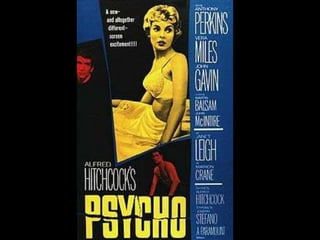
Director: Alfred Hitchcock
Starring: Anthony Perkins as Norman Bates
Janet Leigh as Marion Crane
Vera Miles as Lila Crane
The plot itself is the MacGuffin in Psycho.
Marion Crane has grown tired of how life has
treated her. She has to meet her secret lover
during lunch breaks and
can’t get married because
he has to give most of his
money away in alimony.
In order to get away, she steals $40,000
from a trusting client at work as part
of her plan to get away and start a new life.
Without a clear plan, she simply drives as far
away as possible... under the surveillance of a
police officer.
We perceive this to be the threat- will she get
caught?
However, Marion begins to get tired and stops
off at the secluded Bates Motel. The action that
unfolds following this makes the opening
events of the film surrounding the stolen
money insignificant- it’s purpose was to drive
the plot along (the MacGuffin).
The man who runs the motel is Norman Bates
who seems to be a vulnerable young man
dominated by his controlling mother.
We are made to think that the
film will be about the stolen
money and so when Marion
Crane is murdered at the motel,
we are left in shock. This makes us
apprehensive as to what we should
expect from the rest of the film.
What will happen next? Will somebody else get
killed? Hitchcock stressed that as the apprehension
builds, less and less violence is shown. He much
preferred suspense over surprise.
The external threat is a mad man with a disturbed
mind, we find out that he has a split personality
disorder. Norman Bates’ mother had in fact been dead
for several years and he had been acting as the
controlling and domineering mother all along- he is
the murderer of Marion and Arbogast.
Thrillers are characterised by fast, frequent
action. The main action scenes are the shower,
staircase and car scenes (shown below).
At first, we are made to think that Marion Crane
is the heroine. A blonde woman as the
protagonist is a recurring theme of Hitchcock’s;
he preferred them because he thought that the
audience would be suspicious of a brunette.
Another reason for this was because he believed
blondes looked better on screen than brunettes
in black and white filming.
I believe that the “heroine” is initially the
protagonist Marion Crane. However, quite
quickly into the film we begin to change our
opinion of her when she carries out
mischievous and
criminal behaviour.
She loses all heroic traitsif she even had any
beforehand.
When we are introduced to Norman Bates at the
Bates Motel, he is portrayed as a vulnerable and
emotional “big-kid” dependent on his
controlling mother. We feel sympathetic
towards him, particularly when Marion acts
quite harshly towards him. Transference of guilt
occurs when she commits a crime and is
murdered- the protagonist/heroic role has been
given to the ambiguous Norman Bates.
Overall, there is no consistent hero. His true
character is revealed at the end- Norman Bates is
in fact the genuine villain. Like Marion, our
feelings of sympathy for him gradually fade after
he peers into Marion’s room while she undresses.
This is the first time we feel entirely unsure of his
true character. It is strange for the protagonist to
be killed off so early however this is effective
because Hitchcock ensured we felt sympathetic
towards Norman up until Marion’s death. We had no
suspicions that it was Norman.
Suspense is particularly used after the death of Marion when her sister Lila
and boyfriend Sam attempt to find the murderer. In this scene, Lila is in Bates’
room in attempt to uncover the mystery of Norman’s mother. Hitchcock
builds suspense here with his cinematography. Slow eye-line matches and the
groove in the mattress create suspense. The melodramatic music foreshadows
a drastic event about to occur.
The false shocks, for example
Lila jumping at her own
reflection, also builds the tension.
This misleads us to assume that
Lila will have the same fate as
her sister. Instead, Norman
Bates is caught as his “mother”
and the police intervene.
http://www.youtube.com/watch?v=sIOT-0IQOus
The one main red-herring in Psycho is the first 20 minutes of
the film itself. We are mislead to believe the plot will follow
Marion running away from the police with the $40,000.
Instead, she heads to Bates Motel and the money becomes
irrelevant altogether.

I think that the ending of the film is a cliff-hanger because the
situation isn’t entirely resolved. Norman/”mother” make plans
to appear sane and vulnerable in the vital scene when he says
“she wouldn’t even harm a fly”. This abrupt ending suggests
that Norman could be released in the future and the cycle will
repeat itself. Marion’s car rising from the swamp creates a
sense of inevitability; Norman’s past will never leave him.
http://www.youtube.com/watch?v=dYDxxHrlmUg

Hitchcock: Psycho

  • 2.
    Director: Alfred Hitchcock Starring:Anthony Perkins as Norman Bates Janet Leigh as Marion Crane Vera Miles as Lila Crane
  • 3.
    The plot itselfis the MacGuffin in Psycho. Marion Crane has grown tired of how life has treated her. She has to meet her secret lover during lunch breaks and can’t get married because he has to give most of his money away in alimony.
  • 4.
    In order toget away, she steals $40,000 from a trusting client at work as part of her plan to get away and start a new life. Without a clear plan, she simply drives as far away as possible... under the surveillance of a police officer. We perceive this to be the threat- will she get caught?
  • 5.
    However, Marion beginsto get tired and stops off at the secluded Bates Motel. The action that unfolds following this makes the opening events of the film surrounding the stolen money insignificant- it’s purpose was to drive the plot along (the MacGuffin). The man who runs the motel is Norman Bates who seems to be a vulnerable young man dominated by his controlling mother.
  • 6.
    We are madeto think that the film will be about the stolen money and so when Marion Crane is murdered at the motel, we are left in shock. This makes us apprehensive as to what we should expect from the rest of the film. What will happen next? Will somebody else get killed? Hitchcock stressed that as the apprehension builds, less and less violence is shown. He much preferred suspense over surprise.
  • 7.
    The external threatis a mad man with a disturbed mind, we find out that he has a split personality disorder. Norman Bates’ mother had in fact been dead for several years and he had been acting as the controlling and domineering mother all along- he is the murderer of Marion and Arbogast.
  • 8.
    Thrillers are characterisedby fast, frequent action. The main action scenes are the shower, staircase and car scenes (shown below).
  • 9.
    At first, weare made to think that Marion Crane is the heroine. A blonde woman as the protagonist is a recurring theme of Hitchcock’s; he preferred them because he thought that the audience would be suspicious of a brunette. Another reason for this was because he believed blondes looked better on screen than brunettes in black and white filming.
  • 10.
    I believe thatthe “heroine” is initially the protagonist Marion Crane. However, quite quickly into the film we begin to change our opinion of her when she carries out mischievous and criminal behaviour. She loses all heroic traitsif she even had any beforehand.
  • 11.
    When we areintroduced to Norman Bates at the Bates Motel, he is portrayed as a vulnerable and emotional “big-kid” dependent on his controlling mother. We feel sympathetic towards him, particularly when Marion acts quite harshly towards him. Transference of guilt occurs when she commits a crime and is murdered- the protagonist/heroic role has been given to the ambiguous Norman Bates.
  • 12.
    Overall, there isno consistent hero. His true character is revealed at the end- Norman Bates is in fact the genuine villain. Like Marion, our feelings of sympathy for him gradually fade after he peers into Marion’s room while she undresses. This is the first time we feel entirely unsure of his true character. It is strange for the protagonist to be killed off so early however this is effective because Hitchcock ensured we felt sympathetic towards Norman up until Marion’s death. We had no suspicions that it was Norman.
  • 13.
    Suspense is particularlyused after the death of Marion when her sister Lila and boyfriend Sam attempt to find the murderer. In this scene, Lila is in Bates’ room in attempt to uncover the mystery of Norman’s mother. Hitchcock builds suspense here with his cinematography. Slow eye-line matches and the groove in the mattress create suspense. The melodramatic music foreshadows a drastic event about to occur. The false shocks, for example Lila jumping at her own reflection, also builds the tension. This misleads us to assume that Lila will have the same fate as her sister. Instead, Norman Bates is caught as his “mother” and the police intervene. http://www.youtube.com/watch?v=sIOT-0IQOus
  • 14.
    The one mainred-herring in Psycho is the first 20 minutes of the film itself. We are mislead to believe the plot will follow Marion running away from the police with the $40,000. Instead, she heads to Bates Motel and the money becomes irrelevant altogether. I think that the ending of the film is a cliff-hanger because the situation isn’t entirely resolved. Norman/”mother” make plans to appear sane and vulnerable in the vital scene when he says “she wouldn’t even harm a fly”. This abrupt ending suggests that Norman could be released in the future and the cycle will repeat itself. Marion’s car rising from the swamp creates a sense of inevitability; Norman’s past will never leave him. http://www.youtube.com/watch?v=dYDxxHrlmUg