Paying for Quality
What Clinicians Need to Understand to Thrive in this Brave New World
Megan Douglas, JD – National Center for Primary Care – Morehouse School of Medicine
Overview
• Pay for Performance General Overview & Evidence-
base
• MACRA Overview
– Timeline
– Eligibility
– Composite Performance Score
– Impact
• Primary care
• Emergency Medicine
• FQHCs
• Small, rural, HPSA
• Health equity
– Future
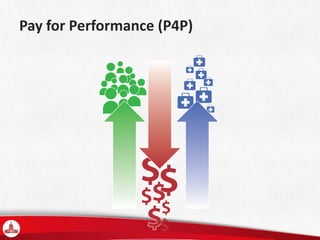
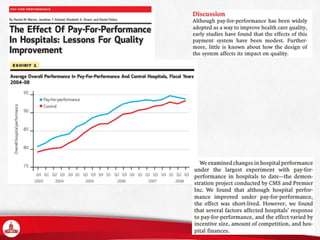
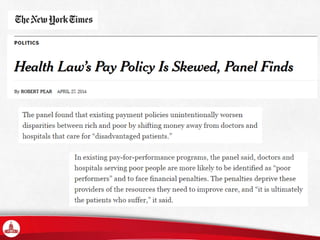
Pay for Performance (P4P)
Fee-for-
Service
Managed
Care
P4P
Medicare Access and CHIP Reauthorization Act
of 2015 (MACRA)
MACRA
• Repeals Sustainable Growth Rate (SGR)
• Revenue Neutral
– Winners = high performers
– Losers = low performers
• Shifts clinician responsibility beyond clinical walls
• Incentivizes clinical practice transformation, use of
health information technology, alternative payment
models
• Public Reporting – Physician Compare
Trump
Administration
American
Health Care Act
MACRA
Merit-based Incentive
Payment System (MIPS)
Combines:
‒ Physician Quality Reporting
System (PQRS)*
‒ Value Modifier (VM
or Value-based Payment
Modifier)
‒ Meaningful Use
Advanced Alternative
Payment Model (APM)
‒ Medicare Shared Savings
Program (Tracks 2 & 3)
‒ Next Generation Accountable
Care Organization (ACO)
‒ Comprehensive End-Stage
Renal Disease (ESRD) Care
‒ Comprehensive Primary Care
Plus (CPC+)
‒ Oncology Care Model (OCM)
Implementation Timeline
MIPS Reporting Timeline – 2017/2019
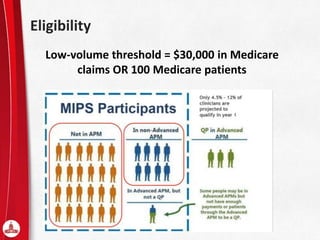
Eligibility
Low-volume threshold = $30,000 in Medicare
claims OR 100 Medicare patients
Merit-based Incentive Payment System (MIPS)
https://www.surveyvitals.com/start/quality-payment-program-preparing-for-mips
Composite Performance Score (CPS)
Quality – 60%
• Physician Quality Reporting System (PQRS)
• 300 Clinical Quality Measures (CQM) to “choose”
from
– Includes specialty measures sets
• Report on 6 CQMs
• Opportunities for bonus points for reporting on high
priority measures
– CAHPS
– outcomes
Resource Use (Cost) – 0%
• Value-based Payment Modifier (VBPM)
• No reporting – claims-based
• Total per capita costs & costs per beneficiary
• Will include Part D (pharmacy) in the future
Advancing Care Information – 25%
• Meaningful Use (MU)
• Requires 2015 Certified Electronic Health Record
Technology (CEHRT)
• Base score & Performance score
• Fewer measures than MU
• Bonus points for reporting via EHR
Clinical Practice Improvement Activities – 15%
• NEW!
• 90 activities to
“choose” from
• Bonus points for high
priority activities
• Report on 4 medium-
or 2 high-weighted
activities (2/1 for
small, rural, HPSA
clinicians)
http://www.telligen.com/blog/breaking-down-clinical-practice-improvement-activities-cpia-category-mips
Impact
• Family Medicine
• Emergency Medicine
• Federally Qualified Health Centers
• Small, rural, health professional shortage areas
(HPSA)
• Health Equity
Family Medicine/Primary Care
Emergency Medicine
“For example, when a patient is discharged from an
emergency department (ED) to a primary care
physician office, health care providers on both sides
of the transition should have a shared incentive for a
seamless transition.”
“ED clinicians automatically earn at least a minimum
score of one-half of the highest potential score for this
performance category simply for providing this access on
an ongoing basis, noting that emergency clinicians are
one of the few clinician specialties that truly provide
24/7 care”
Hospital-based MIPS eligible clinician is a MIPS eligible clinician who furnishes 75
percent or more of his or her covered professional services in sites of service
identified by the Place of Service codes used in the HIPAA standard transaction as
an inpatient hospital, on-campus outpatient hospital or emergency room setting
based on claims for a period prior to the performance period as specified by CMS
Small, Rural, Health Professional Shortage Area
• Less than 15 providers
• $100 million in technical assistance – Quality
Improvement Organizations (QIO)
• BIG difference from MU  received support $, now
just help
• Common questions:
– How do I register?
– How do I report?
– What am I required to report?
– Am I eligible?
– What CQMs are relevant?
Federally Qualified Health Centers (FQHC)
Providers working in FQHCs/RHCs who bill services
under FQHC/RHC formula are not eligible for MIPS
BUT, services performed in FQHCs and billed under
Physician Fee Schedule are subject to MIPS
Health Equity
• Overall quality improvement vs. reduction in
disparities
– Stratification of CQMs by race/ethnicity, disability, SOGI,
SES, etc.
• “Achieving Health Equity” & “Integrating Mental &
Behavioral Health” CPIA
– Evaluation: enough of an incentive?
• Risk Adjustment
– Social Determinants of Health
Future
• Loss of solo/small practices
– Close/retire
– Consolidate with large systems
– Join ACO
• Quality improvement for reported measures –
population-level
• Increased health disparities
– Cherry-picking of patients
– Reduced volume of Medicare patients
• LOTS of MACRA consultants
“Nobody knew health care could be so complicated” - POTUS
Questions & Discussion
Thank You!!
mdouglas@msm.edu
@mdouglas1313

Paying for Quality

  • 1.
    Paying for Quality WhatClinicians Need to Understand to Thrive in this Brave New World Megan Douglas, JD – National Center for Primary Care – Morehouse School of Medicine
  • 2.
    Overview • Pay forPerformance General Overview & Evidence- base • MACRA Overview – Timeline – Eligibility – Composite Performance Score – Impact • Primary care • Emergency Medicine • FQHCs • Small, rural, HPSA • Health equity – Future
  • 3.
  • 4.
    Pay for Performance(P4P) Fee-for- Service Managed Care P4P
  • 10.
    Medicare Access andCHIP Reauthorization Act of 2015 (MACRA)
  • 11.
    MACRA • Repeals SustainableGrowth Rate (SGR) • Revenue Neutral – Winners = high performers – Losers = low performers • Shifts clinician responsibility beyond clinical walls • Incentivizes clinical practice transformation, use of health information technology, alternative payment models • Public Reporting – Physician Compare
  • 12.
  • 13.
    MACRA Merit-based Incentive Payment System(MIPS) Combines: ‒ Physician Quality Reporting System (PQRS)* ‒ Value Modifier (VM or Value-based Payment Modifier) ‒ Meaningful Use Advanced Alternative Payment Model (APM) ‒ Medicare Shared Savings Program (Tracks 2 & 3) ‒ Next Generation Accountable Care Organization (ACO) ‒ Comprehensive End-Stage Renal Disease (ESRD) Care ‒ Comprehensive Primary Care Plus (CPC+) ‒ Oncology Care Model (OCM)
  • 14.
  • 15.
  • 16.
    Eligibility Low-volume threshold =$30,000 in Medicare claims OR 100 Medicare patients
  • 17.
    Merit-based Incentive PaymentSystem (MIPS) https://www.surveyvitals.com/start/quality-payment-program-preparing-for-mips
  • 18.
  • 21.
    Quality – 60% •Physician Quality Reporting System (PQRS) • 300 Clinical Quality Measures (CQM) to “choose” from – Includes specialty measures sets • Report on 6 CQMs • Opportunities for bonus points for reporting on high priority measures – CAHPS – outcomes
  • 22.
    Resource Use (Cost)– 0% • Value-based Payment Modifier (VBPM) • No reporting – claims-based • Total per capita costs & costs per beneficiary • Will include Part D (pharmacy) in the future
  • 23.
    Advancing Care Information– 25% • Meaningful Use (MU) • Requires 2015 Certified Electronic Health Record Technology (CEHRT) • Base score & Performance score • Fewer measures than MU • Bonus points for reporting via EHR
  • 24.
    Clinical Practice ImprovementActivities – 15% • NEW! • 90 activities to “choose” from • Bonus points for high priority activities • Report on 4 medium- or 2 high-weighted activities (2/1 for small, rural, HPSA clinicians) http://www.telligen.com/blog/breaking-down-clinical-practice-improvement-activities-cpia-category-mips
  • 26.
    Impact • Family Medicine •Emergency Medicine • Federally Qualified Health Centers • Small, rural, health professional shortage areas (HPSA) • Health Equity
  • 27.
  • 28.
    Emergency Medicine “For example,when a patient is discharged from an emergency department (ED) to a primary care physician office, health care providers on both sides of the transition should have a shared incentive for a seamless transition.” “ED clinicians automatically earn at least a minimum score of one-half of the highest potential score for this performance category simply for providing this access on an ongoing basis, noting that emergency clinicians are one of the few clinician specialties that truly provide 24/7 care” Hospital-based MIPS eligible clinician is a MIPS eligible clinician who furnishes 75 percent or more of his or her covered professional services in sites of service identified by the Place of Service codes used in the HIPAA standard transaction as an inpatient hospital, on-campus outpatient hospital or emergency room setting based on claims for a period prior to the performance period as specified by CMS
  • 31.
    Small, Rural, HealthProfessional Shortage Area • Less than 15 providers • $100 million in technical assistance – Quality Improvement Organizations (QIO) • BIG difference from MU  received support $, now just help • Common questions: – How do I register? – How do I report? – What am I required to report? – Am I eligible? – What CQMs are relevant?
  • 32.
    Federally Qualified HealthCenters (FQHC) Providers working in FQHCs/RHCs who bill services under FQHC/RHC formula are not eligible for MIPS BUT, services performed in FQHCs and billed under Physician Fee Schedule are subject to MIPS
  • 33.
    Health Equity • Overallquality improvement vs. reduction in disparities – Stratification of CQMs by race/ethnicity, disability, SOGI, SES, etc. • “Achieving Health Equity” & “Integrating Mental & Behavioral Health” CPIA – Evaluation: enough of an incentive? • Risk Adjustment – Social Determinants of Health
  • 34.
    Future • Loss ofsolo/small practices – Close/retire – Consolidate with large systems – Join ACO • Quality improvement for reported measures – population-level • Increased health disparities – Cherry-picking of patients – Reduced volume of Medicare patients • LOTS of MACRA consultants
  • 35.
    “Nobody knew healthcare could be so complicated” - POTUS
  • 36.
    Questions & Discussion ThankYou!! mdouglas@msm.edu @mdouglas1313

Editor's Notes

  • #4 initiatives aimed at improving the quality, efficiency, and overall value of health care Private Sector CA P4P Program BCBS of MA Alternative Quality Contract Premier/CMS Public Sector Value-based purchasing Physician Quality Reporting System Medicare Advantage Bonuses
  • #5 Traditional payment model = fee-for-service, paid per activity 1990s = managed care, concern over costs & incentives from FFS (bill for as many things as possible) Private Sector CA P4P Program BCBS of MA Alternative Quality Contract Public Sector Value-based purchasing Physician Quality Reporting System Medicare Advantage Bonuses Hospital Acquired Infection Program (ACA) Hospital 90-day Readmission Penalties (ACA) Accountable Care Organizations (ACA) United Kingdom – 2004 – Quality & Outcomes Framework – roughly same time as US, but on much larger scale
  • #12 SGR had become unsustainable – adopted in 1997 – mechanism to attempt to control Medicare growth and align with GDP growth
  • #13 Bipartisan support & bending Medicare cost curve is bipartisan issue, important for any administration to address Delay would = budgetary issue if repealed or replaced b/c MACRA is cost-saving mechanism BUT, many of the alternative payment models and clinical practice transformation initiatives, including Center for Medicare & Medicaid Innovation were created and funded by the ACA
  • #15 Initially, CMS expected that a full year of reporting in 2017 would determine payment adjustments in 2019, BUT based on feedback and public comments to proposed rule, adopted a “pick your pace” structure in the final rule
  • #17 All claims submitted under PFS are eligible for MIPS – low-volume threshold, which was also expanded in the final rule Initial CMS estimates that approximately 712,000 clinicians will be affected by QPP changes in the first performance year (2017). But, earlier this month CMS sent letters to over 800,000 clinicians exempting them from reporting in 2017 based on low-volume threshold, so new estimates are around 420,000 who will need to submit MIPS data Included payments and clinicians: Any services billed under the Medicare Physician Fee Schedule (MPFS) will be impacted. Specifically, the adjustments will apply to the work, practice expense, and physician liability insurance (malpractice) RVUs. Physicians, Physician Assistants, Nurse Practitioners, Clinical Nurse Specialists, Certified Registered Nurse, Anesthetists and groups that include any of these clinicians Exempt payments and clinicians: Inpatient Prospective Payment System Outpatient Prospective Payment System Ambulatory Surgical Center Payment System Clinicians or groups that fall under the low volume threshold that CMS defines as clinicians or groups with $30,000 or less in Medicare charges OR 100 or fewer Medicare patients Clinicians in their first year billing Medicare
  • #18 All physicians serving the minimum threshold of Medicare patients will have payments adjusted according to their composite performance score
  • #28 Four components: monthly prospective, risk-adjusted primary care global payments for direct patient care; monthly prospective, population-based payments covering non-face-to-face patient services; fee-for-service payments that cover only services not included in the global payment; and quarterly prospective, performance-based incentive payments related to patient experience, clinical quality and utilization measures. And when it comes to spending, the AAFP cited research to bolster its recommendation that the percentage of total health care dollars spent on primary care be increased to at least 12 percent -- nearly double current estimates of 6 percent to 8 percent.
  • #29 Advancing Care Information: Re-weight to 0 for “hospital-based clinician”
  • #30 Advancing Care Information: Re-weight to 0 for “hospital-based clinician”
  • #32 5-state region, 2 months of TA available, ~400 calls