2016 State of the CIO
SURVEY
Exclusive Research
from CIO
JANUARY 2016
State of the CIO 2016: Navigating a Complex Role
IT executives who have strong relationships with business stakeholders fare
better as they deal with cybersecurity, and challenges to their control.
CIOs who have an active role in developing business strategy and facilitating
company growth are paid the best, get more respect and are more likely to have
the resources they need to address today’s biggest IT challenges, according to
the State of the CIO 2016 survey of 571 executives who are in charge of IT at
their companies.
Although 88 percent of CIOs report their jobs are increasingly more challenging,
the nature of the challenges they face—and their job satisfaction in light of
these—differs depending on their focus. The vast majority of CIOs (84 percent)
agree that the role is becoming more important to their business. But CIOs who
spend most of their time on strategic activities or who are concentrating on
transforming business operations are significantly more likely (87 percent) to say
so than functional IT leaders (78 percent), who have a more traditional role
managing IT operations.
Strategic (71 percent) and transformational (69 percent) CIOs are also
significantly more likely to consider their jobs to be rewarding than functional
CIOs (47 percent). Functional IT leaders, in contrast, are more likely to be
frustrated, if not embattled. They are most likely to say IT is scapegoated when
other departments miss their goals (60 percent), most likely to be viewed by
other departments as an obstacle to their mission (40 percent) and most likely to
feel that the CIO is being sidelined (29 percent). Furthermore, functional CIOs
are most concentrated among a minority (28 percent) of companies where IT is
undervalued, underused or misunderstood, and where their struggles are
exacerbated.
The Value of a Strategic Role
In general, the CIO position within the C-suite appears to be stable. Up slightly
from our 2015 survey, 46 percent of all CIOs report to the CEO. On average,
they have been in the same job for approximately 6 years and 6 months—about
seven months longer than the average a year ago. Job stability may reflect a
more stable economy. Tenure has been lengthening steadily since 2011,
although at large enterprises, CIOs stay less time in their jobs—5 years, 8
months, versus 7 years at smaller companies.
The average compensation is $277,700 in 2016. As might be expected, the
larger the company, the more the CIO is paid. IT executives at enterprises with
1,000 or more employees earn $401,500, on average, compared to $189,420 at
companies with fewer than 1,000 employees.
Regardless of company size, however, strategic CIOs are likely to be paid
significantly more: an average $167,000 more than functional CIOs and an
average $127,000 more than transformational CIOs. Strategic CIOs are also
significantly more likely to have a CEO as their boss.
No End in Sight for Transformation
With the emergence of digital business models and the continued pull of cloud
computing, many companies today are undergoing continuous change, a state
that appears to be reflected at least in part by the persistence of the
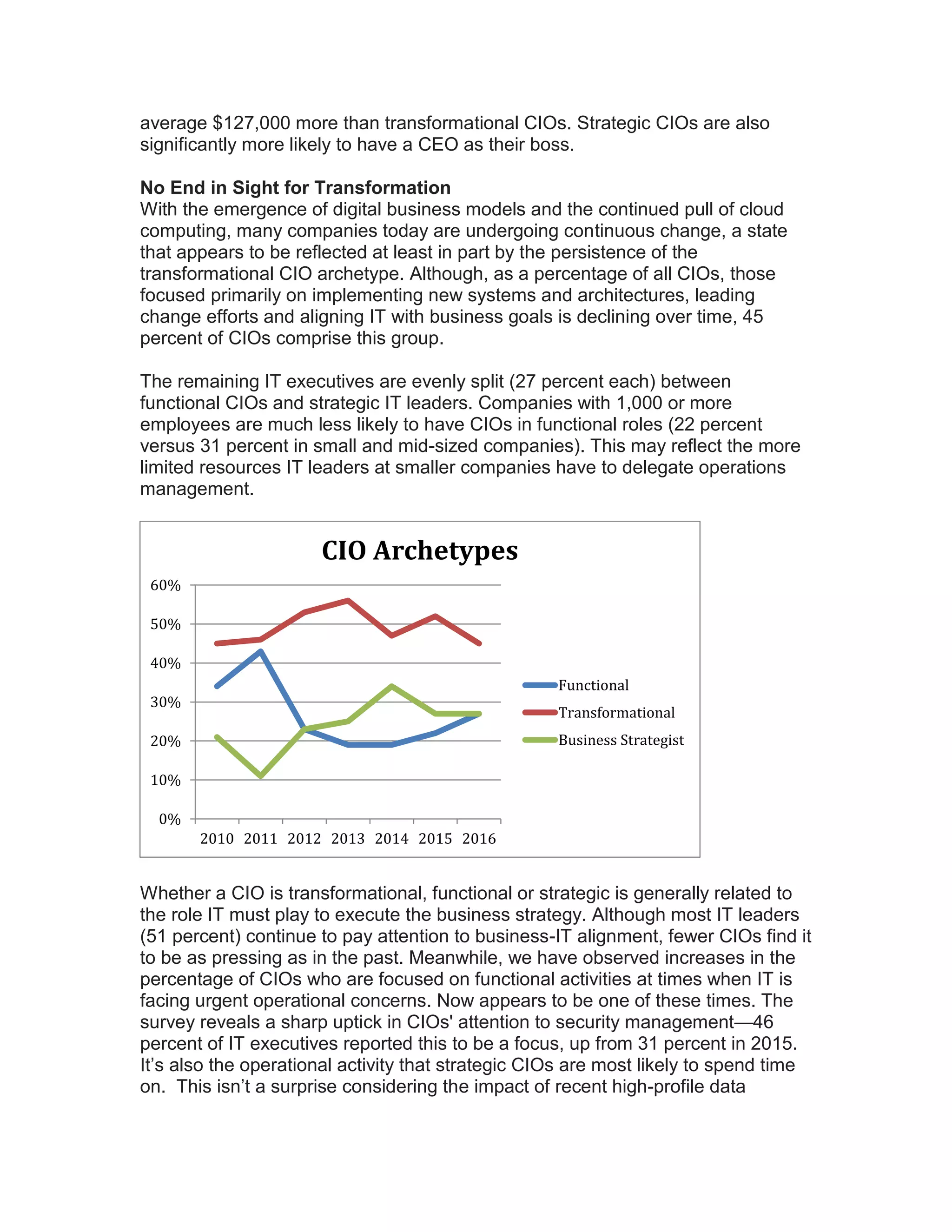
transformational CIO archetype. Although, as a percentage of all CIOs, those
focused primarily on implementing new systems and architectures, leading
change efforts and aligning IT with business goals is declining over time, 45
percent of CIOs comprise this group.
The remaining IT executives are evenly split (27 percent each) between
functional CIOs and strategic IT leaders. Companies with 1,000 or more
employees are much less likely to have CIOs in functional roles (22 percent
versus 31 percent in small and mid-sized companies). This may reflect the more
limited resources IT leaders at smaller companies have to delegate operations
management.
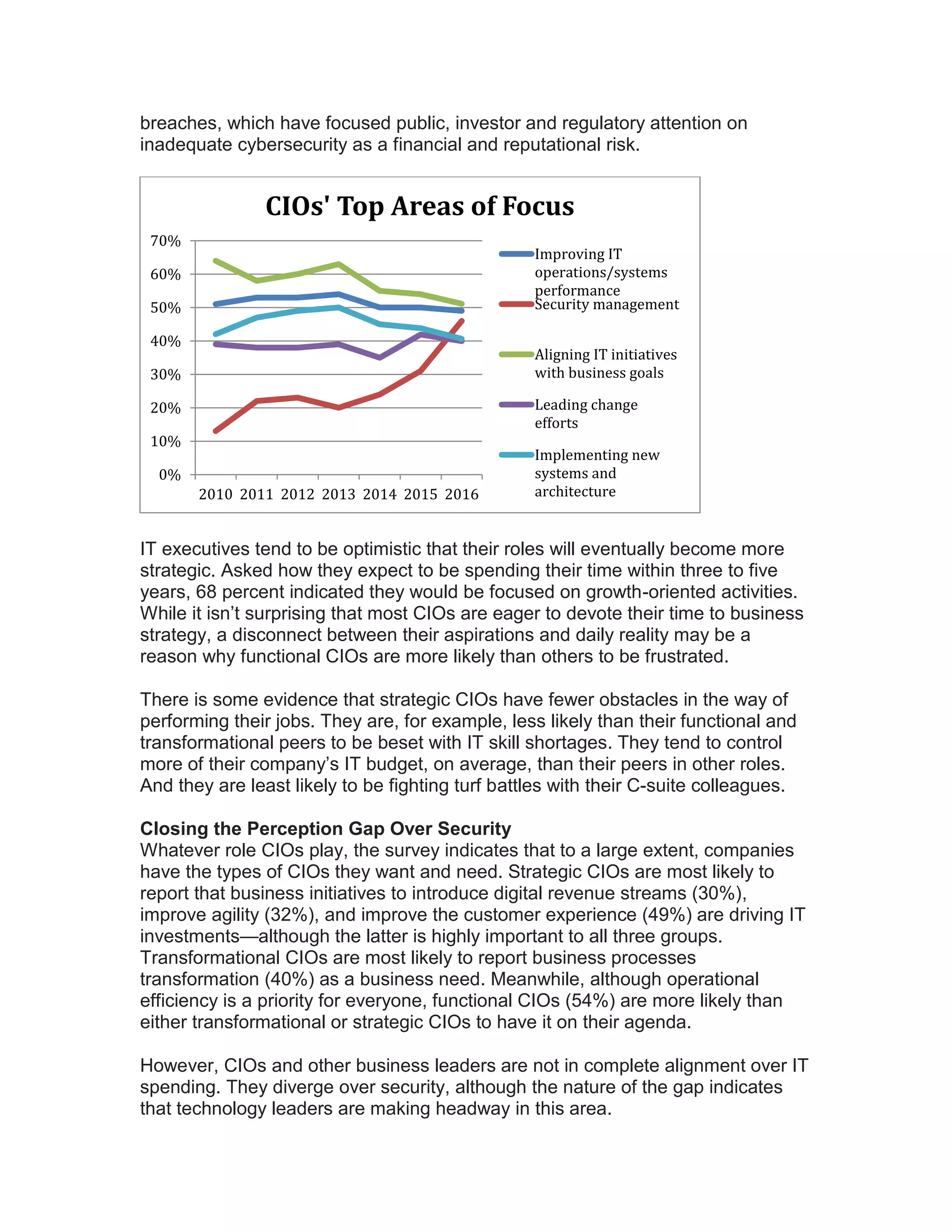
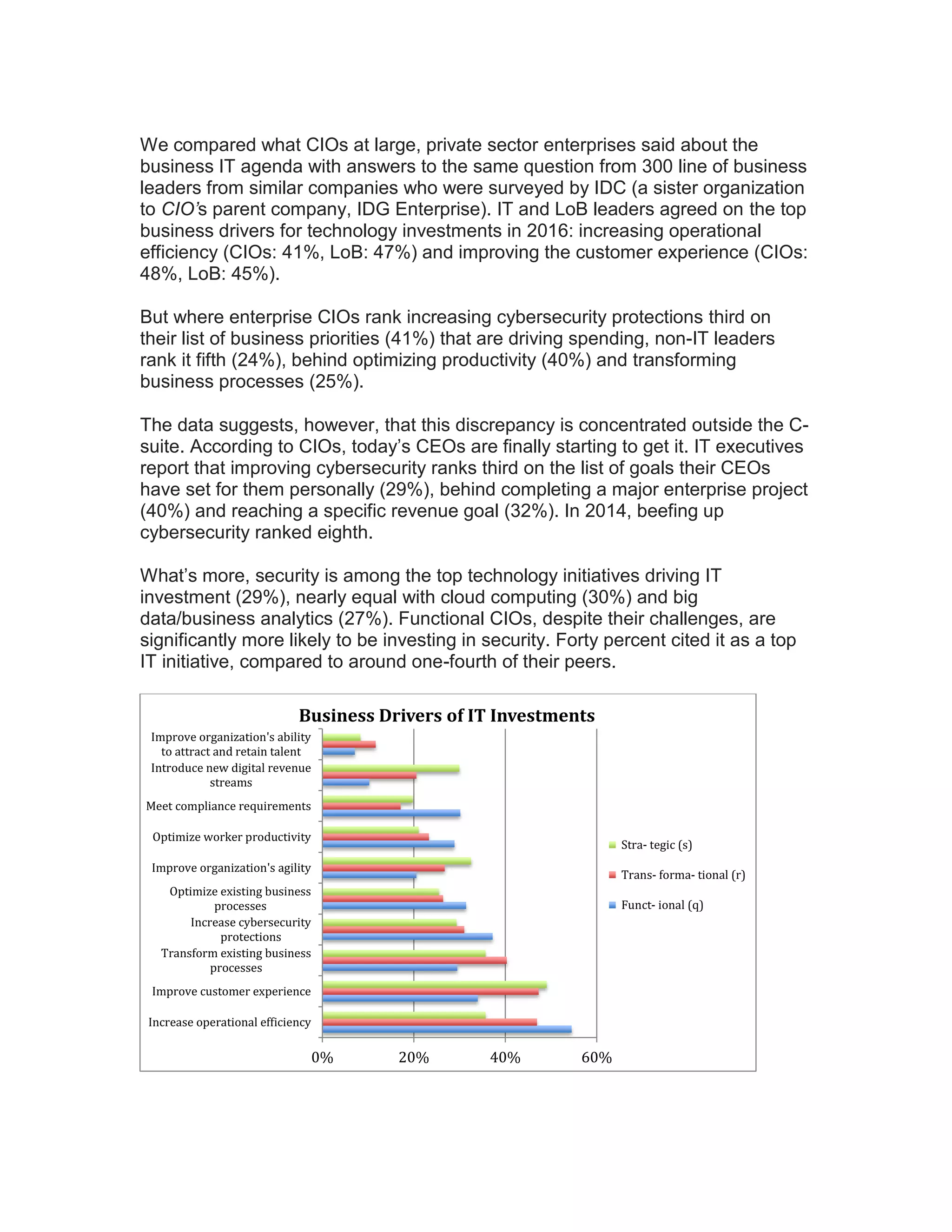
Whether a CIO is transformational, functional or strategic is generally related to
the role IT must play to execute the business strategy. Although most IT leaders
(51 percent) continue to pay attention to business-IT alignment, fewer CIOs find it
to be as pressing as in the past. Meanwhile, we have observed increases in the
percentage of CIOs who are focused on functional activities at times when IT is
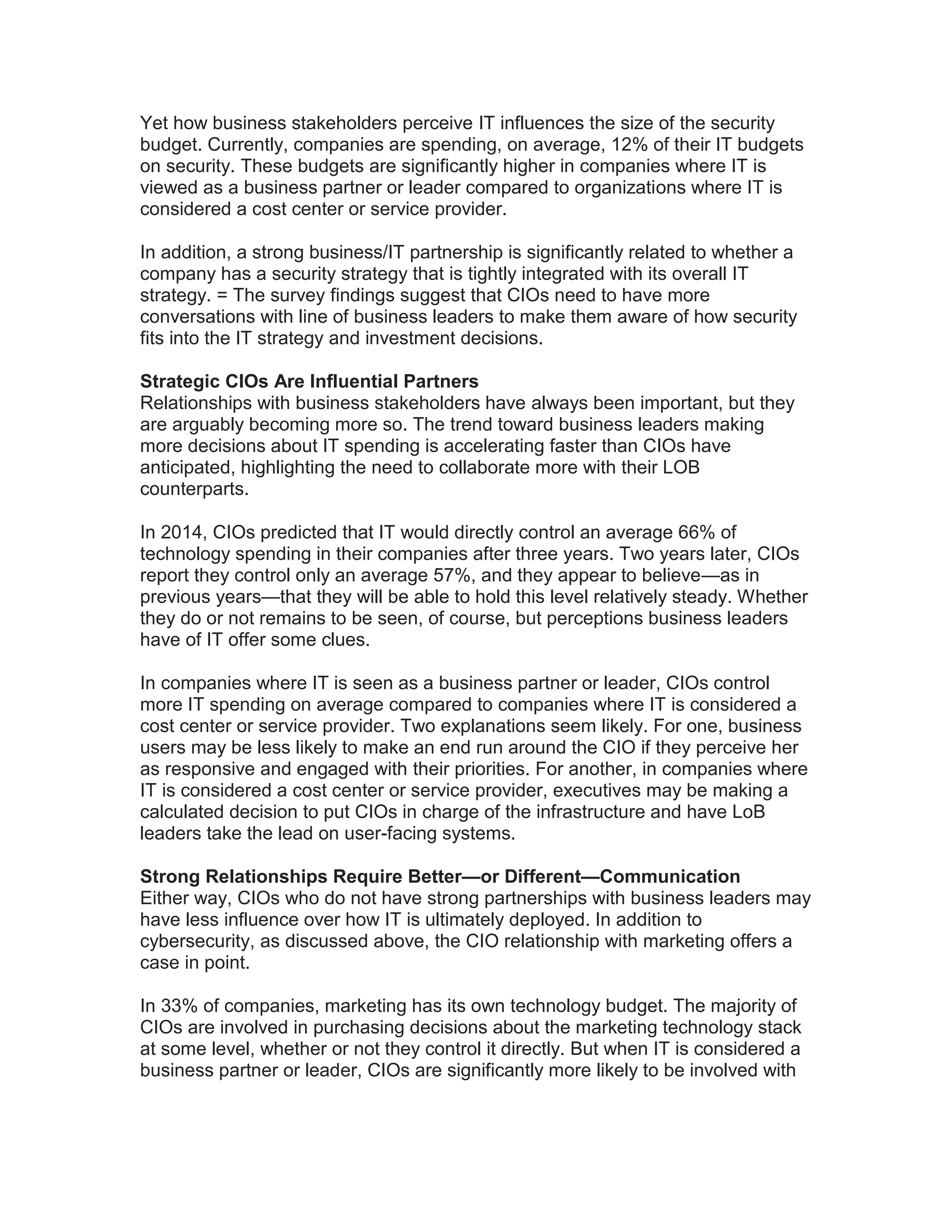
facing urgent operational concerns. Now appears to be one of these times. The
survey reveals a sharp uptick in CIOs' attention to security management—46
percent of IT executives reported this to be a focus, up from 31 percent in 2015.
It’s also the operational activity that strategic CIOs are most likely to spend time
on. This isn’t a surprise considering the impact of recent high-profile data
0%
10%
20%
30%
40%
50%
60%
2010 2011 2012 2013 2014 2015 2016
CIO Archetypes
Functional
Transformational
Business Strategist
breaches, which have focused public, investor and regulatory attention on
inadequate cybersecurity as a financial and reputational risk.
IT executives tend to be optimistic that their roles will eventually become more
strategic. Asked how they expect to be spending their time within three to five
years, 68 percent indicated they would be focused on growth-oriented activities.
While it isn’t surprising that most CIOs are eager to devote their time to business
strategy, a disconnect between their aspirations and daily reality may be a
reason why functional CIOs are more likely than others to be frustrated.
There is some evidence that strategic CIOs have fewer obstacles in the way of
performing their jobs. They are, for example, less likely than their functional and
transformational peers to be beset with IT skill shortages. They tend to control
more of their company’s IT budget, on average, than their peers in other roles.
And they are least likely to be fighting turf battles with their C-suite colleagues.
Closing the Perception Gap Over Security
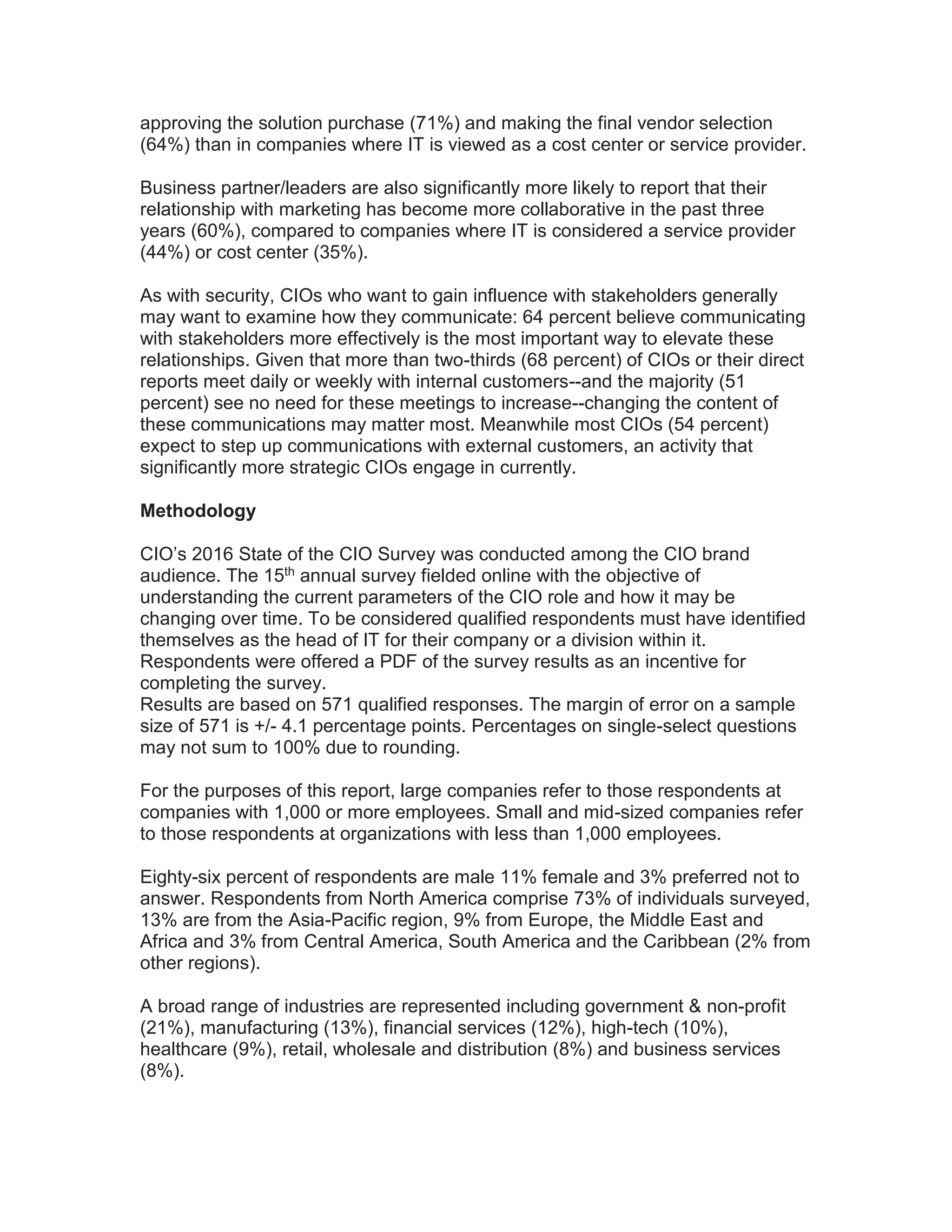
Whatever role CIOs play, the survey indicates that to a large extent, companies
have the types of CIOs they want and need. Strategic CIOs are most likely to
report that business initiatives to introduce digital revenue streams (30%),
improve agility (32%), and improve the customer experience (49%) are driving IT
investments—although the latter is highly important to all three groups.
Transformational CIOs are most likely to report business processes
transformation (40%) as a business need. Meanwhile, although operational
efficiency is a priority for everyone, functional CIOs (54%) are more likely than
either transformational or strategic CIOs to have it on their agenda.
However, CIOs and other business leaders are not in complete alignment over IT
spending. They diverge over security, although the nature of the gap indicates
that technology leaders are making headway in this area.
0%
10%
20%
30%
40%
50%
60%
70%
2010 2011 2012 2013 2014 2015 2016
CIOs' Top Areas of Focus
Improving IT
operations/systems
performance
Security management
Aligning IT initiatives
with business goals
Leading change
efforts
Implementing new
systems and
architecture
We compared what CIOs at large, private sector enterprises said about the
business IT agenda with answers to the same question from 300 line of business
leaders from similar companies who were surveyed by IDC (a sister organization
to CIO’s parent company, IDG Enterprise). IT and LoB leaders agreed on the top
business drivers for technology investments in 2016: increasing operational
efficiency (CIOs: 41%, LoB: 47%) and improving the customer experience (CIOs:
48%, LoB: 45%).
But where enterprise CIOs rank increasing cybersecurity protections third on
their list of business priorities (41%) that are driving spending, non-IT leaders
rank it fifth (24%), behind optimizing productivity (40%) and transforming
business processes (25%).
The data suggests, however, that this discrepancy is concentrated outside the C-
suite. According to CIOs, today’s CEOs are finally starting to get it. IT executives
report that improving cybersecurity ranks third on the list of goals their CEOs
have set for them personally (29%), behind completing a major enterprise project
(40%) and reaching a specific revenue goal (32%). In 2014, beefing up
cybersecurity ranked eighth.
What’s more, security is among the top technology initiatives driving IT
investment (29%), nearly equal with cloud computing (30%) and big
data/business analytics (27%). Functional CIOs, despite their challenges, are
significantly more likely to be investing in security. Forty percent cited it as a top
IT initiative, compared to around one-fourth of their peers.
0% 20% 40% 60%
Increase operational efficiency
Improve customer experience
Transform existing business
processes
Increase cybersecurity
protections
Optimize existing business
processes
Improve organization's agility
Optimize worker productivity
Meet compliance requirements
Introduce new digital revenue
streams
Improve organization's ability
to attract and retain talent
Business Drivers of IT Investments
Stra- tegic (s)
Trans- forma- tional (r)
Funct- ional (q)
Yet how business stakeholders perceive IT influences the size of the security
budget. Currently, companies are spending, on average, 12% of their IT budgets
on security. These budgets are significantly higher in companies where IT is
viewed as a business partner or leader compared to organizations where IT is
considered a cost center or service provider.
In addition, a strong business/IT partnership is significantly related to whether a
company has a security strategy that is tightly integrated with its overall IT
strategy. = The survey findings suggest that CIOs need to have more
conversations with line of business leaders to make them aware of how security
fits into the IT strategy and investment decisions.
Strategic CIOs Are Influential Partners
Relationships with business stakeholders have always been important, but they
are arguably becoming more so. The trend toward business leaders making
more decisions about IT spending is accelerating faster than CIOs have
anticipated, highlighting the need to collaborate more with their LOB
counterparts.
In 2014, CIOs predicted that IT would directly control an average 66% of
technology spending in their companies after three years. Two years later, CIOs
report they control only an average 57%, and they appear to believe—as in
previous years—that they will be able to hold this level relatively steady. Whether
they do or not remains to be seen, of course, but perceptions business leaders
have of IT offer some clues.
In companies where IT is seen as a business partner or leader, CIOs control
more IT spending on average compared to companies where IT is considered a
cost center or service provider. Two explanations seem likely. For one, business
users may be less likely to make an end run around the CIO if they perceive her
as responsive and engaged with their priorities. For another, in companies where
IT is considered a cost center or service provider, executives may be making a
calculated decision to put CIOs in charge of the infrastructure and have LoB
leaders take the lead on user-facing systems.
Strong Relationships Require Better—or Different—Communication
Either way, CIOs who do not have strong partnerships with business leaders may
have less influence over how IT is ultimately deployed. In addition to
cybersecurity, as discussed above, the CIO relationship with marketing offers a
case in point.
In 33% of companies, marketing has its own technology budget. The majority of
CIOs are involved in purchasing decisions about the marketing technology stack
at some level, whether or not they control it directly. But when IT is considered a
business partner or leader, CIOs are significantly more likely to be involved with
approving the solution purchase (71%) and making the final vendor selection
(64%) than in companies where IT is viewed as a cost center or service provider.
Business partner/leaders are also significantly more likely to report that their
relationship with marketing has become more collaborative in the past three
years (60%), compared to companies where IT is considered a service provider
(44%) or cost center (35%).
As with security, CIOs who want to gain influence with stakeholders generally
may want to examine how they communicate: 64 percent believe communicating
with stakeholders more effectively is the most important way to elevate these
relationships. Given that more than two-thirds (68 percent) of CIOs or their direct
reports meet daily or weekly with internal customers--and the majority (51
percent) see no need for these meetings to increase--changing the content of
these communications may matter most. Meanwhile most CIOs (54 percent)
expect to step up communications with external customers, an activity that
significantly more strategic CIOs engage in currently.
Methodology
CIO’s 2016 State of the CIO Survey was conducted among the CIO brand
audience. The 15th annual survey fielded online with the objective of
understanding the current parameters of the CIO role and how it may be
changing over time. To be considered qualified respondents must have identified
themselves as the head of IT for their company or a division within it.
Respondents were offered a PDF of the survey results as an incentive for
completing the survey.
Results are based on 571 qualified responses. The margin of error on a sample
size of 571 is +/- 4.1 percentage points. Percentages on single-select questions
may not sum to 100% due to rounding.
For the purposes of this report, large companies refer to those respondents at
companies with 1,000 or more employees. Small and mid-sized companies refer
to those respondents at organizations with less than 1,000 employees.
Eighty-six percent of respondents are male 11% female and 3% preferred not to
answer. Respondents from North America comprise 73% of individuals surveyed,
13% are from the Asia-Pacific region, 9% from Europe, the Middle East and
Africa and 3% from Central America, South America and the Caribbean (2% from
other regions).
A broad range of industries are represented including government & non-profit
(21%), manufacturing (13%), financial services (12%), high-tech (10%),
healthcare (9%), retail, wholesale and distribution (8%) and business services
(8%).
Fifty-nine percent of respondents are employed by organizations with fewer than
1,000 employees while 40% are employed in companies with 1,000+ employees
(1% did not provide an answer).

2016-state-of-the-cio-executive-summary

  • 1.
    2016 State ofthe CIO SURVEY Exclusive Research from CIO JANUARY 2016
  • 2.
    State of theCIO 2016: Navigating a Complex Role IT executives who have strong relationships with business stakeholders fare better as they deal with cybersecurity, and challenges to their control. CIOs who have an active role in developing business strategy and facilitating company growth are paid the best, get more respect and are more likely to have the resources they need to address today’s biggest IT challenges, according to the State of the CIO 2016 survey of 571 executives who are in charge of IT at their companies. Although 88 percent of CIOs report their jobs are increasingly more challenging, the nature of the challenges they face—and their job satisfaction in light of these—differs depending on their focus. The vast majority of CIOs (84 percent) agree that the role is becoming more important to their business. But CIOs who spend most of their time on strategic activities or who are concentrating on transforming business operations are significantly more likely (87 percent) to say so than functional IT leaders (78 percent), who have a more traditional role managing IT operations. Strategic (71 percent) and transformational (69 percent) CIOs are also significantly more likely to consider their jobs to be rewarding than functional CIOs (47 percent). Functional IT leaders, in contrast, are more likely to be frustrated, if not embattled. They are most likely to say IT is scapegoated when other departments miss their goals (60 percent), most likely to be viewed by other departments as an obstacle to their mission (40 percent) and most likely to feel that the CIO is being sidelined (29 percent). Furthermore, functional CIOs are most concentrated among a minority (28 percent) of companies where IT is undervalued, underused or misunderstood, and where their struggles are exacerbated. The Value of a Strategic Role In general, the CIO position within the C-suite appears to be stable. Up slightly from our 2015 survey, 46 percent of all CIOs report to the CEO. On average, they have been in the same job for approximately 6 years and 6 months—about seven months longer than the average a year ago. Job stability may reflect a more stable economy. Tenure has been lengthening steadily since 2011, although at large enterprises, CIOs stay less time in their jobs—5 years, 8 months, versus 7 years at smaller companies. The average compensation is $277,700 in 2016. As might be expected, the larger the company, the more the CIO is paid. IT executives at enterprises with 1,000 or more employees earn $401,500, on average, compared to $189,420 at companies with fewer than 1,000 employees. Regardless of company size, however, strategic CIOs are likely to be paid significantly more: an average $167,000 more than functional CIOs and an
  • 3.
    average $127,000 morethan transformational CIOs. Strategic CIOs are also significantly more likely to have a CEO as their boss. No End in Sight for Transformation With the emergence of digital business models and the continued pull of cloud computing, many companies today are undergoing continuous change, a state that appears to be reflected at least in part by the persistence of the transformational CIO archetype. Although, as a percentage of all CIOs, those focused primarily on implementing new systems and architectures, leading change efforts and aligning IT with business goals is declining over time, 45 percent of CIOs comprise this group. The remaining IT executives are evenly split (27 percent each) between functional CIOs and strategic IT leaders. Companies with 1,000 or more employees are much less likely to have CIOs in functional roles (22 percent versus 31 percent in small and mid-sized companies). This may reflect the more limited resources IT leaders at smaller companies have to delegate operations management. Whether a CIO is transformational, functional or strategic is generally related to the role IT must play to execute the business strategy. Although most IT leaders (51 percent) continue to pay attention to business-IT alignment, fewer CIOs find it to be as pressing as in the past. Meanwhile, we have observed increases in the percentage of CIOs who are focused on functional activities at times when IT is facing urgent operational concerns. Now appears to be one of these times. The survey reveals a sharp uptick in CIOs' attention to security management—46 percent of IT executives reported this to be a focus, up from 31 percent in 2015. It’s also the operational activity that strategic CIOs are most likely to spend time on. This isn’t a surprise considering the impact of recent high-profile data 0% 10% 20% 30% 40% 50% 60% 2010 2011 2012 2013 2014 2015 2016 CIO Archetypes Functional Transformational Business Strategist
  • 4.
    breaches, which havefocused public, investor and regulatory attention on inadequate cybersecurity as a financial and reputational risk. IT executives tend to be optimistic that their roles will eventually become more strategic. Asked how they expect to be spending their time within three to five years, 68 percent indicated they would be focused on growth-oriented activities. While it isn’t surprising that most CIOs are eager to devote their time to business strategy, a disconnect between their aspirations and daily reality may be a reason why functional CIOs are more likely than others to be frustrated. There is some evidence that strategic CIOs have fewer obstacles in the way of performing their jobs. They are, for example, less likely than their functional and transformational peers to be beset with IT skill shortages. They tend to control more of their company’s IT budget, on average, than their peers in other roles. And they are least likely to be fighting turf battles with their C-suite colleagues. Closing the Perception Gap Over Security Whatever role CIOs play, the survey indicates that to a large extent, companies have the types of CIOs they want and need. Strategic CIOs are most likely to report that business initiatives to introduce digital revenue streams (30%), improve agility (32%), and improve the customer experience (49%) are driving IT investments—although the latter is highly important to all three groups. Transformational CIOs are most likely to report business processes transformation (40%) as a business need. Meanwhile, although operational efficiency is a priority for everyone, functional CIOs (54%) are more likely than either transformational or strategic CIOs to have it on their agenda. However, CIOs and other business leaders are not in complete alignment over IT spending. They diverge over security, although the nature of the gap indicates that technology leaders are making headway in this area. 0% 10% 20% 30% 40% 50% 60% 70% 2010 2011 2012 2013 2014 2015 2016 CIOs' Top Areas of Focus Improving IT operations/systems performance Security management Aligning IT initiatives with business goals Leading change efforts Implementing new systems and architecture
  • 5.
    We compared whatCIOs at large, private sector enterprises said about the business IT agenda with answers to the same question from 300 line of business leaders from similar companies who were surveyed by IDC (a sister organization to CIO’s parent company, IDG Enterprise). IT and LoB leaders agreed on the top business drivers for technology investments in 2016: increasing operational efficiency (CIOs: 41%, LoB: 47%) and improving the customer experience (CIOs: 48%, LoB: 45%). But where enterprise CIOs rank increasing cybersecurity protections third on their list of business priorities (41%) that are driving spending, non-IT leaders rank it fifth (24%), behind optimizing productivity (40%) and transforming business processes (25%). The data suggests, however, that this discrepancy is concentrated outside the C- suite. According to CIOs, today’s CEOs are finally starting to get it. IT executives report that improving cybersecurity ranks third on the list of goals their CEOs have set for them personally (29%), behind completing a major enterprise project (40%) and reaching a specific revenue goal (32%). In 2014, beefing up cybersecurity ranked eighth. What’s more, security is among the top technology initiatives driving IT investment (29%), nearly equal with cloud computing (30%) and big data/business analytics (27%). Functional CIOs, despite their challenges, are significantly more likely to be investing in security. Forty percent cited it as a top IT initiative, compared to around one-fourth of their peers. 0% 20% 40% 60% Increase operational efficiency Improve customer experience Transform existing business processes Increase cybersecurity protections Optimize existing business processes Improve organization's agility Optimize worker productivity Meet compliance requirements Introduce new digital revenue streams Improve organization's ability to attract and retain talent Business Drivers of IT Investments Stra- tegic (s) Trans- forma- tional (r) Funct- ional (q)
  • 6.
    Yet how businessstakeholders perceive IT influences the size of the security budget. Currently, companies are spending, on average, 12% of their IT budgets on security. These budgets are significantly higher in companies where IT is viewed as a business partner or leader compared to organizations where IT is considered a cost center or service provider. In addition, a strong business/IT partnership is significantly related to whether a company has a security strategy that is tightly integrated with its overall IT strategy. = The survey findings suggest that CIOs need to have more conversations with line of business leaders to make them aware of how security fits into the IT strategy and investment decisions. Strategic CIOs Are Influential Partners Relationships with business stakeholders have always been important, but they are arguably becoming more so. The trend toward business leaders making more decisions about IT spending is accelerating faster than CIOs have anticipated, highlighting the need to collaborate more with their LOB counterparts. In 2014, CIOs predicted that IT would directly control an average 66% of technology spending in their companies after three years. Two years later, CIOs report they control only an average 57%, and they appear to believe—as in previous years—that they will be able to hold this level relatively steady. Whether they do or not remains to be seen, of course, but perceptions business leaders have of IT offer some clues. In companies where IT is seen as a business partner or leader, CIOs control more IT spending on average compared to companies where IT is considered a cost center or service provider. Two explanations seem likely. For one, business users may be less likely to make an end run around the CIO if they perceive her as responsive and engaged with their priorities. For another, in companies where IT is considered a cost center or service provider, executives may be making a calculated decision to put CIOs in charge of the infrastructure and have LoB leaders take the lead on user-facing systems. Strong Relationships Require Better—or Different—Communication Either way, CIOs who do not have strong partnerships with business leaders may have less influence over how IT is ultimately deployed. In addition to cybersecurity, as discussed above, the CIO relationship with marketing offers a case in point. In 33% of companies, marketing has its own technology budget. The majority of CIOs are involved in purchasing decisions about the marketing technology stack at some level, whether or not they control it directly. But when IT is considered a business partner or leader, CIOs are significantly more likely to be involved with
  • 7.
    approving the solutionpurchase (71%) and making the final vendor selection (64%) than in companies where IT is viewed as a cost center or service provider. Business partner/leaders are also significantly more likely to report that their relationship with marketing has become more collaborative in the past three years (60%), compared to companies where IT is considered a service provider (44%) or cost center (35%). As with security, CIOs who want to gain influence with stakeholders generally may want to examine how they communicate: 64 percent believe communicating with stakeholders more effectively is the most important way to elevate these relationships. Given that more than two-thirds (68 percent) of CIOs or their direct reports meet daily or weekly with internal customers--and the majority (51 percent) see no need for these meetings to increase--changing the content of these communications may matter most. Meanwhile most CIOs (54 percent) expect to step up communications with external customers, an activity that significantly more strategic CIOs engage in currently. Methodology CIO’s 2016 State of the CIO Survey was conducted among the CIO brand audience. The 15th annual survey fielded online with the objective of understanding the current parameters of the CIO role and how it may be changing over time. To be considered qualified respondents must have identified themselves as the head of IT for their company or a division within it. Respondents were offered a PDF of the survey results as an incentive for completing the survey. Results are based on 571 qualified responses. The margin of error on a sample size of 571 is +/- 4.1 percentage points. Percentages on single-select questions may not sum to 100% due to rounding. For the purposes of this report, large companies refer to those respondents at companies with 1,000 or more employees. Small and mid-sized companies refer to those respondents at organizations with less than 1,000 employees. Eighty-six percent of respondents are male 11% female and 3% preferred not to answer. Respondents from North America comprise 73% of individuals surveyed, 13% are from the Asia-Pacific region, 9% from Europe, the Middle East and Africa and 3% from Central America, South America and the Caribbean (2% from other regions). A broad range of industries are represented including government & non-profit (21%), manufacturing (13%), financial services (12%), high-tech (10%), healthcare (9%), retail, wholesale and distribution (8%) and business services (8%).
  • 8.
    Fifty-nine percent ofrespondents are employed by organizations with fewer than 1,000 employees while 40% are employed in companies with 1,000+ employees (1% did not provide an answer).