Minsk
Sitting pretty on the Svislach and Niamiha rivers, Minsk
is the capital and the largest city in Belarus.
During the Great
Patriotic War Minsk
was destroyed by
German invaders
almost completely. In
post-war years the
city was rebuilt anew.
Modern Minsk is a city
of numerous plants
and factories, modern
buildings, tree-lined
streets, beautiful
parks and gardens.
Minsk industry
Major industrial employers include:
☺Minsk Tractor Plant - specialised in
manufacturing tractors. Established in
1946 in eastern Minsk, is among major
manufacturers of wheeled tractors in the
CIS. Employs about 30,000 staff.
☺Automobile Plant -
specialising in producing
trucks, buses and mini-
vans. Established in 1944
in south-eastern Minsk, is
among major vehicle
manufacturers in the CIS.
☺Minsk Refrigerator
Plant (also known as
Atlant) - specialised in
manufacturing
household goods, such
as refrigerators,
freezers, and recently
also of washing
machines. Established
in 1959 in north-west of
the city.
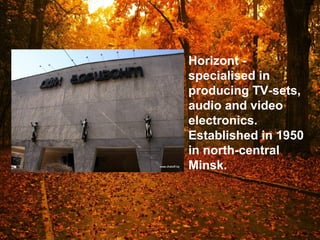
Horizont -
specialised in
producing TV-sets,
audio and video
electronics.
Established in 1950
in north-central
Minsk.
Major higher educational establishments
☺ Academy of Public Administration under the aegis of the
President of the Republic of Belarus.
☺ Belarusian State University
☺ Belarusian State University of Agricultural Technology.
☺ Belarusian National Technical University.
☺ Belarusian State Medical University.
☺ Belarusian State Economic University.
☺ Maxim Tank Belarusian State Pedagogical University.
☺ Belarusian State University of Informatics and
Radioelectronics.
☺ Belarusian State University of Physical Training.
☺ Belarusian State Technological University.
☺ Minsk State Linguistic University
☺ Belarusian State University of Culture and Arts.
☺ International Sakharov Environmental University
Belarusian university
The capital of Belarus boasts a broad network
of cultural centres which include 139 public
libraries, 18 museums (including the National
Arts Museum and the Belarusian State
Museum of the Great Patriotic War), 12
theatres (including the Gorky National Drama
Theatre, Yanka Kupala National Academic
Theatre, National Academic Bolshoi Ballet
Theatre), 36 clubs, 27 children’s arts schools,
20 cinema halls. There are about 300
magazines and 700 newspapers printed in
the city.
Churches
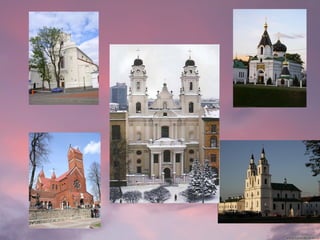
☺ The Orthodox Cathedral of the Holy Spirit is actually the former church of the
Bernardine convent. It was built in the simplified Baroque style in 1642-87 and
went through renovations in 1741-46 and 1869.
☺ The Cathedral of Saint Virgin Mary was built by the Jesuits as their monastery
church in 1700-10, restored in 1951 and 1997; it overlooks the recently restored
18th-century city hall, located on the other side of the Independence Square;
☺ Two other historic churches are the cathedral of St. Joseph, formerly affiliated
with the Bernardine monastery, built in 1644-52 and repaired in 1983, and the
fortified church of Sts. Peter and Paul, originally built in the 1620s and recently
restored, complete with its flanking twin towers.
☺ The impressive Neo-Romanesque Roman Catholic Red Church (Cathedral of Sts.
Simeon and Helene) was built in 1906-10, immediately after religious freedoms
were proclaimed in Imperial Russia and the tsar allowed dissidents to build their
churches;
☺ The largest church built in the Russian imperial period of the town's history is
dedicated to St. Mary Magdalene;
☺ Many Orthodox churches were built after the dissolution of the USSR in a variety
of styles, although most remain true to the Neo-Russian idiom. A good example is
St. Elisabeth's Convent, founded in 1999.
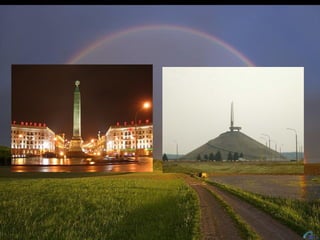
Minsk is a Hero-City
It was honoured with the title in 1974 for peoplr’s
courage and heroism during the Great Patriotic War.
The Mound of Glory is a memorial complex honouring
Soviet soldiers who fought during World War II, located
21 km from Minsk, Belarus on the Moscow Highway.
Designed by O.Stakhovich [1] and sculpted by
A.Bembel, it was established in 1969 on the 25th
anniversary of the liberation of Belarus during Operation
Bagration (1944).
Parks in Minsk
☺Chelyuskinites Park,
☺Forest Park
☺Gorky Park
☺Kurapaty
☺Yanka Kupala Park
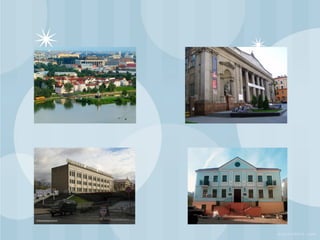
New buildings
In the last few years several new
impressive buildings appeared in Minsk,
namely, the Central Railway Terminal,
the National Library, Football Manege,
Hôtel d’Europe.
Minsk

Minsk

  • 1.
  • 2.
    Sitting pretty onthe Svislach and Niamiha rivers, Minsk is the capital and the largest city in Belarus.
  • 3.
    During the Great PatrioticWar Minsk was destroyed by German invaders almost completely. In post-war years the city was rebuilt anew. Modern Minsk is a city of numerous plants and factories, modern buildings, tree-lined streets, beautiful parks and gardens.
  • 4.
    Minsk industry Major industrialemployers include: ☺Minsk Tractor Plant - specialised in manufacturing tractors. Established in 1946 in eastern Minsk, is among major manufacturers of wheeled tractors in the CIS. Employs about 30,000 staff.
  • 5.
    ☺Automobile Plant - specialisingin producing trucks, buses and mini- vans. Established in 1944 in south-eastern Minsk, is among major vehicle manufacturers in the CIS.
  • 6.
    ☺Minsk Refrigerator Plant (alsoknown as Atlant) - specialised in manufacturing household goods, such as refrigerators, freezers, and recently also of washing machines. Established in 1959 in north-west of the city.
  • 7.
    Horizont - specialised in producingTV-sets, audio and video electronics. Established in 1950 in north-central Minsk.
  • 8.
    Major higher educationalestablishments ☺ Academy of Public Administration under the aegis of the President of the Republic of Belarus. ☺ Belarusian State University ☺ Belarusian State University of Agricultural Technology. ☺ Belarusian National Technical University. ☺ Belarusian State Medical University. ☺ Belarusian State Economic University. ☺ Maxim Tank Belarusian State Pedagogical University. ☺ Belarusian State University of Informatics and Radioelectronics. ☺ Belarusian State University of Physical Training. ☺ Belarusian State Technological University. ☺ Minsk State Linguistic University ☺ Belarusian State University of Culture and Arts. ☺ International Sakharov Environmental University
  • 9.
  • 10.
    The capital ofBelarus boasts a broad network of cultural centres which include 139 public libraries, 18 museums (including the National Arts Museum and the Belarusian State Museum of the Great Patriotic War), 12 theatres (including the Gorky National Drama Theatre, Yanka Kupala National Academic Theatre, National Academic Bolshoi Ballet Theatre), 36 clubs, 27 children’s arts schools, 20 cinema halls. There are about 300 magazines and 700 newspapers printed in the city.
  • 12.
    Churches ☺ The OrthodoxCathedral of the Holy Spirit is actually the former church of the Bernardine convent. It was built in the simplified Baroque style in 1642-87 and went through renovations in 1741-46 and 1869. ☺ The Cathedral of Saint Virgin Mary was built by the Jesuits as their monastery church in 1700-10, restored in 1951 and 1997; it overlooks the recently restored 18th-century city hall, located on the other side of the Independence Square; ☺ Two other historic churches are the cathedral of St. Joseph, formerly affiliated with the Bernardine monastery, built in 1644-52 and repaired in 1983, and the fortified church of Sts. Peter and Paul, originally built in the 1620s and recently restored, complete with its flanking twin towers. ☺ The impressive Neo-Romanesque Roman Catholic Red Church (Cathedral of Sts. Simeon and Helene) was built in 1906-10, immediately after religious freedoms were proclaimed in Imperial Russia and the tsar allowed dissidents to build their churches; ☺ The largest church built in the Russian imperial period of the town's history is dedicated to St. Mary Magdalene; ☺ Many Orthodox churches were built after the dissolution of the USSR in a variety of styles, although most remain true to the Neo-Russian idiom. A good example is St. Elisabeth's Convent, founded in 1999.
  • 14.
    Minsk is aHero-City It was honoured with the title in 1974 for peoplr’s courage and heroism during the Great Patriotic War. The Mound of Glory is a memorial complex honouring Soviet soldiers who fought during World War II, located 21 km from Minsk, Belarus on the Moscow Highway. Designed by O.Stakhovich [1] and sculpted by A.Bembel, it was established in 1969 on the 25th anniversary of the liberation of Belarus during Operation Bagration (1944).
  • 16.
    Parks in Minsk ☺ChelyuskinitesPark, ☺Forest Park ☺Gorky Park ☺Kurapaty ☺Yanka Kupala Park
  • 18.
    New buildings In thelast few years several new impressive buildings appeared in Minsk, namely, the Central Railway Terminal, the National Library, Football Manege, Hôtel d’Europe.