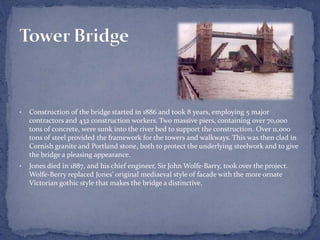
• Construction of the bridge started in 1886 and took 8 years, employing 5 major
contractors and 432 construction workers. Two massive piers, containing over 70,000
tons of concrete, were sunk into the river bed to support the construction. Over 11,000
tons of steel provided the framework for the towers and walkways. This was then clad in
Cornish granite and Portland stone, both to protect the underlying steelwork and to give
the bridge a pleasing appearance.
• Jones died in 1887, and his chief engineer, Sir John Wolfe-Barry, took over the project.
Wolfe-Berry replaced Jones' original mediaeval style of facade with the more ornate
Victorian gothic style that makes the bridge a distinctive.
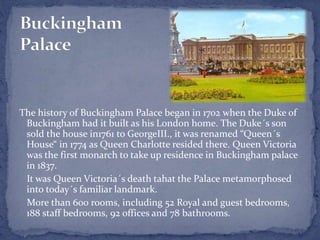
The history of Buckingham Palace began in 1702 when the Duke of
Buckingham had it built as his London home. The Duke´s son
sold the house in1761 to GeorgeIII., it was renamed “Queen´s
House“ in 1774 as Queen Charlotte resided there. Queen Victoria
was the first monarch to take up residence in Buckingham palace
in 1837.
It was Queen Victoria´s death tahat the Palace metamorphosed
into today´s familiar landmark.
More than 600 rooms, including 52 Royal and guest bedrooms,
188 staff bedrooms, 92 offices and 78 bathrooms.
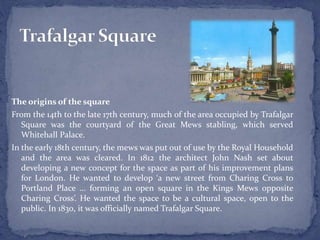
The origins of the square
From the 14th to the late 17th century, much of the area occupied by Trafalgar
Square was the courtyard of the Great Mews stabling, which served
Whitehall Palace.
In the early 18th century, the mews was put out of use by the Royal Household
and the area was cleared. In 1812 the architect John Nash set about
developing a new concept for the space as part of his improvement plans
for London. He wanted to develop ‘a new street from Charing Cross to
Portland Place … forming an open square in the Kings Mews opposite
Charing Cross’. He wanted the space to be a cultural space, open to the
public. In 1830, it was officially named Trafalgar Square.
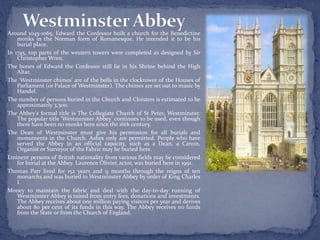
Around 1045-1065, Edward the Confessor built a church for the Benedictine
monks in the Norman form of Romanesque. He intended it to be his
burial place.
In 1745, top parts of the western towers were completed as designed by Sir
Christopher Wren.
The bones of Edward the Confessor still lie in his Shrine behind the High
Altar.
The ‘Westminster chimes’ are of the bells in the clocktower of the Houses of
Parliament (or Palace of Westminster). The chimes are set out to music by
Handel.
The number of persons buried in the Church and Cloisters is estimated to be
approximately 3,300.
The Abbey's formal title is The Collegiate Church of St Peter, Westminster.
The popular title ‘Westminster Abbey' continues to be used, even though
there have been no monks here since the 16th century.
The Dean of Westminster must give his permission for all burials and
monuments in the Church. Ashes only are permitted. People who have
served the Abbey in an official capacity, such as a Dean, a Canon,
Organist or Surveyor of the Fabric may be buried here.
Eminent persons of British nationality from various fields may be considered
for burial at the Abbey. Laurence Olivier, actor, was buried here in 1991.
Thomas Parr lived for 152 years and 9 months through the reigns of ten
monarchs and was buried in Westminster Abbey by order of King Charles
I.
Money to maintain the fabric and deal with the day-to-day running of
Westminster Abbey is raised from entry fees, donations and investments.
The Abbey receives about one million paying visitors per year and derives
about 80 per cent of its funds in this way. The Abbey receives no funds
from the State or from the Church of England.
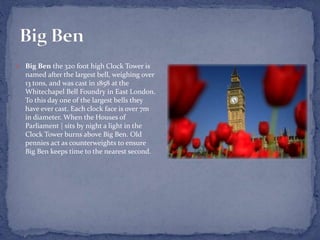
 Big Ben the 320 foot high Clock Tower is
named after the largest bell, weighing over
13 tons, and was cast in 1858 at the
Whitechapel Bell Foundry in East London.
To this day one of the largest bells they
have ever cast. Each clock face is over 7m
in diameter. When the Houses of
Parliament | sits by night a light in the
Clock Tower burns above Big Ben. Old
pennies act as counterweights to ensure
Big Ben keeps time to the nearest second.
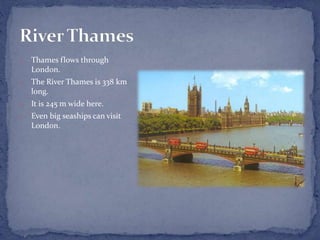
o Thames flows through
London.
o The River Thames is 338 km
long.
o It is 245 m wide here.
o Even big seaships can visit
London.
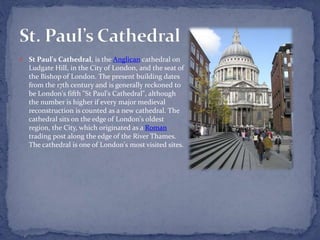
 St Paul's Cathedral, is the Anglican cathedral on
Ludgate Hill, in the City of London, and the seat of
the Bishop of London. The present building dates
from the 17th century and is generally reckoned to
be London's fifth "St Paul's Cathedral", although
the number is higher if every major medieval
reconstruction is counted as a new cathedral. The
cathedral sits on the edge of London's oldest
region, the City, which originated as a Roman
trading post along the edge of the River Thames.
The cathedral is one of London's most visited sites.
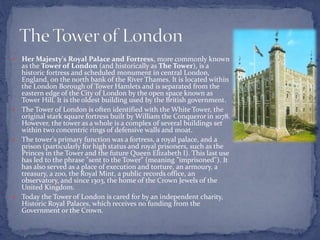
 Her Majesty's Royal Palace and Fortress, more commonly known
as the Tower of London (and historically as The Tower), is a
historic fortress and scheduled monument in central London,
England, on the north bank of the River Thames. It is located within
the London Borough of Tower Hamlets and is separated from the
eastern edge of the City of London by the open space known as
Tower Hill. It is the oldest building used by the British government.
 The Tower of London is often identified with the White Tower, the
original stark square fortress built by William the Conquerorin 1078.
However, the tower as a whole is a complex of several buildings set
within two concentric rings of defensive walls and moat.
 The tower's primary function was a fortress, a royal palace, and a
prison (particularly for high status and royal prisoners, such as the
Princes in the Tower and the future Queen Elizabeth I). This last use
has led to the phrase "sent to the Tower" (meaning "imprisoned"). It
has also served as a place of execution and torture, an armoury, a
treasury, a zoo, the Royal Mint, a public records office, an
observatory, and since 1303, the home of the Crown Jewels of the
United Kingdom.
 Today the Tower of London is cared for by an independent charity,
Historic Royal Palaces, which receives no funding from the
Government or the Crown.
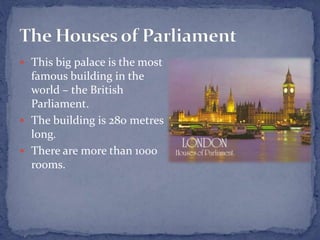
 This big palace is the most
famous building in the
world – the British
Parliament.
 The building is 280 metres
long.
 There are more than 1000
rooms.
London sights

London sights

  • 2.
    • Construction ofthe bridge started in 1886 and took 8 years, employing 5 major contractors and 432 construction workers. Two massive piers, containing over 70,000 tons of concrete, were sunk into the river bed to support the construction. Over 11,000 tons of steel provided the framework for the towers and walkways. This was then clad in Cornish granite and Portland stone, both to protect the underlying steelwork and to give the bridge a pleasing appearance. • Jones died in 1887, and his chief engineer, Sir John Wolfe-Barry, took over the project. Wolfe-Berry replaced Jones' original mediaeval style of facade with the more ornate Victorian gothic style that makes the bridge a distinctive.
  • 3.
    The history ofBuckingham Palace began in 1702 when the Duke of Buckingham had it built as his London home. The Duke´s son sold the house in1761 to GeorgeIII., it was renamed “Queen´s House“ in 1774 as Queen Charlotte resided there. Queen Victoria was the first monarch to take up residence in Buckingham palace in 1837. It was Queen Victoria´s death tahat the Palace metamorphosed into today´s familiar landmark. More than 600 rooms, including 52 Royal and guest bedrooms, 188 staff bedrooms, 92 offices and 78 bathrooms.
  • 4.
    The origins ofthe square From the 14th to the late 17th century, much of the area occupied by Trafalgar Square was the courtyard of the Great Mews stabling, which served Whitehall Palace. In the early 18th century, the mews was put out of use by the Royal Household and the area was cleared. In 1812 the architect John Nash set about developing a new concept for the space as part of his improvement plans for London. He wanted to develop ‘a new street from Charing Cross to Portland Place … forming an open square in the Kings Mews opposite Charing Cross’. He wanted the space to be a cultural space, open to the public. In 1830, it was officially named Trafalgar Square.
  • 5.
    Around 1045-1065, Edwardthe Confessor built a church for the Benedictine monks in the Norman form of Romanesque. He intended it to be his burial place. In 1745, top parts of the western towers were completed as designed by Sir Christopher Wren. The bones of Edward the Confessor still lie in his Shrine behind the High Altar. The ‘Westminster chimes’ are of the bells in the clocktower of the Houses of Parliament (or Palace of Westminster). The chimes are set out to music by Handel. The number of persons buried in the Church and Cloisters is estimated to be approximately 3,300. The Abbey's formal title is The Collegiate Church of St Peter, Westminster. The popular title ‘Westminster Abbey' continues to be used, even though there have been no monks here since the 16th century. The Dean of Westminster must give his permission for all burials and monuments in the Church. Ashes only are permitted. People who have served the Abbey in an official capacity, such as a Dean, a Canon, Organist or Surveyor of the Fabric may be buried here. Eminent persons of British nationality from various fields may be considered for burial at the Abbey. Laurence Olivier, actor, was buried here in 1991. Thomas Parr lived for 152 years and 9 months through the reigns of ten monarchs and was buried in Westminster Abbey by order of King Charles I. Money to maintain the fabric and deal with the day-to-day running of Westminster Abbey is raised from entry fees, donations and investments. The Abbey receives about one million paying visitors per year and derives about 80 per cent of its funds in this way. The Abbey receives no funds from the State or from the Church of England.
  • 6.
     Big Benthe 320 foot high Clock Tower is named after the largest bell, weighing over 13 tons, and was cast in 1858 at the Whitechapel Bell Foundry in East London. To this day one of the largest bells they have ever cast. Each clock face is over 7m in diameter. When the Houses of Parliament | sits by night a light in the Clock Tower burns above Big Ben. Old pennies act as counterweights to ensure Big Ben keeps time to the nearest second.
  • 7.
    o Thames flowsthrough London. o The River Thames is 338 km long. o It is 245 m wide here. o Even big seaships can visit London.
  • 8.
     St Paul'sCathedral, is the Anglican cathedral on Ludgate Hill, in the City of London, and the seat of the Bishop of London. The present building dates from the 17th century and is generally reckoned to be London's fifth "St Paul's Cathedral", although the number is higher if every major medieval reconstruction is counted as a new cathedral. The cathedral sits on the edge of London's oldest region, the City, which originated as a Roman trading post along the edge of the River Thames. The cathedral is one of London's most visited sites.
  • 9.
     Her Majesty'sRoyal Palace and Fortress, more commonly known as the Tower of London (and historically as The Tower), is a historic fortress and scheduled monument in central London, England, on the north bank of the River Thames. It is located within the London Borough of Tower Hamlets and is separated from the eastern edge of the City of London by the open space known as Tower Hill. It is the oldest building used by the British government.  The Tower of London is often identified with the White Tower, the original stark square fortress built by William the Conquerorin 1078. However, the tower as a whole is a complex of several buildings set within two concentric rings of defensive walls and moat.  The tower's primary function was a fortress, a royal palace, and a prison (particularly for high status and royal prisoners, such as the Princes in the Tower and the future Queen Elizabeth I). This last use has led to the phrase "sent to the Tower" (meaning "imprisoned"). It has also served as a place of execution and torture, an armoury, a treasury, a zoo, the Royal Mint, a public records office, an observatory, and since 1303, the home of the Crown Jewels of the United Kingdom.  Today the Tower of London is cared for by an independent charity, Historic Royal Palaces, which receives no funding from the Government or the Crown.
  • 10.
     This bigpalace is the most famous building in the world – the British Parliament.  The building is 280 metres long.  There are more than 1000 rooms.