Every nation and every country has it’s
own customs and traditions. In Belarusian
traditions play a very important part in the
life of the people than in other countries.
Belarusianmen are proud of their customs
and traditions.
Throughout many centuries of history,
the Belarusian people created its
unique and original culture. Traditional
folk customs and rites harmoniously
interlace with Christian traditions.
Christians make up the biggest part of
the population of Belarus. According to
the Christian doctrine, Christmas and
Easter are the main religious holidays,
annually celebrated by
 millions of believers all over the
country. In Belarus, all the Christian
holidays are celebrated twice: by the
Catholic and Orthodox religious
calendars
Along with Christian holidays,
such folk festivities of pagan
origin as Kupalle (Midsummer
Night) and Maslenitsa
(Shrovetide) are widely
celebrated in Belarus. Folk
games and traditional
ceremonies are part of them.
One of the main traditions of
Kupalle is search for the
mythic paparats-kvetka (fern
flower). Those, who find it, will
good luck for the whole year;
all their wishes will come true.
Maslenitsa is a ceremony at
the junction of two seasons; it
sees off winter and meets
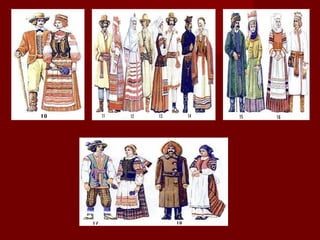
spring. Popular festivals of
folk music, dancing and
national costumes are
organized at the time of
Maslenitsa.
The Belarusian people are proud of
the country’s past and its traditional
culture. The medieval festival “The
White Castle” is arranged every
spring in Minsk. The spectators can
admire performances in costume,
combats of knights and ancient
music. Every summer, in Belarusian
castles (in Lida, Mir, Novogrudok,
Nesvizh, etc.) knights’ tournaments
and international medieval festivals
take place. They attract spectators
and participants from many countries
of the world. During several days,
you will have achance to plunge into
aromantic atmosphere of the Middle
Ages, to contemplate areconstruction
of historic events, to become an
apprentice of acraftsman, enjoy
medieval music and try on knights’
armor or ladies’ magnificent dresses.
When the night grew dark on the River Svislach ,girls made garlands and tried to tell their
fortunes by putting them into water. If the garland swam a long distance, the girl’s future husband
would come from far away; if the garland stuck to the riverbank, the husband would be a local
guy; the sinking garland was a bad omen.The most daring participants of the fest went into the
wood in order to search for a magic “Paparats-kvetka” (fern flower). The one who found this
beautiful flower gleaming in the dark would become a visionary, able to understand the language
of animals and birds, and would also able to see treasures buried under ground. By all counts,
Paparats-kvetka was the flower of happiness. The irony of the legend is that the fern does not
produce flowers. However, this never prevented young people from looking for Paparats-kvetka.
Or, perhaps, they were simply looking for a romance? It was not unusual for a young man who
went to look for the flower to meet that girl from a nearby village he liked so much. Often, the
search continued until morning… Perhaps, this is the reason why Belarusians say that storks
bring children to parents. After all, storks return home from south around March, some nine
months after Kupalle…
Watching the sun rise was also a very special part of the celebration. If one has been awake the
whole night and watched the sun without blinking, he would be able to see it “playing”, dancing in
the morning air.
Traditions in belarus

Traditions in belarus

  • 2.
    Every nation andevery country has it’s own customs and traditions. In Belarusian traditions play a very important part in the life of the people than in other countries. Belarusianmen are proud of their customs and traditions.
  • 6.
    Throughout many centuriesof history, the Belarusian people created its unique and original culture. Traditional folk customs and rites harmoniously interlace with Christian traditions. Christians make up the biggest part of the population of Belarus. According to the Christian doctrine, Christmas and Easter are the main religious holidays, annually celebrated by  millions of believers all over the country. In Belarus, all the Christian holidays are celebrated twice: by the Catholic and Orthodox religious calendars
  • 7.
    Along with Christianholidays, such folk festivities of pagan origin as Kupalle (Midsummer Night) and Maslenitsa (Shrovetide) are widely celebrated in Belarus. Folk games and traditional ceremonies are part of them. One of the main traditions of Kupalle is search for the mythic paparats-kvetka (fern flower). Those, who find it, will good luck for the whole year; all their wishes will come true. Maslenitsa is a ceremony at the junction of two seasons; it sees off winter and meets spring. Popular festivals of folk music, dancing and national costumes are organized at the time of Maslenitsa.
  • 8.
    The Belarusian peopleare proud of the country’s past and its traditional culture. The medieval festival “The White Castle” is arranged every spring in Minsk. The spectators can admire performances in costume, combats of knights and ancient music. Every summer, in Belarusian castles (in Lida, Mir, Novogrudok, Nesvizh, etc.) knights’ tournaments and international medieval festivals take place. They attract spectators and participants from many countries of the world. During several days, you will have achance to plunge into aromantic atmosphere of the Middle Ages, to contemplate areconstruction of historic events, to become an apprentice of acraftsman, enjoy medieval music and try on knights’ armor or ladies’ magnificent dresses.
  • 10.
    When the nightgrew dark on the River Svislach ,girls made garlands and tried to tell their fortunes by putting them into water. If the garland swam a long distance, the girl’s future husband would come from far away; if the garland stuck to the riverbank, the husband would be a local guy; the sinking garland was a bad omen.The most daring participants of the fest went into the wood in order to search for a magic “Paparats-kvetka” (fern flower). The one who found this beautiful flower gleaming in the dark would become a visionary, able to understand the language of animals and birds, and would also able to see treasures buried under ground. By all counts, Paparats-kvetka was the flower of happiness. The irony of the legend is that the fern does not produce flowers. However, this never prevented young people from looking for Paparats-kvetka. Or, perhaps, they were simply looking for a romance? It was not unusual for a young man who went to look for the flower to meet that girl from a nearby village he liked so much. Often, the search continued until morning… Perhaps, this is the reason why Belarusians say that storks bring children to parents. After all, storks return home from south around March, some nine months after Kupalle… Watching the sun rise was also a very special part of the celebration. If one has been awake the whole night and watched the sun without blinking, he would be able to see it “playing”, dancing in the morning air.