Introduction
 Deep fake videos are realistic manipulated media created using advanced
artificial intelligence techniques like deep learning. They pose a significant
threat as they can spread misinformation and manipulate public opinion. The
goal of this project is to develop an effective deep fake video detection
system to identify and combat the spread of deep fake content. The
detection of deep fake videos has become a critical need in the current
digital age, where misinformation can have severe real-world consequences.
What are deepfake videos?
 A deepfake video is a type of manipulated media that uses artificial
intelligence (AI) and deep learning techniques to alter or replace the original
content in a video. The term "deepfake" is derived from "deep learning" and
"fake," signifying the use of deep neural networks to create convincingly
realistic but fabricated videos. Deepfake technology has gained significant
attention due to its potential to create highly deceptive and sophisticated
fake videos that appear genuine.
Dataset
For making the model efficient for real time prediction. We have
gathered the data from different available data-sets like
FaceForensics++ and Celeb-DF. To avoid the training bias of the model
we have considered 50% Real and 50% fake videos.
We have taken 500 Real and 500 Fake videos from the
FaceForensics++ dataset and 500 Real and 500 Fake videos from the
Celeb- DF dataset. Which makes our total dataset consisting 1000
Real, 1000 fake videos and 2000 videos in total.
Preprocessing
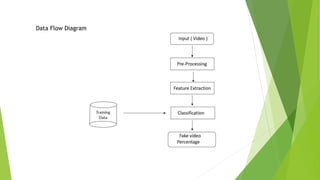
The first steps in the preprocessing of the video is to split the video
into frames.
After splitting the video into frames the face is detected in each of
the frame and the frame is cropped along the face. The frame that
does not contain the face is ignored while preprocessing.
• Using glob we imported all the videos in the directory in a python
list.
• cv2.VideoCapture is used to read the videos and get the mean
number of frames in each video.
Data Flow Diagram
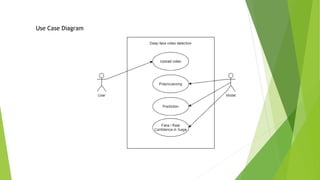
Use Case Diagram
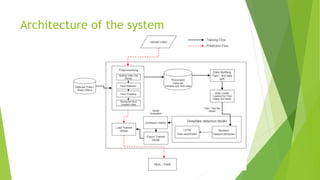
Architecture of the system
Working
 Our model is a combination of CNN and RNN. We have used the ResNext CNN
model to extract the features at frame level and based on the extracted
features a LSTM network is trained to classify the video as deepfake or
pristine.
 ResNext is Residual CNN network optimized for high performance on deeper
neural networks.
 LSTM is used to process the frames in a sequential manner so that the
temporal analysis of the video can be made, by comparing the frame at ‘t’
second with the frame of ‘t-n’ seconds. Where n can be any number of
frames before t.
Working
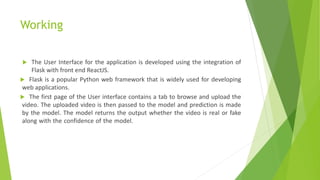
 The User Interface for the application is developed using the integration of
Flask with front end ReactJS.
 Flask is a popular Python web framework that is widely used for developing
web applications.
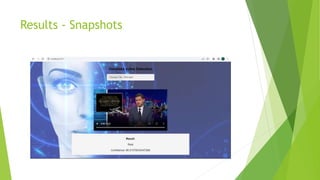
 The first page of the User interface contains a tab to browse and upload the
video. The uploaded video is then passed to the model and prediction is made
by the model. The model returns the output whether the video is real or fake
along with the confidence of the model.
Technologies Used
 Python & Google Colab – Model Building
 Frontend - ReactJS
 Backend server – Flask
 Libraries – torch, face_recognition, cv2, numpy, pandas, matplotlib etc.
Results - Snapshots
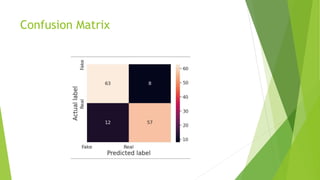
Confusion Matrix
Server terminal
Client terminal
Applications
 Media Integrity: Maintains the credibility of media content and prevents the dissemination of false
information.
 Fake News Prevention: Helps counter the propagation of misinformation in news articles and social media.
 Content Verification: Authenticates video content, vital for legal, investigative, and sensitive contexts.
 Security and Fraud Prevention: Identifies unauthorized impersonation, thwarting security breaches and
fraud.
 Election Integrity: Ensures elections remain unaffected by manipulated videos that could influence voters.
 Entertainment Safeguard: Protects celebrities' reputation and prevents illicit use of their likeness.
 Social Media Safety: Enhances user safety by removing harmful or deceptive deepfake content.
 Forensic Analysis: Verifies video evidence for use in criminal investigations.
Future Enhancements
Real-time Detection: Optimize the model for real-time detection
scenarios, enabling swift identification of deepfake content in live
streams.
Multimodal Analysis: Extend the detection to multimodal data, such
as audio and metadata, to create a more comprehensive deepfake
detection system.
Dataset Expansion: Continuously update and expand the training
dataset to encompass emerging deepfake techniques and variations.
THANK YOU

MINI PROJECT 2023 deepfake detection.pptx

  • 1.
    Introduction  Deep fakevideos are realistic manipulated media created using advanced artificial intelligence techniques like deep learning. They pose a significant threat as they can spread misinformation and manipulate public opinion. The goal of this project is to develop an effective deep fake video detection system to identify and combat the spread of deep fake content. The detection of deep fake videos has become a critical need in the current digital age, where misinformation can have severe real-world consequences.
  • 2.
    What are deepfakevideos?  A deepfake video is a type of manipulated media that uses artificial intelligence (AI) and deep learning techniques to alter or replace the original content in a video. The term "deepfake" is derived from "deep learning" and "fake," signifying the use of deep neural networks to create convincingly realistic but fabricated videos. Deepfake technology has gained significant attention due to its potential to create highly deceptive and sophisticated fake videos that appear genuine.
  • 3.
    Dataset For making themodel efficient for real time prediction. We have gathered the data from different available data-sets like FaceForensics++ and Celeb-DF. To avoid the training bias of the model we have considered 50% Real and 50% fake videos. We have taken 500 Real and 500 Fake videos from the FaceForensics++ dataset and 500 Real and 500 Fake videos from the Celeb- DF dataset. Which makes our total dataset consisting 1000 Real, 1000 fake videos and 2000 videos in total.
  • 4.
    Preprocessing The first stepsin the preprocessing of the video is to split the video into frames. After splitting the video into frames the face is detected in each of the frame and the frame is cropped along the face. The frame that does not contain the face is ignored while preprocessing. • Using glob we imported all the videos in the directory in a python list. • cv2.VideoCapture is used to read the videos and get the mean number of frames in each video.
  • 5.
  • 6.
  • 7.
  • 8.
    Working  Our modelis a combination of CNN and RNN. We have used the ResNext CNN model to extract the features at frame level and based on the extracted features a LSTM network is trained to classify the video as deepfake or pristine.  ResNext is Residual CNN network optimized for high performance on deeper neural networks.  LSTM is used to process the frames in a sequential manner so that the temporal analysis of the video can be made, by comparing the frame at ‘t’ second with the frame of ‘t-n’ seconds. Where n can be any number of frames before t.
  • 9.
    Working  The UserInterface for the application is developed using the integration of Flask with front end ReactJS.  Flask is a popular Python web framework that is widely used for developing web applications.  The first page of the User interface contains a tab to browse and upload the video. The uploaded video is then passed to the model and prediction is made by the model. The model returns the output whether the video is real or fake along with the confidence of the model.
  • 10.
    Technologies Used  Python& Google Colab – Model Building  Frontend - ReactJS  Backend server – Flask  Libraries – torch, face_recognition, cv2, numpy, pandas, matplotlib etc.
  • 11.
  • 12.
  • 13.
  • 14.
  • 15.
    Applications  Media Integrity:Maintains the credibility of media content and prevents the dissemination of false information.  Fake News Prevention: Helps counter the propagation of misinformation in news articles and social media.  Content Verification: Authenticates video content, vital for legal, investigative, and sensitive contexts.  Security and Fraud Prevention: Identifies unauthorized impersonation, thwarting security breaches and fraud.  Election Integrity: Ensures elections remain unaffected by manipulated videos that could influence voters.  Entertainment Safeguard: Protects celebrities' reputation and prevents illicit use of their likeness.  Social Media Safety: Enhances user safety by removing harmful or deceptive deepfake content.  Forensic Analysis: Verifies video evidence for use in criminal investigations.
  • 16.
    Future Enhancements Real-time Detection:Optimize the model for real-time detection scenarios, enabling swift identification of deepfake content in live streams. Multimodal Analysis: Extend the detection to multimodal data, such as audio and metadata, to create a more comprehensive deepfake detection system. Dataset Expansion: Continuously update and expand the training dataset to encompass emerging deepfake techniques and variations.
  • 17.