A WORK IN PROGRESS
HOW A GROWTH MINDSET CAN POWER EVERYTHING YOU DO
July 2014
JANUARY 2014
POSSIBLY THE WORST DAY OF MY ADULT LIFE
So here are some pictures of me from this past January. I was competing for first place in a national business plan competition for women vets, and I’d made it to the final round. I KNEW I was going home with a check. This picture shows me pitching my business to
a room full of maybe 100 women who didn’t know me or my business. I had 90 seconds to convince them that they should vote for me to win the top prize. I got up there, took a deep breath and — I choked. I started talking about how I wanted to be the Oprah of
the outdoors, yelling about free trips. I might have mentioned a campfire, I can’t remember. But whatever I said, people had no idea what I was talking about. In the end, I got third place, which to me, was exactly the same thing as last place. I know - kind of snotty.
But winning the $10,000 was the best thing that ever happened to me — and not because of the reason you think. It was because I failed, spectacularly. A LOT of hard work got me into that competition, RIGHT UP UNTIL the final round. I prepared for months for
the second-to-last presentation. But when it came to that last 90 seconds, I thought, “Man, I’ve got this nailed. I don’t need to practice. I don’t need to run this by anyone. I’ll just stand up there and talk about Oprah, and everyone will vote for me.” Wow, was I
wrong.
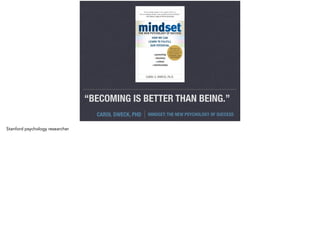
MINDSET: THE NEW PSYCHOLOGY OF SUCCESSCAROL DWECK, PHD
“BECOMING IS BETTER THAN BEING.”
Stanford psychology researcher
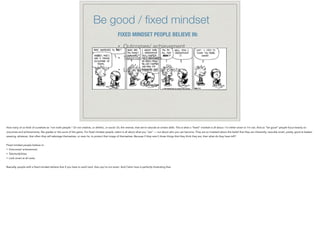
Be good / fixed mindset
FIXED MINDSET PEOPLE BELIEVE IN:
• Outcomes/ achievement

• Talents/abilities

• Look smart at all costs.
How many of us think of ourselves as “not math people.” Or not creative, or athletic, or social. Or, the reverse, that we’re naturals at certain skills. This is what a “fixed” mindset is all about. I’m either smart or I’m not. And so “be good” people focus heavily on
outcomes and achievements, like grades or the score of the game. For fixed mindset people, talent is all about what you “are” — not about who you can become. They are so invested about this belief that they are inherently, naturally smart, pretty, good at basket-
weaving, whatever, that often they will sabotage themselves, or even lie, to protect that image of themselves. Because if they aren’t those things that they think they are, then what do they have left?
!
Fixed mindset people believe in:
• Outcomes/ achievement
• Talents/abilities
• Look smart at all costs.
!
Basically, people with a fixed mindset believe that if you have to work hard, then you’re not smart. And Calvin here is perfectly illustrating that.
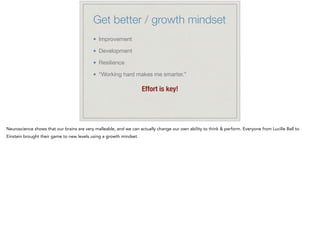
Get better / growth mindset
Improvement

Development

Resilience

“Working hard makes me smarter.”

!
Effort is key!
Neuroscience shows that our brains are very malleable, and we can actually change our own ability to think & perform. Everyone from Lucille Ball to
Einstein brought their game to new levels using a growth mindset.
Benefits of a growth
mindset
Interest

Enjoyment

Deeper thinking

Persistence (grit)

Superior performance
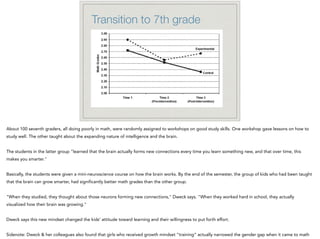
Transition to 7th grade
About 100 seventh graders, all doing poorly in math, were randomly assigned to workshops on good study skills. One workshop gave lessons on how to
study well. The other taught about the expanding nature of intelligence and the brain.
!
The students in the latter group "learned that the brain actually forms new connections every time you learn something new, and that over time, this
makes you smarter."
!
Basically, the students were given a mini-neuroscience course on how the brain works. By the end of the semester, the group of kids who had been taught
that the brain can grow smarter, had significantly better math grades than the other group.
!
"When they studied, they thought about those neurons forming new connections," Dweck says. "When they worked hard in school, they actually
visualized how their brain was growing."
!
Dweck says this new mindset changed the kids' attitude toward learning and their willingness to put forth effort.
!
Sidenote: Dweck & her colleagues also found that girls who received growth mindset “training” actually narrowed the gender gap when it came to math
Med students: organic
chemistry
Aspiring med students have to pass through the really difficult gauntlet of organic chemistry. It’s literally a career changing course, one that some
students allow to change their career path NOT because they no longer want to be a doctor, and NOT because they don’t have a long track record of
academic success. The reality is that nearly all PreMed students struggle in organic chemistry. That’s just a fact. But the ones who have a fixed mindset
tried to memorize everything, and when they did poorly, they said, “oh, chemistry just isn’t my thing…I am not good at it.” Whereas growth mindset
students “looked for themes across lectures, they studied to learn the material rather than ace the test, they went over their mistakes until they figured
things out.” This course wasn’t any easier for the kids with a growth mindset, but they had an attitude that allowed them to be resilient in the face of
challenge, and that ultimately allowed them to bounce back from low test grades with successful self-talk and study strategies. In the end, those with the
growth mindset got better grades and were much more likely to remain PreMed majors.
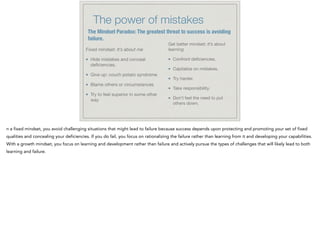
The power of mistakes
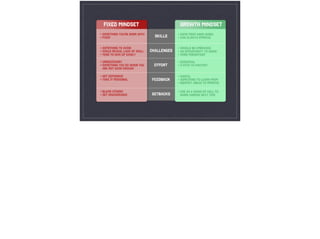
Fixed mindset: It’s about me

Hide mistakes and conceal
deficiencies.

Give up: couch potato syndrome

Blame others or circumstances

Try to feel superior in some other
way
Get better mindset: It’s about
learning

Confront deficiencies.

Capitalize on mistakes.

Try harder.

Take responsibility.

Don’t feel the need to put
others down.
The Mindset Paradox: The greatest threat to success is avoiding
failure.
n a fixed mindset, you avoid challenging situations that might lead to failure because success depends upon protecting and promoting your set of fixed
qualities and concealing your deficiencies. If you do fail, you focus on rationalizing the failure rather than learning from it and developing your capabilities.
With a growth mindset, you focus on learning and development rather than failure and actively pursue the types of challenges that will likely lead to both
learning and failure.
Praise the effort
STUDENTS PRAISED FOR INTELLIGENCE:
Selected easier tasks when given choice

Lied about their scores in an effort to look “smart”

!
STUDENTS PRAISED FOR EFFORT:
Overwhelmingly (90%) chose more challenging tasks

Showed higher levels of engagement and achievement
I’m not saying not to praise your kids, or your employees or your friends, or heck, yourself. But praise the effort. They’ll do it better, they’ll enjoy it more.
That’s how you get better at something - you keep doing it over and over again.
Relationships
I’m perfect as I am (ego).

Criticism construed as “You don’t really love me.”

If you have to work at it, it wasn’t meant to be.

Problems indicate character flaws.
People with a fixed mindset would want a mate who would put them on a pedestal and make them feel perfect as they are. They would want someone
who would boost their ego and never challenge them. Saying anything negative about them would likely mean that the other person doesn’t really love
them, because they have to be perfect as they are or the relationship can’t work. Any criticism would be threatening to the relationship, a signal that the
spouse doesn’t love them.
!
Someone with a growth mindset would want someone who helps them grow and improve and encourage them to learn new things.
!
One problem is that people with the fixed mindset expect everything good to happen automatically. It’s not that the partners will work to help each other
solve their problems or gain skills. It’s that this will magically occur through their love, sort of the way it happened to Sleeping Beauty, whose coma was
cured by her Prince’s kiss, or to Cinderella, whose miserable life was suddenly transformed by her Prince.
!
the belief that problems are a sign of deep-seated flaws. But just as there are no great achievements without setbacks, there are no great relationships
without conflicts and problems along the way.
!
Those who ask themselves “What do I need to learn to improve my relationships?” (as a partner, parent or friend) have relationships that tend to improve
Relationships
What do I need to learn to improve my
relationship?

Wants someone to help them grow & learn new
things.
HOW DO WE DO
IT?
CREATING A GROWTH
MINDSET
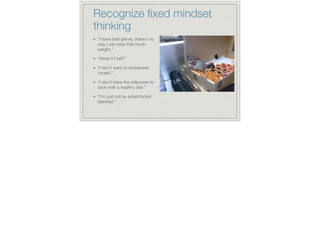
Recognize fixed mindset
thinking
“I have bad genes, there’s no
way I can lose that much
weight.”

“What if I fail?”

“I don’t want to embarrass
myself.”

“I don’t have the willpower to
stick with a healthy diet.”

“I’m just not as smart/lucky/
talented.”
Reframe with a growth
mindset
“No excuses this time … I’m getting started.”

“If I fail, it’s okay. Great accomplishments don’t
happen without risk.”

“Forget diets. I’ll take it slow and making
eating healthy a lifestyle.”

“If I don’t know how to do something, I’ll
learn.”

!
The goal is mastery and competence.
Goal-setting words
improve

learn

progress
develop

become

grow
Parenting: what to say
What did you learn? Did you have fun?

“You must have tried very hard!”

“I love that you kept trying, even when it got
difficult! Good job!”

“Wow that was easy! I’m sorry I wasted your time.
Let’s do something that you can learn from!”
You can’t be a mentor without a growth mindset. One group in this world is curious, and the other wants to look smart. Be in the curious group.
Effort, struggle, persistence despite setbacks	

Strategies, choices	

Choosing difficult tasks	 

Learning, improving	
Things to praise
Stop comparing yourself to
others
Instead, compare
yourself to your past
performances.
Take action
1. Write it down.

2. Embrace learning — and failure.

3. Take calculated risks.
“PERSEVERANCE IS THE HARD WORK
YOU DO AFTER YOU GET TIRED OF DOING
THE HARD WORK YOU ALREADY DID.”
— Newt Gingrich
jill@jillhinton.com
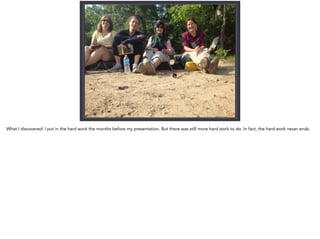
What I discovered: I put in the hard work the months before my presentation. But there was still more hard work to do. In fact, the hard work never ends.

Mindset

  • 1.
    A WORK INPROGRESS HOW A GROWTH MINDSET CAN POWER EVERYTHING YOU DO July 2014
  • 2.
    JANUARY 2014 POSSIBLY THEWORST DAY OF MY ADULT LIFE So here are some pictures of me from this past January. I was competing for first place in a national business plan competition for women vets, and I’d made it to the final round. I KNEW I was going home with a check. This picture shows me pitching my business to a room full of maybe 100 women who didn’t know me or my business. I had 90 seconds to convince them that they should vote for me to win the top prize. I got up there, took a deep breath and — I choked. I started talking about how I wanted to be the Oprah of the outdoors, yelling about free trips. I might have mentioned a campfire, I can’t remember. But whatever I said, people had no idea what I was talking about. In the end, I got third place, which to me, was exactly the same thing as last place. I know - kind of snotty. But winning the $10,000 was the best thing that ever happened to me — and not because of the reason you think. It was because I failed, spectacularly. A LOT of hard work got me into that competition, RIGHT UP UNTIL the final round. I prepared for months for the second-to-last presentation. But when it came to that last 90 seconds, I thought, “Man, I’ve got this nailed. I don’t need to practice. I don’t need to run this by anyone. I’ll just stand up there and talk about Oprah, and everyone will vote for me.” Wow, was I wrong.
  • 3.
    MINDSET: THE NEWPSYCHOLOGY OF SUCCESSCAROL DWECK, PHD “BECOMING IS BETTER THAN BEING.” Stanford psychology researcher
  • 4.
    Be good /fixed mindset FIXED MINDSET PEOPLE BELIEVE IN: • Outcomes/ achievement • Talents/abilities • Look smart at all costs. How many of us think of ourselves as “not math people.” Or not creative, or athletic, or social. Or, the reverse, that we’re naturals at certain skills. This is what a “fixed” mindset is all about. I’m either smart or I’m not. And so “be good” people focus heavily on outcomes and achievements, like grades or the score of the game. For fixed mindset people, talent is all about what you “are” — not about who you can become. They are so invested about this belief that they are inherently, naturally smart, pretty, good at basket- weaving, whatever, that often they will sabotage themselves, or even lie, to protect that image of themselves. Because if they aren’t those things that they think they are, then what do they have left? ! Fixed mindset people believe in: • Outcomes/ achievement • Talents/abilities • Look smart at all costs. ! Basically, people with a fixed mindset believe that if you have to work hard, then you’re not smart. And Calvin here is perfectly illustrating that.
  • 5.
    Get better /growth mindset Improvement Development Resilience “Working hard makes me smarter.” ! Effort is key! Neuroscience shows that our brains are very malleable, and we can actually change our own ability to think & perform. Everyone from Lucille Ball to Einstein brought their game to new levels using a growth mindset.
  • 7.
    Benefits of agrowth mindset Interest Enjoyment Deeper thinking Persistence (grit) Superior performance
  • 8.
    Transition to 7thgrade About 100 seventh graders, all doing poorly in math, were randomly assigned to workshops on good study skills. One workshop gave lessons on how to study well. The other taught about the expanding nature of intelligence and the brain. ! The students in the latter group "learned that the brain actually forms new connections every time you learn something new, and that over time, this makes you smarter." ! Basically, the students were given a mini-neuroscience course on how the brain works. By the end of the semester, the group of kids who had been taught that the brain can grow smarter, had significantly better math grades than the other group. ! "When they studied, they thought about those neurons forming new connections," Dweck says. "When they worked hard in school, they actually visualized how their brain was growing." ! Dweck says this new mindset changed the kids' attitude toward learning and their willingness to put forth effort. ! Sidenote: Dweck & her colleagues also found that girls who received growth mindset “training” actually narrowed the gender gap when it came to math
  • 9.
    Med students: organic chemistry Aspiringmed students have to pass through the really difficult gauntlet of organic chemistry. It’s literally a career changing course, one that some students allow to change their career path NOT because they no longer want to be a doctor, and NOT because they don’t have a long track record of academic success. The reality is that nearly all PreMed students struggle in organic chemistry. That’s just a fact. But the ones who have a fixed mindset tried to memorize everything, and when they did poorly, they said, “oh, chemistry just isn’t my thing…I am not good at it.” Whereas growth mindset students “looked for themes across lectures, they studied to learn the material rather than ace the test, they went over their mistakes until they figured things out.” This course wasn’t any easier for the kids with a growth mindset, but they had an attitude that allowed them to be resilient in the face of challenge, and that ultimately allowed them to bounce back from low test grades with successful self-talk and study strategies. In the end, those with the growth mindset got better grades and were much more likely to remain PreMed majors.
  • 10.
    The power ofmistakes Fixed mindset: It’s about me Hide mistakes and conceal deficiencies. Give up: couch potato syndrome Blame others or circumstances Try to feel superior in some other way Get better mindset: It’s about learning Confront deficiencies. Capitalize on mistakes. Try harder. Take responsibility. Don’t feel the need to put others down. The Mindset Paradox: The greatest threat to success is avoiding failure. n a fixed mindset, you avoid challenging situations that might lead to failure because success depends upon protecting and promoting your set of fixed qualities and concealing your deficiencies. If you do fail, you focus on rationalizing the failure rather than learning from it and developing your capabilities. With a growth mindset, you focus on learning and development rather than failure and actively pursue the types of challenges that will likely lead to both learning and failure.
  • 11.
    Praise the effort STUDENTSPRAISED FOR INTELLIGENCE: Selected easier tasks when given choice Lied about their scores in an effort to look “smart” ! STUDENTS PRAISED FOR EFFORT: Overwhelmingly (90%) chose more challenging tasks Showed higher levels of engagement and achievement I’m not saying not to praise your kids, or your employees or your friends, or heck, yourself. But praise the effort. They’ll do it better, they’ll enjoy it more. That’s how you get better at something - you keep doing it over and over again.
  • 12.
    Relationships I’m perfect asI am (ego). Criticism construed as “You don’t really love me.” If you have to work at it, it wasn’t meant to be. Problems indicate character flaws. People with a fixed mindset would want a mate who would put them on a pedestal and make them feel perfect as they are. They would want someone who would boost their ego and never challenge them. Saying anything negative about them would likely mean that the other person doesn’t really love them, because they have to be perfect as they are or the relationship can’t work. Any criticism would be threatening to the relationship, a signal that the spouse doesn’t love them. ! Someone with a growth mindset would want someone who helps them grow and improve and encourage them to learn new things. ! One problem is that people with the fixed mindset expect everything good to happen automatically. It’s not that the partners will work to help each other solve their problems or gain skills. It’s that this will magically occur through their love, sort of the way it happened to Sleeping Beauty, whose coma was cured by her Prince’s kiss, or to Cinderella, whose miserable life was suddenly transformed by her Prince. ! the belief that problems are a sign of deep-seated flaws. But just as there are no great achievements without setbacks, there are no great relationships without conflicts and problems along the way. ! Those who ask themselves “What do I need to learn to improve my relationships?” (as a partner, parent or friend) have relationships that tend to improve
  • 13.
    Relationships What do Ineed to learn to improve my relationship? Wants someone to help them grow & learn new things.
  • 14.
    HOW DO WEDO IT? CREATING A GROWTH MINDSET
  • 15.
    Recognize fixed mindset thinking “Ihave bad genes, there’s no way I can lose that much weight.” “What if I fail?” “I don’t want to embarrass myself.” “I don’t have the willpower to stick with a healthy diet.” “I’m just not as smart/lucky/ talented.”
  • 16.
    Reframe with agrowth mindset “No excuses this time … I’m getting started.” “If I fail, it’s okay. Great accomplishments don’t happen without risk.” “Forget diets. I’ll take it slow and making eating healthy a lifestyle.” “If I don’t know how to do something, I’ll learn.” ! The goal is mastery and competence.
  • 17.
  • 18.
    Parenting: what tosay What did you learn? Did you have fun? “You must have tried very hard!” “I love that you kept trying, even when it got difficult! Good job!” “Wow that was easy! I’m sorry I wasted your time. Let’s do something that you can learn from!” You can’t be a mentor without a growth mindset. One group in this world is curious, and the other wants to look smart. Be in the curious group.
  • 19.
    Effort, struggle, persistencedespite setbacks Strategies, choices Choosing difficult tasks Learning, improving Things to praise
  • 20.
    Stop comparing yourselfto others Instead, compare yourself to your past performances.
  • 21.
    Take action 1. Writeit down. 2. Embrace learning — and failure. 3. Take calculated risks.
  • 22.
    “PERSEVERANCE IS THEHARD WORK YOU DO AFTER YOU GET TIRED OF DOING THE HARD WORK YOU ALREADY DID.” — Newt Gingrich jill@jillhinton.com What I discovered: I put in the hard work the months before my presentation. But there was still more hard work to do. In fact, the hard work never ends.