Introduction
In a world marked by constant change, competition, and evolving challenges, the ability to adapt,
learn, and grow has become essential for personal and professional success. Central to this ability
is the growth mindset—a transformative perspective that turns setbacks into opportunities and
obstacles into stepping stones toward a fulfilling life.
A growth mindset goes beyond merely believing in the possibility of improvement; it embodies a
commitment to continuous learning, resilience, and the courage to face the unknown. In contrast
to a fixed mindset, which views intelligence and abilities as unchangeable, a growth mindset
acknowledges that effort, perseverance, and intentional practice can lead to significant
transformations in any area of life.
The concept of a growth mindset was popularized by psychologist Carol Dweck, whose
pioneering research revealed the profound impact our beliefs have on our behavior, motivation,
and ultimate success. However, the growth mindset is not just a theoretical idea—it is a practical
tool that has enabled countless individuals, from students and athletes to entrepreneurs and
leaders, to break through limitations and realize their full potential.
This book serves as a guide to understanding, developing, and maintaining a growth mindset. It
delves into the principles that support this transformative approach, offers strategies for
overcoming challenges, and shares real-world examples to motivate readers to embrace change
and thrive in all areas of their lives
Whether you aim to advance your career, improve your relationships, or tap into your creative
potential, the principles discussed in this book will act as a compass, steering you toward a life of
ongoing improvement and fulfillment. It’s not about achieving perfection but about making
progress—a journey of self-discovery that starts with a simple shift in perspective
By the conclusion of this book, you will not only grasp the power of a growth mindset but also
possess the tools to integrate it into your daily life.
,
Chapter 1
What is a Growth Mindset?
Every individual aspires to excel, but the key to reaching one’s potential often lies in how
challenges are perceived. The concept of a growth mindset, introduced by Dr. Carol Dweck,
emphasizes the belief that intelligence, abilities, and talents can be cultivated through dedication
and effort. It’s not about denying natural abilities but recognizing that effort and persistence play
pivotal roles in achievement.
A growth mindset is not limited to academics or career pursuits—it extends to relationships,
personal development, and how we navigate life’s obstacles. By fostering this mindset, you
unlock pathways to greater resilience, creativity, and satisfaction.
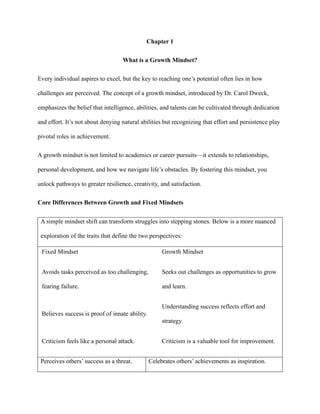
Core Differences Between Growth and Fixed Mindsets
A simple mindset shift can transform struggles into stepping stones. Below is a more nuanced
exploration of the traits that define the two perspectives:
Fixed Mindset Growth Mindset
Avoids tasks perceived as too challenging,
fearing failure.
Seeks out challenges as opportunities to grow
and learn.
Believes success is proof of innate ability.
Understanding success reflects effort and
strategy.
Criticism feels like a personal attack. Criticism is a valuable tool for improvement.
Perceives others’ success as a threat. Celebrates others’ achievements as inspiration.
Expanding the Science Behind the Growth Mindset
Neuroplasticity underscores the principle of growth mindset. Studies show the brain has a
remarkable ability to adapt and evolve through practice and new experiences. For example:
Learning New Skills: MRI scans of individuals learning complex tasks, such as playing a
musical instrument or mastering chess, reveal physical changes in the brain's structure.
Habit Formation: Research demonstrates that consistent repetition rewires the brain, making
once-difficult tasks seem natural over time.
Examples of Growth Mindset in Action
Serena Williams:
Serena’s ability to adapt, train harder after losses, and continually improve illustrates her growth
mindset. She often emphasizes learning from her defeats to refine her techniques and mindset.
The Rise of Elon Musk:
Musk’s relentless pursuit of innovation, from SpaceX to Tesla, showcases how embracing
setbacks (like failed rocket launches) as learning opportunities fuels unprecedented
achievements.
Practical Exercises for Adopting a Growth Mindset
Daily Reflection Practice:
Before bed, jot down one challenge you faced that day.
Reflect on what you learned from it and how it can prepare you for future situations.
Learning Journals:
Dedicate a journal to tracking areas where consistent effort led to improvement. Use it to
highlight milestones achieved over time.
Chapter 2
Overcoming Mental Roadblocks
Mental roadblocks often appear as logical fears or self-preserving instincts, but they can keep us
stuck in a comfort zone. These roadblocks manifest in the form of doubts, over analysis, and
negative self-talk, ultimately stalling progress. However, mental barriers are not unmovable
walls—they are puzzles waiting to be solved.
This chapter delves into identifying these roadblocks, understanding their sources, and providing
tools to break through them.
Common Mental Roadblocks Expanded
Fear of Failure
“What if I try and fail?”
This fear stems from societal stigmas around failure, which is often misconstrued as an endpoint
rather than a stepping stone.
Example: Thomas Edison failed thousands of times before inventing the light bulb. He famously
reframed each failure as another step closer to success.
Imposter Syndrome
“I don’t deserve my success.”
Many high achievers feel they’ve succeeded by luck rather than ability. This belief can erode
confidence and motivation.
Example: Maya Angelou admitted to feeling like an imposter even after publishing multiple
acclaimed works. Her continued effort and self-affirmation helped her push forward.
Procrastination and Perfectionism
The twin roadblocks of delaying tasks and striving for unattainable perfection prevent many
from taking meaningful action.
Practical Insight: Recognize that “done” is better than “perfect” in most situations. Progress fuels
improvement.
Strategies for Overcoming Mental Roadblocks
The 5-Second Rule (Mel Robbins)
Whenever self-doubt or hesitation arises, count backward from five (5-4-3-2-1) and take
immediate action. This simple technique interrupts negative thought patterns and builds
momentum.
Reframing Challenges
Reframe limiting beliefs by asking, “What if the opposite is true?”
Example: Instead of thinking, “I’m bad at managing people,” ask, “What steps can I take to
improve my leadership skills?”
Micro-Goals for Big Wins
Break overwhelming goals into smaller, manageable tasks to build confidence and momentum.
Exercise: Write a big goal, then break it into three daily tasks for the next week.
Positive Visualization
Spend five minutes daily visualizing yourself overcoming a specific roadblock. Imagine every
detail: the emotions, the actions, and the outcome. Visualization helps rewire the brain toward
optimism and confidence.
Case Studies: Breaking Roadblocks
J.K. Rowling
Rowling’s manuscript for Harry Potter was rejected by 12 publishers before being accepted.
Rather than giving up, she remained persistent, driven by her belief in her story’s potential.
Michael Jordan
Known for stating, “I’ve failed over and over again. And that is why I succeed,” Jordan’s growth
came from embracing failure and relentlessly refining his skills.
Exercises to Apply Now
The “What If” Reframe
Write down your top three limiting beliefs. Next to each one, write a positive reframe (e.g., “I’m
too old to learn” becomes “I have the experience to learn faster”).
Challenge Yourself Daily
Identify one fear-driven behavior (e.g., avoiding speaking up in meetings). Commit to
challenging that behavior once daily. Track your progress for two weeks.
Constructive Feedback Loop
Ask a trusted friend or mentor for feedback on an area you struggle with. Use this input to create
an improvement plan.
The Link Between Adaptability and the Growth Mindset
Adaptability and the growth mindset are deeply intertwined. A growth mindset allows you to
view change as a natural part of progress, making it easier to adapt without fear or resistance.
Conversely, adaptability strengthens a growth mindset by encouraging you to approach change
with curiosity and creativity.
Consider this
When faced with a career shift, someone with a fixed mindset might resist, believing their skills
are too specific or outdated to pivot.
A person with a growth mindset sees this as a chance to learn, grow, and even excel in a new
domain.
Why Adaptability Matters
Resilience in the Face of Change
Life rarely goes as planned. Adaptability helps you bounce back from setbacks, adjusting your
approach without losing sight of your goals.
Increased Opportunities
Those who adapt quickly to change often seize opportunities others miss. They’re seen as
resourceful, innovative, and reliable in dynamic environments.
Emotional Well-Being
Resistance to change often leads to stress and frustration. Embracing adaptability fosters a sense
of control and optimism, even in uncertain times.
Examples of Adaptability in Action
The Pandemic Pivot
During the COVID-19 pandemic, businesses and individuals were forced to adapt overnight.
Companies that embraced remote work and e-commerce thrived, while those resistant to change
struggled.
Oprah Winfrey
Oprah's adaptability has been a cornerstone of her success. From talk shows to network
ownership, she has consistently evolved her career to stay relevant, exploring new opportunities
with confidence.
Historical Innovators
Charles Darwin noted, “It is not the strongest of the species that survives, nor the most
intelligent. It is the one most adaptable to change.” Innovators like Thomas Edison and Marie
Curie exemplify this principle, constantly refining their approaches to achieve groundbreaking
results.
How to Cultivate Adaptability
Reframe Change as Growth
Instead of focusing on the discomfort of change, ask, “What can I learn from this?”
Example: If a company adopts new technology, see it as a chance to master a skill that could set
you apart.
Stay Curious
Curiosity drives adaptability. Make it a habit to ask questions and seek knowledge in unfamiliar
areas.
Practical Tip: Dedicate 10 minutes daily to reading about a new trend or skill in your field.
Practice Emotional Flexibility
Acknowledge the emotions that come with change but don’t let them dictate your actions.
Exercise: When faced with change, write down your initial feelings. Then, list three potential
positive outcomes of the situation.
Develop a Problem-Solving Mindset
Adaptability thrives on the ability to find solutions.
Strategy: Break problems into smaller, manageable tasks. For example, if you're transitioning
careers, focus first on updating your resume, then on networking, and finally on skills
development.
Build a Support Network
Surround yourself with adaptable individuals who inspire and challenge you.
Action Step: Join professional or community groups that emphasize learning and growth.
Exercises for Building Adaptability
The Comfort Zone Challenge
Weekly, engage in an activity that stretches your comfort zone. This could be as simple as trying
a new cuisine or as bold as speaking at an event.
Scenario Planning
Imagine three “what if” scenarios related to your career or personal life (e.g., losing a job,
moving to a new city). Develop a plan for each.
Rapid Feedback Loop
Choose a task where you can get immediate feedback (e.g., writing, public speaking). Use the
feedback to make adjustments and improve in real-time.
Adaptability in Different Spheres
Career
Jobs and industries are evolving. Those who embrace lifelong learning are better equipped to
transition and thrive.
Example: A teacher who integrates technology into their classroom becomes more effective and
future-ready.
Personal Life
Relationships often require adaptability to navigate changing dynamics. Learning to compromise
and communicate is key.
Health and Wellness
Physical and mental well-being depend on your ability to adapt to life’s demands. Whether it’s
finding a new workout routine or managing stress, flexibility ensures consistency.
Challenges to Adaptability and How to Overcome Them
Fear of the Unknown
Solution: Break down uncertainty into smaller, actionable steps. Taking one step at a time makes
change less intimidating.
Clinging to the Past
Solution: Focus on the future benefits of change. Visualize where adaptability could lead you.
Perfectionism
Solution: Embrace imperfection as part of the process. Adaptability is about progress, not
perfection.
Chapter 4
The Role of Resilience in a Growth Mindset
Life is a series of peaks and valleys, where moments of success are often interwoven with
failures, setbacks, and unexpected challenges. Resilience—the ability to bounce back, recover,
and even grow stronger after adversity—is the cornerstone of a growth mindset. Without
resilience, the journey toward self-improvement and success can be easily derailed by
difficulties.
This chapter explores how resilience fortifies a growth mindset, why it is essential for navigating
life’s uncertainties, and how you can cultivate it through practical tools and strategies
What is Resilience?
Resilience isn’t about being unaffected by hardship; it’s about thriving despite it. It’s the mental,
emotional, and behavioral toughness that enables individuals to adapt to stress, overcome
obstacles, and maintain a sense of purpose.
Psychologists describe resilience as a dynamic process influenced by personal traits, support
systems, and external circumstances. Some key attributes include:
Emotional Regulation: Staying composed under pressure.
Optimism: Believing in a better future despite present challenges.
Problem-Solving Skills: Approaching setbacks with a solution-oriented mindset.
Why Resilience is Critical to a Growth Mindset
Embracing Failure as a Learning Opportunity
A resilient person sees failure as a natural part of growth rather than an endpoint.
Example: After being cut from his high school basketball team, Michael Jordan famously used
the setback to fuel his relentless practice and eventual success.
Sustaining Effort Over Time
Cultivating skills, mastering a craft, or achieving long-term goals requires endurance. Resilience
ensures you persevere, even when progress feels slow.
Adapting to Change:
Change is inevitable, and those with resilience are better equipped to navigate life’s twists and
turns while staying focused on their goals.
How to Build Resilience
Strengthen Your Emotional Awareness
Acknowledge your feelings without judgment. Understanding your emotions allows you to
respond thoughtfully rather than react impulsively.
Exercise: Keep a journal to record daily emotional highs and lows, reflecting on triggers and
responses.
Reframe Negative Experiences
Shift your perspective by asking, “What is this teaching me?”
Example: A job loss might feel devastating but could open doors to new opportunities better
aligned with your passions.
Practice Gratitude
Gratitude fosters optimism, which is crucial for resilience.
Action Step: Write down three things you’re grateful for each day, focusing on small wins or
moments of joy.
Build a Strong Support System
Relationships with friends, family, and mentors provide emotional support and guidance during
tough times.
Note: Actively nurture these connections by checking in regularly and expressing
appreciation.
Develop a Problem-Solving Mindset
Break challenges into smaller, manageable parts and focus on actionable steps.
Example: If you're overwhelmed by a big project, start by outlining the first three tasks you can
complete today.
Resilience in Action: Real-Life Examples
Nelson Mandela
Mandela’s 27 years of imprisonment could have embittered him, but his resilience enabled him
to emerge as a symbol of reconciliation and hope. His ability to forgive and work toward a united
South Africa demonstrates the power of emotional strength and adaptability.
Oprah Winfrey
Overcoming a traumatic childhood and numerous professional setbacks, Oprah used her
resilience to build an empire and inspire millions.
Everyday Heroes
From parents balancing multiple jobs to students persevering through financial hardships,
resilience is demonstrated daily by those who refuse to give up on their dreams despite
overwhelming odds.
Resilience-Building Exercises
The “What Went Right” Reflection
At the end of each day, write down one thing that went right and why it mattered. This reinforces
your ability to see the positive, even on difficult days.
Visualization of Success
Spend five minutes daily visualizing yourself overcoming a current challenge. Imagine the steps
you take and how you’ll feel after achieving your goal.
Resilience Role Models
Identify someone you admire for their resilience. Study their journey and reflect on how you can
apply similar strategies to your life.
Challenges to Resilience and How to Overcome Them
Burnout
Solution: Prioritize self-care by setting boundaries, getting enough rest, and practicing
mindfulness.
Self-Doubt:
Solution: Counter negative thoughts with evidence of past successes. Create a “wins” list to
remind yourself of your achievements.
Fear of Vulnerability:
Solution: Embrace vulnerability as a strength. Sharing your struggles with trusted
individuals fosters connection and reduces feelings of isolation.
Chapter 5
The Art of Setting Goals in a Growth Mindset
Goals are the compass that guides us toward our aspirations, shaping our decisions and actions.
However, the type of mindset we bring to goal-setting determines whether those goals inspire
progress or hinder it. A growth mindset transforms goal-setting into a dynamic process that
focuses not only on outcomes but also on learning, persistence, and adaptability along the way.
This chapter explores how to align your goals with a growth mindset, avoid common pitfalls, and
maintain motivation through practical strategies and real-life examples.
Why Goals Matter in a Growth Mindset
Goals provide a sense of direction, making it easier to focus efforts and track progress.
With a growth mindset, goals emphasize improvement and mastery rather than fixed results.
Motivation to Persevere
Purposeful goals fuel determination, especially when challenges arise.
Example: A student aiming to "improve math skills" stays motivated by seeing incremental
progress, even if test scores don’t immediately reflect mastery.
Catalyst for Learning
Growth-oriented goals prioritize learning new skills and habits over avoiding failure.
The SMART Framework with a Growth Twist
A growth mindset redefines the traditional SMART goal framework:
Specific: Focus on learning and improvement.
Example: Instead of “Become fluent in French,” aim for “Practice French vocabulary daily
and hold a 10-minute conversation in three months.”
Measurable: Include progress-based markers, not just outcomes.
Example: Track “Hours practiced weekly” rather than focusing solely on a final exam
score.
Achievable: Stretch your abilities while staying realistic.
Growth Twist: Accept that setbacks, they are part of the journey and revise goals as needed.
Relevant: Ensure goals align with your long-term aspirations and values.
Time-Bound: Set deadlines for tasks but remain flexible when life intervenes.
Types of Goals in a Growth Mindset
Process Goals
Focus on actions rather than results.
Example: “Write 500 words daily” instead of “Finish a novel in a month.”
Learning Goals
Emphasize skill development and knowledge acquisition.
Example: “Master Excel’s advanced functions” rather than “Get promoted this quarter.”
Stretch Goals
Challenge you to move outside your comfort zone while remaining attainable.
Example: “Deliver a presentation to a large audience within six months.”
Overcoming Goal-Setting Pitfalls
Fear of Failure
Solution: Reframe failure as a learning experience. Ask, “What did this teach me?”
Lack of Flexibility
Solution: Treat goals as a roadmap, not a rigid contract. Adjust them as circumstances evolve.
Overloading Goals:
Solution: Prioritize quality over quantity. Focus on two or three meaningful goals rather than a
long list.
Short-Term Thinking
Solution: Balance immediate targets with long-term aspirations.
Practical Strategies for Effective Goal-Setting
Visualization of Success
Spend time imagining how achieving your goal will feel and what steps it will take. Visualization
strengthens motivation.
Accountability Partners
Share your goals with a trusted friend or mentor who can offer encouragement and feedback.
Create Milestones
Break larger goals into smaller, actionable steps. Celebrate each milestone to maintain
momentum.
Regular Review
Schedule weekly or monthly goal reviews to assess progress, refine your approach, and stay
aligned with your values.
Case Studies: Goal-Setting in Action
Serena Williams
Known for setting process-oriented goals, Serena focuses on improving specific aspects of her
game, such as footwork or serve accuracy. This approach fuels her continuous growth.
Elon Musk
Musk’s audacious goals—like colonizing Mars—are complemented by smaller, iterative
milestones that ensure consistent progress toward larger visions.
Personal Story – Everyday Aspirations
A single parent sets a goal to “save $500 for emergencies.” By breaking it into smaller goals of
saving $50 a month, they steadily build financial security.
Exercises to Develop Growth-Oriented Goals
The “Why” Drill-Down
For each goal, ask yourself “Why do I want this?” three times. This clarifies motivation and
ensures alignment with your values.
Future Self Visualization
Picture your life in five years. Write down the goals that will help you become that version of
yourself.
Weekly Growth Tracker
Create a chart to log daily actions toward your goals. Reflect on what worked and what can be
improved each week.
Chapter 6
Sustaining a Growth Mindset for a Lifetime
Achieving a growth mindset is not the final destination; it’s the beginning of a lifelong journey.
Life’s complexities and challenges require continuous renewal of this mindset, ensuring that
learning, adaptation, and self-improvement remain integral to who we are. Sustaining a growth
mindset isn’t about never wavering but about finding ways to refocus and recommit when faced
with doubt or complacency.
In this final chapter, we’ll explore strategies for maintaining a growth mindset over time, even
during moments of adversity, and reflect on how this mindset empowers individuals to live a
fulfilling and impactful life.
The Long-Term Benefits of a Growth Mindset
Personal Fulfillment
A commitment to growth fosters a sense of accomplishment and purpose, as progress—no matter
how small—becomes deeply satisfying.
Resilience to Life’s Uncertainties
A growth mindset equips individuals to see change and challenges as opportunities for self-
discovery and development.
Enhanced Relationships
By valuing feedback and collaboration, those with a growth mindset cultivate deeper and more
meaningful connections with others.
Professional Advancement
Continuous learning and adaptability ensure relevance and leadership in any field.
Key Strategies for Sustaining a Growth Mindset
Embrace Lifelong Learning
Commit to exploring new ideas, skills, and perspectives regularly.
Action Step: Set annual goals to learn something new, whether it’s a language, a technical
skill, or a creative hobby.
Create a Growth-Friendly Environment
Surround yourself with people, resources, and habits that reinforce your mindset.
Example: Join communities or organizations that prioritize innovation, collaboration, and
constructive feedback.
Practice Mindfulness
Stay present and self-aware to recognize when fixed-mindset thinking starts creeping in.
Exercise: Dedicate five minutes daily to reflect on moments when you overcame a challenge or
learned something new.
Celebrate Effort Over Results
Acknowledge the hard work and resilience you display, regardless of the outcome.
Teach and Inspire Others:
Sharing your journey and supporting others in their growth reinforces your commitment to the
mindset.
Challenges to Sustaining a Growth Mindset and How to Overcome Them
Complacency
Over time, success can lead to a plateau if effort diminishes.
Solution: Continuously set stretch goals that push you to explore uncharted territories.
Fear of Burnout
Sustained growth requires balance.
Solution: Integrate periods of rest and reflection to rejuvenate your mind and energy.
Negative Influences
Fixed-mindset environments can hinder progress.
Solution: Actively seek supportive mentors, peers, and communities that align with your values.
Over-Identifying with the Growth Mindset:
Avoid viewing the growth mindset as a fixed identity, which can lead to defensiveness or
resistance to constructive criticism.
Solution: Remain humble and open to evolving your approach as new insights emerge.
Reflecting on Your Growth Journey
Look Back
Reflect on your transformation since beginning the journey to adopt a growth mindset.
Recognize moments of courage, learning, and adaptability.
Look Forward
Envision how your growth mindset can impact the next phase of your life, whether in
relationships, career, or personal fulfillment.
Stay Curious
Cultivate a sense of wonder about what’s next and remain excited about the endless possibilities
for growth.
Real-Life Inspiration: The Growth Mindset in Action
J.K. Rowling
From numerous rejections of her Harry Potter manuscript to becoming a global literary icon,
Rowling’s journey exemplifies perseverance and an unwavering belief in her ability to grow.
Everyday Heroes
Consider the stories of individuals in your life—teachers who adapt to ever-changing student
needs, parents balancing work and family, or entrepreneurs taking risks to bring their visions to
life.
Conclusion
Sustaining a growth mindset is a journey of self-discovery and continuous evolution. It’s not
about perfection or constant success but about resilience, curiosity, and the courage to embrace
the unknown.
As you move forward, remember that growth is not a straight line—it’s a winding path filled
with opportunities to learn, adapt, and thrive. By committing to this mindset, you empower
yourself to face challenges head-on, inspire those around you, and live a life of purpose and
fulfillment.
The power to grow is already within you. Trust the process, and let your journey be a testament
to the transformative impact of a growth.
Works Cited
1. Dweck, Carol S. Mindset: The New Psychology of Success. New York: Random House,
2006.
2. Duckworth, Angela. Grit: The Power of Passion and Perseverance. New York: Scribner,
2016.
3. Grant, Adam. Think Again: The Power of Knowing What You Don’t Know. New York:
Viking, 2021.
4. Pink, Daniel H. Drive: The Surprising Truth About What Motivates Us. New York:
Riverhead Books, 2009.
5. Coyle, Daniel. The Talent Code: Greatness Isn’t Born. It’s Grown. Here’s How. New
York: Bantam Books, 2009.