MINDING THE GAP:THE TECH
BEHIND MAKING TRANSIT
MORE EQUITABLE
TRANSLOC + CITY OF WILSON
TRANSIT IS
CHANGING
• Outdated Systems
• Changing Demographics
• Rising Transit Fares
• Declining Ridership
• Competition with low fuel prices
• Technological Innovation
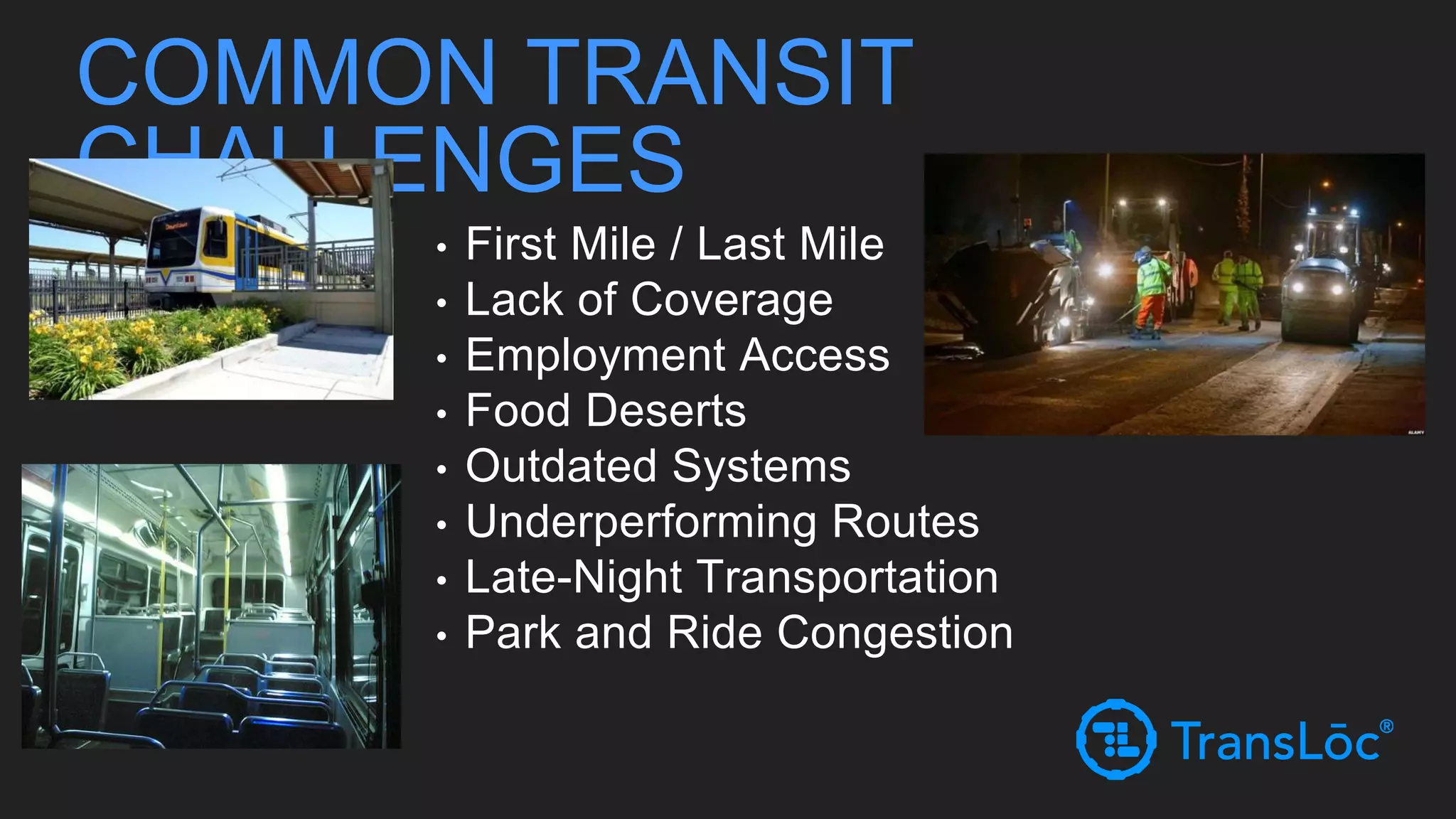
• First Mile / Last Mile
• Lack of Coverage
• Employment Access
• Food Deserts
• Outdated Systems
• Underperforming Routes
• Late-Night Transportation
• Park and Ride Congestion
COMMON TRANSIT
CHALLENGES
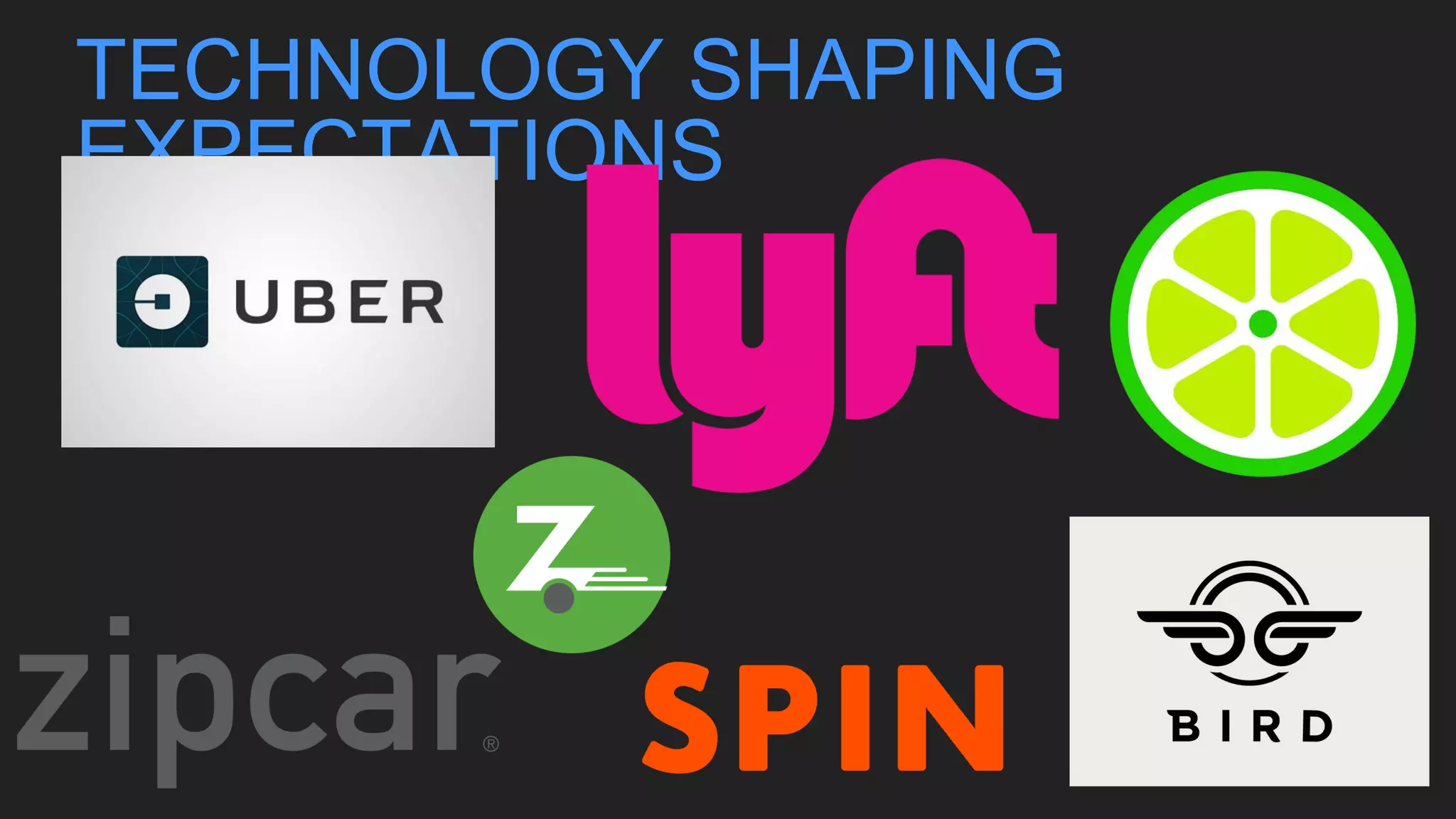
TECHNOLOGY SHAPING
EXPECTATIONS
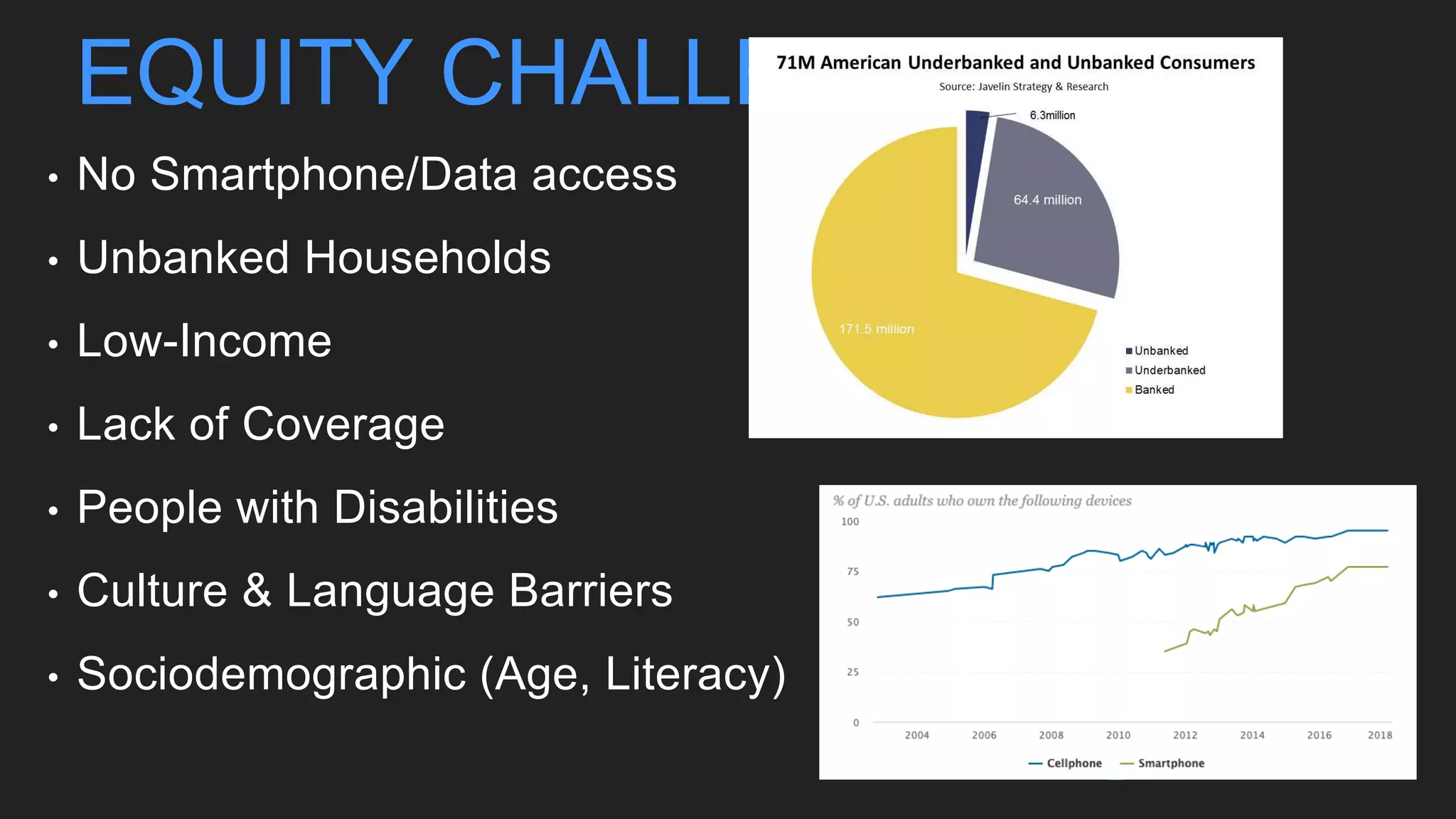
EQUITY CHALLENGES
• No Smartphone/Data access
• Unbanked Households
• Low-Income
• Lack of Coverage
• People with Disabilities
• Culture & Language Barriers
• Sociodemographic (Age, Literacy)
RETHINKING TRANSIT
By rethinking how they handle city transit to focus on mobility engineering, city and transit
leaders can drive economic development for businesses, individual citizens, and the city
itself:
Businesses across a city
leverage easier access to
a broader pool of
employees of all ages and
backgrounds, as well as
greater access to
consumers.
Citizens enjoy a wealth of
benefits, from greater
access to jobs to easier
and more secure access to
shopping, exploring,
dining, and running
everyday errands—without
the frustration of
congested roads and
packed parking lots.
Cities take tax dollars
further by combining more
efficient high- capacity
transit systems with agile
mobility options through
creative public and private
partnerships.
ECONOMIC DEVELOPMENT
With a more flexible and agile focus on mobility, cities can drive economic development in
several important ways:
Help citizens easily and
affordably get to their jobs,
education, shopping, and
health care, promoting
more vibrant, prosperous,
and healthy communities.
Take taxpayers’ dollars
further with better transit
efficiency and less
spending on parking lots,
road maintenance, and
other physical
infrastructure.
Improve community
opportunities and business
connections by fostering
better partnerships
between private and public
organizations.
Best of all, the advantages of focusing on mobility are not limited to urban areas.
in urban, suburban, and rural communities are embracing new approaches to mobility in order
to drive economic development in their cities, towns, and regions.
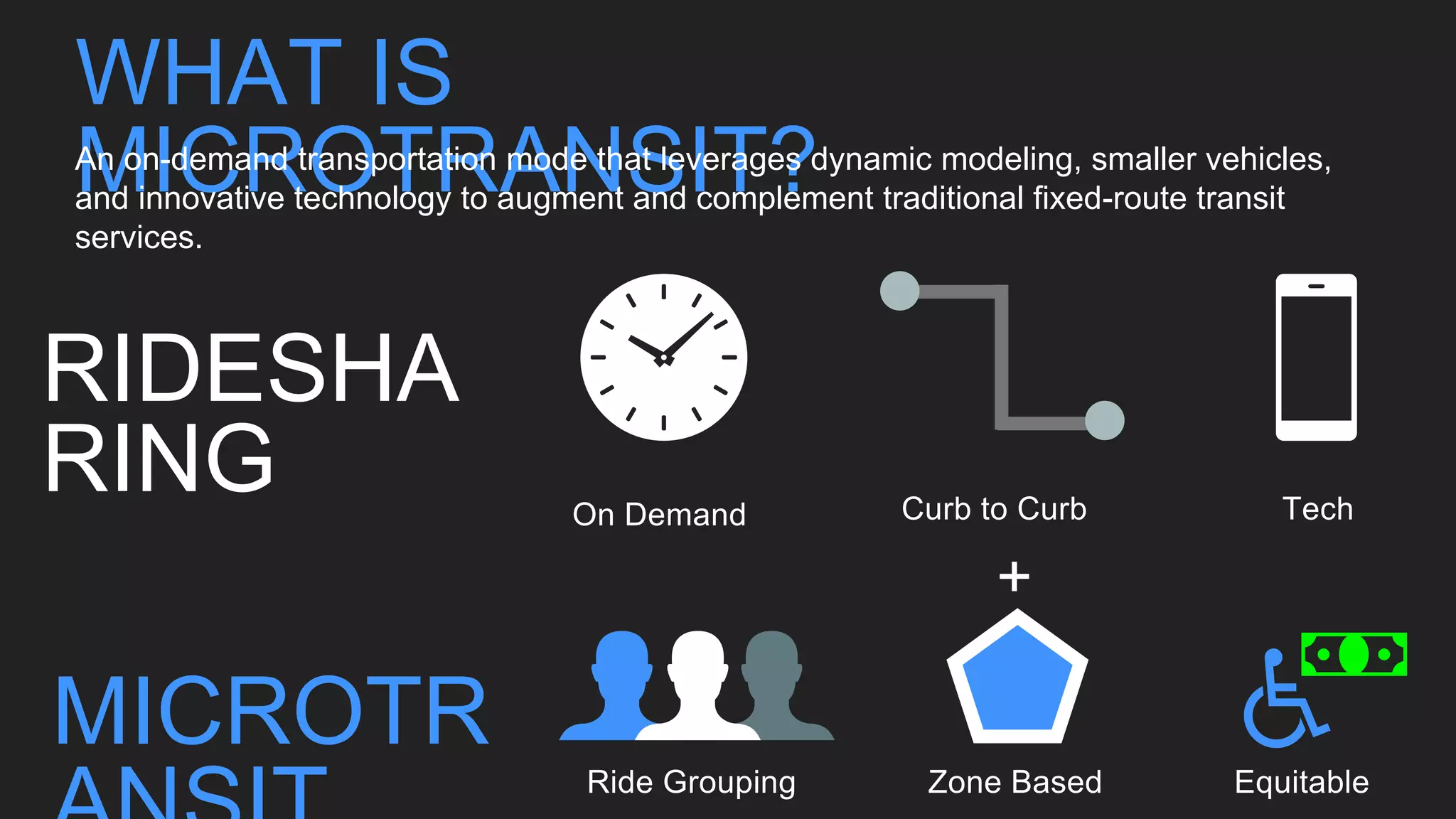
WHAT IS
MICROTRANSIT?
RIDESHA
RING Curb to CurbOn Demand
Zone BasedRide Grouping
MICROTR
+
Equitable
Tech
An on-demand transportation mode that leverages dynamic modeling, smaller vehicles,
and innovative technology to augment and complement traditional fixed-route transit
services.
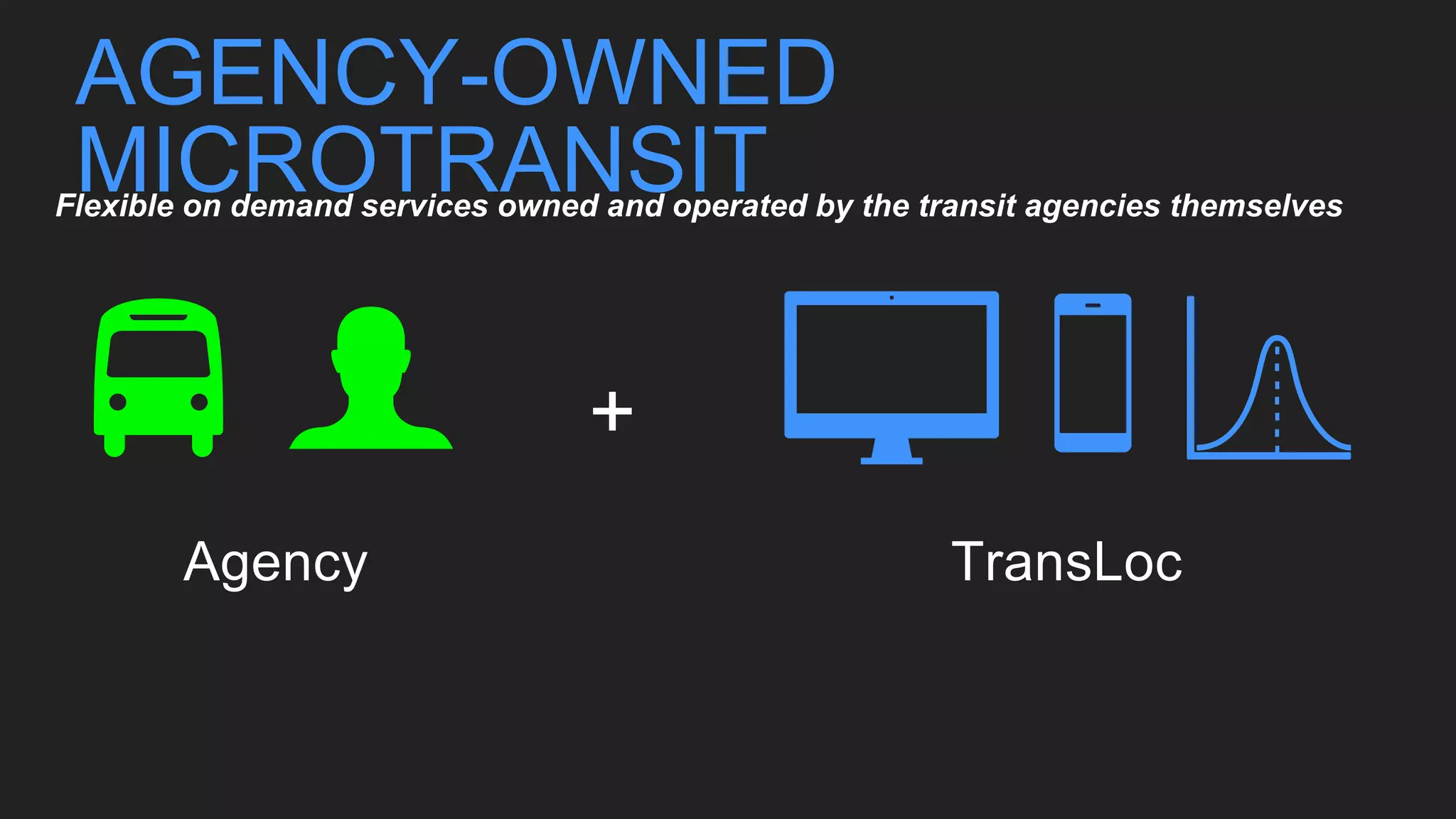
AGENCY-OWNED
MICROTRANSIT
TransLocAgency
+
Flexible on demand services owned and operated by the transit agencies themselves
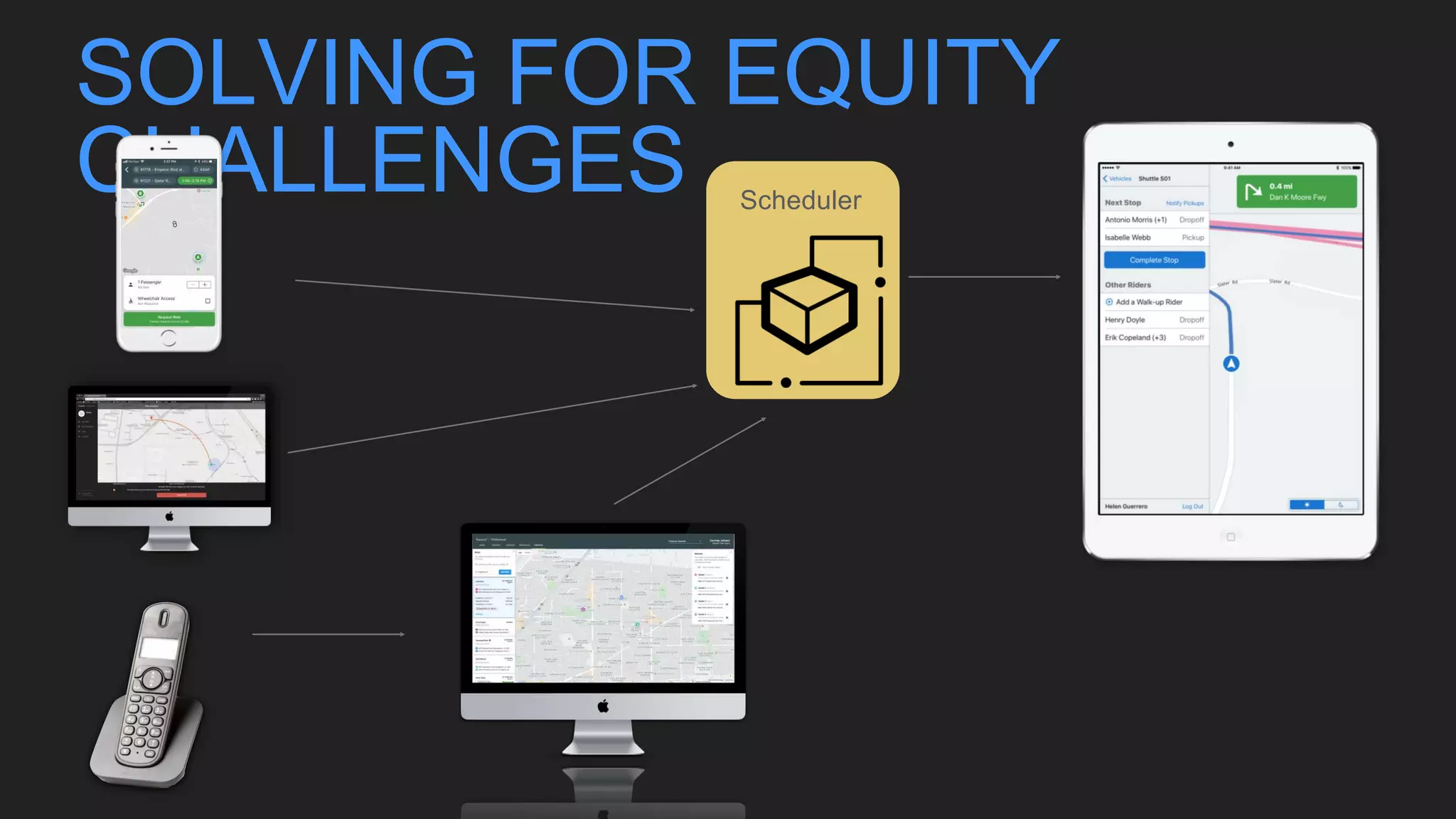
SOLVING FOR EQUITY
CHALLENGES Scheduler
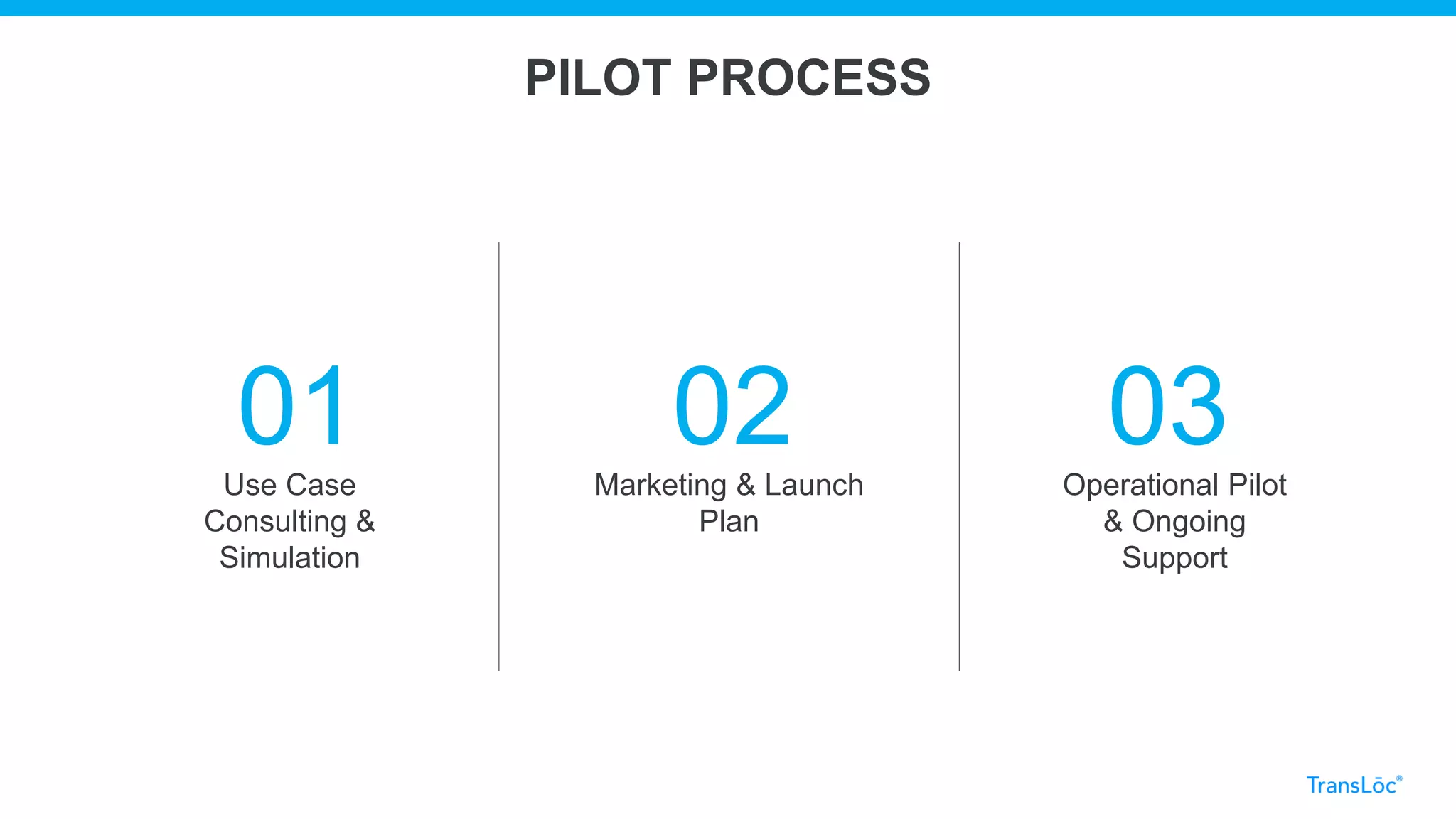
PILOT PROCESS
Use Case
Consulting &
Simulation
01 Marketing & Launch
Plan
02 Operational Pilot
& Ongoing
Support
03
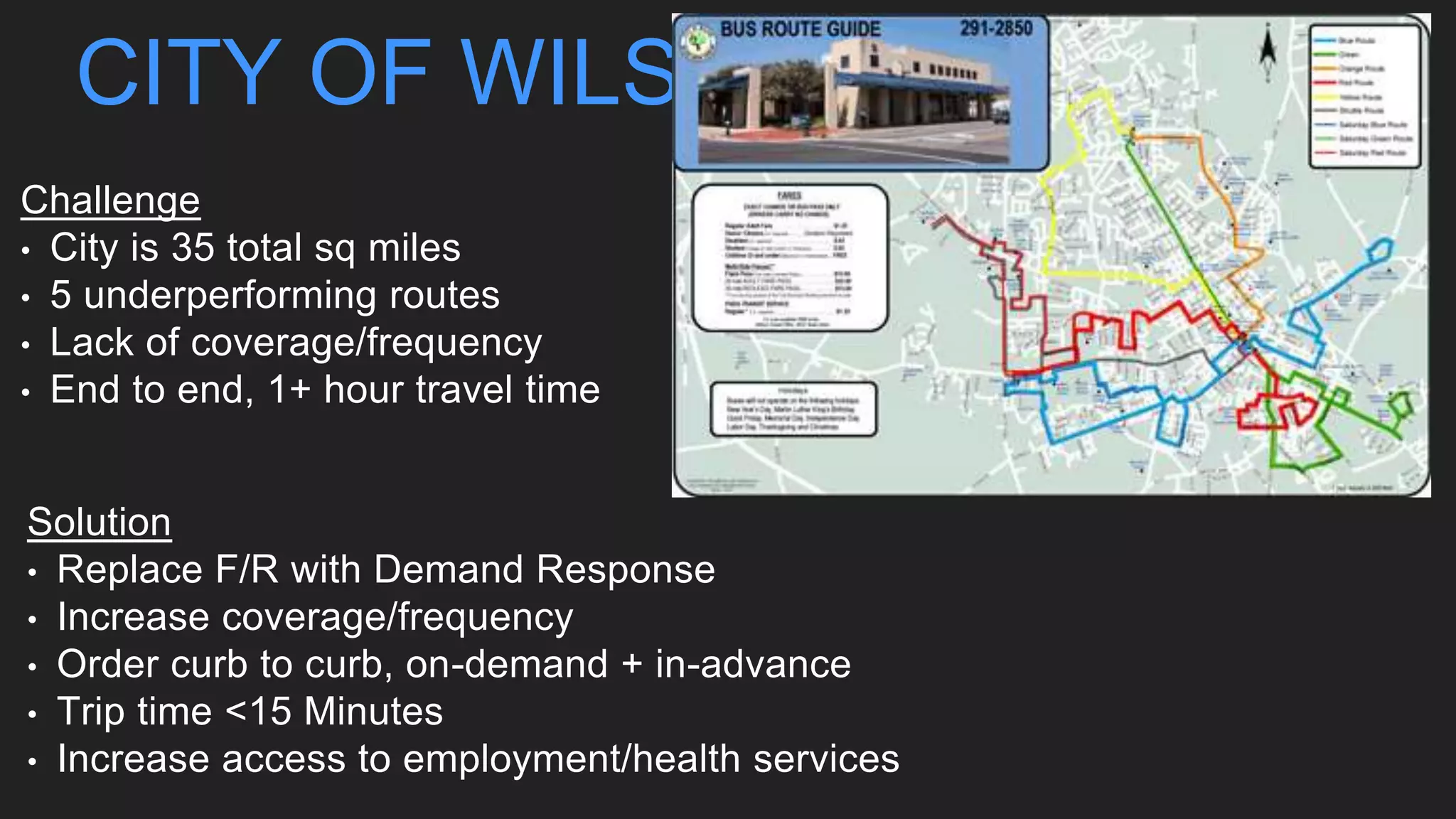
CITY OF WILSON
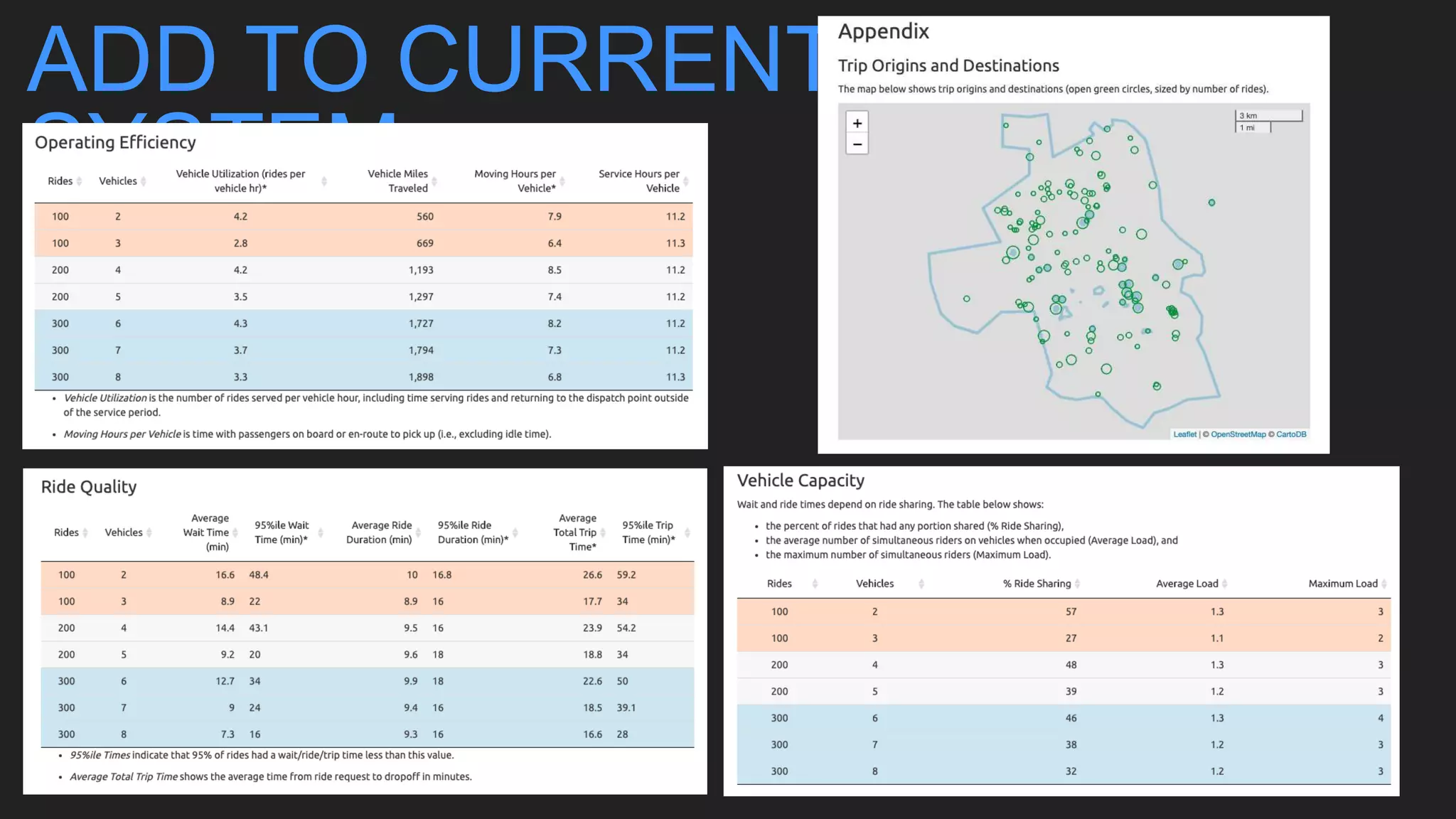
Challenge
• City is 35 total sq miles
• 5 underperforming routes
• Lack of coverage/frequency
• End to end, 1+ hour travel time
Solution
• Replace F/R with Demand Response
• Increase coverage/frequency
• Order curb to curb, on-demand + in-advance
• Trip time <15 Minutes
• Increase access to employment/health services
ADD TO CURRENT
SYSTEM
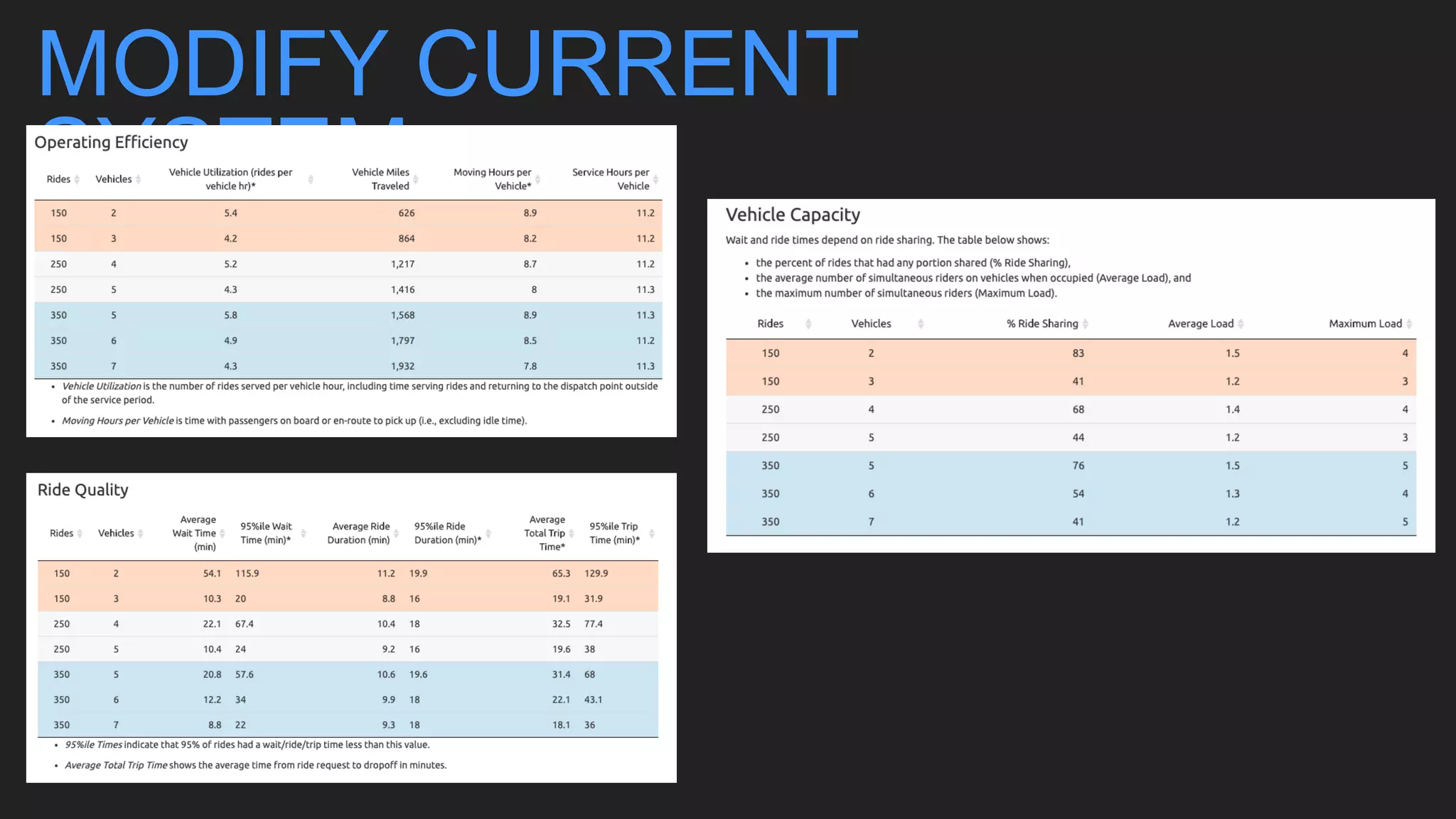
MODIFY CURRENT
SYSTEM
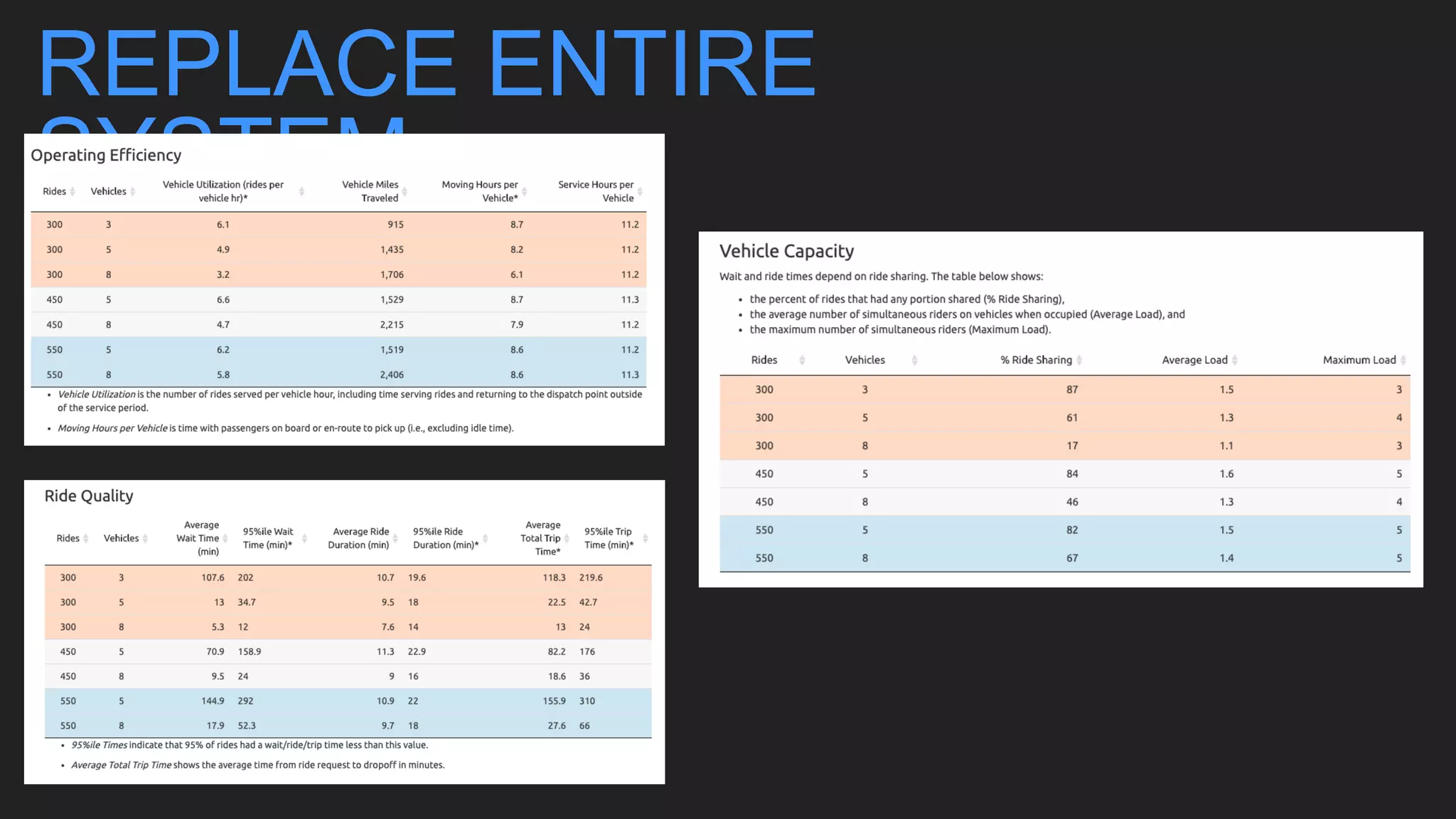
REPLACE ENTIRE
SYSTEM
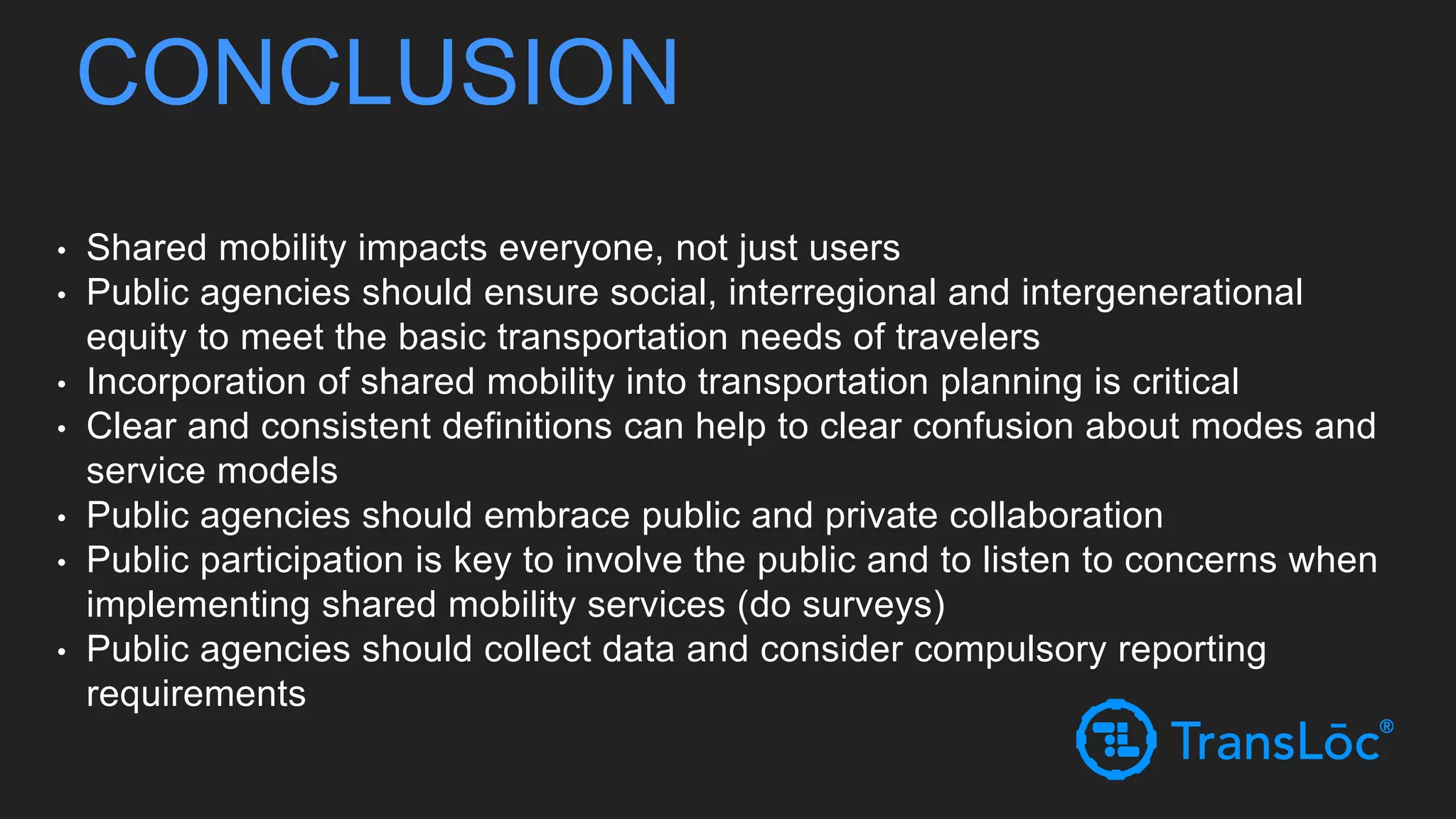
CONCLUSION
• Shared mobility impacts everyone, not just users
• Public agencies should ensure social, interregional and intergenerational
equity to meet the basic transportation needs of travelers
• Incorporation of shared mobility into transportation planning is critical
• Clear and consistent definitions can help to clear confusion about modes and
service models
• Public agencies should embrace public and private collaboration
• Public participation is key to involve the public and to listen to concerns when
implementing shared mobility services (do surveys)
• Public agencies should collect data and consider compulsory reporting
requirements
QUESTIONS /
CONTACT US
Nathan Gyori
Business Development Associate
nathan.gyori@transloc.com
(919) 973-3819

Minding the Gap: The Tech Behind Making Transit More Equitable

  • 1.
    MINDING THE GAP:THETECH BEHIND MAKING TRANSIT MORE EQUITABLE TRANSLOC + CITY OF WILSON
  • 2.
    TRANSIT IS CHANGING • OutdatedSystems • Changing Demographics • Rising Transit Fares • Declining Ridership • Competition with low fuel prices • Technological Innovation
  • 3.
    • First Mile/ Last Mile • Lack of Coverage • Employment Access • Food Deserts • Outdated Systems • Underperforming Routes • Late-Night Transportation • Park and Ride Congestion COMMON TRANSIT CHALLENGES
  • 4.
  • 5.
    EQUITY CHALLENGES • NoSmartphone/Data access • Unbanked Households • Low-Income • Lack of Coverage • People with Disabilities • Culture & Language Barriers • Sociodemographic (Age, Literacy)
  • 6.
    RETHINKING TRANSIT By rethinkinghow they handle city transit to focus on mobility engineering, city and transit leaders can drive economic development for businesses, individual citizens, and the city itself: Businesses across a city leverage easier access to a broader pool of employees of all ages and backgrounds, as well as greater access to consumers. Citizens enjoy a wealth of benefits, from greater access to jobs to easier and more secure access to shopping, exploring, dining, and running everyday errands—without the frustration of congested roads and packed parking lots. Cities take tax dollars further by combining more efficient high- capacity transit systems with agile mobility options through creative public and private partnerships.
  • 7.
    ECONOMIC DEVELOPMENT With amore flexible and agile focus on mobility, cities can drive economic development in several important ways: Help citizens easily and affordably get to their jobs, education, shopping, and health care, promoting more vibrant, prosperous, and healthy communities. Take taxpayers’ dollars further with better transit efficiency and less spending on parking lots, road maintenance, and other physical infrastructure. Improve community opportunities and business connections by fostering better partnerships between private and public organizations. Best of all, the advantages of focusing on mobility are not limited to urban areas. in urban, suburban, and rural communities are embracing new approaches to mobility in order to drive economic development in their cities, towns, and regions.
  • 8.
    WHAT IS MICROTRANSIT? RIDESHA RING Curbto CurbOn Demand Zone BasedRide Grouping MICROTR + Equitable Tech An on-demand transportation mode that leverages dynamic modeling, smaller vehicles, and innovative technology to augment and complement traditional fixed-route transit services.
  • 9.
    AGENCY-OWNED MICROTRANSIT TransLocAgency + Flexible on demandservices owned and operated by the transit agencies themselves
  • 10.
  • 11.
    PILOT PROCESS Use Case Consulting& Simulation 01 Marketing & Launch Plan 02 Operational Pilot & Ongoing Support 03
  • 12.
    CITY OF WILSON Challenge •City is 35 total sq miles • 5 underperforming routes • Lack of coverage/frequency • End to end, 1+ hour travel time Solution • Replace F/R with Demand Response • Increase coverage/frequency • Order curb to curb, on-demand + in-advance • Trip time <15 Minutes • Increase access to employment/health services
  • 13.
  • 14.
  • 15.
  • 16.
    CONCLUSION • Shared mobilityimpacts everyone, not just users • Public agencies should ensure social, interregional and intergenerational equity to meet the basic transportation needs of travelers • Incorporation of shared mobility into transportation planning is critical • Clear and consistent definitions can help to clear confusion about modes and service models • Public agencies should embrace public and private collaboration • Public participation is key to involve the public and to listen to concerns when implementing shared mobility services (do surveys) • Public agencies should collect data and consider compulsory reporting requirements
  • 17.
    QUESTIONS / CONTACT US NathanGyori Business Development Associate nathan.gyori@transloc.com (919) 973-3819

Editor's Notes

  • #3 The traditional framework for city transit has been around for several decades Cities rely on trains and buses for major routes, highways and roads keep expanding alongside parking lots to meet the swelling masses of cars Many of today’s transportation systems were originally designed in the 1950s and it is little surprise that they have struggled to serve rapidly growing city populations and shifting demographics. At the same time, citizens in lower socioeconomic classes suffer from longer, more expensive commutes on the remaining bus lines This transit burden slows growth by forcing companies to cut back work schedules and hiring because of limited access to the working population. over the last 10 years national transit ridership has fallen by 7 percent In certain places, that drop in ridership is even higher. This has been attributed to lower gasoline costs, inc car ownership, and reliance on (TNCs) such as Uber and Lyft All of these factors signal that it’s time for a change to the system, how and where we provide service, and the business model ______________________________ Many public transit systems are in need of maintenance and repair Changing Demographics Technological innovation creating new demand for real-time information services, rider amenities, and on-demand/flexible route services Rising transit fares as other modes (ridesourcing and driving) are less expensive Competition with low fuel prices (auto use)
  • #4 -Some of the more common challenges that have emerged as a result of these factors: -F/LM gaps, lack of coverage resulting in limited access to jobs, restaurants and shopping -Systems that are outdated with old technology and underperforming routes -and lastly limited hours of service and traffic / parking congestion _________________________________ -shared mobility solutions must be tailored to meet a diverse array of needs, use cases and urban contexts -one size does not fit all (commuter, mid-day trips, non-work trips, urban walkable, urban quasi-walkable, edge city, suburban -Where can existing and planned transit services be enhanced to attract greater ridership? -How should the City tailor and prioritize multimodal investments to supplement transit service? -When/where should the City integrate new and emerging trends and technologies?
  • #5 -Uber, Lyft, Zipcar, Byrd, Lime -As a result of these challenges we seen the technology options for how people get around and plan their trip evolve tremendously -People now have access to smart-phone apps and flexible ride options that focus on ease of use and providing a great rider experience -Existing urban transit modes can continue to operate, but citizens today demand more than just expanding old systems -Their expectations have grown with these new technologies to demand higher quality service and choices from transit providors -This Smart city technology is meant to enhance the overall transit experience, but it can also risk leaving many people behind ____________ Technological innovation creating new demand for real-time information services, rider amenities, and on-demand/flexible route services Rising transit fares as other modes (ridesourcing and driving) are less expensive __________________________________________ -Transit’s impact on the growing gap between America’s rural and urban communities when it comes to job availability, economic stability, technological advancement, access to healthcare and education, and more.
  • #6 -A lack of accessible transit coupled with new tech meant to benefit a small percentage of the population is creating a lack of equality, and thus, prohibiting social mobility among citizens living in underserved communities -Some of the common equity challenges that have emerged include: -Riders who don’t have smartphones (can’t access), are unbanked (can’t pay) those who can’t afford TNC pricing and surge pricing -Those who live in areas that private mobility providers tend to avoid -and those who are disabled or may require a WC accessible vehicle or the attention of a trained transit professional -So what is the solution? ____________________________ -What if a person doesn’t have a smartphone? -What happens if they require a wheelchair accessible vehicle? _____________________________________________________________________________ Economics - Poverty, banking access Culture - Language Mindset - Fear of technology Rural vs Urban, spatial & geographic Sociodemographic - Age, social, disability, literacy -neighborhoods with similar densities and built environments should have equal access & equivalent level of transportation services Ex: same transportation modes, hours and frequency of service, wait times *** SacRT having riders who primarily speak Spanish -transloc’s Spanish white paper ____________________________ As the landscape of how service is delivered, we believe agencies will redefine and remain the center of mobility by providing equitable service to drive greater accessibility for all people, economic development, and a more sustainable future. It is our mission to empower agencies to provide a safe and equitable microtransit option to riders that are orchestrated and wholly-owned by transit agencies and cities. -Utilize the technology in order to serve riders, help plan, custom design and thoroughly implement new desired zones through professional data science practices, and ensure key performance indicators are met at each milestone. ____________________ Low-income / minority neighborhood (lack of service availability) People with disabilities (cannot access/lack of service availability)
  • #7 We need to rethink the way we approach transit! We need to move away from thinking the job is to get a bus from Point A to Point B The focus should be on how do we move people efficiently? How do we help them contribute to the greater good of the community? It’s time for city transit leaders to embrace this mind change by reimagining city transit agencies as mobility integrators This can realign how their communities approach urban, suburban, and rural transportation There will be risks and a lot of hard work But the result will evolve transit departments beyond traditional approaches to embrace smarter, more flexible ways to get citizens where they want to go __________________________________________________ By rethinking how they handle city transit to focus on mobility engineering, city and transit leaders can drive economic development for businesses, individual citizens, and the city itself: Businesses across a city leverage easier access to a broader pool of employees of all ages and backgrounds, as well as greater access to consumers. Citizens enjoy a wealth of benefits, from greater access to jobs to easier and more secure access to shopping, exploring, dining, and running everyday errands—without the frustration of congested roads and packed parking lots. Cities take tax dollars further by combining more efficient high- capacity transit systems with agile mobility options through creative public and private partnerships.
  • #8 With a more flexible focus on mobility, cities can drive economic development in several important ways: Help citizens easily and affordably get to their jobs, education, shopping, and health care, promoting more vibrant, prosperous, and healthy communities. Take taxpayers’ dollars further with better transit efficiency and less spending on parking lots, road maintenance, and other physical infrastructure. Improve community opportunities and business connections by fostering better partnerships between private and public organizations. Best of all, the advantages of focusing on mobility are not limited to urban areas. in urban, suburban, and rural communities are embracing new approaches to mobility in order to drive economic development in their cities, towns, and regions Microtransit is one of these new approaches and it can be utilized by transit agencies to fill in the gaps that aren’t being met by the current system ______________________________________ -These changes signal that it’s time for a change to the transit systems of the past and a shift to focus on how and where we provide service and the overall business model in general transit’s impact on the growing gap between America’s rural and urban communities when it comes to job availability, economic stability, technological advancement, access to healthcare and education, and more.
  • #9 -So what is Microtransit? There are tons of different definitions and vendors within the marketplace but at TransLoc we define it as: -A form of on-demand transportation that leverages smaller vehicles and innovative technology to enhance and compliment traditional fixed route services Their are some key differences between the ways in which TNCS and Microtransit handle ridesharing With TNC’s users can order trips on demand through a smartphone but the majority of trips tend to be a single occupant traveling to a specific destination (point out density and areas uber tries to avoid?) With Microtransit, we try to group together as many riders that are headed in a similar direction We typically use ADA/WC accessible vehicles, and users can order rides curb to curb within a geo-fenced area __________________________
  • #10 There are several different flavors of Microtransit but at TransLoc we believe that Agency Owned Microtransit represents the best way for cities and agencies to serve their communities Rather than trying to compete with TNCs and other private transit providers, Agency Owned represents a flexible public-private partnerships that allow each sector to do what it does best Transit Agencies can align bus lines with high-demand areas, and work with private companies to connect riders to fixed routes to boost ridership and take riders that First or Last mile One of the benefits of microtransit is it allows riders to choose their own schedule and book trips in a way that is customer friendly With Agencies owning how these services are delivered, they can remain the center of this mobility, providing equitable service to drive greater accessibility for all people, economic development, and a more sustainable future _______________________________________________________ It is our mission to empower agencies to provide a safe and equitable microtransit option to riders that are orchestrated and wholly-owned by transit agencies and cities. -Utilize the technology in order to serve riders, help plan, custom design and thoroughly implement new desired zones through professional data science practices, and ensure key performance indicators are met at each milestone. ____________________________________ -So when I say agency owned what I really mean is,          a flexible on demand service that is owned and operated by the transit agencies themselves -TransLoc works with cities and public transit agencies providing them with the software to operate their own flexible demand response services similar to Uber and Lyft.
  • #11 -With TransLoc’s Microtransit software we solve for some of these equity challenges by allowing -People who are unbanked to use the service by paying with cash onboard the vehicle -Giving those without smartphones the ability to call into dispatch to order a ride, or to use any internet enabled device -Allowing those who are disabled to inform the drivers if they need a WC accessible vehicle within the app or when they call in -And by enabling those without cellular data to receive push notifications -Mobile app that is user friendly whether you are a senior or speak English as a second language
  • #13 -The City of Wilson, NC is currently doing a microtransit pilot with TransLoc and their use case shares a lot of similarities to the challenges you described in Montevallo. -The city itself is approximately 25 sq. miles, underperforming f/r service which doesn’t provide frequent coverage to many areas in their community. If you were to take a trip on the F/R service from one end to the other it would take you over an hour, whereas in a car it would take you under 15 minutes. -Wilson’s objective was to find a better way to make access to employment and health services more accessible to their population. -They believe it would be more effective to replace the F/R service with an on-demand microtransit service to increase coverage and ridership, while ultimately improving the rider experience.
  • #14 -The City of Wilson, NC is currently doing a microtransit pilot with TransLoc and their use case shares a lot of similarities to the challenges you described in Montevallo. -The city itself is approximately 25 sq. miles, underperforming f/r service which doesn’t provide frequent coverage to many areas in their community. If you were to take a trip on the F/R service from one end to the other it would take you over an hour, whereas in a car it would take you under 15 minutes. -Wilson’s objective was to find a better way to make access to employment and health services more accessible to their population. -They believe it would be more effective to replace the F/R service with an on-demand microtransit service to increase coverage and ridership, while ultimately improving the rider experience.
  • #15 -The City of Wilson, NC is currently doing a microtransit pilot with TransLoc and their use case shares a lot of similarities to the challenges you described in Montevallo. -The city itself is approximately 25 sq. miles, underperforming f/r service which doesn’t provide frequent coverage to many areas in their community. If you were to take a trip on the F/R service from one end to the other it would take you over an hour, whereas in a car it would take you under 15 minutes. -Wilson’s objective was to find a better way to make access to employment and health services more accessible to their population. -They believe it would be more effective to replace the F/R service with an on-demand microtransit service to increase coverage and ridership, while ultimately improving the rider experience.
  • #16 -The City of Wilson, NC is currently doing a microtransit pilot with TransLoc and their use case shares a lot of similarities to the challenges you described in Montevallo. -The city itself is approximately 25 sq. miles, underperforming f/r service which doesn’t provide frequent coverage to many areas in their community. If you were to take a trip on the F/R service from one end to the other it would take you over an hour, whereas in a car it would take you under 15 minutes. -Wilson’s objective was to find a better way to make access to employment and health services more accessible to their population. -They believe it would be more effective to replace the F/R service with an on-demand microtransit service to increase coverage and ridership, while ultimately improving the rider experience.
  • #17 shared mobility impacts everyone, not just users Clear and consistent definitions can help to clear confusion about modes and service models Public agencies should embrace public and private collaboration Public participation is key to involve the public and to listen to concerns when implementing shared mobility services (do surveys) Public agencies should collect data and consider compulsory reporting requirements Incorporation of shared mobility into transportation planning is critical Public agencies should ensure social, interregional and intergenerational equity to meet the basic transportation needs of travelers -As the landscape of how service is delivered, we believe agencies will redefine and remain the center of mobility by providing equitable service to drive greater accessibility for all people, economic development, and a more sustainable future. It is our mission to empower agencies to provide a safe and equitable microtransit option to riders that are orchestrated and wholly-owned by transit agencies and cities. -Utilize the technology in order to serve riders, help plan, custom design and thoroughly implement new desired zones through professional data science practices, and ensure key performance indicators are met at each milestone.
  • #18 With a more flexible and agile focus on mobility, cities can drive economic development in several important ways: Help citizens easily and affordably get to their jobs, education, shopping, and health care, promoting more vibrant, prosperous, and healthy communities. Take taxpayers’ dollars further with better transit efficiency and less spending on parking lots, road maintenance, and other physical infrastructure. Improve community opportunities and business connections by fostering better partnerships between private and public organizations. Best of all, the advantages of focusing on mobility are not limited to urban areas. in urban, suburban, and rural communities are embracing new approaches to mobility in order to drive economic development in their cities, towns, and regions. -These changes signal that it’s time for a change to the transit systems of the past and a shift to focus on how and where we provide service and the overall business model in general transit’s impact on the growing gap between America’s rural and urban communities when it comes to job availability, economic stability, technological advancement, access to healthcare and education, and more.