ERREICHBARKEIT IN STÄDTEN –
EIN STADTGESPRÄCH ÜBER
NACHHALTIGE MOBILITÄT
ACCESSIBILITY IN CITIES – AN URBAN
DIALOGUE ON SUSTAINABLE MOBILITY
Alexander C. Lembcke 25 Feb 2021
Centre for Entrepreneurship, SMEs, Regions and Cities
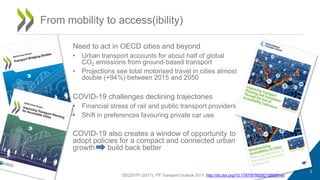
Need to act in OECD cities and beyond
• Urban transport accounts for about half of global
CO2 emissions from ground-based transport
• Projections see total motorised travel in cities almost
double (+94%) between 2015 and 2050
COVID-19 challenges declining trajectories
• Financial stress of rail and public transport providers
• Shift in preferences favouring private car use
COVID-19 also creates a window of opportunity to
adopt policies for a compact and connected urban
growth => build back better
2
From mobility to access(ibility)
OECD/ITF (2017), ITF Transport Outlook 2017, http://dx.doi.org/10.1787/9789282108000-en
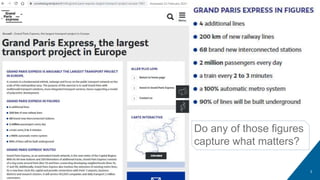
Do any of those figures
capture what matters?
3
Accessed 23 February 2021
4
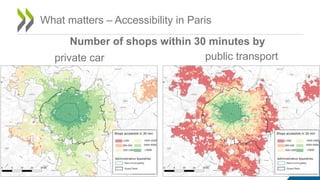
What matters – Accessibility in Paris
Number of shops within 30 minutes by
private car public transport
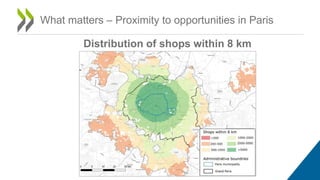
What matters – Proximity to opportunities in Paris
Distribution of shops within 8 km
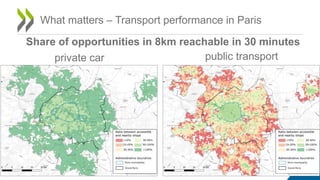
What matters – Transport performance in Paris
Share of opportunities in 8km reachable in 30 minutes
private car public transport
WHO BENEFITS FROM ACCESS IN
CITIES?
7
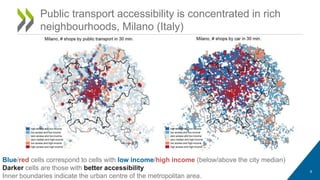
Public transport accessibility is concentrated in rich
neighbourhoods, Milano (Italy)
8
Blue/red cells correspond to cells with low income/high income (below/above the city median)
Darker cells are those with better accessibility
Inner boundaries indicate the urban centre of the metropolitan area.
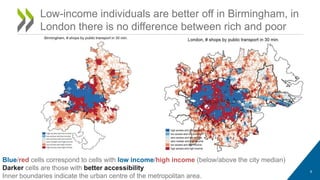
Low-income individuals are better off in Birmingham, in
London there is no difference between rich and poor
Blue/red cells correspond to cells with low income/high income (below/above the city median)
Darker cells are those with better accessibility
Inner boundaries indicate the urban centre of the metropolitan area.
9
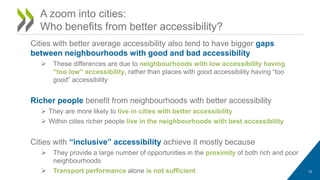
A zoom into cities:
Who benefits from better accessibility?
Cities with better average accessibility also tend to have bigger gaps
between neighbourhoods with good and bad accessibility
 These differences are due to neighbourhoods with low accessibility having
“too low” accessibility, rather than places with good accessibility having “too
good” accessibility
Richer people benefit from neighbourhoods with better accessibility
 They are more likely to live in cities with better accessibility
 Within cities richer people live in the neighbourhoods with best accessibility
Cities with “inclusive” accessibility achieve it mostly because
 They provide a large number of opportunities in the proximity of both rich and poor
neighbourhoods
 Transport performance alone is not sufficient 10
PLANNING BETTER CITIES
11
12
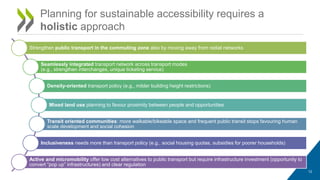
Planning for sustainable accessibility requires a
holistic approach
Strengthen public transport in the commuting zone also by moving away from radial networks
Seamlessly integrated transport network across transport modes
(e.g., strengthen interchanges, unique ticketing service)
Density-oriented transport policy (e.g., milder building height restrictions)
Mixed land use planning to favour proximity between people and opportunities
Transit oriented communities: more walkable/bikeable space and frequent public transit stops favouring human
scale development and social cohesion
Inclusiveness needs more than transport policy (e.g., social housing quotas, subsidies for poorer households)
Active and micromobility offer low cost alternatives to public transport but require infrastructure investment (opportunity to
convert “pop up” infrastructures) and clear regulation
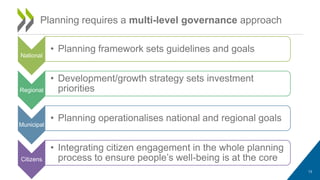
Planning requires a multi-level governance approach
13
National
• Planning framework sets guidelines and goals
Regional
• Development/growth strategy sets investment
priorities
Municipal
• Planning operationalises national and regional goals
Citizens
• Integrating citizen engagement in the whole planning
process to ensure people’s well-being is at the core
http://www.oecd.org/cfe
alexander.lembcke@oecd.org
14
Thank you
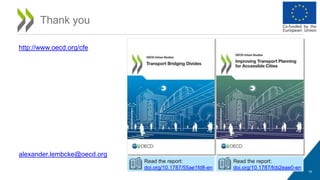
Read the report:
doi.org/10.1787/55ae1fd8-en
Read the report:
doi.org/10.1787/fcb2eae0-en

Erreichbarkeit in Städten

  • 1.
    ERREICHBARKEIT IN STÄDTEN– EIN STADTGESPRÄCH ÜBER NACHHALTIGE MOBILITÄT ACCESSIBILITY IN CITIES – AN URBAN DIALOGUE ON SUSTAINABLE MOBILITY Alexander C. Lembcke 25 Feb 2021 Centre for Entrepreneurship, SMEs, Regions and Cities
  • 2.
    Need to actin OECD cities and beyond • Urban transport accounts for about half of global CO2 emissions from ground-based transport • Projections see total motorised travel in cities almost double (+94%) between 2015 and 2050 COVID-19 challenges declining trajectories • Financial stress of rail and public transport providers • Shift in preferences favouring private car use COVID-19 also creates a window of opportunity to adopt policies for a compact and connected urban growth => build back better 2 From mobility to access(ibility) OECD/ITF (2017), ITF Transport Outlook 2017, http://dx.doi.org/10.1787/9789282108000-en
  • 3.
    Do any ofthose figures capture what matters? 3 Accessed 23 February 2021
  • 4.
    4 What matters –Accessibility in Paris Number of shops within 30 minutes by private car public transport
  • 5.
    What matters –Proximity to opportunities in Paris Distribution of shops within 8 km
  • 6.
    What matters –Transport performance in Paris Share of opportunities in 8km reachable in 30 minutes private car public transport
  • 7.
    WHO BENEFITS FROMACCESS IN CITIES? 7
  • 8.
    Public transport accessibilityis concentrated in rich neighbourhoods, Milano (Italy) 8 Blue/red cells correspond to cells with low income/high income (below/above the city median) Darker cells are those with better accessibility Inner boundaries indicate the urban centre of the metropolitan area.
  • 9.
    Low-income individuals arebetter off in Birmingham, in London there is no difference between rich and poor Blue/red cells correspond to cells with low income/high income (below/above the city median) Darker cells are those with better accessibility Inner boundaries indicate the urban centre of the metropolitan area. 9
  • 10.
    A zoom intocities: Who benefits from better accessibility? Cities with better average accessibility also tend to have bigger gaps between neighbourhoods with good and bad accessibility  These differences are due to neighbourhoods with low accessibility having “too low” accessibility, rather than places with good accessibility having “too good” accessibility Richer people benefit from neighbourhoods with better accessibility  They are more likely to live in cities with better accessibility  Within cities richer people live in the neighbourhoods with best accessibility Cities with “inclusive” accessibility achieve it mostly because  They provide a large number of opportunities in the proximity of both rich and poor neighbourhoods  Transport performance alone is not sufficient 10
  • 11.
  • 12.
    12 Planning for sustainableaccessibility requires a holistic approach Strengthen public transport in the commuting zone also by moving away from radial networks Seamlessly integrated transport network across transport modes (e.g., strengthen interchanges, unique ticketing service) Density-oriented transport policy (e.g., milder building height restrictions) Mixed land use planning to favour proximity between people and opportunities Transit oriented communities: more walkable/bikeable space and frequent public transit stops favouring human scale development and social cohesion Inclusiveness needs more than transport policy (e.g., social housing quotas, subsidies for poorer households) Active and micromobility offer low cost alternatives to public transport but require infrastructure investment (opportunity to convert “pop up” infrastructures) and clear regulation
  • 13.
    Planning requires amulti-level governance approach 13 National • Planning framework sets guidelines and goals Regional • Development/growth strategy sets investment priorities Municipal • Planning operationalises national and regional goals Citizens • Integrating citizen engagement in the whole planning process to ensure people’s well-being is at the core
  • 14.
    http://www.oecd.org/cfe alexander.lembcke@oecd.org 14 Thank you Read thereport: doi.org/10.1787/55ae1fd8-en Read the report: doi.org/10.1787/fcb2eae0-en

Editor's Notes

  • #6 Moving average of density That’s why its smoother than what you’d expect fr
  • #7 Private car performs very good in the areas surrounding
  • #14 Vancouver’s 2009 update of the Official Community Plan involved 3 major rounds of community consultation with over 30 public open houses, city-wide surveys and online discussion forums