Mechanical Engineering
D e p a r t m e n t
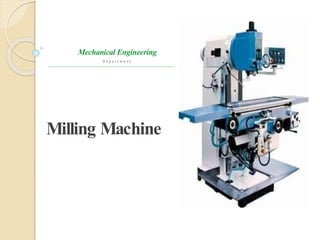
Milling Machine
Table of Contents
 Milling Introduction
 Types of Milling Machine
 Cutting Tools
 Milling Processes
 Typical Milling Operations
INTRODUCTION
Milling is one of most important machining operations
which employ a multipoint cutting tool is called milling
cutter.
Working Principle:
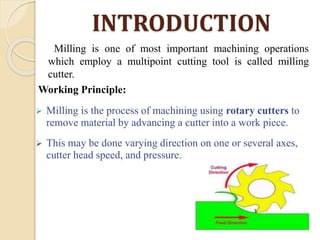
 Milling is the process of machining using rotary cutters to
remove material by advancing a cutter into a work piece.
 This may be done varying direction on one or several axes,
cutter head speed, and pressure.
Types of milling Machines
 Column and Knee type
a) Hand milling Machine
b) Plain (horizontal) Milling Machine
c) Universal Milling Machine
d) Omniversal Milling Machine
e) Vertical Milling Machine
 Fixed bed type Milling Machine
 Planer type Milling Machine
 Special purpose machines
a) Rotary table milling machine
b) Planetary milling machine
c) Cam milling machine
d) Profile milling machine
Size of Milling Machine
 The sizes of working surface of the table
 The maximum length of longitudinal, cross and vertical
travel of the table.
 The power of driving motor
 Number of feeds
 Floor space required
HORIZONTAL MILLING MACHINE
 In milling operation the metal is removed from the
work piece by rotating milling cutter
 In horizontal milling machine the axis of milling
cutter is parallel to the surface of work piece.
 The work piece mounted on a table can be removed
in three directions at right angles to each other.
a) longitudinal direction to provide length of cut
b) Vertical direction to provide depth of cut
c) Transverse direction to provide width of cut
 In normal operation the machine is operated in
only one direction at a time.
Construction details:
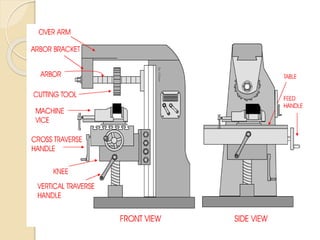
The main parts of horizontal milling machine are:
 Base
 Column
 Saddle
 Knee
 The work table
 The over arm
 Arbor support
 Spindle
 Base: The base is a grey cast iron which supports the
column at its one end.
 Column: It is a large mounted vertically on the base. On
the front of the column guide ways are provided to support
the knee. A dovetail slide is also provided on the top to the
hold an over arm.
 Saddle: The saddle is moved horizontally towards or away
from the face of the column by turning the cross feed.
 Worktable: The work table provides the longitudinal
movement to the work by hand. The table is provided with
T-slots for direct mounting of the work pieces.
 Over arm: The over arm is located in the sideway at the
top of the column.
 Arbor support: the arbor support is positioned on the
under side of the over arm. It provides support for the
arbor.
 Spindle: The machine spindle is located in the upper
part of the column and receives power from the motor
through belts, gears and clutches.
 Arbor: it is fixed in the taper of the spindle nose. It
locates the cutters in position, and is driven by the
spindle.
HAND MILLING MACHINE
 In Hand milling machine the cutter is mounted on a
horizontal arbor and is rotated by power. The work
mounted on table is fed manually against the cutter.
 It is used for simple milling operations such as cutting
grooves, short key-ways and slotting.
PLAIN MILLING MACHINE
 The plain milling machine with horizontal spindle is
called horizontal milling machine. The work fitted on
the table may be fed in three directions, longitudinal,
transverse, and vertical. The table movements are
provided by hand or power.
UNIVERSAL MILLING MACHINE
 It is similar to a plain milling machine and differs in
respect of the table movements. It is capable of
handling a very wide range of jobs.
VERTICAL MILLING MACHINES
In vertical knee type milling machines, the position of the
cutter spindle is vertical. Though it has the same table
movements as in plain milling cutter, the spindle head
swivel . The tool head is attached to the end of the ram

MILLING machines.pptx

  • 1.
    Mechanical Engineering D ep a r t m e n t Milling Machine
  • 2.
    Table of Contents Milling Introduction  Types of Milling Machine  Cutting Tools  Milling Processes  Typical Milling Operations
  • 3.
    INTRODUCTION Milling is oneof most important machining operations which employ a multipoint cutting tool is called milling cutter. Working Principle:  Milling is the process of machining using rotary cutters to remove material by advancing a cutter into a work piece.  This may be done varying direction on one or several axes, cutter head speed, and pressure.
  • 4.
    Types of millingMachines  Column and Knee type a) Hand milling Machine b) Plain (horizontal) Milling Machine c) Universal Milling Machine d) Omniversal Milling Machine e) Vertical Milling Machine  Fixed bed type Milling Machine  Planer type Milling Machine  Special purpose machines a) Rotary table milling machine b) Planetary milling machine c) Cam milling machine d) Profile milling machine
  • 5.
    Size of MillingMachine  The sizes of working surface of the table  The maximum length of longitudinal, cross and vertical travel of the table.  The power of driving motor  Number of feeds  Floor space required
  • 6.
    HORIZONTAL MILLING MACHINE In milling operation the metal is removed from the work piece by rotating milling cutter  In horizontal milling machine the axis of milling cutter is parallel to the surface of work piece.  The work piece mounted on a table can be removed in three directions at right angles to each other. a) longitudinal direction to provide length of cut b) Vertical direction to provide depth of cut c) Transverse direction to provide width of cut  In normal operation the machine is operated in only one direction at a time.
  • 7.
    Construction details: The mainparts of horizontal milling machine are:  Base  Column  Saddle  Knee  The work table  The over arm  Arbor support  Spindle
  • 9.
     Base: Thebase is a grey cast iron which supports the column at its one end.  Column: It is a large mounted vertically on the base. On the front of the column guide ways are provided to support the knee. A dovetail slide is also provided on the top to the hold an over arm.  Saddle: The saddle is moved horizontally towards or away from the face of the column by turning the cross feed.  Worktable: The work table provides the longitudinal movement to the work by hand. The table is provided with T-slots for direct mounting of the work pieces.  Over arm: The over arm is located in the sideway at the top of the column.  Arbor support: the arbor support is positioned on the under side of the over arm. It provides support for the arbor.
  • 10.
     Spindle: Themachine spindle is located in the upper part of the column and receives power from the motor through belts, gears and clutches.  Arbor: it is fixed in the taper of the spindle nose. It locates the cutters in position, and is driven by the spindle. HAND MILLING MACHINE  In Hand milling machine the cutter is mounted on a horizontal arbor and is rotated by power. The work mounted on table is fed manually against the cutter.  It is used for simple milling operations such as cutting grooves, short key-ways and slotting.
  • 11.
    PLAIN MILLING MACHINE The plain milling machine with horizontal spindle is called horizontal milling machine. The work fitted on the table may be fed in three directions, longitudinal, transverse, and vertical. The table movements are provided by hand or power. UNIVERSAL MILLING MACHINE  It is similar to a plain milling machine and differs in respect of the table movements. It is capable of handling a very wide range of jobs.
  • 12.
    VERTICAL MILLING MACHINES Invertical knee type milling machines, the position of the cutter spindle is vertical. Though it has the same table movements as in plain milling cutter, the spindle head swivel . The tool head is attached to the end of the ram