Chapter 2


            Size Reduction
Importance of Size Reduction


            In industries that process raw material in the solid state or use
            solid material in the processing of fluids, reduction in the size of
Chapter 2


            solid particles is frequently required. In the production of
            gypsum plaster, the raw gypsum rock is removed from the
            quarry in large blocks, sometimes five feet in diameter. It must
            be reduced to particles fine enough to pass through 100 mesh
            screen in order to provide sufficient specific surface for
            hydration to take place rapidly. This means a reduction in size
            from 60 inch to 0.005 inch. Pigments in paints must be very
            fine in order to give good coverage when applied to surface.
            Sodium chloride used in cooking is also an example of size
            reduction.
How reduction is done

            Reduction in size involves the production of small mass units
            from larger mass units of the same material. It is an operation
            which causes fracture to the larger units. This fracturing or
            shattering of larger units is accomplished by the application of
Chapter 2


            pressure. All true solid materials are crystalline in nature i.e. the
            atoms in the individual crystals are arranged in definite repeating
            geometrical pattern, and there are certain planes in the crystal
            along which shear takes place more rapidly. The pressure applied
            must be sufficient to cause fracture by shear along these
            cleavage planes. If the shear along these planes results in
            deformation but not rupture, the deformation is called as “Plastic
            Deformation”

            It appears that the best method of causing rupture to take place
            in solid material would be the application of shearing loads.
            However, the orientation of crystals in solid matter is usually so
            irregular that the direct application of compressive loads is just
            as effective as shearing loads. All equipment for size reduction of
            solids uses compression or shearing or both as disrupting forces.
Objectives of size reduction


            The purpose of size reduction is not only to make “little ones out of
            big ones” when the effectiveness can be measured by the degree of
Chapter 2

            fineness of the product, but also to produce a product to the desired
            size or size range. The size required for various products may vary
            widely, and hence different machines and procedures are involved. A
            size range entirely satisfactory for one purpose may be highly
            undesirable for another, even when the same substance is involved.

            Example:
            Powdered coal is widely used for firing industrial furnaces, and lump
            coal is also fed into furnaces by mechanical strokes. But powdered
            coal could not be used in the stoker and lump coal could not be used
            in the equipment designed for firing pulverized or powdered coal.

            This unit operation has a number of advantages and purposes. Some
            of the objectives are as follows:
1. Increasing rate of chemical reaction
            We know that the rate of the chemical reaction is directly
            proportional to the area of contact of the reacting species i.e.
            greater the surface area of the particles, greater would be the
            products. Size reduction is thus very helpful in reducing the
            larger lumps to very fine size in order to bring the greater area,
Chapter 2

            thus increasing the rate of chemical reaction.

            2. In mixing
            More intimate mixing of solids can be achieved if the particle
            size is small, also in solid- liquid mixing more precise work of
            mixing is possible.

            3. In coating pigments
            Color and covering of a pigment is considerably affected by the
            size of the particles.

            4. To make material handling easy
            It is very difficult to transport the very heavy particles, thus for
            easy conveying from point to point, size reduction is necessary.
5. To dissolve solid in solvents
            It is a common practice that is to dissolve a lump of sodium
            chloride in water is not so rapid in this case, we break the lump
            with spoon and make it smaller and smaller to dissolve it in
            water, thus lesser the size of solid particles, greater will be the
            dissolution.
Chapter 2

            6. To dry the material
            To get more rate of drying, a solid material is reduced in the size
            because we know greater the surface area, greater will be the
            evaporation, because evaporation is a surface process, thus by
            reducing, that is by making more surface area we get more rate
            of drying.

            7. To separate valuable minerals from the ore
            It is almost impossible to get a valuable material say gold from
            its ore without the use of reduction of the material. How it is
            possible to get gold from the interior or under the surface
            without breakages of the valuable metal and get the solid metal,
            however if it is possible, but in most cases after reducing the
            size, by the chemical etc, we achieve the valuable. In an iron
            sand mixture, we may use iron separator.
Operating variables in Size Reduction

            The operating variables in size reduction are as follows:

            Moisture contents:
            The moisture content of solids to be reduced in size is
Chapter 2

            important. When it is below 3% or 4% by weight no particular
            difficulties are encountered. When moisture content exceeds
            about 4%, most material become sticky or pasty with the
            tendency to clog the machine. This is particularly true in the
            coarse and intermediate stages of grinding. A large excess of
            water (50% or more) facilitates the operation by washing the
            feed into and product out of the zone of action by furnishing a
            mean for transporting the solids about the plant as a
            suspension or slurry. Wet grinding is mostly confined to the
            fine stage of reduction.

            Reduction ratio:
            It is the ratio of the average diameter of the feed to the
            average diameter of the product. Most machines in the
            coarser ranges of crushing have a reduction ratio from 3 to 7.
            Fine grinders may have a reduction ratio as high as 100.
Free crushing:
            In free crushing, the crushed product with whatever fines
            have been formed is quickly removed after a relatively
            shorter time interval in the crushing zone. The product may
            flow out by gravity, be thrown out by centrifugal force. This
            method of operation prevents the formation of an excessive
Chapter 2

            amount of fines by limiting the number of contacts.

             Choke feeding:
            In choke feeding (the opposite of free crushing), the crusher
            is equipped with a feeder hopper and kept filled (or choked)
            so that it does not freely discharge the crushed product. This
            increases greatly the proportion of fines produced and
            decreases the capacity. In some instances, choke feeding
            may result in economy of operation eliminating one or more
            reducing stages because of the large quantity of fines
            produced. This method is used only when a comparatively
            small amount of material is to be crushed and when it is
            desired to complete the whole of the size reduction in one
            operation.
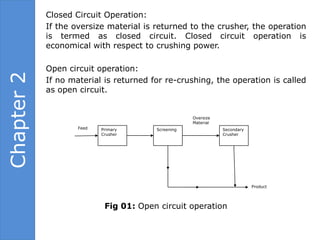
Closed Circuit Operation:
            If the oversize material is returned to the crusher, the operation
            is termed as closed circuit. Closed circuit operation is
            economical with respect to crushing power.

            Open circuit operation:
Chapter 2

            If no material is returned for re-crushing, the operation is called
            as open circuit.


                                                    Oversize
                                                    Material
                    Feed   Primary      Screening              Secondary
                           Crusher                             Crusher


                                                                           Product


                            Fig 01: Open circuit operation

27 3 size reduction

  • 1.
    Chapter 2 Size Reduction
  • 2.
    Importance of SizeReduction In industries that process raw material in the solid state or use solid material in the processing of fluids, reduction in the size of Chapter 2 solid particles is frequently required. In the production of gypsum plaster, the raw gypsum rock is removed from the quarry in large blocks, sometimes five feet in diameter. It must be reduced to particles fine enough to pass through 100 mesh screen in order to provide sufficient specific surface for hydration to take place rapidly. This means a reduction in size from 60 inch to 0.005 inch. Pigments in paints must be very fine in order to give good coverage when applied to surface. Sodium chloride used in cooking is also an example of size reduction.
  • 3.
    How reduction isdone Reduction in size involves the production of small mass units from larger mass units of the same material. It is an operation which causes fracture to the larger units. This fracturing or shattering of larger units is accomplished by the application of Chapter 2 pressure. All true solid materials are crystalline in nature i.e. the atoms in the individual crystals are arranged in definite repeating geometrical pattern, and there are certain planes in the crystal along which shear takes place more rapidly. The pressure applied must be sufficient to cause fracture by shear along these cleavage planes. If the shear along these planes results in deformation but not rupture, the deformation is called as “Plastic Deformation” It appears that the best method of causing rupture to take place in solid material would be the application of shearing loads. However, the orientation of crystals in solid matter is usually so irregular that the direct application of compressive loads is just as effective as shearing loads. All equipment for size reduction of solids uses compression or shearing or both as disrupting forces.
  • 4.
    Objectives of sizereduction The purpose of size reduction is not only to make “little ones out of big ones” when the effectiveness can be measured by the degree of Chapter 2 fineness of the product, but also to produce a product to the desired size or size range. The size required for various products may vary widely, and hence different machines and procedures are involved. A size range entirely satisfactory for one purpose may be highly undesirable for another, even when the same substance is involved. Example: Powdered coal is widely used for firing industrial furnaces, and lump coal is also fed into furnaces by mechanical strokes. But powdered coal could not be used in the stoker and lump coal could not be used in the equipment designed for firing pulverized or powdered coal. This unit operation has a number of advantages and purposes. Some of the objectives are as follows:
  • 5.
    1. Increasing rateof chemical reaction We know that the rate of the chemical reaction is directly proportional to the area of contact of the reacting species i.e. greater the surface area of the particles, greater would be the products. Size reduction is thus very helpful in reducing the larger lumps to very fine size in order to bring the greater area, Chapter 2 thus increasing the rate of chemical reaction. 2. In mixing More intimate mixing of solids can be achieved if the particle size is small, also in solid- liquid mixing more precise work of mixing is possible. 3. In coating pigments Color and covering of a pigment is considerably affected by the size of the particles. 4. To make material handling easy It is very difficult to transport the very heavy particles, thus for easy conveying from point to point, size reduction is necessary.
  • 6.
    5. To dissolvesolid in solvents It is a common practice that is to dissolve a lump of sodium chloride in water is not so rapid in this case, we break the lump with spoon and make it smaller and smaller to dissolve it in water, thus lesser the size of solid particles, greater will be the dissolution. Chapter 2 6. To dry the material To get more rate of drying, a solid material is reduced in the size because we know greater the surface area, greater will be the evaporation, because evaporation is a surface process, thus by reducing, that is by making more surface area we get more rate of drying. 7. To separate valuable minerals from the ore It is almost impossible to get a valuable material say gold from its ore without the use of reduction of the material. How it is possible to get gold from the interior or under the surface without breakages of the valuable metal and get the solid metal, however if it is possible, but in most cases after reducing the size, by the chemical etc, we achieve the valuable. In an iron sand mixture, we may use iron separator.
  • 7.
    Operating variables inSize Reduction The operating variables in size reduction are as follows: Moisture contents: The moisture content of solids to be reduced in size is Chapter 2 important. When it is below 3% or 4% by weight no particular difficulties are encountered. When moisture content exceeds about 4%, most material become sticky or pasty with the tendency to clog the machine. This is particularly true in the coarse and intermediate stages of grinding. A large excess of water (50% or more) facilitates the operation by washing the feed into and product out of the zone of action by furnishing a mean for transporting the solids about the plant as a suspension or slurry. Wet grinding is mostly confined to the fine stage of reduction. Reduction ratio: It is the ratio of the average diameter of the feed to the average diameter of the product. Most machines in the coarser ranges of crushing have a reduction ratio from 3 to 7. Fine grinders may have a reduction ratio as high as 100.
  • 8.
    Free crushing: In free crushing, the crushed product with whatever fines have been formed is quickly removed after a relatively shorter time interval in the crushing zone. The product may flow out by gravity, be thrown out by centrifugal force. This method of operation prevents the formation of an excessive Chapter 2 amount of fines by limiting the number of contacts. Choke feeding: In choke feeding (the opposite of free crushing), the crusher is equipped with a feeder hopper and kept filled (or choked) so that it does not freely discharge the crushed product. This increases greatly the proportion of fines produced and decreases the capacity. In some instances, choke feeding may result in economy of operation eliminating one or more reducing stages because of the large quantity of fines produced. This method is used only when a comparatively small amount of material is to be crushed and when it is desired to complete the whole of the size reduction in one operation.
  • 9.
    Closed Circuit Operation: If the oversize material is returned to the crusher, the operation is termed as closed circuit. Closed circuit operation is economical with respect to crushing power. Open circuit operation: Chapter 2 If no material is returned for re-crushing, the operation is called as open circuit. Oversize Material Feed Primary Screening Secondary Crusher Crusher Product Fig 01: Open circuit operation