Size Reduction
Course : Pharmaceutical Engineering (Theory)
Session : 2024-25
Course Code : BP304T
Semester : B. Pharm III semester
Presented by : Ms. Megha Tonk
Assistant Professor
CONTENTS
• Size reduction
• Objectives of size reduction
• Mechanism of size reduction
• Laws governing of size reduction
• Hammer mill
• Ball mill
• Edge runner mill
• End runner mill
• Fluid energy mill
Size reduction
* It is the process of reducing drugs size in smaller particles, or fine powder. The term size reduction is applied to ways in which
particles of solids are cut or broken into smaller pieces. Size reduction is necessary if the starting material is too coarse, and final
product needs to be a fine powder.
*Size reduction process is also referred to as Comminution and Grinding. When the particle size of solids is reduced by mechanical
means it is known as Milling. The size reduction operation can be divided into two major categories depending on whether the
material is a solid or a liquid. If the material is solid, the process is called grinding and cutting, if it is liquid, emulsification or
atomization.
Objectives of size reduction
● Size reduction leads to increase of surface area.
● Pharmaceutical capsules, insufflations (i.e. powders inhaled directly into the
lungs), suppositories and ointments require particles size to be below 60 mm size.
● To increase the therapeutic effectiveness of certain drugs by reducing the particle
size.
● Size reduction produces particles in narrow size range. Mixing of powders with
narrow size range is easier and uniform .
● Pharmaceutical suspensions require finer particle size. It reduces rate of
sedimentation.
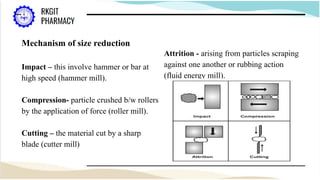
Mechanism of size reduction
Impact – this involve hammer or bar at
high speed (hammer mill).
Compression- particle crushed b/w rollers
by the application of force (roller mill).
Cutting – the material cut by a sharp
blade (cutter mill)
Attrition - arising from particles scraping
against one another or rubbing action
(fluid energy mill).
Laws governing size reduction
● Griffith theory -The amount of force to be applied depends on the crack length.
● Kick's law- Work required to reduce the size of a given quantity of material is
constant for the same reduction ratio regardless of the original size.
● Rittinger's law -Worked use for particulate size reduction is directly proportional to
the new surface produced.
● Bond's law -Worked used to reduce particle size is proportional to the square root of
the diameter of the particle produced.
Factors affecting Size Reduction
● Factors related to nature of raw materials affecting size reduction
● Hardness - It is easier to break soft material than hard materials. Ex: For iodine hammer mill
is used.
● Fibrous - These are tough in nature. A soft, tough material has more difficulty than a hard,
brittle substance. Ex: Raowulfia, Ginger. Here cutters can be used.
● Elastic / Sticky - Become soft during milling. Ex: synthetic gums, waxes, resins. Low melting
substances should be chilled before milling. These are milled using hammer, colloid or fluid
energy mill.
● Melting point - Waxy substances, fats and oils are softened during size reduction due to heat
generated. This is avoided by cooling the mill and the substance.
● Hygroscopic - Certain substances absorb moisture content rapidly. This wet mass hampers the
milling process. Ex: Potassium carbonate. Closed system such as porcelain ball mill is used.
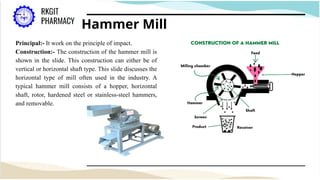
Hammer Mill
Principal:- It work on the principle of impact.
Construction:- The construction of the hammer mill is
shown in the slide. This construction can either be of
vertical or horizontal shaft type. This slide discusses the
horizontal type of mill often used in the industry. A
typical hammer mill consists of a hopper, horizontal
shaft, rotor, hardened steel or stainless-steel hammers,
and removable.
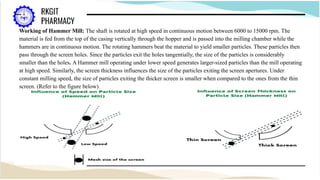
Working of Hammer Mill: The shaft is rotated at high speed in continuous motion between 6000 to 15000 rpm. The
material is fed from the top of the casing vertically through the hopper and is passed into the milling chamber while the
hammers are in continuous motion. The rotating hammers beat the material to yield smaller particles. These particles then
pass through the screen holes. Since the particles exit the holes tangentially, the size of the particles is considerably
smaller than the holes. A Hammer mill operating under lower speed generates larger-sized particles than the mill operating
at high speed. Similarly, the screen thickness influences the size of the particles exiting the screen apertures. Under
constant milling speed, the size of particles exiting the thicker screen is smaller when compared to the ones from the thin
screen. (Refer to the figure below).
Uses: (i) Brittle material is best fractured by impact from blunt hammers.
(ii) Fibrous material is best reduced by cutting edges
Advantages
It is rapid in action, and is capable of grinding many different types of materials.
They are easy to install and operate, the operation is continuous.
There is little contamination of the product with metal abraded from the mill as surface move against
each other.
The particle size of the material to be reduced can be easily controlled by changing the speed of the rotor,
hammer type, shape and size of the screen.
Disadvantages
Heat build up during milling is more, therefore, product degradation is possible.
Hammer mills cannot be employed to mill sticky, fibrous and hard materials.
The screens may get clogged.
Ball Mill
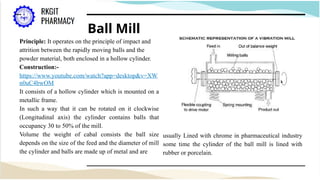
Principle: It operates on the principle of impact and
attrition between the rapidly moving balls and the
powder material, both enclosed in a hollow cylinder.
Construction:-
https://www.youtube.com/watch?app=desktop&v=XW
n0uC4bwOM
It consists of a hollow cylinder which is mounted on a
metallic frame.
In such a way that it can be rotated on it clockwise
(Longitudinal axis) the cylinder contains balls that
occupancy 30 to 50% of the mill.
Volume the weight of cabal consists the ball size
depends on the size of the feed and the diameter of mill
the cylinder and balls are made up of metal and are
usually Lined with chrome in pharmaceutical industry
some time the cylinder of the ball mill is lined with
rubber or porcelain.
Working:-
The drug to be round to put into the cylinder of the mill and is rotates the speed of rotation is very important at a low the mass
of ball will slide or rollover each other and only a negligible amount of size reduction at a high speed the ball mill will be
thrown out to the walls by centrifugal force and grinding but at about to 2/3rd of the speed the centrifugal force just occur with
the results that the balls are carried or most to be the top of the mill and then fallen by this way the mix size reduction is effect
by attrition after a suitable time the material is taken out and pass through a sieve to get powder of the required size.
Advantages:-
It can product very fine powder.
It can be used for continues operation.
If sieve are classified classifier to attach to the balls.
The suitable for both weight and drug grinding process.
Disadvantage:-
The ball mill is a very noise.
Wear occurs from the ball as well as from the casing which may result contamination.
USES: Stainless steel are preferred in the production of ophthalmic & parentral products.
ball mill at low speed is used for milling dyes , pigments & insecticides.
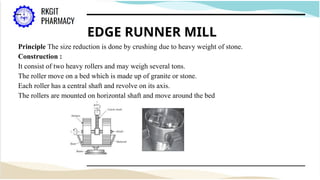
EDGE RUNNER MILL
Principle The size reduction is done by crushing due to heavy weight of stone.
Construction :
It consist of two heavy rollers and may weigh several tons.
The roller move on a bed which is made up of granite or stone.
Each roller has a central shaft and revolve on its axis.
The rollers are mounted on horizontal shaft and move around the bed
Working:
The material to be ground is placed on the bed with the help of the scrapper in such a way that it
comes in the path of the stone wheel.
These stones revolve on its own axis and at the same time travel around the shallow stone bed.
The material is ground for definite period.
The powder is collected and passed through a sieve to get powder of required size.
Advantages: Does not require attention during operation.
Disadvantages: More space than other mill, Contamination, Time consuming, Not use for sticky
materials.
Uses: Grinding tough material to fine powder.
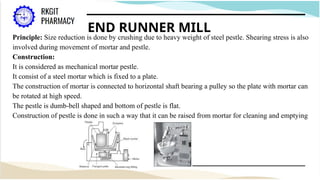
END RUNNER MILL
Principle: Size reduction is done by crushing due to heavy weight of steel pestle. Shearing stress is also
involved during movement of mortar and pestle.
Construction:
It is considered as mechanical mortar pestle.
It consist of a steel mortar which is fixed to a plate.
The construction of mortar is connected to horizontal shaft bearing a pulley so the plate with mortar can
be rotated at high speed.
The pestle is dumb-bell shaped and bottom of pestle is flat.
Construction of pestle is done in such a way that it can be raised from mortar for cleaning and emptying
Working:
The material to be ground is placed in the mortar. The mortar revolves at a high speed. The revolving mortar
causes the pestle to revolve during this process, size reduction is achieved.
Advantages:
End runner mill provides moderately fine powder and operates successfully with fibrous materials, bark,
woods fruits, leaves, etc. Wet grinding with very viscous material such as ointments and paste is also
possible.
Disadvantages:
Not suitable for unbroken or slightly broken condition of drug
Uses:
Use for fine grinding.
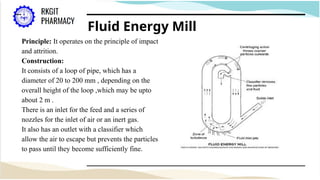
Fluid Energy Mill
Principle: It operates on the principle of impact
and attrition.
Construction:
It consists of a loop of pipe, which has a
diameter of 20 to 200 mm , depending on the
overall height of the loop ,which may be upto
about 2 m .
There is an inlet for the feed and a series of
nozzles for the inlet of air or an inert gas.
It also has an outlet with a classifier which
allow the air to escape but prevents the particles
to pass until they become sufficiently fine.
Working:
The air or inert gas is introduced with a very high pressure through the nozzles .Solids are introduced into air steam through inlet .due to high degree of turbulence,
impact and attritional forces occurs between the particles.The fine particles are collected through a classifier .Fluid energy mill reduces the particles to 1 to 20 micron.
To get a very fine powder ,even upto five micron, the material is pretreated to reduce the particle size to the order of 100 mesh and then passed through fluid energy
mill.
Advantages:
The mill is used to grind the material to fine powder.
The particle size of powder can be controlled due to the use of a classifier.
There is no wear of the mill and hence there is no contamination of the product.
It is useful for grinding heat sensitive substances such as sulphonamides, vitamins and antibiotics.
Disadvantages:
Tendency of forming aggregates or agglomerates after milling.
Generation of amorphous content due to high energy impact.
Formation of ultra-fine particles
High energy consumption.
Uses :
The mill is used to grind heat sensitive material to fine powder.
The mill is used to grind those drugs in which high degree of purity is required.
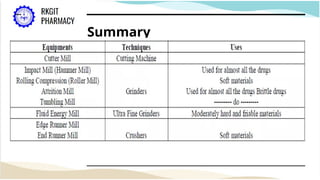
Summary

unit 1 size reduction (Pharm. Eng.).pptx

  • 1.
    Size Reduction Course :Pharmaceutical Engineering (Theory) Session : 2024-25 Course Code : BP304T Semester : B. Pharm III semester Presented by : Ms. Megha Tonk Assistant Professor
  • 2.
    CONTENTS • Size reduction •Objectives of size reduction • Mechanism of size reduction • Laws governing of size reduction • Hammer mill • Ball mill • Edge runner mill • End runner mill • Fluid energy mill
  • 3.
    Size reduction * Itis the process of reducing drugs size in smaller particles, or fine powder. The term size reduction is applied to ways in which particles of solids are cut or broken into smaller pieces. Size reduction is necessary if the starting material is too coarse, and final product needs to be a fine powder. *Size reduction process is also referred to as Comminution and Grinding. When the particle size of solids is reduced by mechanical means it is known as Milling. The size reduction operation can be divided into two major categories depending on whether the material is a solid or a liquid. If the material is solid, the process is called grinding and cutting, if it is liquid, emulsification or atomization.
  • 4.
    Objectives of sizereduction ● Size reduction leads to increase of surface area. ● Pharmaceutical capsules, insufflations (i.e. powders inhaled directly into the lungs), suppositories and ointments require particles size to be below 60 mm size. ● To increase the therapeutic effectiveness of certain drugs by reducing the particle size. ● Size reduction produces particles in narrow size range. Mixing of powders with narrow size range is easier and uniform . ● Pharmaceutical suspensions require finer particle size. It reduces rate of sedimentation.
  • 5.
    Mechanism of sizereduction Impact – this involve hammer or bar at high speed (hammer mill). Compression- particle crushed b/w rollers by the application of force (roller mill). Cutting – the material cut by a sharp blade (cutter mill) Attrition - arising from particles scraping against one another or rubbing action (fluid energy mill).
  • 6.
    Laws governing sizereduction ● Griffith theory -The amount of force to be applied depends on the crack length. ● Kick's law- Work required to reduce the size of a given quantity of material is constant for the same reduction ratio regardless of the original size. ● Rittinger's law -Worked use for particulate size reduction is directly proportional to the new surface produced. ● Bond's law -Worked used to reduce particle size is proportional to the square root of the diameter of the particle produced.
  • 7.
    Factors affecting SizeReduction ● Factors related to nature of raw materials affecting size reduction ● Hardness - It is easier to break soft material than hard materials. Ex: For iodine hammer mill is used. ● Fibrous - These are tough in nature. A soft, tough material has more difficulty than a hard, brittle substance. Ex: Raowulfia, Ginger. Here cutters can be used. ● Elastic / Sticky - Become soft during milling. Ex: synthetic gums, waxes, resins. Low melting substances should be chilled before milling. These are milled using hammer, colloid or fluid energy mill. ● Melting point - Waxy substances, fats and oils are softened during size reduction due to heat generated. This is avoided by cooling the mill and the substance. ● Hygroscopic - Certain substances absorb moisture content rapidly. This wet mass hampers the milling process. Ex: Potassium carbonate. Closed system such as porcelain ball mill is used.
  • 8.
    Hammer Mill Principal:- Itwork on the principle of impact. Construction:- The construction of the hammer mill is shown in the slide. This construction can either be of vertical or horizontal shaft type. This slide discusses the horizontal type of mill often used in the industry. A typical hammer mill consists of a hopper, horizontal shaft, rotor, hardened steel or stainless-steel hammers, and removable.
  • 9.
    Working of HammerMill: The shaft is rotated at high speed in continuous motion between 6000 to 15000 rpm. The material is fed from the top of the casing vertically through the hopper and is passed into the milling chamber while the hammers are in continuous motion. The rotating hammers beat the material to yield smaller particles. These particles then pass through the screen holes. Since the particles exit the holes tangentially, the size of the particles is considerably smaller than the holes. A Hammer mill operating under lower speed generates larger-sized particles than the mill operating at high speed. Similarly, the screen thickness influences the size of the particles exiting the screen apertures. Under constant milling speed, the size of particles exiting the thicker screen is smaller when compared to the ones from the thin screen. (Refer to the figure below).
  • 10.
    Uses: (i) Brittlematerial is best fractured by impact from blunt hammers. (ii) Fibrous material is best reduced by cutting edges Advantages It is rapid in action, and is capable of grinding many different types of materials. They are easy to install and operate, the operation is continuous. There is little contamination of the product with metal abraded from the mill as surface move against each other. The particle size of the material to be reduced can be easily controlled by changing the speed of the rotor, hammer type, shape and size of the screen. Disadvantages Heat build up during milling is more, therefore, product degradation is possible. Hammer mills cannot be employed to mill sticky, fibrous and hard materials. The screens may get clogged.
  • 11.
    Ball Mill Principle: Itoperates on the principle of impact and attrition between the rapidly moving balls and the powder material, both enclosed in a hollow cylinder. Construction:- https://www.youtube.com/watch?app=desktop&v=XW n0uC4bwOM It consists of a hollow cylinder which is mounted on a metallic frame. In such a way that it can be rotated on it clockwise (Longitudinal axis) the cylinder contains balls that occupancy 30 to 50% of the mill. Volume the weight of cabal consists the ball size depends on the size of the feed and the diameter of mill the cylinder and balls are made up of metal and are usually Lined with chrome in pharmaceutical industry some time the cylinder of the ball mill is lined with rubber or porcelain.
  • 12.
    Working:- The drug tobe round to put into the cylinder of the mill and is rotates the speed of rotation is very important at a low the mass of ball will slide or rollover each other and only a negligible amount of size reduction at a high speed the ball mill will be thrown out to the walls by centrifugal force and grinding but at about to 2/3rd of the speed the centrifugal force just occur with the results that the balls are carried or most to be the top of the mill and then fallen by this way the mix size reduction is effect by attrition after a suitable time the material is taken out and pass through a sieve to get powder of the required size. Advantages:- It can product very fine powder. It can be used for continues operation. If sieve are classified classifier to attach to the balls. The suitable for both weight and drug grinding process. Disadvantage:- The ball mill is a very noise. Wear occurs from the ball as well as from the casing which may result contamination. USES: Stainless steel are preferred in the production of ophthalmic & parentral products. ball mill at low speed is used for milling dyes , pigments & insecticides.
  • 13.
    EDGE RUNNER MILL PrincipleThe size reduction is done by crushing due to heavy weight of stone. Construction : It consist of two heavy rollers and may weigh several tons. The roller move on a bed which is made up of granite or stone. Each roller has a central shaft and revolve on its axis. The rollers are mounted on horizontal shaft and move around the bed
  • 14.
    Working: The material tobe ground is placed on the bed with the help of the scrapper in such a way that it comes in the path of the stone wheel. These stones revolve on its own axis and at the same time travel around the shallow stone bed. The material is ground for definite period. The powder is collected and passed through a sieve to get powder of required size. Advantages: Does not require attention during operation. Disadvantages: More space than other mill, Contamination, Time consuming, Not use for sticky materials. Uses: Grinding tough material to fine powder.
  • 15.
    END RUNNER MILL Principle:Size reduction is done by crushing due to heavy weight of steel pestle. Shearing stress is also involved during movement of mortar and pestle. Construction: It is considered as mechanical mortar pestle. It consist of a steel mortar which is fixed to a plate. The construction of mortar is connected to horizontal shaft bearing a pulley so the plate with mortar can be rotated at high speed. The pestle is dumb-bell shaped and bottom of pestle is flat. Construction of pestle is done in such a way that it can be raised from mortar for cleaning and emptying
  • 16.
    Working: The material tobe ground is placed in the mortar. The mortar revolves at a high speed. The revolving mortar causes the pestle to revolve during this process, size reduction is achieved. Advantages: End runner mill provides moderately fine powder and operates successfully with fibrous materials, bark, woods fruits, leaves, etc. Wet grinding with very viscous material such as ointments and paste is also possible. Disadvantages: Not suitable for unbroken or slightly broken condition of drug Uses: Use for fine grinding.
  • 17.
    Fluid Energy Mill Principle:It operates on the principle of impact and attrition. Construction: It consists of a loop of pipe, which has a diameter of 20 to 200 mm , depending on the overall height of the loop ,which may be upto about 2 m . There is an inlet for the feed and a series of nozzles for the inlet of air or an inert gas. It also has an outlet with a classifier which allow the air to escape but prevents the particles to pass until they become sufficiently fine.
  • 18.
    Working: The air orinert gas is introduced with a very high pressure through the nozzles .Solids are introduced into air steam through inlet .due to high degree of turbulence, impact and attritional forces occurs between the particles.The fine particles are collected through a classifier .Fluid energy mill reduces the particles to 1 to 20 micron. To get a very fine powder ,even upto five micron, the material is pretreated to reduce the particle size to the order of 100 mesh and then passed through fluid energy mill. Advantages: The mill is used to grind the material to fine powder. The particle size of powder can be controlled due to the use of a classifier. There is no wear of the mill and hence there is no contamination of the product. It is useful for grinding heat sensitive substances such as sulphonamides, vitamins and antibiotics. Disadvantages: Tendency of forming aggregates or agglomerates after milling. Generation of amorphous content due to high energy impact. Formation of ultra-fine particles High energy consumption. Uses : The mill is used to grind heat sensitive material to fine powder. The mill is used to grind those drugs in which high degree of purity is required.
  • 19.