MILK INDUSTRY
BY ,YADAV VIKAS
Subtitle
INTRODUCTION
INDIAN MILK INDUSTRY
World largest milk producing nations
Contribute about 15% to the total milk
production of the world
Indian milk industry stand at a mammoth size
of US$70 billion
INTRODUCTION
More than 10 million milk industry belong
to the 9600 local dairy cooperatives, who
sell their product to one of 170 milk
producer, cooperative unions who in turn
are supported by is state cooperative milk
marketing federation.
Indian Dairy Association (IDA),is the apex body
of the dairy industry in India.
The members are from the cooperatives
MNCs,corporate bodies private institutions
,educational institution, government and public
sector unit.
 Amul is major milk industry in India. It's located
in Anand,Gujarat .
IDA
EQUIPMENTS USED IN MILK
INDUSTRY
SEPARATOR
HOMOGENIZER
TANK
PASTEURISERS
PACKAGING
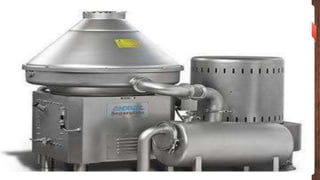
Separator
Milk separator is a device that removes cream from
whole milk. As a result, the whole milk is divided into a
cream and skim milk after separation.
Cream and skim milk have different densities and
therefore they tend to get separated under the impact of
gravity. You can test it yourself: Leave cow’s milk out for
24 hours and you will see how cream gathers at the top.
WORKING
A centrifugal milk separator machine has conical discs
that rotate in a bowl (drum) at a speed of 6,000 to
10,000 revolutions per minute, depending on the
model.
When whole milk gets inside the bowl, the centrifugal
force runs it through the holes of the discs.
The milk’s fat globules go to the centre of the drum
and the skim milk goes to its outer edge because it’s
HOMOGENIZERS
A Homogenizer is a machine that take a substance and
make its a uniform consistency and help reduce separation
It's reduces the big fat globules into smaller one.
Provide uniform consistency and give a smooth, rich flavor.
One of the oldest application of Homogenizer is in milk
processing.
Homogenizer mainly work by agitation the liquid that is to be
homogenized.
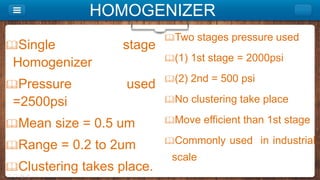
HOMOGENIZER
Single stage
Homogenizer
Pressure used
=2500psi
Mean size = 0.5 um
Range = 0.2 to 2um
Clustering takes place.
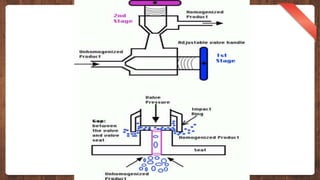
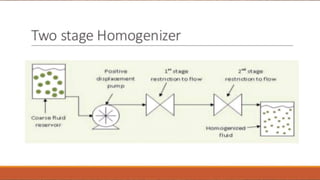
Two stages pressure used
(1) 1st stage = 2000psi
(2) 2nd = 500 psi
No clustering take place
Move efficient than 1st stage
Commonly used in industrial
scale
TANKS
Milk is stored in a great variety of storage tanks, first near to villages as
Bulk milk cooling units, then transported by Road Tankers and then to
Raw Milk Storage tanks in dairy plants. Further, it may be transported in
Rail Tankers to long distances after processing, to large urban centers.
Further, there may be requirement for processing operations like mixing,
ripening, culturing, aging etc, which require further special features in
storage tanks
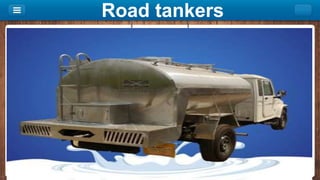
Road tankers
 The milk once collected in milk collection centers, has to be transported to dairy plants
by Road tankers. The tankers have to withstand great deal of stress due to vibrations,
jerks, exposure to weather, while transporting milk. Hence, the essential features include,
thicker SS sheet for inner and outer shells, better insulation, weather proof manhole doors
covered with a hood, two or three compartments to prevent rolling over of milk during jerks.
Further, the whole structure has to be mountable on the truck, or the articulated trailer, with
all the limitations of safe maneuverability during driving. The capacity, mounting and length
should be suitable for village roads, which is a severe limitation. The insulation will be a
thermocol in two or three layers, with proper seal of bitumen to prevent moisture seepage.
The newer road tankers are having PUF insulation material. The barrel of the tankers is
preferably oval in shape to reduce the centre of gravity, and is supported by M.S. supports,
to be fitted to the chassis of the vehicle. The vehicle will have a ladder at the rear and a
walk way (of suitably checkered plate to avoid slippage) to approach the manhole during
Other kind of tanks
There are other types of tanks suited to specific purposes like cream
storage tank, ghee settling tank, etc, which are double jacketed. The
jacket has SS perforated ring to allow a gentle flow of cold/hot/well
water to maintain the temperature of the fluid in the tank. They are
usually vertical types, with all the essential features as that of
horizontal milk storage tank. Milk reconstitution tanks are again
special purpose tanks connected with additional features like funnel
with venturi and valve at bottom, circulation pump, potable water inlet
to tank. This tank is not insulated, as the temperature is expected to
be about 40 °C.
PASTEURIZERS
A pasteurizers is a device which pasteurizers, treating
a food products to kill disease - causing organism such
as bacteria.
Milk is one of the most widely pasteurized food but
pasteurizers can also be used with a variety of other
liquid and some other food can be pasteurized.
Pasteurization is used to make food safer, in milk
industry milk get pasteurize to remove bacteria from
milk.
Method Of Pasteurization
Batch Pasteurization
Continuous Pasteurization
Flash Pasteurization (HTST)
Batch process
This process is also called the Low –Temperature-Long-Time
(LTLT) method. This process is not popular in the dairy industry
any more after HTST system was introduced. The milk and milk
products is heated or cooled in batches in one, two, or three
tanks. The process involves heating the milk to a temperature
between 62.8 and 65.60C, holding it at that temperature for 30
min, and rapidly cooling it to below 100C. Batch processing
involves filling the vessel, heating, holding, cooling, emptying the
vessel and filling into containers, and cleaning the vessels
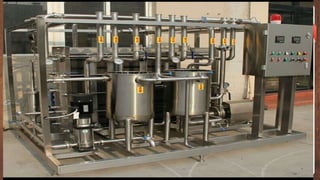
Continuous Pasteurization
Continuous processing a high temperatures
short time (HTST), pasteurizer is used the
milk is heated to a temperature of 72°C and
held for 15 second.and them cooled rapidly
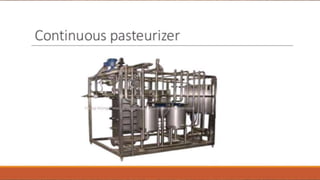
The heat treatment is accomplished using a
plates heat exchanger.
Flash Pasteurization
Flash pasteurization involves heating milk to 71.7°C for 15 seconds to kill
Coxiella burnetii, which is the most heat resistant pathogen in raw milk.
Since it is technically impossible to bring the milk to that exact temperature, it
is always safe to work with a range of temperatures. To be safe, you can heat
the milk to between 72°C to 74°C for 15 to 20 seconds.
This will ensure that the milk is heated uniformly to the required temperature.
This method is most suitable in continuous pasteurization systems.
Flash pasteurized milk will keep for between 16 and 21 days. For commercial
reasons, some manufacturers intentionally reduce the number of days to
push the products out of the shelves.
Packaging
Packaging Materials Used For Fluid Milk
A container of good quality must prevent post-processing
contamination from bacterial sources. It should be such that all
indirect or direct chemical change in the milk should be
prevented. The package should be of such materials that their
constituents do not get transmitted into milk. It should also be
resistant to the cleaning materials used in the dairy. It may either
be used once (single-use) or may be returned to the processing
factory for reuse.
Single-use Packaging machines
The pouch-filling machine is an integral part of a modern fluid
milk plant. Several types of plastic materials are used in
forming the pouches. The material generally comes in the form
of rolls, which are loaded onto the machine. The layer of plastic
is folded vertically and sealed. A horizontal sealer seals the
bottom of the pouch. Simultaneously, milk from an overhead
float tank is siphoned into the formed cylinder. It is then again
horizontally sealed at the top and cut off to form a pouch filled
with milk. These machines come with adjustable filling heads
capable of filling several volumes of milk as the need be.
Machinery for Multiple-use Packaging
Milk industry wps office

Milk industry wps office

  • 1.
  • 2.
    INTRODUCTION INDIAN MILK INDUSTRY Worldlargest milk producing nations Contribute about 15% to the total milk production of the world Indian milk industry stand at a mammoth size of US$70 billion
  • 3.
    INTRODUCTION More than 10million milk industry belong to the 9600 local dairy cooperatives, who sell their product to one of 170 milk producer, cooperative unions who in turn are supported by is state cooperative milk marketing federation.
  • 4.
    Indian Dairy Association(IDA),is the apex body of the dairy industry in India. The members are from the cooperatives MNCs,corporate bodies private institutions ,educational institution, government and public sector unit.  Amul is major milk industry in India. It's located in Anand,Gujarat . IDA
  • 5.
    EQUIPMENTS USED INMILK INDUSTRY SEPARATOR HOMOGENIZER TANK PASTEURISERS PACKAGING
  • 6.
    Separator Milk separator isa device that removes cream from whole milk. As a result, the whole milk is divided into a cream and skim milk after separation. Cream and skim milk have different densities and therefore they tend to get separated under the impact of gravity. You can test it yourself: Leave cow’s milk out for 24 hours and you will see how cream gathers at the top.
  • 8.
    WORKING A centrifugal milkseparator machine has conical discs that rotate in a bowl (drum) at a speed of 6,000 to 10,000 revolutions per minute, depending on the model. When whole milk gets inside the bowl, the centrifugal force runs it through the holes of the discs. The milk’s fat globules go to the centre of the drum and the skim milk goes to its outer edge because it’s
  • 9.
    HOMOGENIZERS A Homogenizer isa machine that take a substance and make its a uniform consistency and help reduce separation It's reduces the big fat globules into smaller one. Provide uniform consistency and give a smooth, rich flavor. One of the oldest application of Homogenizer is in milk processing. Homogenizer mainly work by agitation the liquid that is to be homogenized.
  • 10.
    HOMOGENIZER Single stage Homogenizer Pressure used =2500psi Meansize = 0.5 um Range = 0.2 to 2um Clustering takes place. Two stages pressure used (1) 1st stage = 2000psi (2) 2nd = 500 psi No clustering take place Move efficient than 1st stage Commonly used in industrial scale
  • 13.
    TANKS Milk is storedin a great variety of storage tanks, first near to villages as Bulk milk cooling units, then transported by Road Tankers and then to Raw Milk Storage tanks in dairy plants. Further, it may be transported in Rail Tankers to long distances after processing, to large urban centers. Further, there may be requirement for processing operations like mixing, ripening, culturing, aging etc, which require further special features in storage tanks
  • 14.
  • 15.
     The milkonce collected in milk collection centers, has to be transported to dairy plants by Road tankers. The tankers have to withstand great deal of stress due to vibrations, jerks, exposure to weather, while transporting milk. Hence, the essential features include, thicker SS sheet for inner and outer shells, better insulation, weather proof manhole doors covered with a hood, two or three compartments to prevent rolling over of milk during jerks. Further, the whole structure has to be mountable on the truck, or the articulated trailer, with all the limitations of safe maneuverability during driving. The capacity, mounting and length should be suitable for village roads, which is a severe limitation. The insulation will be a thermocol in two or three layers, with proper seal of bitumen to prevent moisture seepage. The newer road tankers are having PUF insulation material. The barrel of the tankers is preferably oval in shape to reduce the centre of gravity, and is supported by M.S. supports, to be fitted to the chassis of the vehicle. The vehicle will have a ladder at the rear and a walk way (of suitably checkered plate to avoid slippage) to approach the manhole during
  • 16.
    Other kind oftanks There are other types of tanks suited to specific purposes like cream storage tank, ghee settling tank, etc, which are double jacketed. The jacket has SS perforated ring to allow a gentle flow of cold/hot/well water to maintain the temperature of the fluid in the tank. They are usually vertical types, with all the essential features as that of horizontal milk storage tank. Milk reconstitution tanks are again special purpose tanks connected with additional features like funnel with venturi and valve at bottom, circulation pump, potable water inlet to tank. This tank is not insulated, as the temperature is expected to be about 40 °C.
  • 17.
    PASTEURIZERS A pasteurizers isa device which pasteurizers, treating a food products to kill disease - causing organism such as bacteria. Milk is one of the most widely pasteurized food but pasteurizers can also be used with a variety of other liquid and some other food can be pasteurized. Pasteurization is used to make food safer, in milk industry milk get pasteurize to remove bacteria from milk.
  • 18.
    Method Of Pasteurization BatchPasteurization Continuous Pasteurization Flash Pasteurization (HTST)
  • 19.
    Batch process This processis also called the Low –Temperature-Long-Time (LTLT) method. This process is not popular in the dairy industry any more after HTST system was introduced. The milk and milk products is heated or cooled in batches in one, two, or three tanks. The process involves heating the milk to a temperature between 62.8 and 65.60C, holding it at that temperature for 30 min, and rapidly cooling it to below 100C. Batch processing involves filling the vessel, heating, holding, cooling, emptying the vessel and filling into containers, and cleaning the vessels
  • 20.
    Continuous Pasteurization Continuous processinga high temperatures short time (HTST), pasteurizer is used the milk is heated to a temperature of 72°C and held for 15 second.and them cooled rapidly The heat treatment is accomplished using a plates heat exchanger.
  • 22.
    Flash Pasteurization Flash pasteurizationinvolves heating milk to 71.7°C for 15 seconds to kill Coxiella burnetii, which is the most heat resistant pathogen in raw milk. Since it is technically impossible to bring the milk to that exact temperature, it is always safe to work with a range of temperatures. To be safe, you can heat the milk to between 72°C to 74°C for 15 to 20 seconds. This will ensure that the milk is heated uniformly to the required temperature. This method is most suitable in continuous pasteurization systems. Flash pasteurized milk will keep for between 16 and 21 days. For commercial reasons, some manufacturers intentionally reduce the number of days to push the products out of the shelves.
  • 24.
    Packaging Packaging Materials UsedFor Fluid Milk A container of good quality must prevent post-processing contamination from bacterial sources. It should be such that all indirect or direct chemical change in the milk should be prevented. The package should be of such materials that their constituents do not get transmitted into milk. It should also be resistant to the cleaning materials used in the dairy. It may either be used once (single-use) or may be returned to the processing factory for reuse.
  • 25.
    Single-use Packaging machines Thepouch-filling machine is an integral part of a modern fluid milk plant. Several types of plastic materials are used in forming the pouches. The material generally comes in the form of rolls, which are loaded onto the machine. The layer of plastic is folded vertically and sealed. A horizontal sealer seals the bottom of the pouch. Simultaneously, milk from an overhead float tank is siphoned into the formed cylinder. It is then again horizontally sealed at the top and cut off to form a pouch filled with milk. These machines come with adjustable filling heads capable of filling several volumes of milk as the need be.
  • 26.