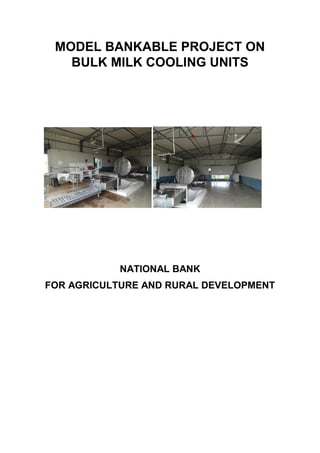
MODEL BANKABLE PROJECT ON
BULK MILK COOLING UNITS
NATIONAL BANK
FOR AGRICULTURE AND RURAL DEVELOPMENT
CONTENTS
Sl. No. Particulars Page No.
1. Introduction
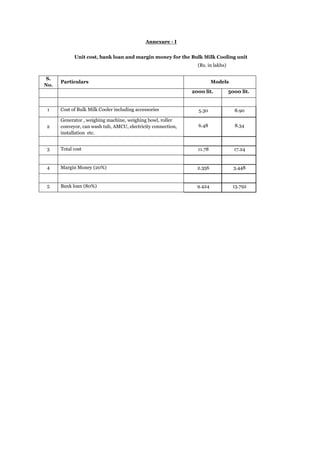
2. Objectives
3. Potential Areas
4. Beneficiaries
5. Project Details
6. Technical Collaboration
7. Capital Cost
8. Backward and forward linkages
9. Economics of the Project
10. Financial Analysis
12. Financial Assistance
13. Lending Terms
14 Special Terms and Conditions
ANNEXURES
I. Unit Cost, bank loan and margin money
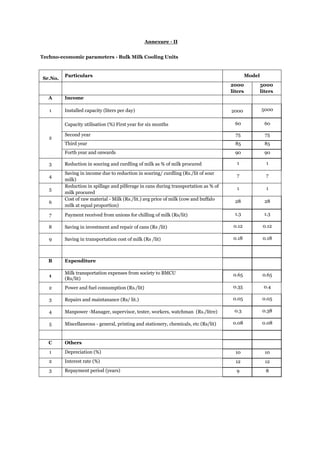
II. Techno economic parameters
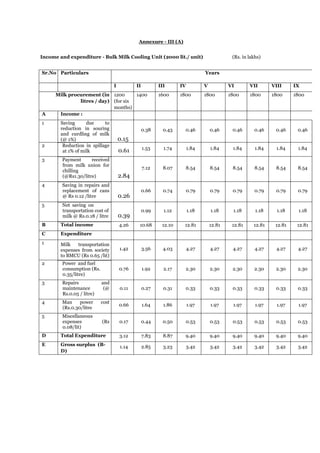
III. Income and Expenditure
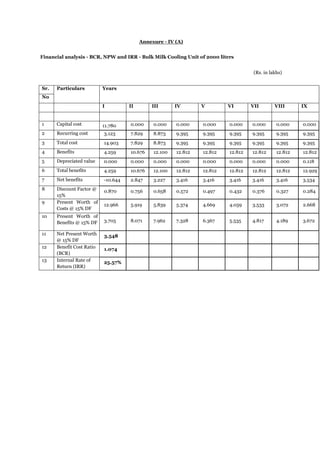
IV. Financial Analysis – BCR, NPW and IRR
V. Repayment Schedule
VI. Special terms and conditions
APPENDICES
1. Technical specifications of bulk milk coolers
2. List of Major Suppliers of Bulk Milk Coolers
MODEL BANKABLE PROJECT ON
BULK MILK COOLING UNITS
1. Introduction:
1.1 Indian dairy industry is contributing significantly to the country's economy,
besides improving the health standard by increasing the nutritional value of the food.
India occupies first position in the world milk production with 19% share of in global
milk output. The milk production is estimated at 155.5 million tonnes during 2015-
16 as compared to 146.3 million tonnes of milk during 2014-15. The value of output of
milk was Rs 4,07,396 crore in the year 2013-14.
1.2 The milk production significantly increased from 17 million tones in 1950-1951 to
127.9 million tonnes at the end of the Eleventh Plan (2011-12) and to 155.5 million
tonnes during 2015-16. The per capita availability of the milk was 337 grams per day
during the year 2015-16, which is more than the world average of 294 grams per day
and the ICMR recommendation of 250 gms.
1.3 As per 19th Livestock census, 2012, the country has about 190.90 million cattle
(122.98 million female cattle) and 108.7 million buffaloes (92.6 million female
buffaloes). Breedable female cattle and breedable female buffaloes account for 76.685
million (21.268 million crossbred cattle and 55.417 million indigenous cattle) and
56.586 million numbers, respectively.
1.4 Recognizing the importance of the sector, the notable programmes taken up by
GOI are key village schemes, intensive cattle development projects, crossbreeding
projects through bilateral assistance, Operation Flood programme, Technology
Mission etc. Most of the milk in the Country is produced by small, marginal farmers
and landless labourers. About 15.1 million farmers have been brought under the ambit
of 1,55,634 village level dairy corporative societies up to March 2013. The cooperative
milk unions procured an average of 32.8 million kgs of milk per day during the year
2012-13 as compared to 28.7 million kgs in the previous year recording a growth of
14.3 percent. The sale of liquid milk by cooperative sector reached 23.7 million litres
per day during the year 2012-13 registering a growth of 3.7% over the previous year.
1.5 For strengthening the efforts of the dairy cooperatives to increase productivity and
income of the milk producers/farmers through improved management of breeding
and feeding, Government implemented the National Dairy Plan (Phase-I). National
Dairy Plan Phase I (NDP I) is a Central Sector Scheme for a period of 2011-12 to 2018-
19. NDP I will be implemented with a total investment of about Rs. 2242 crore. NDP
I will focus on 18 major milk producing states namely Andhra Pradesh, Bihar, Gujarat,
Haryana, Karnataka, Kerala, Madhya Pradesh, Maharashtra, Odisha, Punjab,
Rajasthan, Tamil Nadu, Uttar Pradesh, West Bengal, Telangana, Uttarakhand,
Jharkhand and Chhattisgarh which together account for over 90% of the country’s
milk production. Coverage of NDP I will however be across the country in terms of
benefits accruing from the scheme.
1.6 National Programme for Bovine Breeding and Dairy Development
(NPBB&DD) : The Scheme titled “National Programme for Bovine Breeding and
Dairy Development” (NPBB&DD) was launched on 27.02.2014 by merger of four
ongoing schemes viz. Integrated Dairy Development Programme (IDDP),
Strengthening Infrastructure for Quality & Clean Milk Production (SIQ-CMP),
Assistant to Cooperatives (A to C) and National Project for Cattle & Buffalo Breeding
(NPCBB). NPBB&DD will have two components (a) National Programme for Bovine
Breeding (NPBB) and (b) National Programme for Dairy Development (NPDD). A
budgetary provision of Rs1,800 crore has been made for implementation the scheme
during 12th Five Year Plan (2012-17). Milk chilling capacity of 1,705 TLPD and 1844
TLPD was created during 2012-13 and 2013-14 in Cooperative dairy sector.
1.7 As per APEDA, the export of dairy products (Butter, butter oil, cheese, butter milk,
skimmed milk powder, milk for babies, whole milk and ghee) was to the tune of 1.59
lakh MT valued at Rs 3318.5 crore during 2013-14 to Bangladesh, Egypt, UAE,
Algeria, Yemen and Pakistan.
1.8. Having made a significant stride in production and processing, efforts have to be
directed to provide hygienically safe milk and milk products to the consumers. In
addition to fat and SNF, the bacteriological quality has also be taken into account for
determining quality of the milk. Therefore, emphasis has to be on veterinary support
infrastructure and strengthening cold chain for quality milk production. As per Codex
Alimentarius, immediately after milking, the milk must be cooled preferably to 4° C.
This requires mechanical refrigeration or milk cooling tanks. It is important to
remember that under a hot environment milk will spoil within 3-4 hours. So cooling
will lower the temperature of milk to prevent multiplication of bacteria. Further,
when milk for further processing is not used within 2 hours after milking, it shall be
cooled to a temperature cooled to or below 4° C.
1.9 The best alternative to the present collection system of milk is cooling of milk
immediately after milking by Bulk Cooling Tanks. The usage of such tanks has become
popular and is on the rise as it helps in increasing the shelf life of milk, facilitates
systematic and simple way of milk procurement and ensures procurement of more
milk by covering untapped farther areas for Milk Collection. Further the efforts are
aimed at setting up of collection centres along milk routes to increase procurement in
the organized sector and to facilitate scientific handling of milk as per quality norms.
1.10. NABARD has been actively involved in credit planning, fixation of unit costs and
promoting credit flow for various investments under dairy sector. NABARD is also
acting as the nodal agency for implementing the credit linked Dairy Entrepreneurship
Development Scheme (DEDS) of Got of India for routing of subsidy admissible (25 %
or 33.33%) under the scheme. Purchase of Milking Machine/ Milko testers/ Bulk Milk
Cooling Units up to 5000 LPD capacity is one of the eligible activity under the
scheme. The scheme was extended during 12th Plan and is also being implemented
during 2017-18.
2. Objectives:
The financial assistance is extended for purchase of bulk milk coolers with the
following objectives.
1. To arrest bacterial growth, retain freshness and enhance the keeping quality of
milk
2. To avoid economic losses to the producers due to spillage/ curdling of milk.
3. To make available quality milk for production of quality products for export as
well as to meet the domestic requirements.
4. To reduce the transportation cost by regulating transportation of the milk on
alternative days or once in day for two collections and also through reduction
in expenditure on purchase and maintenance of cans.
5. To ensure clean milk production
3. Potential areas:
Bulk Milk Cooling Units are now taken up in all parts of the country. The scheme has
potential to finance in Operation Flood programme(OFP) and also In non- OFP
districts under Govt., private and cooperative sectors.
4. Beneficiaries:
Village Milk Cooperative Societies of Cooperative Milk Unions or Milk Collection
Centres of private Dairies or units. Producer Companies and SHG Federations.
Individuals in tie up with private dairies can also take up the activity.
The bulk cooling units are also considered as part of large dairy farms and processing
units.
5. Project Details:
• Components: The components of Bulk Milk Cooling Unit comprises of bulk
cooling tank with accessories, DG set, weighing machine, weighing bowl, roller
conveyor, can wash tub, Automatic Milk Collection Unit (AMCU), water storage
tanks etc.
• Capacity :The capacity of Bulk Milk Cooling Units is ranging from 500 to 10000
litres.
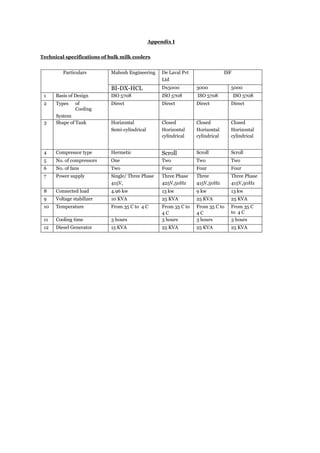
• Specifications: The specifications of different models manufactured by two
firms are given in Appendix 1.
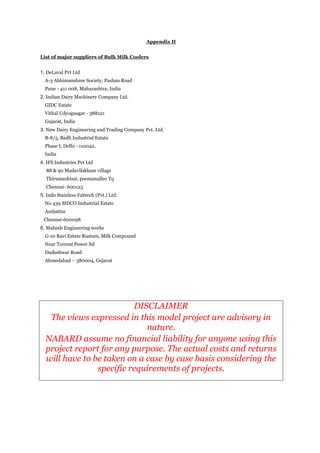
• Equipment suppliers: The machinery should confirm to the BIS standards and
are presently manufactured in the country by DeLaval Pvt Ltd, IDMC, IFS
Industries Pvt Ltd,etc. The addresses of few manufacturers are given in Appendix
II for reference.
• Processing: The operations involve collection of milk and chilling to a
temperature of 4 o C.
Advantages:
1. Elimination of souring/curdling of milk due to cooling at the collection
centre itself.
2. Adulteration of milk and spillage from cans can be eliminated during
transport.
3. Transportation cost of milk can be brought down by regulating
transportation to the main dairy either on alternative days or once in a
day.
4. Saving of initial investment on purchase of cans and subsequent
maintenance cost (Repairs, cleaning etc.).
5. Improved quality of milk can be supplied to the main dairy to
manufacture quality products for domestic as well as export markets.
6. Flexibility in milk collection time results in increase in volume of milk
collected at the centres.
7. Farmers will get better returns for the quality of milk.
8. Chilling at the Main dairy can be avoided.
6. Technical Collaboration: Since the process is simple no technical
collaboration is envisaged for the project, however the Milk Unions/Private Dairy
Plants would be providing guidance to the societies/collection centres in purchase and
installation of Bulk Milk Coolers, milk testing and in training of manpower in the
operations and maintenance.
7. Capital Cost: The capital cost varies with the capacity and the specifications
of the Bulk Milk Coolers. However, two models have been considered i.e. 2000 and
5000 litres capacity, whose unit costs are Rs. 11.80 lakhs and 17.25 lakhs respectively.
The detailed unit cost is given in the Annexure I. It is assumed that the space available
in the existing collection centre/cooperative society will be sufficient to install the
equipment and accordingly no cost on civil structures is considered. In case if the civil
structures are required to be considered, the same may be included under project cost.
Similarly rental accommodation could also be explored. Constructed area of about
800 to 1200 sq.ft is sufficient.
8. Backward and forward Linkages
The location of the Bulk Cooling unit should be in milk shed area having potential for
milk procurement. Proper arrangements for milk procurement from farmers to the
unit through milk routes or alternate means have to be taken care. Regular supply of
utilities such as power, fuel and water have to be ensured. Availability of man power
in terms of operator, tester, workers, incharge , etc. is to be ensured.
9. Economics of the project:
Based on the various techno economic parameters given in Annexure II, the
economics of the project has been worked out and presented in Annexure III A and B
for two different models. The items of income include saving due to reduction in
souring/curdling of milk, reduction in spillage and pilferage of milk, payment
received for chilling, saving in repairs and replacement of cans, saving in expenditure
on transportation, etc. The components of expenditure include transport expenses
from society to BMCU, power and fuel expenses, repairs and maintenance,
manpower, miscellaneous expenses, etc.
10. Financial Analysis:
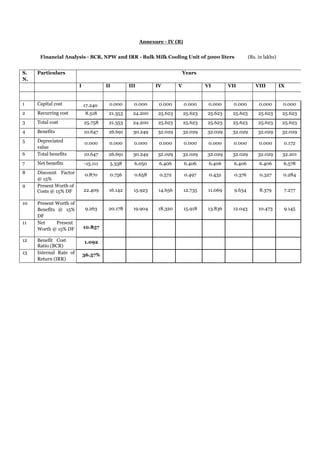
The income and expenditure details for two models are presented in Annexure III A
and III B. Financial analysis covering the Benefit Cost Ratio (BCR) Net Present Worth
(NPW) and Internal Rate of Return (IRR) have been worked out and presented in
Annexure IV A and IV B. For the models of 2000 litres and 5000 litres, the BCR,
NPW and IRR worked out to 1.074 :1 and 1.092:1; Rs. 3.548 lakhs and Rs.10.857 lakh
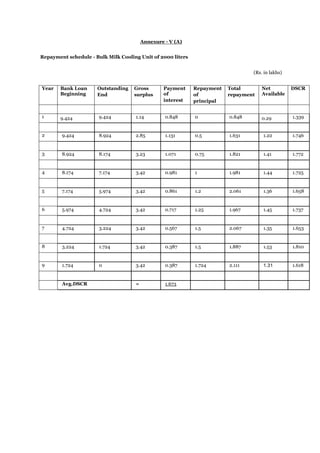
and 25.57 % and 36.57%, respectively. The entire bank loan can be repaid in nine/
Eight years without any grace period as per the repayment schedules presented in
Annexure V A and V B.
11. Financial assistance:
Bulk Milk Cooling units of various sizes are eligible economic activities for loan from
banks and refinance support by NABARD. The banks may consider financing for this
activity subject to technical feasibility, financial viability and bankability.
12. Lending Terms and other requirements:
12.1 Margin Money: The society or Milk collection centre should normally meet
20% of the project cost
12.2 Interest rate: Interest rate will be as determined by the financing bank. For
working out model ,the rate has been considered at 12 percent.
12.3 Security: As stipulated by the RBI
12.4 Insurance: The financing bank may ensure that the society takes adequate
insurance cover for the asset
12.5 Repayment period: Depends upon the gross surplus generated, it may be upto
8 -9 years without any grace period for the two models (Annexure-V- A and V – B).
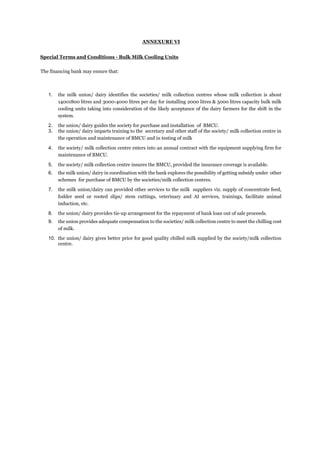
13 Special terms and conditions:
The special terms and conditions of the project are given in Annexure VI.
Annexure - I
Unit cost, bank loan and margin money for the Bulk Milk Cooling unit
(Rs. in lakhs)
S.
No.
Particulars Models
2000 lit. 5000 lit.
1 Cost of Bulk Milk Cooler including accessories 5.30 8.90
2
Generator , weighing machine, weighing bowl, roller
conveyor, can wash tub, AMCU, electricity connection,
installation etc.
6.48 8.34
3 Total cost 11.78 17.24
4 Margin Money (20%) 2.356 3.448
5 Bank loan (80%) 9.424 13.792
Annexure - II
Techno-economic parameters - Bulk Milk Cooling Units
Sr.No.
Particulars Model
2000
liters
5000
liters
A Income
1 Installed capacity (liters per day) 2000 5000
2
Capacity utilisation (%) First year for six months 60 60
Second year 75 75
Third year 85 85
Forth year and onwards 90 90
3 Reduction in souring and curdling of milk as % of milk procured 1 1
4
Saving in income due to reduction in souring/ curdling (Rs./lit of sour
milk)
7 7
5
Reduction in spillage and pilferage in cans during transportation as % of
milk procured
1 1
6
Cost of raw material - Milk (Rs./lit.) avg price of milk (cow and buffalo
milk at equal proportion)
28 28
7 Payment received from unions for chilling of milk (Rs/lit) 1.3 1.3
8 Saving in investment and repair of cans (Rs /lit) 0.12 0.12
9 Saving in transportation cost of milk (Rs /lit) 0.18 0.18
B Expenditure
1
Milk transportation expenses from society to BMCU
(Rs/lit)
0.65 0.65
2 Power and fuel consumption (Rs./lit) 0.35 0.4
3 Repairs and maintanance (Rs/ lit.) 0.05 0.05
4 Manpower -Manager, supervisor, tester, workers, watchman (Rs./litre) 0.3 0.38
5 Miscellaneous - general, printing and stationery, chemicals, etc (Rs/lit) 0.08 0.08
C Others
1 Depreciation (%) 10 10
2 Interest rate (%) 12 12
3 Repayment period (years) 9 8
Annexure - III (A)
Income and expenditure - Bulk Milk Cooling Unit (2000 lit./ unit) (Rs. in lakhs)
Sr.No Particulars Years
I II III IV V VI VII VIII IX
Milk procurement (in
litres / day)
1200
(for six
months)
1400 1600 1800 1800 1800 1800 1800 1800
A Income :
1 Saving due to
reduction in souring
and curdling of milk
(@ 1%) 0.15
0.38 0.43 0.46 0.46 0.46 0.46 0.46 0.46
2 Reduction in spillage
at 1% of milk 0.61 1.53 1.74 1.84 1.84 1.84 1.84 1.84 1.84
3 Payment received
from milk union for
chilling
(@Rs1.30/litre) 2.84
7.12 8.07 8.54 8.54 8.54 8.54 8.54 8.54
4 Saving in repairs and
replacement of cans
@ Rs 0.12 /litre 0.26
0.66 0.74 0.79 0.79 0.79 0.79 0.79 0.79
5 Net saving on
transportation cost of
milk @ Rs.0.18 / litre 0.39
0.99 1.12 1.18 1.18 1.18 1.18 1.18 1.18
B Total income 4.26 10.68 12.10 12.81 12.81 12.81 12.81 12.81 12.81
C Expenditure
1 Milk transportation
expenses from society
to BMCU (Rs 0.65 /lit)
1.42 3.56 4.03 4.27 4.27 4.27 4.27 4.27 4.27
2 Power and fuel
consumption (Rs.
0.35/litre)
0.76 1.92 2.17 2.30 2.30 2.30 2.30 2.30 2.30
3 Repairs and
maintenance (@
Rs.0.05 / litre)
0.11 0.27 0.31 0.33 0.33 0.33 0.33 0.33 0.33
4 Man power cost
(Rs.0.30/litre
0.66 1.64 1.86 1.97 1.97 1.97 1.97 1.97 1.97
5 Miscellaneous
expenses (Rs
0.08/lit)
0.17 0.44 0.50 0.53 0.53 0.53 0.53 0.53 0.53
D Total Expenditure 3.12 7.83 8.87 9.40 9.40 9.40 9.40 9.40 9.40
E Gross surplus (B-
D)
1.14 2.85 3.23 3.42 3.42 3.42 3.42 3.42 3.42
Annexure - III (B)
Income and expenditure - Bulk Milk Cooling Unit (5000 lit./ unit) (Rs. in lakhs)
Sr.No Particulars Years
I II III IV V VI VII VIII IX
Milk procurement (in
litres / day)
3000
(for 6
months)
3750 4250 4500 4500 4500 4500 4500 4500
A Income :
1 Saving due to
reduction in souring
and curdling of milk
(@ 1%) 0.38
0.96 1.09 1.15 1.15 1.15 1.15 1.15 1.15
2 Reduction in spillage
at 1% of milk 1.53 3.83 4.34 4.60 4.60 4.60 4.60 4.60 4.60
3 Payment received
from milk union for
chilling
(@Rs1.30/litre) 7.10
17.79 20.17 21.35 21.35 21.35 21.35 21.35 21.35
4 Saving in repairs and
replacement of cans
@ Rs 0.12/litre 0.66
1.64 1.86 1.97 1.97 1.97 1.97 1.97 1.97
5 Net saving on
transportation cost of
milk @ Rs.0.18 / litre 0.98
2.46 2.79 2.96 2.96 2.96 2.96 2.96 2.96
B Total income 10.65 26.69 30.25 32.03 32.03 32.03 32.03 32.03 32.03
C Expenditure
1 Milk transportation
expenses from society
to BMCU (Rs 0.65 /lit)
3.55 8.90 10.08 10.68 10.68 10.68 10.68 10.68 10.68
2 Power and fuel
consumption (Rs.
0.40/litre)
2.18 5.48 6.21 6.57 6.57 6.57 6.57 6.57 6.57
3 Repairs and
maintenance (@
Rs.0.05 / litre)
0.27 0.68 0.78 0.82 0.82 0.82 0.82 0.82 0.82
4 Man power cost
(Rs.0.38/litre
2.07 5.20 5.89 6.24 6.24 6.24 6.24 6.24 6.24
5 Miscellaneous
expenses (Rs 0.08/lit)
0.44 1.10 1.24 1.31 1.31 1.31 1.31 1.31 1.31
D Total Expenditure 8.52 21.35 24.20 25.62 25.62 25.62 25.62 25.62 25.62
E Gross surplus (B-
D)
2.13 5.34 6.05 6.41 6.41 6.41 6.41 6.41 6.41
Annexure - IV (A)
Financial analysis - BCR, NPW and IRR - Bulk Milk Cooling Unit of 2000 liters
(Rs. in lakhs)
Sr. Particulars Years
No
I II III IV V VI VII VIII IX
1 Capital cost 11.780 0.000 0.000 0.000 0.000 0.000 0.000 0.000 0.000
2 Recurring cost 3.123 7.829 8.873 9.395 9.395 9.395 9.395 9.395 9.395
3 Total cost 14.903 7.829 8.873 9.395 9.395 9.395 9.395 9.395 9.395
4 Benefits 4.259 10.676 12.100 12.812 12.812 12.812 12.812 12.812 12.812
5 Depreciated value 0.000 0.000 0.000 0.000 0.000 0.000 0.000 0.000 0.118
6 Total benefits 4.259 10.676 12.100 12.812 12.812 12.812 12.812 12.812 12.929
7 Net benefits -10.644 2.847 3.227 3.416 3.416 3.416 3.416 3.416 3.534
8 Discount Factor @
15%
0.870 0.756 0.658 0.572 0.497 0.432 0.376 0.327 0.284
9 Present Worth of
Costs @ 15% DF
12.966 5.919 5.839 5.374 4.669 4.059 3.533 3.072 2.668
10 Present Worth of
Benefits @ 15% DF 3.705 8.071 7.962 7.328 6.367 5.535 4.817 4.189 3.672
11 Net Present Worth
@ 15% DF
3.548
12 Benefit Cost Ratio
(BCR)
1.074
13 Internal Rate of
Return (IRR)
25.57%
Annexure - IV (B)
Financial Analysis - BCR, NPW and IRR - Bulk Milk Cooling Unit of 5000 liters (Rs. in lakhs)
S.
N.
Particulars Years
I II III IV V VI VII VIII IX
1 Capital cost 17.240 0.000 0.000 0.000 0.000 0.000 0.000 0.000 0.000
2 Recurring cost 8.518 21.353 24.200 25.623 25.623 25.623 25.623 25.623 25.623
3 Total cost 25.758 21.353 24.200 25.623 25.623 25.623 25.623 25.623 25.623
4 Benefits 10.647 26.691 30.249 32.029 32.029 32.029 32.029 32.029 32.029
5 Depreciated
value
0.000 0.000 0.000 0.000 0.000 0.000 0.000 0.000 0.172
6 Total benefits 10.647 26.691 30.249 32.029 32.029 32.029 32.029 32.029 32.201
7 Net benefits -15.111 5.338 6.050 6.406 6.406 6.406 6.406 6.406 6.578
8 Discount Factor
@ 15%
0.870 0.756 0.658 0.572 0.497 0.432 0.376 0.327 0.284
9 Present Worth of
Costs @ 15% DF 22.409 16.142 15.923 14.656 12.735 11.069 9.634 8.379 7.277
10 Present Worth of
Benefits @ 15%
DF
9.263 20.178 19.904 18.320 15.918 13.836 12.043 10.473 9.145
11 Net Present
Worth @ 15% DF 10.857
12 Benefit Cost
Ratio (BCR)
1.092
13 Internal Rate of
Return (IRR)
36.57%
Annexure - V (A)
Repayment schedule - Bulk Milk Cooling Unit of 2000 liters
(Rs. in lakhs)
Year Bank Loan
Beginning
Outstanding
End
Gross
surplus
Payment
of
interest
Repayment
of
principal
Total
repayment
Net
Available
DSCR
1 9.424 9.424 1.14 0.848 0 0.848 0.29 1.339
2 9.424 8.924 2.85 1.131 0.5 1.631 1.22 1.746
3 8.924 8.174 3.23 1.071 0.75 1.821 1.41 1.772
4 8.174 7.174 3.42 0.981 1 1.981 1.44 1.725
5 7.174 5.974 3.42 0.861 1.2 2.061 1.36 1.658
6 5.974 4.724 3.42 0.717 1.25 1.967 1.45 1.737
7 4.724 3.224 3.42 0.567 1.5 2.067 1.35 1.653
8 3.224 1.724 3.42 0.387 1.5 1.887 1.53 1.810
9 1.724 0 3.42 0.387 1.724 2.111 1.31 1.618
Avg.DSCR = 1.673
Annexure - V (B)
Repayment schedule - Bulk Milk Cooling Unit of 5000 liters
(Rs. in lakhs)
Year Bank
Loan
Beginning
Outstanding
End
Gross
surplus
Payment
of
interest
Repayment
of
principal
Total
repayment
Net
Available
DSCR
1 13.792 13.542 2.13 1.241 0.25 1.491 0.64 1.428
2 13.542 12.542 5.34 1.625 1 2.625 2.71 2.034
3 12.542 11.042 6.05 1.505 1.5 3.005 3.04 2.013
4 11.042 9.292 6.41 1.325 1.75 3.075 3.33 2.083
5 9.292 7.292 6.41 1.115 2 3.115 3.29 2.056
6 7.292 5.292 6.41 0.875 2 2.875 3.53 2.228
7 5.292 2.292 6.41 0.635 3 3 3.41 2.135
8 2.292 0.002 6.41 0.275 2.29 2.565 3.84 2.497
Avg. DSCR = 2.059
ANNEXURE VI
Special Terms and Conditions - Bulk Milk Cooling Units
The financing bank may ensure that:
1. the milk union/ dairy identifies the societies/ milk collection centres whose milk collection is about
14001800 litres and 3000-4000 litres per day for installing 2000 litres & 5000 litres capacity bulk milk
cooling units taking into consideration of the likely acceptance of the dairy farmers for the shift in the
system.
2. the union/ dairy guides the society for purchase and installation of BMCU.
3. the union/ dairy imparts training to the secretary and other staff of the society/ milk collection centre in
the operation and maintenance of BMCU and in testing of milk
4. the society/ milk collection centre enters into an annual contract with the equipment supplying firm for
maintenance of BMCU.
5. the society/ milk collection centre insures the BMCU, provided the insurance coverage is available.
6. the milk union/ dairy in coordination with the bank explores the possibility of getting subsidy under other
schemes for purchase of BMCU by the societies/milk collection centres.
7. the milk union/dairy can provided other services to the milk suppliers viz. supply of concentrate feed,
fodder seed or rooted slips/ stem cuttings, veterinary and AI services, trainings, facilitate animal
induction, etc.
8. the union/ dairy provides tie-up arrangement for the repayment of bank loan out of sale proceeds.
9. the union provides adequate compensation to the societies/ milk collection centre to meet the chilling cost
of milk.
10. the union/ dairy gives better price for good quality chilled milk supplied by the society/milk collection
centre.
Appendix I
Technical specifications of bulk milk coolers
Particulars Mahesh Engineering De Laval Pvt
Ltd
ISF
BI-DX-HCL Dx5000 3000 5000
1 Basis of Design ISO 5708 ISO 5708 ISO 5708 ISO 5708
2 Types of
Cooling
System
Direct Direct Direct Direct
3 Shape of Tank Horizontal
Semi-cylindrical
Closed
Horizontal
cylindrical
Closed
Horizontal
cylindrical
Closed
Horizontal
cylindrical
4 Compressor type Hermetic Scroll Scroll Scroll
5 No. of compressors One Two Two Two
6 No. of fans Two Four Four Four
7 Power supply Single/ Three Phase
415V,
Three Phase
425V,50Hz
Three
415V,50Hz
Three Phase
415V,50Hz
8 Connected load 4.96 kw 13 kw 9 kw 13 kw
9 Voltage stabilizer 10 KVA 25 KVA 25 KVA 25 KVA
10 Temperature From 35 C to 4 C From 35 C to
4 C
From 35 C to
4 C
From 35 C
to 4 C
11 Cooling time 3 hours 3 hours 3 hours 3 hours
12 Diesel Generator 15 KVA 25 KVA 25 KVA 25 KVA
Appendix II
List of major suppliers of Bulk Milk Coolers
1. DeLaval Pvt Ltd
A-3 Abhimanshree Society, Pashan Road
Pune - 411 008, Maharashtra, India
2. Indian Dairy Machinery Company Ltd.
GIDC Estate
Vithal Udyognagar - 388121
Gujarat, India
3. New Dairy Engineering and Trading Company Pvt. Ltd.
B-8/5, Badli Industrial Estate
Phase I, Delhi - 110042,
India
4. IFS Industries Pvt Ltd
88 & 90 Madavilakkam village
Thirumazhisai, poonamallee Tq
Chennai- 600123
5. Indo Stainless Fabtech (Pvt.) Ltd.
No 439 SIDCO Industrial Estate
Ambattur
Chennai-600098
6. Mahesh Engineering works
G-10 Ravi Estate Rustam, Milk Compound
Near Torrent Power ltd
Dudeshwar Road
Ahmedabad – 380004, Gujarat
DISCLAIMER
The views expressed in this model project are advisory in
nature.
NABARD assume no financial liability for anyone using this
project report for any purpose. The actual costs and returns
will have to be taken on a case by case basis considering the
specific requirements of projects.

Bulk milk cooling unit 5000 litr

  • 1.
    MODEL BANKABLE PROJECTON BULK MILK COOLING UNITS NATIONAL BANK FOR AGRICULTURE AND RURAL DEVELOPMENT
  • 2.
    CONTENTS Sl. No. ParticularsPage No. 1. Introduction 2. Objectives 3. Potential Areas 4. Beneficiaries 5. Project Details 6. Technical Collaboration 7. Capital Cost 8. Backward and forward linkages 9. Economics of the Project 10. Financial Analysis 12. Financial Assistance 13. Lending Terms 14 Special Terms and Conditions
  • 3.
    ANNEXURES I. Unit Cost,bank loan and margin money II. Techno economic parameters III. Income and Expenditure IV. Financial Analysis – BCR, NPW and IRR V. Repayment Schedule VI. Special terms and conditions APPENDICES 1. Technical specifications of bulk milk coolers 2. List of Major Suppliers of Bulk Milk Coolers
  • 4.
    MODEL BANKABLE PROJECTON BULK MILK COOLING UNITS 1. Introduction: 1.1 Indian dairy industry is contributing significantly to the country's economy, besides improving the health standard by increasing the nutritional value of the food. India occupies first position in the world milk production with 19% share of in global milk output. The milk production is estimated at 155.5 million tonnes during 2015- 16 as compared to 146.3 million tonnes of milk during 2014-15. The value of output of milk was Rs 4,07,396 crore in the year 2013-14. 1.2 The milk production significantly increased from 17 million tones in 1950-1951 to 127.9 million tonnes at the end of the Eleventh Plan (2011-12) and to 155.5 million tonnes during 2015-16. The per capita availability of the milk was 337 grams per day during the year 2015-16, which is more than the world average of 294 grams per day and the ICMR recommendation of 250 gms. 1.3 As per 19th Livestock census, 2012, the country has about 190.90 million cattle (122.98 million female cattle) and 108.7 million buffaloes (92.6 million female buffaloes). Breedable female cattle and breedable female buffaloes account for 76.685 million (21.268 million crossbred cattle and 55.417 million indigenous cattle) and 56.586 million numbers, respectively. 1.4 Recognizing the importance of the sector, the notable programmes taken up by GOI are key village schemes, intensive cattle development projects, crossbreeding projects through bilateral assistance, Operation Flood programme, Technology Mission etc. Most of the milk in the Country is produced by small, marginal farmers and landless labourers. About 15.1 million farmers have been brought under the ambit of 1,55,634 village level dairy corporative societies up to March 2013. The cooperative milk unions procured an average of 32.8 million kgs of milk per day during the year 2012-13 as compared to 28.7 million kgs in the previous year recording a growth of 14.3 percent. The sale of liquid milk by cooperative sector reached 23.7 million litres per day during the year 2012-13 registering a growth of 3.7% over the previous year. 1.5 For strengthening the efforts of the dairy cooperatives to increase productivity and income of the milk producers/farmers through improved management of breeding and feeding, Government implemented the National Dairy Plan (Phase-I). National Dairy Plan Phase I (NDP I) is a Central Sector Scheme for a period of 2011-12 to 2018- 19. NDP I will be implemented with a total investment of about Rs. 2242 crore. NDP I will focus on 18 major milk producing states namely Andhra Pradesh, Bihar, Gujarat, Haryana, Karnataka, Kerala, Madhya Pradesh, Maharashtra, Odisha, Punjab, Rajasthan, Tamil Nadu, Uttar Pradesh, West Bengal, Telangana, Uttarakhand, Jharkhand and Chhattisgarh which together account for over 90% of the country’s milk production. Coverage of NDP I will however be across the country in terms of benefits accruing from the scheme.
  • 5.
    1.6 National Programmefor Bovine Breeding and Dairy Development (NPBB&DD) : The Scheme titled “National Programme for Bovine Breeding and Dairy Development” (NPBB&DD) was launched on 27.02.2014 by merger of four ongoing schemes viz. Integrated Dairy Development Programme (IDDP), Strengthening Infrastructure for Quality & Clean Milk Production (SIQ-CMP), Assistant to Cooperatives (A to C) and National Project for Cattle & Buffalo Breeding (NPCBB). NPBB&DD will have two components (a) National Programme for Bovine Breeding (NPBB) and (b) National Programme for Dairy Development (NPDD). A budgetary provision of Rs1,800 crore has been made for implementation the scheme during 12th Five Year Plan (2012-17). Milk chilling capacity of 1,705 TLPD and 1844 TLPD was created during 2012-13 and 2013-14 in Cooperative dairy sector. 1.7 As per APEDA, the export of dairy products (Butter, butter oil, cheese, butter milk, skimmed milk powder, milk for babies, whole milk and ghee) was to the tune of 1.59 lakh MT valued at Rs 3318.5 crore during 2013-14 to Bangladesh, Egypt, UAE, Algeria, Yemen and Pakistan. 1.8. Having made a significant stride in production and processing, efforts have to be directed to provide hygienically safe milk and milk products to the consumers. In addition to fat and SNF, the bacteriological quality has also be taken into account for determining quality of the milk. Therefore, emphasis has to be on veterinary support infrastructure and strengthening cold chain for quality milk production. As per Codex Alimentarius, immediately after milking, the milk must be cooled preferably to 4° C. This requires mechanical refrigeration or milk cooling tanks. It is important to remember that under a hot environment milk will spoil within 3-4 hours. So cooling will lower the temperature of milk to prevent multiplication of bacteria. Further, when milk for further processing is not used within 2 hours after milking, it shall be cooled to a temperature cooled to or below 4° C. 1.9 The best alternative to the present collection system of milk is cooling of milk immediately after milking by Bulk Cooling Tanks. The usage of such tanks has become popular and is on the rise as it helps in increasing the shelf life of milk, facilitates systematic and simple way of milk procurement and ensures procurement of more milk by covering untapped farther areas for Milk Collection. Further the efforts are aimed at setting up of collection centres along milk routes to increase procurement in the organized sector and to facilitate scientific handling of milk as per quality norms. 1.10. NABARD has been actively involved in credit planning, fixation of unit costs and promoting credit flow for various investments under dairy sector. NABARD is also acting as the nodal agency for implementing the credit linked Dairy Entrepreneurship Development Scheme (DEDS) of Got of India for routing of subsidy admissible (25 % or 33.33%) under the scheme. Purchase of Milking Machine/ Milko testers/ Bulk Milk Cooling Units up to 5000 LPD capacity is one of the eligible activity under the scheme. The scheme was extended during 12th Plan and is also being implemented during 2017-18.
  • 6.
    2. Objectives: The financialassistance is extended for purchase of bulk milk coolers with the following objectives. 1. To arrest bacterial growth, retain freshness and enhance the keeping quality of milk 2. To avoid economic losses to the producers due to spillage/ curdling of milk. 3. To make available quality milk for production of quality products for export as well as to meet the domestic requirements. 4. To reduce the transportation cost by regulating transportation of the milk on alternative days or once in day for two collections and also through reduction in expenditure on purchase and maintenance of cans. 5. To ensure clean milk production 3. Potential areas: Bulk Milk Cooling Units are now taken up in all parts of the country. The scheme has potential to finance in Operation Flood programme(OFP) and also In non- OFP districts under Govt., private and cooperative sectors. 4. Beneficiaries: Village Milk Cooperative Societies of Cooperative Milk Unions or Milk Collection Centres of private Dairies or units. Producer Companies and SHG Federations. Individuals in tie up with private dairies can also take up the activity. The bulk cooling units are also considered as part of large dairy farms and processing units. 5. Project Details: • Components: The components of Bulk Milk Cooling Unit comprises of bulk cooling tank with accessories, DG set, weighing machine, weighing bowl, roller conveyor, can wash tub, Automatic Milk Collection Unit (AMCU), water storage tanks etc. • Capacity :The capacity of Bulk Milk Cooling Units is ranging from 500 to 10000 litres. • Specifications: The specifications of different models manufactured by two firms are given in Appendix 1.
  • 7.
    • Equipment suppliers:The machinery should confirm to the BIS standards and are presently manufactured in the country by DeLaval Pvt Ltd, IDMC, IFS Industries Pvt Ltd,etc. The addresses of few manufacturers are given in Appendix II for reference. • Processing: The operations involve collection of milk and chilling to a temperature of 4 o C. Advantages: 1. Elimination of souring/curdling of milk due to cooling at the collection centre itself. 2. Adulteration of milk and spillage from cans can be eliminated during transport. 3. Transportation cost of milk can be brought down by regulating transportation to the main dairy either on alternative days or once in a day. 4. Saving of initial investment on purchase of cans and subsequent maintenance cost (Repairs, cleaning etc.). 5. Improved quality of milk can be supplied to the main dairy to manufacture quality products for domestic as well as export markets. 6. Flexibility in milk collection time results in increase in volume of milk collected at the centres. 7. Farmers will get better returns for the quality of milk. 8. Chilling at the Main dairy can be avoided. 6. Technical Collaboration: Since the process is simple no technical collaboration is envisaged for the project, however the Milk Unions/Private Dairy Plants would be providing guidance to the societies/collection centres in purchase and installation of Bulk Milk Coolers, milk testing and in training of manpower in the operations and maintenance. 7. Capital Cost: The capital cost varies with the capacity and the specifications of the Bulk Milk Coolers. However, two models have been considered i.e. 2000 and 5000 litres capacity, whose unit costs are Rs. 11.80 lakhs and 17.25 lakhs respectively. The detailed unit cost is given in the Annexure I. It is assumed that the space available in the existing collection centre/cooperative society will be sufficient to install the equipment and accordingly no cost on civil structures is considered. In case if the civil structures are required to be considered, the same may be included under project cost. Similarly rental accommodation could also be explored. Constructed area of about 800 to 1200 sq.ft is sufficient.
  • 8.
    8. Backward andforward Linkages The location of the Bulk Cooling unit should be in milk shed area having potential for milk procurement. Proper arrangements for milk procurement from farmers to the unit through milk routes or alternate means have to be taken care. Regular supply of utilities such as power, fuel and water have to be ensured. Availability of man power in terms of operator, tester, workers, incharge , etc. is to be ensured. 9. Economics of the project: Based on the various techno economic parameters given in Annexure II, the economics of the project has been worked out and presented in Annexure III A and B for two different models. The items of income include saving due to reduction in souring/curdling of milk, reduction in spillage and pilferage of milk, payment received for chilling, saving in repairs and replacement of cans, saving in expenditure on transportation, etc. The components of expenditure include transport expenses from society to BMCU, power and fuel expenses, repairs and maintenance, manpower, miscellaneous expenses, etc. 10. Financial Analysis: The income and expenditure details for two models are presented in Annexure III A and III B. Financial analysis covering the Benefit Cost Ratio (BCR) Net Present Worth (NPW) and Internal Rate of Return (IRR) have been worked out and presented in Annexure IV A and IV B. For the models of 2000 litres and 5000 litres, the BCR, NPW and IRR worked out to 1.074 :1 and 1.092:1; Rs. 3.548 lakhs and Rs.10.857 lakh and 25.57 % and 36.57%, respectively. The entire bank loan can be repaid in nine/ Eight years without any grace period as per the repayment schedules presented in Annexure V A and V B. 11. Financial assistance: Bulk Milk Cooling units of various sizes are eligible economic activities for loan from banks and refinance support by NABARD. The banks may consider financing for this activity subject to technical feasibility, financial viability and bankability. 12. Lending Terms and other requirements: 12.1 Margin Money: The society or Milk collection centre should normally meet 20% of the project cost
  • 9.
    12.2 Interest rate:Interest rate will be as determined by the financing bank. For working out model ,the rate has been considered at 12 percent. 12.3 Security: As stipulated by the RBI 12.4 Insurance: The financing bank may ensure that the society takes adequate insurance cover for the asset 12.5 Repayment period: Depends upon the gross surplus generated, it may be upto 8 -9 years without any grace period for the two models (Annexure-V- A and V – B). 13 Special terms and conditions: The special terms and conditions of the project are given in Annexure VI.
  • 10.
    Annexure - I Unitcost, bank loan and margin money for the Bulk Milk Cooling unit (Rs. in lakhs) S. No. Particulars Models 2000 lit. 5000 lit. 1 Cost of Bulk Milk Cooler including accessories 5.30 8.90 2 Generator , weighing machine, weighing bowl, roller conveyor, can wash tub, AMCU, electricity connection, installation etc. 6.48 8.34 3 Total cost 11.78 17.24 4 Margin Money (20%) 2.356 3.448 5 Bank loan (80%) 9.424 13.792
  • 11.
    Annexure - II Techno-economicparameters - Bulk Milk Cooling Units Sr.No. Particulars Model 2000 liters 5000 liters A Income 1 Installed capacity (liters per day) 2000 5000 2 Capacity utilisation (%) First year for six months 60 60 Second year 75 75 Third year 85 85 Forth year and onwards 90 90 3 Reduction in souring and curdling of milk as % of milk procured 1 1 4 Saving in income due to reduction in souring/ curdling (Rs./lit of sour milk) 7 7 5 Reduction in spillage and pilferage in cans during transportation as % of milk procured 1 1 6 Cost of raw material - Milk (Rs./lit.) avg price of milk (cow and buffalo milk at equal proportion) 28 28 7 Payment received from unions for chilling of milk (Rs/lit) 1.3 1.3 8 Saving in investment and repair of cans (Rs /lit) 0.12 0.12 9 Saving in transportation cost of milk (Rs /lit) 0.18 0.18 B Expenditure 1 Milk transportation expenses from society to BMCU (Rs/lit) 0.65 0.65 2 Power and fuel consumption (Rs./lit) 0.35 0.4 3 Repairs and maintanance (Rs/ lit.) 0.05 0.05 4 Manpower -Manager, supervisor, tester, workers, watchman (Rs./litre) 0.3 0.38 5 Miscellaneous - general, printing and stationery, chemicals, etc (Rs/lit) 0.08 0.08 C Others 1 Depreciation (%) 10 10 2 Interest rate (%) 12 12 3 Repayment period (years) 9 8
  • 12.
    Annexure - III(A) Income and expenditure - Bulk Milk Cooling Unit (2000 lit./ unit) (Rs. in lakhs) Sr.No Particulars Years I II III IV V VI VII VIII IX Milk procurement (in litres / day) 1200 (for six months) 1400 1600 1800 1800 1800 1800 1800 1800 A Income : 1 Saving due to reduction in souring and curdling of milk (@ 1%) 0.15 0.38 0.43 0.46 0.46 0.46 0.46 0.46 0.46 2 Reduction in spillage at 1% of milk 0.61 1.53 1.74 1.84 1.84 1.84 1.84 1.84 1.84 3 Payment received from milk union for chilling (@Rs1.30/litre) 2.84 7.12 8.07 8.54 8.54 8.54 8.54 8.54 8.54 4 Saving in repairs and replacement of cans @ Rs 0.12 /litre 0.26 0.66 0.74 0.79 0.79 0.79 0.79 0.79 0.79 5 Net saving on transportation cost of milk @ Rs.0.18 / litre 0.39 0.99 1.12 1.18 1.18 1.18 1.18 1.18 1.18 B Total income 4.26 10.68 12.10 12.81 12.81 12.81 12.81 12.81 12.81 C Expenditure 1 Milk transportation expenses from society to BMCU (Rs 0.65 /lit) 1.42 3.56 4.03 4.27 4.27 4.27 4.27 4.27 4.27 2 Power and fuel consumption (Rs. 0.35/litre) 0.76 1.92 2.17 2.30 2.30 2.30 2.30 2.30 2.30 3 Repairs and maintenance (@ Rs.0.05 / litre) 0.11 0.27 0.31 0.33 0.33 0.33 0.33 0.33 0.33 4 Man power cost (Rs.0.30/litre 0.66 1.64 1.86 1.97 1.97 1.97 1.97 1.97 1.97 5 Miscellaneous expenses (Rs 0.08/lit) 0.17 0.44 0.50 0.53 0.53 0.53 0.53 0.53 0.53 D Total Expenditure 3.12 7.83 8.87 9.40 9.40 9.40 9.40 9.40 9.40 E Gross surplus (B- D) 1.14 2.85 3.23 3.42 3.42 3.42 3.42 3.42 3.42
  • 13.
    Annexure - III(B) Income and expenditure - Bulk Milk Cooling Unit (5000 lit./ unit) (Rs. in lakhs) Sr.No Particulars Years I II III IV V VI VII VIII IX Milk procurement (in litres / day) 3000 (for 6 months) 3750 4250 4500 4500 4500 4500 4500 4500 A Income : 1 Saving due to reduction in souring and curdling of milk (@ 1%) 0.38 0.96 1.09 1.15 1.15 1.15 1.15 1.15 1.15 2 Reduction in spillage at 1% of milk 1.53 3.83 4.34 4.60 4.60 4.60 4.60 4.60 4.60 3 Payment received from milk union for chilling (@Rs1.30/litre) 7.10 17.79 20.17 21.35 21.35 21.35 21.35 21.35 21.35 4 Saving in repairs and replacement of cans @ Rs 0.12/litre 0.66 1.64 1.86 1.97 1.97 1.97 1.97 1.97 1.97 5 Net saving on transportation cost of milk @ Rs.0.18 / litre 0.98 2.46 2.79 2.96 2.96 2.96 2.96 2.96 2.96 B Total income 10.65 26.69 30.25 32.03 32.03 32.03 32.03 32.03 32.03 C Expenditure 1 Milk transportation expenses from society to BMCU (Rs 0.65 /lit) 3.55 8.90 10.08 10.68 10.68 10.68 10.68 10.68 10.68 2 Power and fuel consumption (Rs. 0.40/litre) 2.18 5.48 6.21 6.57 6.57 6.57 6.57 6.57 6.57 3 Repairs and maintenance (@ Rs.0.05 / litre) 0.27 0.68 0.78 0.82 0.82 0.82 0.82 0.82 0.82 4 Man power cost (Rs.0.38/litre 2.07 5.20 5.89 6.24 6.24 6.24 6.24 6.24 6.24 5 Miscellaneous expenses (Rs 0.08/lit) 0.44 1.10 1.24 1.31 1.31 1.31 1.31 1.31 1.31 D Total Expenditure 8.52 21.35 24.20 25.62 25.62 25.62 25.62 25.62 25.62 E Gross surplus (B- D) 2.13 5.34 6.05 6.41 6.41 6.41 6.41 6.41 6.41
  • 14.
    Annexure - IV(A) Financial analysis - BCR, NPW and IRR - Bulk Milk Cooling Unit of 2000 liters (Rs. in lakhs) Sr. Particulars Years No I II III IV V VI VII VIII IX 1 Capital cost 11.780 0.000 0.000 0.000 0.000 0.000 0.000 0.000 0.000 2 Recurring cost 3.123 7.829 8.873 9.395 9.395 9.395 9.395 9.395 9.395 3 Total cost 14.903 7.829 8.873 9.395 9.395 9.395 9.395 9.395 9.395 4 Benefits 4.259 10.676 12.100 12.812 12.812 12.812 12.812 12.812 12.812 5 Depreciated value 0.000 0.000 0.000 0.000 0.000 0.000 0.000 0.000 0.118 6 Total benefits 4.259 10.676 12.100 12.812 12.812 12.812 12.812 12.812 12.929 7 Net benefits -10.644 2.847 3.227 3.416 3.416 3.416 3.416 3.416 3.534 8 Discount Factor @ 15% 0.870 0.756 0.658 0.572 0.497 0.432 0.376 0.327 0.284 9 Present Worth of Costs @ 15% DF 12.966 5.919 5.839 5.374 4.669 4.059 3.533 3.072 2.668 10 Present Worth of Benefits @ 15% DF 3.705 8.071 7.962 7.328 6.367 5.535 4.817 4.189 3.672 11 Net Present Worth @ 15% DF 3.548 12 Benefit Cost Ratio (BCR) 1.074 13 Internal Rate of Return (IRR) 25.57%
  • 15.
    Annexure - IV(B) Financial Analysis - BCR, NPW and IRR - Bulk Milk Cooling Unit of 5000 liters (Rs. in lakhs) S. N. Particulars Years I II III IV V VI VII VIII IX 1 Capital cost 17.240 0.000 0.000 0.000 0.000 0.000 0.000 0.000 0.000 2 Recurring cost 8.518 21.353 24.200 25.623 25.623 25.623 25.623 25.623 25.623 3 Total cost 25.758 21.353 24.200 25.623 25.623 25.623 25.623 25.623 25.623 4 Benefits 10.647 26.691 30.249 32.029 32.029 32.029 32.029 32.029 32.029 5 Depreciated value 0.000 0.000 0.000 0.000 0.000 0.000 0.000 0.000 0.172 6 Total benefits 10.647 26.691 30.249 32.029 32.029 32.029 32.029 32.029 32.201 7 Net benefits -15.111 5.338 6.050 6.406 6.406 6.406 6.406 6.406 6.578 8 Discount Factor @ 15% 0.870 0.756 0.658 0.572 0.497 0.432 0.376 0.327 0.284 9 Present Worth of Costs @ 15% DF 22.409 16.142 15.923 14.656 12.735 11.069 9.634 8.379 7.277 10 Present Worth of Benefits @ 15% DF 9.263 20.178 19.904 18.320 15.918 13.836 12.043 10.473 9.145 11 Net Present Worth @ 15% DF 10.857 12 Benefit Cost Ratio (BCR) 1.092 13 Internal Rate of Return (IRR) 36.57%
  • 16.
    Annexure - V(A) Repayment schedule - Bulk Milk Cooling Unit of 2000 liters (Rs. in lakhs) Year Bank Loan Beginning Outstanding End Gross surplus Payment of interest Repayment of principal Total repayment Net Available DSCR 1 9.424 9.424 1.14 0.848 0 0.848 0.29 1.339 2 9.424 8.924 2.85 1.131 0.5 1.631 1.22 1.746 3 8.924 8.174 3.23 1.071 0.75 1.821 1.41 1.772 4 8.174 7.174 3.42 0.981 1 1.981 1.44 1.725 5 7.174 5.974 3.42 0.861 1.2 2.061 1.36 1.658 6 5.974 4.724 3.42 0.717 1.25 1.967 1.45 1.737 7 4.724 3.224 3.42 0.567 1.5 2.067 1.35 1.653 8 3.224 1.724 3.42 0.387 1.5 1.887 1.53 1.810 9 1.724 0 3.42 0.387 1.724 2.111 1.31 1.618 Avg.DSCR = 1.673
  • 17.
    Annexure - V(B) Repayment schedule - Bulk Milk Cooling Unit of 5000 liters (Rs. in lakhs) Year Bank Loan Beginning Outstanding End Gross surplus Payment of interest Repayment of principal Total repayment Net Available DSCR 1 13.792 13.542 2.13 1.241 0.25 1.491 0.64 1.428 2 13.542 12.542 5.34 1.625 1 2.625 2.71 2.034 3 12.542 11.042 6.05 1.505 1.5 3.005 3.04 2.013 4 11.042 9.292 6.41 1.325 1.75 3.075 3.33 2.083 5 9.292 7.292 6.41 1.115 2 3.115 3.29 2.056 6 7.292 5.292 6.41 0.875 2 2.875 3.53 2.228 7 5.292 2.292 6.41 0.635 3 3 3.41 2.135 8 2.292 0.002 6.41 0.275 2.29 2.565 3.84 2.497 Avg. DSCR = 2.059
  • 18.
    ANNEXURE VI Special Termsand Conditions - Bulk Milk Cooling Units The financing bank may ensure that: 1. the milk union/ dairy identifies the societies/ milk collection centres whose milk collection is about 14001800 litres and 3000-4000 litres per day for installing 2000 litres & 5000 litres capacity bulk milk cooling units taking into consideration of the likely acceptance of the dairy farmers for the shift in the system. 2. the union/ dairy guides the society for purchase and installation of BMCU. 3. the union/ dairy imparts training to the secretary and other staff of the society/ milk collection centre in the operation and maintenance of BMCU and in testing of milk 4. the society/ milk collection centre enters into an annual contract with the equipment supplying firm for maintenance of BMCU. 5. the society/ milk collection centre insures the BMCU, provided the insurance coverage is available. 6. the milk union/ dairy in coordination with the bank explores the possibility of getting subsidy under other schemes for purchase of BMCU by the societies/milk collection centres. 7. the milk union/dairy can provided other services to the milk suppliers viz. supply of concentrate feed, fodder seed or rooted slips/ stem cuttings, veterinary and AI services, trainings, facilitate animal induction, etc. 8. the union/ dairy provides tie-up arrangement for the repayment of bank loan out of sale proceeds. 9. the union provides adequate compensation to the societies/ milk collection centre to meet the chilling cost of milk. 10. the union/ dairy gives better price for good quality chilled milk supplied by the society/milk collection centre.
  • 19.
    Appendix I Technical specificationsof bulk milk coolers Particulars Mahesh Engineering De Laval Pvt Ltd ISF BI-DX-HCL Dx5000 3000 5000 1 Basis of Design ISO 5708 ISO 5708 ISO 5708 ISO 5708 2 Types of Cooling System Direct Direct Direct Direct 3 Shape of Tank Horizontal Semi-cylindrical Closed Horizontal cylindrical Closed Horizontal cylindrical Closed Horizontal cylindrical 4 Compressor type Hermetic Scroll Scroll Scroll 5 No. of compressors One Two Two Two 6 No. of fans Two Four Four Four 7 Power supply Single/ Three Phase 415V, Three Phase 425V,50Hz Three 415V,50Hz Three Phase 415V,50Hz 8 Connected load 4.96 kw 13 kw 9 kw 13 kw 9 Voltage stabilizer 10 KVA 25 KVA 25 KVA 25 KVA 10 Temperature From 35 C to 4 C From 35 C to 4 C From 35 C to 4 C From 35 C to 4 C 11 Cooling time 3 hours 3 hours 3 hours 3 hours 12 Diesel Generator 15 KVA 25 KVA 25 KVA 25 KVA
  • 20.
    Appendix II List ofmajor suppliers of Bulk Milk Coolers 1. DeLaval Pvt Ltd A-3 Abhimanshree Society, Pashan Road Pune - 411 008, Maharashtra, India 2. Indian Dairy Machinery Company Ltd. GIDC Estate Vithal Udyognagar - 388121 Gujarat, India 3. New Dairy Engineering and Trading Company Pvt. Ltd. B-8/5, Badli Industrial Estate Phase I, Delhi - 110042, India 4. IFS Industries Pvt Ltd 88 & 90 Madavilakkam village Thirumazhisai, poonamallee Tq Chennai- 600123 5. Indo Stainless Fabtech (Pvt.) Ltd. No 439 SIDCO Industrial Estate Ambattur Chennai-600098 6. Mahesh Engineering works G-10 Ravi Estate Rustam, Milk Compound Near Torrent Power ltd Dudeshwar Road Ahmedabad – 380004, Gujarat DISCLAIMER The views expressed in this model project are advisory in nature. NABARD assume no financial liability for anyone using this project report for any purpose. The actual costs and returns will have to be taken on a case by case basis considering the specific requirements of projects.