MILITARY STANDARDS
4.09.2015
4.09.2015 2
Military Standard 105E
 Most widely used acceptance sampling system for attributes
 MIL STD 105E is Acceptance Sampling System
 collection of sampling schemes
 Can be used with single, double or multiple sampling plans
 We will consider single sampling plans for this course
4.09.2015 3
Inspection Types
 Normal Inspection
 Used at start of inspection activity
 Tightened Inspection
 Instituted when vendor’s recent quality history has deteriorated
 Acceptance requirements for lots are more stringent
 Reduced Inspection
 Instituted when vendor’s recent quality history has been exceptionally
good
 Sample size is usually smaller than under normal inspection
04.09.2015 4
Switching Rules
- Production Steady
- 10 consecutive lots accepted
- Approved by responsible
authority
NormalReduced Tightened
- Lot rejected
- Irregular production
- Lot meets neither accept
nor reject criteria
- Other conditions warrant
return to normal inspection
2 out of 5 consecutive lots
rejected
5 consecutive
lots accepted
10 consecutive lots remain
on tightened inspection
Start
Discontinue
Inspection
AND conditions
OR conditions
Procedure for MIL STD 105E
 Choose AQL
 Choose the inspection level
 Determine the lot size
 Find the appropriate sample code size letter from table A-1.
 Determine the appropriate type of sampling plan to use.
 Enter appropriate table to find the type of plan to be used.
 Determine the corresponding normal and reduced inspection
plans to be used when required.
04.09.2015 5
04/09/2015 6
Example
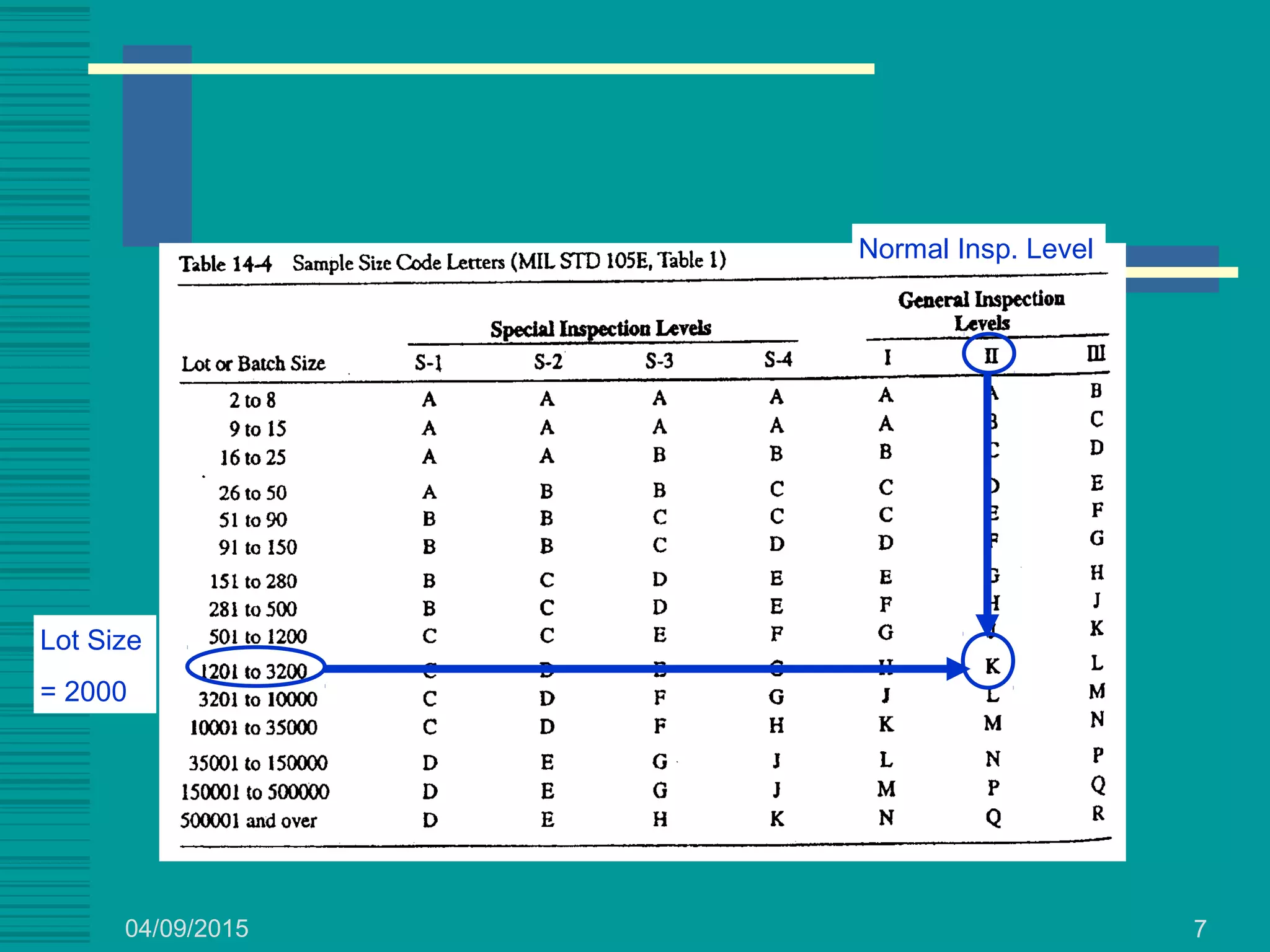
 Suppose product comes from vendor in lots of size 2000
units. The acceptable quality level is 0.65%. Determine the
MIL STD 105E acceptance-sampling system.
04/09/2015 7
Normal Insp. Level
Lot Size
= 2000
04/09/2015 8
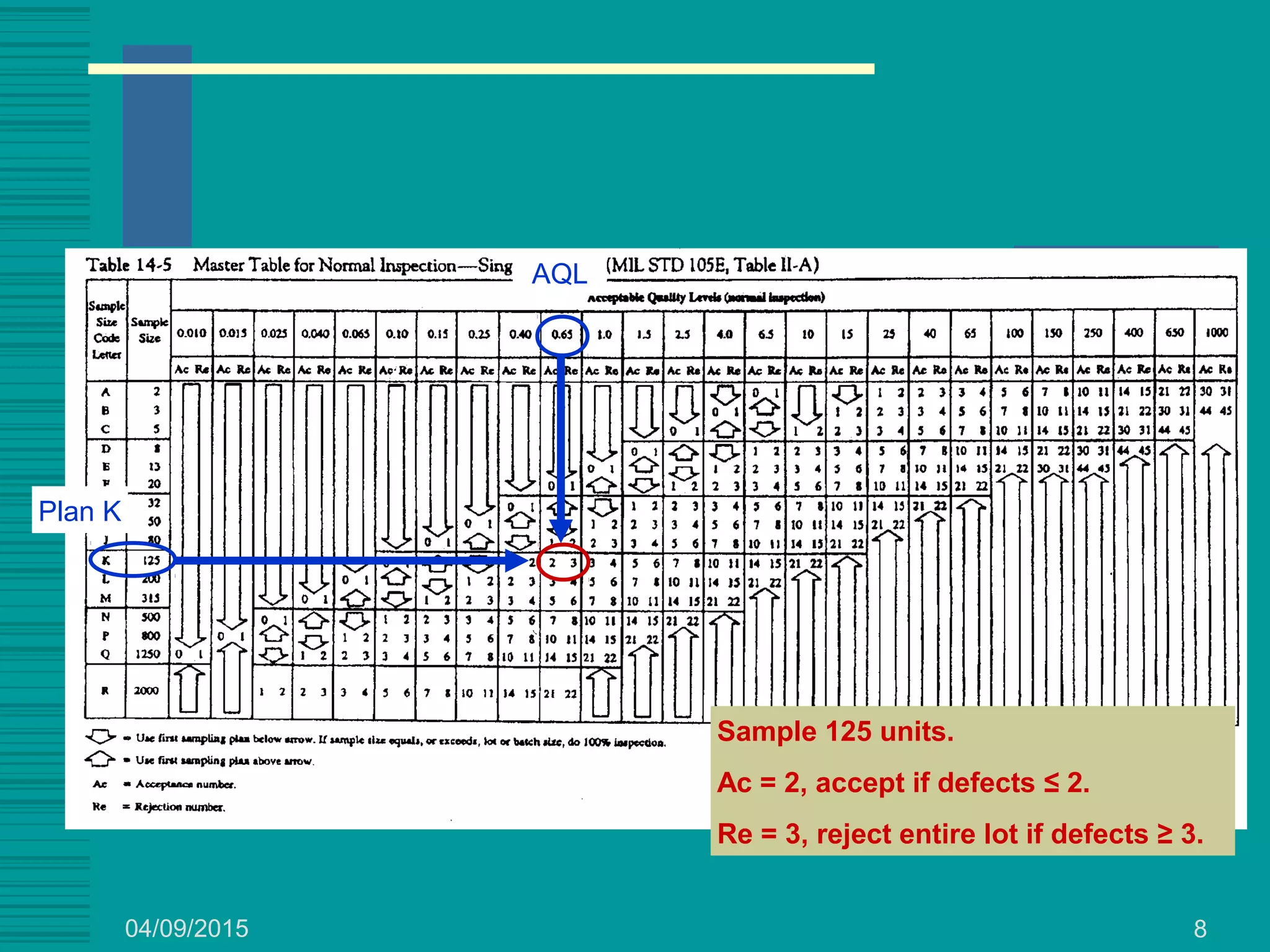
AQL
Plan K
Sample 125 units.
Ac = 2, accept if defects ≤ 2.
Re = 3, reject entire lot if defects ≥ 3.
04/09/2015 9
AQL
Plan K
Sample 125 units
Ac = 1, accept if defects ≤ 1.
Re = 2, reject entire lot if defects ≥ 2.
04/09/2015 10
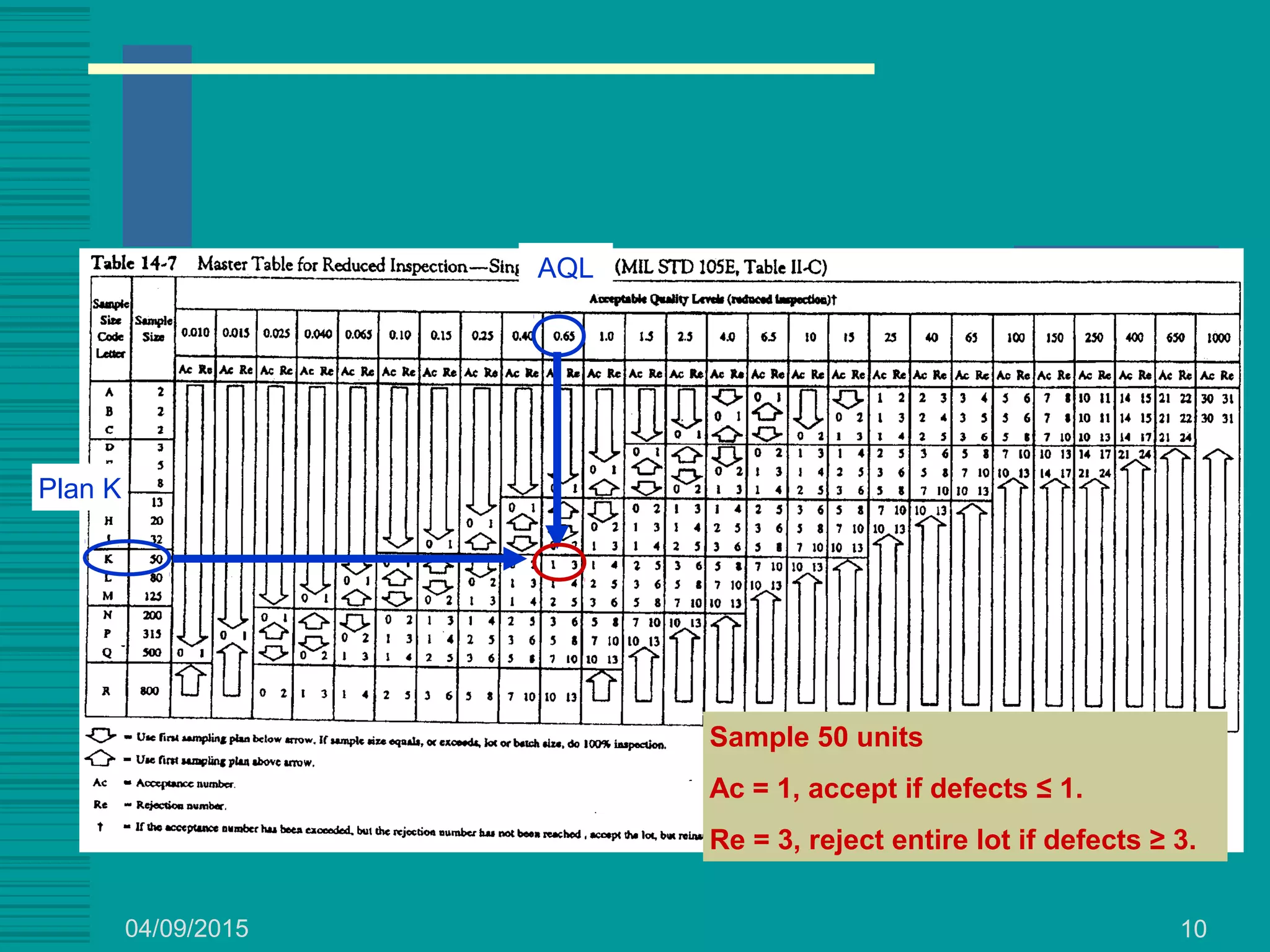
Sample 50 units
Ac = 1, accept if defects ≤ 1.
Re = 3, reject entire lot if defects ≥ 3.
AQL
Plan K
Military Standard 414
 MIL STD 414 is a lot-by-lot acceptance-sampling
plan for variables introduced in 1957.
 Sample sizes are a function of the lot size and
the inspection level.
 All sampling plans assume the quality
characteristic of interest is normally distributed.
04/09/2015 11
Military Standard 414
 MIL STD 414 is divided into four sections:
 A: general description of the sampling plans including
definitions, sample size code letters, and OC curves
for the plans.
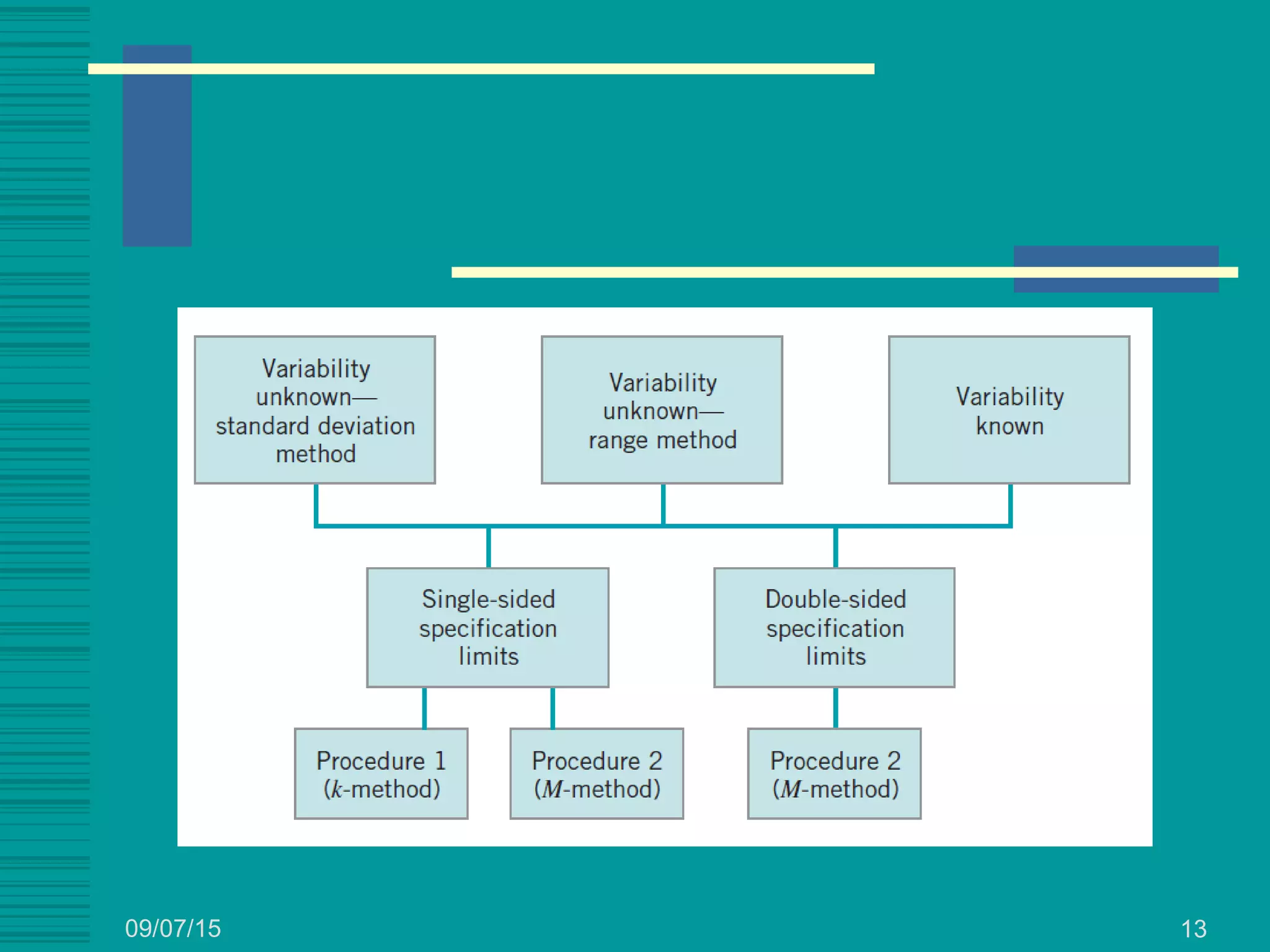
 B: variables sampling plans based on the sample
standard deviation for the case in which the process or
lot variability is unknown.
 C: variables sampling plans based on the sample
range method
 D: variables sampling plans for the case where the
process standard deviation is known.
04/09/2015 12
09/07/15 13
Procedure 1 (k-Method)
04/09/2015 14
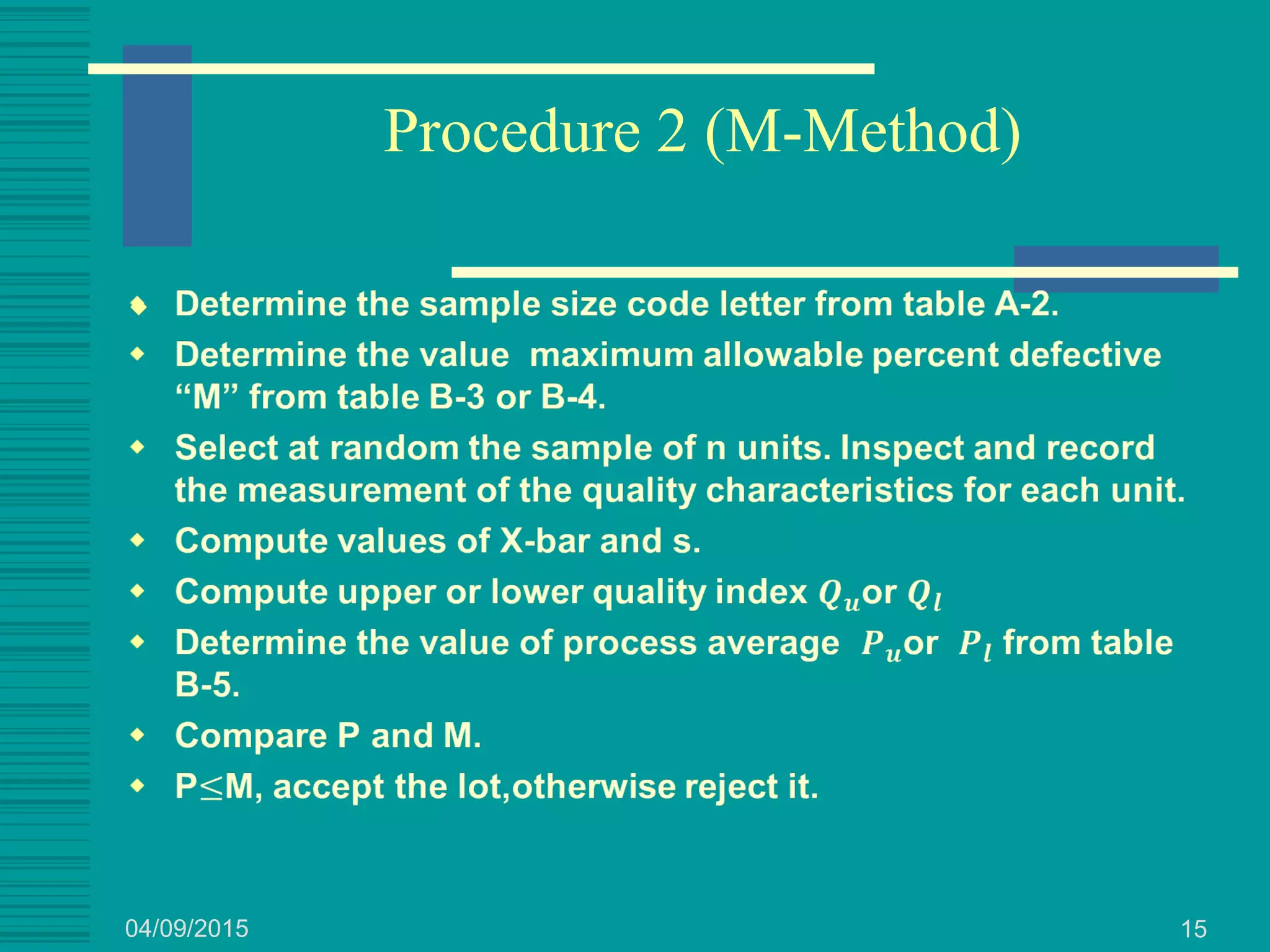
Procedure 2 (M-Method)
04/09/2015 15
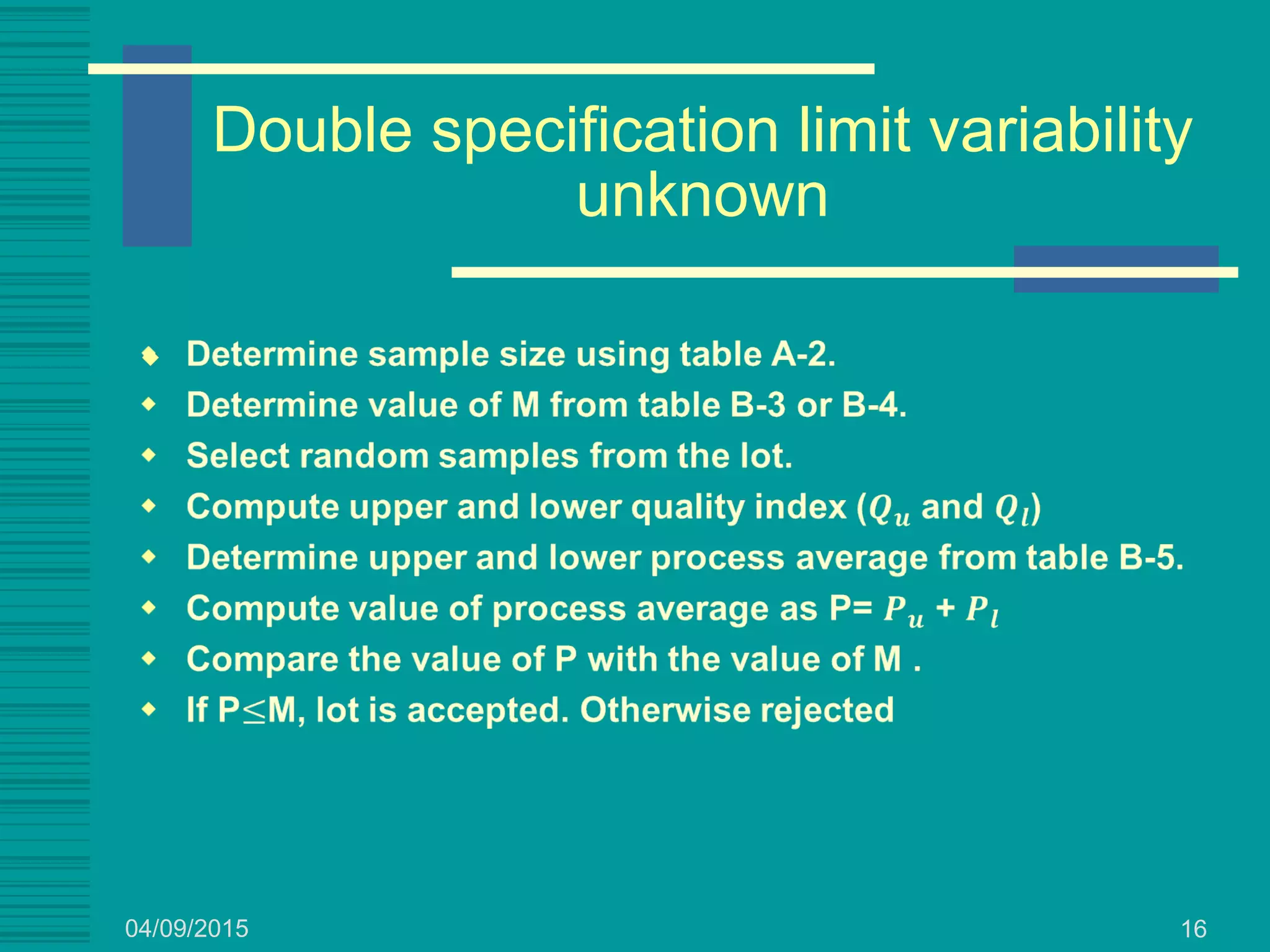
Double specification limit variability
unknown
04/09/2015 16
Example
04/09/2015 17
Range method for variability
unknown
 If mentioned in the question then we will go for
this method.
 In this method all the steps are same as we have
done before only difference is instead of
calculating standard deviation we will calculate
range.
 The table used in this method is C1 or C2 and C3
or C4.
04/09/2015 18
Thank You
09/07/15 19

Military standard 105E and 414

  • 1.
  • 2.
    4.09.2015 2 Military Standard105E  Most widely used acceptance sampling system for attributes  MIL STD 105E is Acceptance Sampling System  collection of sampling schemes  Can be used with single, double or multiple sampling plans  We will consider single sampling plans for this course
  • 3.
    4.09.2015 3 Inspection Types Normal Inspection  Used at start of inspection activity  Tightened Inspection  Instituted when vendor’s recent quality history has deteriorated  Acceptance requirements for lots are more stringent  Reduced Inspection  Instituted when vendor’s recent quality history has been exceptionally good  Sample size is usually smaller than under normal inspection
  • 4.
    04.09.2015 4 Switching Rules -Production Steady - 10 consecutive lots accepted - Approved by responsible authority NormalReduced Tightened - Lot rejected - Irregular production - Lot meets neither accept nor reject criteria - Other conditions warrant return to normal inspection 2 out of 5 consecutive lots rejected 5 consecutive lots accepted 10 consecutive lots remain on tightened inspection Start Discontinue Inspection AND conditions OR conditions
  • 5.
    Procedure for MILSTD 105E  Choose AQL  Choose the inspection level  Determine the lot size  Find the appropriate sample code size letter from table A-1.  Determine the appropriate type of sampling plan to use.  Enter appropriate table to find the type of plan to be used.  Determine the corresponding normal and reduced inspection plans to be used when required. 04.09.2015 5
  • 6.
    04/09/2015 6 Example  Supposeproduct comes from vendor in lots of size 2000 units. The acceptable quality level is 0.65%. Determine the MIL STD 105E acceptance-sampling system.
  • 7.
    04/09/2015 7 Normal Insp.Level Lot Size = 2000
  • 8.
    04/09/2015 8 AQL Plan K Sample125 units. Ac = 2, accept if defects ≤ 2. Re = 3, reject entire lot if defects ≥ 3.
  • 9.
    04/09/2015 9 AQL Plan K Sample125 units Ac = 1, accept if defects ≤ 1. Re = 2, reject entire lot if defects ≥ 2.
  • 10.
    04/09/2015 10 Sample 50units Ac = 1, accept if defects ≤ 1. Re = 3, reject entire lot if defects ≥ 3. AQL Plan K
  • 11.
    Military Standard 414 MIL STD 414 is a lot-by-lot acceptance-sampling plan for variables introduced in 1957.  Sample sizes are a function of the lot size and the inspection level.  All sampling plans assume the quality characteristic of interest is normally distributed. 04/09/2015 11
  • 12.
    Military Standard 414 MIL STD 414 is divided into four sections:  A: general description of the sampling plans including definitions, sample size code letters, and OC curves for the plans.  B: variables sampling plans based on the sample standard deviation for the case in which the process or lot variability is unknown.  C: variables sampling plans based on the sample range method  D: variables sampling plans for the case where the process standard deviation is known. 04/09/2015 12
  • 13.
  • 14.
  • 15.
  • 16.
    Double specification limitvariability unknown 04/09/2015 16
  • 17.
  • 18.
    Range method forvariability unknown  If mentioned in the question then we will go for this method.  In this method all the steps are same as we have done before only difference is instead of calculating standard deviation we will calculate range.  The table used in this method is C1 or C2 and C3 or C4. 04/09/2015 18
  • 19.