Downloaded via google images
Model based on complexity System theory – von Bertalanffy(1967) ‘ pattern which connects’ –Bateson (1979) [ cybernetics – Wiener ( 1940) ] Double bind hypothesis Family homeostasis hypothesis –  Jackson  ( 1957) –> conjoint FT ( similarity to homeopathy) -> paradoxical intervention -> strategic approach.
Model based on complexity Brief therapy- > problem oriented therapy  -> behavioural oriented Systemic approach emphasize on meaning ( Batesonian concept)-> Milan school
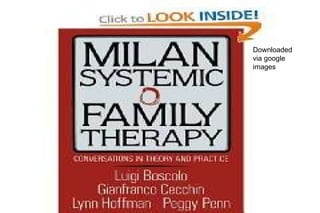
Downloaded  via google images cecchin lugi maraselvini
Milan school- salient features five part therapy sessions. the use of co-therapy and a team behind a screen. a commitment to the guidelines of hypothesizing. circularity and neutrality & circular questioning. end of session interventions involving positive connotation and the prescription of rituals, some of which were apparently paradoxical;
Features long gaps between sessions and the idea that the goal of therapy was altering the family belief system so as to end the symptom –maintaining interactional patterns
Processes Circular causality  Circular questioning. Counter-paradox Family games Hypothesizing Invariant prescription Neutrality
Processes Odd days and even days Positive connotation Problem of the referring person Rituals
Intervention Restructuring (+ve connotation) The simple prescription  (counter paradox, Meta communication) Metaphoric prescription
Team split in 1980 Cecchin and Boscolo  have evolved a non-interventionist style premised on social constructionism  where the therapist’s use of circular questioning opens up space for the client and therapist to co-construct multiple new perspectives on the problem situation Selvini Palazzoli and Prata  developed the strategic aspects of the original model further by outlining the development of particular types of problem maintaining interaction patterns that they referred to as family games. stratergic therapy style-> highly directive)
Summary Each family system develops a unique set of relationships, patterns of interactions and belief systems In healthy families these are sufficiently flexible to promote adaptation to the changing demands of the family lifecycle and the wider ecological system. Unhealthy families hold belief systems that are  not  sufficiently flexible to promote adaptation.
Summary Circular questions asked from positions of curiosity and irreverence (neutrality) to bring forth the family’s construction of the problem. Challenging the family belief system that underpins problem maintaining interaction patterns. Circular questioning within sessions and end of session interventions are used to promote change.
References FAMILY THERAPY Concepts, Process and Practice Second Edition .Alan Carr John Wiley & Sons Ltd, 2006. The Milan Approach to Family Therapy. Guido L burbatti, Laura Formenti.Jason Aronson Inc.1988

Milan school family therapy

  • 1.
  • 2.
    Model based oncomplexity System theory – von Bertalanffy(1967) ‘ pattern which connects’ –Bateson (1979) [ cybernetics – Wiener ( 1940) ] Double bind hypothesis Family homeostasis hypothesis – Jackson ( 1957) –> conjoint FT ( similarity to homeopathy) -> paradoxical intervention -> strategic approach.
  • 3.
    Model based oncomplexity Brief therapy- > problem oriented therapy -> behavioural oriented Systemic approach emphasize on meaning ( Batesonian concept)-> Milan school
  • 4.
    Downloaded viagoogle images cecchin lugi maraselvini
  • 5.
    Milan school- salientfeatures five part therapy sessions. the use of co-therapy and a team behind a screen. a commitment to the guidelines of hypothesizing. circularity and neutrality & circular questioning. end of session interventions involving positive connotation and the prescription of rituals, some of which were apparently paradoxical;
  • 6.
    Features long gapsbetween sessions and the idea that the goal of therapy was altering the family belief system so as to end the symptom –maintaining interactional patterns
  • 7.
    Processes Circular causality Circular questioning. Counter-paradox Family games Hypothesizing Invariant prescription Neutrality
  • 8.
    Processes Odd daysand even days Positive connotation Problem of the referring person Rituals
  • 9.
    Intervention Restructuring (+veconnotation) The simple prescription (counter paradox, Meta communication) Metaphoric prescription
  • 10.
    Team split in1980 Cecchin and Boscolo have evolved a non-interventionist style premised on social constructionism where the therapist’s use of circular questioning opens up space for the client and therapist to co-construct multiple new perspectives on the problem situation Selvini Palazzoli and Prata developed the strategic aspects of the original model further by outlining the development of particular types of problem maintaining interaction patterns that they referred to as family games. stratergic therapy style-> highly directive)
  • 11.
    Summary Each familysystem develops a unique set of relationships, patterns of interactions and belief systems In healthy families these are sufficiently flexible to promote adaptation to the changing demands of the family lifecycle and the wider ecological system. Unhealthy families hold belief systems that are not sufficiently flexible to promote adaptation.
  • 12.
    Summary Circular questionsasked from positions of curiosity and irreverence (neutrality) to bring forth the family’s construction of the problem. Challenging the family belief system that underpins problem maintaining interaction patterns. Circular questioning within sessions and end of session interventions are used to promote change.
  • 13.
    References FAMILY THERAPYConcepts, Process and Practice Second Edition .Alan Carr John Wiley & Sons Ltd, 2006. The Milan Approach to Family Therapy. Guido L burbatti, Laura Formenti.Jason Aronson Inc.1988