
THEORY
 An organized system of accepted knowledge that is
composed of concept, propositions, definitions and
assumptions intended to explain a set of fact, event or
phenomenon.
a)Concept- building blocks of theory.
- it brings mental picture of the properties
and meaning of things.
Example: Love, War, Disease
b) Proposition- explains relationships of different
concepts.
Example: Children who do not want to stay
in the hospital because they are afraid of
needles.
c) Definitions- Composed of various description which
convey a general meaning and reduces vagueness
in understanding a set of concepts.
“Specifies the meaning of a word”
d)Assumption- Statements that specifies the
relationship or connection of factual concept or
phenomenon.
Example: Patients who are not able to take good
care of themselves need nurses.
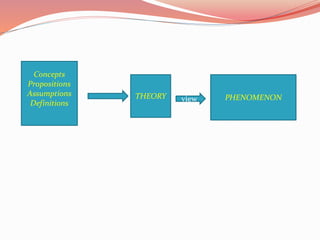
Concepts
Propositions
Assumptions
Definitions
THEORY view PHENOMENON
Characteristics of theory
a) Clarity-”How clear is the theory”
b) Simplicity- “How simple is the theory”
c) Generality- “ How general is the theory”
d) Empirical precision-”How accessible is the theory”
e) Derivable consequences-”How important is the
theory”
Nursing Theory
Group of interrelated concepts that are developed
from various studies of discipline and related
experiences.
Aims to view the essence of nursing care.
Provides foundation of nursing knowledge and gives
direction to nursing practice.
Classification of Nursing
theories according to function
a) Descriptive theories/ Factor isolating theories
 The primary level of theory development.
 They identify and describe major concepts of
phenomena.
 Do not explain the relationship of the concept.
 Purpose: present a phenomenon based on five senses
together with their corresponding meaning.
b) Explanatory theories/ Factor relating theories
 Type of theory that present relationship among
concepts and propositions.
 Aim to provide information on how or why concepts are
related .
 Cause and effect relationship are well explained using
explanatory theories.
c) Predictive theories/ Situation relating theories.
 Achieved when the relationship of concept under a
certain condition are able to describe future outcomes
consistently.
 This kind of theory is generated and tested using
experimental research.
d)Prescriptive theories/ Situation producing theories
 Deal with nursing action, and test the validity and
specific nursing intervention.
 This kind of theory is commonly used in testing new
interventions.
What are nursing paradigms
Pattern or models used to show a clear relationship
among the existing theoretical works in nursing.
Metaparadigms of nursing
a) Person- The recipient of nursing care like individual,
families, and communities.
Example: Florence nightingale proposed that the
physical, intellectual and spiritual being of a person is
not capable of manipulating the environment to
produce health.
-This means that a person is passive recipient of care.
b) Environment- The external and internal aspect of life that
influence the person.
Example: Physical environment is emphasized by
nightingale in her theory.
Example: She focused ventilation, warmth, noise, light,
and cleanliness.
c) Health- The holistic level of wellness that the person
experiences.
Example: Nightingale defined nursing as profession for
women(a calling) with the goal to discover and use the laws
governing health in the service of humanity.
- She believe that the goal of all nursing activity should
promote client’s health.
d) Nursing- The intervention of the nurse rendering care in
support of, or in cooperation with the client.
Example: Nightingale emphasized that a nurse is
responsible in promoting well being of clients by
manipulating the environment.
**These concepts are collectively referred to as metaparadigm
of nursing>
What is philosophy in nursing
 Philosophy is the next knowledge level after
metaparadigm.
It specifies the definition of metaparadigm concepts
in each conceptual models of nursing .
It sets the meaning of phenomena through analysis,
reasoning , and logical argument.
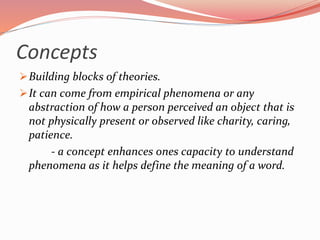
Concepts
Building blocks of theories.
It can come from empirical phenomena or any
abstraction of how a person perceived an object that is
not physically present or observed like charity, caring,
patience.
- a concept enhances ones capacity to understand
phenomena as it helps define the meaning of a word.
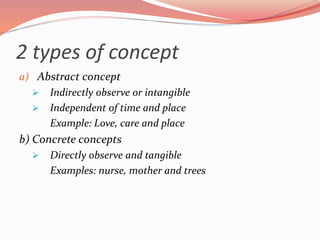
2 types of concept
a) Abstract concept
 Indirectly observe or intangible
 Independent of time and place
Example: Love, care and place
b) Concrete concepts
 Directly observe and tangible
Examples: nurse, mother and trees
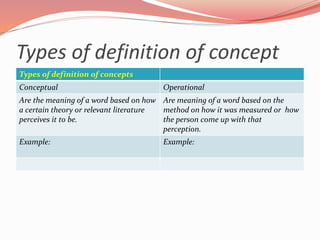
Types of definition of concept
Types of definition of concepts
Conceptual Operational
Are the meaning of a word based on how
a certain theory or relevant literature
perceives it to be.
Are meaning of a word based on the
method on how it was measured or how
the person come up with that
perception.
Example: Example:
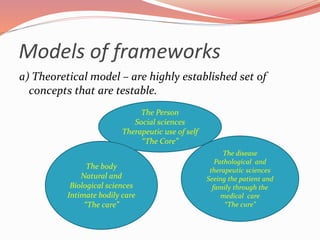
Models of frameworks
a) Theoretical model – are highly established set of
concepts that are testable.
The Person
Social sciences
Therapeutic use of self
“The Core”
The body
Natural and
Biological sciences
Intimate bodily care
“The care”
The disease
Pathological and
therapeutic sciences
Seeing the patient and
family through the
medical care
“The cure”
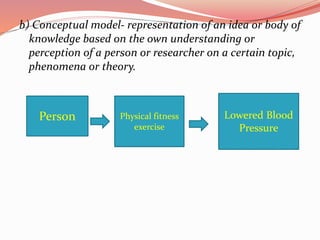
b) Conceptual model- representation of an idea or body of
knowledge based on the own understanding or
perception of a person or researcher on a certain topic,
phenomena or theory.
Person Physical fitness
exercise
Lowered Blood
Pressure
Science
 Latin scientia meaning “knowledge”
Refers to any systematic knowledge or practice in a
discipline of study.
System of acquiring knowledge based on the scientific
method.
It is also an organized boy of knowledge gain through
research.
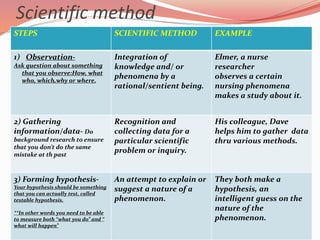
Scientific method
STEPS SCIENTIFIC METHOD EXAMPLE
1) Observation-
Ask question about something
that you observe:How, what
who, which,why or where.
Integration of
knowledge and/ or
phenomena by a
rational/sentient being.
Elmer, a nurse
researcher
observes a certain
nursing phenomena
makes a study about it.
2) Gathering
information/data- Do
background research to ensure
that you don’t do the same
mistake at th past
Recognition and
collecting data for a
particular scientific
problem or inquiry.
His colleague, Dave
helps him to gather data
thru various methods.
3) Forming hypothesis-
Your hypothesis should be something
that you can actually test, called
testable hypothesis.
**In other words you need to be able
to measure both “what you do” and “
what will happen”
An attempt to explain or
suggest a nature of a
phenomenon.
They both make a
hypothesis, an
intelligent guess on the
nature of the
phenomenon.
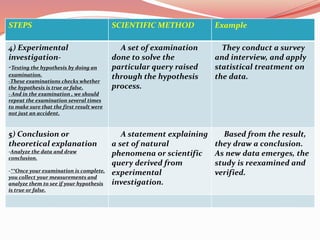
STEPS SCIENTIFIC METHOD Example
4) Experimental
investigation-
-Testing the hypothesis by doing an
examination.
-These examinations checks whether
the hypothesis is true or false.
- And in the examination , we should
repeat the examination several times
to make sure that the first result were
not just an accident.
A set of examination
done to solve the
particular query raised
through the hypothesis
process.
They conduct a survey
and interview, and apply
statistical treatment on
the data.
5) Conclusion or
theoretical explanation
-Analyze the data and draw
conclusion.
-**Once your examination is complete,
you collect your measurements and
analyze them to see if your hypothesis
is true or false.
A statement explaining
a set of natural
phenomena or scientific
query derived from
experimental
investigation.
Based from the result,
they draw a conclusion.
As new data emerges, the
study is reexamined and
verified.
Knowledge
 Information, skills and expertise acquired by a person
through various life experiences or through formal/ learning
such as formal education, self study, vocational.
 The abstract or workable understanding of subject or idea.
 What is known in a particular field of discipline or study .
 Facts and information or awareness or familiarity gained by
experience of a fact or situation.
 There is however no single agreed classification of
knowledge.
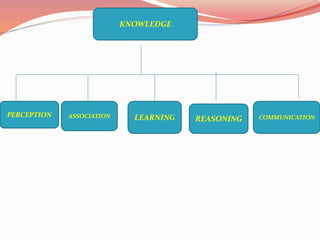
KNOWLEDGE
PERCEPTION ASSOCIATION LEARNING REASONING COMMUNICATION
Types of cognitive process
1) Perception- Achieving understanding of sensory data.
2) Association- combining two or more concepts/ ideas
to form a new concept, or for comparison.
3) Learning- acquiring experiences, skills, information
and values.
4) Reasoning- Mental process of seeking conclusion
through reason.
5) Communication- Transferring data from sender
receiver using different mediums or tools of
communication.
Sources of knowledge
1) Traditional knowledge-
 is a nursing practice which is passed down from generation to
generation.
 “It’s always been practiced this way”
Example: Routine changing of be linens whether soiled or not.
2) Authoritative knowledge
 Idea by a person of authority which is perceived as true because of his or
her expertise.
Example: Nurse supervisor who is an expert teaches a student about giving
an injection.
3) Scientific knowledge
 knowledge came from scientific method through research.
 These new ideas are tested and measured systematically using
objective criteria.
Example: Student nurse providing Tepid sponge bath (TSB) to a patient
who have fever, should know the rationale(reason) behind this
procedure which is heat transfer through evaporation.
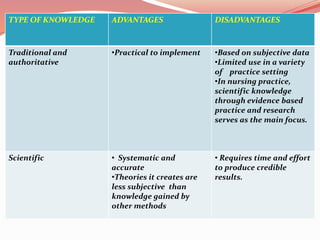
TYPE OF KNOWLEDGE ADVANTAGES DISADVANTAGES
Traditional and
authoritative
‱Practical to implement ‱Based on subjective data
‱Limited use in a variety
of practice setting
‱In nursing practice,
scientific knowledge
through evidence based
practice and research
serves as the main focus.
Scientific ‱ Systematic and
accurate
‱Theories it creates are
less subjective than
knowledge gained by
other methods
‱ Requires time and effort
to produce credible
results.
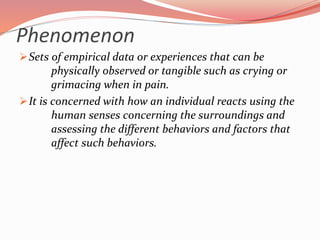
Phenomenon
Sets of empirical data or experiences that can be
physically observed or tangible such as crying or
grimacing when in pain.
It is concerned with how an individual reacts using the
human senses concerning the surroundings and
assessing the different behaviors and factors that
affect such behaviors.
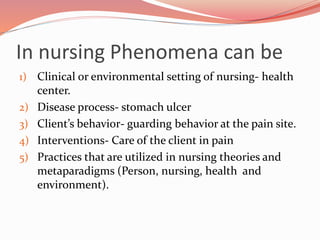
In nursing Phenomena can be
1) Clinical or environmental setting of nursing- health
center.
2) Disease process- stomach ulcer
3) Client’s behavior- guarding behavior at the pain site.
4) Interventions- Care of the client in pain
5) Practices that are utilized in nursing theories and
metaparadigms (Person, nursing, health and
environment).
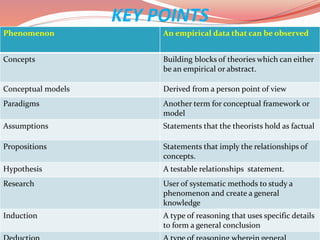
KEY POINTS
Phenomenon An empirical data that can be observed
Concepts Building blocks of theories which can either
be an empirical or abstract.
Conceptual models Derived from a person point of view
Paradigms Another term for conceptual framework or
model
Assumptions Statements that the theorists hold as factual
Propositions Statements that imply the relationships of
concepts.
Hypothesis A testable relationships statement.
Research User of systematic methods to study a
phenomenon and create a general
knowledge
Induction A type of reasoning that uses specific details
to form a general conclusion

Chapter i instructor

  • 2.
    THEORY  An organizedsystem of accepted knowledge that is composed of concept, propositions, definitions and assumptions intended to explain a set of fact, event or phenomenon. a)Concept- building blocks of theory. - it brings mental picture of the properties and meaning of things. Example: Love, War, Disease b) Proposition- explains relationships of different concepts. Example: Children who do not want to stay in the hospital because they are afraid of needles.
  • 3.
    c) Definitions- Composedof various description which convey a general meaning and reduces vagueness in understanding a set of concepts. “Specifies the meaning of a word” d)Assumption- Statements that specifies the relationship or connection of factual concept or phenomenon. Example: Patients who are not able to take good care of themselves need nurses.
  • 4.
  • 5.
    Characteristics of theory a)Clarity-”How clear is the theory” b) Simplicity- “How simple is the theory” c) Generality- “ How general is the theory” d) Empirical precision-”How accessible is the theory” e) Derivable consequences-”How important is the theory”
  • 6.
    Nursing Theory Group ofinterrelated concepts that are developed from various studies of discipline and related experiences. Aims to view the essence of nursing care. Provides foundation of nursing knowledge and gives direction to nursing practice.
  • 7.
    Classification of Nursing theoriesaccording to function a) Descriptive theories/ Factor isolating theories  The primary level of theory development.  They identify and describe major concepts of phenomena.  Do not explain the relationship of the concept.  Purpose: present a phenomenon based on five senses together with their corresponding meaning. b) Explanatory theories/ Factor relating theories  Type of theory that present relationship among concepts and propositions.
  • 8.
     Aim toprovide information on how or why concepts are related .  Cause and effect relationship are well explained using explanatory theories. c) Predictive theories/ Situation relating theories.  Achieved when the relationship of concept under a certain condition are able to describe future outcomes consistently.  This kind of theory is generated and tested using experimental research. d)Prescriptive theories/ Situation producing theories  Deal with nursing action, and test the validity and specific nursing intervention.  This kind of theory is commonly used in testing new interventions.
  • 9.
    What are nursingparadigms Pattern or models used to show a clear relationship among the existing theoretical works in nursing.
  • 10.
    Metaparadigms of nursing a)Person- The recipient of nursing care like individual, families, and communities. Example: Florence nightingale proposed that the physical, intellectual and spiritual being of a person is not capable of manipulating the environment to produce health. -This means that a person is passive recipient of care. b) Environment- The external and internal aspect of life that influence the person. Example: Physical environment is emphasized by nightingale in her theory. Example: She focused ventilation, warmth, noise, light, and cleanliness.
  • 11.
    c) Health- Theholistic level of wellness that the person experiences. Example: Nightingale defined nursing as profession for women(a calling) with the goal to discover and use the laws governing health in the service of humanity. - She believe that the goal of all nursing activity should promote client’s health. d) Nursing- The intervention of the nurse rendering care in support of, or in cooperation with the client. Example: Nightingale emphasized that a nurse is responsible in promoting well being of clients by manipulating the environment. **These concepts are collectively referred to as metaparadigm of nursing>
  • 12.
    What is philosophyin nursing  Philosophy is the next knowledge level after metaparadigm. It specifies the definition of metaparadigm concepts in each conceptual models of nursing . It sets the meaning of phenomena through analysis, reasoning , and logical argument.
  • 13.
    Concepts Building blocks oftheories. It can come from empirical phenomena or any abstraction of how a person perceived an object that is not physically present or observed like charity, caring, patience. - a concept enhances ones capacity to understand phenomena as it helps define the meaning of a word.
  • 14.
    2 types ofconcept a) Abstract concept  Indirectly observe or intangible  Independent of time and place Example: Love, care and place b) Concrete concepts  Directly observe and tangible Examples: nurse, mother and trees
  • 15.
    Types of definitionof concept Types of definition of concepts Conceptual Operational Are the meaning of a word based on how a certain theory or relevant literature perceives it to be. Are meaning of a word based on the method on how it was measured or how the person come up with that perception. Example: Example:
  • 16.
    Models of frameworks a)Theoretical model – are highly established set of concepts that are testable. The Person Social sciences Therapeutic use of self “The Core” The body Natural and Biological sciences Intimate bodily care “The care” The disease Pathological and therapeutic sciences Seeing the patient and family through the medical care “The cure”
  • 17.
    b) Conceptual model-representation of an idea or body of knowledge based on the own understanding or perception of a person or researcher on a certain topic, phenomena or theory. Person Physical fitness exercise Lowered Blood Pressure
  • 18.
    Science  Latin scientiameaning “knowledge” Refers to any systematic knowledge or practice in a discipline of study. System of acquiring knowledge based on the scientific method. It is also an organized boy of knowledge gain through research.
  • 19.
    Scientific method STEPS SCIENTIFICMETHOD EXAMPLE 1) Observation- Ask question about something that you observe:How, what who, which,why or where. Integration of knowledge and/ or phenomena by a rational/sentient being. Elmer, a nurse researcher observes a certain nursing phenomena makes a study about it. 2) Gathering information/data- Do background research to ensure that you don’t do the same mistake at th past Recognition and collecting data for a particular scientific problem or inquiry. His colleague, Dave helps him to gather data thru various methods. 3) Forming hypothesis- Your hypothesis should be something that you can actually test, called testable hypothesis. **In other words you need to be able to measure both “what you do” and “ what will happen” An attempt to explain or suggest a nature of a phenomenon. They both make a hypothesis, an intelligent guess on the nature of the phenomenon.
  • 20.
    STEPS SCIENTIFIC METHODExample 4) Experimental investigation- -Testing the hypothesis by doing an examination. -These examinations checks whether the hypothesis is true or false. - And in the examination , we should repeat the examination several times to make sure that the first result were not just an accident. A set of examination done to solve the particular query raised through the hypothesis process. They conduct a survey and interview, and apply statistical treatment on the data. 5) Conclusion or theoretical explanation -Analyze the data and draw conclusion. -**Once your examination is complete, you collect your measurements and analyze them to see if your hypothesis is true or false. A statement explaining a set of natural phenomena or scientific query derived from experimental investigation. Based from the result, they draw a conclusion. As new data emerges, the study is reexamined and verified.
  • 21.
    Knowledge  Information, skillsand expertise acquired by a person through various life experiences or through formal/ learning such as formal education, self study, vocational.  The abstract or workable understanding of subject or idea.  What is known in a particular field of discipline or study .  Facts and information or awareness or familiarity gained by experience of a fact or situation.  There is however no single agreed classification of knowledge.
  • 22.
  • 23.
    Types of cognitiveprocess 1) Perception- Achieving understanding of sensory data. 2) Association- combining two or more concepts/ ideas to form a new concept, or for comparison. 3) Learning- acquiring experiences, skills, information and values. 4) Reasoning- Mental process of seeking conclusion through reason. 5) Communication- Transferring data from sender receiver using different mediums or tools of communication.
  • 24.
    Sources of knowledge 1)Traditional knowledge-  is a nursing practice which is passed down from generation to generation.  “It’s always been practiced this way” Example: Routine changing of be linens whether soiled or not. 2) Authoritative knowledge  Idea by a person of authority which is perceived as true because of his or her expertise. Example: Nurse supervisor who is an expert teaches a student about giving an injection. 3) Scientific knowledge  knowledge came from scientific method through research.  These new ideas are tested and measured systematically using objective criteria. Example: Student nurse providing Tepid sponge bath (TSB) to a patient who have fever, should know the rationale(reason) behind this procedure which is heat transfer through evaporation.
  • 25.
    TYPE OF KNOWLEDGEADVANTAGES DISADVANTAGES Traditional and authoritative ‱Practical to implement ‱Based on subjective data ‱Limited use in a variety of practice setting ‱In nursing practice, scientific knowledge through evidence based practice and research serves as the main focus. Scientific ‱ Systematic and accurate ‱Theories it creates are less subjective than knowledge gained by other methods ‱ Requires time and effort to produce credible results.
  • 26.
    Phenomenon Sets of empiricaldata or experiences that can be physically observed or tangible such as crying or grimacing when in pain. It is concerned with how an individual reacts using the human senses concerning the surroundings and assessing the different behaviors and factors that affect such behaviors.
  • 27.
    In nursing Phenomenacan be 1) Clinical or environmental setting of nursing- health center. 2) Disease process- stomach ulcer 3) Client’s behavior- guarding behavior at the pain site. 4) Interventions- Care of the client in pain 5) Practices that are utilized in nursing theories and metaparadigms (Person, nursing, health and environment).
  • 28.
    KEY POINTS Phenomenon Anempirical data that can be observed Concepts Building blocks of theories which can either be an empirical or abstract. Conceptual models Derived from a person point of view Paradigms Another term for conceptual framework or model Assumptions Statements that the theorists hold as factual Propositions Statements that imply the relationships of concepts. Hypothesis A testable relationships statement. Research User of systematic methods to study a phenomenon and create a general knowledge Induction A type of reasoning that uses specific details to form a general conclusion