MIGRAINE AURA
Saber Jan
PGY-3 Pediatric neurology
Introduction
■ 25% of patients with migraine can have aura
■ Typical migraine auras are characterized by gradual development
■ Duration from 5 min but not longer than one hour, a mix of positive and negative
features with complete reversibility
Presentation
■ Positive symptoms:
– Indicates active discharge from central nervous system neurons.
– Visual (eg, bright lines, shapes, objects): the most common
– Auditory (eg, tinnitus, noises, music)
– Somatosensory (eg, burning, pain, paresthesia),
– Motor (eg, jerking or repetitive rhythmic movements).
■ Negative symptoms indicate an absence or loss of function, such as loss of vision,
hearing, feeling, or ability to move a part of the body.
ICDH-3 criteria for migraine with aura
A. At least two attacks fulfilling criteria B andC
B. One or more of the following fully reversible aura
symptoms:
1. visual
2. sensory
3. speech and/or language
4. motor
5. brainstem
6. retinal
C. At least three of the following six characteristics:
1. at least one aura symptom spreads gradually over 5 minutes
2. two or more aura symptoms occur in succession
3. each individual aura symptom lasts 5–60 minutes
4. at least one aura symptom is unilateral
5. at least one aura symptom is positive
6. the aura is accompanied, or followed within 60 minutes, by headache
D. Not better accounted for by another ICHD-3 diagnosis
Migraine with typical aura
■ Description: Migraine with aura, in which aura consists of visual and/or sensory and/or
speech/language symptoms, but no motor weakness, and is characterized by gradual
development, duration of each symptom no longer than one hour, a mix of positive
and negative features and complete reversibility
Visual aura
■ Most common 90%.
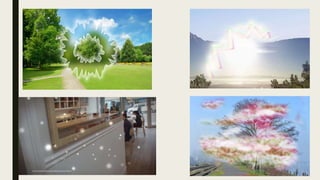
■ Zigzag figure near the point of fixation that may gradually spread right or left and
assume a laterally convex shape with an angulated scintillating edge
■ Scotoma
■ Scotoma without positive phenomena may occur; this is often perceived as being of
acute onset but, on scrutiny, usually. enlarges gradually.
Sensory
■ Tingling in one limb or on one side of the face.
■ Migrates across one side of the face or down the limb
■ The sensory aura may also move inside the mouth, affecting the buccal mucosa and half the
tongue.
Speech/language
■ Language auras cause transient problems that may run the gamut from mild wording
difficulties to frank dysphasia with paraphasic errors.
Motor aura (hemiplegic migraine)
■ ICHD Diagnostic criteria:
■ A. Attacks fulfilling criteria for Migraine with aura and criterion B below
■ B. Aura consisting of both of the following:
■ 1. fully reversible motor weakness
■ 2. fully reversible visual
■ N.B. Motor symptoms generally last less than 72 hours but, in some patients, motor
weakness may persist for weeks.
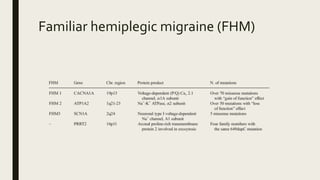
Familiar hemiplegic migraine (FHM)
Migraine with brainstem aura (aka
basilar migraine)
■ Almost always have additional typical aura symptoms.
■ ICHD Diagnostic criteria:
■ A. Attacks fulfilling criteria for 1.2 Migraine with aura and criterion B below
■ B. Aura with both of the following:
■ 1. at least two of the following fully reversible brainstem symptoms:
a. dysarthria
b. vertigo
c. tinnitus
d. hypacusis: hearing loss
e. diplopia
f. ataxia not attributable to sensory deficit
g. decreased level of consciousness (GCS <13)
■ 2. no motor or retinal symptoms.
Retina
■ Description: Repeated attacks of monocular visual disturbance, including scintillations,
scotomata or blindness, associated with migraine headache.
■ Retinal migraine is an extremely rare cause of transient monocular visual loss.
■ Cases of permanent monocular visual loss associated with migraine have been described.
However, other common causes should be excluded.
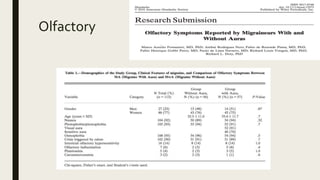
Olfactory
Red flags forTIA/Stroke
■ First time after age 40
■ When symptoms are exclusively negative (e.g. hemianopia)
■ When aura is prolonged or very short
Typical aura without headache (TAWH)
or acephalgic migraine aura
■ The incidence of these phenomena in migraine patients is 3% in women and about 1%
in men
■ Few case reports
■ Usually there is history of migraine
Pathophysiology
■ Regional cerebral blood flow is decreased in the cortex corresponding to the clinically
affected area and often over a wider area.
■ Blood flow reduction usually starts posteriorly and spreads anteriorly, and is usually
above the ischaemic threshold.
■ Cortical spreading depression (CSD): In the 1940s, Leao, described an
electrophysiological event, characterized by cortical hyperexcitation followed by
suppression, which originated and migrated over the cortical surface of experimental
animals at a slow rate of 3–4 mm per minute after mechanical or chemical
stimulations.
Why it’s important?
■ Most attempts to treat the aura involve the use of preventive drugs, although, to date,
none has been successful in affecting the aura in blinded placebo-controlled studies
■ Reduction in headache frequency > reduction in aura episodes
■ Risk of stroke in patients who are on contraception
References
■ Headache ClassificationCommittee of the International Headache Society (IHS).The
InternationalClassification of Headache Disorders, 3rd edition (beta version).
Cephalalgia 2013; 33:629.
■ Cutrer FM, Huerter K. Migraine aura. Neurologist 2007; 13:118.
■ Fornazieri, M.A., Neto, A. R., Pinna, F. D., Porto, F. H., Navarro, P. D.,Voegels, R. L., &
Doty, R. L. (2016). Olfactory symptoms reported by migraineurs with and without
auras. Headache:The Journal of Head and Face Pain, 56(10), 1608-1616.
doi:10.1111/head.12973

Migraine Aura

  • 1.
    MIGRAINE AURA Saber Jan PGY-3Pediatric neurology
  • 2.
    Introduction ■ 25% ofpatients with migraine can have aura ■ Typical migraine auras are characterized by gradual development ■ Duration from 5 min but not longer than one hour, a mix of positive and negative features with complete reversibility
  • 3.
    Presentation ■ Positive symptoms: –Indicates active discharge from central nervous system neurons. – Visual (eg, bright lines, shapes, objects): the most common – Auditory (eg, tinnitus, noises, music) – Somatosensory (eg, burning, pain, paresthesia), – Motor (eg, jerking or repetitive rhythmic movements). ■ Negative symptoms indicate an absence or loss of function, such as loss of vision, hearing, feeling, or ability to move a part of the body.
  • 4.
    ICDH-3 criteria formigraine with aura A. At least two attacks fulfilling criteria B andC B. One or more of the following fully reversible aura symptoms: 1. visual 2. sensory 3. speech and/or language 4. motor 5. brainstem 6. retinal C. At least three of the following six characteristics: 1. at least one aura symptom spreads gradually over 5 minutes 2. two or more aura symptoms occur in succession 3. each individual aura symptom lasts 5–60 minutes 4. at least one aura symptom is unilateral 5. at least one aura symptom is positive 6. the aura is accompanied, or followed within 60 minutes, by headache D. Not better accounted for by another ICHD-3 diagnosis
  • 5.
    Migraine with typicalaura ■ Description: Migraine with aura, in which aura consists of visual and/or sensory and/or speech/language symptoms, but no motor weakness, and is characterized by gradual development, duration of each symptom no longer than one hour, a mix of positive and negative features and complete reversibility
  • 6.
    Visual aura ■ Mostcommon 90%. ■ Zigzag figure near the point of fixation that may gradually spread right or left and assume a laterally convex shape with an angulated scintillating edge ■ Scotoma ■ Scotoma without positive phenomena may occur; this is often perceived as being of acute onset but, on scrutiny, usually. enlarges gradually.
  • 8.
    Sensory ■ Tingling inone limb or on one side of the face. ■ Migrates across one side of the face or down the limb ■ The sensory aura may also move inside the mouth, affecting the buccal mucosa and half the tongue.
  • 9.
    Speech/language ■ Language aurascause transient problems that may run the gamut from mild wording difficulties to frank dysphasia with paraphasic errors.
  • 10.
    Motor aura (hemiplegicmigraine) ■ ICHD Diagnostic criteria: ■ A. Attacks fulfilling criteria for Migraine with aura and criterion B below ■ B. Aura consisting of both of the following: ■ 1. fully reversible motor weakness ■ 2. fully reversible visual ■ N.B. Motor symptoms generally last less than 72 hours but, in some patients, motor weakness may persist for weeks.
  • 11.
  • 12.
    Migraine with brainstemaura (aka basilar migraine) ■ Almost always have additional typical aura symptoms. ■ ICHD Diagnostic criteria: ■ A. Attacks fulfilling criteria for 1.2 Migraine with aura and criterion B below ■ B. Aura with both of the following: ■ 1. at least two of the following fully reversible brainstem symptoms: a. dysarthria b. vertigo c. tinnitus d. hypacusis: hearing loss e. diplopia f. ataxia not attributable to sensory deficit g. decreased level of consciousness (GCS <13) ■ 2. no motor or retinal symptoms.
  • 13.
    Retina ■ Description: Repeatedattacks of monocular visual disturbance, including scintillations, scotomata or blindness, associated with migraine headache. ■ Retinal migraine is an extremely rare cause of transient monocular visual loss. ■ Cases of permanent monocular visual loss associated with migraine have been described. However, other common causes should be excluded.
  • 14.
  • 15.
    Red flags forTIA/Stroke ■First time after age 40 ■ When symptoms are exclusively negative (e.g. hemianopia) ■ When aura is prolonged or very short
  • 16.
    Typical aura withoutheadache (TAWH) or acephalgic migraine aura ■ The incidence of these phenomena in migraine patients is 3% in women and about 1% in men ■ Few case reports ■ Usually there is history of migraine
  • 17.
    Pathophysiology ■ Regional cerebralblood flow is decreased in the cortex corresponding to the clinically affected area and often over a wider area. ■ Blood flow reduction usually starts posteriorly and spreads anteriorly, and is usually above the ischaemic threshold. ■ Cortical spreading depression (CSD): In the 1940s, Leao, described an electrophysiological event, characterized by cortical hyperexcitation followed by suppression, which originated and migrated over the cortical surface of experimental animals at a slow rate of 3–4 mm per minute after mechanical or chemical stimulations.
  • 18.
    Why it’s important? ■Most attempts to treat the aura involve the use of preventive drugs, although, to date, none has been successful in affecting the aura in blinded placebo-controlled studies ■ Reduction in headache frequency > reduction in aura episodes ■ Risk of stroke in patients who are on contraception
  • 19.
    References ■ Headache ClassificationCommitteeof the International Headache Society (IHS).The InternationalClassification of Headache Disorders, 3rd edition (beta version). Cephalalgia 2013; 33:629. ■ Cutrer FM, Huerter K. Migraine aura. Neurologist 2007; 13:118. ■ Fornazieri, M.A., Neto, A. R., Pinna, F. D., Porto, F. H., Navarro, P. D.,Voegels, R. L., & Doty, R. L. (2016). Olfactory symptoms reported by migraineurs with and without auras. Headache:The Journal of Head and Face Pain, 56(10), 1608-1616. doi:10.1111/head.12973

Editor's Notes

  • #15 Phantosmia (phantom smell), also called an olfactory hallucination,  cacosmia (Gk.), is an olfactory dysfunction that is characterized by the inability of the brain to properly identify an odor's "natural" smell.[1] What happens instead, is that the natural odor is transcribed into what is most often described as an unpleasant aroma, typically a "'burned,' 'rotting,' 'fecal,' or 'chemical' smell".[2] There are instances, however, of pleasant odors; this is more specifically called euosmia (Greek).[3]