BY,
NANDHU MADHUKUMAR
CONFLICT COLLABORATION &
COMPETITION ,SENSITIVITY
TRAINING
CONFLICT
Conflict may be defined as a struggle or contest
between people with opposing needs, ideas,
beliefs, values, or goals. Conflict on teams is
inevitable; however,
The results of conflict are not predetermined.
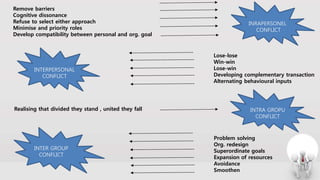
INRAPERSONEL
CONFLICT
Remove barriers
Cognitive dissonance
Refuse to select either approach
Minimise and priority roles
Develop compatibility between personal and org. goal
INTERPERSONAL
CONFLICT
Lose-lose
Win-win
Lose-win
Developing complementary transaction
Alternating behavioural inputs
INTRA GROPU
CONFLICT
Realising that divided they stand , united they fall
INTER GROUP
CONFLICT
Problem solving
Org. redesign
Superordinate goals
Expansion of resources
Avoidance
Smoothen
Intrapersonal conflict
– Occurs within an individual
• Threat to a person’s values
• Feeling of unfair treatment
Interpersonal conflict
– Between two or more people
– Differences in views about what should be done
– Efforts to get more resources
Intragroup conflict
– Conflict among members of a group
– Early stages of group development
– Ways of doing tasks or reaching group's goals
Intergroup conflict : between two or more groups
CONFLICT STYLES
The Competing Style is when you stress your position without considering
opposing points of view. This style is highly assertive with minimal
cooperativeness; the goal is to win .The competing style is used when a
person has to take quick action
The Avoiding Style is when you do not satisfy your concerns or the
concerns of the other person .This style is low assertiveness and low coopera
-tiveness.
The Compromising Style is finding a middle ground or forgoing some of
your concerns and committing to other's concerns. This style is moderately
assertive and moderately cooperative; the goal is to find middle ground.
The compromising style is used with issues of moderate importance, when
both parties are equally powerful and equally committed to opposing views.
COLLABORATION
Uses:
 To find an integrative solution when both sets of concerns are too
important to be compromised.
 When your objective is to learn – e.g., testing your own assumptions,
understanding the views of others.
 To merge insights from people with different perspectives on a
problem.
 To gain commitment by incorporating other's concerns into a
consensual decision.
 To work through hard feelings which have been interfering with an
interpersonal relationship.
COMPETITION
When you are participating in a contest where there are
many others contestants trying to win a trophy or any other
prize, it is said to be a competition. Students in a class
compete with each other not just to get the highest marks
from the teacher but also to rise higher than others in the
eyes of the teachers. Competition can be there inside a
family also where two brothers or sisters compete with each
other for recognition and respect from parents or other
members of the family.
DIFFERENCE BETWEEN CONFLICT AND COMPETITION
 Conflict involves discord and disagreement whereas competition can take place
without any clash or hard feelings.
 Competition is a healthy process that encourages intelligence, innovation, and
entrepreneurship whereas conflict crushes all such concepts.
 In real life, conflict is inevitable because all people are different from one another
and different viewpoints lead to conflict.
SENSITIVITY TRAINING
 The most commonly used Organizational Development intervention
is sensitivity training.
 It is called laboratory training as it is conducted by creating an
experimental laboratory situation in which employees are brought
together, in groups, to interact in an unstructured environment.
 The members are encouraged to interact with new members and
new individual behaviours.
THE OBJECTIVES OF LABORATORY TRAINING ARE
 To help people understand themselves better
 Some people never understand why they feel and act as they do and how the others feel about them.
 Some people are insensitive to the effects of their behaviour upon others and their orders upon
subordinates
 Laboratory training helps such people to understand the impact of their behaviour on others.
 Most of the people concentrate on what they are going to say rather than what the others are saying.
 This training develops the communication skills of the employers and develops them as good listeners
 It also helps the participants to form into informal groups and teams and work more effectively
Migp

Migp

  • 1.
    BY, NANDHU MADHUKUMAR CONFLICT COLLABORATION& COMPETITION ,SENSITIVITY TRAINING
  • 2.
    CONFLICT Conflict may bedefined as a struggle or contest between people with opposing needs, ideas, beliefs, values, or goals. Conflict on teams is inevitable; however, The results of conflict are not predetermined.
  • 3.
    INRAPERSONEL CONFLICT Remove barriers Cognitive dissonance Refuseto select either approach Minimise and priority roles Develop compatibility between personal and org. goal INTERPERSONAL CONFLICT Lose-lose Win-win Lose-win Developing complementary transaction Alternating behavioural inputs INTRA GROPU CONFLICT Realising that divided they stand , united they fall INTER GROUP CONFLICT Problem solving Org. redesign Superordinate goals Expansion of resources Avoidance Smoothen
  • 4.
    Intrapersonal conflict – Occurswithin an individual • Threat to a person’s values • Feeling of unfair treatment Interpersonal conflict – Between two or more people – Differences in views about what should be done – Efforts to get more resources Intragroup conflict – Conflict among members of a group – Early stages of group development – Ways of doing tasks or reaching group's goals Intergroup conflict : between two or more groups
  • 5.
    CONFLICT STYLES The CompetingStyle is when you stress your position without considering opposing points of view. This style is highly assertive with minimal cooperativeness; the goal is to win .The competing style is used when a person has to take quick action The Avoiding Style is when you do not satisfy your concerns or the concerns of the other person .This style is low assertiveness and low coopera -tiveness. The Compromising Style is finding a middle ground or forgoing some of your concerns and committing to other's concerns. This style is moderately assertive and moderately cooperative; the goal is to find middle ground. The compromising style is used with issues of moderate importance, when both parties are equally powerful and equally committed to opposing views.
  • 6.
    COLLABORATION Uses:  To findan integrative solution when both sets of concerns are too important to be compromised.  When your objective is to learn – e.g., testing your own assumptions, understanding the views of others.  To merge insights from people with different perspectives on a problem.  To gain commitment by incorporating other's concerns into a consensual decision.  To work through hard feelings which have been interfering with an interpersonal relationship.
  • 7.
    COMPETITION When you areparticipating in a contest where there are many others contestants trying to win a trophy or any other prize, it is said to be a competition. Students in a class compete with each other not just to get the highest marks from the teacher but also to rise higher than others in the eyes of the teachers. Competition can be there inside a family also where two brothers or sisters compete with each other for recognition and respect from parents or other members of the family.
  • 8.
    DIFFERENCE BETWEEN CONFLICTAND COMPETITION  Conflict involves discord and disagreement whereas competition can take place without any clash or hard feelings.  Competition is a healthy process that encourages intelligence, innovation, and entrepreneurship whereas conflict crushes all such concepts.  In real life, conflict is inevitable because all people are different from one another and different viewpoints lead to conflict.
  • 9.
    SENSITIVITY TRAINING  Themost commonly used Organizational Development intervention is sensitivity training.  It is called laboratory training as it is conducted by creating an experimental laboratory situation in which employees are brought together, in groups, to interact in an unstructured environment.  The members are encouraged to interact with new members and new individual behaviours.
  • 10.
    THE OBJECTIVES OFLABORATORY TRAINING ARE  To help people understand themselves better  Some people never understand why they feel and act as they do and how the others feel about them.  Some people are insensitive to the effects of their behaviour upon others and their orders upon subordinates  Laboratory training helps such people to understand the impact of their behaviour on others.  Most of the people concentrate on what they are going to say rather than what the others are saying.  This training develops the communication skills of the employers and develops them as good listeners  It also helps the participants to form into informal groups and teams and work more effectively