An Ounce of Prevention or a  Metric Ton of Cure It’s Your Choice…  David Rosenthal President Commodity/Cashew Concern Certification January 19, 2009 PTNPA  Annual Convention and Trade Show  Grand Bahama Island
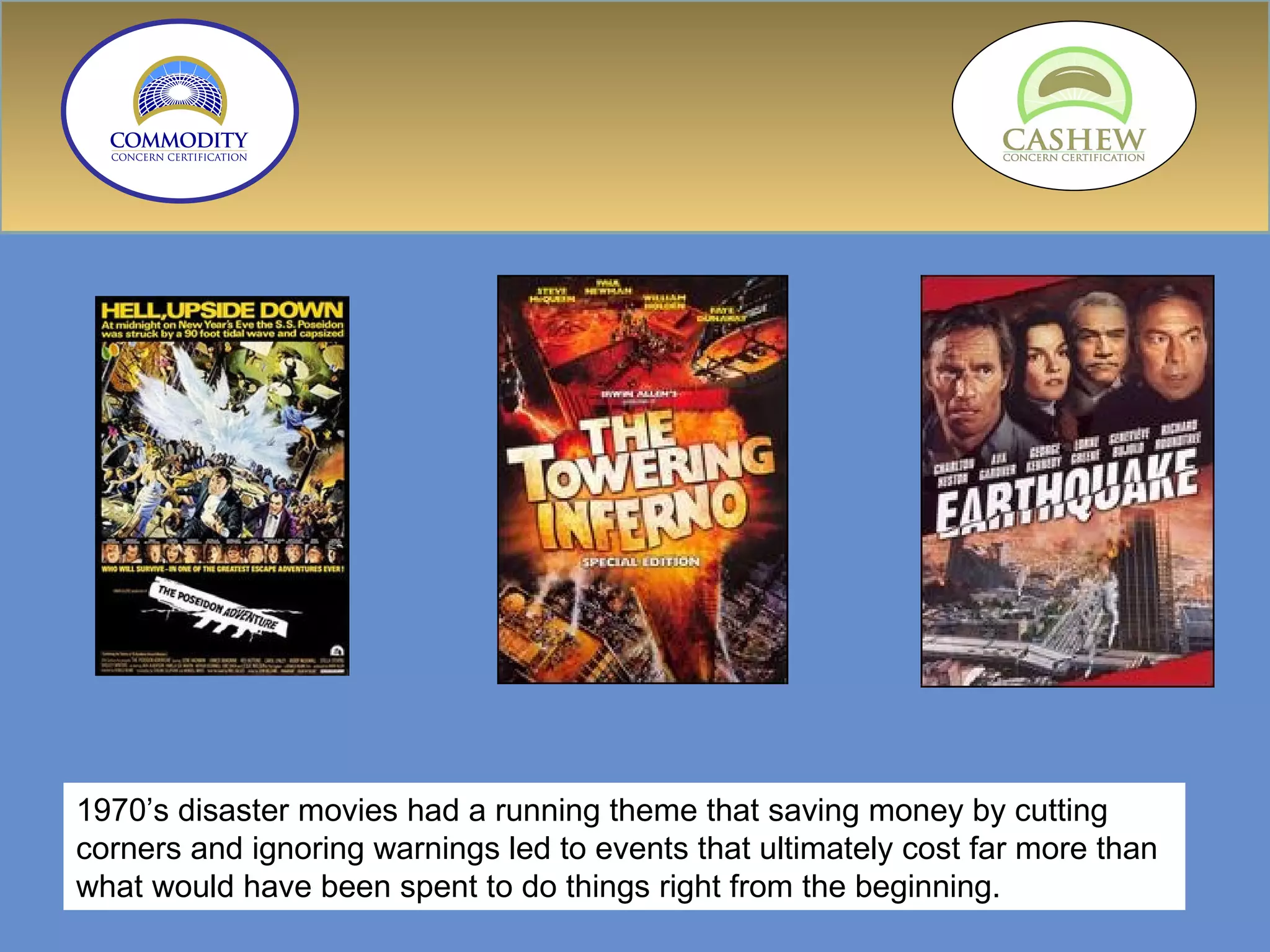
1970’s disaster movies had a running theme that saving money by cutting corners and ignoring warnings led to events that ultimately cost far more than what would have been spent to do things right from the beginning.
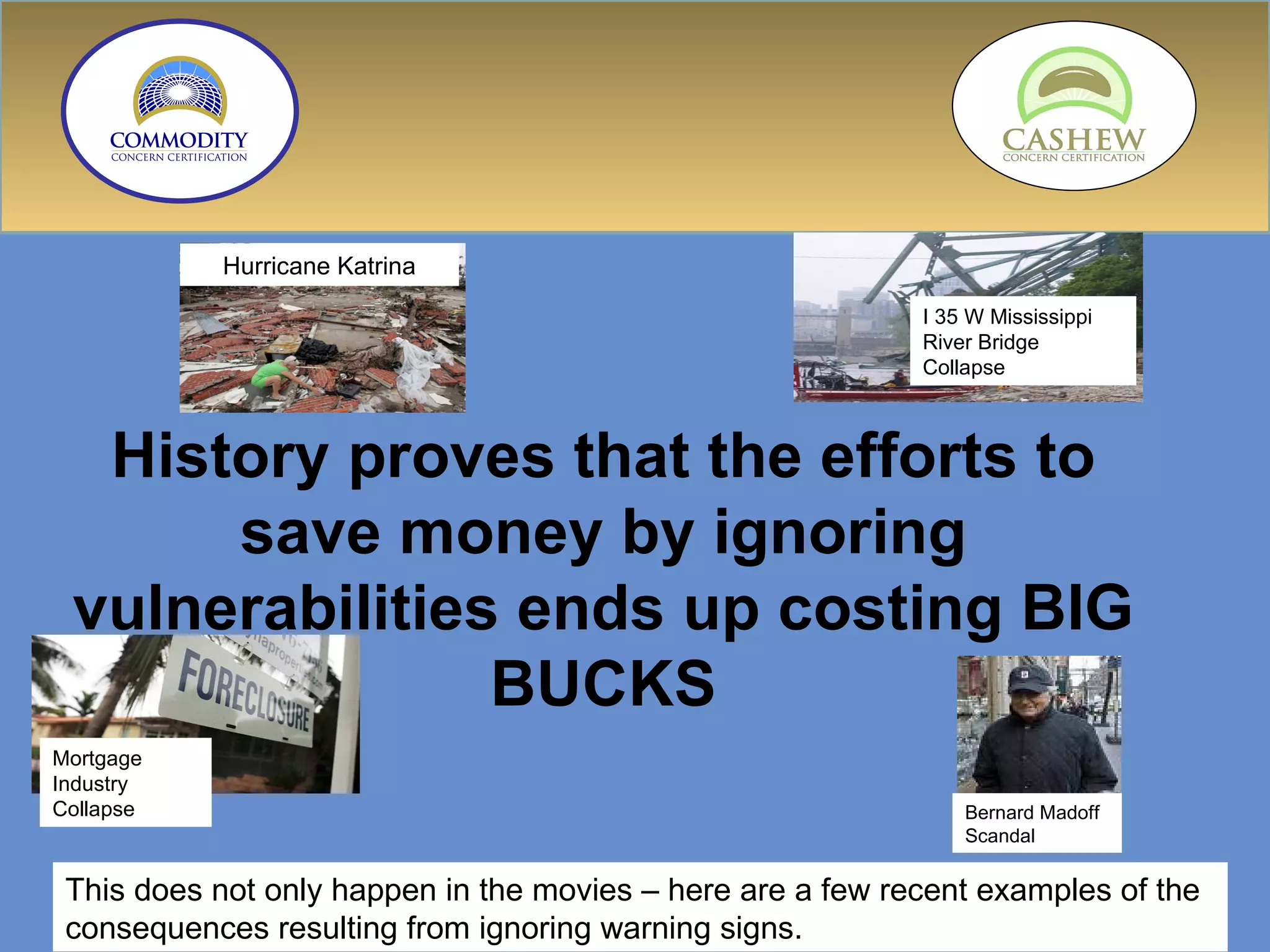
History proves that the efforts to save money by ignoring vulnerabilities ends up costing BIG BUCKS This does not only happen in the movies – here are a few recent examples of the consequences resulting from ignoring warning signs. Mortgage Industry Collapse Bernard Madoff Scandal Hurricane Katrina I 35 W Mississippi River Bridge Collapse
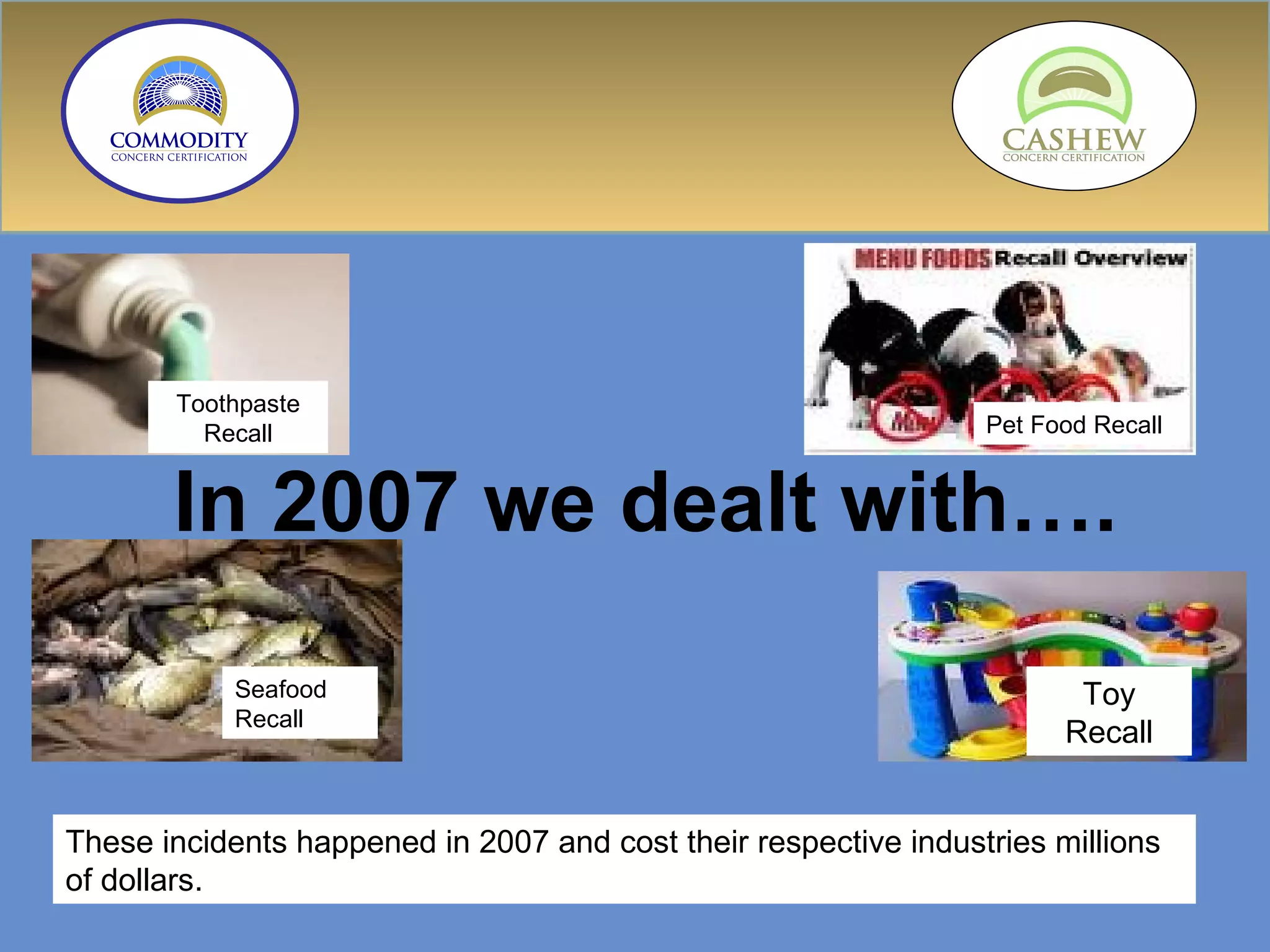
In 2007 we dealt with…. These incidents happened in 2007 and cost their respective industries millions of dollars. Seafood Recall Toy Recall Pet Food Recall Toothpaste Recall
And in 2008…… It even hit the nut industry ! In 2008, the trend continues and even hit the nut industry.  The chlorophenol issue did not become a public incident, but serves as a warning sign to our industry that there are vulnerabilities in overseas processing that must be addressed. Tomato Recall Melamine in Baby Formula Chlorophenol in Cashews
This was a warning sign As opposed to the recent peanut butter recall, the chlorophenol issue did not become a public incident, but serves as a warning sign to our industry that there are vulnerabilities in overseas processing that must be addressed.
We have a two choices:  Ignore the issues and hope they go away Take proactive measures to avoid potential consequences
Know where your product is coming from Expand your sources of information Know your ultimate supplier Right now, the only source of information on conditions in overseas processing facilities is from the importing sector, who have historically given few details.
All terms buyers hear, but what do they mean? Small Shipper Good Shipper Group Packer Top Shipper Medium Shipper Reliable Shipper Buyers hear various terms relating to the caliber of shipper.  These are clearly arbitrary and have no clearly defined criteria.
How can we ensure that we are buying from facilities that subscribe to Good Manufacturing Practices? This can be accomplished through verifiable third party certification.
Do we have verifiable information to document  Good Manufacturing  Practices? At present, certifications are difficult to verify.
Documentation  What’s more important?  The certificate,  or what it represents? Is what it represents verifiable? As buyers, are we more concerned about getting the certificate or what that certificate actually represents?  We put our companies in a vulnerable position if the certification that we are relying upon proves to be unfounded.
Right now there is no industry wide protocol to track product from the source Tracking Recently food safety incidents have revealed the necessity for traceability.  At present there is no way for us to effectively track imported food products back to their source of production.
What measures has the importing sector taken to ensure responsible sourcing practices? At present, the importing sector has no industry-wide  program to ensure responsible sourcing practices.
In the past problems have been dealt with then the product reaches our.. Borders Warehouses Production Lines  Why not take measures to prevent problems before product is shipped?
This costs $$$$ and wasted time because the product is already here!  IT’S TIME TO ADOPT A PREVENTATIVE APPROACH!  A great deal of money and time is spent dealing with problems when the product is already here.  A preventative approach would save companies needless expenses and significantly reduce the chances of a consumer incident.
Everyone in the food chain takes responsibility for their own part and checks their suppliers.  Authorities can then carry out surveillance of the system and effectively investigate incidents if they should arise.  If an incident should occur, at least the industry has a system in place to present to the authorities. Not having a system in place to ensure traceability and responsible food sourcing will highlight our deficiencies, and would present an embarrassment to the industry.
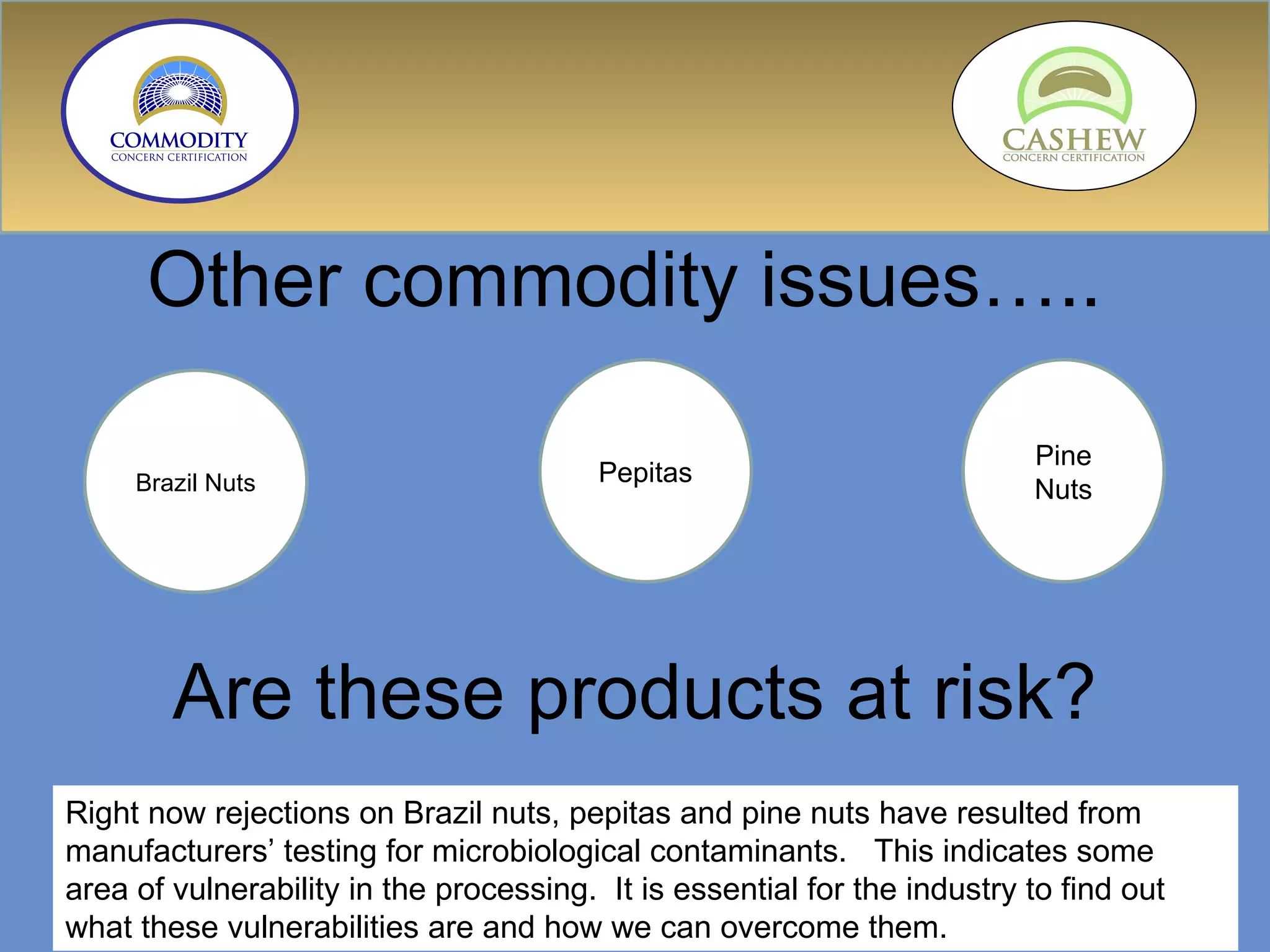
Other commodity issues…..  Are these products at risk?  Brazil Nuts Pepitas Pine Nuts Right now rejections on Brazil nuts, pepitas and pine nuts have resulted from manufacturers’ testing for microbiological contaminants.  This indicates some area of vulnerability in the processing.  It is essential for the industry to find out what these vulnerabilities are and how we can overcome them.
What do we do now? NOTHING if we don’t know about it We don’t know if no one talks about it What do we do if we find out about it? STERILIZATION  –  is this the best defense? If we are not aware of these issues there is no way for us to take measures to protect our companies, and the ultimate consumer.  Addressing the problems and not being afraid of them will put us in a stronger position.  Sterilization is a partial solution to some food borne contaminants.
We have two choices… React to problems when they get here…will this be acceptable practice in the future? Prevention Adopting policies for a mandatory kill step when these contaminants are found will ensure industry-wide protection.  However adopting a preventative approach at origin to ensure the integrity of the product and the facility where it is manufactured is a more complete solution.
Prevention… Thoroughly know where product is sourced through effective 3 rd  party audits.  Implement industry wide tracking procedures to trace product back to  source.
Working with Food Importers who care about responsible sourcing, not just Commodity Traders. IT’S YOUR CHOICE Historically these imported products have been viewed solely as a traded commodity.  We must not forget that these commodities are ultimately consumed by the public.
We need to act now, and not wait. New Democratic executive branch who has more concern about food safety and responsible sourcing issues Increased consumer concern about the origins of food products Increased legislation with stiffer penalties and more restrictive food importing procedures. Working with legislators to develop systems that satisfy both government and business. Although the economy is on the forefront of legislators’ agenda, this does not mean that we should ignore responsible sourcing initiatives.  Having a system in place will put us ahead of the game.  Keep in mind that food safety and responsible sourcing are still in the top five priorities of the new administration.
January 2009  FDA issues Draft of Good Importer Practices. Establish a Product Safety Management Program Knowing the Product and Applicable U.S. Requirements Verifying Product and Firm Compliance with U.S. Requirements throughout the Supply Chain and Product Life Cycle; and Taking Corrective and Preventive Action When the Imported Product or Firm is not Compliant with U.S. Requirements This draft of Good Importer Practices, issued by the FDA in collaboration with several regulatory agencies, shows the necessity of an industry-wide responsible sourcing campaign and attention to preventative action when vulnerabilities are detected.
Change is imminent Let’s be a part of it ! Commodity Concern and Cashew Concern have been developed to address these very issues, and to help the importing community to adapt to these changing conditions through a turnkey program designed specifically for our industry.  Call David Rosenthal at 804-745-2848 if you have any questions, comments or suggestions.
CONTACT: David Rosenthal President Commodity Concern Certification/Cashew Concern Certification 9947 Hull Street Road Unit 112 Richmond, VA  23236 Tel: 804-745-2848 (office) 804-240-4237 Info @cashewconcern.com  www. cashewconcern.com  www. commodityconcern.com
Commodity Concern Certification Offering Solutions for the Global Marketplace

An Ounce Of Prevention Ptnpa 2009 Annotated

  • 1.
  • 2.
    An Ounce ofPrevention or a Metric Ton of Cure It’s Your Choice… David Rosenthal President Commodity/Cashew Concern Certification January 19, 2009 PTNPA Annual Convention and Trade Show Grand Bahama Island
  • 3.
    1970’s disaster movieshad a running theme that saving money by cutting corners and ignoring warnings led to events that ultimately cost far more than what would have been spent to do things right from the beginning.
  • 4.
    History proves thatthe efforts to save money by ignoring vulnerabilities ends up costing BIG BUCKS This does not only happen in the movies – here are a few recent examples of the consequences resulting from ignoring warning signs. Mortgage Industry Collapse Bernard Madoff Scandal Hurricane Katrina I 35 W Mississippi River Bridge Collapse
  • 5.
    In 2007 wedealt with…. These incidents happened in 2007 and cost their respective industries millions of dollars. Seafood Recall Toy Recall Pet Food Recall Toothpaste Recall
  • 6.
    And in 2008……It even hit the nut industry ! In 2008, the trend continues and even hit the nut industry. The chlorophenol issue did not become a public incident, but serves as a warning sign to our industry that there are vulnerabilities in overseas processing that must be addressed. Tomato Recall Melamine in Baby Formula Chlorophenol in Cashews
  • 7.
    This was awarning sign As opposed to the recent peanut butter recall, the chlorophenol issue did not become a public incident, but serves as a warning sign to our industry that there are vulnerabilities in overseas processing that must be addressed.
  • 8.
    We have atwo choices: Ignore the issues and hope they go away Take proactive measures to avoid potential consequences
  • 9.
    Know where yourproduct is coming from Expand your sources of information Know your ultimate supplier Right now, the only source of information on conditions in overseas processing facilities is from the importing sector, who have historically given few details.
  • 10.
    All terms buyershear, but what do they mean? Small Shipper Good Shipper Group Packer Top Shipper Medium Shipper Reliable Shipper Buyers hear various terms relating to the caliber of shipper. These are clearly arbitrary and have no clearly defined criteria.
  • 11.
    How can weensure that we are buying from facilities that subscribe to Good Manufacturing Practices? This can be accomplished through verifiable third party certification.
  • 12.
    Do we haveverifiable information to document Good Manufacturing Practices? At present, certifications are difficult to verify.
  • 13.
    Documentation What’smore important? The certificate, or what it represents? Is what it represents verifiable? As buyers, are we more concerned about getting the certificate or what that certificate actually represents? We put our companies in a vulnerable position if the certification that we are relying upon proves to be unfounded.
  • 14.
    Right now thereis no industry wide protocol to track product from the source Tracking Recently food safety incidents have revealed the necessity for traceability. At present there is no way for us to effectively track imported food products back to their source of production.
  • 15.
    What measures hasthe importing sector taken to ensure responsible sourcing practices? At present, the importing sector has no industry-wide program to ensure responsible sourcing practices.
  • 16.
    In the pastproblems have been dealt with then the product reaches our.. Borders Warehouses Production Lines Why not take measures to prevent problems before product is shipped?
  • 17.
    This costs $$$$and wasted time because the product is already here! IT’S TIME TO ADOPT A PREVENTATIVE APPROACH! A great deal of money and time is spent dealing with problems when the product is already here. A preventative approach would save companies needless expenses and significantly reduce the chances of a consumer incident.
  • 18.
    Everyone in thefood chain takes responsibility for their own part and checks their suppliers. Authorities can then carry out surveillance of the system and effectively investigate incidents if they should arise. If an incident should occur, at least the industry has a system in place to present to the authorities. Not having a system in place to ensure traceability and responsible food sourcing will highlight our deficiencies, and would present an embarrassment to the industry.
  • 19.
    Other commodity issues….. Are these products at risk? Brazil Nuts Pepitas Pine Nuts Right now rejections on Brazil nuts, pepitas and pine nuts have resulted from manufacturers’ testing for microbiological contaminants. This indicates some area of vulnerability in the processing. It is essential for the industry to find out what these vulnerabilities are and how we can overcome them.
  • 20.
    What do wedo now? NOTHING if we don’t know about it We don’t know if no one talks about it What do we do if we find out about it? STERILIZATION – is this the best defense? If we are not aware of these issues there is no way for us to take measures to protect our companies, and the ultimate consumer. Addressing the problems and not being afraid of them will put us in a stronger position. Sterilization is a partial solution to some food borne contaminants.
  • 21.
    We have twochoices… React to problems when they get here…will this be acceptable practice in the future? Prevention Adopting policies for a mandatory kill step when these contaminants are found will ensure industry-wide protection. However adopting a preventative approach at origin to ensure the integrity of the product and the facility where it is manufactured is a more complete solution.
  • 22.
    Prevention… Thoroughly knowwhere product is sourced through effective 3 rd party audits. Implement industry wide tracking procedures to trace product back to source.
  • 23.
    Working with FoodImporters who care about responsible sourcing, not just Commodity Traders. IT’S YOUR CHOICE Historically these imported products have been viewed solely as a traded commodity. We must not forget that these commodities are ultimately consumed by the public.
  • 24.
    We need toact now, and not wait. New Democratic executive branch who has more concern about food safety and responsible sourcing issues Increased consumer concern about the origins of food products Increased legislation with stiffer penalties and more restrictive food importing procedures. Working with legislators to develop systems that satisfy both government and business. Although the economy is on the forefront of legislators’ agenda, this does not mean that we should ignore responsible sourcing initiatives. Having a system in place will put us ahead of the game. Keep in mind that food safety and responsible sourcing are still in the top five priorities of the new administration.
  • 25.
    January 2009 FDA issues Draft of Good Importer Practices. Establish a Product Safety Management Program Knowing the Product and Applicable U.S. Requirements Verifying Product and Firm Compliance with U.S. Requirements throughout the Supply Chain and Product Life Cycle; and Taking Corrective and Preventive Action When the Imported Product or Firm is not Compliant with U.S. Requirements This draft of Good Importer Practices, issued by the FDA in collaboration with several regulatory agencies, shows the necessity of an industry-wide responsible sourcing campaign and attention to preventative action when vulnerabilities are detected.
  • 26.
    Change is imminentLet’s be a part of it ! Commodity Concern and Cashew Concern have been developed to address these very issues, and to help the importing community to adapt to these changing conditions through a turnkey program designed specifically for our industry. Call David Rosenthal at 804-745-2848 if you have any questions, comments or suggestions.
  • 27.
    CONTACT: David RosenthalPresident Commodity Concern Certification/Cashew Concern Certification 9947 Hull Street Road Unit 112 Richmond, VA 23236 Tel: 804-745-2848 (office) 804-240-4237 Info @cashewconcern.com www. cashewconcern.com www. commodityconcern.com
  • 28.
    Commodity Concern CertificationOffering Solutions for the Global Marketplace