CIT: Voice of the Middle MarketTM 
Perspectives from the Heart of the 
U.S. Economy 
CIT’s 2014 Voice of the Middle MarketTM study 
examines the perspectives of U.S. middle market 
executives on the U.S. economy, the availability 
of financing and the health of their companies. 
This year’s study also assessed respondents’ 
perspectives on the upcoming 2014 mid-term 
elections and 2016 presidential election. 
Results from the 2014 CIT: Voice of the Middle 
Market study show that the economic outlook 
of senior middle market executives is trending 
upwards, as compared to opinions from 2013. 
Middle market executives are favorable about the 
state of their own companies, with many describing 
it as strong. Few say they are worse off today as 
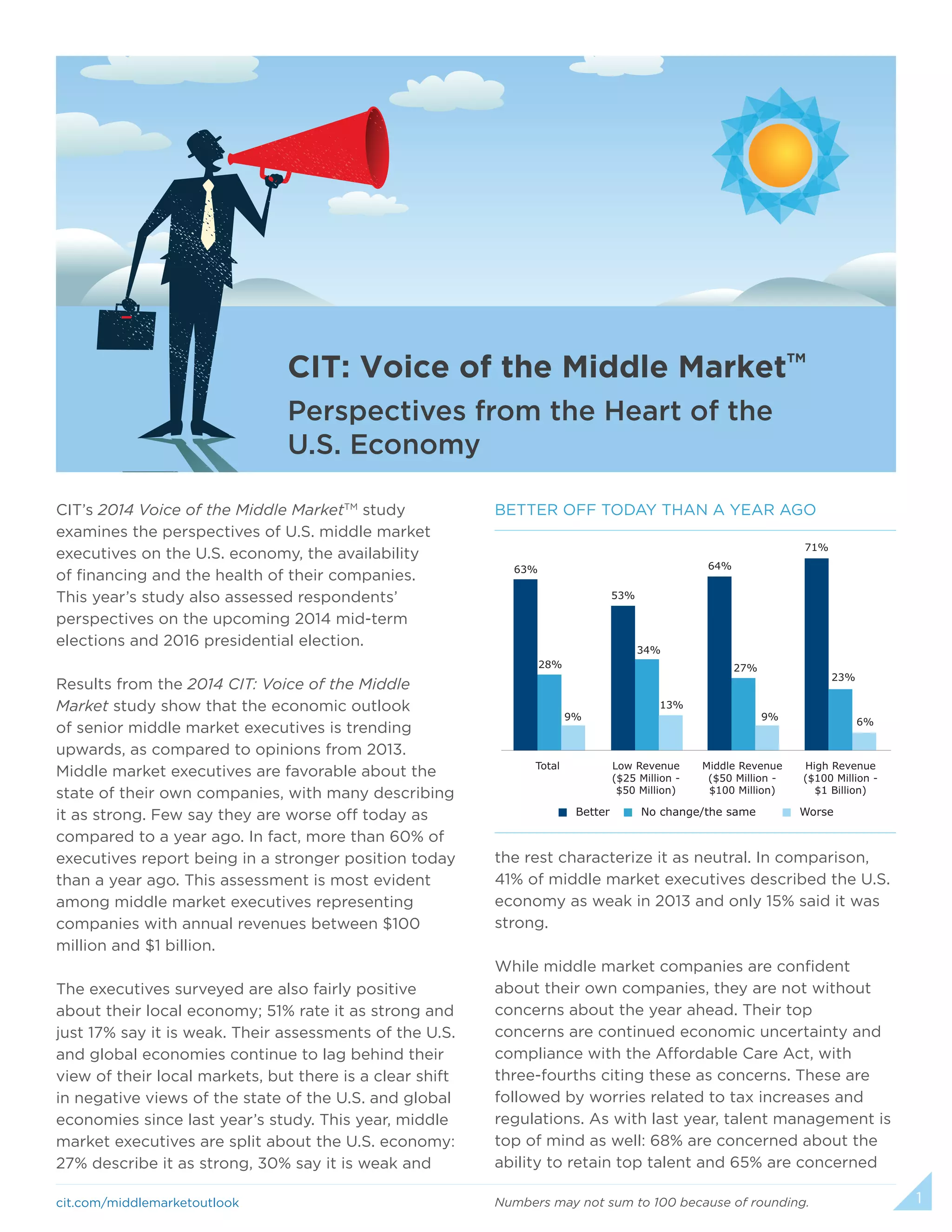
compared to a year ago. In fact, more than 60% of 
executives report being in a stronger position today 
than a year ago. This assessment is most evident 
among middle market executives representing 
companies with annual revenues between $100 
million and $1 billion. 
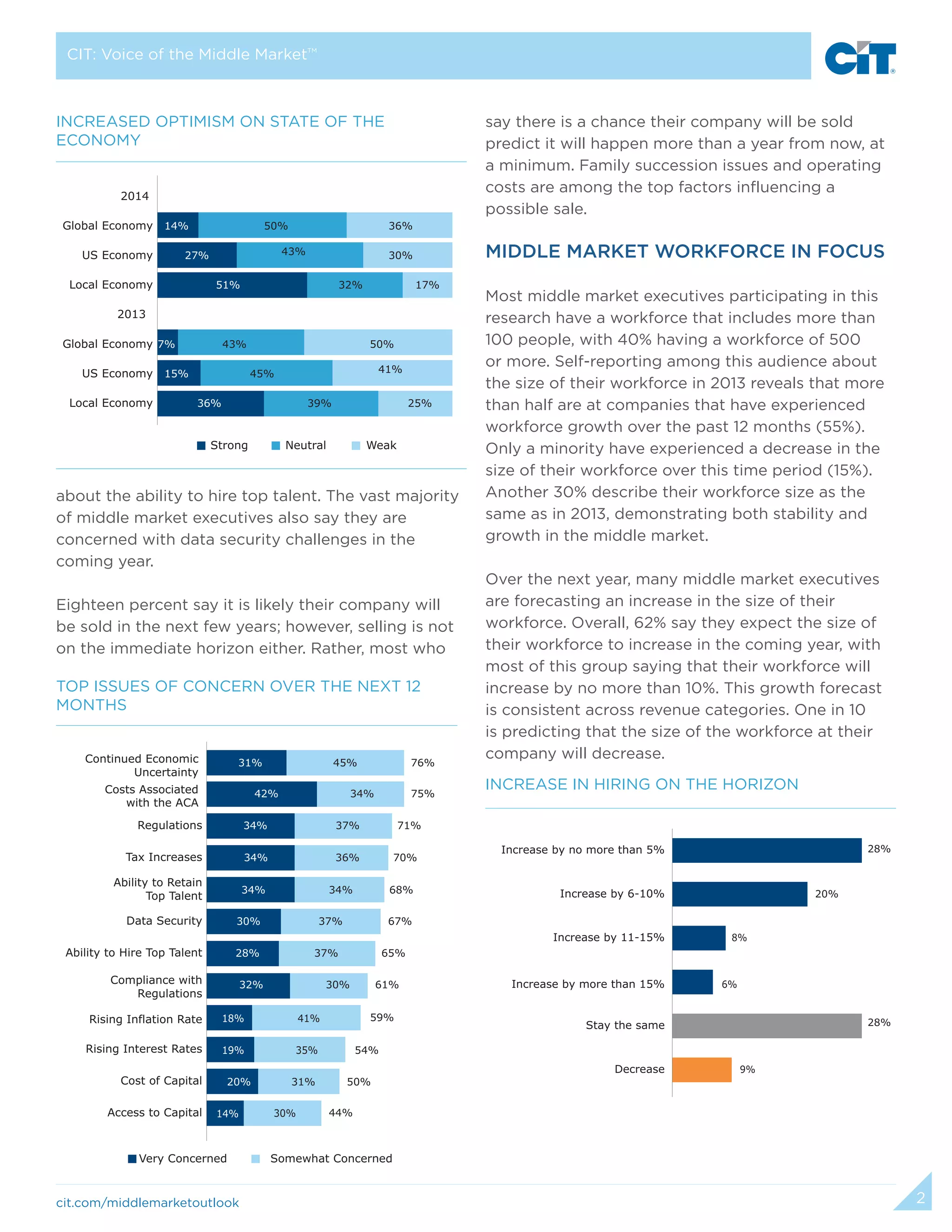
The executives surveyed are also fairly positive 
about their local economy; 51% rate it as strong and 
just 17% say it is weak. Their assessments of the U.S. 
and global economies continue to lag behind their 
view of their local markets, but there is a clear shift 
in negative views of the state of the U.S. and global 
economies since last year’s study. This year, middle 
market executives are split about the U.S. economy: 
27% describe it as strong, 30% say it is weak and 
BETTER OFF TODAY THAN A YEAR AGO 
63% 64% 
71% 
53% 
34% 
27% 
23% 
13% 
9% 9% 6% 
Total Low Revenue 
($25 Million - 
$50 Million) 
Middle Revenue 
($50 Million - 
$100 Million) 
High Revenue 
($100 Million - 
$1 Billion) 
Better No change/the same Worse 
28% 
the rest characterize it as neutral. In comparison, 
41% of middle market executives described the U.S. 
economy as weak in 2013 and only 15% said it was 
strong. 
While middle market companies are confident 
about their own companies, they are not without 
concerns about the year ahead. Their top 
concerns are continued economic uncertainty and 
compliance with the Affordable Care Act, with 
three-fourths citing these as concerns. These are 
followed by worries related to tax increases and 
regulations. As with last year, talent management is 
top of mind as well: 68% are concerned about the 
ability to retain top talent and 65% are concerned 
cit.com/middlemarketoutlook 1 
Numbers may not sum to 100 because of rounding.
2 
CIT: Voice of the Middle MarketTM 
Increased Optimism on State of the 
Economy 
2014 
Global Economy 
US Economy 
Local Economy 
Global Economy 
US Economy 
14% 50% 36% 
43% 30% 
7% 43% 50% 
15% 45% 41% 
about the ability to hire top talent. The vast majority 
of middle market executives also say they are 
concerned with data security challenges in the 
coming year. 
Eighteen percent say it is likely their company will 
be sold in the next few years; however, selling is not 
on the immediate horizon either. Rather, most who 
Top Issues of Concern OVER THE NEXT 12 
MONTHS 
Continued Economic 
Uncertainty 
31% 45% 76% 
Costs Associated 
with the ACA 
Regulations 
Tax Increases 
Ability to Retain 
Top Talent 
42% 34% 75% 
Data Security 30% 
Ability to Hire Top Talent 
Compliance with 
Regulations 
Rising Inflation Rate 
Rising Interest Rates 
28% 
37% 
36% 
34% 68% 
37% 
67% 
37% 65% 
18% 41% 59% 
54% 
Cost of Capital 20% 31% 50% 
Access to Capital 
19% 
14% 
cit.com/middlemarketoutlook 
say there is a chance their company will be sold 
predict it will happen more than a year from now, at 
a minimum. Family succession issues and operating 
costs are among the top factors influencing a 
possible sale. 
Middle Market Workforce in Focus 
Most middle market executives participating in this 
research have a workforce that includes more than 
100 people, with 40% having a workforce of 500 
or more. Self-reporting among this audience about 
the size of their workforce in 2013 reveals that more 
than half are at companies that have experienced 
workforce growth over the past 12 months (55%). 
Only a minority have experienced a decrease in the 
size of their workforce over this time period (15%). 
Another 30% describe their workforce size as the 
same as in 2013, demonstrating both stability and 
growth in the middle market. 
Over the next year, many middle market executives 
are forecasting an increase in the size of their 
workforce. Overall, 62% say they expect the size of 
their workforce to increase in the coming year, with 
most of this group saying that their workforce will 
increase by no more than 10%. This growth forecast 
is consistent across revenue categories. One in 10 
is predicting that the size of the workforce at their 
company will decrease. 
2013 
Local Economy 
Strong Neutral Weak 
27% 
51% 32% 17% 
36% 39% 25% 
Increase by no more than 5% 
Increase by 6-10% 
Increase by 11-15% 
Increase by more than 15% 
Stay the same 
Decrease 
8% 
9% 
28% 
28% 
6% 
20% 
Increase in Hiring on the Horizon 
35% 
30% 
44% 
Very Concerned Somewhat Concerned 
71% 
70% 
34% 
34% 
34% 
32% 30% 61%
3 
CIT: Voice of the Middle MarketTM 
New Hiring Needed To Accommodate Future 
Growth 
Increase Business 
Demand/Opportunities 
Need to Innovate to Stay 
Ahead in the Industry 
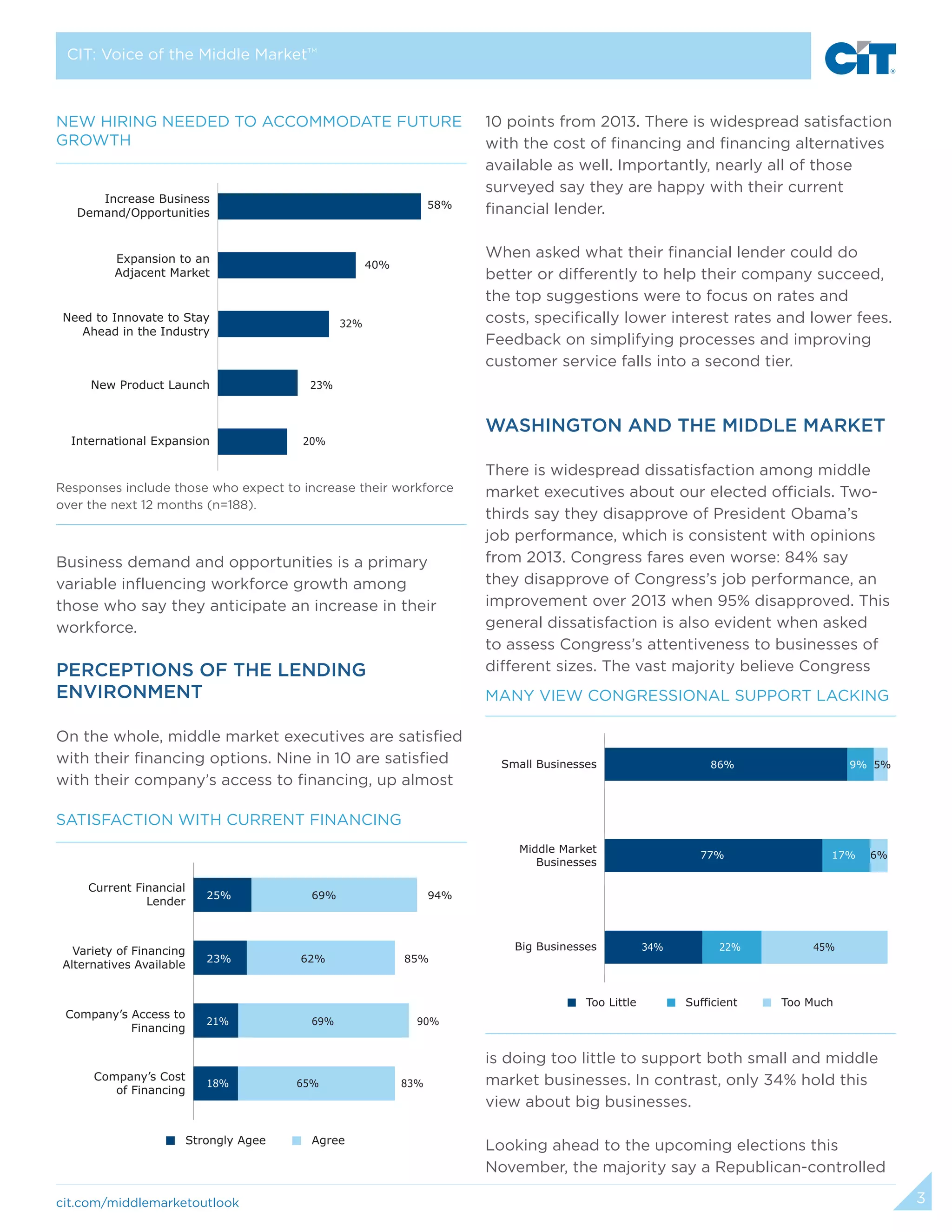
Business demand and opportunities is a primary 
variable influencing workforce growth among 
those who say they anticipate an increase in their 
workforce. 
Perceptions of the Lending 
Environment 
On the whole, middle market executives are satisfied 
with their financing options. Nine in 10 are satisfied 
with their company’s access to financing, up almost 
Satisfaction with Current Financing 
Current Financial 
Lender 25% 69% 94% 
Variety of Financing 
Alternatives Available 23% 62% 85% 
Company’s Access to 
Financing 21% 69% 90% 
cit.com/middlemarketoutlook 
10 points from 2013. There is widespread satisfaction 
with the cost of financing and financing alternatives 
available as well. Importantly, nearly all of those 
surveyed say they are happy with their current 
financial lender. 
When asked what their financial lender could do 
better or differently to help their company succeed, 
the top suggestions were to focus on rates and 
costs, specifically lower interest rates and lower fees. 
Feedback on simplifying processes and improving 
customer service falls into a second tier. 
Washington and the Middle Market 
There is widespread dissatisfaction among middle 
market executives about our elected officials. Two-thirds 
say they disapprove of President Obama’s 
job performance, which is consistent with opinions 
from 2013. Congress fares even worse: 84% say 
they disapprove of Congress’s job performance, an 
improvement over 2013 when 95% disapproved. This 
general dissatisfaction is also evident when asked 
to assess Congress’s attentiveness to businesses of 
different sizes. The vast majority believe Congress 
Many View Congressional Support Lacking 
Small Businesses 86% 9% 5% 
Middle Market 
Businesses 77% 17% 6% 
is doing too little to support both small and middle 
market businesses. In contrast, only 34% hold this 
view about big businesses. 
Looking ahead to the upcoming elections this 
November, the majority say a Republican-controlled 
Company’s Cost 
of Financing 18% 65% 83% 
Strongly Agee Agree 
Big Businesses 34% 22% 45% 
Too Little Sufficient Too Much 
International Expansion 20% 
58% 
New Product Launch 23% 
32% 
Expansion to an 
Adjacent Market 
40% 
Responses include those who expect to increase their workforce 
over the next 12 months (n=188).
4 
CIT: Voice of the Middle MarketTM 
Importance of Congressional Action on 
Key Issues 
Tax Reform 44% 41% 84% 
Changes to 
Healthcare Reform 
Increasing Domestic 
Energy Production 
Investments in 
Infrastructure 
Regulatory Reform 
Immigration Reform 37% 30% 66% 
Tort Reform 
Raising the Federal 
Minimum Wage 
48% 30% 77% 
37% 40% 76% 
33% 43% 76% 
31% 43% 73% 
21% 41% 62% 
21% 20% 40% 
Congress would be good for their company (55%), 
with only one in five thinking a Democrat-controlled 
Congress would be better for their company (21%). 
The rest are divided between saying split control 
would be preferable or that the party in the majority 
in Congress does not impact their company (13% and 
10%, respectively). 
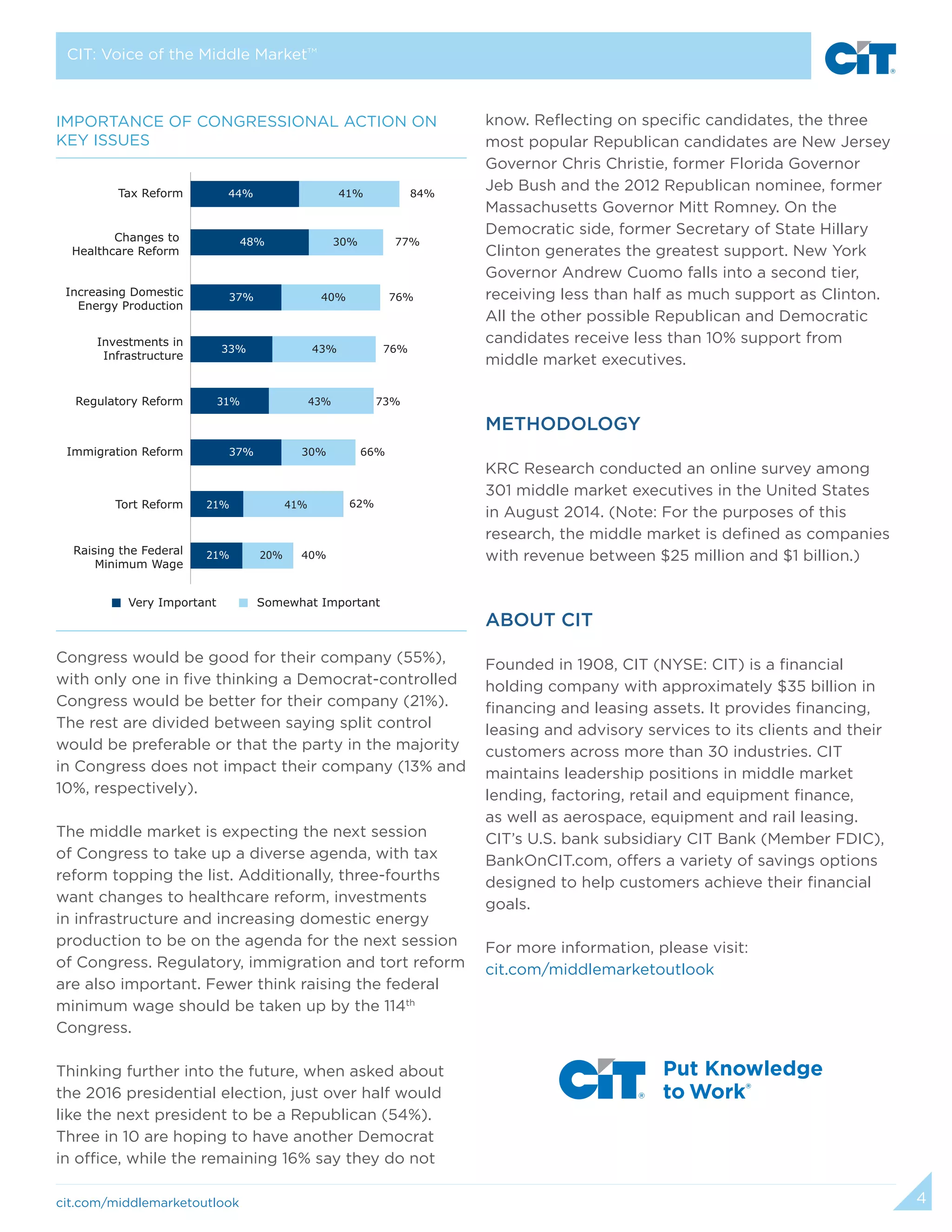
The middle market is expecting the next session 
of Congress to take up a diverse agenda, with tax 
reform topping the list. Additionally, three-fourths 
want changes to healthcare reform, investments 
in infrastructure and increasing domestic energy 
production to be on the agenda for the next session 
of Congress. Regulatory, immigration and tort reform 
are also important. Fewer think raising the federal 
minimum wage should be taken up by the 114th 
Congress. 
Thinking further into the future, when asked about 
the 2016 presidential election, just over half would 
like the next president to be a Republican (54%). 
Three in 10 are hoping to have another Democrat 
in office, while the remaining 16% say they do not 
cit.com/middlemarketoutlook 
know. Reflecting on specific candidates, the three 
most popular Republican candidates are New Jersey 
Governor Chris Christie, former Florida Governor 
Jeb Bush and the 2012 Republican nominee, former 
Massachusetts Governor Mitt Romney. On the 
Democratic side, former Secretary of State Hillary 
Clinton generates the greatest support. New York 
Governor Andrew Cuomo falls into a second tier, 
receiving less than half as much support as Clinton. 
All the other possible Republican and Democratic 
candidates receive less than 10% support from 
middle market executives. 
Methodology 
KRC Research conducted an online survey among 
301 middle market executives in the United States 
in August 2014. (Note: For the purposes of this 
research, the middle market is defined as companies 
with revenue between $25 million and $1 billion.) 
About CIT 
Founded in 1908, CIT (NYSE: CIT) is a financial 
holding company with approximately $35 billion in 
financing and leasing assets. It provides financing, 
leasing and advisory services to its clients and their 
customers across more than 30 industries. CIT 
maintains leadership positions in middle market 
lending, factoring, retail and equipment finance, 
as well as aerospace, equipment and rail leasing. 
CIT’s U.S. bank subsidiary CIT Bank (Member FDIC), 
BankOnCIT.com, offers a variety of savings options 
designed to help customers achieve their financial 
goals. 
For more information, please visit: 
cit.com/middlemarketoutlook 
Very Important Somewhat Important

2014 mmo-report

  • 1.
    CIT: Voice ofthe Middle MarketTM Perspectives from the Heart of the U.S. Economy CIT’s 2014 Voice of the Middle MarketTM study examines the perspectives of U.S. middle market executives on the U.S. economy, the availability of financing and the health of their companies. This year’s study also assessed respondents’ perspectives on the upcoming 2014 mid-term elections and 2016 presidential election. Results from the 2014 CIT: Voice of the Middle Market study show that the economic outlook of senior middle market executives is trending upwards, as compared to opinions from 2013. Middle market executives are favorable about the state of their own companies, with many describing it as strong. Few say they are worse off today as compared to a year ago. In fact, more than 60% of executives report being in a stronger position today than a year ago. This assessment is most evident among middle market executives representing companies with annual revenues between $100 million and $1 billion. The executives surveyed are also fairly positive about their local economy; 51% rate it as strong and just 17% say it is weak. Their assessments of the U.S. and global economies continue to lag behind their view of their local markets, but there is a clear shift in negative views of the state of the U.S. and global economies since last year’s study. This year, middle market executives are split about the U.S. economy: 27% describe it as strong, 30% say it is weak and BETTER OFF TODAY THAN A YEAR AGO 63% 64% 71% 53% 34% 27% 23% 13% 9% 9% 6% Total Low Revenue ($25 Million - $50 Million) Middle Revenue ($50 Million - $100 Million) High Revenue ($100 Million - $1 Billion) Better No change/the same Worse 28% the rest characterize it as neutral. In comparison, 41% of middle market executives described the U.S. economy as weak in 2013 and only 15% said it was strong. While middle market companies are confident about their own companies, they are not without concerns about the year ahead. Their top concerns are continued economic uncertainty and compliance with the Affordable Care Act, with three-fourths citing these as concerns. These are followed by worries related to tax increases and regulations. As with last year, talent management is top of mind as well: 68% are concerned about the ability to retain top talent and 65% are concerned cit.com/middlemarketoutlook 1 Numbers may not sum to 100 because of rounding.
  • 2.
    2 CIT: Voiceof the Middle MarketTM Increased Optimism on State of the Economy 2014 Global Economy US Economy Local Economy Global Economy US Economy 14% 50% 36% 43% 30% 7% 43% 50% 15% 45% 41% about the ability to hire top talent. The vast majority of middle market executives also say they are concerned with data security challenges in the coming year. Eighteen percent say it is likely their company will be sold in the next few years; however, selling is not on the immediate horizon either. Rather, most who Top Issues of Concern OVER THE NEXT 12 MONTHS Continued Economic Uncertainty 31% 45% 76% Costs Associated with the ACA Regulations Tax Increases Ability to Retain Top Talent 42% 34% 75% Data Security 30% Ability to Hire Top Talent Compliance with Regulations Rising Inflation Rate Rising Interest Rates 28% 37% 36% 34% 68% 37% 67% 37% 65% 18% 41% 59% 54% Cost of Capital 20% 31% 50% Access to Capital 19% 14% cit.com/middlemarketoutlook say there is a chance their company will be sold predict it will happen more than a year from now, at a minimum. Family succession issues and operating costs are among the top factors influencing a possible sale. Middle Market Workforce in Focus Most middle market executives participating in this research have a workforce that includes more than 100 people, with 40% having a workforce of 500 or more. Self-reporting among this audience about the size of their workforce in 2013 reveals that more than half are at companies that have experienced workforce growth over the past 12 months (55%). Only a minority have experienced a decrease in the size of their workforce over this time period (15%). Another 30% describe their workforce size as the same as in 2013, demonstrating both stability and growth in the middle market. Over the next year, many middle market executives are forecasting an increase in the size of their workforce. Overall, 62% say they expect the size of their workforce to increase in the coming year, with most of this group saying that their workforce will increase by no more than 10%. This growth forecast is consistent across revenue categories. One in 10 is predicting that the size of the workforce at their company will decrease. 2013 Local Economy Strong Neutral Weak 27% 51% 32% 17% 36% 39% 25% Increase by no more than 5% Increase by 6-10% Increase by 11-15% Increase by more than 15% Stay the same Decrease 8% 9% 28% 28% 6% 20% Increase in Hiring on the Horizon 35% 30% 44% Very Concerned Somewhat Concerned 71% 70% 34% 34% 34% 32% 30% 61%
  • 3.
    3 CIT: Voiceof the Middle MarketTM New Hiring Needed To Accommodate Future Growth Increase Business Demand/Opportunities Need to Innovate to Stay Ahead in the Industry Business demand and opportunities is a primary variable influencing workforce growth among those who say they anticipate an increase in their workforce. Perceptions of the Lending Environment On the whole, middle market executives are satisfied with their financing options. Nine in 10 are satisfied with their company’s access to financing, up almost Satisfaction with Current Financing Current Financial Lender 25% 69% 94% Variety of Financing Alternatives Available 23% 62% 85% Company’s Access to Financing 21% 69% 90% cit.com/middlemarketoutlook 10 points from 2013. There is widespread satisfaction with the cost of financing and financing alternatives available as well. Importantly, nearly all of those surveyed say they are happy with their current financial lender. When asked what their financial lender could do better or differently to help their company succeed, the top suggestions were to focus on rates and costs, specifically lower interest rates and lower fees. Feedback on simplifying processes and improving customer service falls into a second tier. Washington and the Middle Market There is widespread dissatisfaction among middle market executives about our elected officials. Two-thirds say they disapprove of President Obama’s job performance, which is consistent with opinions from 2013. Congress fares even worse: 84% say they disapprove of Congress’s job performance, an improvement over 2013 when 95% disapproved. This general dissatisfaction is also evident when asked to assess Congress’s attentiveness to businesses of different sizes. The vast majority believe Congress Many View Congressional Support Lacking Small Businesses 86% 9% 5% Middle Market Businesses 77% 17% 6% is doing too little to support both small and middle market businesses. In contrast, only 34% hold this view about big businesses. Looking ahead to the upcoming elections this November, the majority say a Republican-controlled Company’s Cost of Financing 18% 65% 83% Strongly Agee Agree Big Businesses 34% 22% 45% Too Little Sufficient Too Much International Expansion 20% 58% New Product Launch 23% 32% Expansion to an Adjacent Market 40% Responses include those who expect to increase their workforce over the next 12 months (n=188).
  • 4.
    4 CIT: Voiceof the Middle MarketTM Importance of Congressional Action on Key Issues Tax Reform 44% 41% 84% Changes to Healthcare Reform Increasing Domestic Energy Production Investments in Infrastructure Regulatory Reform Immigration Reform 37% 30% 66% Tort Reform Raising the Federal Minimum Wage 48% 30% 77% 37% 40% 76% 33% 43% 76% 31% 43% 73% 21% 41% 62% 21% 20% 40% Congress would be good for their company (55%), with only one in five thinking a Democrat-controlled Congress would be better for their company (21%). The rest are divided between saying split control would be preferable or that the party in the majority in Congress does not impact their company (13% and 10%, respectively). The middle market is expecting the next session of Congress to take up a diverse agenda, with tax reform topping the list. Additionally, three-fourths want changes to healthcare reform, investments in infrastructure and increasing domestic energy production to be on the agenda for the next session of Congress. Regulatory, immigration and tort reform are also important. Fewer think raising the federal minimum wage should be taken up by the 114th Congress. Thinking further into the future, when asked about the 2016 presidential election, just over half would like the next president to be a Republican (54%). Three in 10 are hoping to have another Democrat in office, while the remaining 16% say they do not cit.com/middlemarketoutlook know. Reflecting on specific candidates, the three most popular Republican candidates are New Jersey Governor Chris Christie, former Florida Governor Jeb Bush and the 2012 Republican nominee, former Massachusetts Governor Mitt Romney. On the Democratic side, former Secretary of State Hillary Clinton generates the greatest support. New York Governor Andrew Cuomo falls into a second tier, receiving less than half as much support as Clinton. All the other possible Republican and Democratic candidates receive less than 10% support from middle market executives. Methodology KRC Research conducted an online survey among 301 middle market executives in the United States in August 2014. (Note: For the purposes of this research, the middle market is defined as companies with revenue between $25 million and $1 billion.) About CIT Founded in 1908, CIT (NYSE: CIT) is a financial holding company with approximately $35 billion in financing and leasing assets. It provides financing, leasing and advisory services to its clients and their customers across more than 30 industries. CIT maintains leadership positions in middle market lending, factoring, retail and equipment finance, as well as aerospace, equipment and rail leasing. CIT’s U.S. bank subsidiary CIT Bank (Member FDIC), BankOnCIT.com, offers a variety of savings options designed to help customers achieve their financial goals. For more information, please visit: cit.com/middlemarketoutlook Very Important Somewhat Important