© 2015 CIT Group Inc. CIT and the CIT logo are registered service marks of CIT Group Inc.	 1
KEY HEADLINES FROM
THE RESEARCH
	z	 Interest Rates and Fuel
Prices Expected To Rise —
Creating Risk for Airlines
z	 Fleet Leasing Expected
to Remain High;
Responsiveness and
Reputation of Lessor 	
A Must
	z	 Airlines Comfortable with
Their Total Fleet Size and
Order Book Commitments
	z	 Innovations and
Technological Advances
Highly Anticipated
CIT Aerospace Outlook
Fleet and finance executives of passenger airlines
have a positive outlook for the industry’s immediate
future—anticipating growth in many areas of their
business. Currently, leasing plays an important
role in aircraft acquisition and this is expected
to continue, underscoring the importance of
reputations and relations with lessors. The industry
is likely to be faced with challenges stemming from
rising interest rates as well as fuel price volatility.
But for now, airlines are taking advantage of lower
fuel prices and investing in technology in order to
accommodate changing trends.
In order to understand current trends, challenges
and the outlook for airlines, Harris Poll on behalf of
CIT, a leader in financing and advisory services to
the aerospace industry, conducted research from
February to May among 100 global airline fleet and
finance executives.
View from the Middle™ • Insights for Your Business
View from the Middle™ | CIT Aerospace Outlook
© 2015 CIT Group Inc. CIT and the CIT logo are registered service marks of CIT Group Inc.	 2
Interest rates are expected to rise over the
next couple of years giving way to several
challenges, such as paying more for financed
aircraft. In addition to those increased financing
costs, executives expect to face other obstacles
such as fuel price volatility and increased
competition.
Fuel price volatility, while always a challenge, is
not necessarily viewed as a bad thing—almost
four in ten feel it will have a positive impact on
their airlines' ability to acquire new technology,
and a quarter say it will have no impact at all.
For now, while fuel prices are relatively low,
fleet and finance executives have been taking
advantage of the lower fuel prices by reducing
ticket prices and increasing utilization of their
current fleet. However this is only temporary, as
the overall outlook on fuel prices among airlines
is that they will be on the rise in the future.
Future Challenges
Interest Rates and Fuel Prices Expected to Rise —
Creating Risk for Airlines
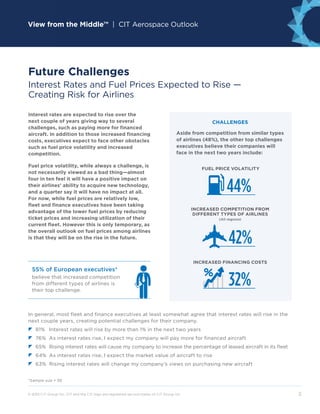
CHALLENGES
Aside from competition from similar types
of airlines (48%), the other top challenges
executives believe their companies will
face in the next two years include:
In general, most fleet and finance executives at least somewhat agree that interest rates will rise in the
next couple years, creating potential challenges for their company.
	z	 81%	Interest rates will rise by more than 1% in the next two years
	z	 76%	As interest rates rise, I expect my company will pay more for financed aircraft
	z	 65%	Rising interest rates will cause my company to increase the percentage of leased aircraft in its fleet
	z	 64%	As interest rates rise, I expect the market value of aircraft to rise
	z	 63%	Rising interest rates will change my company’s views on purchasing new aircraft
FUEL PRICE VOLATILITY
44%
INCREASED COMPETITION FROM
DIFFERENT TYPES OF AIRLINES
(All regions)
42%
INCREASED FINANCING COSTS
32%
55% of European executives*
believe that increased competition
from different types of airlines is
their top challenge.
*Sample size = 38
View from the Middle™ | CIT Aerospace Outlook
© 2015 CIT Group Inc. CIT and the CIT logo are registered service marks of CIT Group Inc.	 3
Despite the unpredictability 	
of fuel prices, the general outlook
is that they will RISE
And while fuel price volatility is an anticipated
challenge that airlines will face over the next two
years, executives believe fuel price volatility has
no impact or a positive impact on their airlines'
plans to acquire new technology.
	z	 10%	of executives believe fuel price volatility
will have a very positive impact on
their airlines' plans to acquire new
technology aircraft while 28% feel the
impact will be somewhat positive
	z	 25%	 feel it has no impact at all
Among other challenges likely to be
faced in the next two years, in particular
by increases in competition, one
executive feels:
In the U.S., perhaps there has been
more focus on control of the routes,
and rights to certain cities or routes,
but for us [in Latin America], we have
to focus on the newcomers to the
market, new airlines from Europe
or the U.S. We need to find better
ways to compete against them.
- Fleet director
Despite anticipated increases in fuel
prices, the top three actions taken by fleet
and finance executives to take advantage
of current fuel prices are:
1. Hedged at current fuel prices
2. Reduced ticket prices
3. Increased utilization
of current fleet
continuedFuture Challenges
Increase in the next
18 months
Increase in 	
the next	
3 years
Increase in 	
the next	
5 years
50%
80%
82%
View from the Middle™ | CIT Aerospace Outlook
© 2015 CIT Group Inc. CIT and the CIT logo are registered service marks of CIT Group Inc.	 4
In the upcoming years, fleet and finance
executives expect their companies to increase
areas such as in-flight sales, number of routes
and flights the most. While a majority still
anticipates an increase, more than 20% expect
a reduction in number of aircraft.
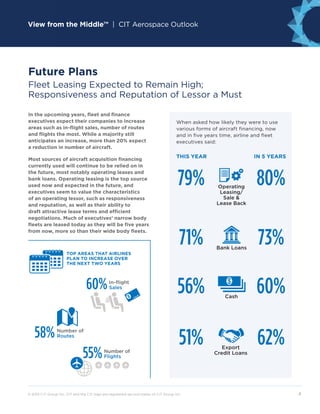
Most sources of aircraft acquisition financing
currently used will continue to be relied on in
the future, most notably operating leases and
bank loans. Operating leasing is the top source
used now and expected in the future, and
executives seem to value the characteristics
of an operating lessor, such as responsiveness
and reputation, as well as their ability to
draft attractive lease terms and efficient
negotiations. Much of executives’ narrow body
fleets are leased today as they will be five years
from now, more so than their wide body fleets.
When asked how likely they were to use
various forms of aircraft financing, now
and in five years time, airline and fleet
executives said:
TOP AREAS THAT AIRLINES
PLAN TO INCREASE OVER
THE NEXT TWO YEARS
In-flight	
Sales
Number of	
Flights
Number of	
Routes
60%
55%
58%
THIS YEAR IN 5 YEARS
Future Plans
Fleet Leasing Expected to Remain High;
Responsiveness and Reputation of Lessor a Must
Operating 	
Leasing/	
Sale  	
Lease Back
79% 80%
Bank Loans
71% 73%
Cash
56% 60%
Export 	
Credit Loans
51% 62%
View from the Middle™ | CIT Aerospace Outlook
© 2015 CIT Group Inc. CIT and the CIT logo are registered service marks of CIT Group Inc.	 5
In five years, fleet and finance executives
anticipate leasing a higher percentage of
narrow body (on average 52%) than wide body
(on average 32%) aircraft.
When leasing aircraft from an operating lessor,
key areas of importance relate to lease terms
and characteristics of the lessor*.
	z	 62%	 Lease terms
	z	 53%	 Lessor’s responsiveness to my requests
	z	 48%	 Efficiency of lease negotiation process
	z	 44%	 Lessor’s reputation and experience
continued
As mentioned by one executive, the
“whole package” of a lessor and their
company is what matters most:
It is not just about [delivering] the
airplane; it is about having access
to the reserves, knowing how the
delivery is going to go, how the
re-delivery is going to go. We look
at the whole package. So it is:
do you feel comfortable with the
people you are going to be dealing
with in the company and know
that they are going to deliver
on those issues?
– C-suite executive
More than half of airline and fleet executives
expect their airline to increase the number of
routes, flights and aircraft in the next two years.
Future Plans
*Percentages may not add up to 100 because of acceptance of multiple answers from respondents answering that question.
Plans Over Next Two Years
View from the Middle™ | CIT Aerospace Outlook
© 2015 CIT Group Inc. CIT and the CIT logo are registered service marks of CIT Group Inc.	 6
One airline executive raised concerns about
age restrictions:
More and more countries have imposed
regulations when it comes to the
maximum number of years an aircraft
can operate, well actually how old an
aircraft can be to be leased into that
country. So they have age restrictions
now in many countries and those tend
to even be the less developed countries,
which is the interesting part of it... This
definitely has an effect on our business
and on the airline and aircraft business
in general because it can impact your
estimations on the lifespan of the aircraft
when it leaves the factory and what
options you have when it comes to
placing it and operating it. We are seeing
everything as low as a maximum of 10
years and that is ridiculous because we
would consider that a new aircraft.
– C-suite executive
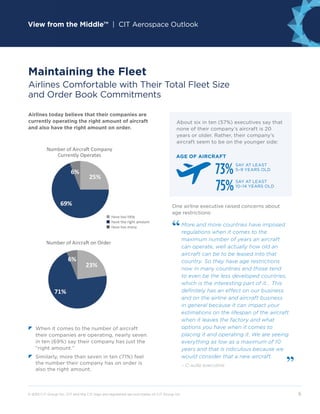
Airlines today believe that their companies are
currently operating the right amount of aircraft
and also have the right amount on order.
z	When it comes to the number of aircraft
their companies are operating, nearly seven
in ten (69%) say their company has just the
“right amount.”
z	Similarly, more than seven in ten (71%) feel
the number their company has on order is
also the right amount.
Maintaining the Fleet
Airlines Comfortable with Their Total Fleet Size
and Order Book Commitments
About six in ten (57%) executives say that
none of their company’s aircraft is 20
years or older. Rather, their company’s
aircraft seem to be on the younger side:
75%SAY AT LEAST
10–14 YEARS OLD
73%SAY AT LEAST
5–9 YEARS OLD
AGE OF AIRCRAFT
View from the Middle™ | CIT Aerospace Outlook
© 2015 CIT Group Inc. CIT and the CIT logo are registered service marks of CIT Group Inc.	 7
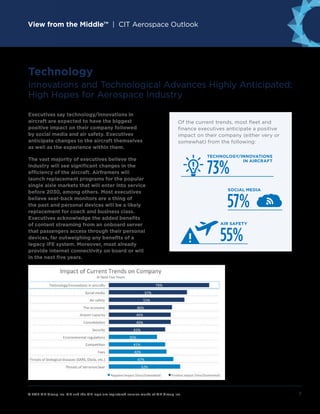
Executives say technology/innovations in
aircraft are expected to have the biggest
positive impact on their company followed
by social media and air safety. Executives
anticipate changes to the aircraft themselves
as well as the experience within them.
The vast majority of executives believe the
industry will see significant changes in the
efficiency of the aircraft. Airframers will
launch replacement programs for the popular
single aisle markets that will enter into service
before 2030, among others. Most executives
believe seat-back monitors are a thing of
the past and personal devices will be a likely
replacement for coach and business class.
Executives acknowledge the added benefits
of content streaming from an onboard server
that passengers access through their personal
devices, far outweighing any benefits of a
legacy IFE system. Moreover, most already
provide internet connectivity on board or will
in the next five years.
Technology
Innovations and Technological Advances Highly Anticipated;
High Hopes for Aerospace Industry
Of the current trends, most fleet and
finance executives anticipate a positive
impact on their company (either very or
somewhat) from the following:
TECHNOLOGY/INNOVATIONS
IN AIRCRAFT
SOCIAL MEDIA
73%
AIR SAFETY
55%
57%
View from the Middle™ | CIT Aerospace Outlook
© 2015 CIT Group Inc. CIT and the CIT logo are registered service marks of CIT Group Inc.	 8
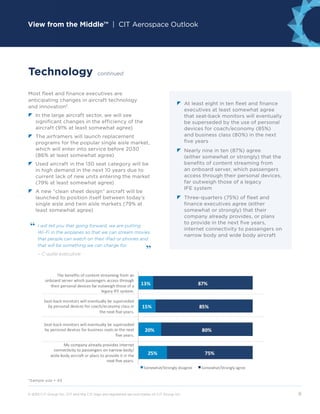
Most fleet and finance executives are
anticipating changes in aircraft technology
and innovation*.
z	In the large aircraft sector, we will see
significant changes in the efficiency of the
aircraft (91% at least somewhat agree)
z	The airframers will launch replacement
programs for the popular single aisle market,
which will enter into service before 2030
(86% at least somewhat agree)
z	Used aircraft in the 130 seat category will be
in high demand in the next 10 years due to
current lack of new units entering the market
(79% at least somewhat agree)
z	A new “clean sheet design” aircraft will be
launched to position itself between today’s
single aisle and twin aisle markets (79% at
least somewhat agree)
	z	At least eight in ten fleet and finance
executives at least somewhat agree
that seat-back monitors will eventually
be superseded by the use of personal
devices for coach/economy (85%)
and business class (80%) in the next
five years
	z	Nearly nine in ten (87%) agree
(either somewhat or strongly) that the
benefits of content streaming from
an onboard server, which passengers
access through their personal devices,
far outweigh those of a legacy
IFE system
	z	Three-quarters (75%) of fleet and
finance executives agree (either
somewhat or strongly) that their
company already provides, or plans
to provide in the next five years,
internet connectivity to passengers on
narrow body and wide body aircraft
Technology continued
I will tell you that going forward, we are putting
Wi-Fi in the airplanes so that we can stream movies
that people can watch on their iPad or phones and
that will be something we can charge for.
– C-suite executive
*Sample size = 43
View from the Middle™ | CIT Aerospace Outlook
© 2015 CIT Group Inc. CIT and the CIT logo are registered service marks of CIT Group Inc.	 9
This study was commissioned by CIT
and conducted online by Harris Poll between
February 11 and May 15, 2015, among 100
executives within the aerospace industry
globally who are employed full-time and
working for a commercial airline; the sample
included a mix of CIT’s customers and
prospects. Key demographics are:
z	Decision maker: Involved in general
management, finance or fleet management
(92%)
	z	Title: Board member (9%), C-level executive
(37%), Fleet director/manager (17%), SVP/
VP/Director (14%), Head of business unit/
department (7%), Manager (10%), Consultant
(2%), Other (4%)
z	Functional role: Finance (18%), General
management (27%), Fleet management
(38%), Operations (7%), Strategy and
business development (6%), Other (4%)
z	Company revenue: Less than $500 million
(29%), $500 million – $999 million (9%), $1
billion – $2.99 billion (11%), $3 billion – $4.99
billion (12%), $5 billion - $9.99 billion (13%), $10
billion – $14.99 billion (15%), $15 billion – $19.99
billion (6%), $20 billion+ (5%)
	z	Area of operation: Europe (38%), North
America (38%), Asia/Pacific (13%), South
America (5%), Africa (3%), Middle East (3%)
z	No more than four respondents were
surveyed from the same company
Five in-depth interviews, approximately 30 minutes
in length, were conducted among airline fleet
and finance executives who agreed to talk further
about some of the topics covered in the survey.
All sample surveys and polls, whether or not
they use probability sampling, are subject to
multiple sources of error, which are most often
not possible to quantify or estimate, including
sampling error, coverage error, error associated
with nonresponse, error associated with question
wording and response options, and post-survey
Methodology
weighting and adjustments. Therefore, The Harris
Poll avoids the words margin of error as they
are misleading. All that can be calculated are
different possible sampling errors with different
probabilities for pure, unweighted, random
samples with 100% response rates. These are
only theoretical because no published polls
come close to this ideal.
ABOUT CIT
Founded in 1908, CIT (NYSE: CIT) is a financial
holding company with more than $65 billion in
assets. Its principal bank subsidiary, CIT Bank,
N.A., (Member FDIC, Equal Housing Lender)
has more than $30 billion of deposits and more
than $40 billion of assets. It provides financing,
leasing and advisory services principally to
middle market companies across more than
30 industries primarily in North America, and
equipment financing and leasing solutions to
the transportation sector. It also offers products
and services to consumers through its Internet
bank franchise and a network of retail branches
in Southern California, operating as OneWest
Bank, a division of CIT Bank, N.A. cit.com
www.cit.com/viewfromthemiddle
To subscribe to the CIT View from the Middle,
please send an email to:
viewfromthemiddle@cit.com.
FOR PRESS INQUIRIES, PLEASE CONTACT
Curt Ritter
Senior Vice President,
Corporate Communications
curt.ritter@cit.com
Matt Klein
Vice President, Media Relations
matt.klein@cit.com
FOR BUSINESS INQUIRIES, PLEASE CONTACT
Dan Infanti
Senior Vice President,
Marketing and Advertising
dan.infanti@cit.com
Debbie Haeringer
Director, Content Marketing
debbie.haeringer@cit.com

CIT Aerospace Outlook Report

  • 1.
    © 2015 CITGroup Inc. CIT and the CIT logo are registered service marks of CIT Group Inc. 1 KEY HEADLINES FROM THE RESEARCH z Interest Rates and Fuel Prices Expected To Rise — Creating Risk for Airlines z Fleet Leasing Expected to Remain High; Responsiveness and Reputation of Lessor A Must z Airlines Comfortable with Their Total Fleet Size and Order Book Commitments z Innovations and Technological Advances Highly Anticipated CIT Aerospace Outlook Fleet and finance executives of passenger airlines have a positive outlook for the industry’s immediate future—anticipating growth in many areas of their business. Currently, leasing plays an important role in aircraft acquisition and this is expected to continue, underscoring the importance of reputations and relations with lessors. The industry is likely to be faced with challenges stemming from rising interest rates as well as fuel price volatility. But for now, airlines are taking advantage of lower fuel prices and investing in technology in order to accommodate changing trends. In order to understand current trends, challenges and the outlook for airlines, Harris Poll on behalf of CIT, a leader in financing and advisory services to the aerospace industry, conducted research from February to May among 100 global airline fleet and finance executives. View from the Middle™ • Insights for Your Business
  • 2.
    View from theMiddle™ | CIT Aerospace Outlook © 2015 CIT Group Inc. CIT and the CIT logo are registered service marks of CIT Group Inc. 2 Interest rates are expected to rise over the next couple of years giving way to several challenges, such as paying more for financed aircraft. In addition to those increased financing costs, executives expect to face other obstacles such as fuel price volatility and increased competition. Fuel price volatility, while always a challenge, is not necessarily viewed as a bad thing—almost four in ten feel it will have a positive impact on their airlines' ability to acquire new technology, and a quarter say it will have no impact at all. For now, while fuel prices are relatively low, fleet and finance executives have been taking advantage of the lower fuel prices by reducing ticket prices and increasing utilization of their current fleet. However this is only temporary, as the overall outlook on fuel prices among airlines is that they will be on the rise in the future. Future Challenges Interest Rates and Fuel Prices Expected to Rise — Creating Risk for Airlines CHALLENGES Aside from competition from similar types of airlines (48%), the other top challenges executives believe their companies will face in the next two years include: In general, most fleet and finance executives at least somewhat agree that interest rates will rise in the next couple years, creating potential challenges for their company. z 81% Interest rates will rise by more than 1% in the next two years z 76% As interest rates rise, I expect my company will pay more for financed aircraft z 65% Rising interest rates will cause my company to increase the percentage of leased aircraft in its fleet z 64% As interest rates rise, I expect the market value of aircraft to rise z 63% Rising interest rates will change my company’s views on purchasing new aircraft FUEL PRICE VOLATILITY 44% INCREASED COMPETITION FROM DIFFERENT TYPES OF AIRLINES (All regions) 42% INCREASED FINANCING COSTS 32% 55% of European executives* believe that increased competition from different types of airlines is their top challenge. *Sample size = 38
  • 3.
    View from theMiddle™ | CIT Aerospace Outlook © 2015 CIT Group Inc. CIT and the CIT logo are registered service marks of CIT Group Inc. 3 Despite the unpredictability of fuel prices, the general outlook is that they will RISE And while fuel price volatility is an anticipated challenge that airlines will face over the next two years, executives believe fuel price volatility has no impact or a positive impact on their airlines' plans to acquire new technology. z 10% of executives believe fuel price volatility will have a very positive impact on their airlines' plans to acquire new technology aircraft while 28% feel the impact will be somewhat positive z 25% feel it has no impact at all Among other challenges likely to be faced in the next two years, in particular by increases in competition, one executive feels: In the U.S., perhaps there has been more focus on control of the routes, and rights to certain cities or routes, but for us [in Latin America], we have to focus on the newcomers to the market, new airlines from Europe or the U.S. We need to find better ways to compete against them. - Fleet director Despite anticipated increases in fuel prices, the top three actions taken by fleet and finance executives to take advantage of current fuel prices are: 1. Hedged at current fuel prices 2. Reduced ticket prices 3. Increased utilization of current fleet continuedFuture Challenges Increase in the next 18 months Increase in the next 3 years Increase in the next 5 years 50% 80% 82%
  • 4.
    View from theMiddle™ | CIT Aerospace Outlook © 2015 CIT Group Inc. CIT and the CIT logo are registered service marks of CIT Group Inc. 4 In the upcoming years, fleet and finance executives expect their companies to increase areas such as in-flight sales, number of routes and flights the most. While a majority still anticipates an increase, more than 20% expect a reduction in number of aircraft. Most sources of aircraft acquisition financing currently used will continue to be relied on in the future, most notably operating leases and bank loans. Operating leasing is the top source used now and expected in the future, and executives seem to value the characteristics of an operating lessor, such as responsiveness and reputation, as well as their ability to draft attractive lease terms and efficient negotiations. Much of executives’ narrow body fleets are leased today as they will be five years from now, more so than their wide body fleets. When asked how likely they were to use various forms of aircraft financing, now and in five years time, airline and fleet executives said: TOP AREAS THAT AIRLINES PLAN TO INCREASE OVER THE NEXT TWO YEARS In-flight Sales Number of Flights Number of Routes 60% 55% 58% THIS YEAR IN 5 YEARS Future Plans Fleet Leasing Expected to Remain High; Responsiveness and Reputation of Lessor a Must Operating Leasing/ Sale Lease Back 79% 80% Bank Loans 71% 73% Cash 56% 60% Export Credit Loans 51% 62%
  • 5.
    View from theMiddle™ | CIT Aerospace Outlook © 2015 CIT Group Inc. CIT and the CIT logo are registered service marks of CIT Group Inc. 5 In five years, fleet and finance executives anticipate leasing a higher percentage of narrow body (on average 52%) than wide body (on average 32%) aircraft. When leasing aircraft from an operating lessor, key areas of importance relate to lease terms and characteristics of the lessor*. z 62% Lease terms z 53% Lessor’s responsiveness to my requests z 48% Efficiency of lease negotiation process z 44% Lessor’s reputation and experience continued As mentioned by one executive, the “whole package” of a lessor and their company is what matters most: It is not just about [delivering] the airplane; it is about having access to the reserves, knowing how the delivery is going to go, how the re-delivery is going to go. We look at the whole package. So it is: do you feel comfortable with the people you are going to be dealing with in the company and know that they are going to deliver on those issues? – C-suite executive More than half of airline and fleet executives expect their airline to increase the number of routes, flights and aircraft in the next two years. Future Plans *Percentages may not add up to 100 because of acceptance of multiple answers from respondents answering that question. Plans Over Next Two Years
  • 6.
    View from theMiddle™ | CIT Aerospace Outlook © 2015 CIT Group Inc. CIT and the CIT logo are registered service marks of CIT Group Inc. 6 One airline executive raised concerns about age restrictions: More and more countries have imposed regulations when it comes to the maximum number of years an aircraft can operate, well actually how old an aircraft can be to be leased into that country. So they have age restrictions now in many countries and those tend to even be the less developed countries, which is the interesting part of it... This definitely has an effect on our business and on the airline and aircraft business in general because it can impact your estimations on the lifespan of the aircraft when it leaves the factory and what options you have when it comes to placing it and operating it. We are seeing everything as low as a maximum of 10 years and that is ridiculous because we would consider that a new aircraft. – C-suite executive Airlines today believe that their companies are currently operating the right amount of aircraft and also have the right amount on order. z When it comes to the number of aircraft their companies are operating, nearly seven in ten (69%) say their company has just the “right amount.” z Similarly, more than seven in ten (71%) feel the number their company has on order is also the right amount. Maintaining the Fleet Airlines Comfortable with Their Total Fleet Size and Order Book Commitments About six in ten (57%) executives say that none of their company’s aircraft is 20 years or older. Rather, their company’s aircraft seem to be on the younger side: 75%SAY AT LEAST 10–14 YEARS OLD 73%SAY AT LEAST 5–9 YEARS OLD AGE OF AIRCRAFT
  • 7.
    View from theMiddle™ | CIT Aerospace Outlook © 2015 CIT Group Inc. CIT and the CIT logo are registered service marks of CIT Group Inc. 7 Executives say technology/innovations in aircraft are expected to have the biggest positive impact on their company followed by social media and air safety. Executives anticipate changes to the aircraft themselves as well as the experience within them. The vast majority of executives believe the industry will see significant changes in the efficiency of the aircraft. Airframers will launch replacement programs for the popular single aisle markets that will enter into service before 2030, among others. Most executives believe seat-back monitors are a thing of the past and personal devices will be a likely replacement for coach and business class. Executives acknowledge the added benefits of content streaming from an onboard server that passengers access through their personal devices, far outweighing any benefits of a legacy IFE system. Moreover, most already provide internet connectivity on board or will in the next five years. Technology Innovations and Technological Advances Highly Anticipated; High Hopes for Aerospace Industry Of the current trends, most fleet and finance executives anticipate a positive impact on their company (either very or somewhat) from the following: TECHNOLOGY/INNOVATIONS IN AIRCRAFT SOCIAL MEDIA 73% AIR SAFETY 55% 57%
  • 8.
    View from theMiddle™ | CIT Aerospace Outlook © 2015 CIT Group Inc. CIT and the CIT logo are registered service marks of CIT Group Inc. 8 Most fleet and finance executives are anticipating changes in aircraft technology and innovation*. z In the large aircraft sector, we will see significant changes in the efficiency of the aircraft (91% at least somewhat agree) z The airframers will launch replacement programs for the popular single aisle market, which will enter into service before 2030 (86% at least somewhat agree) z Used aircraft in the 130 seat category will be in high demand in the next 10 years due to current lack of new units entering the market (79% at least somewhat agree) z A new “clean sheet design” aircraft will be launched to position itself between today’s single aisle and twin aisle markets (79% at least somewhat agree) z At least eight in ten fleet and finance executives at least somewhat agree that seat-back monitors will eventually be superseded by the use of personal devices for coach/economy (85%) and business class (80%) in the next five years z Nearly nine in ten (87%) agree (either somewhat or strongly) that the benefits of content streaming from an onboard server, which passengers access through their personal devices, far outweigh those of a legacy IFE system z Three-quarters (75%) of fleet and finance executives agree (either somewhat or strongly) that their company already provides, or plans to provide in the next five years, internet connectivity to passengers on narrow body and wide body aircraft Technology continued I will tell you that going forward, we are putting Wi-Fi in the airplanes so that we can stream movies that people can watch on their iPad or phones and that will be something we can charge for. – C-suite executive *Sample size = 43
  • 9.
    View from theMiddle™ | CIT Aerospace Outlook © 2015 CIT Group Inc. CIT and the CIT logo are registered service marks of CIT Group Inc. 9 This study was commissioned by CIT and conducted online by Harris Poll between February 11 and May 15, 2015, among 100 executives within the aerospace industry globally who are employed full-time and working for a commercial airline; the sample included a mix of CIT’s customers and prospects. Key demographics are: z Decision maker: Involved in general management, finance or fleet management (92%) z Title: Board member (9%), C-level executive (37%), Fleet director/manager (17%), SVP/ VP/Director (14%), Head of business unit/ department (7%), Manager (10%), Consultant (2%), Other (4%) z Functional role: Finance (18%), General management (27%), Fleet management (38%), Operations (7%), Strategy and business development (6%), Other (4%) z Company revenue: Less than $500 million (29%), $500 million – $999 million (9%), $1 billion – $2.99 billion (11%), $3 billion – $4.99 billion (12%), $5 billion - $9.99 billion (13%), $10 billion – $14.99 billion (15%), $15 billion – $19.99 billion (6%), $20 billion+ (5%) z Area of operation: Europe (38%), North America (38%), Asia/Pacific (13%), South America (5%), Africa (3%), Middle East (3%) z No more than four respondents were surveyed from the same company Five in-depth interviews, approximately 30 minutes in length, were conducted among airline fleet and finance executives who agreed to talk further about some of the topics covered in the survey. All sample surveys and polls, whether or not they use probability sampling, are subject to multiple sources of error, which are most often not possible to quantify or estimate, including sampling error, coverage error, error associated with nonresponse, error associated with question wording and response options, and post-survey Methodology weighting and adjustments. Therefore, The Harris Poll avoids the words margin of error as they are misleading. All that can be calculated are different possible sampling errors with different probabilities for pure, unweighted, random samples with 100% response rates. These are only theoretical because no published polls come close to this ideal. ABOUT CIT Founded in 1908, CIT (NYSE: CIT) is a financial holding company with more than $65 billion in assets. Its principal bank subsidiary, CIT Bank, N.A., (Member FDIC, Equal Housing Lender) has more than $30 billion of deposits and more than $40 billion of assets. It provides financing, leasing and advisory services principally to middle market companies across more than 30 industries primarily in North America, and equipment financing and leasing solutions to the transportation sector. It also offers products and services to consumers through its Internet bank franchise and a network of retail branches in Southern California, operating as OneWest Bank, a division of CIT Bank, N.A. cit.com www.cit.com/viewfromthemiddle To subscribe to the CIT View from the Middle, please send an email to: viewfromthemiddle@cit.com. FOR PRESS INQUIRIES, PLEASE CONTACT Curt Ritter Senior Vice President, Corporate Communications curt.ritter@cit.com Matt Klein Vice President, Media Relations matt.klein@cit.com FOR BUSINESS INQUIRIES, PLEASE CONTACT Dan Infanti Senior Vice President, Marketing and Advertising dan.infanti@cit.com Debbie Haeringer Director, Content Marketing debbie.haeringer@cit.com