Science of Plastics Instructor Guide
Session Outline Science of Plastics Introduction General Characteristics of Plastics Technical Make-up of PVC Resin Review Questions & Answers PVC Compound Recipe Variables The End Recipe: Ingredients and Processes Review Questions and Answers
Objectives At the end of this session, you will be able to: Describe key scientific elements and terms for making vinyl Define how  PVC  ( P oly V inyl  C hloride) compound is made Describe the key ingredients & steps for creating the PVC that JELD-WEN uses in their extrusions
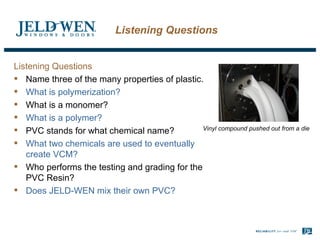
Listening Questions Listening Questions Name three of the many properties of plastic. What is polymerization? What is a monomer? What is a polymer? PVC stands for what chemical name? What two chemicals are used to eventually create VCM? Who performs the testing and grading for the PVC Resin? Does JELD-WEN mix their own PVC? Vinyl compound pushed out from a die
The Benefits of Window Grade PVC Plastics Properties Lightweight Water Proof Chemically Resistant Varieties of Colors Does not Rust or Rot Opaque Lower Density than Metal Moldable - Extrudable
Question Answer the question. Name 3 of the many properties of plastic. Answer: Lightweight Water Proof Chemically Resistant Varieties of Colors Does not Rust or Rot Opaque Lower Density than Metal Moldable - Extrudable
The Benefits of Window Grade PVC Plastics Plastics Responsible Safe Efficient Recyclable Economical Durable Innovative Versatile
The Benefits of Window Grade PVC Plastics   Responsible   Responsible Life Cycle Assessment (LCA) Worker Safety Recycling Landfills
The Benefits of Window Grade PVC Plastics   Safe   Safe Fire Retardant Low Toxicity Food Grade Ingredients
The Benefits of Window Grade PVC Plastics   Efficient Efficient Energy Efficiency Thermal Efficiency Water & Air Infiltration Resistance Reduced Material Use Efficient Products
Hidden Slide
The Benefits of Window Grade PVC Plastics   Recyclable Recyclable Post - Industrial Post - Consumer
The Benefits of Window Grade PVC Plastics   Economical Economical Production Distribution Installation and Function Disposal
Hidden slides
The Benefits of Window Grade PVC Plastics   Durable Durable Building and Construction Resource Conservation Low Maintenance
The Benefits of Window Grade PVC Plastics   Innovative Innovative Processes Applications Gates - Christo
The Benefits of Window Grade PVC Plastics   Versatile Versatile Form and Appearance Function
JELD-WEN & PVC PVC or polyvinyl chloride is the plastic used to create JELD-WEN’s vinyl extrusions  JELD-WEN recycles vinyl by-products to reduce environmental impact and costs By understanding how PVC Resin and PVC Compound is made, you will be able to ensure quality of the extrusion during the entire manufacturing process
Hidden slide
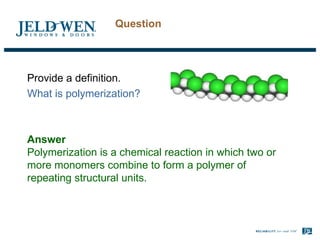
Plastic Composition:  Molecular Structure Polymerization  is a chemical reaction in which two or more  monomers  combine to form a  polymer  of repeating structural units. Monomers  are the repeating structural unit, and are typically hydrocarbons, silanes * , or amides * . Polymers  are a chain of either a single type of monomer or several types arranged in a repeating pattern.
Question Provide a definition. What is a polymer? Definition Dimensions Plastic is made of long chains of carbon molecules.  Products that are made of long carbon chains are   called polymers.
Question Define the following term: What are monomers? Definition Dimensions Plastic is made of long chains of carbon molecules.  Products that are made of long carbon chains are   called polymers. A monomer can be chemically bound as a unit of a   polymer.  Monomers are repeating structural units and are   typically hydrocarbons, silanes, or amides.
HOW IS PVC MADE? Ethylene EDC Chlorine VCM PVC PVC Products PVC PVC Converter Industry PVC Industry
Question Answer the question. What is the abbreviated chemical name for polyvinyl Chloride? Answer PVC
Question Provide a definition. What is polymerization?  Answer Polymerization is a chemical reaction in which two or more monomers combine to form a polymer of repeating structural units.
Question Answer the question. What two chemicals are used to eventually create VCM? Answer Ethylene & Chloride
PVC Resin Industrial Standards Resins Are engineered for specific uses Are made of different monomers Have industry standards they must meet Have standards that include but are not limited to color, density, weight, gravity, and/or bulk JELD-WEN does not make PVC Resin
Question Answer the question. Does JELD-WEN make their own PCV Resin? Answer No. JELD-WEN buys their PVC Resin from a supplier.
Properties Properties of plastic are determined by the lengths of the plastic molecule and the specific monomer present. Elastomers or rubbers are plastics that are composed of long twisted molecules which stretch and recoil like a spring.
Review Questions What do we remember?
 
 
PVC Compound Recipe 100.0% 126.1 Parts Total Parts 0.2 0.2 10. Pigment 7.9 10.0 9.  Titanium Dioxide 4.0 5.0 8.  Filler 4.0 5.0 7.  Impact Modifier 1.2 1.5 6.  Process Aid 0.2 0.2 5.  Lubricant 3 - External 1.2 1.5 4.  Lubricant 2 –    Internal/External 1.2 1.5 3.  Lubricant 1 - Internal 1.0 1.2 2.  Heat Stabilizer 79.3 100 1.  Resin Percent % Parts Polymer
Why a Recipe? Pure PVC Resin   IS NOT Useful Poor Heat Stability Sticks to Metal Parts Poor Impact Poor Weather Ability Pale Yellow Semi Opaque
Question Answer the Question Why is pure PVC Resin not useful? Poor heat stability Sticks to metal parts Poorly receives impact Poor weathering  Pale yellow Semi opaque
Formulating a Recipe What is formulating?  Formulating  is the modification of a pure PVC resin by adding other chemicals that will offset the undesirable properties. The end product of formulating is the   recipe . Each recipe is engineered for a specific end use like windows or pipe.
Question Fill-in-the-blank. Additives, Modification, Properties What is formulation? Formulation is the _______________of a pure PVC Resin  by adding other chemicals or ____________ that will offset undesirable _____________. modification additives properties
Question Fill-in-the-blank  The end product of formulating is called a _________. recipe
Compounding High Intensity Blending or Compounding The process of mixing all the ingredients  Uses very specific equipment and follows very specific rules or steps that are part of the recipe
Review Question Fill-in-the-Blank High intensity blending or ________________ is the process of mixing all the ingredients and using specific  _______________ in a recipe. compounding steps or rules
Additives Overcoming Poor Heat Stability Add heat stabilizer Liquid tin type Level range from 0.8 parts to 1.5 parts Overcoming Sticking to Metal Lubricant package of 2 to 4 different lubricants Improves melt flow characteristics & surface gloss
Additives Overcoming Poor Weatherability Add ultraviolet block & absorber  Example: White pigment Titanium Dioxide Provides base for white & improves opacity Improves melt strength Improves modulus (stiffness of the finished profile) Levels used depend on where the windows are being sold
Question True or False? An additive is a chemical that offsets a positive property of a plastic. Answer: False  An Additive is a chemical that offsets a negative property of a plastic.  For example, The filler, calcium carbonate which is also known as chalk or limestone  is used to improve melt strength.
Additives Process Aid Improves Process Ability Impact Modifier Improves Strength Emproves Ductile Characteristics  Drop Dart Lab Test Drop Test Results
Additives Fillers Are Used to Improve Melt strength Stiffness of the window profile Reduces costs slightly  Most common: Calcium carbonate  (chalk or limestone) Levels vary from 0 to 5 parts
Matching B.  Heat Stabilizer D.  Lubricant A.  Titanium Dioxide C.   Fillers like calcium carbonate known as chalk or limestone. D. Lubricant 4. Improves melt strength C. Fillers like calcium carbonate   known as chalk or limestone 3. Overcomes poor weathering B. Heat stabilizer 2. Overcomes plastic sticking to metal and improves the melt flow characteristics A. Titanium dioxide 1. Overcomes poor heat stability
The Recipe: Ingredients & Processes 100.0% 126.1 Parts Total Parts 0.2 0.2 10. Pigment 7.9 10.0 9.  Titanium Dioxide 4.0 5.0 8.  Filler 4.0 5.0 7.  Impact Modifier 1.2 1.5 6.  Process Aid 0.2 0.2 5.  Lubricant 3- External 1.2 1.5 4.  Lubricant 2 –    Internal/External 1.2 1.5 3.  Lubricant 1 - Internal 1.0 1.2 2.  Heat Stabilizer 79.3 100 1.  Resin Percent % Parts Polymer
Hidden Slide
Question Can you substitute one additive for another additive in a standard recipe and still manufacture a successful profile? Answer: Probably Not Any change in the formulation of a recipe will impact the performance of the end product.
7 Step PVC Compound Recipe Step One Step One Add resin Mix at high speed until it reaches 140 º  F 140º F
7 Step PVC Compound Recipe Step Two Step Two Add a Heat Stabilizer -often a liquid tin type Mix until 160 º  F 160º F
7 Step PVC Compound Recipe Step Three Step Three Add the lubricants Make sure the lubricant is evenly coated onto the resin Mix until 180 ºF 180º F
7 Step PVC Compound Recipe Step Four Step Four At 180 ºF, a dd the process aid and impact modifier The process aid helps fusion during the extrusion process The impact modifier improves the poor impact properties of pure PVC Mix until 210 º  F 210º F
7 Step PVC Compound Recipe Step Five Step Five Add Titanium Dioxide, which adds opacity, white color and resists ultraviolet yellowing Add Filler, which will help to reduce costs & improve melt strength Add color pigment package Mix until 220 º  F NOTE Titanium dioxide and calcium carbonate are very abrasive and are added last to avoid excessive wear to the processing equipment. 220º F
7 Step PVC Compound Recipe Step Six Step Six At 220 º  F the blend has reached the desired process temperature Now the mixture is dropped into the cooler/blender where it will be slowly agitated and cooled to 120 º  F The end products looks and feels like suger Note The cooler blender is normally 2 to 3 times the size of the blender. This allows the mixing of the blends. 120º F
7 Step PVC Compound Recipe Step Seven Step Seven The completed blend is now transferred to the storage silo. PVC compound is now ready to ship to JELD-WEN
Testing the Compound JELD-WEN receives the compound LAB tests the compound before using in our extrusions Tests Pour ability Bulk Density C.O.A. Torque Rheometer Pressed Disc Test
Hidden slide
Testing the Compound Rheology: Fusion Time & Torque for JW Formulation
Review Question Does JELD-WEN produce it’s own PVC Compound? Answer: No.  JELD-WEN buys their PVC Compound from a supplier. We receive the shipment in Yakima, WA by train or truck.
Review Questions Summarize Our Learning

Science of Plastic

  • 1.
    Science of PlasticsInstructor Guide
  • 2.
    Session Outline Scienceof Plastics Introduction General Characteristics of Plastics Technical Make-up of PVC Resin Review Questions & Answers PVC Compound Recipe Variables The End Recipe: Ingredients and Processes Review Questions and Answers
  • 3.
    Objectives At theend of this session, you will be able to: Describe key scientific elements and terms for making vinyl Define how PVC ( P oly V inyl C hloride) compound is made Describe the key ingredients & steps for creating the PVC that JELD-WEN uses in their extrusions
  • 4.
    Listening Questions ListeningQuestions Name three of the many properties of plastic. What is polymerization? What is a monomer? What is a polymer? PVC stands for what chemical name? What two chemicals are used to eventually create VCM? Who performs the testing and grading for the PVC Resin? Does JELD-WEN mix their own PVC? Vinyl compound pushed out from a die
  • 5.
    The Benefits ofWindow Grade PVC Plastics Properties Lightweight Water Proof Chemically Resistant Varieties of Colors Does not Rust or Rot Opaque Lower Density than Metal Moldable - Extrudable
  • 6.
    Question Answer thequestion. Name 3 of the many properties of plastic. Answer: Lightweight Water Proof Chemically Resistant Varieties of Colors Does not Rust or Rot Opaque Lower Density than Metal Moldable - Extrudable
  • 7.
    The Benefits ofWindow Grade PVC Plastics Plastics Responsible Safe Efficient Recyclable Economical Durable Innovative Versatile
  • 8.
    The Benefits ofWindow Grade PVC Plastics Responsible Responsible Life Cycle Assessment (LCA) Worker Safety Recycling Landfills
  • 9.
    The Benefits ofWindow Grade PVC Plastics Safe Safe Fire Retardant Low Toxicity Food Grade Ingredients
  • 10.
    The Benefits ofWindow Grade PVC Plastics Efficient Efficient Energy Efficiency Thermal Efficiency Water & Air Infiltration Resistance Reduced Material Use Efficient Products
  • 11.
  • 12.
    The Benefits ofWindow Grade PVC Plastics Recyclable Recyclable Post - Industrial Post - Consumer
  • 13.
    The Benefits ofWindow Grade PVC Plastics Economical Economical Production Distribution Installation and Function Disposal
  • 14.
  • 15.
    The Benefits ofWindow Grade PVC Plastics Durable Durable Building and Construction Resource Conservation Low Maintenance
  • 16.
    The Benefits ofWindow Grade PVC Plastics Innovative Innovative Processes Applications Gates - Christo
  • 17.
    The Benefits ofWindow Grade PVC Plastics Versatile Versatile Form and Appearance Function
  • 18.
    JELD-WEN & PVCPVC or polyvinyl chloride is the plastic used to create JELD-WEN’s vinyl extrusions JELD-WEN recycles vinyl by-products to reduce environmental impact and costs By understanding how PVC Resin and PVC Compound is made, you will be able to ensure quality of the extrusion during the entire manufacturing process
  • 19.
  • 20.
    Plastic Composition: Molecular Structure Polymerization is a chemical reaction in which two or more monomers combine to form a polymer of repeating structural units. Monomers are the repeating structural unit, and are typically hydrocarbons, silanes * , or amides * . Polymers are a chain of either a single type of monomer or several types arranged in a repeating pattern.
  • 21.
    Question Provide adefinition. What is a polymer? Definition Dimensions Plastic is made of long chains of carbon molecules. Products that are made of long carbon chains are called polymers.
  • 22.
    Question Define thefollowing term: What are monomers? Definition Dimensions Plastic is made of long chains of carbon molecules. Products that are made of long carbon chains are called polymers. A monomer can be chemically bound as a unit of a polymer. Monomers are repeating structural units and are typically hydrocarbons, silanes, or amides.
  • 23.
    HOW IS PVCMADE? Ethylene EDC Chlorine VCM PVC PVC Products PVC PVC Converter Industry PVC Industry
  • 24.
    Question Answer thequestion. What is the abbreviated chemical name for polyvinyl Chloride? Answer PVC
  • 25.
    Question Provide adefinition. What is polymerization? Answer Polymerization is a chemical reaction in which two or more monomers combine to form a polymer of repeating structural units.
  • 26.
    Question Answer thequestion. What two chemicals are used to eventually create VCM? Answer Ethylene & Chloride
  • 27.
    PVC Resin IndustrialStandards Resins Are engineered for specific uses Are made of different monomers Have industry standards they must meet Have standards that include but are not limited to color, density, weight, gravity, and/or bulk JELD-WEN does not make PVC Resin
  • 28.
    Question Answer thequestion. Does JELD-WEN make their own PCV Resin? Answer No. JELD-WEN buys their PVC Resin from a supplier.
  • 29.
    Properties Properties ofplastic are determined by the lengths of the plastic molecule and the specific monomer present. Elastomers or rubbers are plastics that are composed of long twisted molecules which stretch and recoil like a spring.
  • 30.
    Review Questions Whatdo we remember?
  • 31.
  • 32.
  • 33.
    PVC Compound Recipe100.0% 126.1 Parts Total Parts 0.2 0.2 10. Pigment 7.9 10.0 9. Titanium Dioxide 4.0 5.0 8. Filler 4.0 5.0 7. Impact Modifier 1.2 1.5 6. Process Aid 0.2 0.2 5. Lubricant 3 - External 1.2 1.5 4. Lubricant 2 – Internal/External 1.2 1.5 3. Lubricant 1 - Internal 1.0 1.2 2. Heat Stabilizer 79.3 100 1. Resin Percent % Parts Polymer
  • 34.
    Why a Recipe?Pure PVC Resin IS NOT Useful Poor Heat Stability Sticks to Metal Parts Poor Impact Poor Weather Ability Pale Yellow Semi Opaque
  • 35.
    Question Answer theQuestion Why is pure PVC Resin not useful? Poor heat stability Sticks to metal parts Poorly receives impact Poor weathering Pale yellow Semi opaque
  • 36.
    Formulating a RecipeWhat is formulating? Formulating is the modification of a pure PVC resin by adding other chemicals that will offset the undesirable properties. The end product of formulating is the recipe . Each recipe is engineered for a specific end use like windows or pipe.
  • 37.
    Question Fill-in-the-blank. Additives,Modification, Properties What is formulation? Formulation is the _______________of a pure PVC Resin by adding other chemicals or ____________ that will offset undesirable _____________. modification additives properties
  • 38.
    Question Fill-in-the-blank The end product of formulating is called a _________. recipe
  • 39.
    Compounding High IntensityBlending or Compounding The process of mixing all the ingredients Uses very specific equipment and follows very specific rules or steps that are part of the recipe
  • 40.
    Review Question Fill-in-the-BlankHigh intensity blending or ________________ is the process of mixing all the ingredients and using specific _______________ in a recipe. compounding steps or rules
  • 41.
    Additives Overcoming PoorHeat Stability Add heat stabilizer Liquid tin type Level range from 0.8 parts to 1.5 parts Overcoming Sticking to Metal Lubricant package of 2 to 4 different lubricants Improves melt flow characteristics & surface gloss
  • 42.
    Additives Overcoming PoorWeatherability Add ultraviolet block & absorber Example: White pigment Titanium Dioxide Provides base for white & improves opacity Improves melt strength Improves modulus (stiffness of the finished profile) Levels used depend on where the windows are being sold
  • 43.
    Question True orFalse? An additive is a chemical that offsets a positive property of a plastic. Answer: False An Additive is a chemical that offsets a negative property of a plastic. For example, The filler, calcium carbonate which is also known as chalk or limestone is used to improve melt strength.
  • 44.
    Additives Process AidImproves Process Ability Impact Modifier Improves Strength Emproves Ductile Characteristics Drop Dart Lab Test Drop Test Results
  • 45.
    Additives Fillers AreUsed to Improve Melt strength Stiffness of the window profile Reduces costs slightly Most common: Calcium carbonate (chalk or limestone) Levels vary from 0 to 5 parts
  • 46.
    Matching B. Heat Stabilizer D. Lubricant A. Titanium Dioxide C. Fillers like calcium carbonate known as chalk or limestone. D. Lubricant 4. Improves melt strength C. Fillers like calcium carbonate known as chalk or limestone 3. Overcomes poor weathering B. Heat stabilizer 2. Overcomes plastic sticking to metal and improves the melt flow characteristics A. Titanium dioxide 1. Overcomes poor heat stability
  • 47.
    The Recipe: Ingredients& Processes 100.0% 126.1 Parts Total Parts 0.2 0.2 10. Pigment 7.9 10.0 9. Titanium Dioxide 4.0 5.0 8. Filler 4.0 5.0 7. Impact Modifier 1.2 1.5 6. Process Aid 0.2 0.2 5. Lubricant 3- External 1.2 1.5 4. Lubricant 2 – Internal/External 1.2 1.5 3. Lubricant 1 - Internal 1.0 1.2 2. Heat Stabilizer 79.3 100 1. Resin Percent % Parts Polymer
  • 48.
  • 49.
    Question Can yousubstitute one additive for another additive in a standard recipe and still manufacture a successful profile? Answer: Probably Not Any change in the formulation of a recipe will impact the performance of the end product.
  • 50.
    7 Step PVCCompound Recipe Step One Step One Add resin Mix at high speed until it reaches 140 º F 140º F
  • 51.
    7 Step PVCCompound Recipe Step Two Step Two Add a Heat Stabilizer -often a liquid tin type Mix until 160 º F 160º F
  • 52.
    7 Step PVCCompound Recipe Step Three Step Three Add the lubricants Make sure the lubricant is evenly coated onto the resin Mix until 180 ºF 180º F
  • 53.
    7 Step PVCCompound Recipe Step Four Step Four At 180 ºF, a dd the process aid and impact modifier The process aid helps fusion during the extrusion process The impact modifier improves the poor impact properties of pure PVC Mix until 210 º F 210º F
  • 54.
    7 Step PVCCompound Recipe Step Five Step Five Add Titanium Dioxide, which adds opacity, white color and resists ultraviolet yellowing Add Filler, which will help to reduce costs & improve melt strength Add color pigment package Mix until 220 º F NOTE Titanium dioxide and calcium carbonate are very abrasive and are added last to avoid excessive wear to the processing equipment. 220º F
  • 55.
    7 Step PVCCompound Recipe Step Six Step Six At 220 º F the blend has reached the desired process temperature Now the mixture is dropped into the cooler/blender where it will be slowly agitated and cooled to 120 º F The end products looks and feels like suger Note The cooler blender is normally 2 to 3 times the size of the blender. This allows the mixing of the blends. 120º F
  • 56.
    7 Step PVCCompound Recipe Step Seven Step Seven The completed blend is now transferred to the storage silo. PVC compound is now ready to ship to JELD-WEN
  • 57.
    Testing the CompoundJELD-WEN receives the compound LAB tests the compound before using in our extrusions Tests Pour ability Bulk Density C.O.A. Torque Rheometer Pressed Disc Test
  • 58.
  • 59.
    Testing the CompoundRheology: Fusion Time & Torque for JW Formulation
  • 60.
    Review Question DoesJELD-WEN produce it’s own PVC Compound? Answer: No. JELD-WEN buys their PVC Compound from a supplier. We receive the shipment in Yakima, WA by train or truck.
  • 61.

Editor's Notes

  • #2 Instructor Notes Overview the session and prepare the participant to learn. Introduce the topics by reviewing the outline and associated objectives. Encourage learning by setting an open atmosphere for learning. Relate no question is stupid. Indicate interactive questions will be part of the learning experience. The purpose is to prompt participation and help to reinforce learning the content of the material. Last File Location: Desktop>Lynn's>Vinyl>Current>VNL_SCIPLSTC_P1_IG Last Revision Date: March 4, 2008