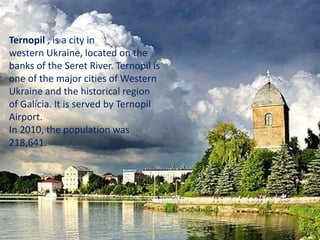
Ternopil , is a city in
western Ukraine, located on the
banks of the Seret River. Ternopil is
one of the major cities of Western
Ukraine and the historical region
of Galicia. It is served by Ternopil
Airport.
In 2010, the population was
218,641.
The city was founded in 1540 by Jan Amor Tarnowski as a military stronghold and a
castle. In 1544 the Ternopil Castle was constructed and repelled its
first Tatar attacks. In 1548 Ternopil was granted city rights by king Sigismund I the
Old. In 1567 the city passed to the Ostrogski family. In 1575 it was plundered by
the Tatars. In 1623 the city passed to the Zamoyski family.
In the 17th century the town was almost wiped from the face of the Earth in the
Khmelnytsky Uprising which drove out or killed most of its Jewish residents.
Ternopil was almost completely destroyed by the Turks and Tatars in 1675 and
rebuilt by Aleksander Koniecpolski but did not recover its previous glory until it
passed to Marie Casimire, the wife of king Jan III Sobieski in 1690. The city was
later sacked for the last time by Tatars in 1694, and twice by Russians in the course
of the Great Northern War in 1710 and the War of the Polish Succession in 1733.
In 1747 Józef Potocki invited the Dominicanes and founded the beautiful late-
baroque Dominican Church (today the Cathedral of the Immaculate Conception of The
Blessed Virgin Mary of the Ternopil-Zboriv eparchy of theUkrainian Greek Catholic Church).
The city was thrice looted during the confederation of Bar (1768–1772), by the confederates
themselves, by the king's army and by Russians. In 1770 it was further devastated by an
outbreak of smallpox.
Tarnopol Voivodeship
In 1772 the city came under Austrian rule. In 1809 the city came under Russian rule, which
created Ternopol krai there. In 1815 the city (then with 11,000 residents) returned to the
Austrian rule in accordance with the Congress of Vienna. In 1820 Jesuits expelled
from Polatsk by the Russians established a gymnasium in Ternopil. In 1870 a rail
line connected Ternopil with Lviv, accelerating the city's growth. At that time Ternopil had a
population of about 25,000.
The region was part of Habsburg Galicia and was an ethnic mix of mainly Roman
Catholic Poles, Greek Catholic Ruthenians, and Jews. Intermarriage between Poles
and Ruthenians was common. During World War I the city passed
from German and Austrian forces to Russia several times. In 1917 it was burnt down
by fleeing Russian forces. After the dissolution of the Austro-Hungarian Empire, the
city was proclaimed part of the West Ukrainian People's Republic on 11 November
1918. After Polish forces captured Lwow during thePolish-Ukrainian War, Ternopol
became the country's temporary capital (22 November to 30 December 1918). After
the act of union between Western-Ukrainian Republic and the Ukrainian People's
Republic (UPR), Ternopol formally passed under the UPR's control. On 15 July 1919
the city was captured by Polish forces. In 1920 the exiled Ukrainian
government of Symon Petlura accepted Polish control of Ternopol and of the entire
area after receiving the assurance of Josef Pilsudski, the Lithuanian born Field
Marshal of the Polish Army, that there would be no peace with the Russians without
creating a Ukrainian state. In July and August 1920 the Red Army captured Ternopol
in the course of the Polish-Soviet War. The city then served as the capital of
the Galician Soviet Socialist Republic. Although the Poles and their Ukrainian allies
badly defeated the Russians on the battle field and the Russians had offered to cede
Ukraine and Belarus, Polish politicians in Warsaw refused to honor Pilsudski's
promise. By the terms of the Riga treaty, the Soviets and Poles effectively partitioned
Ukraine. For the next 19 years, the ethnically mixed Ternopol area remained in Polish
control.
From 1922 to September 1939, Ternopol served as the capital of the Tarnopol
Voivodeship that consisted of 17 powiats. According to the official 1939 Statistical Yearbook
of Poland, Ukrainian speaking Ruthenians accounted for less than half of the voivodship's
population as ethnic Poles and Jews also lived in the region in large numbers.[citation
needed] Ukrainian Nationalism was supported by the militantOrganization of Ukrainian
Nationalists whose local Ternopol branch was led by Roman Paladiychuk and Yaroslav
Stetsko, the future leader of OUN.
After the September 17, 1939 the Red Army entered Eastern Poland, in furtherance of the
Molotov–Ribbentrop Pact and contrary to the Soviet-Polish non-aggression treaty and
captured Ternopol, which was renamed Ternopil and incorporated into their Ukrainian
Soviet Socialist Republic. The Soviets made it their first priority to destroy the Organization
of Ukrainian Nationalists and exterminate its leaders. Mass arrests, torture and executions
of Ukrainians and Poles followed. The Soviets also carried out mass deportations of the
"enemies of the working class" to Kazakhstan. In practice, this translated into members of
the former state administration, police, border service, land and business owners.
In 1941 the city was occupied by the Nazi Germans who
continued exterminating the population by murdering
the Jews and sending Ukrainians as forced labour to
Germany. In the years 1942–1943 the Polish Armia
Krajowa was active opposing Nazi rule and defending
ethnic Poles from violence from Ukrainian Nationalists.
During the Soviet release in March and April 1944, the
city was encircled. In March 1944 the city was declared
a fortified place by Adolf Hitler, to be defended until the
last round was shot. The stiff German resistance caused
extensive use of heavy artillery by the Red Army,
resulting in the complete destruction of the city and
killing of nearly all German occupants (55 survivors out
of 4,500). Unlike many other occasions, where the
Germans had practised a scorched earth policy during
their withdrawal from territories of the Soviet Union,
the devastation was caused directly by the
hostilities.[Following the defeat of Nazi Germany, the
ethnic Polish population of the Ternopol region was
forcibly deported to former German territory near
Wrocław (Breslau) as part of Soviet ethnic cleansing of
modern day Ukraine. After World War II Ternopil was
rebuilt in typically Soviet style. Only a few buildings
were reconstructed.
Polish Jews settled in Ternopil beginning at its founding and soon formed a majority of the
population. During the 16th and 17th centuries there were 300 Jewish families in the city.
The Great Synagogue of Ternopil was built in Gothic Survival style between 1622 and
1628.Among the towns destroyed by Bohdan Khmelnytsky during his march from Zolochiv
through Galicia was Tarnopol, the large Jewish population of which carried on an
extensive trade. Shortly afterward, however, when the Cossacks had been subdued
by John III of Poland, the town began to prosper anew, and its Jewish population
exceeded all previous figures. It may be noted that Hasidism at this time dominated the
community, which opposed any introduction of Western culture. During the troubled
times in the latter part of the eighteenth century, the city was stormed (1770) by the
adherents of the Confederacy of Bar, who massacred many of its inhabitants, especially
the Jews.
After the second partition of Poland, Ternopil came under Austrian domination
and Joseph Perl was able to continue his efforts to improve the condition of the
Jews there, which he had begun under Russian rule. In 1813 he established a Jewish
school which had as its chief object the instruction of Jewish youth in German as
well as in Hebrew and in various other subjects. Controversy between the traditional
Hasidim and the modernising Maskilim which this school caused, resulted four years
later in a victory for the latter, whereupon the institution received official
recognition and was placed under communal control. Starting in 1863, the school
policy was gradually modified by Polish influences, and very little attention was
given to instruction in German. The Tempel für Geregelten Gottesdienst, opened
by Perl in 1819, also caused dissensions within the community, and its rabbi, Samuel
Judah Löb Rapoport, was forced to withdraw. This dispute also was eventually
settled in favour of the Maskilim. As of 1905, the Jewish community numbered
14,000 in a total population of 30,415. Jews took control of the active import/export
trade with Russia conducted through the border city of Pidvolochysk.
In 1941, 500 Jews were murdered on the grounds of Ternopil's Christian cemetery by
local inhabitants using weapons borrowed from aGerman army camp. According to
interviews conducted by a Roman Catholic priest, Father Patrick Desbois, some of the
bodies were decapitated. In September 1941, the Germans announced the establishment
of a Jewish ghetto in the city. In the winter of 1941/42, mortality in the ghetto escalated
to such a degree that the Judenrat was constrained to bury the dead in a common grave.
Between August 1942 to June 1943 there were 5 "selections" that depleted the Jewish
population of the ghetto by sending the Jews to Belzec extermination camp. A few
hundred Jews from Tarnopol and its vicinity attempted to survive by hiding within the
town limits. Many were denounced to the Germans, including some 200 people shortly
before the Soviets liberated the area. A number of Jews survived by hiding with Poles. A
monument in memory of the Holocaust victims was built at Petrikovsky Yar in 1996.
On September 19, 2012 the monument was desecrated, in what seems to be an anti-
Semitic act.
Ternopil city

Ternopil city

  • 1.
    Ternopil , isa city in western Ukraine, located on the banks of the Seret River. Ternopil is one of the major cities of Western Ukraine and the historical region of Galicia. It is served by Ternopil Airport. In 2010, the population was 218,641.
  • 2.
    The city wasfounded in 1540 by Jan Amor Tarnowski as a military stronghold and a castle. In 1544 the Ternopil Castle was constructed and repelled its first Tatar attacks. In 1548 Ternopil was granted city rights by king Sigismund I the Old. In 1567 the city passed to the Ostrogski family. In 1575 it was plundered by the Tatars. In 1623 the city passed to the Zamoyski family. In the 17th century the town was almost wiped from the face of the Earth in the Khmelnytsky Uprising which drove out or killed most of its Jewish residents. Ternopil was almost completely destroyed by the Turks and Tatars in 1675 and rebuilt by Aleksander Koniecpolski but did not recover its previous glory until it passed to Marie Casimire, the wife of king Jan III Sobieski in 1690. The city was later sacked for the last time by Tatars in 1694, and twice by Russians in the course of the Great Northern War in 1710 and the War of the Polish Succession in 1733.
  • 3.
    In 1747 JózefPotocki invited the Dominicanes and founded the beautiful late- baroque Dominican Church (today the Cathedral of the Immaculate Conception of The Blessed Virgin Mary of the Ternopil-Zboriv eparchy of theUkrainian Greek Catholic Church). The city was thrice looted during the confederation of Bar (1768–1772), by the confederates themselves, by the king's army and by Russians. In 1770 it was further devastated by an outbreak of smallpox. Tarnopol Voivodeship In 1772 the city came under Austrian rule. In 1809 the city came under Russian rule, which created Ternopol krai there. In 1815 the city (then with 11,000 residents) returned to the Austrian rule in accordance with the Congress of Vienna. In 1820 Jesuits expelled from Polatsk by the Russians established a gymnasium in Ternopil. In 1870 a rail line connected Ternopil with Lviv, accelerating the city's growth. At that time Ternopil had a population of about 25,000.
  • 4.
    The region waspart of Habsburg Galicia and was an ethnic mix of mainly Roman Catholic Poles, Greek Catholic Ruthenians, and Jews. Intermarriage between Poles and Ruthenians was common. During World War I the city passed from German and Austrian forces to Russia several times. In 1917 it was burnt down by fleeing Russian forces. After the dissolution of the Austro-Hungarian Empire, the city was proclaimed part of the West Ukrainian People's Republic on 11 November 1918. After Polish forces captured Lwow during thePolish-Ukrainian War, Ternopol became the country's temporary capital (22 November to 30 December 1918). After the act of union between Western-Ukrainian Republic and the Ukrainian People's Republic (UPR), Ternopol formally passed under the UPR's control. On 15 July 1919 the city was captured by Polish forces. In 1920 the exiled Ukrainian government of Symon Petlura accepted Polish control of Ternopol and of the entire area after receiving the assurance of Josef Pilsudski, the Lithuanian born Field Marshal of the Polish Army, that there would be no peace with the Russians without creating a Ukrainian state. In July and August 1920 the Red Army captured Ternopol in the course of the Polish-Soviet War. The city then served as the capital of the Galician Soviet Socialist Republic. Although the Poles and their Ukrainian allies badly defeated the Russians on the battle field and the Russians had offered to cede Ukraine and Belarus, Polish politicians in Warsaw refused to honor Pilsudski's promise. By the terms of the Riga treaty, the Soviets and Poles effectively partitioned Ukraine. For the next 19 years, the ethnically mixed Ternopol area remained in Polish control.
  • 5.
    From 1922 toSeptember 1939, Ternopol served as the capital of the Tarnopol Voivodeship that consisted of 17 powiats. According to the official 1939 Statistical Yearbook of Poland, Ukrainian speaking Ruthenians accounted for less than half of the voivodship's population as ethnic Poles and Jews also lived in the region in large numbers.[citation needed] Ukrainian Nationalism was supported by the militantOrganization of Ukrainian Nationalists whose local Ternopol branch was led by Roman Paladiychuk and Yaroslav Stetsko, the future leader of OUN. After the September 17, 1939 the Red Army entered Eastern Poland, in furtherance of the Molotov–Ribbentrop Pact and contrary to the Soviet-Polish non-aggression treaty and captured Ternopol, which was renamed Ternopil and incorporated into their Ukrainian Soviet Socialist Republic. The Soviets made it their first priority to destroy the Organization of Ukrainian Nationalists and exterminate its leaders. Mass arrests, torture and executions of Ukrainians and Poles followed. The Soviets also carried out mass deportations of the "enemies of the working class" to Kazakhstan. In practice, this translated into members of the former state administration, police, border service, land and business owners.
  • 6.
    In 1941 thecity was occupied by the Nazi Germans who continued exterminating the population by murdering the Jews and sending Ukrainians as forced labour to Germany. In the years 1942–1943 the Polish Armia Krajowa was active opposing Nazi rule and defending ethnic Poles from violence from Ukrainian Nationalists. During the Soviet release in March and April 1944, the city was encircled. In March 1944 the city was declared a fortified place by Adolf Hitler, to be defended until the last round was shot. The stiff German resistance caused extensive use of heavy artillery by the Red Army, resulting in the complete destruction of the city and killing of nearly all German occupants (55 survivors out of 4,500). Unlike many other occasions, where the Germans had practised a scorched earth policy during their withdrawal from territories of the Soviet Union, the devastation was caused directly by the hostilities.[Following the defeat of Nazi Germany, the ethnic Polish population of the Ternopol region was forcibly deported to former German territory near Wrocław (Breslau) as part of Soviet ethnic cleansing of modern day Ukraine. After World War II Ternopil was rebuilt in typically Soviet style. Only a few buildings were reconstructed.
  • 7.
    Polish Jews settledin Ternopil beginning at its founding and soon formed a majority of the population. During the 16th and 17th centuries there were 300 Jewish families in the city. The Great Synagogue of Ternopil was built in Gothic Survival style between 1622 and 1628.Among the towns destroyed by Bohdan Khmelnytsky during his march from Zolochiv through Galicia was Tarnopol, the large Jewish population of which carried on an extensive trade. Shortly afterward, however, when the Cossacks had been subdued by John III of Poland, the town began to prosper anew, and its Jewish population exceeded all previous figures. It may be noted that Hasidism at this time dominated the community, which opposed any introduction of Western culture. During the troubled times in the latter part of the eighteenth century, the city was stormed (1770) by the adherents of the Confederacy of Bar, who massacred many of its inhabitants, especially the Jews.
  • 8.
    After the secondpartition of Poland, Ternopil came under Austrian domination and Joseph Perl was able to continue his efforts to improve the condition of the Jews there, which he had begun under Russian rule. In 1813 he established a Jewish school which had as its chief object the instruction of Jewish youth in German as well as in Hebrew and in various other subjects. Controversy between the traditional Hasidim and the modernising Maskilim which this school caused, resulted four years later in a victory for the latter, whereupon the institution received official recognition and was placed under communal control. Starting in 1863, the school policy was gradually modified by Polish influences, and very little attention was given to instruction in German. The Tempel für Geregelten Gottesdienst, opened by Perl in 1819, also caused dissensions within the community, and its rabbi, Samuel Judah Löb Rapoport, was forced to withdraw. This dispute also was eventually settled in favour of the Maskilim. As of 1905, the Jewish community numbered 14,000 in a total population of 30,415. Jews took control of the active import/export trade with Russia conducted through the border city of Pidvolochysk.
  • 9.
    In 1941, 500Jews were murdered on the grounds of Ternopil's Christian cemetery by local inhabitants using weapons borrowed from aGerman army camp. According to interviews conducted by a Roman Catholic priest, Father Patrick Desbois, some of the bodies were decapitated. In September 1941, the Germans announced the establishment of a Jewish ghetto in the city. In the winter of 1941/42, mortality in the ghetto escalated to such a degree that the Judenrat was constrained to bury the dead in a common grave. Between August 1942 to June 1943 there were 5 "selections" that depleted the Jewish population of the ghetto by sending the Jews to Belzec extermination camp. A few hundred Jews from Tarnopol and its vicinity attempted to survive by hiding within the town limits. Many were denounced to the Germans, including some 200 people shortly before the Soviets liberated the area. A number of Jews survived by hiding with Poles. A monument in memory of the Holocaust victims was built at Petrikovsky Yar in 1996. On September 19, 2012 the monument was desecrated, in what seems to be an anti- Semitic act.