The Queen Maria of
Romania
Students: Chelariu Alexandra
Sandu Adina
8316
Who was Queen Maria?
Maria Alexandra Victoria, Princess of Edinburgh,
granddaughter of Queen Victoria of England and Tsar Alexander II of
Russia, became at the age of 17 the wife of Prince heir Ferdinand of
Romania and then, in 1914, Queen Maria of Romania.
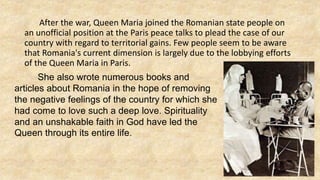
From the beginning, Queen Maria has been actively involved in
political life, having meetings with ministers and diplomats. Observing the
young prince's interest in the country's problems, King Carol I and Prince
Ferdinand have named Maria the Honorable Commander of the 4th Red
Crescent (Cavalry) Regiment. Maria proudly wore the military uniform and
was actively involved in all the actions that the 4th Red Cross has deployed.
Thus, it became known as "the wounded mother" or "the queen of the soldier"
After the war, Queen Maria joined the Romanian state people on
an unofficial position at the Paris peace talks to plead the case of our
country with regard to territorial gains. Few people seem to be aware
that Romania's current dimension is largely due to the lobbying efforts
of the Queen Maria in Paris.
She also wrote numerous books and
articles about Romania in the hope of removing
the negative feelings of the country for which she
had come to love such a deep love. Spirituality
and an unshakable faith in God have led the
Queen through its entire life.
Queen Maria and The Great Union
There have been several moments that preceded, but also that succeeded
the Great Union from December 1, 1918, moments that in fact consolidated this
historical date. The stages of the Union remained in history with two dates: that of
the Julian calendar or "old style" still used in the Kingdom of Romania and
Bessarabia at the time of the Union, and that of the Gregorian calendar used in
Transylvania and Bucovina. Due to a need to consolidate and modernize the new
unitary state, Great Romania officially adopted the Gregorian calendar in 1919,
April 1 becoming officially April 14th.
Even after the great powers of the world were made and
recognized by the Great Union, the Queen Maria continued to plead
the cause of Romania and promote the country's values ​​beyond the
borders until she was removed from the political life of the country
with Carol taking over the throne II. He then retired to Balchik or to
Bran Castle, and spent the last days of his life at Pelişor Castle, where
he died on July 18, 1938.
The role of the Queen Maria after The Great Union
"Why did I come here? Well, I was
at the Peace Conference in Paris
after the war, and they asked me
this question and I said, "Every
country needs a face. So when you
gather together for deliberations, I
want Romania to have a face. I am
here to be that face, to make
Romania something more personal
than statistics and maps. "" Queen
Maria said in autumn 1926 during a
visit to the United States.
• Dicţionarul personalităţilor feminine din România (Ed. Meronia, 2009)
• Istoria românilor în timpul celor patru regi (1866-1947) - Ferdinand
I (Ioan Scurtu, Ed. Enciclopedică, vol. II, 2004).
• http://peles.ro/personalitati/regina-maria/
Bibliography

Mm

  • 1.
    The Queen Mariaof Romania Students: Chelariu Alexandra Sandu Adina 8316
  • 2.
    Who was QueenMaria? Maria Alexandra Victoria, Princess of Edinburgh, granddaughter of Queen Victoria of England and Tsar Alexander II of Russia, became at the age of 17 the wife of Prince heir Ferdinand of Romania and then, in 1914, Queen Maria of Romania. From the beginning, Queen Maria has been actively involved in political life, having meetings with ministers and diplomats. Observing the young prince's interest in the country's problems, King Carol I and Prince Ferdinand have named Maria the Honorable Commander of the 4th Red Crescent (Cavalry) Regiment. Maria proudly wore the military uniform and was actively involved in all the actions that the 4th Red Cross has deployed. Thus, it became known as "the wounded mother" or "the queen of the soldier"
  • 3.
    After the war,Queen Maria joined the Romanian state people on an unofficial position at the Paris peace talks to plead the case of our country with regard to territorial gains. Few people seem to be aware that Romania's current dimension is largely due to the lobbying efforts of the Queen Maria in Paris. She also wrote numerous books and articles about Romania in the hope of removing the negative feelings of the country for which she had come to love such a deep love. Spirituality and an unshakable faith in God have led the Queen through its entire life.
  • 4.
    Queen Maria andThe Great Union There have been several moments that preceded, but also that succeeded the Great Union from December 1, 1918, moments that in fact consolidated this historical date. The stages of the Union remained in history with two dates: that of the Julian calendar or "old style" still used in the Kingdom of Romania and Bessarabia at the time of the Union, and that of the Gregorian calendar used in Transylvania and Bucovina. Due to a need to consolidate and modernize the new unitary state, Great Romania officially adopted the Gregorian calendar in 1919, April 1 becoming officially April 14th.
  • 5.
    Even after thegreat powers of the world were made and recognized by the Great Union, the Queen Maria continued to plead the cause of Romania and promote the country's values ​​beyond the borders until she was removed from the political life of the country with Carol taking over the throne II. He then retired to Balchik or to Bran Castle, and spent the last days of his life at Pelişor Castle, where he died on July 18, 1938. The role of the Queen Maria after The Great Union
  • 6.
    "Why did Icome here? Well, I was at the Peace Conference in Paris after the war, and they asked me this question and I said, "Every country needs a face. So when you gather together for deliberations, I want Romania to have a face. I am here to be that face, to make Romania something more personal than statistics and maps. "" Queen Maria said in autumn 1926 during a visit to the United States.
  • 7.
    • Dicţionarul personalităţilorfeminine din România (Ed. Meronia, 2009) • Istoria românilor în timpul celor patru regi (1866-1947) - Ferdinand I (Ioan Scurtu, Ed. Enciclopedică, vol. II, 2004). • http://peles.ro/personalitati/regina-maria/ Bibliography