The Digital Barbados
Initiative
Towards a Digital Society
Prepared by: David Smith (Chair, ISOC Barbados)
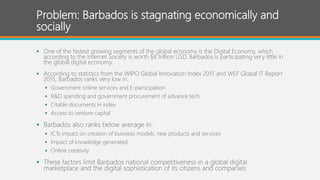
Problem: Barbados is stagnating economically and
socially
 One of the fastest growing segments of the global economy is the Digital Economy, which
according to the Internet Society is worth $8 trillion USD. Barbados is participating very little in
the global digital economy.
 According to statistics from the WIPO Global Innovation Index 2015 and WEF Global IT Report
2015, Barbados ranks very low in:
 Government online services and E-participation
 R&D spending and government procurement of advance tech.
 Citable documents H index
 Access to venture capital
 Barbados also ranks below average in:
 ICTs impact on creation of business models, new products and services
 Impact of knowledge generated
 Online creativity
 These factors limit Barbados national competitiveness in a global digital
marketplace and the digital sophistication of its citizens and companies
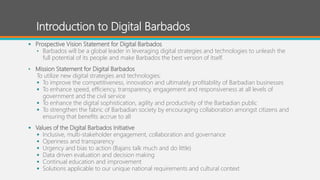
Introduction to Digital Barbados
 Prospective Vision Statement for Digital Barbados
• Barbados will be a global leader in leveraging digital strategies and technologies to unleash the
full potential of its people and make Barbados the best version of itself.
• Mission Statement for Digital Barbados
To utilize new digital strategies and technologies:
 To improve the competitiveness, innovation and ultimately profitability of Barbadian businesses
 To enhance speed, efficiency, transparency, engagement and responsiveness at all levels of
government and the civil service
 To enhance the digital sophistication, agility and productivity of the Barbadian public
 To strengthen the fabric of Barbadian society by encouraging collaboration amongst citizens and
ensuring that benefits accrue to all
 Values of the Digital Barbados Initiative
 Inclusive, multi-stakeholder engagement, collaboration and governance
 Openness and transparency
 Urgency and bias to action (Bajans talk much and do little)
 Data driven evaluation and decision making
 Continual education and improvement
 Solutions applicable to our unique national requirements and cultural context
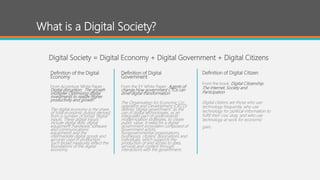
What is a Digital Society?
Definition of the Digital
Economy
From Accenture White Paper:
Digital disruption: The growth
multiplier Optimizing digital
investments to realize higher
productivity and growth
The digital economy is the share
of total economic output derived
from a number of broad “digital”
inputs. These digital inputs
include digital skills, digital
equipment (hardware, software
and communications
equipment) and the
intermediate digital goods and
services used in production.
Such broad measures reflect the
foundations of the digital
economy.
Definition of Digital
Government
From the EY White Paper: Agents of
change How government CTOs can
drive digital transformation
The Organisation for Economic Co-
operation and Development (OECD)
defines “digital government” as the
use of digital technologies, as an
integrated part of governments’
modernization strategies, to create
public value. It relies on a digital
government ecosystem composed of
government actors,
nongovernmental organizations,
businesses, citizens’ associations and
individuals, which supports the
production of and access to data,
services and content through
interactions with the government.
Digital Society = Digital Economy + Digital Government + Digital Citizens
Definition of Digital Citizen
From the book: Digital Citizenship:
The Internet, Society and
Participation
Digital citizens are those who use
technology frequently, who use
technology for political information to
fulfill their civic duty, and who use
technology at work for economic
gain.
The Need for a Digital Economy
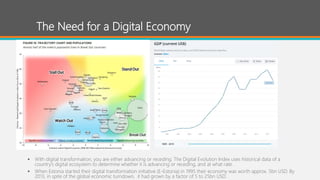
 With digital transformation, you are either advancing or receding. The Digital Evolution Index uses historical data of a
country’s digital ecosystem to determine whether it is advancing or receding, and at what rate.
 When Estonia started their digital transformation initiative (E-Estonia) in 1995 their economy was worth approx. 5bn USD. By
2013, in spite of the global economic turndown, it had grown by a factor of 5 to 25bn USD.
The Digital Evolution Index
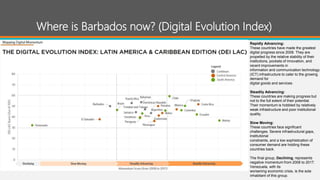
Where is Barbados now? (Digital Evolution Index)
World Economic Forum Global Information Technology Report 2015 – Barbados’ Rank
Rapidly Advancing:
These countries have made the greatest
digital progress since 2008. They are
propelled by the relative stability of their
institutions, pockets of innovation, and
recent improvements in
information and communication technology
(ICT) infrastructure to cater to the growing
demand for
digital goods and services.
Steadily Advancing:
These countries are making progress but
not to the full extent of their potential.
Their momentum is hobbled by relatively
weak infrastructure and poor institutional
quality.
Slow Moving:
These countries face significant
challenges. Severe infrastructural gaps,
institutional
constraints, and a low sophistication of
consumer demand are holding these
countries back.
The final group, Declining, represents
negative momentum from 2008 to 2017.
Venezuela, with its
worsening economic crisis, is the sole
inhabitant of this group.
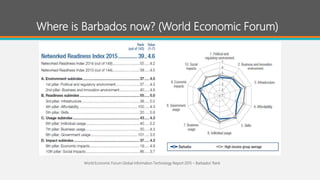
Where is Barbados now? (World Economic Forum)
World Economic Forum Global Information Technology Report 2015 – Barbados’ Rank
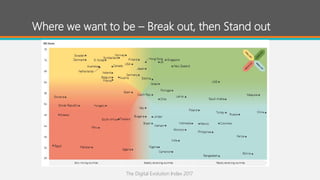
Where we want to be – Break out, then Stand out
World Economic Forum Global Information Technology Report 2015 – Estonia’s Rank
The Digital Evolution Index 2017
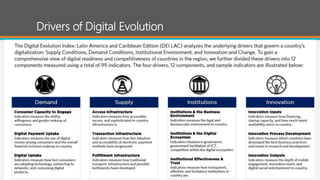
Drivers of Digital Evolution
TRPC – Going Digital: The Status and Future Potential of Internet-Based Economies in Asia – A Report by TRPC
Don’t just copy someone else, make it ours
Video: Black Panther
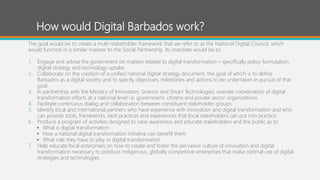
How would Digital Barbados work?
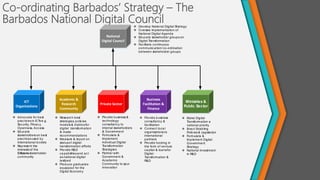
The goal would be to create a multi-stakeholder framework that we refer to as the National Digital Council, which
would function in a similar manner to the Social Partnership. Its mandate would be to:
1. Engage and advise the government on matters related to digital transformation – specifically policy formulation,
digital strategy and technology uptake.
2. Collaborate on the creation of a unified national digital strategy document, the goal of which is to define
Barbados as a digital society and to specify objectives, milestones and actions to be undertaken in pursuit of that
goal.
3. In partnership with the Ministry of Innovation, Science and Smart Technologies, oversee coordination of digital
transformation efforts at a national level i.e. government, citizens and private sector organizations.
4. Facilitate continuous dialog and collaboration between constituent stakeholder groups.
5. Identify local and international partners who have experience with innovation and digital transformation and who
can provide tools, frameworks, best practices and experiences that local stakeholders can put into practice.
6. Produce a program of activities designed to raise awareness and educate stakeholders and the public as to:
 What is digital transformation
 How a national digital transformation initiative can benefit them
 What role they have to play in digital transformation
7. Help educate local enterprises on how to create and foster the pervasive culture of innovation and digital
transformation necessary to produce indigenous, globally competitive enterprises that make optimal use of digital
strategies and technologies.
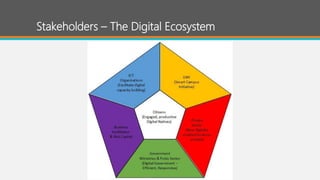
Stakeholders – The Digital Ecosystem
Co-ordinating Barbados’ Strategy – The
Barbados National Digital Council
National
Digital Council
ICT
Organizations
Academic &
Research
Community
Private Sector
Business
Facilitation &
Finance
Ministries &
Public Sector
v Make Digital
Transformation a
national priority
v Enact Enabling
Polic ies & Legislation
v Formulate &
Implement Digital
Government
Strategy
v National Investment
in R&D
v Provide business
consultancy &
facilitation
v Connect loca l
organizations to
international
partners
v Provide funding in
the form of venture
ca pital & loansfor
Digital
Transformation &
R&D
v Provide business &
technology
consultancy to
internal stakeholders
& Government
v Formulate &
Implement
individual Digital
Transformation
Strategies
v Partner with
Government &
Academic
Community to spur
innovation
v Researc h best
strategies, polic ies
models& metrics for
digital transformation
& make
recommendations
v Measure & report on
statusof digital
transformation efforts
v Provide R&D
ca pabilitiesand ac t
as national digital
testbed
v Produce graduates
equipped for the
Digital Economy
v Advocate for best
prac tices in ICTs e.g.
Security, Privac y,
Openness, Acc ess
v Educate
stakeholders on best
prac tices used by
international bodies
v Represent the
interests of the
Citizensstakeholder
community
v Develop National Digital Strategy
v Oversee Implementation of
National Digital Agenda
v Educate stakeholder groups on
Digital Transformation
v Fac ilitate continuous
communic ation/co-ordination
between stakeholder groups
Next Steps
Introductory
Meeting
Working Group
Formation
Working Group
Meetings
National
Consultation

The Digital Barbados Initiative - Presentation 3

  • 1.
    The Digital Barbados Initiative Towardsa Digital Society Prepared by: David Smith (Chair, ISOC Barbados)
  • 2.
    Problem: Barbados isstagnating economically and socially  One of the fastest growing segments of the global economy is the Digital Economy, which according to the Internet Society is worth $8 trillion USD. Barbados is participating very little in the global digital economy.  According to statistics from the WIPO Global Innovation Index 2015 and WEF Global IT Report 2015, Barbados ranks very low in:  Government online services and E-participation  R&D spending and government procurement of advance tech.  Citable documents H index  Access to venture capital  Barbados also ranks below average in:  ICTs impact on creation of business models, new products and services  Impact of knowledge generated  Online creativity  These factors limit Barbados national competitiveness in a global digital marketplace and the digital sophistication of its citizens and companies
  • 3.
    Introduction to DigitalBarbados  Prospective Vision Statement for Digital Barbados • Barbados will be a global leader in leveraging digital strategies and technologies to unleash the full potential of its people and make Barbados the best version of itself. • Mission Statement for Digital Barbados To utilize new digital strategies and technologies:  To improve the competitiveness, innovation and ultimately profitability of Barbadian businesses  To enhance speed, efficiency, transparency, engagement and responsiveness at all levels of government and the civil service  To enhance the digital sophistication, agility and productivity of the Barbadian public  To strengthen the fabric of Barbadian society by encouraging collaboration amongst citizens and ensuring that benefits accrue to all  Values of the Digital Barbados Initiative  Inclusive, multi-stakeholder engagement, collaboration and governance  Openness and transparency  Urgency and bias to action (Bajans talk much and do little)  Data driven evaluation and decision making  Continual education and improvement  Solutions applicable to our unique national requirements and cultural context
  • 4.
    What is aDigital Society? Definition of the Digital Economy From Accenture White Paper: Digital disruption: The growth multiplier Optimizing digital investments to realize higher productivity and growth The digital economy is the share of total economic output derived from a number of broad “digital” inputs. These digital inputs include digital skills, digital equipment (hardware, software and communications equipment) and the intermediate digital goods and services used in production. Such broad measures reflect the foundations of the digital economy. Definition of Digital Government From the EY White Paper: Agents of change How government CTOs can drive digital transformation The Organisation for Economic Co- operation and Development (OECD) defines “digital government” as the use of digital technologies, as an integrated part of governments’ modernization strategies, to create public value. It relies on a digital government ecosystem composed of government actors, nongovernmental organizations, businesses, citizens’ associations and individuals, which supports the production of and access to data, services and content through interactions with the government. Digital Society = Digital Economy + Digital Government + Digital Citizens Definition of Digital Citizen From the book: Digital Citizenship: The Internet, Society and Participation Digital citizens are those who use technology frequently, who use technology for political information to fulfill their civic duty, and who use technology at work for economic gain.
  • 5.
    The Need fora Digital Economy  With digital transformation, you are either advancing or receding. The Digital Evolution Index uses historical data of a country’s digital ecosystem to determine whether it is advancing or receding, and at what rate.  When Estonia started their digital transformation initiative (E-Estonia) in 1995 their economy was worth approx. 5bn USD. By 2013, in spite of the global economic turndown, it had grown by a factor of 5 to 25bn USD.
  • 6.
  • 7.
    Where is Barbadosnow? (Digital Evolution Index) World Economic Forum Global Information Technology Report 2015 – Barbados’ Rank Rapidly Advancing: These countries have made the greatest digital progress since 2008. They are propelled by the relative stability of their institutions, pockets of innovation, and recent improvements in information and communication technology (ICT) infrastructure to cater to the growing demand for digital goods and services. Steadily Advancing: These countries are making progress but not to the full extent of their potential. Their momentum is hobbled by relatively weak infrastructure and poor institutional quality. Slow Moving: These countries face significant challenges. Severe infrastructural gaps, institutional constraints, and a low sophistication of consumer demand are holding these countries back. The final group, Declining, represents negative momentum from 2008 to 2017. Venezuela, with its worsening economic crisis, is the sole inhabitant of this group.
  • 8.
    Where is Barbadosnow? (World Economic Forum) World Economic Forum Global Information Technology Report 2015 – Barbados’ Rank
  • 9.
    Where we wantto be – Break out, then Stand out World Economic Forum Global Information Technology Report 2015 – Estonia’s Rank The Digital Evolution Index 2017
  • 10.
    Drivers of DigitalEvolution TRPC – Going Digital: The Status and Future Potential of Internet-Based Economies in Asia – A Report by TRPC
  • 11.
    Don’t just copysomeone else, make it ours Video: Black Panther
  • 12.
    How would DigitalBarbados work? The goal would be to create a multi-stakeholder framework that we refer to as the National Digital Council, which would function in a similar manner to the Social Partnership. Its mandate would be to: 1. Engage and advise the government on matters related to digital transformation – specifically policy formulation, digital strategy and technology uptake. 2. Collaborate on the creation of a unified national digital strategy document, the goal of which is to define Barbados as a digital society and to specify objectives, milestones and actions to be undertaken in pursuit of that goal. 3. In partnership with the Ministry of Innovation, Science and Smart Technologies, oversee coordination of digital transformation efforts at a national level i.e. government, citizens and private sector organizations. 4. Facilitate continuous dialog and collaboration between constituent stakeholder groups. 5. Identify local and international partners who have experience with innovation and digital transformation and who can provide tools, frameworks, best practices and experiences that local stakeholders can put into practice. 6. Produce a program of activities designed to raise awareness and educate stakeholders and the public as to:  What is digital transformation  How a national digital transformation initiative can benefit them  What role they have to play in digital transformation 7. Help educate local enterprises on how to create and foster the pervasive culture of innovation and digital transformation necessary to produce indigenous, globally competitive enterprises that make optimal use of digital strategies and technologies.
  • 13.
    Stakeholders – TheDigital Ecosystem
  • 14.
    Co-ordinating Barbados’ Strategy– The Barbados National Digital Council National Digital Council ICT Organizations Academic & Research Community Private Sector Business Facilitation & Finance Ministries & Public Sector v Make Digital Transformation a national priority v Enact Enabling Polic ies & Legislation v Formulate & Implement Digital Government Strategy v National Investment in R&D v Provide business consultancy & facilitation v Connect loca l organizations to international partners v Provide funding in the form of venture ca pital & loansfor Digital Transformation & R&D v Provide business & technology consultancy to internal stakeholders & Government v Formulate & Implement individual Digital Transformation Strategies v Partner with Government & Academic Community to spur innovation v Researc h best strategies, polic ies models& metrics for digital transformation & make recommendations v Measure & report on statusof digital transformation efforts v Provide R&D ca pabilitiesand ac t as national digital testbed v Produce graduates equipped for the Digital Economy v Advocate for best prac tices in ICTs e.g. Security, Privac y, Openness, Acc ess v Educate stakeholders on best prac tices used by international bodies v Represent the interests of the Citizensstakeholder community v Develop National Digital Strategy v Oversee Implementation of National Digital Agenda v Educate stakeholder groups on Digital Transformation v Fac ilitate continuous communic ation/co-ordination between stakeholder groups
  • 15.