Sovereign Wealth Funds’ (SWF’s)
Venture Capital Fund Form
Dr. Bashar Al-Zu‘bi, MENA – OECD Investment Programme
Fifth Meeting of the Working Group on Investment Zones in Iraq
28-29 April 2013, Cairo
Definition of SWF
Sovereign Wealth Funds (SWFs) are investment vehicles
managing portfolios on behalf of their governments.
Their investment capital is usually derived from either
petroleum revenues such as GCC region funds, Russia or
Norway; or persistent current account trade surpluses
such as China or Singapore (Dewenter et al, 2010).

2
Growing interest
• Natural resources are finite, becoming depleted overtime. GCC
region economies are interested in developing non-oil income
based industries and markets in which SWF would be a main
catalyst.
• Unprecedented growth from US$ 500billion to 3.5trillion has
brought many managerial issues of concerns to the domain of
SWFs.
• More and more the SWFs comprise of ―alternative assets such
as property, Venture Capital Fund, infrastructure assets or other
non-bond type financial assets.
3
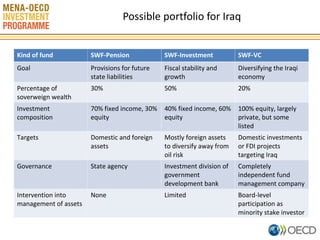
Possible portfolio for Iraq
Kind of fund

SWF-Pension

SWF-Investment

SWF-VC

Goal

Provisions for future
state liabilities

Fiscal stability and
growth

Diversifying the Iraqi
economy

Percentage of
soverweign wealth

30%

50%

20%

Investment
composition

70% fixed income, 30%
equity

40% fixed income, 60%
equity

100% equity, largely
private, but some
listed

Targets

Domestic and foreign
assets

Mostly foreign assets
to diversify away from
oil risk

Domestic investments
or FDI projects
targeting Iraq

Governance

State agency

Investment division of
government
development bank

Completely
independent fund
management company

Intervention into
management of assets

None

Limited

Board-level
participation as
minority stake investor
4
Structure plan for VCF

5
Level of risk and return

Typology of potential investments into Iraq

Not a priority for Iraq

Key strategic bets
SW VCF

Development
banks

Market mechanisms

Support debt financing
mechanisms

Contribution to diversification
6
Factors in designing Government Venture Capital
Target equity gap

There are type of investments – sectors which has high cost of
capital. These are the sectors to which government equity
investment should be directed. It makes sense to “subsidise” risky
investments because of the value of the social signal they give.

Fund management

Public officials should not be directly involved in the investment
process. Rather, this responsibility should be delegated to topquality venture capitalists from the private sector. While the
government should monitor programmes, its involvement in
investment decisions should be minimal and the decision-making
mechanism should be transparent.

Additionality

A programme goal should be to attract new private sector
investment and create a commercially viable market. Programmes
should seek to maximize private sector participation through
reducing the imbedded risk.
7
Several distinct institutions needed

8
Russian Direct Investment Fund

•
•
•

•
•

•

The Russian Direct Investment Fund (RDIF) is a $10 billion fund established by the Russian
government to make equity investments in the Russian economy.
In all of its investments, the fund is mandated to co-invest alongside some of the largest and most
sophisticated investors globally – thus acting as a catalyst for direct investment in Russia.
The Russian Direct Investment Fund was created in 2011 under the leadership of President and
Prime Minister of Russian Federation and is managed by a highly qualified team of private equity
investment professionals with broad international and Russian experience.
In all of its investments, RDIF is mandated to co-invest alongside some of the largest and most
sophisticated global investors - thus acting as a catalyst for direct investment in Russia.
RDIF was created in June 2011 under the leadership of both President Dmitry Medvedev and
Prime Minister Vladimir Putin as part of a broader initiative to improve the investment climate of
Russia and establish Moscow as an international financial center. RDIF is managed by a highlyqualified team of private equity investors with broad international and Russian experience.
The Management Company of RDIF is a 100% subsidiary of Vnesheconombank (VEB), Russia's state
development bank.

9
Recommendations

• Iraq has a large natural resources of oil, therefore, the government should
ensure that oil wealth advantages are invested to create non-oil dependent
economy.
• The Government of Iraq should use part of its oil income to establish
government VCF. The underlying operating principle of the fund is that, it
mainly taking minority minority equity (or quasi equity) stakes in riskier direct
investments into the economy.
• The VCF should target investments that:
Ä
Ä
Ä
Ä
Ä

Are innovative, with a higher level of technology usage
Represent activities not present in Iraq at the moment
May lead to the establishment of new sectors of activities
May lead to a contribution of the Iraqi export basket
Would not be done without some kind of help with self-discovery costs
10
Recommendations

• The GoI need to infuse culture of quality and developing the wealth
management skills of the fund. Public officials should not be directly involved
in the investment process. Rather, this responsibility should be delegated to
top-quality venture capitalists from the private sector.
• The fund should be part of a professional separate organizational entity
rather than belonging to the finance ministry. The fund has to be a separate
agency with complete autonomy and professional management without any
political and ministerial influence except laid down overall strategy.
• Increased transparency and accountability would increase investors‘
confidence in the country’s business climate which may attract more foreign
direct investments (FDI). This would help fund’s growth as government will
invest profitably in FDI supported projects.
11

Lessons learnt from sovereign wealth funds

  • 1.
    Sovereign Wealth Funds’(SWF’s) Venture Capital Fund Form Dr. Bashar Al-Zu‘bi, MENA – OECD Investment Programme Fifth Meeting of the Working Group on Investment Zones in Iraq 28-29 April 2013, Cairo
  • 2.
    Definition of SWF SovereignWealth Funds (SWFs) are investment vehicles managing portfolios on behalf of their governments. Their investment capital is usually derived from either petroleum revenues such as GCC region funds, Russia or Norway; or persistent current account trade surpluses such as China or Singapore (Dewenter et al, 2010). 2
  • 3.
    Growing interest • Naturalresources are finite, becoming depleted overtime. GCC region economies are interested in developing non-oil income based industries and markets in which SWF would be a main catalyst. • Unprecedented growth from US$ 500billion to 3.5trillion has brought many managerial issues of concerns to the domain of SWFs. • More and more the SWFs comprise of ―alternative assets such as property, Venture Capital Fund, infrastructure assets or other non-bond type financial assets. 3
  • 4.
    Possible portfolio forIraq Kind of fund SWF-Pension SWF-Investment SWF-VC Goal Provisions for future state liabilities Fiscal stability and growth Diversifying the Iraqi economy Percentage of soverweign wealth 30% 50% 20% Investment composition 70% fixed income, 30% equity 40% fixed income, 60% equity 100% equity, largely private, but some listed Targets Domestic and foreign assets Mostly foreign assets to diversify away from oil risk Domestic investments or FDI projects targeting Iraq Governance State agency Investment division of government development bank Completely independent fund management company Intervention into management of assets None Limited Board-level participation as minority stake investor 4
  • 5.
  • 6.
    Level of riskand return Typology of potential investments into Iraq Not a priority for Iraq Key strategic bets SW VCF Development banks Market mechanisms Support debt financing mechanisms Contribution to diversification 6
  • 7.
    Factors in designingGovernment Venture Capital Target equity gap There are type of investments – sectors which has high cost of capital. These are the sectors to which government equity investment should be directed. It makes sense to “subsidise” risky investments because of the value of the social signal they give. Fund management Public officials should not be directly involved in the investment process. Rather, this responsibility should be delegated to topquality venture capitalists from the private sector. While the government should monitor programmes, its involvement in investment decisions should be minimal and the decision-making mechanism should be transparent. Additionality A programme goal should be to attract new private sector investment and create a commercially viable market. Programmes should seek to maximize private sector participation through reducing the imbedded risk. 7
  • 8.
  • 9.
    Russian Direct InvestmentFund • • • • • • The Russian Direct Investment Fund (RDIF) is a $10 billion fund established by the Russian government to make equity investments in the Russian economy. In all of its investments, the fund is mandated to co-invest alongside some of the largest and most sophisticated investors globally – thus acting as a catalyst for direct investment in Russia. The Russian Direct Investment Fund was created in 2011 under the leadership of President and Prime Minister of Russian Federation and is managed by a highly qualified team of private equity investment professionals with broad international and Russian experience. In all of its investments, RDIF is mandated to co-invest alongside some of the largest and most sophisticated global investors - thus acting as a catalyst for direct investment in Russia. RDIF was created in June 2011 under the leadership of both President Dmitry Medvedev and Prime Minister Vladimir Putin as part of a broader initiative to improve the investment climate of Russia and establish Moscow as an international financial center. RDIF is managed by a highlyqualified team of private equity investors with broad international and Russian experience. The Management Company of RDIF is a 100% subsidiary of Vnesheconombank (VEB), Russia's state development bank. 9
  • 10.
    Recommendations • Iraq hasa large natural resources of oil, therefore, the government should ensure that oil wealth advantages are invested to create non-oil dependent economy. • The Government of Iraq should use part of its oil income to establish government VCF. The underlying operating principle of the fund is that, it mainly taking minority minority equity (or quasi equity) stakes in riskier direct investments into the economy. • The VCF should target investments that: Ä Ä Ä Ä Ä Are innovative, with a higher level of technology usage Represent activities not present in Iraq at the moment May lead to the establishment of new sectors of activities May lead to a contribution of the Iraqi export basket Would not be done without some kind of help with self-discovery costs 10
  • 11.
    Recommendations • The GoIneed to infuse culture of quality and developing the wealth management skills of the fund. Public officials should not be directly involved in the investment process. Rather, this responsibility should be delegated to top-quality venture capitalists from the private sector. • The fund should be part of a professional separate organizational entity rather than belonging to the finance ministry. The fund has to be a separate agency with complete autonomy and professional management without any political and ministerial influence except laid down overall strategy. • Increased transparency and accountability would increase investors‘ confidence in the country’s business climate which may attract more foreign direct investments (FDI). This would help fund’s growth as government will invest profitably in FDI supported projects. 11