Connectors for Integration
Ben Thompson
IBM Integration Bus Chief Architect
Please Note:
• IBM’s statements regarding its plans, directions, and intent are subject to change or withdrawal without notice at IBM’s sole
discretion.
• Information regarding potential future products is intended to outline our general product direction and it should not be relied on in
making a purchasing decision.
• The information mentioned regarding potential future products is not a commitment, promise, or legal obligation to deliver any
material, code or functionality. Information about potential future products may not be incorporated into any contract.
• The development, release, and timing of any future features or functionality described for our products remains at our sole discretion.
• Performance is based on measurements and projections using standard IBM benchmarks in a controlled environment. The actual
throughput or performance that any user will experience will vary depending upon many factors, including considerations such as the
amount of multiprogramming in the user’s job stream, the I/O configuration, the storage configuration, and the workload processed.
Therefore, no assurance can be given that an individual user will achieve results similar to those stated here.
What behaviours should a Connector
provide and why?
2
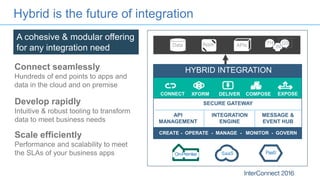
Hybrid is the future of integration
3
Connect seamlessly
Hundreds of end points to apps and
data in the cloud and on premise
Develop rapidly
Intuitive & robust tooling to transform
data to meet business needs
Scale efficiently
Performance and scalability to meet
the SLAs of your business apps
HYBRID INTEGRATION
SaaS PaaSOn-Premise
CONNECT XFORM DELIVER COMPOSE EXPOSE
API
MANAGEMENT
SECURE GATEWAY
INTEGRATION
ENGINE
CREATE - OPERATE - MANAGE - MONITOR - GOVERN
Data APIsApps TH GS
IN
MESSAGE &
EVENT HUB
A cohesive & modular offering
for any integration need
IBM Confidential until Announce
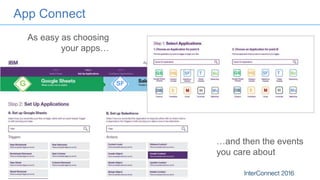
App Connect
As easy as choosing
your apps…
…and then the events
you care about
G SF
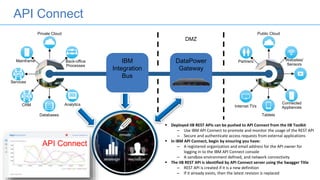
API Connect
 Deployed IIB REST APIs can be pushed to API Connect from the IIB Toolkit
– Use IBM API Connect to promote and monitor the usage of the REST API
– Secure and authenticate access requests from external applications
 In IBM API Connect, begin by ensuring you have:
– A registered organization and email address for the API owner for
logging in to the IBM API Connect console
– A sandbox environment defined, and network connectivity
 The IIB REST API is identified by API Connect server using the Swagger Title
– REST API is created if it is a new definition
– If it already exists, then the latest revision is replaced
API Connect
Connected
Appliances
Partners Websites/
Sensors
Internet TVs
Tablets
Public Cloud
Analytics
Mainframe Back-office
Processes
CRM
Services
Databases
Private Cloud
DataPower
Gateway
DMZ
IBM
Integration
Bus
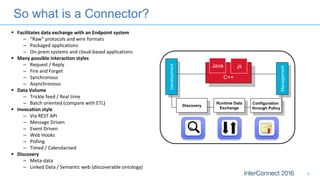
So what is a Connector?
6
 Facilitates data exchange with an Endpoint system
– “Raw” protocols and wire formats
– Packaged applications
– On-prem systems and cloud-based applications
 Many possible interaction styles
– Request / Reply
– Fire and Forget
– Synchronous
– Asynchronous
 Data Volume
– Trickle feed / Real time
– Batch oriented (compare with ETL)
 Invocation style
– Via REST API
– Message Driven
– Event Driven
– Web Hooks
– Polling
– Timed / Calendarised
 Discovery
– Meta-data
– Linked Data / Semantic web (discoverable ontology)
Development
Management
Discovery
Runtime Data
Exchange
C++
Java .js
Configuration
through Policy
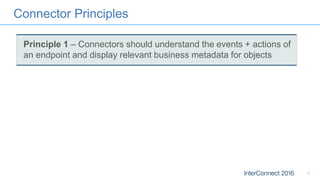
Connector Principles
7
Principle 1 – Connectors should understand the events + actions of
an endpoint and display relevant business metadata for objects
8
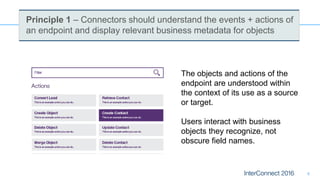
Principle 1 – Connectors should understand the events + actions of
an endpoint and display relevant business metadata for objects
The objects and actions of the
endpoint are understood within
the context of its use as a source
or target.
Users interact with business
objects they recognize, not
obscure field names.
Connector Principles
9
Principle 1 – Connectors should understand the events + actions
of an endpoint and display relevant business metadata for objects
Principle 2 – Connectors should aim to provide an event / trigger
method even if an endpoint doesn’t specifically provide one
10
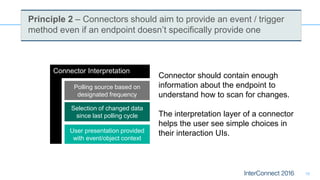
Principle 2 – Connectors should aim to provide an event / trigger
method even if an endpoint doesn’t specifically provide one
Connector Interpretation
Polling source based on
designated frequency
Selection of changed data
since last polling cycle
User presentation provided
with event/object context
Connector should contain enough
information about the endpoint to
understand how to scan for changes.
The interpretation layer of a connector
helps the user see simple choices in
their interaction UIs.
Connector Principles
11
Principle 1 – Connectors should understand the events + actions
of an endpoint and display relevant business metadata for objects
Principle 2 – Connectors should aim to provide an event / trigger
method even if an endpoint doesn’t specifically provide one
Principle 3 – When bridging product runtimes, connectors should
leverage semantic models for common objects across applications
12
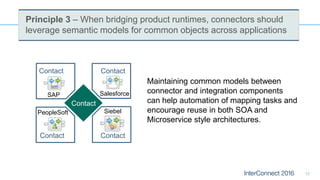
Principle 3 – When bridging product runtimes, connectors should
leverage semantic models for common objects across applications
Contact Contact
Contact Contact
Contact
SAP
PeopleSoft
Salesforce
Siebel
Maintaining common models between
connector and integration components
can help automation of mapping tasks and
encourage reuse in both SOA and
Microservice style architectures.
Connector Principles
13
Principle 4 – Errors that can be anticipated from an endpoint should
be handled by configuration with intelligent defaults.
14
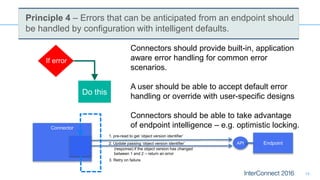
Principle 4 – Errors that can be anticipated from an endpoint should
be handled by configuration with intelligent defaults.
If error
Do this
Connectors should provide built-in, application
aware error handling for common error
scenarios.
A user should be able to accept default error
handling or override with user-specific designs
Connectors should be able to take advantage
of endpoint intelligence – e.g. optimistic locking.Connector
EndpointAPI
1. pre-read to get ‘object version identifier’
3. Retry on failure
2. Update passing ‘object version identifier’
(response) if the object version has changed
between 1 and 2 – return an error
Connector Principles
15
Principle 5 – Connectors should offer efficient and scalable
integration for event driven and data synchronization patterns
Principle 4 – Errors that can be anticipated from an endpoint should
be handled by configuration with intelligent defaults.
16
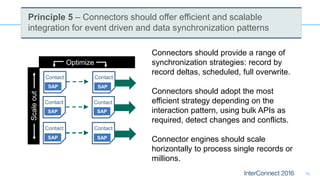
Principle 5 – Connectors should offer efficient and scalable
integration for event driven and data synchronization patterns
Connectors should provide a range of
synchronization strategies: record by
record deltas, scheduled, full overwrite.
Connectors should adopt the most
efficient strategy depending on the
interaction pattern, using bulk APIs as
required, detect changes and conflicts.
Connector engines should scale
horizontally to process single records or
millions.
Contact
Contact
Contact
Contact
Contact
Contact
Scaleout
Optimize
SAP SAP
SAP SAP
SAP SAP
Connector Principles
17
Principle 6 – Connector deployment and execution should be
flexible and can be independent of other integration components
Principle 5 – Connectors should offer efficient and scalable
integration for event driven and data synchronization patterns
Principle 4 – Errors that can be anticipated from an endpoint should
be handled by configuration with intelligent defaults.
18
App4
App3
App2
App1
Integration
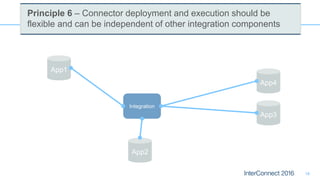
Principle 6 – Connector deployment and execution should be
flexible and can be independent of other integration components
19
App4
App3
App2
App1
Integration
Connector
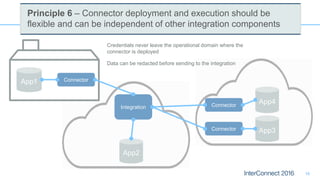
Credentials never leave the operational domain where the
connector is deployed
Data can be redacted before sending to the integration
Connector
Connector
Principle 6 – Connector deployment and execution should be
flexible and can be independent of other integration components
20
App4
App3
App2
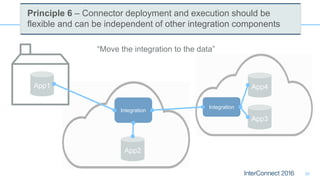
App1
Integration
Integration
“Move the integration to the data”
Principle 6 – Connector deployment and execution should be
flexible and can be independent of other integration components
Connectors and IBM Integration Bus
21
IIB Nodes and Connectors
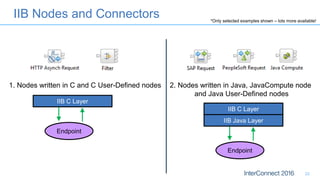
22
IIB C Layer
Endpoint
1. Nodes written in C and C User-Defined nodes
IIB Java Layer
Endpoint
2. Nodes written in Java, JavaCompute node
and Java User-Defined nodes
IIB C Layer
*Only selected examples shown – lots more available!
IIB Nodes and Connectors
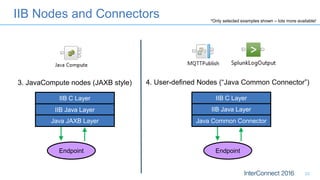
23
IIB C Layer
IIB Java Layer
Java JAXB Layer
3. JavaCompute nodes (JAXB style)
Endpoint
IIB Java Layer
IIB C Layer
Java Common Connector
4. User-defined Nodes (“Java Common Connector”)
Endpoint
*Only selected examples shown – lots more available!
IIB Nodes and Connectors
24
IIB C Layer
IIB .NET Layer
Endpoint
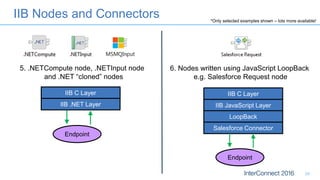
5. .NETCompute node, .NETInput node
and .NET “cloned” nodes
IIB C Layer
IIB JavaScript Layer
LoopBack
Salesforce Connector
Endpoint
6. Nodes written using JavaScript LoopBack
e.g. Salesforce Request node
*Only selected examples shown – lots more available!
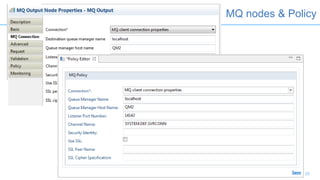
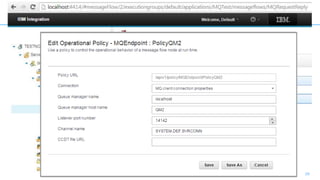
MQ nodes & Policy
25
26
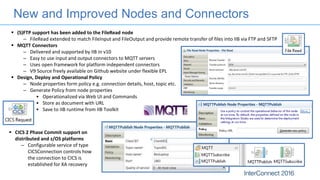
New and Improved Nodes and Connectors
 (S)FTP support has been added to the FileRead node
– FileRead extended to match FileInput and FileOutput and provide remote transfer of files into IIB via FTP and SFTP
 MQTT Connectors
– Delivered and supported by IIB in v10
– Easy to use input and output connectors to MQTT servers
– Uses open framework for platform independent connectors
– V9 Source freely available on Github website under flexible EPL
 Design, Deploy and Operational Policy
– Node properties form policy e.g. connection details, host, topic etc.
– Generate Policy from node properties
• Operationalized via Web UI and Commands
• Store as document with URL
• Save to IIB runtime from IIB Toolkit
 CICS 2 Phase Commit support on
distributed and z/OS platforms
– Configurable service of type
CICSConnection controls how
the connection to CICS is
established for XA recovery
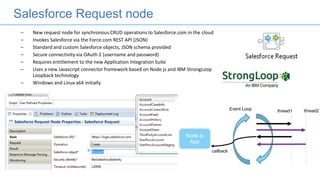
Salesforce Request node
– New request node for synchronous CRUD operations to Salesforce.com in the cloud
– Invokes Salesforce via the Force.com REST API (JSON)
– Standard and custom Salesforce objects, JSON schema provided
– Secure connectivity via OAuth 2 (username and password)
– Requires entitlement to the new Application Integration Suite
– Uses a new Javascript connector framework based on Node.js and IBM StrongLoop
Loopback technology
– Windows and Linux x64 initially
Node.js
App
callback
thread1 thread2Event Loop
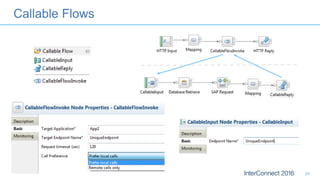
Callable Flows
29
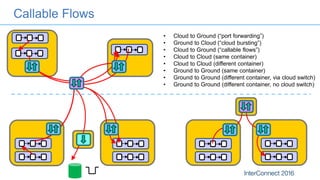
Callable Flows
• Cloud to Ground (“port forwarding”)
• Ground to Cloud (“cloud bursting”)
• Cloud to Ground (“callable flows”)
• Cloud to Cloud (same container)
• Cloud to Cloud (different container)
• Ground to Ground (same container)
• Ground to Ground (different container, via cloud switch)
• Ground to Ground (different container, no cloud switch)
31
Connector Discovery and Bluemix
32
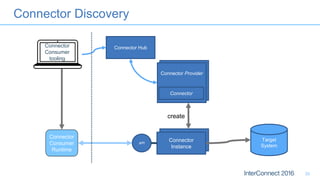
Connector Discovery
33
create
Connector
Consumer
Runtime
Connector Hub
API
Target
System
Connector
Instance
Connector
Instance
Connector Provider
Connector
Connector Provider
Connector
Connector
Consumer
tooling
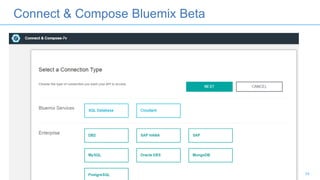
Connect & Compose Bluemix Beta
34
Thank You
Your Feedback is Important!
Access the InterConnect 2016 Conference Attendee
Portal to complete your session surveys from your
smartphone,
laptop or conference kiosk.
Notices and Disclaimers
36
Copyright © 2016 by International Business Machines Corporation (IBM). No part of this document may be reproduced or transmitted in any form without written permission
from IBM.
U.S. Government Users Restricted Rights - Use, duplication or disclosure restricted by GSA ADP Schedule Contract with IBM.
Information in these presentations (including information relating to products that have not yet been announced by IBM) has been reviewed for accuracy as of the date of
initial publication and could include unintentional technical or typographical errors. IBM shall have no responsibility to update this information. THIS DOCUMENT IS
DISTRIBUTED "AS IS" WITHOUT ANY WARRANTY, EITHER EXPRESS OR IMPLIED. IN NO EVENT SHALL IBM BE LIABLE FOR ANY DAMAGE ARISING FROM THE
USE OF THIS INFORMATION, INCLUDING BUT NOT LIMITED TO, LOSS OF DATA, BUSINESS INTERRUPTION, LOSS OF PROFIT OR LOSS OF OPPORTUNITY.
IBM products and services are warranted according to the terms and conditions of the agreements under which they are provided.
Any statements regarding IBM's future direction, intent or product plans are subject to change or withdrawal without notice.
Performance data contained herein was generally obtained in a controlled, isolated environments. Customer examples are presented as illustrations of how those customers
have used IBM products and the results they may have achieved. Actual performance, cost, savings or other results in other operating environments may vary.
References in this document to IBM products, programs, or services does not imply that IBM intends to make such products, programs or services available in all countries in
which IBM operates or does business.
Workshops, sessions and associated materials may have been prepared by independent session speakers, and do not necessarily reflect the views of IBM. All materials
and discussions are provided for informational purposes only, and are neither intended to, nor shall constitute legal or other guidance or advice to any individual participant or
their specific situation.
It is the customer’s responsibility to insure its own compliance with legal requirements and to obtain advice of competent legal counsel as to the identification and
interpretation of any relevant laws and regulatory requirements that may affect the customer’s business and any actions the customer may need to take to comply with such
laws. IBM does not provide legal advice or represent or warrant that its services or products will ensure that the customer is in compliance with any law
Notices and Disclaimers Con’t.
37
Information concerning non-IBM products was obtained from the suppliers of those products, their published announcements or other publicly available sources. IBM has not
tested those products in connection with this publication and cannot confirm the accuracy of performance, compatibility or any other claims related to non-IBM products.
Questions on the capabilities of non-IBM products should be addressed to the suppliers of those products. IBM does not warrant the quality of any third-party products, or the
ability of any such third-party products to interoperate with IBM’s products. IBM EXPRESSLY DISCLAIMS ALL WARRANTIES, EXPRESSED OR IMPLIED, INCLUDING BUT
NOT LIMITED TO, THE IMPLIED WARRANTIES OF MERCHANTABILITY AND FITNESS FOR A PARTICULAR PURPOSE.
The provision of the information contained h erein is not intended to, and does not, grant any right or license under any IBM patents, copyrights, trademarks or other intellectual
property right.
IBM, the IBM logo, ibm.com, Aspera®, Bluemix, Blueworks Live, CICS, Clearcase, Cognos®, DOORS®, Emptoris®, Enterprise Document Management System™, FASP®,
FileNet®, Global Business Services ®, Global Technology Services ®, IBM ExperienceOne™, IBM SmartCloud®, IBM Social Business®, Information on Demand, ILOG,
Maximo®, MQIntegrator®, MQSeries®, Netcool®, OMEGAMON, OpenPower, PureAnalytics™, PureApplication®, pureCluster™, PureCoverage®, PureData®,
PureExperience®, PureFlex®, pureQuery®, pureScale®, PureSystems®, QRadar®, Rational®, Rhapsody®, Smarter Commerce®, SoDA, SPSS, Sterling Commerce®,
StoredIQ, Tealeaf®, Tivoli®, Trusteer®, Unica®, urban{code}®, Watson, WebSphere®, Worklight®, X-Force® and System z® Z/OS, are trademarks of International Business
Machines Corporation, registered in many jurisdictions worldwide. Other product and service names might be trademarks of IBM or other companies. A current list of IBM
trademarks is available on the Web at "Copyright and trademark information" at: www.ibm.com/legal/copytrade.shtml.

ConnectorsForIntegration

  • 1.
    Connectors for Integration BenThompson IBM Integration Bus Chief Architect
  • 2.
    Please Note: • IBM’sstatements regarding its plans, directions, and intent are subject to change or withdrawal without notice at IBM’s sole discretion. • Information regarding potential future products is intended to outline our general product direction and it should not be relied on in making a purchasing decision. • The information mentioned regarding potential future products is not a commitment, promise, or legal obligation to deliver any material, code or functionality. Information about potential future products may not be incorporated into any contract. • The development, release, and timing of any future features or functionality described for our products remains at our sole discretion. • Performance is based on measurements and projections using standard IBM benchmarks in a controlled environment. The actual throughput or performance that any user will experience will vary depending upon many factors, including considerations such as the amount of multiprogramming in the user’s job stream, the I/O configuration, the storage configuration, and the workload processed. Therefore, no assurance can be given that an individual user will achieve results similar to those stated here.
  • 3.
    What behaviours shoulda Connector provide and why? 2
  • 4.
    Hybrid is thefuture of integration 3 Connect seamlessly Hundreds of end points to apps and data in the cloud and on premise Develop rapidly Intuitive & robust tooling to transform data to meet business needs Scale efficiently Performance and scalability to meet the SLAs of your business apps HYBRID INTEGRATION SaaS PaaSOn-Premise CONNECT XFORM DELIVER COMPOSE EXPOSE API MANAGEMENT SECURE GATEWAY INTEGRATION ENGINE CREATE - OPERATE - MANAGE - MONITOR - GOVERN Data APIsApps TH GS IN MESSAGE & EVENT HUB A cohesive & modular offering for any integration need IBM Confidential until Announce
  • 5.
    App Connect As easyas choosing your apps… …and then the events you care about G SF
  • 6.
    API Connect  DeployedIIB REST APIs can be pushed to API Connect from the IIB Toolkit – Use IBM API Connect to promote and monitor the usage of the REST API – Secure and authenticate access requests from external applications  In IBM API Connect, begin by ensuring you have: – A registered organization and email address for the API owner for logging in to the IBM API Connect console – A sandbox environment defined, and network connectivity  The IIB REST API is identified by API Connect server using the Swagger Title – REST API is created if it is a new definition – If it already exists, then the latest revision is replaced API Connect Connected Appliances Partners Websites/ Sensors Internet TVs Tablets Public Cloud Analytics Mainframe Back-office Processes CRM Services Databases Private Cloud DataPower Gateway DMZ IBM Integration Bus
  • 7.
    So what isa Connector? 6  Facilitates data exchange with an Endpoint system – “Raw” protocols and wire formats – Packaged applications – On-prem systems and cloud-based applications  Many possible interaction styles – Request / Reply – Fire and Forget – Synchronous – Asynchronous  Data Volume – Trickle feed / Real time – Batch oriented (compare with ETL)  Invocation style – Via REST API – Message Driven – Event Driven – Web Hooks – Polling – Timed / Calendarised  Discovery – Meta-data – Linked Data / Semantic web (discoverable ontology) Development Management Discovery Runtime Data Exchange C++ Java .js Configuration through Policy
  • 8.
    Connector Principles 7 Principle 1– Connectors should understand the events + actions of an endpoint and display relevant business metadata for objects
  • 9.
    8 Principle 1 –Connectors should understand the events + actions of an endpoint and display relevant business metadata for objects The objects and actions of the endpoint are understood within the context of its use as a source or target. Users interact with business objects they recognize, not obscure field names.
  • 10.
    Connector Principles 9 Principle 1– Connectors should understand the events + actions of an endpoint and display relevant business metadata for objects Principle 2 – Connectors should aim to provide an event / trigger method even if an endpoint doesn’t specifically provide one
  • 11.
    10 Principle 2 –Connectors should aim to provide an event / trigger method even if an endpoint doesn’t specifically provide one Connector Interpretation Polling source based on designated frequency Selection of changed data since last polling cycle User presentation provided with event/object context Connector should contain enough information about the endpoint to understand how to scan for changes. The interpretation layer of a connector helps the user see simple choices in their interaction UIs.
  • 12.
    Connector Principles 11 Principle 1– Connectors should understand the events + actions of an endpoint and display relevant business metadata for objects Principle 2 – Connectors should aim to provide an event / trigger method even if an endpoint doesn’t specifically provide one Principle 3 – When bridging product runtimes, connectors should leverage semantic models for common objects across applications
  • 13.
    12 Principle 3 –When bridging product runtimes, connectors should leverage semantic models for common objects across applications Contact Contact Contact Contact Contact SAP PeopleSoft Salesforce Siebel Maintaining common models between connector and integration components can help automation of mapping tasks and encourage reuse in both SOA and Microservice style architectures.
  • 14.
    Connector Principles 13 Principle 4– Errors that can be anticipated from an endpoint should be handled by configuration with intelligent defaults.
  • 15.
    14 Principle 4 –Errors that can be anticipated from an endpoint should be handled by configuration with intelligent defaults. If error Do this Connectors should provide built-in, application aware error handling for common error scenarios. A user should be able to accept default error handling or override with user-specific designs Connectors should be able to take advantage of endpoint intelligence – e.g. optimistic locking.Connector EndpointAPI 1. pre-read to get ‘object version identifier’ 3. Retry on failure 2. Update passing ‘object version identifier’ (response) if the object version has changed between 1 and 2 – return an error
  • 16.
    Connector Principles 15 Principle 5– Connectors should offer efficient and scalable integration for event driven and data synchronization patterns Principle 4 – Errors that can be anticipated from an endpoint should be handled by configuration with intelligent defaults.
  • 17.
    16 Principle 5 –Connectors should offer efficient and scalable integration for event driven and data synchronization patterns Connectors should provide a range of synchronization strategies: record by record deltas, scheduled, full overwrite. Connectors should adopt the most efficient strategy depending on the interaction pattern, using bulk APIs as required, detect changes and conflicts. Connector engines should scale horizontally to process single records or millions. Contact Contact Contact Contact Contact Contact Scaleout Optimize SAP SAP SAP SAP SAP SAP
  • 18.
    Connector Principles 17 Principle 6– Connector deployment and execution should be flexible and can be independent of other integration components Principle 5 – Connectors should offer efficient and scalable integration for event driven and data synchronization patterns Principle 4 – Errors that can be anticipated from an endpoint should be handled by configuration with intelligent defaults.
  • 19.
    18 App4 App3 App2 App1 Integration Principle 6 –Connector deployment and execution should be flexible and can be independent of other integration components
  • 20.
    19 App4 App3 App2 App1 Integration Connector Credentials never leavethe operational domain where the connector is deployed Data can be redacted before sending to the integration Connector Connector Principle 6 – Connector deployment and execution should be flexible and can be independent of other integration components
  • 21.
    20 App4 App3 App2 App1 Integration Integration “Move the integrationto the data” Principle 6 – Connector deployment and execution should be flexible and can be independent of other integration components
  • 22.
    Connectors and IBMIntegration Bus 21
  • 23.
    IIB Nodes andConnectors 22 IIB C Layer Endpoint 1. Nodes written in C and C User-Defined nodes IIB Java Layer Endpoint 2. Nodes written in Java, JavaCompute node and Java User-Defined nodes IIB C Layer *Only selected examples shown – lots more available!
  • 24.
    IIB Nodes andConnectors 23 IIB C Layer IIB Java Layer Java JAXB Layer 3. JavaCompute nodes (JAXB style) Endpoint IIB Java Layer IIB C Layer Java Common Connector 4. User-defined Nodes (“Java Common Connector”) Endpoint *Only selected examples shown – lots more available!
  • 25.
    IIB Nodes andConnectors 24 IIB C Layer IIB .NET Layer Endpoint 5. .NETCompute node, .NETInput node and .NET “cloned” nodes IIB C Layer IIB JavaScript Layer LoopBack Salesforce Connector Endpoint 6. Nodes written using JavaScript LoopBack e.g. Salesforce Request node *Only selected examples shown – lots more available!
  • 26.
    MQ nodes &Policy 25
  • 27.
  • 28.
    New and ImprovedNodes and Connectors  (S)FTP support has been added to the FileRead node – FileRead extended to match FileInput and FileOutput and provide remote transfer of files into IIB via FTP and SFTP  MQTT Connectors – Delivered and supported by IIB in v10 – Easy to use input and output connectors to MQTT servers – Uses open framework for platform independent connectors – V9 Source freely available on Github website under flexible EPL  Design, Deploy and Operational Policy – Node properties form policy e.g. connection details, host, topic etc. – Generate Policy from node properties • Operationalized via Web UI and Commands • Store as document with URL • Save to IIB runtime from IIB Toolkit  CICS 2 Phase Commit support on distributed and z/OS platforms – Configurable service of type CICSConnection controls how the connection to CICS is established for XA recovery
  • 29.
    Salesforce Request node –New request node for synchronous CRUD operations to Salesforce.com in the cloud – Invokes Salesforce via the Force.com REST API (JSON) – Standard and custom Salesforce objects, JSON schema provided – Secure connectivity via OAuth 2 (username and password) – Requires entitlement to the new Application Integration Suite – Uses a new Javascript connector framework based on Node.js and IBM StrongLoop Loopback technology – Windows and Linux x64 initially Node.js App callback thread1 thread2Event Loop
  • 30.
  • 31.
    Callable Flows • Cloudto Ground (“port forwarding”) • Ground to Cloud (“cloud bursting”) • Cloud to Ground (“callable flows”) • Cloud to Cloud (same container) • Cloud to Cloud (different container) • Ground to Ground (same container) • Ground to Ground (different container, via cloud switch) • Ground to Ground (different container, no cloud switch)
  • 32.
  • 33.
  • 34.
  • 35.
    Connect & ComposeBluemix Beta 34
  • 36.
    Thank You Your Feedbackis Important! Access the InterConnect 2016 Conference Attendee Portal to complete your session surveys from your smartphone, laptop or conference kiosk.
  • 37.
    Notices and Disclaimers 36 Copyright© 2016 by International Business Machines Corporation (IBM). No part of this document may be reproduced or transmitted in any form without written permission from IBM. U.S. Government Users Restricted Rights - Use, duplication or disclosure restricted by GSA ADP Schedule Contract with IBM. Information in these presentations (including information relating to products that have not yet been announced by IBM) has been reviewed for accuracy as of the date of initial publication and could include unintentional technical or typographical errors. IBM shall have no responsibility to update this information. THIS DOCUMENT IS DISTRIBUTED "AS IS" WITHOUT ANY WARRANTY, EITHER EXPRESS OR IMPLIED. IN NO EVENT SHALL IBM BE LIABLE FOR ANY DAMAGE ARISING FROM THE USE OF THIS INFORMATION, INCLUDING BUT NOT LIMITED TO, LOSS OF DATA, BUSINESS INTERRUPTION, LOSS OF PROFIT OR LOSS OF OPPORTUNITY. IBM products and services are warranted according to the terms and conditions of the agreements under which they are provided. Any statements regarding IBM's future direction, intent or product plans are subject to change or withdrawal without notice. Performance data contained herein was generally obtained in a controlled, isolated environments. Customer examples are presented as illustrations of how those customers have used IBM products and the results they may have achieved. Actual performance, cost, savings or other results in other operating environments may vary. References in this document to IBM products, programs, or services does not imply that IBM intends to make such products, programs or services available in all countries in which IBM operates or does business. Workshops, sessions and associated materials may have been prepared by independent session speakers, and do not necessarily reflect the views of IBM. All materials and discussions are provided for informational purposes only, and are neither intended to, nor shall constitute legal or other guidance or advice to any individual participant or their specific situation. It is the customer’s responsibility to insure its own compliance with legal requirements and to obtain advice of competent legal counsel as to the identification and interpretation of any relevant laws and regulatory requirements that may affect the customer’s business and any actions the customer may need to take to comply with such laws. IBM does not provide legal advice or represent or warrant that its services or products will ensure that the customer is in compliance with any law
  • 38.
    Notices and DisclaimersCon’t. 37 Information concerning non-IBM products was obtained from the suppliers of those products, their published announcements or other publicly available sources. IBM has not tested those products in connection with this publication and cannot confirm the accuracy of performance, compatibility or any other claims related to non-IBM products. Questions on the capabilities of non-IBM products should be addressed to the suppliers of those products. IBM does not warrant the quality of any third-party products, or the ability of any such third-party products to interoperate with IBM’s products. IBM EXPRESSLY DISCLAIMS ALL WARRANTIES, EXPRESSED OR IMPLIED, INCLUDING BUT NOT LIMITED TO, THE IMPLIED WARRANTIES OF MERCHANTABILITY AND FITNESS FOR A PARTICULAR PURPOSE. The provision of the information contained h erein is not intended to, and does not, grant any right or license under any IBM patents, copyrights, trademarks or other intellectual property right. IBM, the IBM logo, ibm.com, Aspera®, Bluemix, Blueworks Live, CICS, Clearcase, Cognos®, DOORS®, Emptoris®, Enterprise Document Management System™, FASP®, FileNet®, Global Business Services ®, Global Technology Services ®, IBM ExperienceOne™, IBM SmartCloud®, IBM Social Business®, Information on Demand, ILOG, Maximo®, MQIntegrator®, MQSeries®, Netcool®, OMEGAMON, OpenPower, PureAnalytics™, PureApplication®, pureCluster™, PureCoverage®, PureData®, PureExperience®, PureFlex®, pureQuery®, pureScale®, PureSystems®, QRadar®, Rational®, Rhapsody®, Smarter Commerce®, SoDA, SPSS, Sterling Commerce®, StoredIQ, Tealeaf®, Tivoli®, Trusteer®, Unica®, urban{code}®, Watson, WebSphere®, Worklight®, X-Force® and System z® Z/OS, are trademarks of International Business Machines Corporation, registered in many jurisdictions worldwide. Other product and service names might be trademarks of IBM or other companies. A current list of IBM trademarks is available on the Web at "Copyright and trademark information" at: www.ibm.com/legal/copytrade.shtml.