Frank van der Wal
Digital Transformation Specialist for Enterprises
thewall@nl.ibm.com
26 September 2017
Building blocks for the Digital Transformation
2
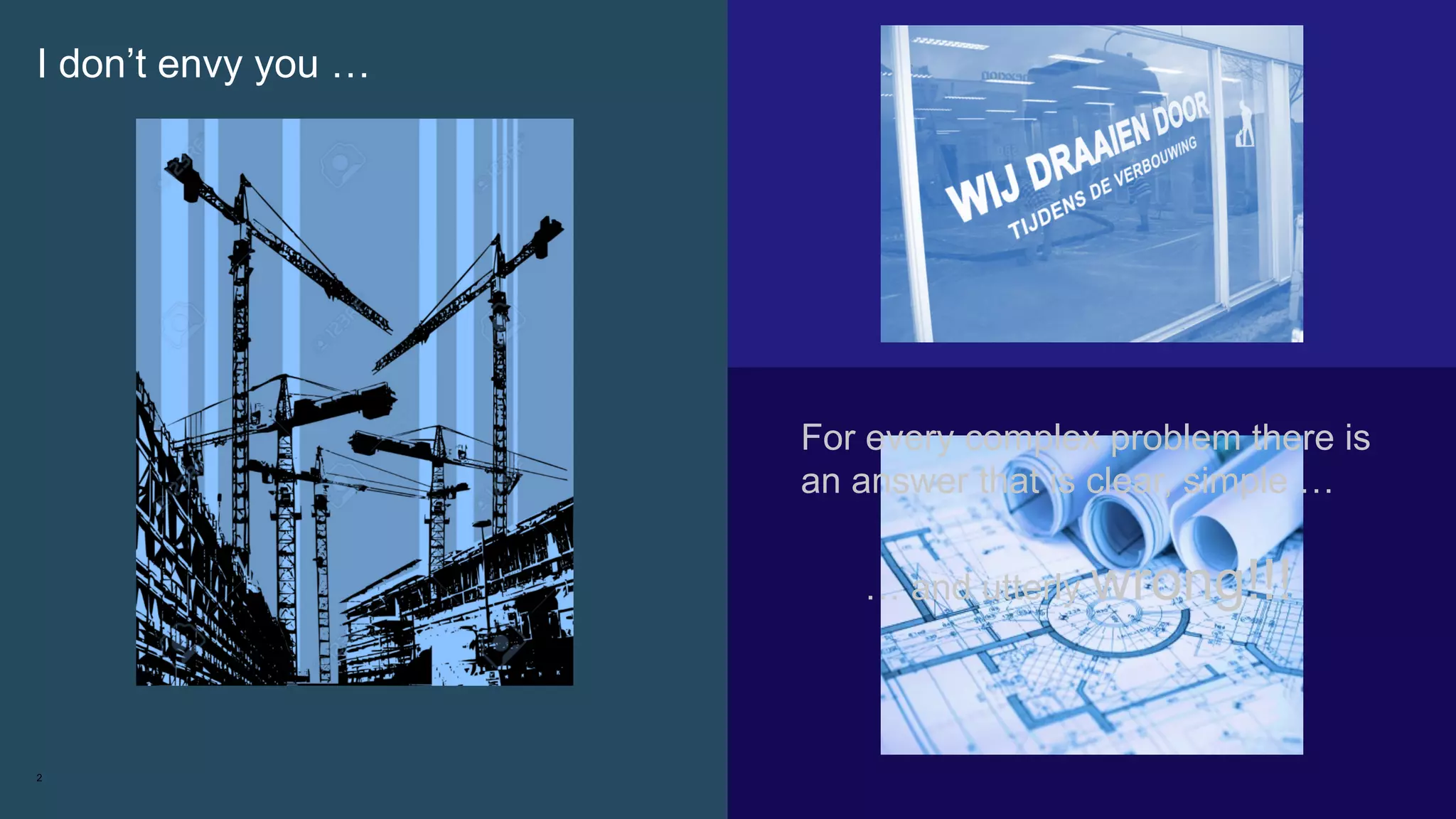
I don’t envy you …
For every complex problem there is
an answer that is clear, simple …
… and utterly wrong!!!
When business and technology
objectives are one and the same…
FLEXIBILITY AND
SCALABILITY
SECURITY
BAKED IN
CORE
STRENGTH
Your business strategy and your technology
are now inseparable — and we’ve reached the
point for cloud, data technologies and a
cognitive/AI approach
3
What you need is a solid architecture
…it’s time to think about 3 important domains:
• Create a new and very compelling User Experiences
• Develop new Business Models and innovative Ecosystems
• Flexible Operations / Reduce Operational Expenses
Cloud Infrastructure
A highly scalable, security
enabled infrastructure
Artificial Intelligence
Cognitive building blocks for
developers
Data
Tools to prepare data
for cognitive
Applications, solutions
and services
Targeted solutions for
enterprise businesses
rup
This requires an architecture
engineered for dis tion.
5
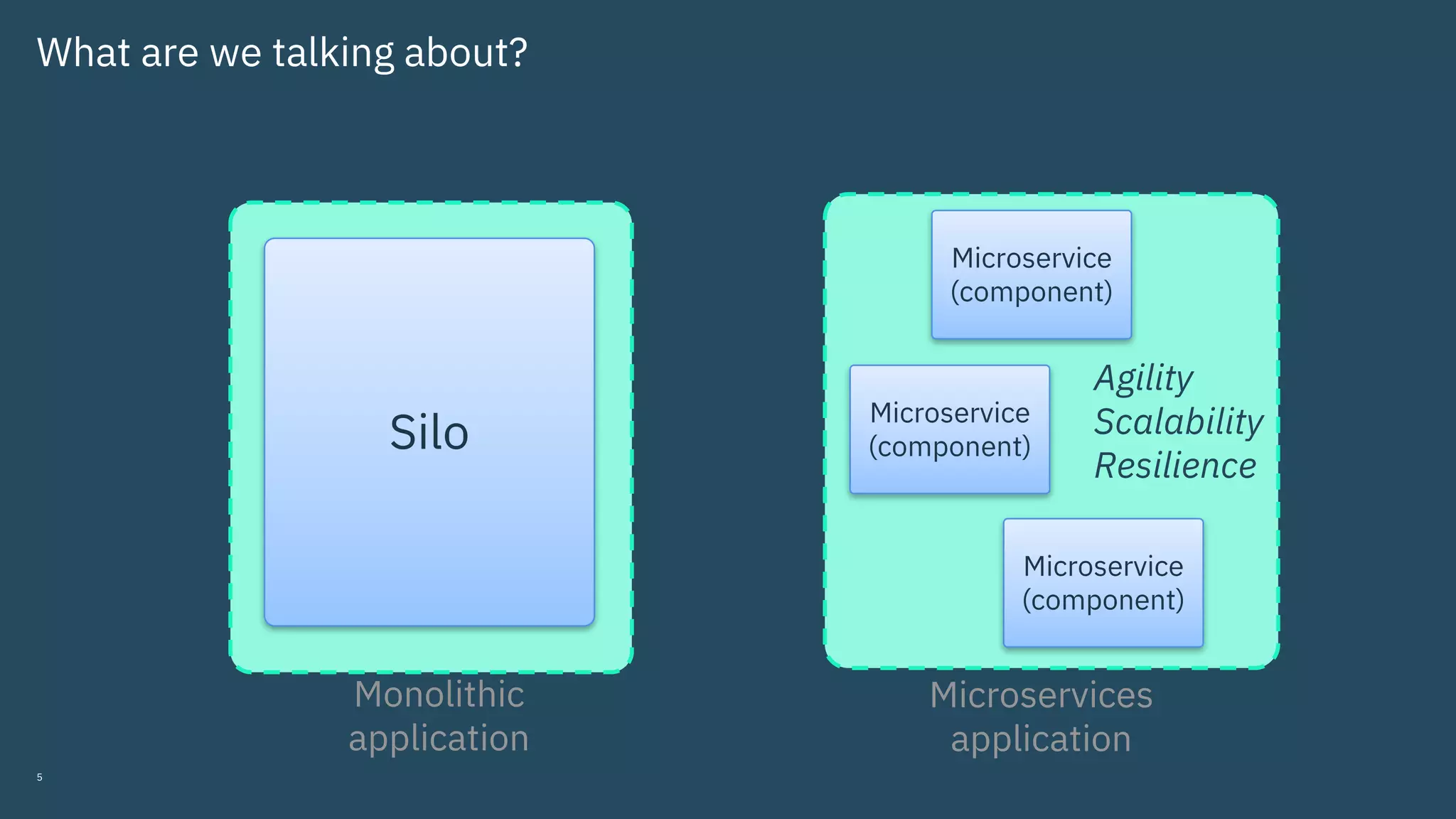
What are we talking about?
Monolithic
application
Silo
Microservices
application
Microservice
(component)
Microservice
(component)
Microservice
(component)
Agility
Scalability
Resilience
6
Monolithic application
Silo logic
Silo
data
Microservice
component
Microservice
component
Microservice
component
Microservices application
7
Monolithic application
Silo logic
Silo
data
Microservice
component
Microservice
component
Microservice
component
Microservices application
Node.js
MongoDB
WAS Liberty
Cloudant
MariaDB
Swift
WebSphere ND
DB2
REST/HTTP
Messaging
Messaging
REST/HTTP
Lightweight protocols
• REST (JSON/HTTP)
• Messaging (e.g. MQ-like)
Aim is complete decoupling,
achieved by:
• Messaging wherever possible
• Service registry/discovery
• Load balancing
8
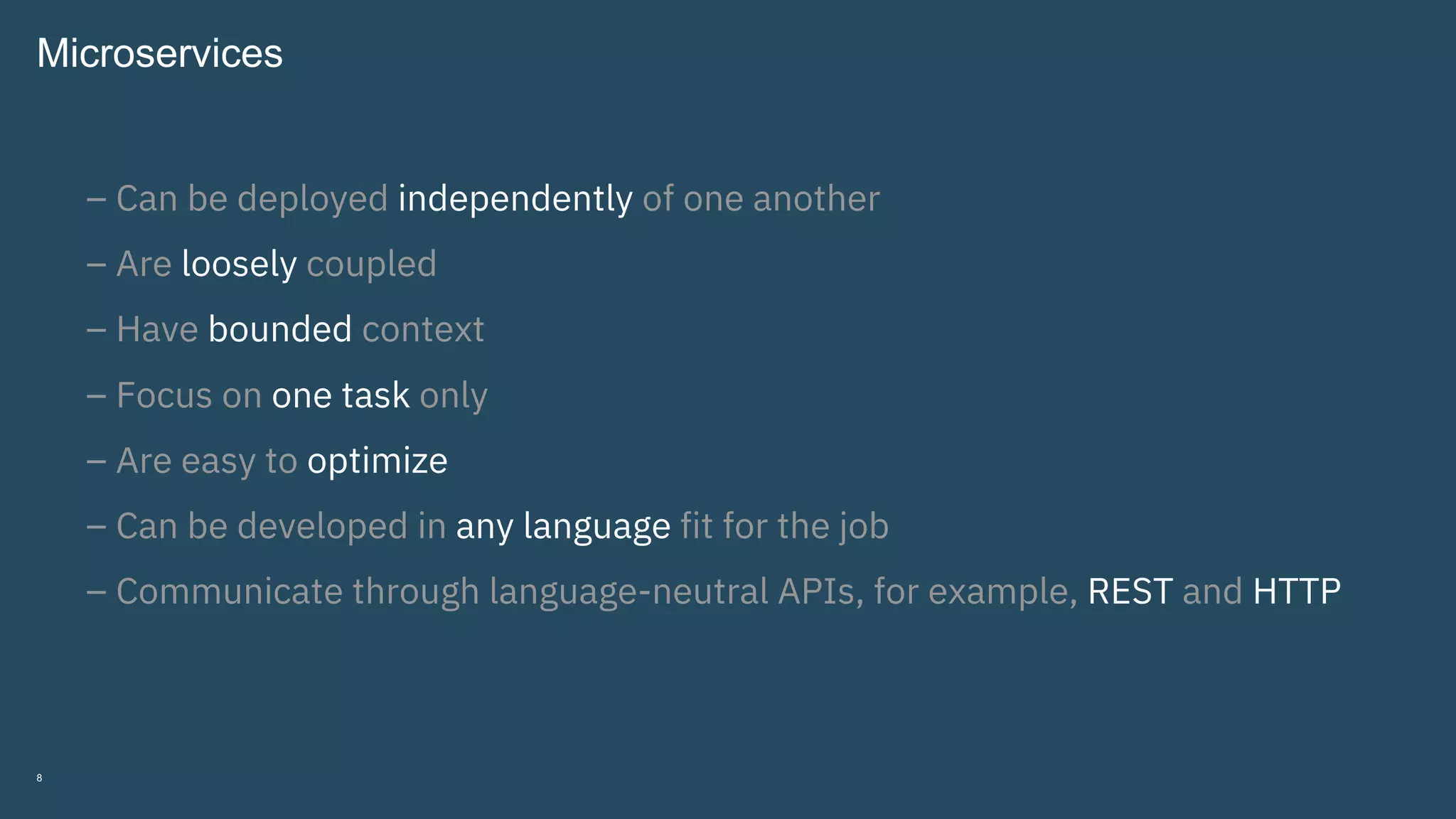
Microservices
– Can be deployed independently of one another
– Are loosely coupled
– Have bounded context
– Focus on one task only
– Are easy to optimize
– Can be developed in any language fit for the job
– Communicate through language-neutral APIs, for example, REST and HTTP
SOA ≠ REST ≠ Microservices
Microservices vs. SOA
Microservices are components. SOA is an architecture.
Microservices vs. APIs
APIs are an interface. A mechanism for exposing business
function. Microservices are the component architecture used
to implement those business functions. It makes no sense to
directly compare them.
Microservice
component
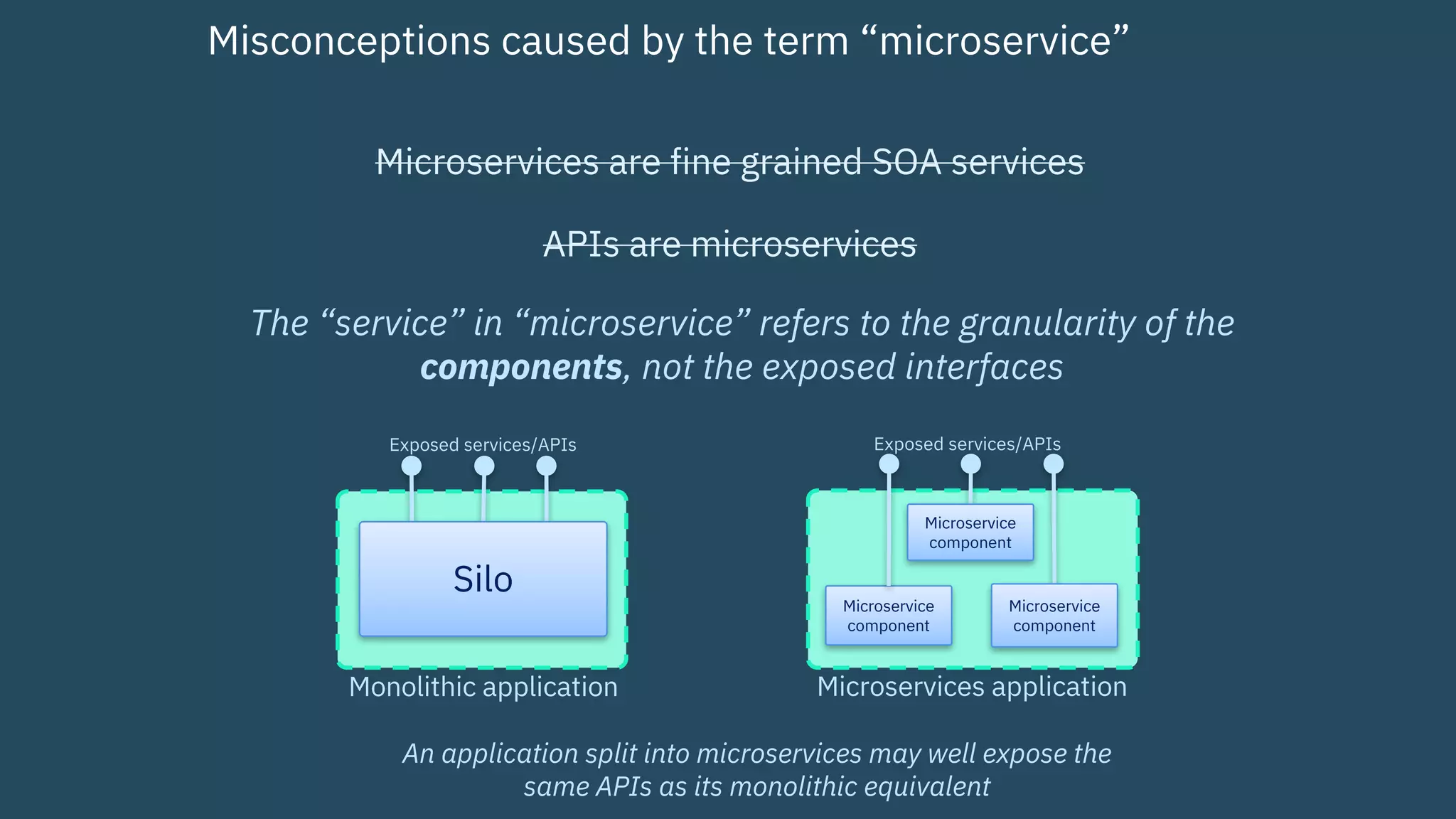
Misconceptions caused by the term “microservice”
Monolithic application Microservices application
Exposed services/APIs
Microservice
component
Microservice
component
Exposed services/APIs
Silo
Microservices are fine grained SOA services
APIs are microservices
The “service” in “microservice” refers to the granularity of the
components, not the exposed interfaces
An application split into microservices may well expose the
same APIs as its monolithic equivalent
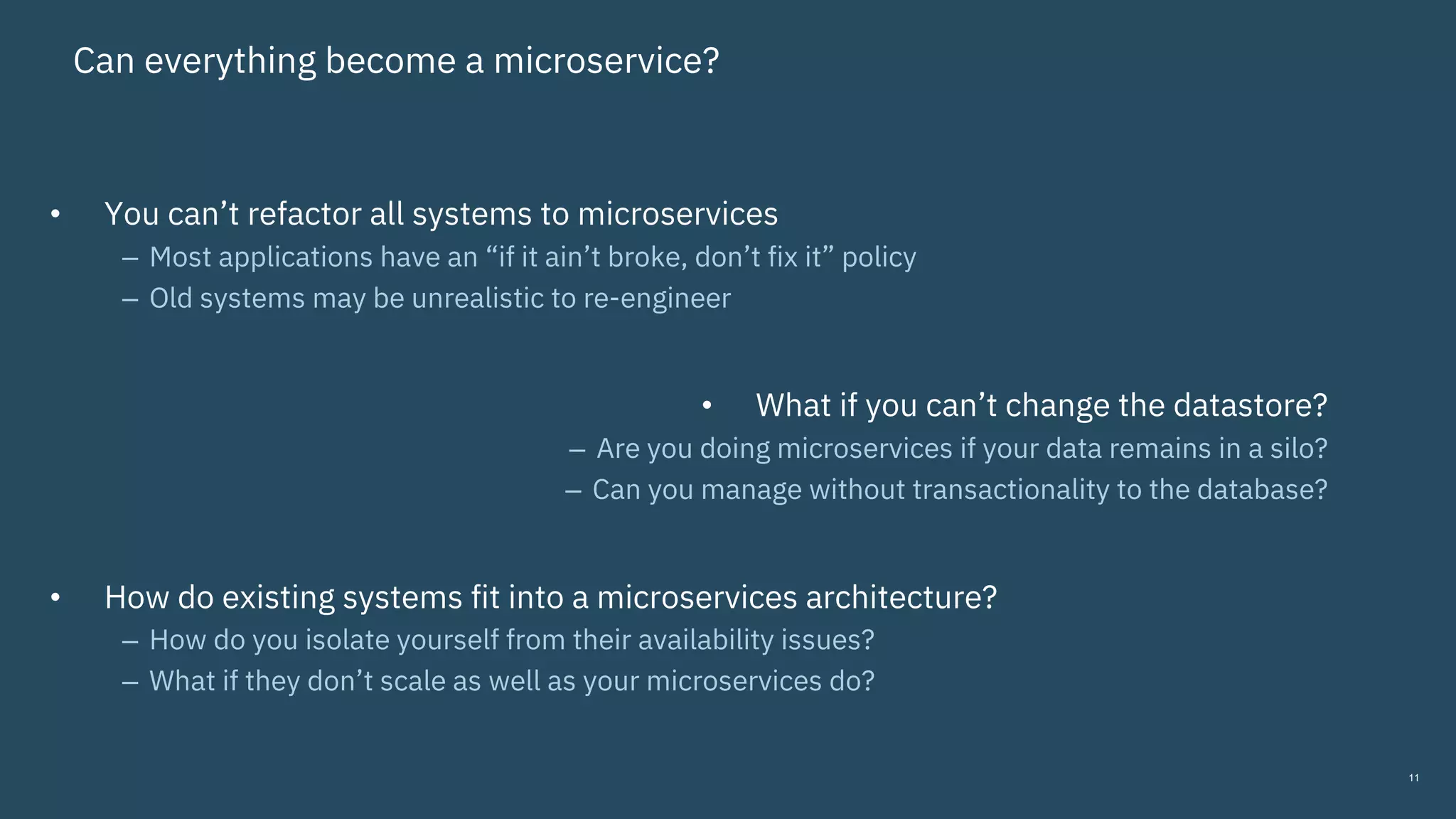
Can everything become a microservice?
• You can’t refactor all systems to microservices
– Most applications have an “if it ain’t broke, don’t fix it” policy
– Old systems may be unrealistic to re-engineer
• What if you can’t change the datastore?
– Are you doing microservices if your data remains in a silo?
– Can you manage without transactionality to the database?
• How do existing systems fit into a microservices architecture?
– How do you isolate yourself from their availability issues?
– What if they don’t scale as well as your microservices do?
11
Challenges with microservices
• Maintenance
– Given the aim of freedom of language and runtime, will you have the breadth of skillsets to
maintain the microservices in the future.
• Latency
– A request/response chained down a set of microservices must incur some extra latency from
network hops and serialization.
• Data sharing
– Not all data can be split into a grid, some things are shared.
• Real-time dependencies and their combined availability
– Microservices calling other microservices synchronously need careful consideration.
– Tends to creep, as one service built on top of another.
• Manageability
– How do you manage and monitor a vast network of microservices
12
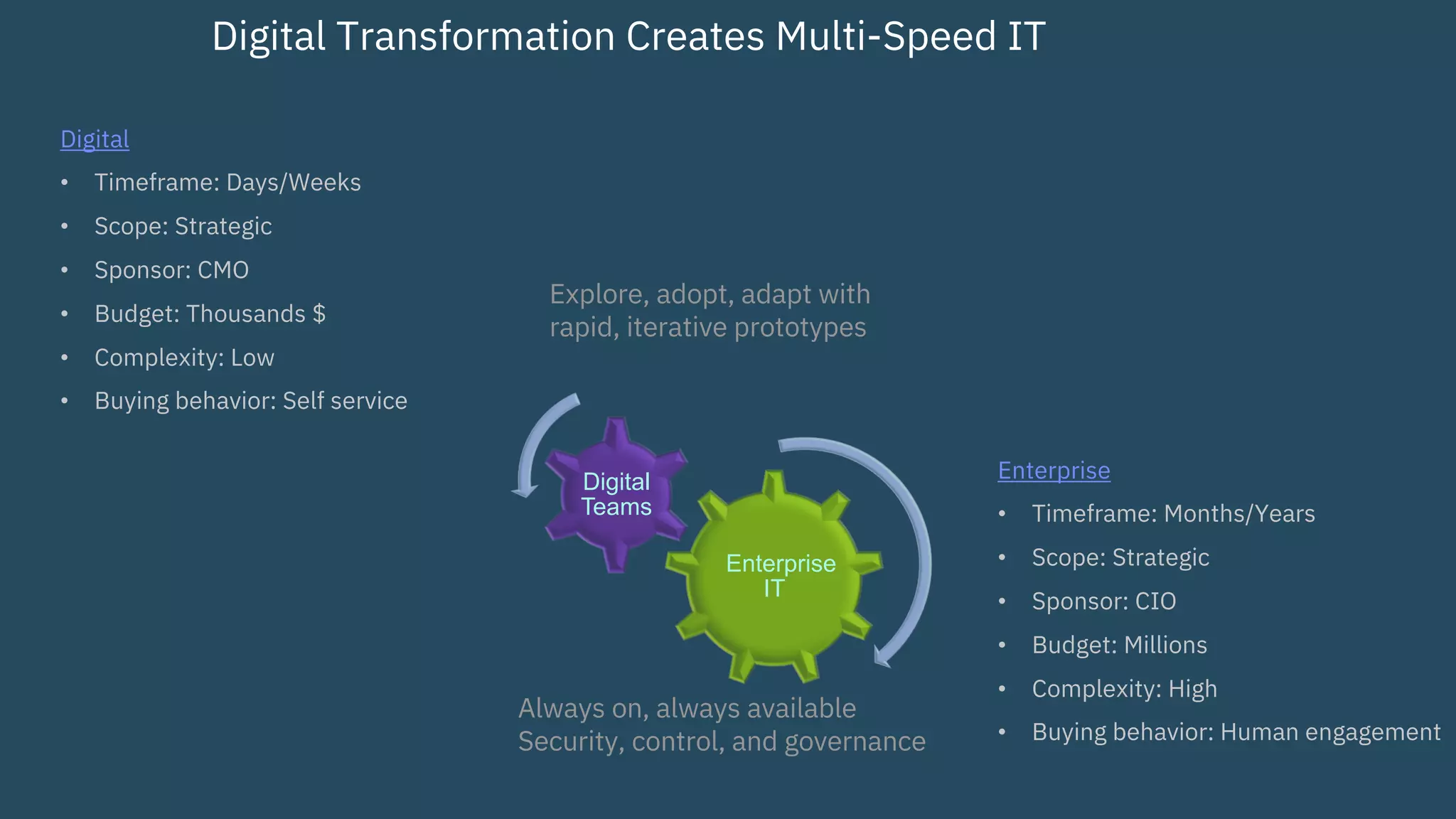
Digital Transformation Creates Multi-Speed IT
Digital
• Timeframe: Days/Weeks
• Scope: Strategic
• Sponsor: CMO
• Budget: Thousands $
• Complexity: Low
• Buying behavior: Self service
Enterprise
• Timeframe: Months/Years
• Scope: Strategic
• Sponsor: CIO
• Budget: Millions
• Complexity: High
• Buying behavior: Human engagement
Enterprise
IT
Digital
Teams
Explore, adopt, adapt with
rapid, iterative prototypes
Always on, always available
Security, control, and governance
Integration Reference Architecture
Mobile
Partners
Cloud Apps
API Economy
IoT
Systems of Engagement
Channel
Applications
Integration
Layer
Consumers Systems of Record
XaaS On-Premise
Security+APIGateway
APIGateway
Enterprise
Application
Enterprise
Application
Cloud Affinity
Enterprise
Application
AccessLayer
Enterprise
Data
AdapterAdapter
Microservices
Applications
15
And then one day you find
ten years have got behind you.
‘s :
• Create a new and very compelling User Experiences
• Develop new Business Models and innovative Ecosystems
• Flexible Operations / Reduce Operational Expenses

CWIN17 Utrecht / cg u services - frank van der wal

  • 1.
    Frank van derWal Digital Transformation Specialist for Enterprises thewall@nl.ibm.com 26 September 2017 Building blocks for the Digital Transformation
  • 2.
    2 I don’t envyyou … For every complex problem there is an answer that is clear, simple … … and utterly wrong!!!
  • 3.
    When business andtechnology objectives are one and the same… FLEXIBILITY AND SCALABILITY SECURITY BAKED IN CORE STRENGTH Your business strategy and your technology are now inseparable — and we’ve reached the point for cloud, data technologies and a cognitive/AI approach 3 What you need is a solid architecture …it’s time to think about 3 important domains: • Create a new and very compelling User Experiences • Develop new Business Models and innovative Ecosystems • Flexible Operations / Reduce Operational Expenses
  • 4.
    Cloud Infrastructure A highlyscalable, security enabled infrastructure Artificial Intelligence Cognitive building blocks for developers Data Tools to prepare data for cognitive Applications, solutions and services Targeted solutions for enterprise businesses rup This requires an architecture engineered for dis tion.
  • 5.
    5 What are wetalking about? Monolithic application Silo Microservices application Microservice (component) Microservice (component) Microservice (component) Agility Scalability Resilience
  • 6.
  • 7.
    7 Monolithic application Silo logic Silo data Microservice component Microservice component Microservice component Microservicesapplication Node.js MongoDB WAS Liberty Cloudant MariaDB Swift WebSphere ND DB2 REST/HTTP Messaging Messaging REST/HTTP Lightweight protocols • REST (JSON/HTTP) • Messaging (e.g. MQ-like) Aim is complete decoupling, achieved by: • Messaging wherever possible • Service registry/discovery • Load balancing
  • 8.
    8 Microservices – Can bedeployed independently of one another – Are loosely coupled – Have bounded context – Focus on one task only – Are easy to optimize – Can be developed in any language fit for the job – Communicate through language-neutral APIs, for example, REST and HTTP
  • 9.
    SOA ≠ REST≠ Microservices Microservices vs. SOA Microservices are components. SOA is an architecture. Microservices vs. APIs APIs are an interface. A mechanism for exposing business function. Microservices are the component architecture used to implement those business functions. It makes no sense to directly compare them.
  • 10.
    Microservice component Misconceptions caused bythe term “microservice” Monolithic application Microservices application Exposed services/APIs Microservice component Microservice component Exposed services/APIs Silo Microservices are fine grained SOA services APIs are microservices The “service” in “microservice” refers to the granularity of the components, not the exposed interfaces An application split into microservices may well expose the same APIs as its monolithic equivalent
  • 11.
    Can everything becomea microservice? • You can’t refactor all systems to microservices – Most applications have an “if it ain’t broke, don’t fix it” policy – Old systems may be unrealistic to re-engineer • What if you can’t change the datastore? – Are you doing microservices if your data remains in a silo? – Can you manage without transactionality to the database? • How do existing systems fit into a microservices architecture? – How do you isolate yourself from their availability issues? – What if they don’t scale as well as your microservices do? 11
  • 12.
    Challenges with microservices •Maintenance – Given the aim of freedom of language and runtime, will you have the breadth of skillsets to maintain the microservices in the future. • Latency – A request/response chained down a set of microservices must incur some extra latency from network hops and serialization. • Data sharing – Not all data can be split into a grid, some things are shared. • Real-time dependencies and their combined availability – Microservices calling other microservices synchronously need careful consideration. – Tends to creep, as one service built on top of another. • Manageability – How do you manage and monitor a vast network of microservices 12
  • 13.
    Digital Transformation CreatesMulti-Speed IT Digital • Timeframe: Days/Weeks • Scope: Strategic • Sponsor: CMO • Budget: Thousands $ • Complexity: Low • Buying behavior: Self service Enterprise • Timeframe: Months/Years • Scope: Strategic • Sponsor: CIO • Budget: Millions • Complexity: High • Buying behavior: Human engagement Enterprise IT Digital Teams Explore, adopt, adapt with rapid, iterative prototypes Always on, always available Security, control, and governance
  • 14.
    Integration Reference Architecture Mobile Partners CloudApps API Economy IoT Systems of Engagement Channel Applications Integration Layer Consumers Systems of Record XaaS On-Premise Security+APIGateway APIGateway Enterprise Application Enterprise Application Cloud Affinity Enterprise Application AccessLayer Enterprise Data AdapterAdapter Microservices Applications
  • 15.
    15 And then oneday you find ten years have got behind you.
  • 16.
    ‘s : • Createa new and very compelling User Experiences • Develop new Business Models and innovative Ecosystems • Flexible Operations / Reduce Operational Expenses