Who am I?
• Coert van den Thillart
• Solution Architect at rubiX
• coert@rubix.nl
• http://rubix.nl/coert-van-den-thillart
Microservices
from an integration perspective
Assumptions
About you:
• You have at least heard/read/done/seen something about
Microservices
• You are active in or at least familiar with the system integration
space
The "what are microservices?"
slide"In short, the microservice architectural style is an approach to developing
a single application as a suite of small services, each running in its
own process and communicating with lightweight mechanisms, often
an HTTP resource API. These services are built around business
capabilities and independently deployable by fully automated
deployment machinery. There is a bare minimum of centralized
management of these services, which may be written in different
programming languages and use different data storage
technologies."
- Martin Fowler
http://martinfowler.com/articles/microservices.html
Sound familiar?
Composability
Loose coupling
Autonomy
Abstraction
The Microservice difference?
Autonomy
Independent life cycle
Runtime independence
Dedicated development team
Autonomous deployment
Nothing else?
Other benefits and concepts associated with microservices aren’t
exclusive to microservices. They are good practices applicable to any
service oriented architecture.
• Bounded context
• High cohesion, low coupling
• Focus on business functionality
But they are very valuable in achieving autonomy.
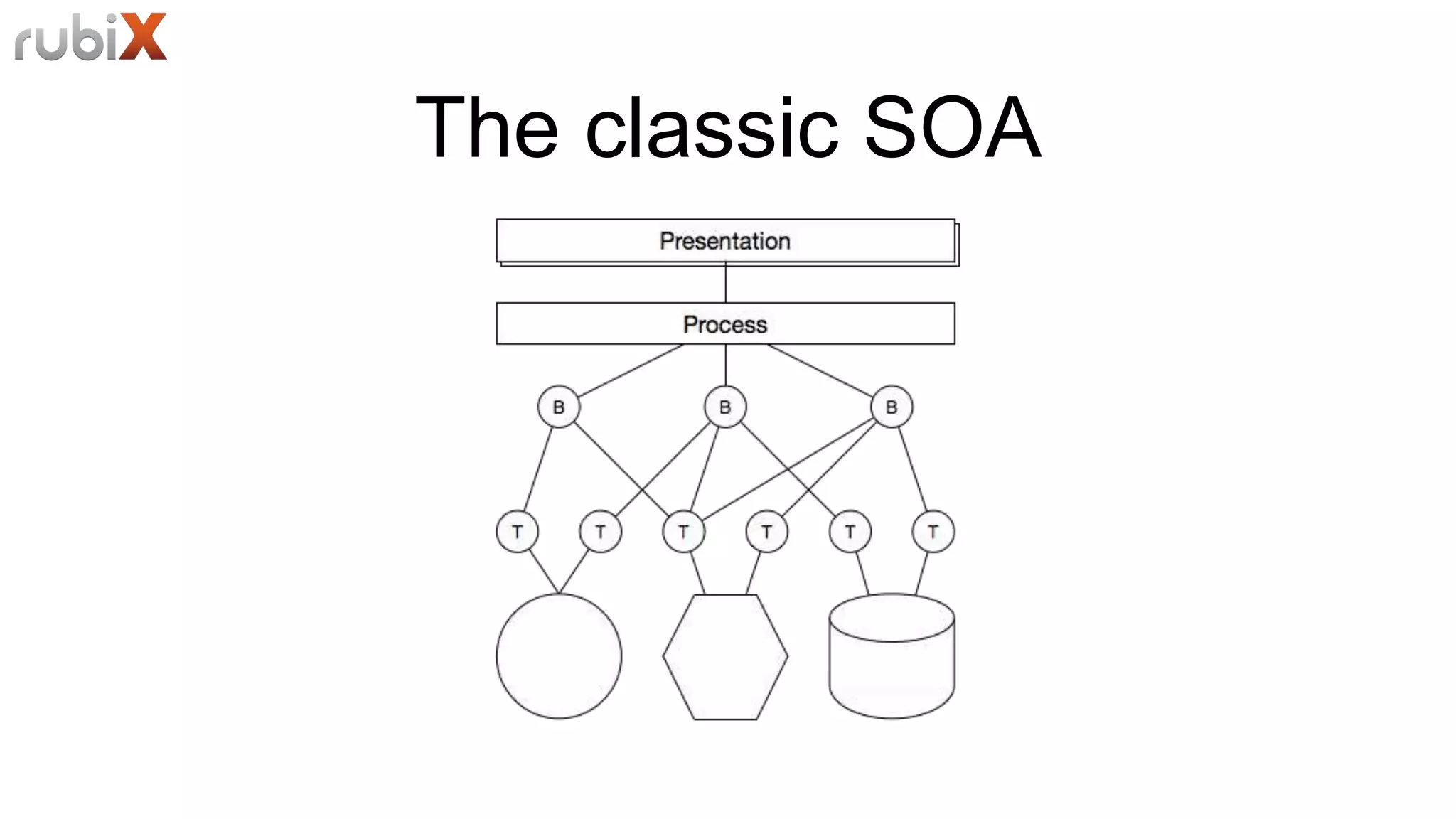
The classic SOA
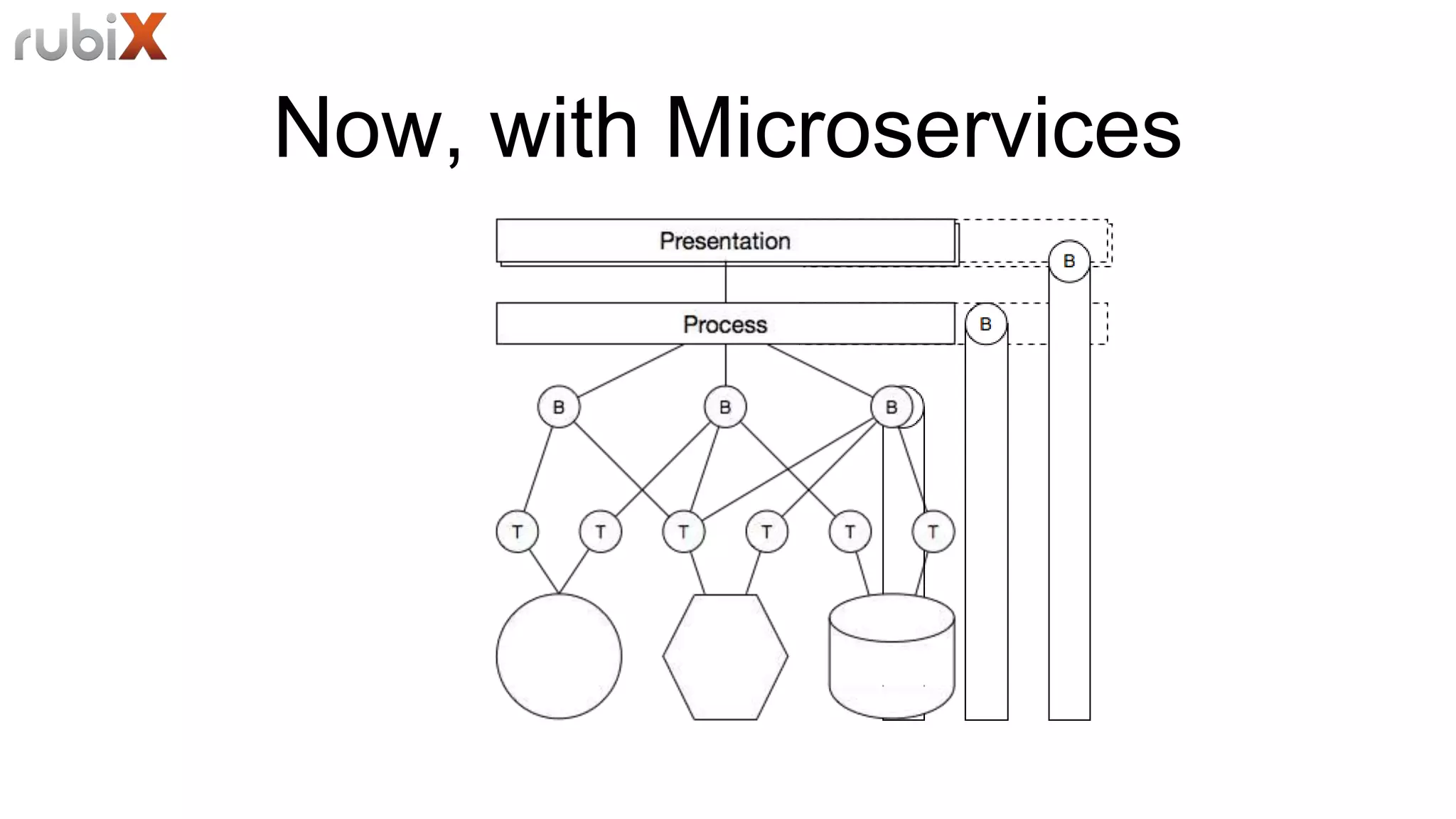
Now, with Microservices
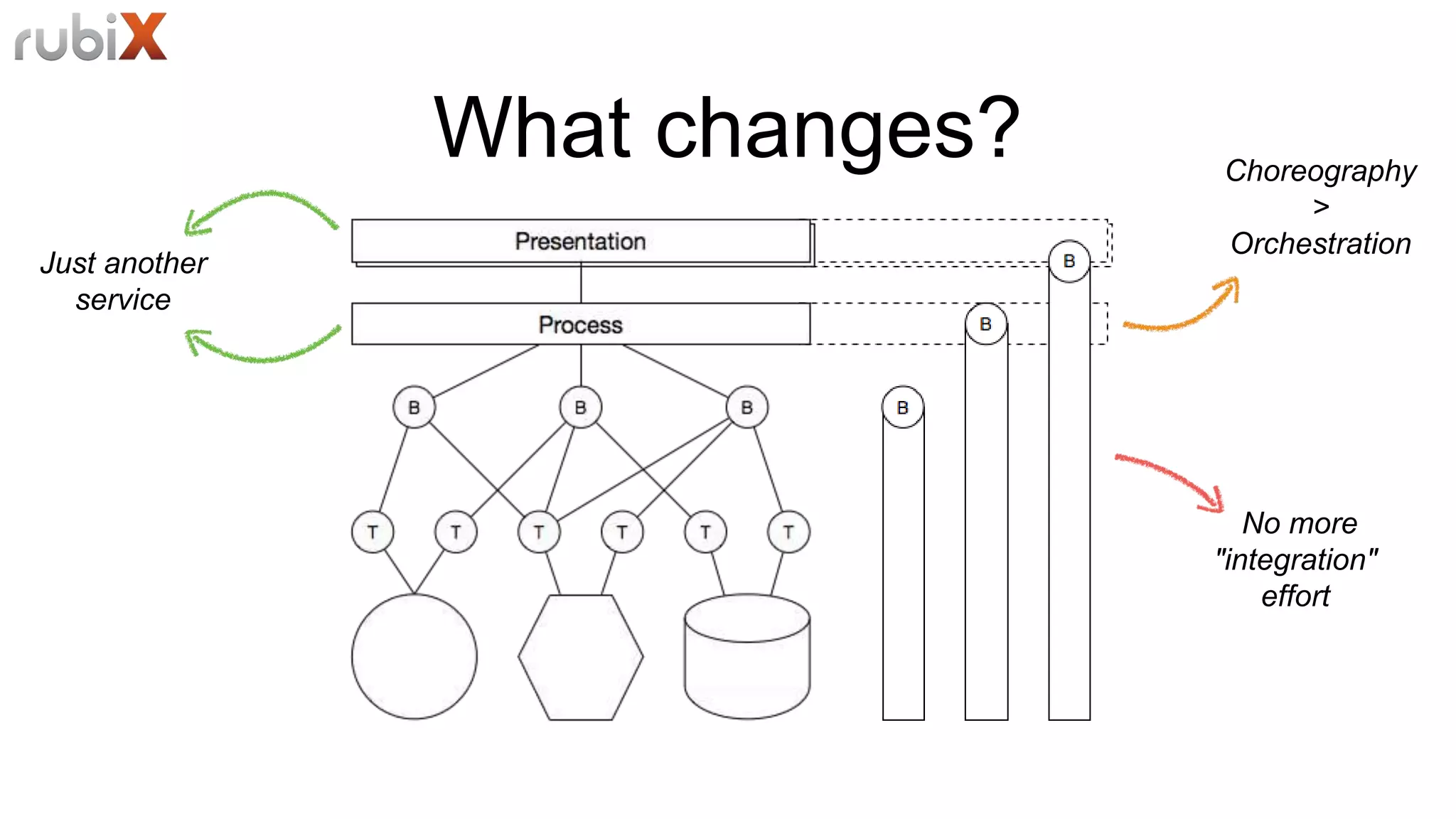
What changes?
Just another
service
No more
"integration"
effort
Choreography
>
Orchestration
That’s it?
• Using REST doesn't make something a microservice anymore than
using SOAP meant you were doing SOA.
• The emphasis on autonomy does drive integration patterns in a
certain direction:
• Asynchronous > Synchronous
• Choreography > Orchestration
• These decisions shouldn’t be exclusive to Microservices
Reasons to adopt microservices
• Scalability
• Independent LCM
• Runtime independence & Autonomous deployment
Only good things? Not quite…
• Distributed systems are still hard
• What about those pesky "enterprise features"?
• Resilience doesn’t come included in the box
• Applications and services still need to be built for failure
• On top of "existing" service challenges like contract versioning
• Eventual consistency
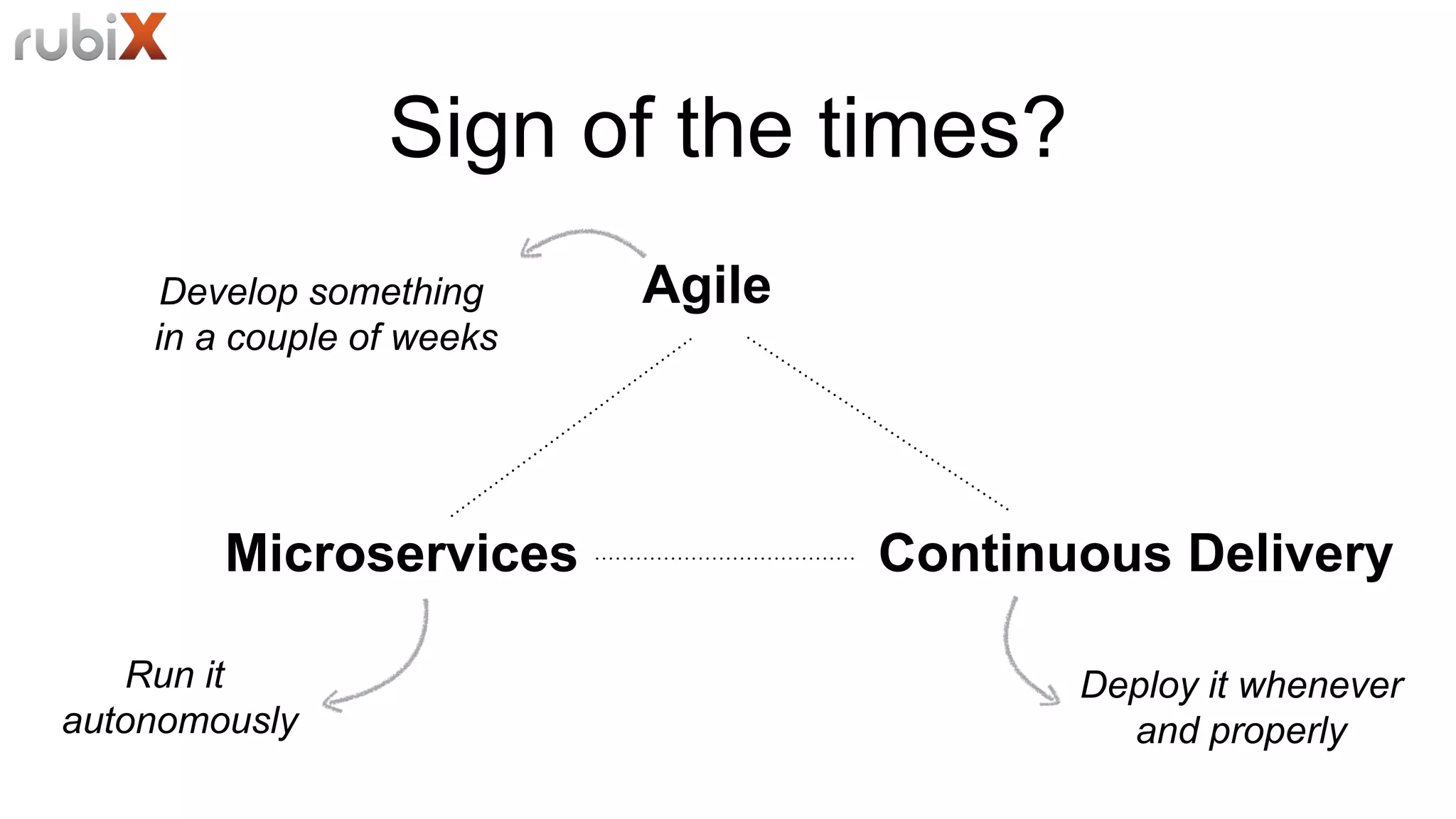
Sign of the times?
Microservices
Agile
Continuous Delivery
Develop something
in a couple of weeks
Deploy it whenever
and properly
Run it
autonomously
Any questions
Other concepts of interest
• Domain Driven Design (Eric J. Evans)
• Vertically Aligned Synergistically Partitioned or 'Snowman'
Architecture (Roger Sessions)
• Simple Iterative Partitions
• Autonomous Business Capabilities
• Self-Contained Systems (http://scs-architecture.org/)

Microservices - an integration perspective

  • 1.
    Who am I? •Coert van den Thillart • Solution Architect at rubiX • coert@rubix.nl • http://rubix.nl/coert-van-den-thillart
  • 2.
  • 3.
    Assumptions About you: • Youhave at least heard/read/done/seen something about Microservices • You are active in or at least familiar with the system integration space
  • 4.
    The "what aremicroservices?" slide"In short, the microservice architectural style is an approach to developing a single application as a suite of small services, each running in its own process and communicating with lightweight mechanisms, often an HTTP resource API. These services are built around business capabilities and independently deployable by fully automated deployment machinery. There is a bare minimum of centralized management of these services, which may be written in different programming languages and use different data storage technologies." - Martin Fowler http://martinfowler.com/articles/microservices.html
  • 5.
  • 6.
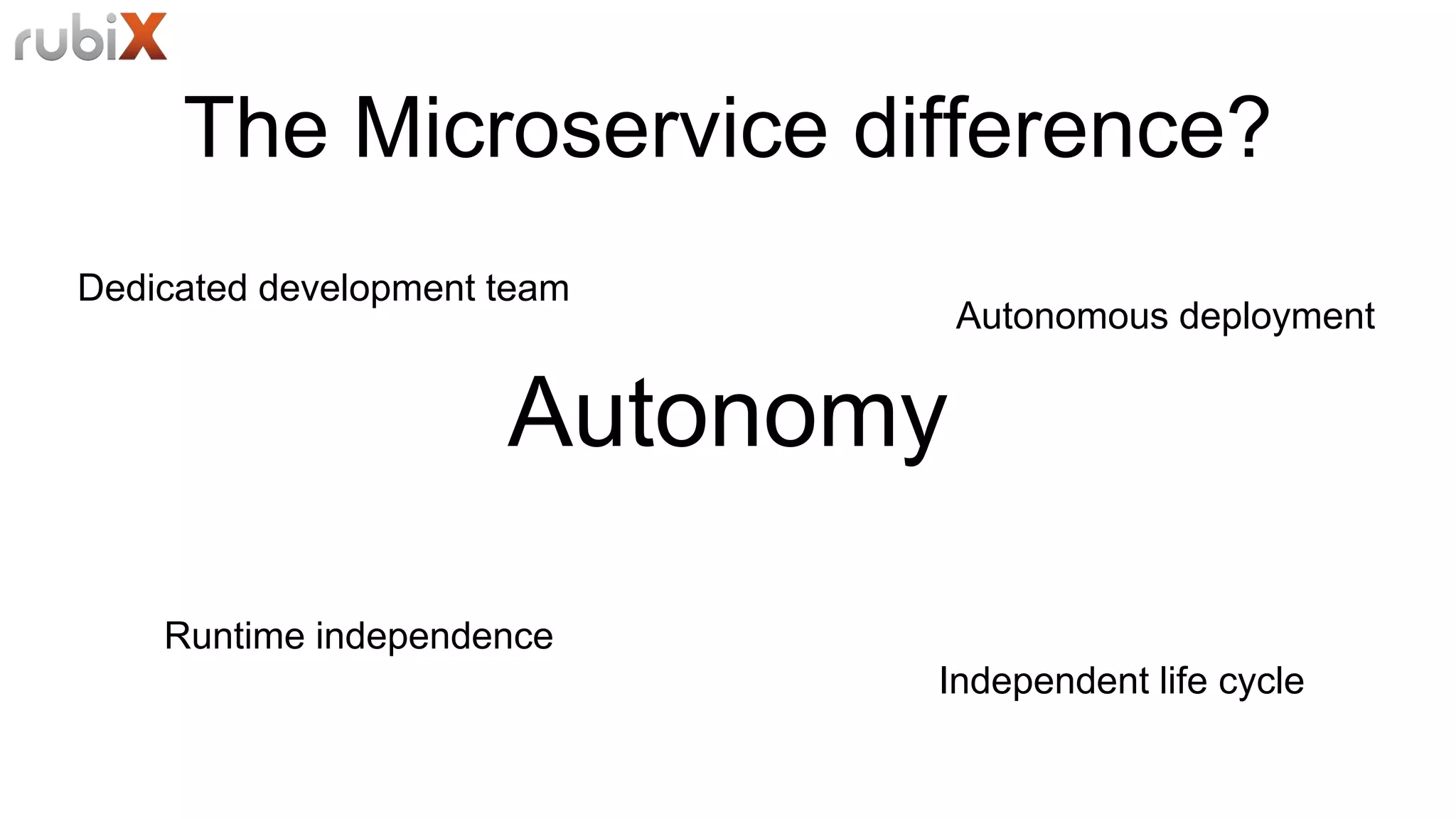
    The Microservice difference? Autonomy Independentlife cycle Runtime independence Dedicated development team Autonomous deployment
  • 7.
    Nothing else? Other benefitsand concepts associated with microservices aren’t exclusive to microservices. They are good practices applicable to any service oriented architecture. • Bounded context • High cohesion, low coupling • Focus on business functionality But they are very valuable in achieving autonomy.
  • 8.
  • 9.
  • 10.
    What changes? Just another service Nomore "integration" effort Choreography > Orchestration
  • 11.
    That’s it? • UsingREST doesn't make something a microservice anymore than using SOAP meant you were doing SOA. • The emphasis on autonomy does drive integration patterns in a certain direction: • Asynchronous > Synchronous • Choreography > Orchestration • These decisions shouldn’t be exclusive to Microservices
  • 12.
    Reasons to adoptmicroservices • Scalability • Independent LCM • Runtime independence & Autonomous deployment
  • 13.
    Only good things?Not quite… • Distributed systems are still hard • What about those pesky "enterprise features"? • Resilience doesn’t come included in the box • Applications and services still need to be built for failure • On top of "existing" service challenges like contract versioning • Eventual consistency
  • 14.
    Sign of thetimes? Microservices Agile Continuous Delivery Develop something in a couple of weeks Deploy it whenever and properly Run it autonomously
  • 15.
  • 16.
    Other concepts ofinterest • Domain Driven Design (Eric J. Evans) • Vertically Aligned Synergistically Partitioned or 'Snowman' Architecture (Roger Sessions) • Simple Iterative Partitions • Autonomous Business Capabilities • Self-Contained Systems (http://scs-architecture.org/)

Editor's Notes

  • #4 This presentation won’t go into the details of microservices.
  • #5 Autonoom ("own process", "lightweight", "independently deployable") "Built around business capabilities" —> ABC Implementatie agnostisch ("may be written in different programming languages and use different data storage technologies.")
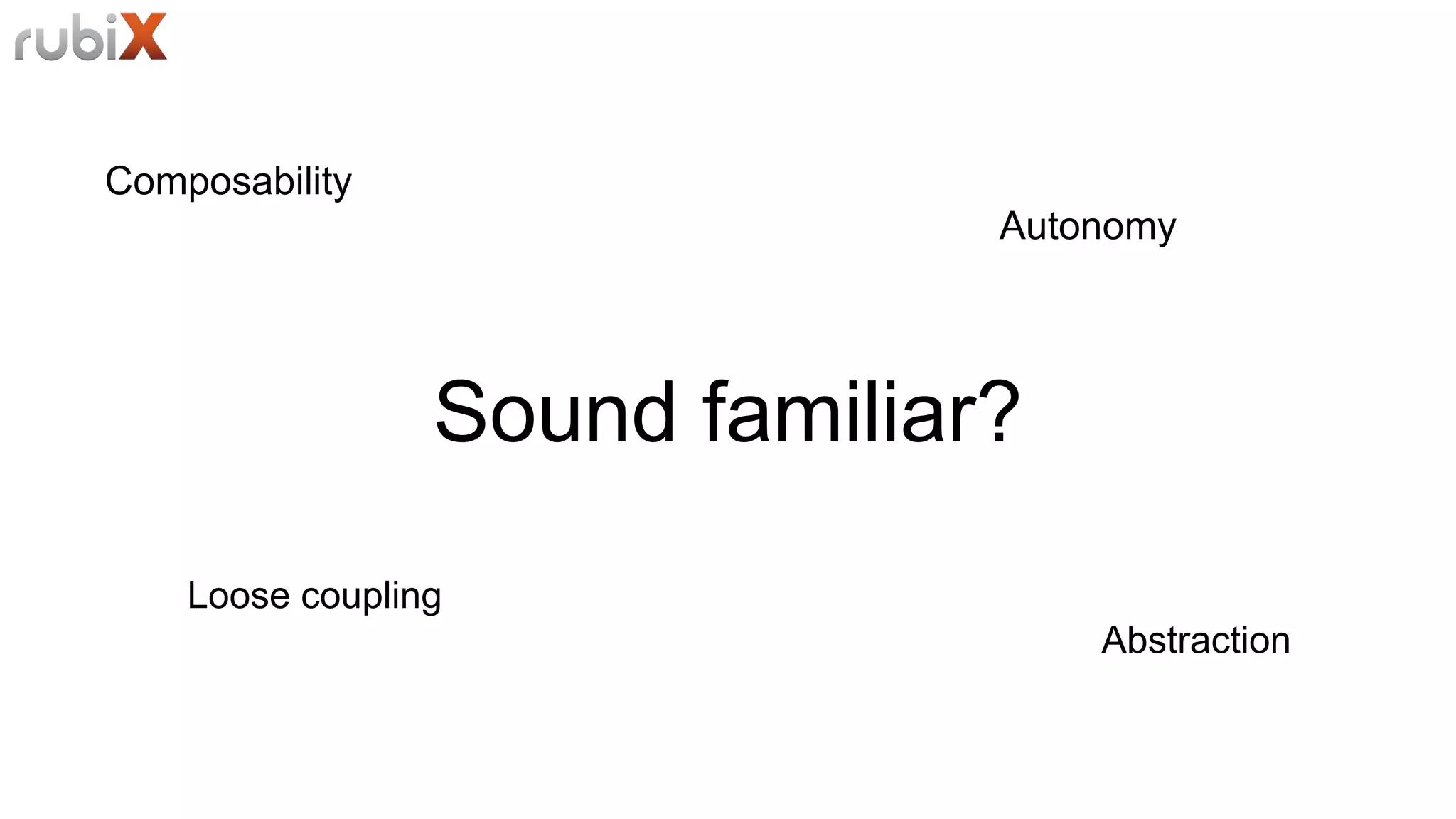
  • #6 Composability, Autonomy, Loose Coupling & Abstraction are all principles of service design (Erl, 2007). Almost 10 years old but still applicable to (micro)services.
  • #7 Autonomy is the key with microservices. And not just on a functional level. But at all levels: design, run and deployment time.
  • #9 Standaard 5 lagen architectuur. Van beneden naar boven: Applicaties hebben functionaliteit, die worden door technische services (T) ontsloten. Deze technische services worden gebruikt door business services (B) om algehele business functies te implementeren. Deze business services worden gebruikt in processen welke op hun beurt weer aansluiten op een of meer presentatie lagen.
  • #10 Microservices implementeren de volledige stack vanaf het "business service" niveau. Maar ze kunnen ook "hoger" gaan door een stuk proces te implementeren (order lifecycle bijvoorbeeld) of zelf een UI (otto.de model)
  • #11 On the presentation & process layer basically nothing changes. For either it’s just a bunch of new services. That said, for the process layer things might change as due to the autonomous nature of microservices there is a preference for choreography over orchestration. Biggest change is with implementing mircroservices. Basically they are full stack applications with their own stack from datastore to UI.
  • #12 Technology choice doesn’t drive the architecture. Integration patterns don’t define the architecture either.
  • #13 Runtime, no dependency on a runtime platform, other services etc. Because of runtime independence deployment becomes autonomous Develop what you want and need (but contracts remain a worry) Given their bounded context it should be easier to assign a dedicated team
  • #14 Distributed systems put a lot more load on your ops. CD is practically a requirement. Automated monitoring tools as well. Little mature platforms out there, but a lot emerging. Enterprise features like logging, monitoring, security, auditability etc. While an asynchronous/EDA approach might help with resilience, it’s not a given. Eventual consistency is a result of using asynchronous communications across vertically scaled services.
  • #15 Agile aims to deliver "done" code every sprint. This is usually a smaller package than with monolithic systems. Because of the smaller size there should be less risk involved to test it and deploy it. Because of this automated deployment should be less scary and it it goes wrong more easily rolled back. Combine that with the autonomous nature of microservices and the impact is limited even further.