

1
Sail in the Cloud
@kamesh_sampath ksampath@redhat.com
developers.redhat.com
The microservice architectural style is an approach to developing a single application as a
suite of small services, each running in its own process and communicating with lightweight
mechanisms, often an HTTP resource API.
These services are built around business capabilities and independently deployable by fully
automated deployment machinery. There is a bare minimum of centralized management of
these services, which may be written in different programming languages and use different
data storage technologies.
Martin Fowler
What is a microservice ?
Microservices Properties
MyService
Monitoring
Tracing
Discovery
API
Invocation
Resilience
Pipeline
Authentication
Logging Elasticity
Istio Service Mesh
Envoy
istio-ingress
Envoy
App A
Envoy
App B
Envoy
App C
istio-pilot istio-mixer istio-auth
HTTP Req/Resp
Kubernetes Pods
Istio Components Config to Envoy Access Control and Telemetry
Istio Components
● Control Plane
○ Istio-Pilot
■ Traffic Management
○ Istio-Mixer
■ Access Control
○ Istio-Auth
■ TLS and Certificates
● Data Plane
○ Envoy proxy deployed as “side-cars” with applications
Sidecar
SideCars
git-sync ngnix
● Two or more containers
deployed to same pod
● Share
○ same namespace
○ same Pod IP
○ Shared lifecycle
● Used to enhance the
containers
Composite Container Application
Source: http://blog.kubernetes.io/2015/06/the-distributed-system-toolkit-patterns.html
Pod
web-sources(Volume)
Demo
Distributed Tracing
Istio - Distributed Tracing
● Zero code change
● Propagate set of headers
○ x-request-id
○ x-b3-traceid
○ x-b3-spanid
○ x-b3-parentspanid
○ x-b3-sampled
○ x-b3-flags
○ x-ot-span-context
● Integrated with Zipkin
Demo
Canary Release
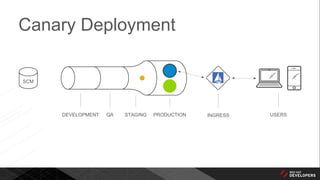
Canary release is a technique to reduce the risk of introducing a new
software version in production by slowly rolling out the change to a small
subset of users before rolling it out to the entire infrastructure and
making it available to everybody.
Source: https://martinfowler.com/bliki/CanaryRelease.html
Microservice Architecture - Principles
Canary Release
Canary Deployment
DEVELOPMENT QA STAGING PRODUCTION INGRESS USERS
SCM
Canary Deployment
DEVELOPMENT QA STAGING PRODUCTION INGRESS USERS
SCM
Canary Deployment
DEVELOPMENT QA STAGING PRODUCTION INGRESS USERS
SCM
Canary Deployment
DEVELOPMENT QA STAGING PRODUCTION INGRESS USERS
SCM
Canary Deployment
DEVELOPMENT QA STAGING PRODUCTION INGRESS USERS
SCM
Canary Deployment
DEVELOPMENT QA STAGING PRODUCTION INGRESS USERS
SCM
Canary Deployment
DEVELOPMENT QA STAGING PRODUCTION INGRESS USERS
SCM
Canary Deployment
DEVELOPMENT QA STAGING PRODUCTION INGRESS USERS
SCM
Canary Deployment
DEVELOPMENT QA STAGING PRODUCTION INGRESS USERS
SCM
Canary Deployment
DEVELOPMENT QA STAGING PRODUCTION INGRESS USERS
SCM
Demo
Circuit Breakers
The basic idea behind the circuit breaker is very simple. You wrap a
protected function call in a circuit breaker object, which monitors for
failures. Once the failures reach a certain threshold, the circuit breaker
trips, and all further calls to the circuit breaker return with an error,
without the protected call being made at all
Source: https://martinfowler.com/bliki/CircuitBreaker.html
Microservice Architecture - Principles
Circuit Breaker
Demo
Summary
▪ Minikube
▪ Docker Maven Plugin
▪ Service Mesh https://istio.io
▪ Demo Repo - https://goo.gl/pRKKqL
@kamesh_sampath
developers.redhat.com
A sail in the cloud

A sail in the cloud