E N GIN E E R IN G
THERMODYNAMICS
DEPARTMENT OF MECHANICAL ENGINEERING
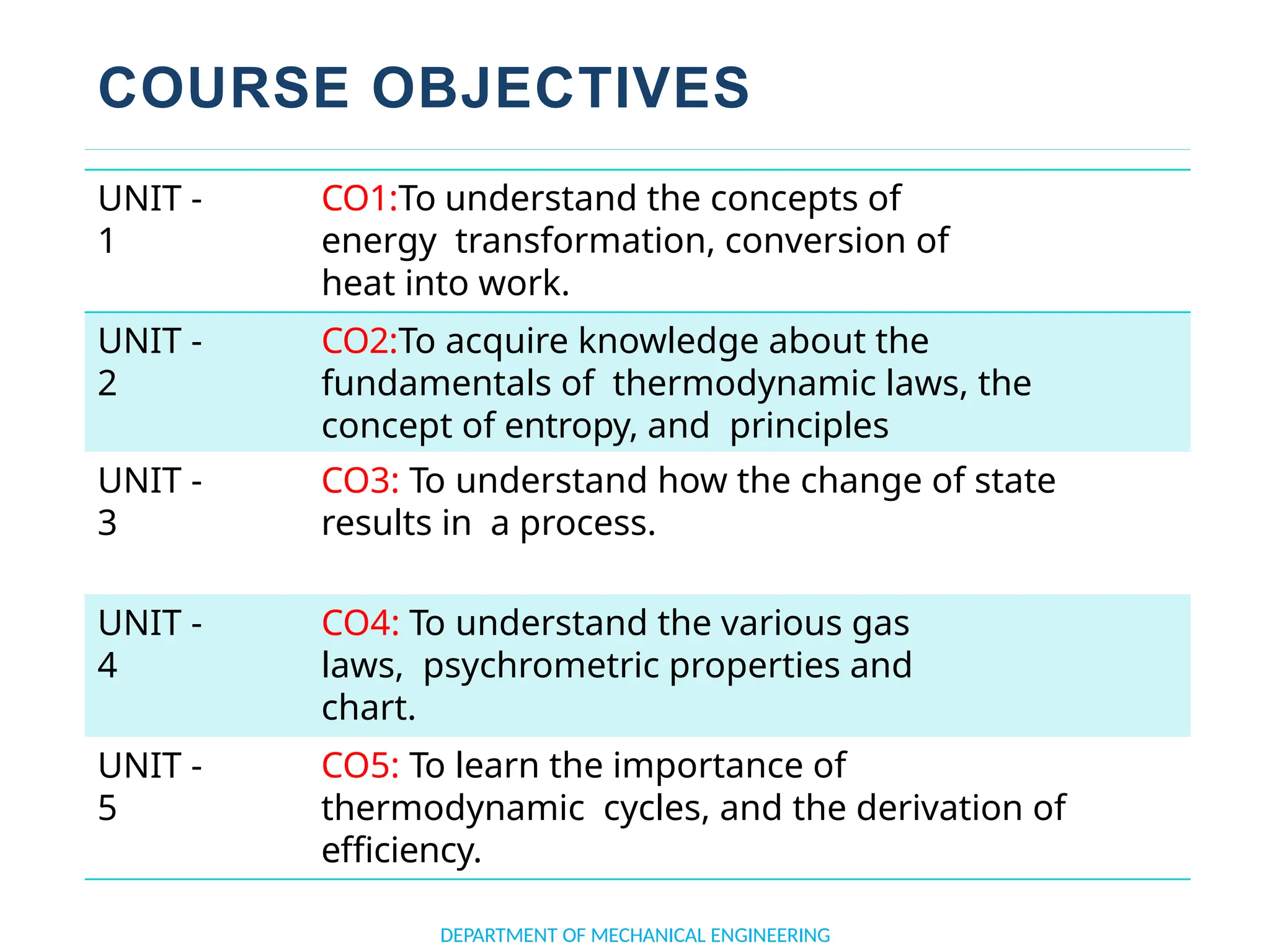
COURSE OBJECTIVES
UNIT -
1
CO1:To understand the concepts of
energy transformation, conversion of
heat into work.
UNIT -
2
CO2:To acquire knowledge about the
fundamentals of thermodynamic laws, the
concept of entropy, and principles
UNIT -
3
CO3: To understand how the change of state
results in a process.
UNIT -
4
CO4: To understand the various gas
laws, psychrometric properties and
chart.
UNIT -
5
CO5: To learn the importance of
thermodynamic cycles, and the derivation of
efficiency.
UNIT 1
CO1: To understand the concepts of
energy
transformation, conversion of heat into work.
B A S I C SO F
T H E R M O D Y N A M I
C S
UNIT – I (SYLLABUS)
Introduction - System - Types of Systems
• System - Types of Systems - Control Volume - Macroscopic
and Microscopic viewpoints
• Thermodynamic Equilibrium- State, Property, Process, Cycle
• Reversibility – Quasi static Process, Irreversible Process,
First law of
Thermodynamics
• PMM I - Joule’s Experiment
• First law applied to a Process
• Steady Flow Energy Equation.
DEPARTMENT OF MECHANICAL ENGINEERING
COURSE OUTLINE
DEPARTMENT OF MECHANICAL ENGINEERING
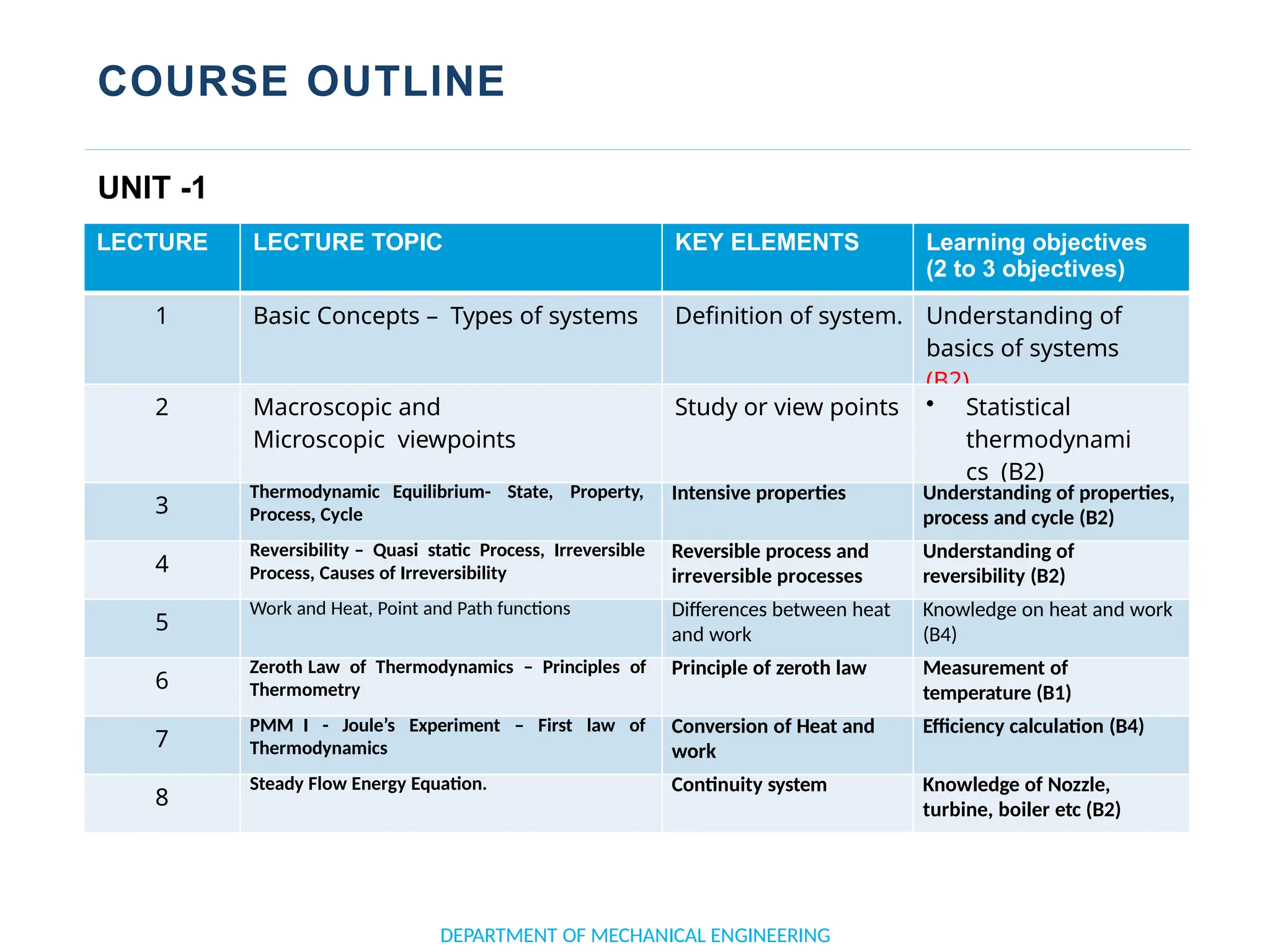
LECTURE LECTURE TOPIC KEY ELEMENTS Learning objectives
(2 to 3 objectives)
1 Basic Concepts – Types of systems Definition of system. Understanding of
basics of systems
(B2)
2 Macroscopic and
Microscopic viewpoints
Study or view points • Statistical
thermodynami
cs (B2)
3
Thermodynamic Equilibrium- State, Property,
Process, Cycle
Intensive properties Understanding of properties,
process and cycle (B2)
4
Reversibility – Quasi static Process, Irreversible
Process, Causes of Irreversibility
Reversible process and
irreversible processes
Understanding of
reversibility (B2)
5
Work and Heat, Point and Path functions Differences between heat
and work
Knowledge on heat and work
(B4)
6
Zeroth Law of Thermodynamics – Principles of
Thermometry
Principle of zeroth law Measurement of
temperature (B1)
7
PMM I - Joule’s Experiment – First law of
Thermodynamics
Conversion of Heat and
work
Efficiency calculation (B4)
8
Steady Flow Energy Equation. Continuity system Knowledge of Nozzle,
turbine, boiler etc (B2)
UNIT -1
LECTURE 1
Introduction - Types of systems
INTRODUCTION: UNITS
DEPARTMENT OF MECHANICAL ENGINEERING
INTRODUCTION: UNITS
DEPARTMENT OF MECHANICAL ENGINEERING
INTRODUCTION:
DEPARTMENT OF MECHANICAL ENGINEERING
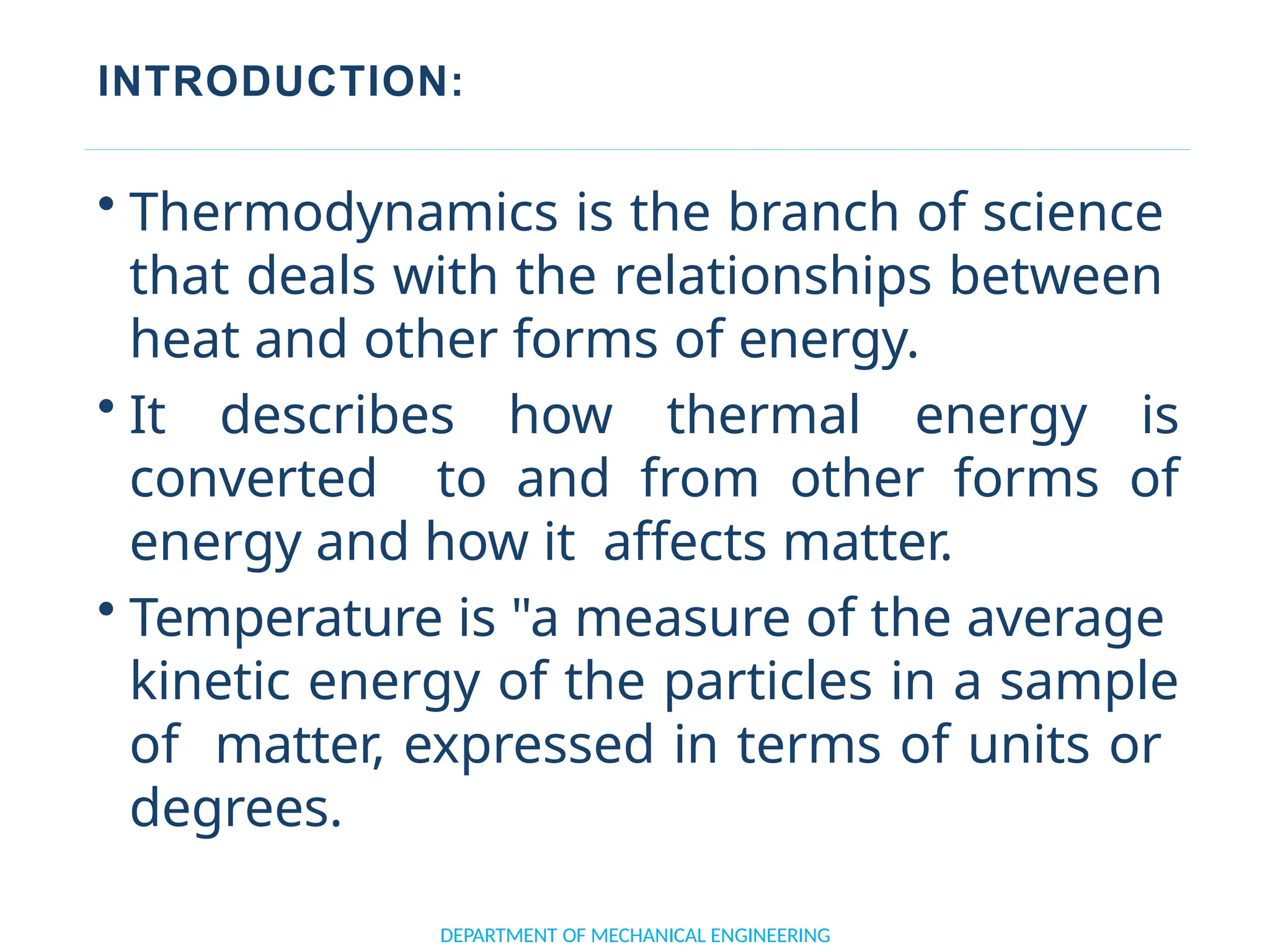
• Thermodynamics is the branch of science
that deals with the relationships between
heat and other forms of energy.
• It describes how thermal energy is
converted to and from other forms of
energy and how it affects matter.
• Temperature is "a measure of the average
kinetic energy of the particles in a sample
of matter, expressed in terms of units or
degrees.
BASIC CONCEPTS
• Temperature is "a measure of the average
kinetic energy of the particles in a sample of
matter, expressed in terms of units or
degrees.
• Heat is a form of energy which is transferred
by virtue of temperature difference.
• Energy of a body is its capacity to do work.
DEPARTMENT OF MECHANICAL ENGINEERING
BASIC CONCEPTS
• Work is said to be done by a force when a
body moves in the direction of force.
Work done = Force * Displacement
• Specific heat is the amount of heat required
to increase the temperature of a certain
mass of a substance by unit degree.
• The fundamental concepts of heat capacity
and latent heat, which were necessary for
the development of thermodynamics.
DEPARTMENT OF MECHANICAL ENGINEERING
SYSTEM
DEPARTMENT OF MECHANICAL ENGINEERING
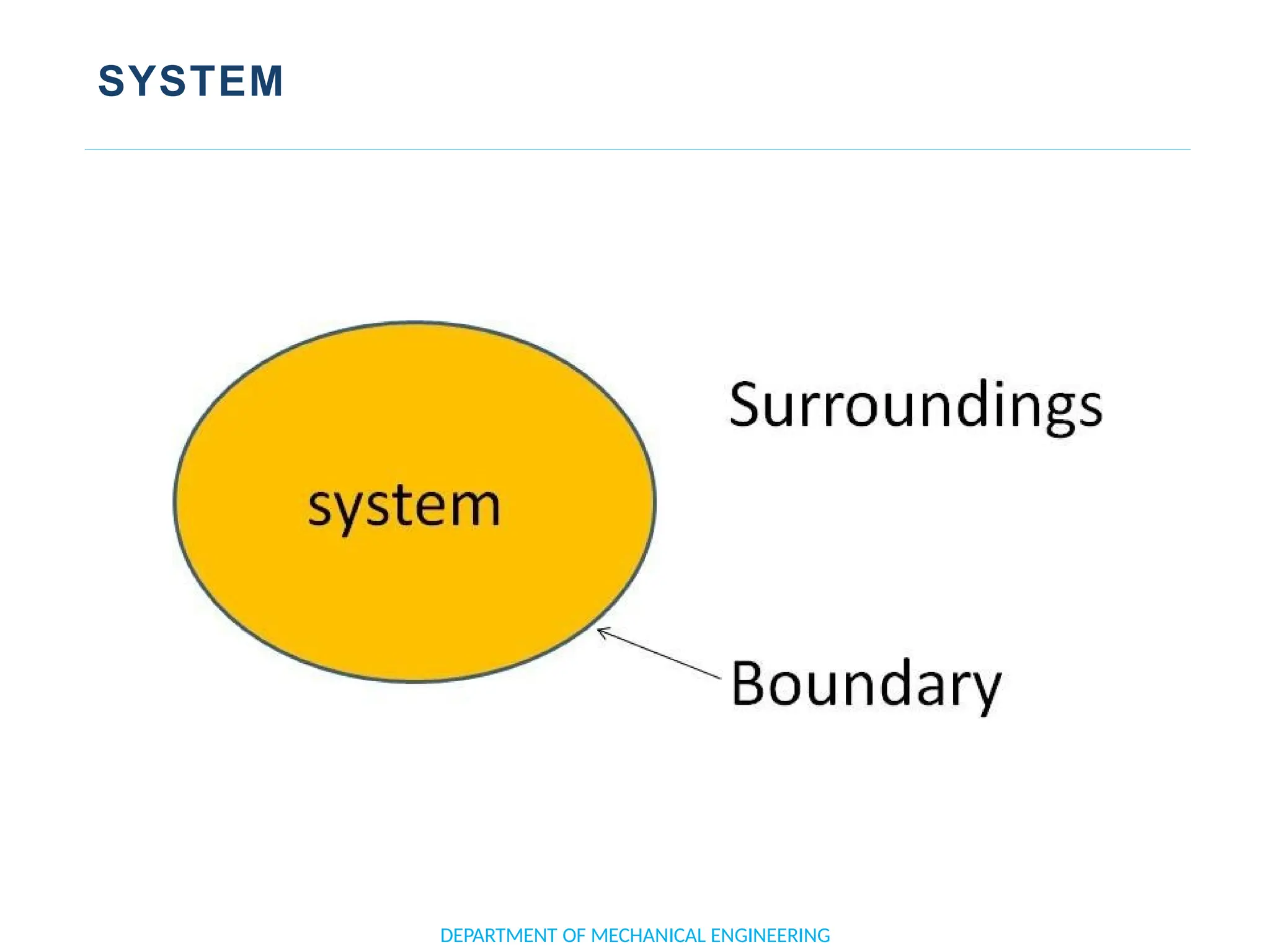
System:
• A thermodynamic system is defined as a quantity of
matter or a region in space which is selected for the
study.
Surroundings:
• The mass or region outside the system is called
surroundings.
Boundary:
• The real or imaginary surfaces which separates the
system and surroundings is called boundary. The
real or imaginary surfaces which separates the
system and surroundings is called boundary.
SYSTEM
DEPARTMENT OF MECHANICAL ENGINEERING
TYPES OF THERMODYNAMIC SYSTEM
• On the basis of mass and energy transfer
the thermodynamic system is divided into
three types.
Closed system
Open system
Isolated system
DEPARTMENT OF MECHANICAL ENGINEERING
TYPES OF THERMODYNAMIC SYSTEM
DEPARTMENT OF MECHANICAL ENGINEERING
TYPES OF THERMODYNAMIC SYSTEM
DEPARTMENT OF MECHANICAL ENGINEERING
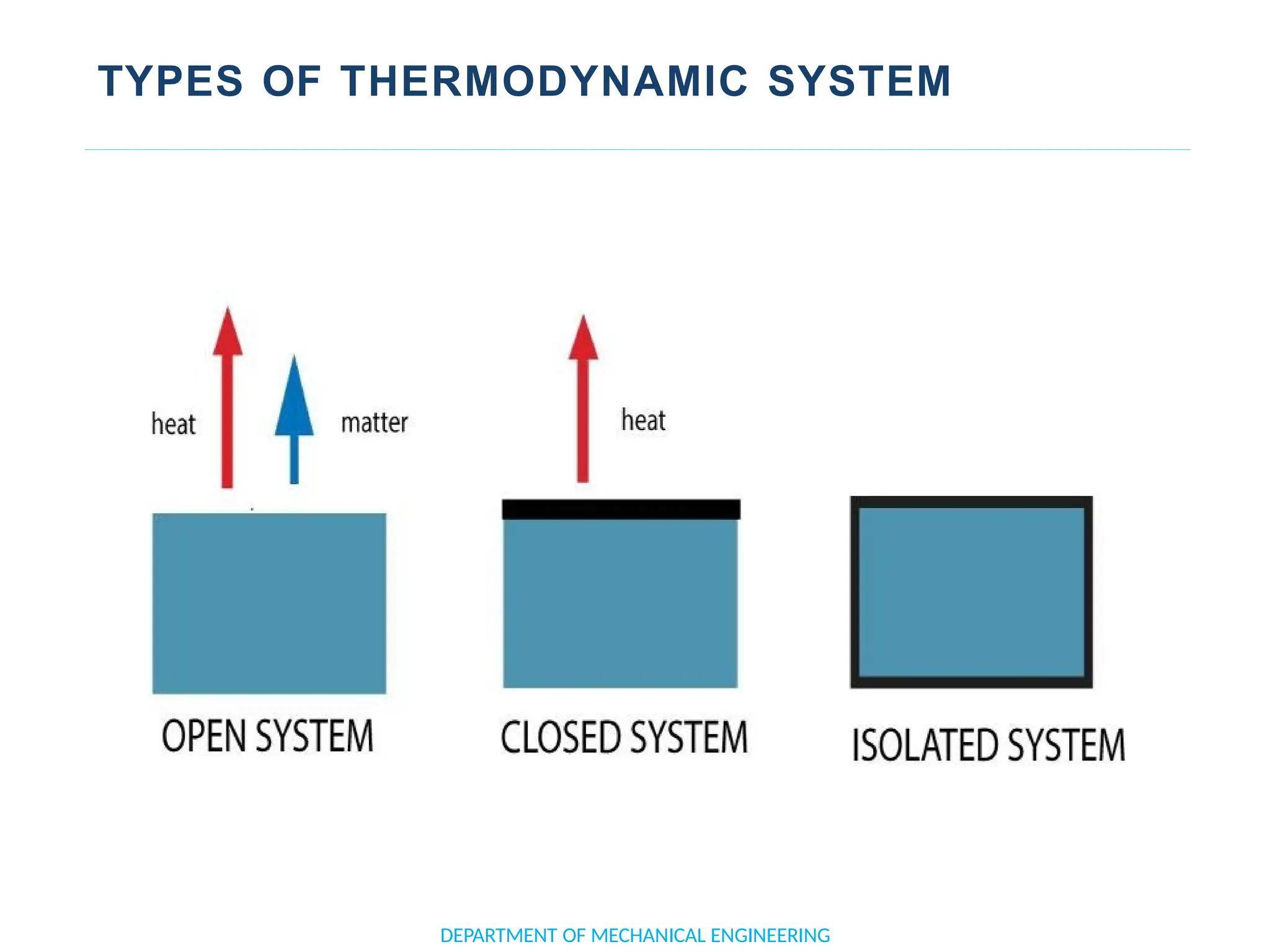
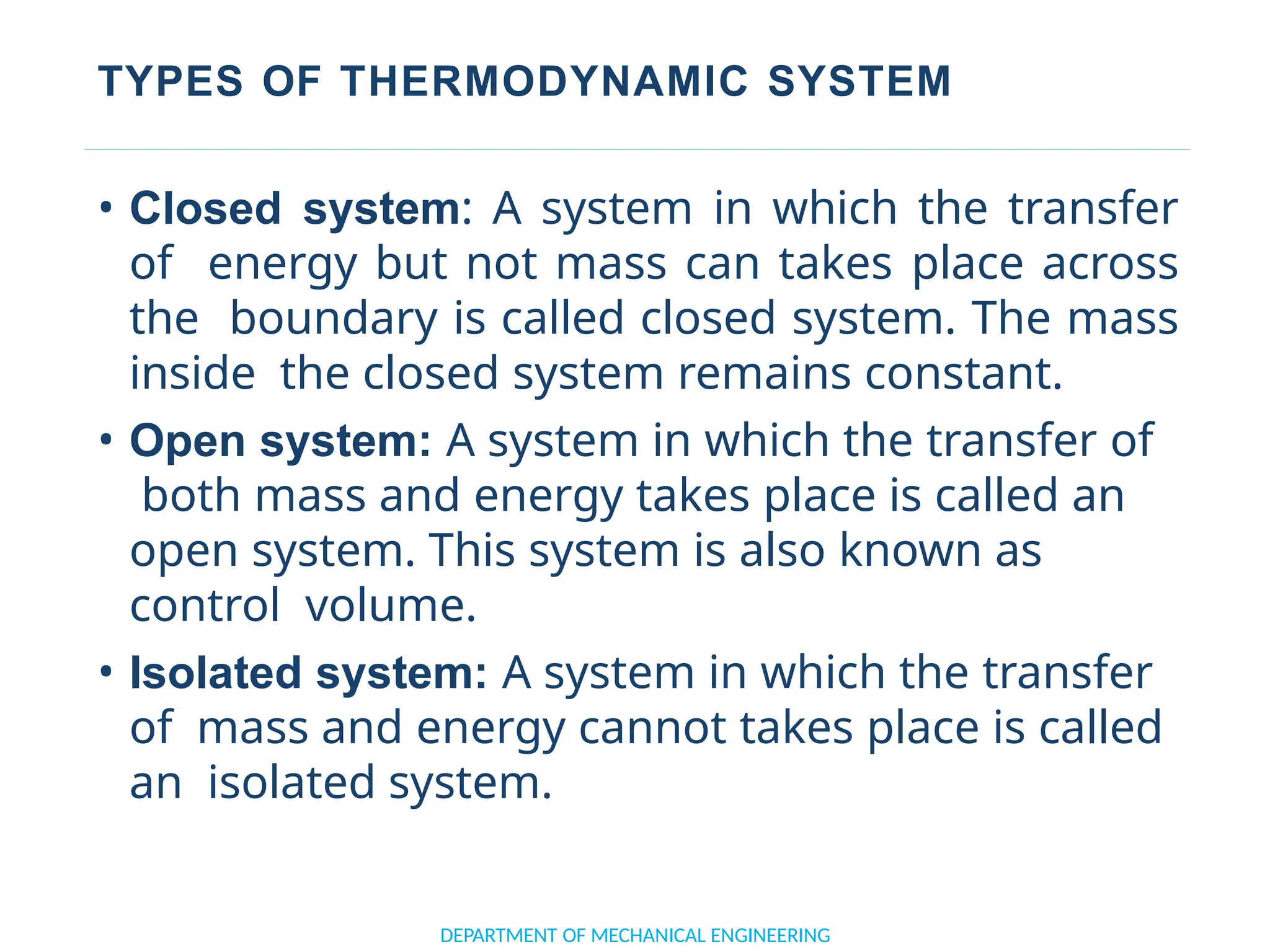
• Closed system: A system in which the transfer
of energy but not mass can takes place across
the boundary is called closed system. The mass
inside the closed system remains constant.
• Open system: A system in which the transfer of
both mass and energy takes place is called an
open system. This system is also known as
control volume.
• Isolated system: A system in which the transfer
of mass and energy cannot takes place is called
an isolated system.
MICROSCOPIC VIEW OR STUDY:
DEPARTMENT OF MECHANICAL ENGINEERING
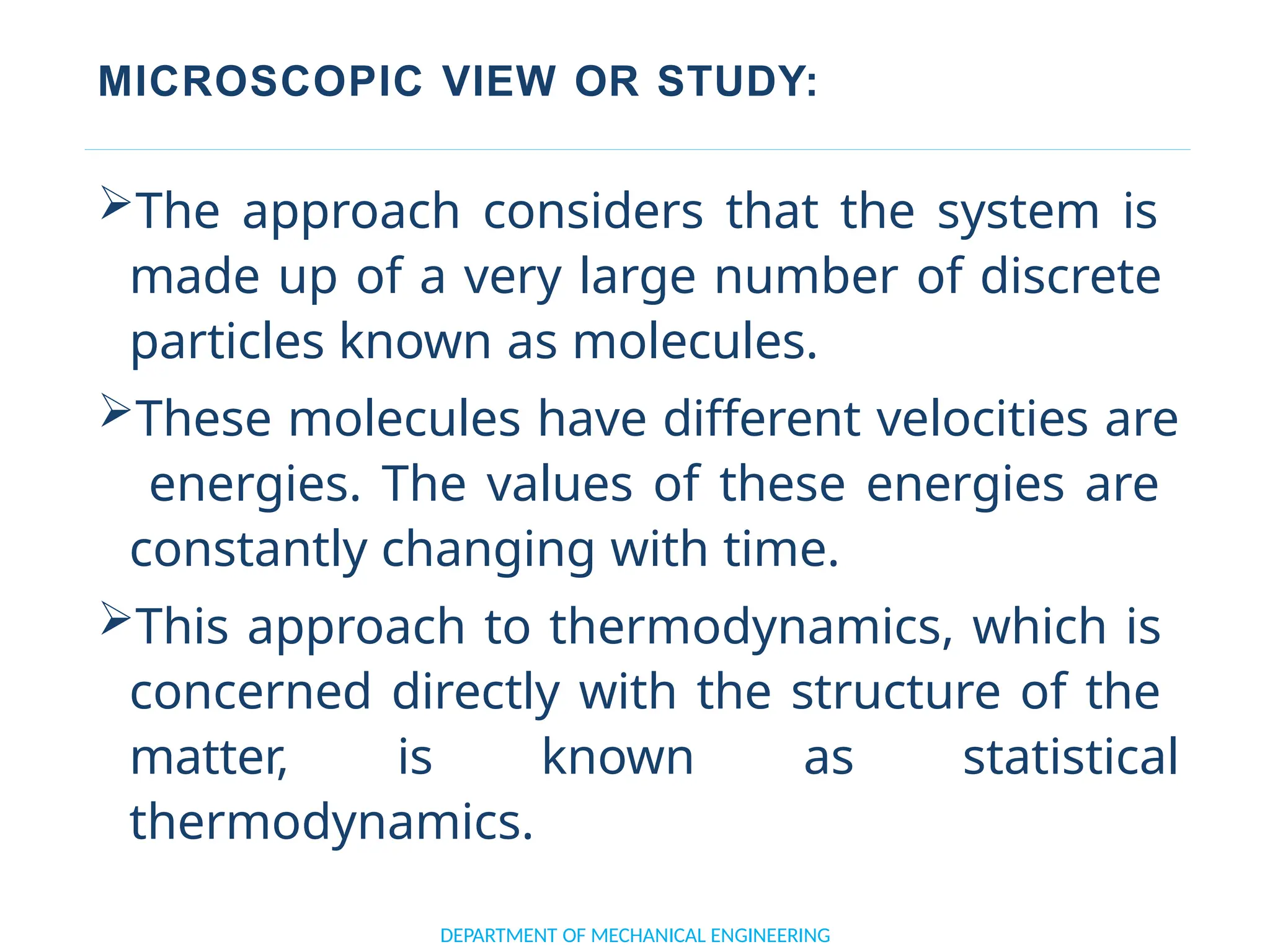
The approach considers that the system is
made up of a very large number of discrete
particles known as molecules.
These molecules have different velocities are
energies. The values of these energies are
constantly changing with time.
This approach to thermodynamics, which is
concerned directly with the structure of the
matter, is known as statistical
thermodynamics.
MICROSCOPIC VIEW OR STUDY:
DEPARTMENT OF MECHANICAL ENGINEERING
• The behavior of the system is found by using
statistical methods, as the number of
molecules is very large.
• So advanced statistical and mathematical
methods are needed to explain the changes
in the system.
• The properties like velocity, momentum,
impulse, kinetic energy and instruments
cannot easily measure force of impact etc.
that describe the molecule.
MACROSCOPIC VIEW OR STUDY:
In this approach a certain quantity of
matter is considered without taking
into account the
DEPARTMENT OF MECHANICAL ENGINEERING
thermodynamicsis concerned with
gross
events occurring at molecular level.
In other words this approach
to
or
overall behavior. This is known as
classical thermodynamics.
The analysis of macroscopic system
requires simple mathematical formula.
MACROSCOPIC VIEW OR STUDY:
DEPARTMENT OF MECHANICAL ENGINEERING
The value of the properties of the system
are their average values. For examples
consider a sample of gas in a closed
container.
The pressure of the gas is the average value
of the pressure exerted by millions of
individual molecules.
In order to describe a system only a
few properties are needed.
HEAT AND WORK
DEPARTMENT OF MECHANICAL ENGINEERING
Similarities :
Both are path functions and inexact
differentials.
Both are boundary phenomenon i.e., both
are recognized at the boundaries of the
system as they cross them.
Both are associated with a process, not a
state. Unlike properties, work or heat has no
meaning at a state.
HEAT AND WORK
DEPARTMENT OF MECHANICAL ENGINEERING
Dissimilarities :
In heat
transfer
required.
temperature difference
is
In a stable system there cannot be work
transfer, however, there is no restriction for
the transfer of heat.
The sole effect external to the system could
be reduced to rise of a weight but in the
case of a heat transfer other effects are
also observed.
THERMODYNAMIC EQUILIBRIUM
A thermodynamic system is said to exist in a
state of thermodynamic equilibrium when no
change in any macroscopic property is
registered if the system is isolated from its
surroundings.
An isolated system always reaches in
the
DEPARTMENT OF MECHANICAL ENGINEERING
course of
equilibriu
m
time a state of
thermodynamic and can never
depart from it
spontaneousl
y.
THERMODYNAMIC EQUILIBRIUM
DEPARTMENT OF MECHANICAL ENGINEERING
Mechanical equilibrium:
The criteriafor Mechanical equilibrium
are the equality of pressures.
Chemical equilibrium:
The criteria for Chemical equilibriumare
the equality of chemical potentials.
Thermal equilibrium:
The criterion for Thermal equilibriumis
the equality of temperatures.
STATE AND PROPERTY
DEPARTMENT OF MECHANICAL ENGINEERING
State:
The thermodynamic state
of defined by
specifyingvalues
a system
is
of a
set of
measurable properties sufficient to
determine all other properties.
For fluid systems, typical properties
are pressure, volume and temperature.
Property:
Properties may be extensive or intensive.
TYPES OF PROPERTIES
DEPARTMENT OF MECHANICAL ENGINEERING
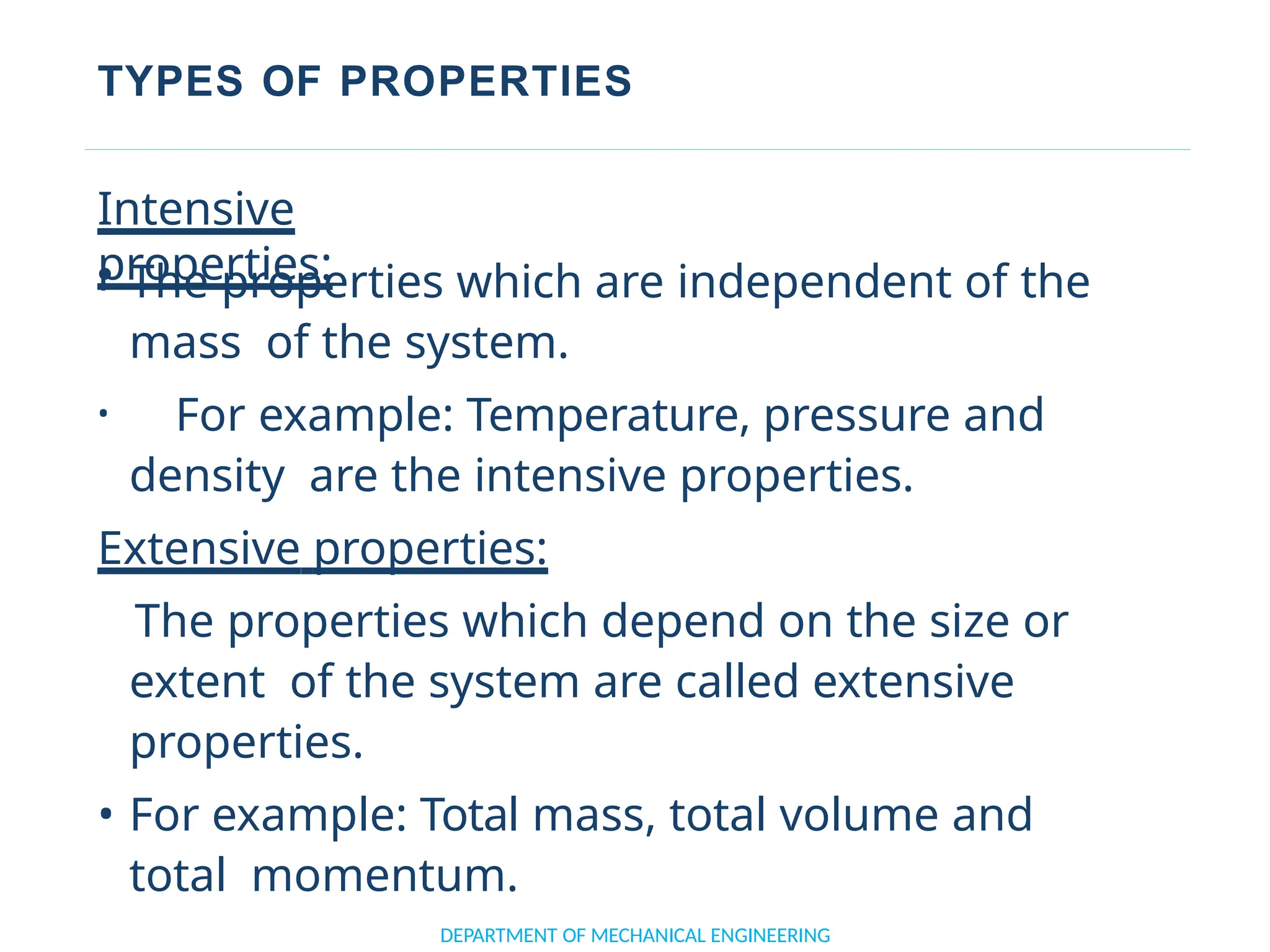
Intensive
properties:
• The properties which are independent of the
mass of the system.
• For example: Temperature, pressure and
density are the intensive properties.
Extensive properties:
The properties which depend on the size or
extent of the system are called extensive
properties.
• For example: Total mass, total volume and
total momentum.
THERMODYNAMIC PROCESS
• When the system undergoes change from
one thermodynamic state to final state due
change in properties like temperature,
pressure, volume etc, the system is said to
have undergone thermodynamic process.
• Various types of thermodynamic processes
are:
DEPARTMENT OF MECHANICAL ENGINEERING
isotherm
al
isochoric
process, adiabatic
process, process, isobaric
process and
reversible
process.
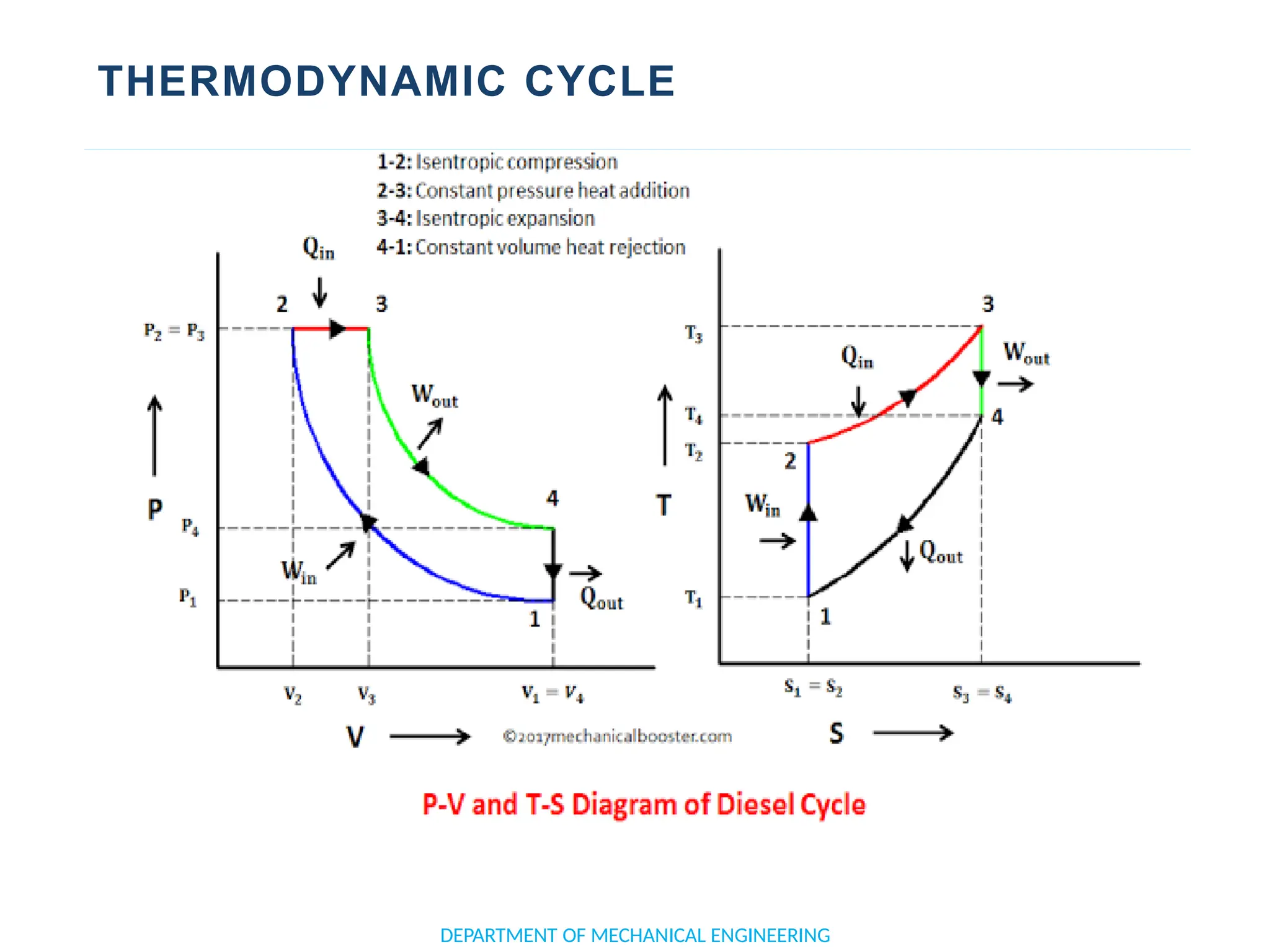
THERMODYNAMIC CYCLE
DEPARTMENT OF MECHANICAL ENGINEERING
• Thermodynamic cycle refers to any closed
system that undergoes various changes due
to temperature, pressure, and volume,
however, its final and initial state are equal.
• In the process of going through this cycle,
the system may perform work on its
surroundings, thereby acting as a heat
engine
THERMODYNAMIC CYCLE
DEPARTMENT OF MECHANICAL ENGINEERING
REVERSIBLE PROCESSES
DEPARTMENT OF MECHANICAL ENGINEERING
• A thermodynamic process (state i → state f ) is said
to be reversible if the process can be turned
back such that both the system and the
surroundings return to their original states, with
no other change anywhere else in the universe.
• As we know, in reality, no such processes as
reversible processes can exist, thus, the reversible
processes can easily be defined as idealizations or
models of real processes, on which the limits of
the system or device
are to
be
defined. They
help maximum
efficiency a system
us in
incurring
the can provide
in ideal
working conditions and thus the target design that
can
be set.
REVERSIBLE PROCESSES
• They help us in incurring the maximum
efficiency a system can provide in ideal
working conditions and thus the target
design that can be set.
Examples of Reversible Process
slow adiabatic compression or expansion of
gases.
slow isothermal compression or expansion
of gases
DEPARTMENT OF MECHANICAL ENGINEERING
IRREVERSIBLE PROCESS
DEPARTMENT OF MECHANICAL ENGINEERING
• An irreversible process can be defined as a
process in which the system and the
surroundings do not return to their original
condition once the process is initiated.
• Taking an example of an automobile engine,
that has travelled a distance with the aid of
fuel equal to an amount ‘x’. During the
process, the fuel burns to provide energy to
the engine, converting itself into smoke and
heat energy.
IRREVERSIBLE PROCESS
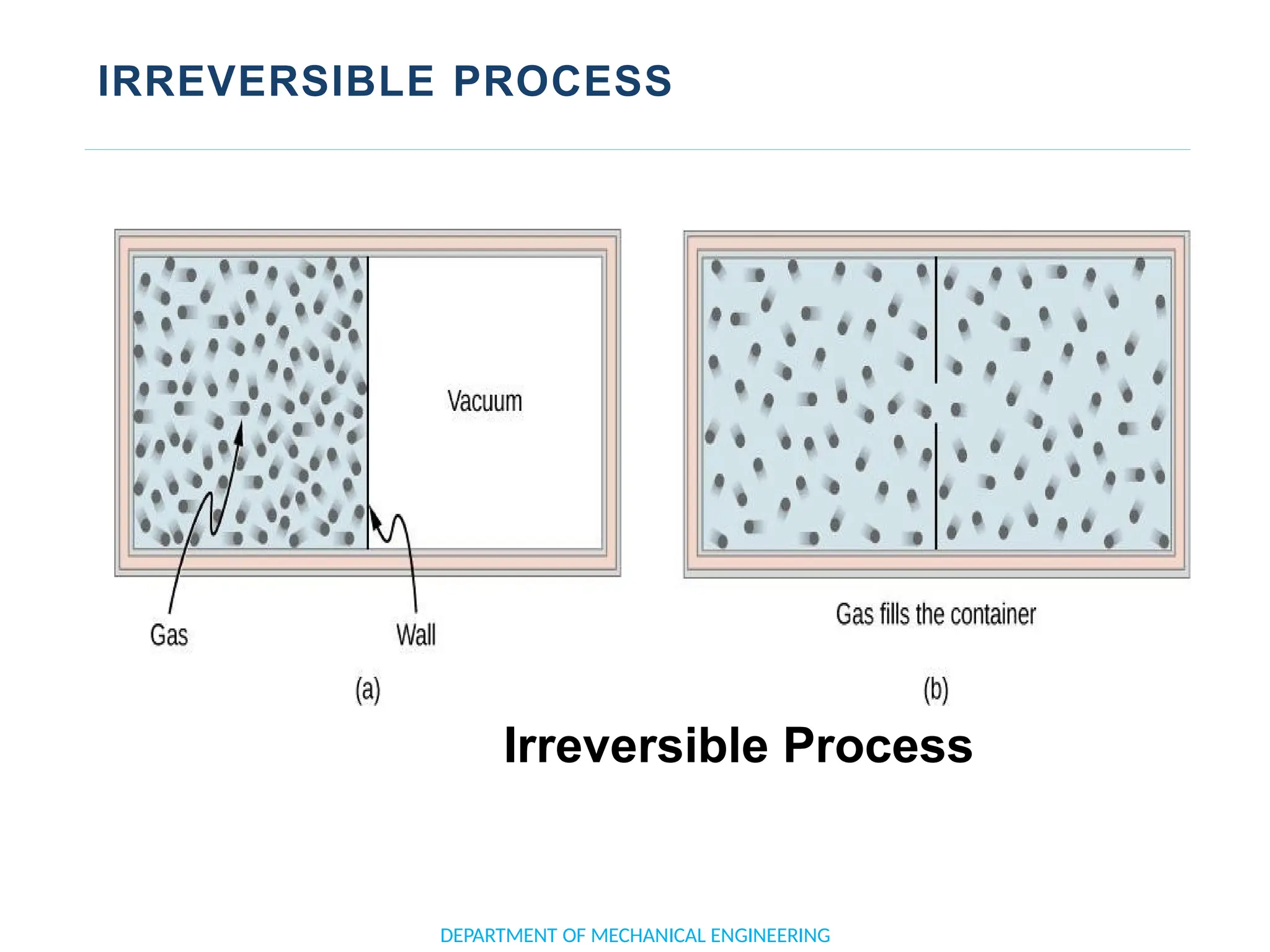
Irreversible Process
DEPARTMENT OF MECHANICAL ENGINEERING
IRREVERSIBLE PROCESS
DEPARTMENT OF MECHANICAL ENGINEERING
• We cannot retrieve the energy lost by the fuel
and cannot get back the original form.
There are many factors due to which the
irreversibility of a process occurs, namely:
The friction that converts the energy of the
fuel to heat energy.
• Mixing of two different substances which
cannot be separated as the process of
intermixing is again spontaneous in nature,
the reverse of which is not feasible.
EXAMPLES OF IRREVERSIBLE PROCESSES
Relative motion with friction
Throttling
Heat transfer
Diffusion
Electricity flow through a resistance
DEPARTMENT OF MECHANICAL ENGINEERING
QUASI-STATIC PROCESS
DEPARTMENT OF MECHANICAL ENGINEERING
QUASI-STATIC PROCESS
When the process is carried out in such a way
that at every instant, the system deviation from
the thermodynamic equilibrium is infinitesimal,
then the process is known as quasi-static or
quasi- equilibrium process and each state in the
process may be considered as an equilibrium
state.
In simple words, we can say that if system is
going
DEPARTMENT OF MECHANICAL ENGINEERING
succession of
thermodynamic
under a thermodynamic process
through
states and each
state is equilibrium statethen the
process will be termed as quasi static
process.
ZEROTH LAW OF THERMODYNAMICS
DEPARTMENT OF MECHANICAL ENGINEERING
ZEROTH LAW OF THERMODYNAMICS
• If objects ‘A’ and ‘C’ are in thermal
equilibrium with ‘B’, then object ‘A’ is in
thermal equilibrium with object ‘C’.
Practically this means all three objects
are at the same temperature and it
forms the basis for comparison of
temperatures.
• If a=b; b=c then a=c
DEPARTMENT OF MECHANICAL ENGINEERING
PRINCIPLES OF THERMOMETRY
• Thermometry is the science and practice of
temperature measurement.
• Any measurable change in a thermometric
probe (e.g. the dilatation of a liquid in a
capillary tube, variation of electrical
resistance of a conductor, of refractive index
of a transparent material, and so on) can be
used to mark temperature levels, that
should later be calibrated against an
internationally agreed unit if the measure is
to be related to other thermodynamic
variables.
DEPARTMENT OF MECHANICAL ENGINEERING
PRINCIPLES OF THERMOMETRY
DEPARTMENT OF MECHANICAL ENGINEERING
• Thermometry is sometimes split in
metrological studies in two subfields:
contact thermometry and noncontact
thermometry.
• As there can never be complete thermal
uniformity at large, thermometry is
always associated to a heat transfer
problem with some space-time
coordinates of measurement, given rise
to time-series plots and temperature
maps.
CONSTANT VOLUME GAS THERMOMETER
DEPARTMENT OF MECHANICAL ENGINEERING
CONSTANT VOLUME GAS THERMOMETER
• Thermometers are working examples of
the zeroth law of thermodynamics.
• The significance of constant volume gas
thermometers is that they are used to
calibrate other th
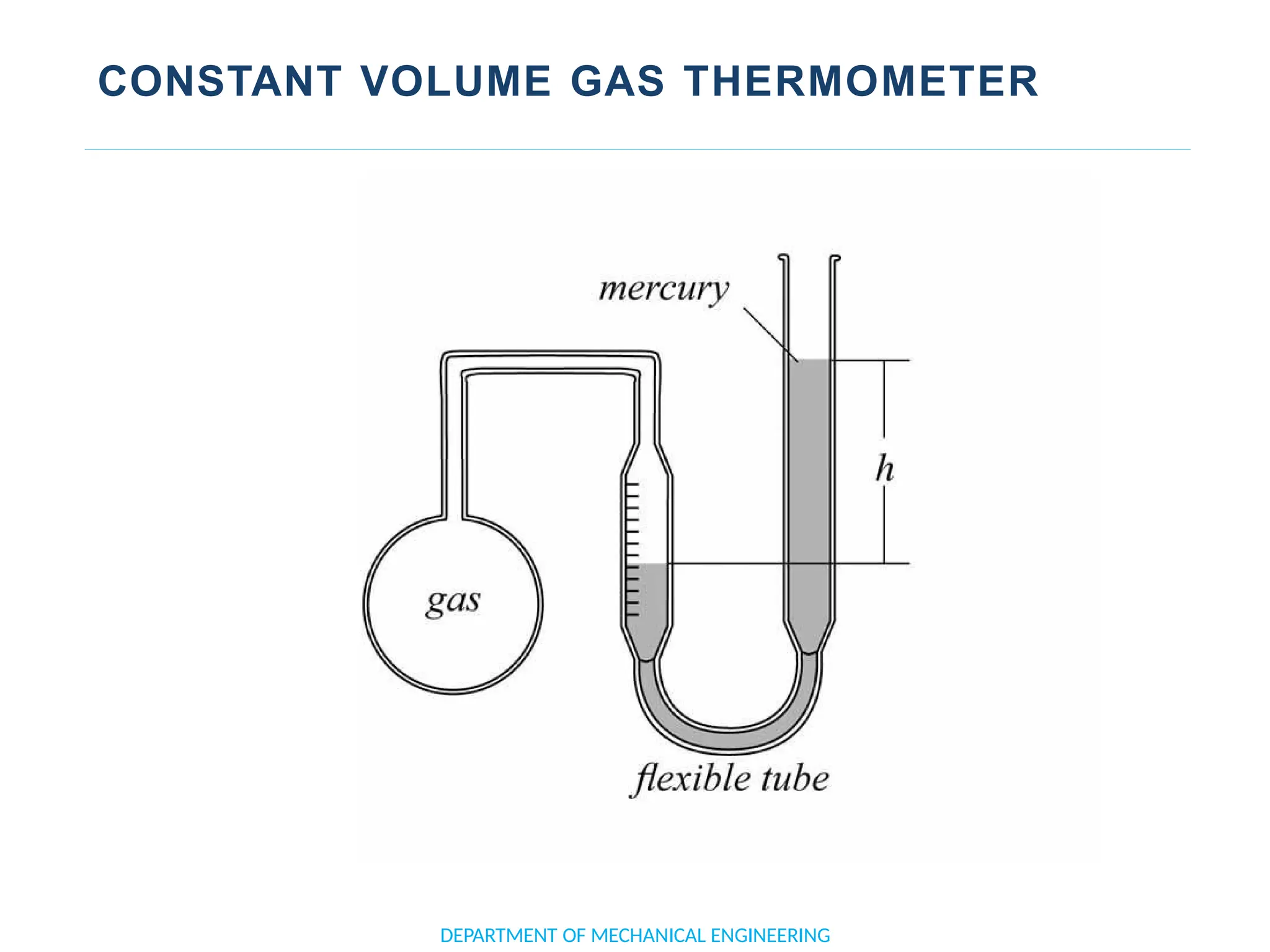
• A constant volume gas thermometer is
composed of a bulb filled with a fixed
amount of a dilute gas that is attached to a
mercury manometer.
DEPARTMENT OF MECHANICAL ENGINEERING
CONSTANT VOLUME GAS THERMOMETER
• A manometer is a device used to
measure pressure.
• The mercury manometer has a column partially
filled with mercury that is connected to a flexible
tube that has another partially filled column of
mercury, called a reservoir, attached to the other
end.
• The height of the mercury in the first column is
set to a reference point or pressure P that it
must stay at, while the mercury in the reservoir
is allowed to move up and down in relation to a
scale or ruler.
DEPARTMENT OF MECHANICAL ENGINEERING
CONSTANT VOLUME GAS THERMOMETER
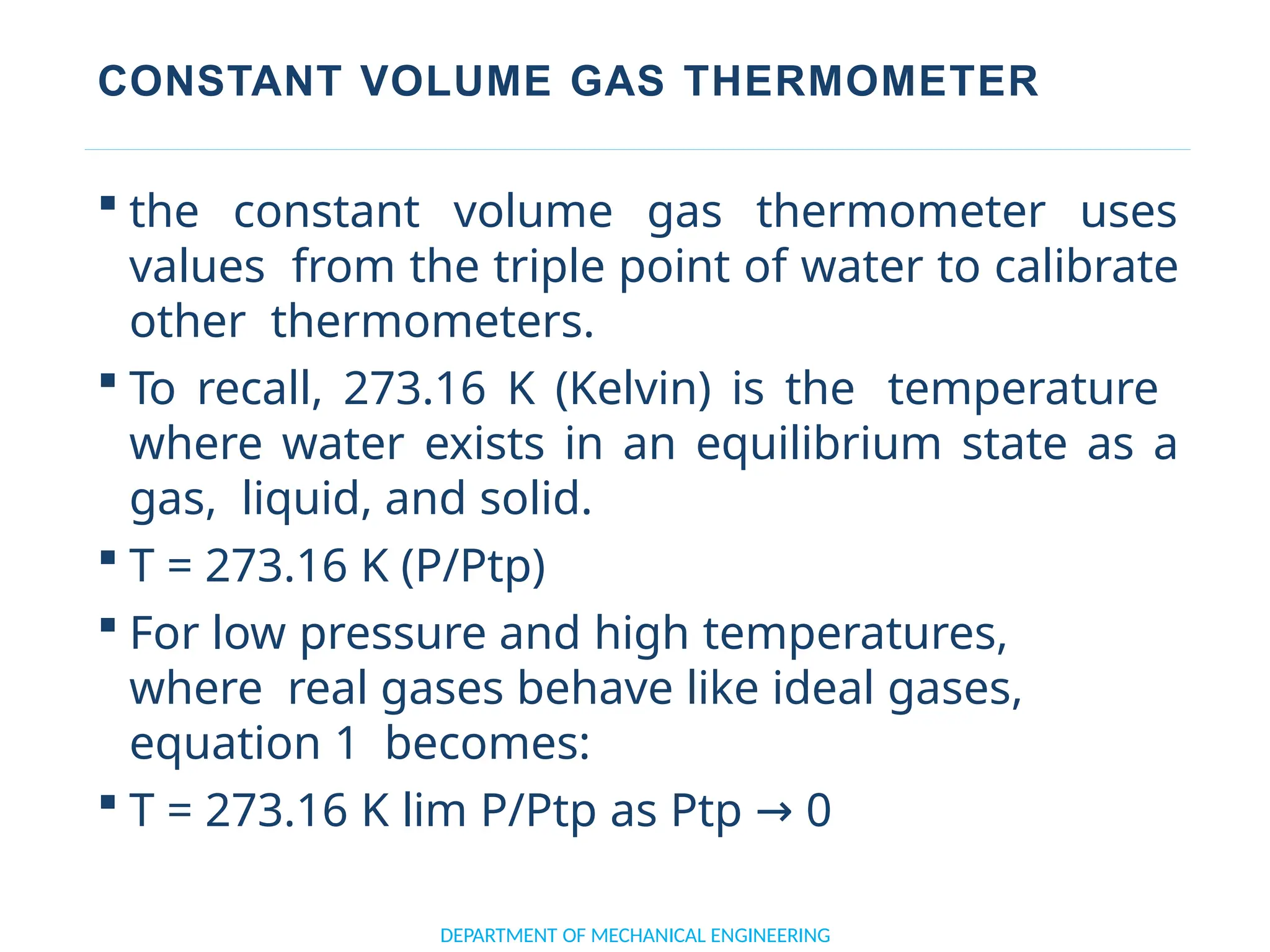
 the constant volume gas thermometer uses
values from the triple point of water to calibrate
other thermometers.
 To recall, 273.16 K (Kelvin) is the temperature
where water exists in an equilibrium state as a
gas, liquid, and solid.
 T = 273.16 K (P/Ptp)
 For low pressure and high temperatures,
where real gases behave like ideal gases,
equation 1 becomes:
 T = 273.16 K lim P/Ptp as Ptp → 0
DEPARTMENT OF MECHANICAL ENGINEERING
SCALES OF TEMPERATURE
DEPARTMENT OF MECHANICAL ENGINEERING
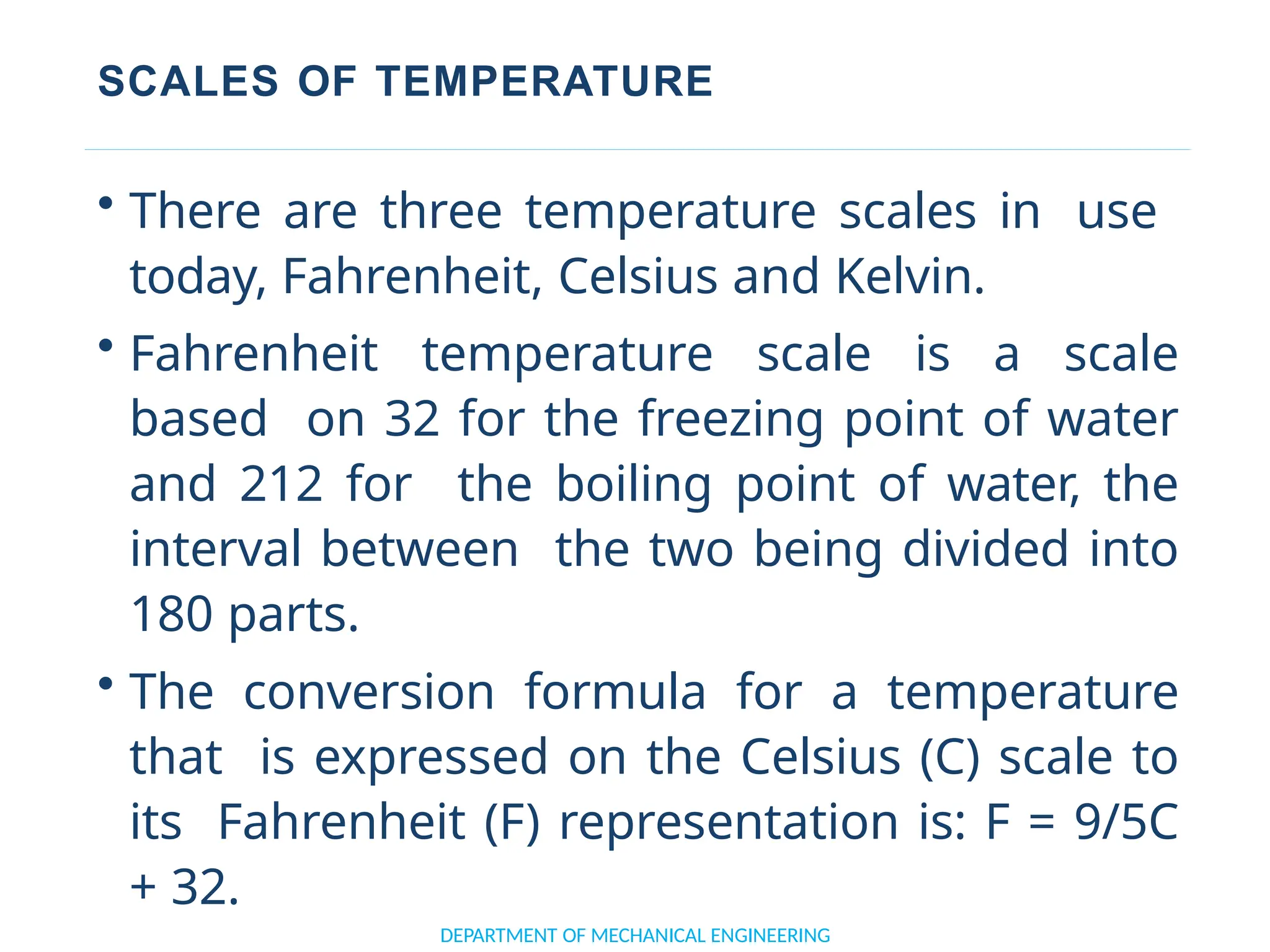
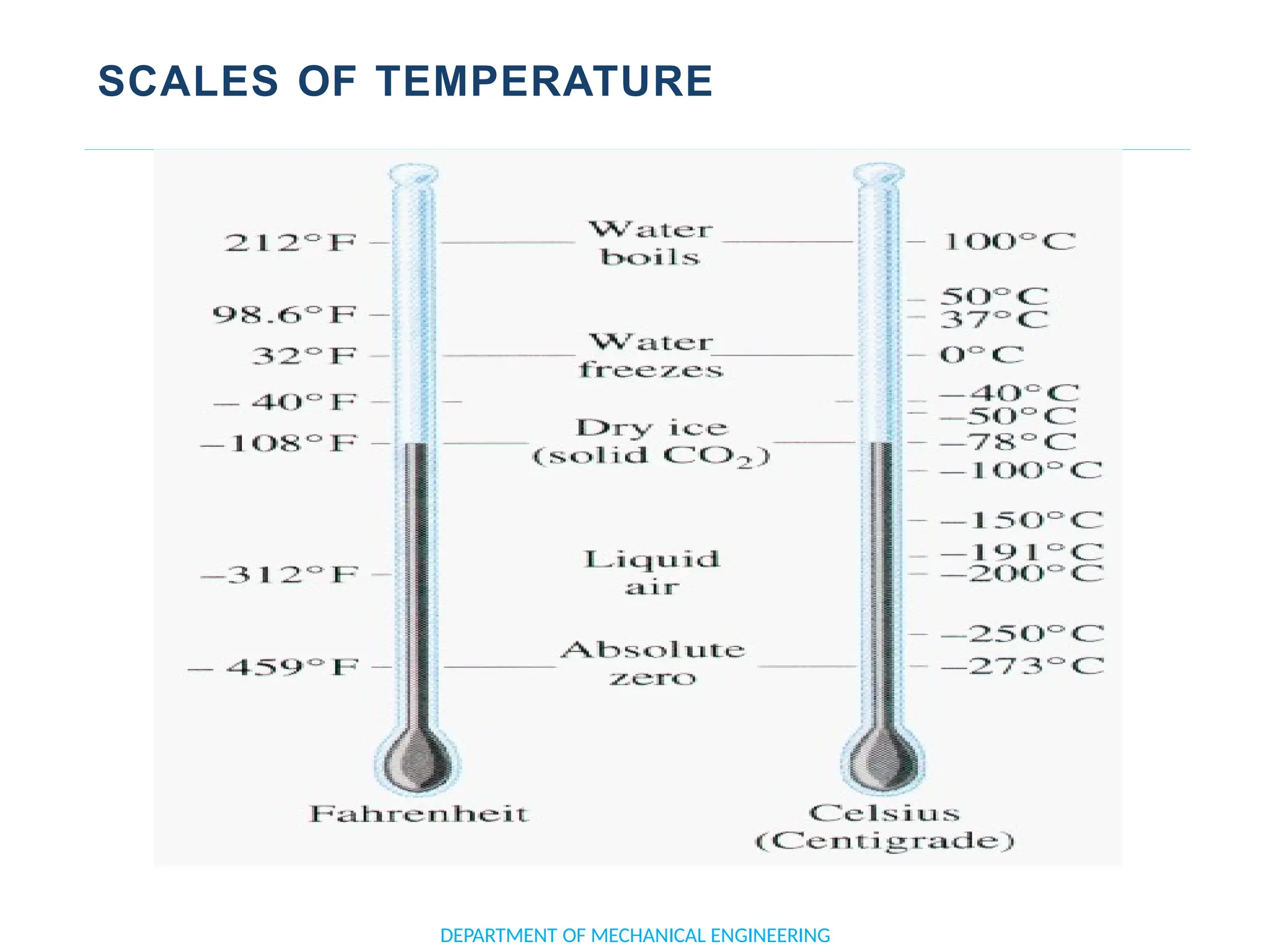
• There are three temperature scales in use
today, Fahrenheit, Celsius and Kelvin.
• Fahrenheit temperature scale is a scale
based on 32 for the freezing point of water
and 212 for the boiling point of water, the
interval between the two being divided into
180 parts.
• The conversion formula for a temperature
that is expressed on the Celsius (C) scale to
its Fahrenheit (F) representation is: F = 9/5C
+ 32.
SCALES OF TEMPERATURE
DEPARTMENT OF MECHANICAL ENGINEERING
JOULES EXPERIMENT
DEPARTMENT OF MECHANICAL ENGINEERING
JOULES EXPERIMENT
DEPARTMENT OF MECHANICAL ENGINEERING
FIRST LAW OF THERMODYNAMICS
DEPARTMENT OF MECHANICAL ENGINEERING
FIRST LAW OF THERMODYNAMICS
DEPARTMENT OF MECHANICAL ENGINEERING
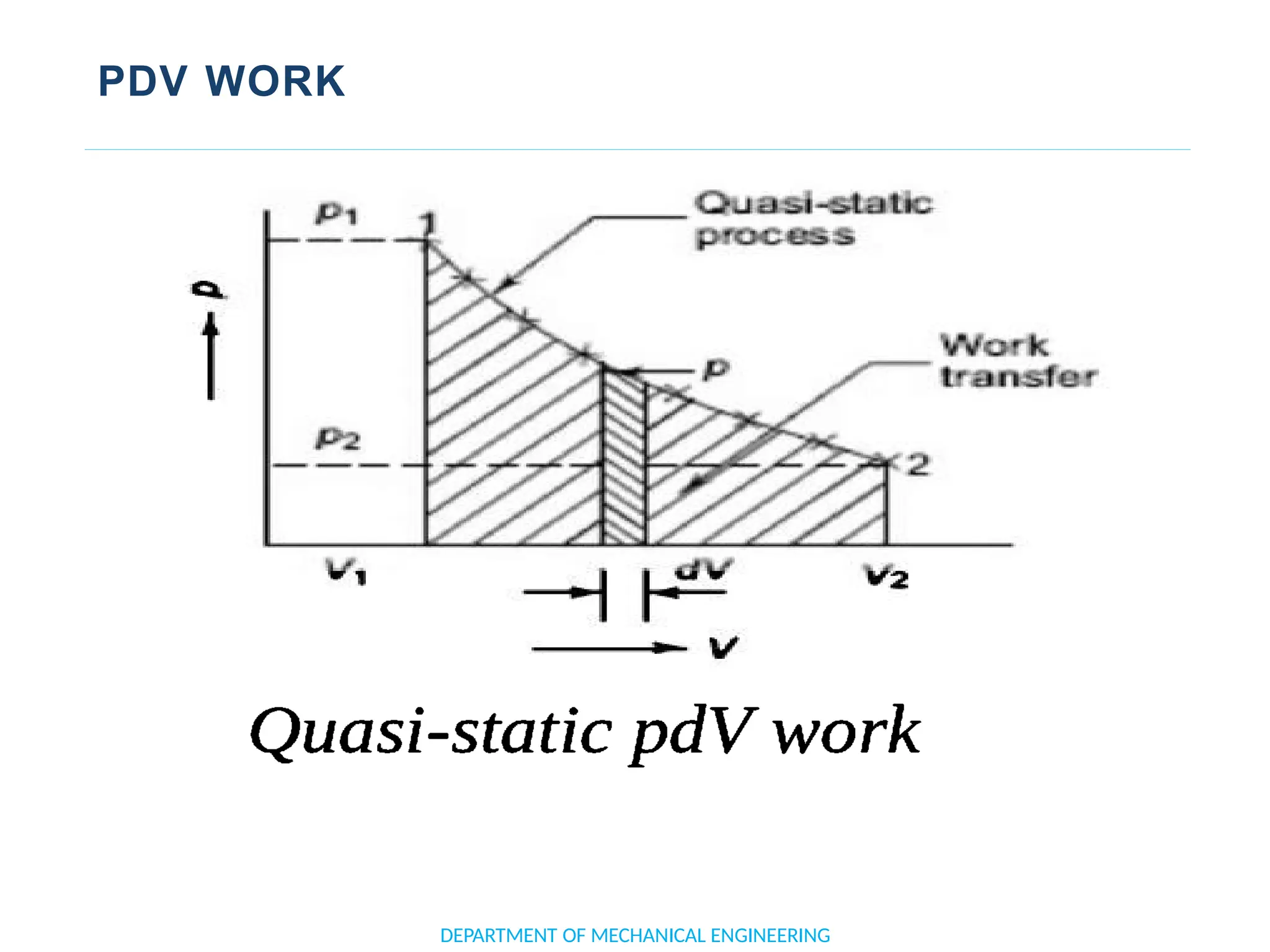
PDV WORK
DEPARTMENT OF MECHANICAL ENGINEERING
PDV WORK
DEPARTMENT OF MECHANICAL ENGINEERING
PDV WORK
DEPARTMENT OF MECHANICAL ENGINEERING
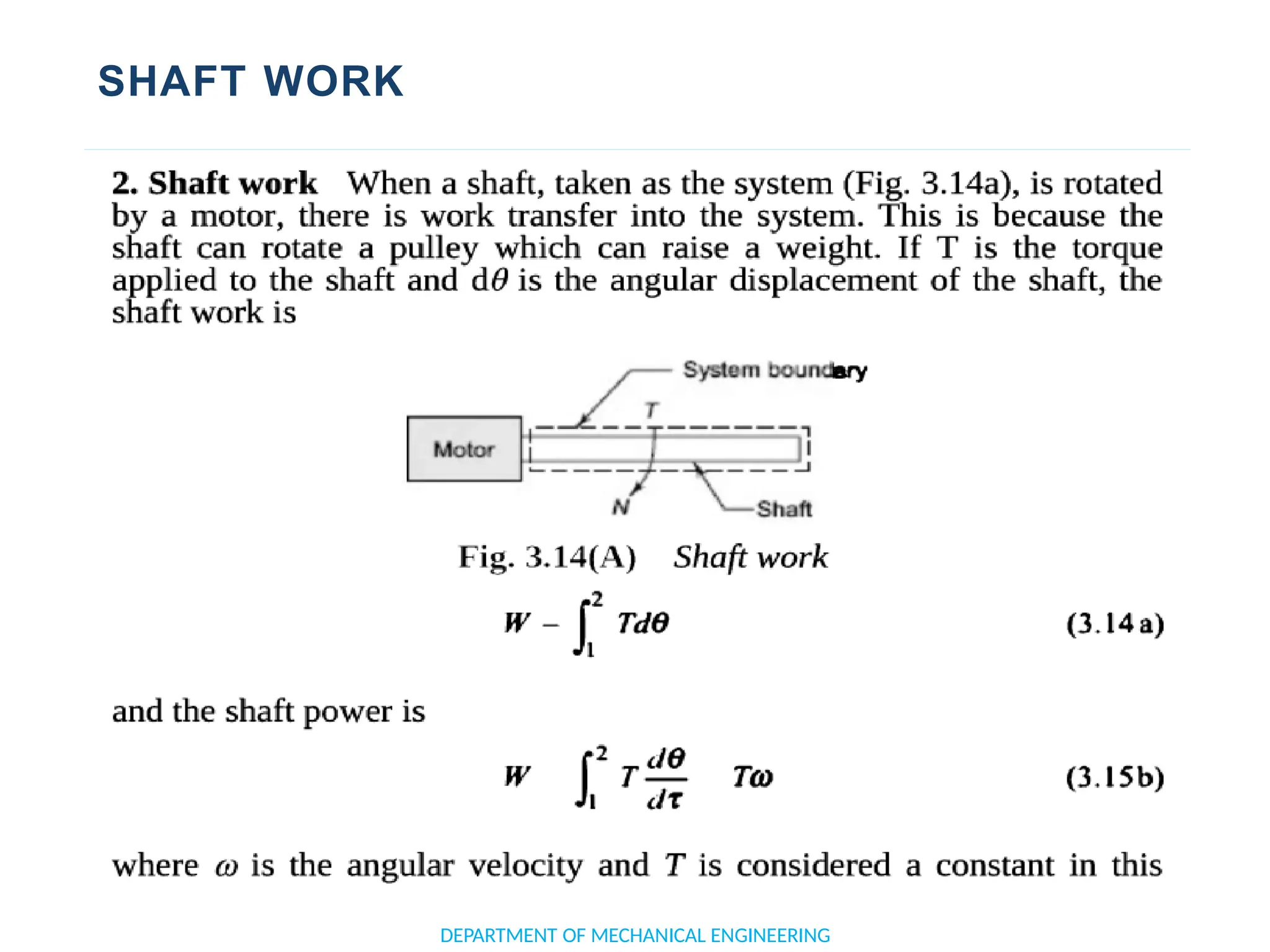
SHAFT WORK
DEPARTMENT OF MECHANICAL ENGINEERING
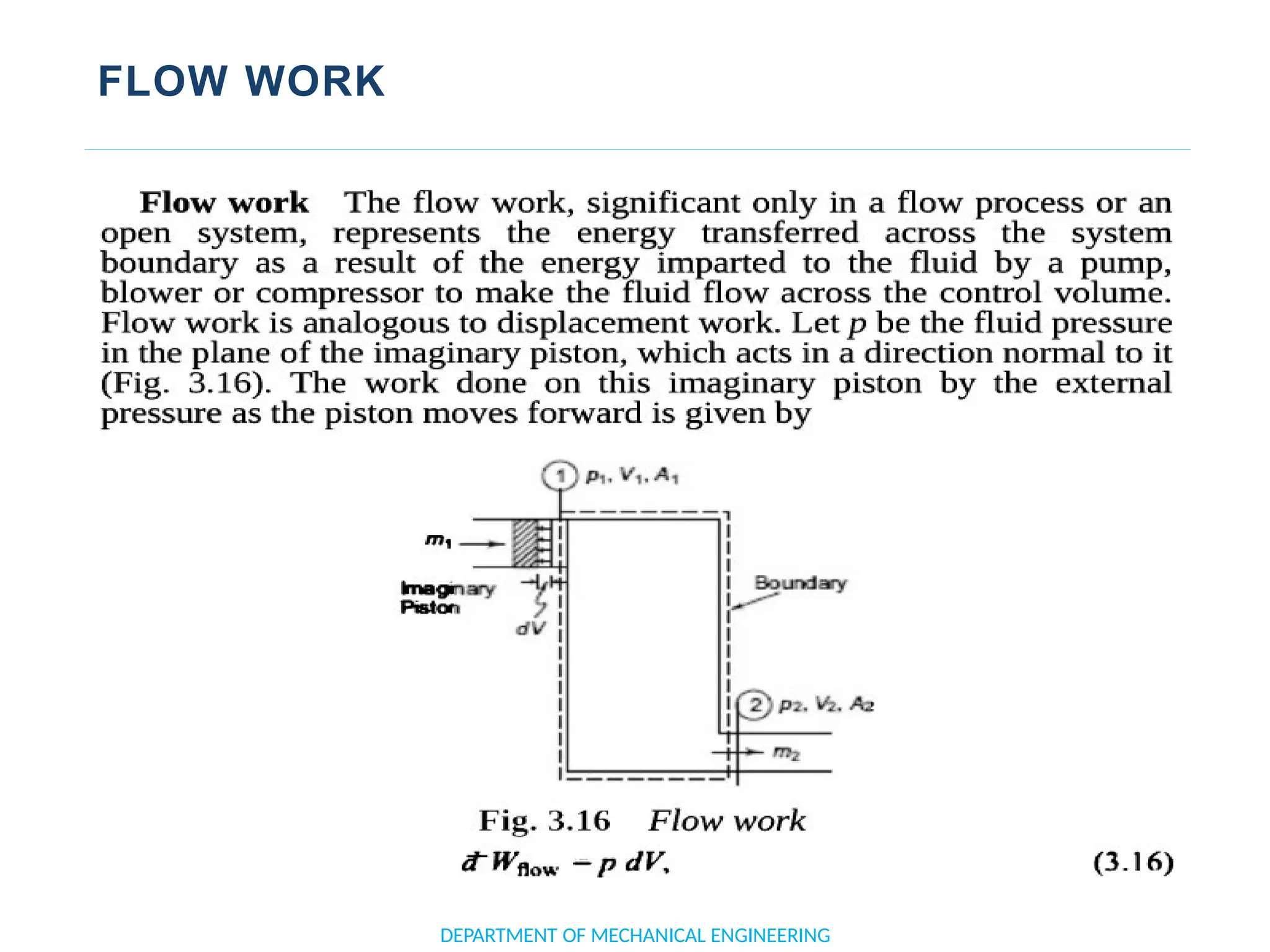
FLOW WORK
DEPARTMENT OF MECHANICAL ENGINEERING
FIRST LAW OF THERMODYNAMICS
DEPARTMENT OF MECHANICAL ENGINEERING
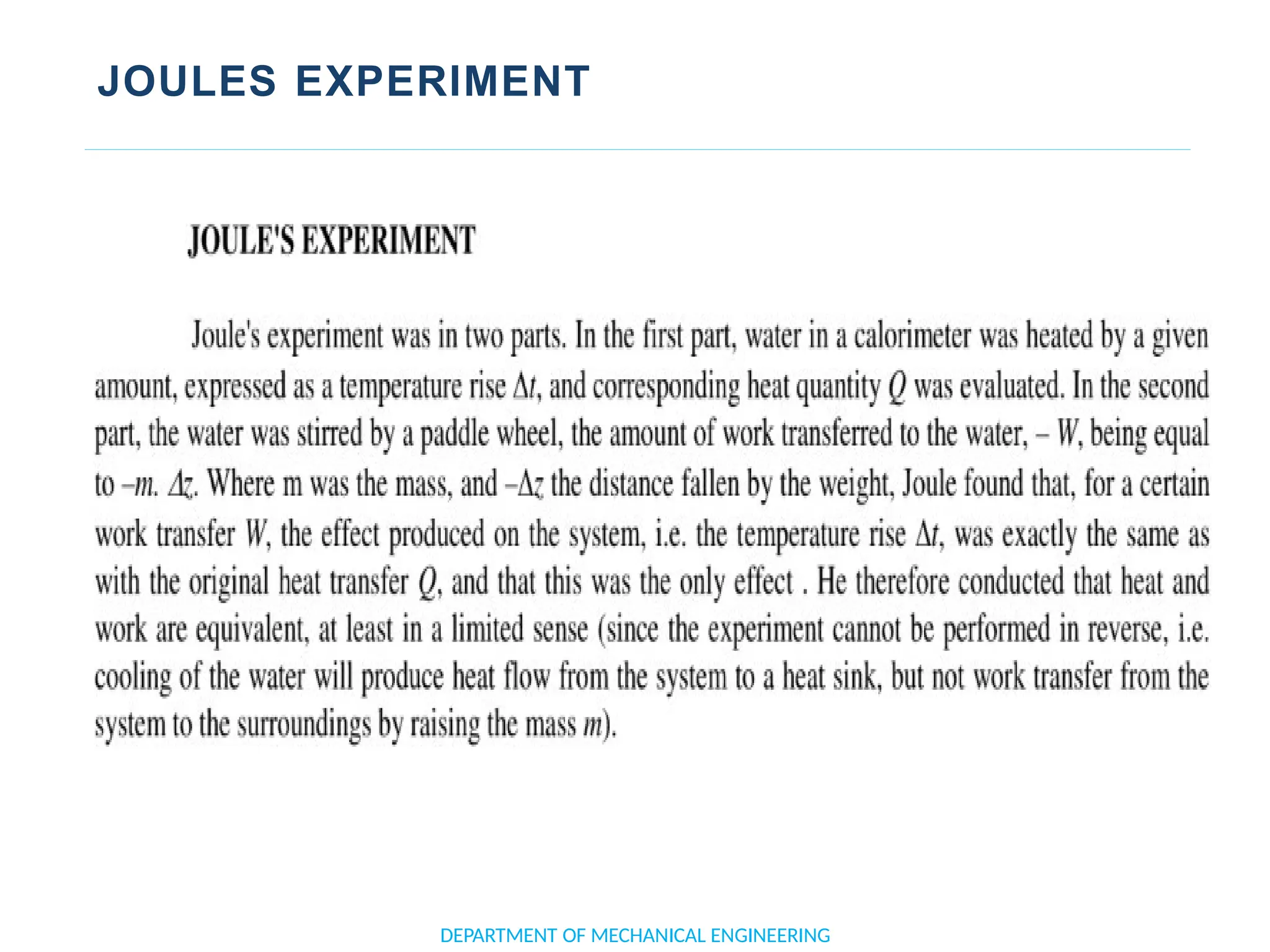
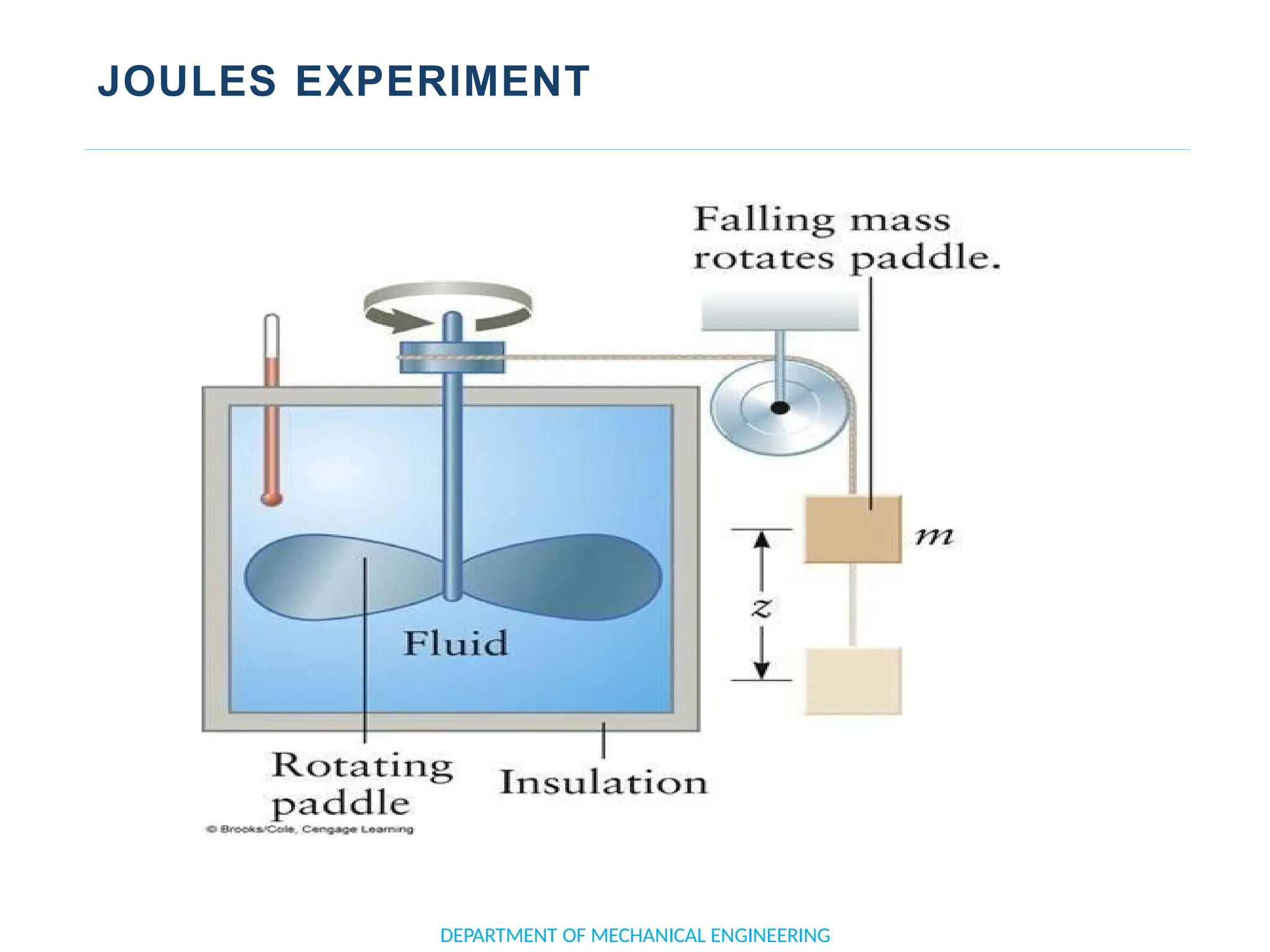
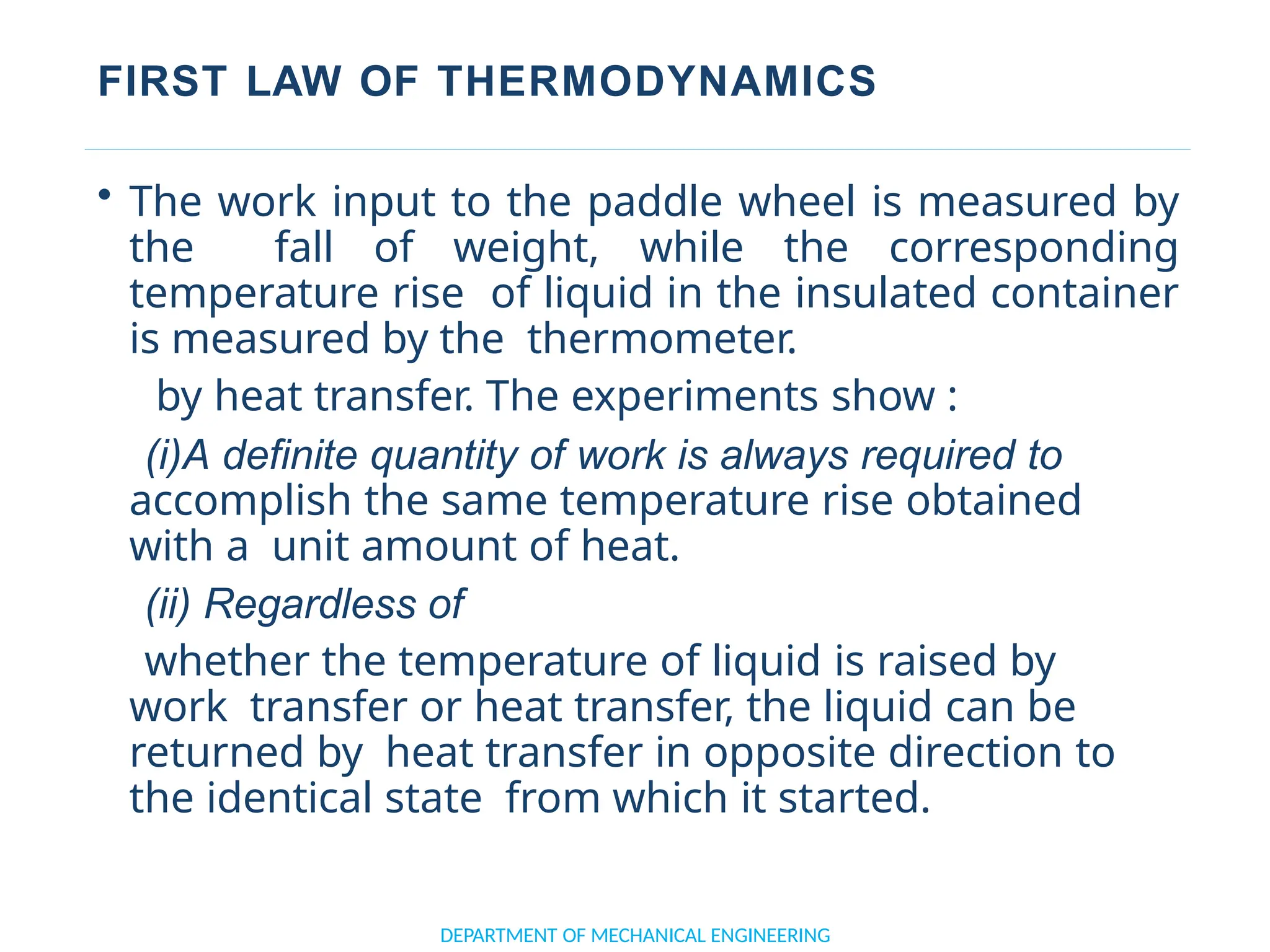
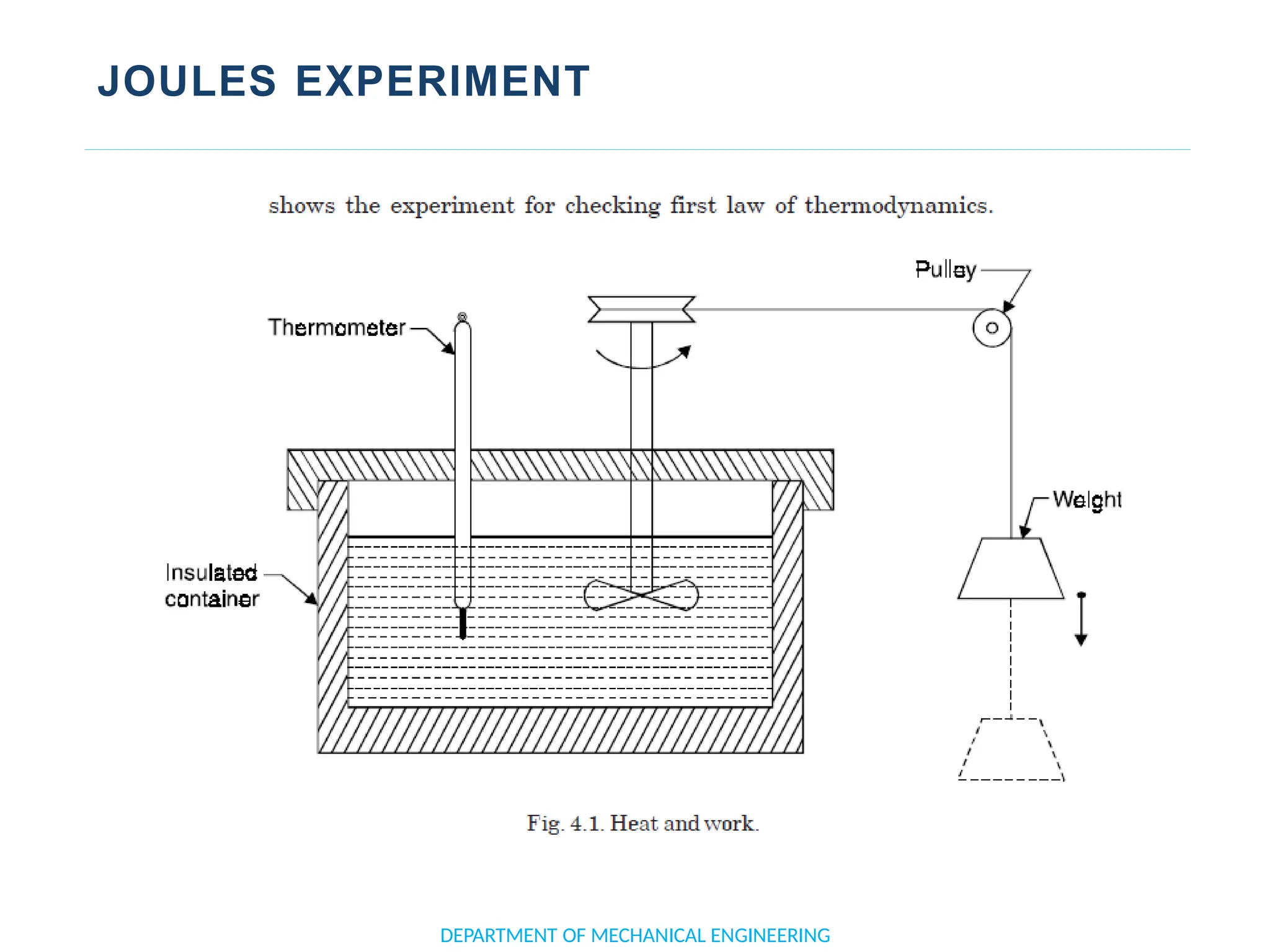
• The work input to the paddle wheel is measured by
the fall of weight, while the corresponding
temperature rise of liquid in the insulated container
is measured by the thermometer.
by heat transfer. The experiments show :
(i)A definite quantity of work is always required to
accomplish the same temperature rise obtained
with a unit amount of heat.
(ii) Regardless of
whether the temperature of liquid is raised by
work transfer or heat transfer, the liquid can be
returned by heat transfer in opposite direction to
the identical state from which it started.
JOULES EXPERIMENT
DEPARTMENT OF MECHANICAL ENGINEERING
FIRST LAW OF THERMODYNAMICS
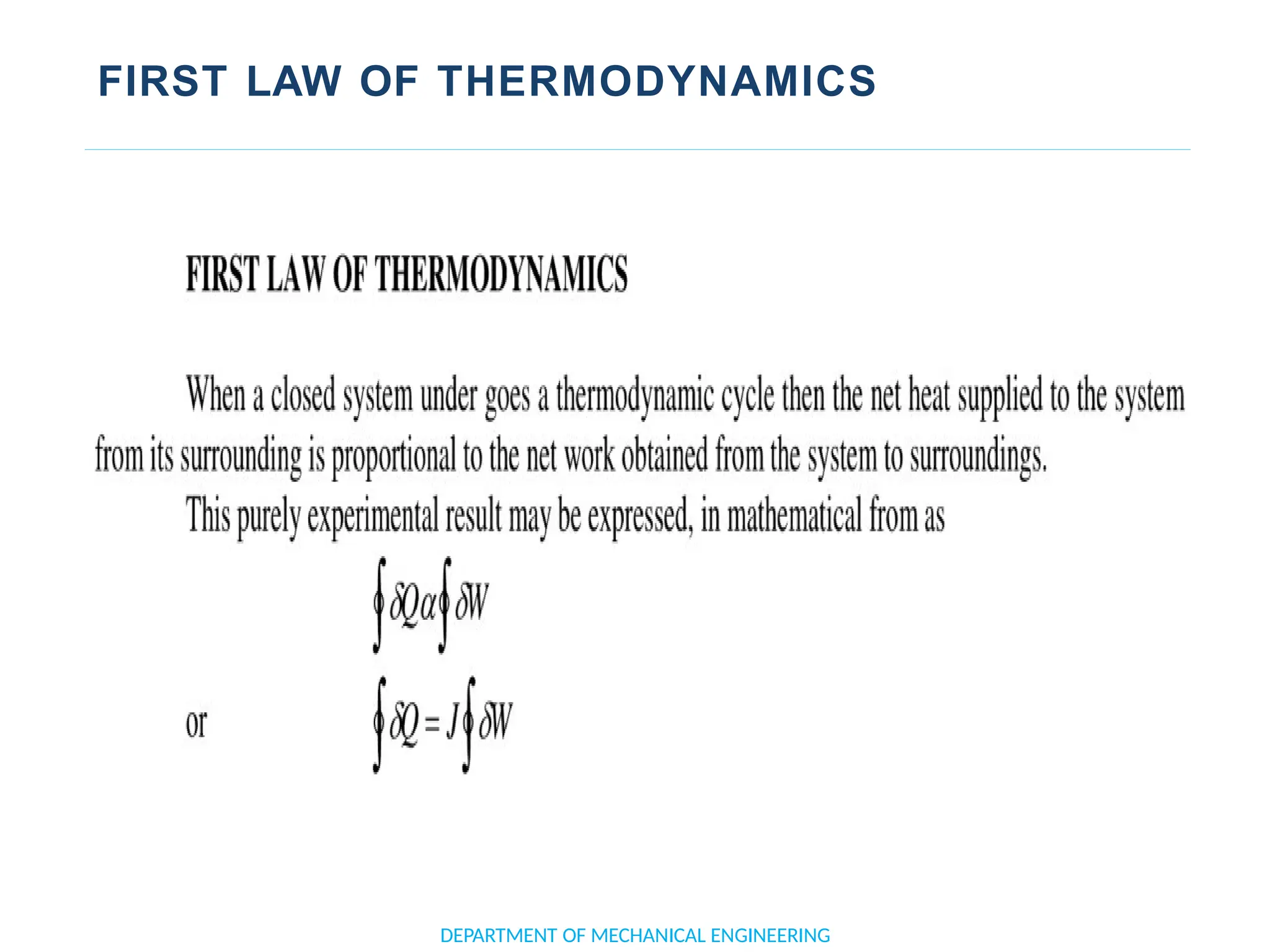
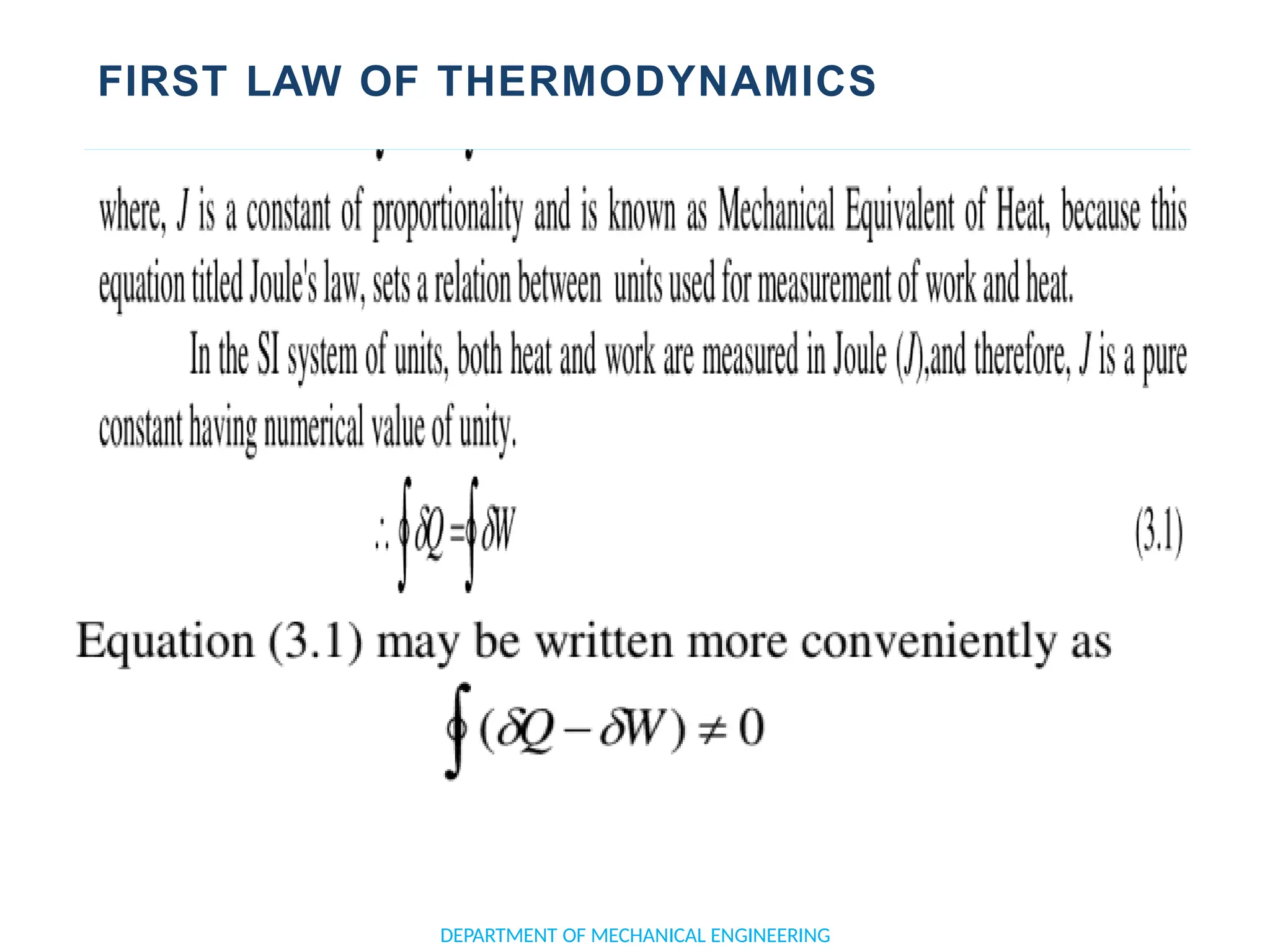
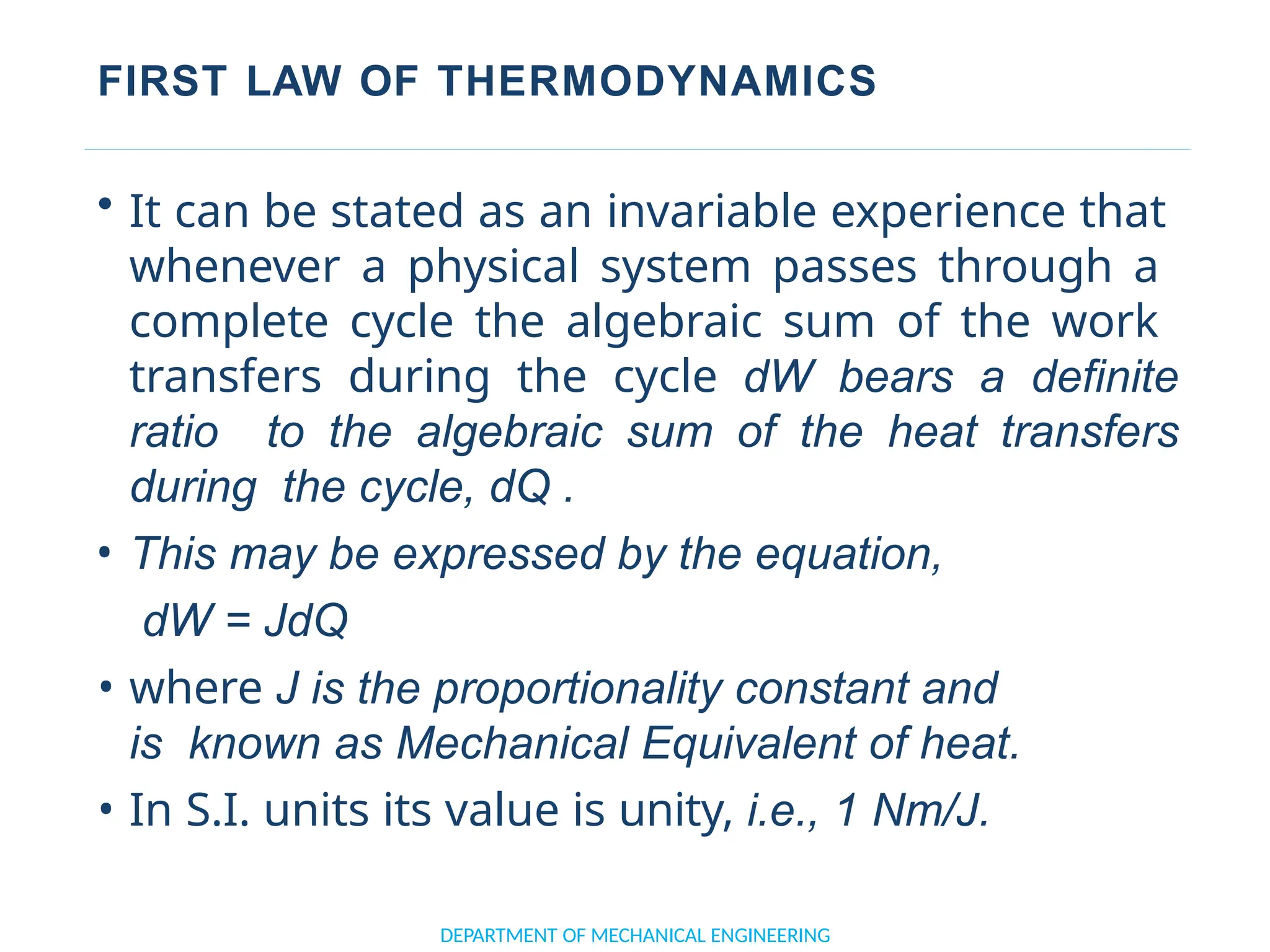
• It can be stated as an invariable experience that
whenever a physical system passes through a
complete cycle the algebraic sum of the work
transfers during the cycle dW bears a definite
ratio to the algebraic sum of the heat transfers
during the cycle, dQ .
• This may be expressed by the equation,
dW = JdQ
• where J is the proportionality constant and
is known as Mechanical Equivalent of heat.
• In S.I. units its value is unity, i.e., 1 Nm/J.
DEPARTMENT OF MECHANICAL ENGINEERING
APPLICATION OF FIRST LAW TO A PROCESS
• When a process is executed by a system,
the change in stored energy of the system is
numerically equal to the net heat interactions
minus the net work interaction during the
process.
• ∴ E2 – E1 = Q – W
• ∴ ΔE = Q – W [or Q = Δ E + W]
• Or d(Q −W) 12 = Δ E = E2 – E1
• Where E represents the total internal
energy.
DEPARTMENT OF MECHANICAL ENGINEERING
APPLICATION OF FIRST LAW TO A PROCESS
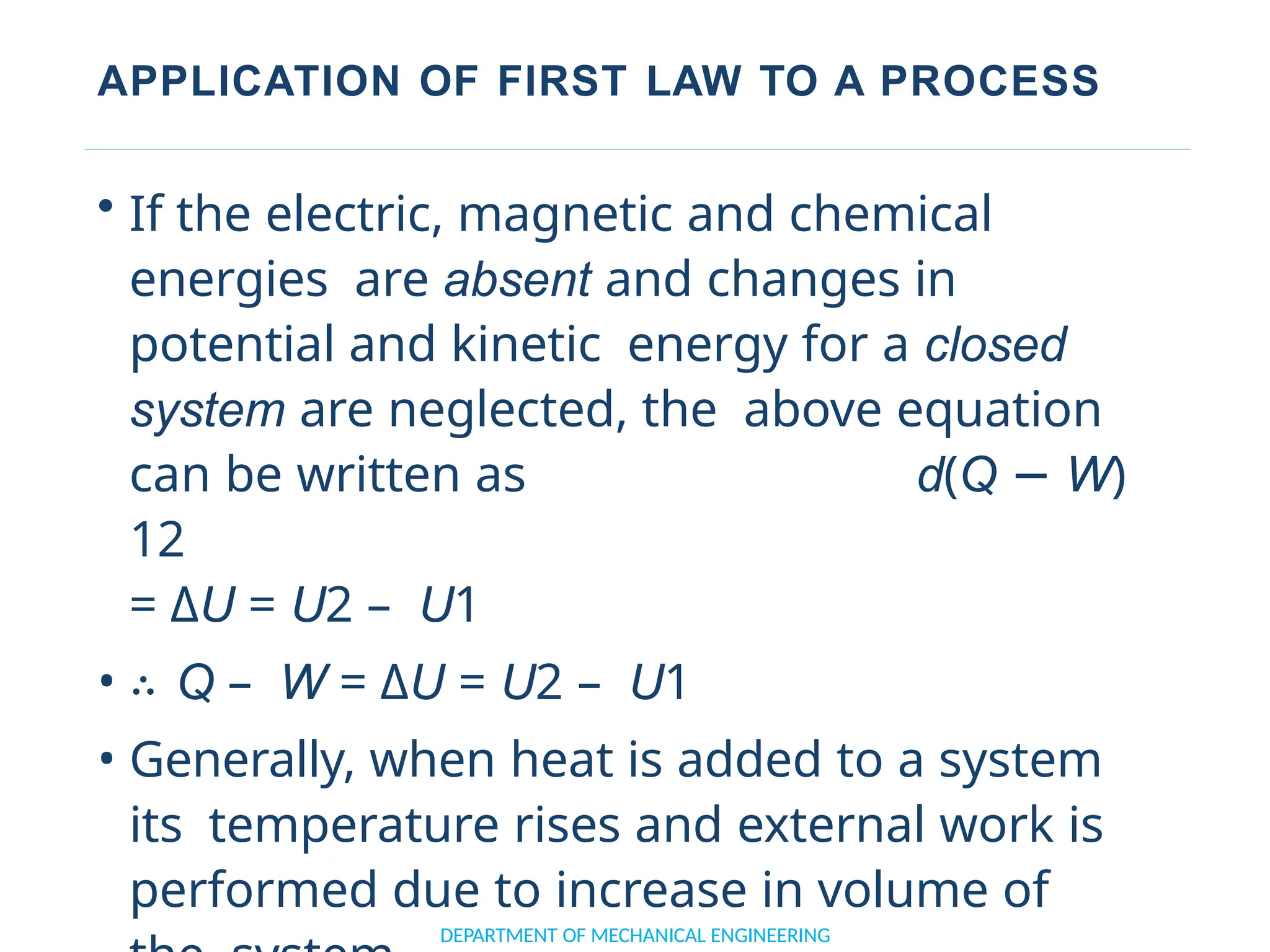
• If the electric, magnetic and chemical
energies are absent and changes in
potential and kinetic energy for a closed
system are neglected, the above equation
can be written as d(Q − W)
12
= ΔU = U2 – U1
• ∴ Q – W = ΔU = U2 – U1
• Generally, when heat is added to a system
its temperature rises and external work is
performed due to increase in volume of
DEPARTMENT OF MECHANICAL ENGINEERING
APPLICATION OF FIRST LAW TO A PROCESS
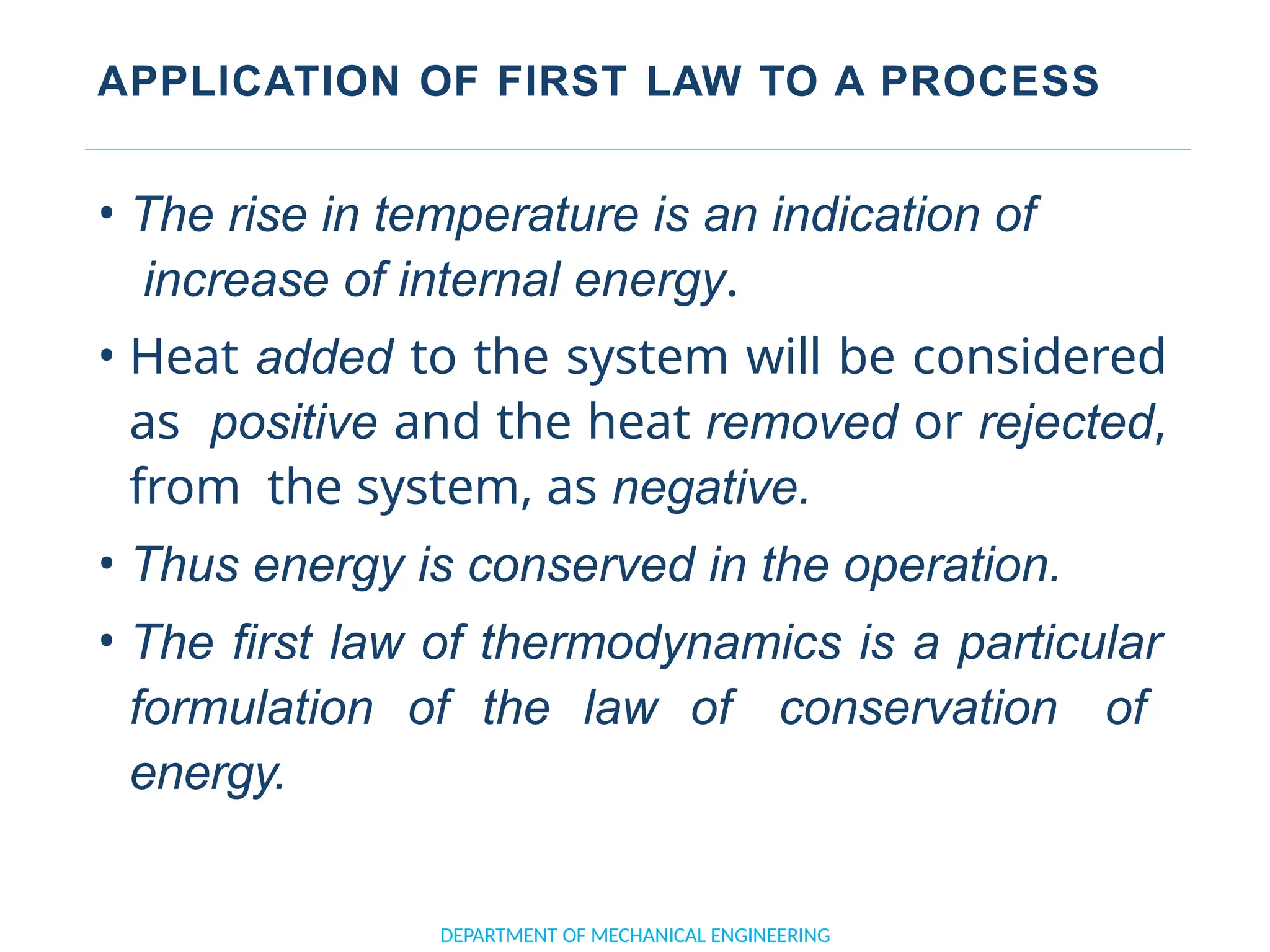
• The rise in temperature is an indication of
increase of internal energy.
• Heat added to the system will be considered
as positive and the heat removed or rejected,
from the system, as negative.
• Thus energy is conserved in the operation.
• The first law of thermodynamics is a particular
formulation of the law of conservation of
energy.
DEPARTMENT OF MECHANICAL ENGINEERING
PMM 1
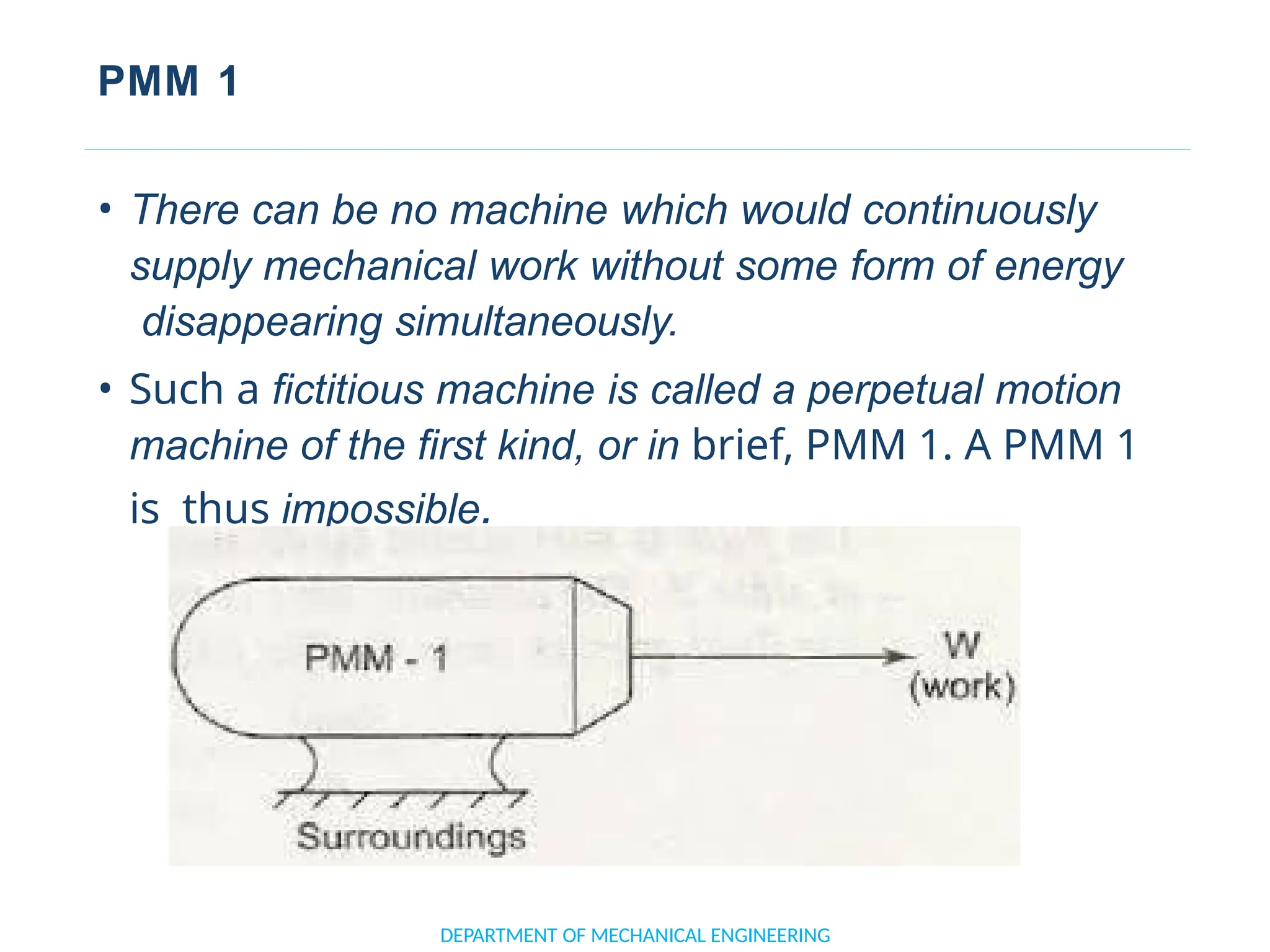
• There can be no machine which would continuously
supply mechanical work without some form of energy
disappearing simultaneously.
• Such a fictitious machine is called a perpetual motion
machine of the first kind, or in brief, PMM 1. A PMM 1
is thus impossible.
DEPARTMENT OF MECHANICAL ENGINEERING
INTERNAL ENERGY—A PROPERTY OF SYSTEM
DEPARTMENT OF MECHANICAL ENGINEERING
INTERNAL ENERGY—A PROPERTY OF SYSTEM
DEPARTMENT OF MECHANICAL ENGINEERING
INTERNAL ENERGY—A PROPERTY OF SYSTEM
DEPARTMENT OF MECHANICAL ENGINEERING
INTERNAL ENERGY—A PROPERTY OF SYSTEM
DEPARTMENT OF MECHANICAL ENGINEERING
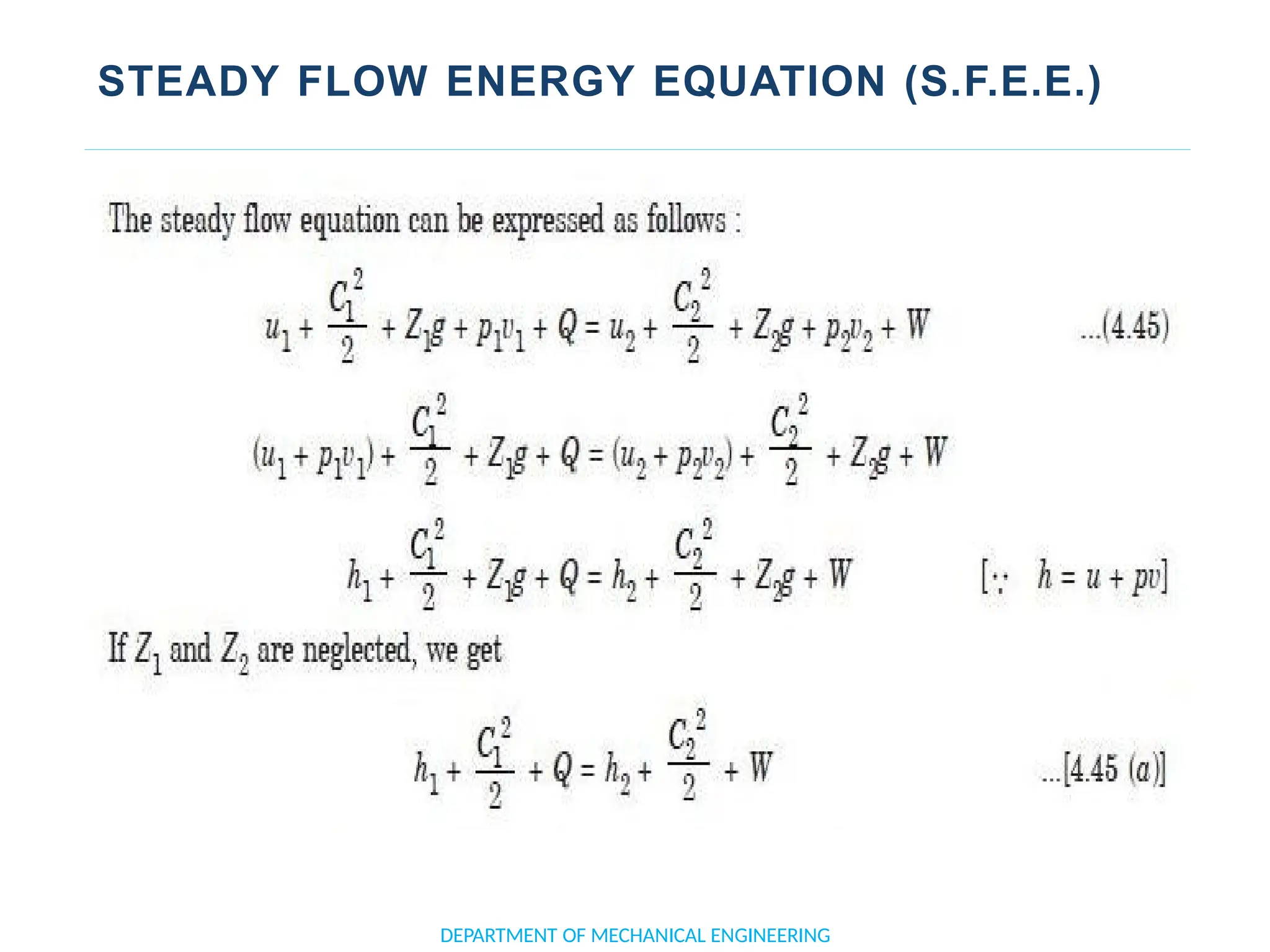
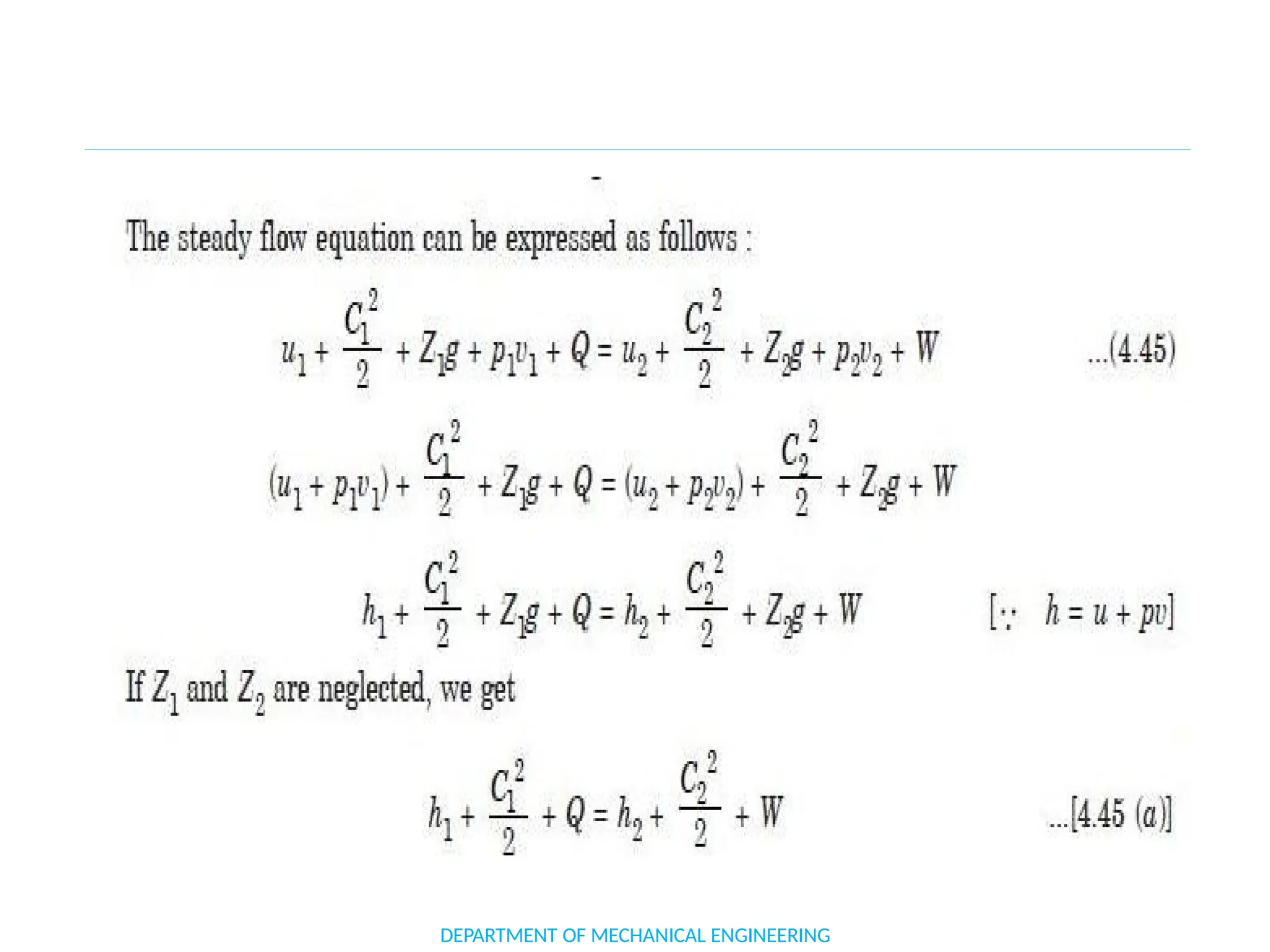
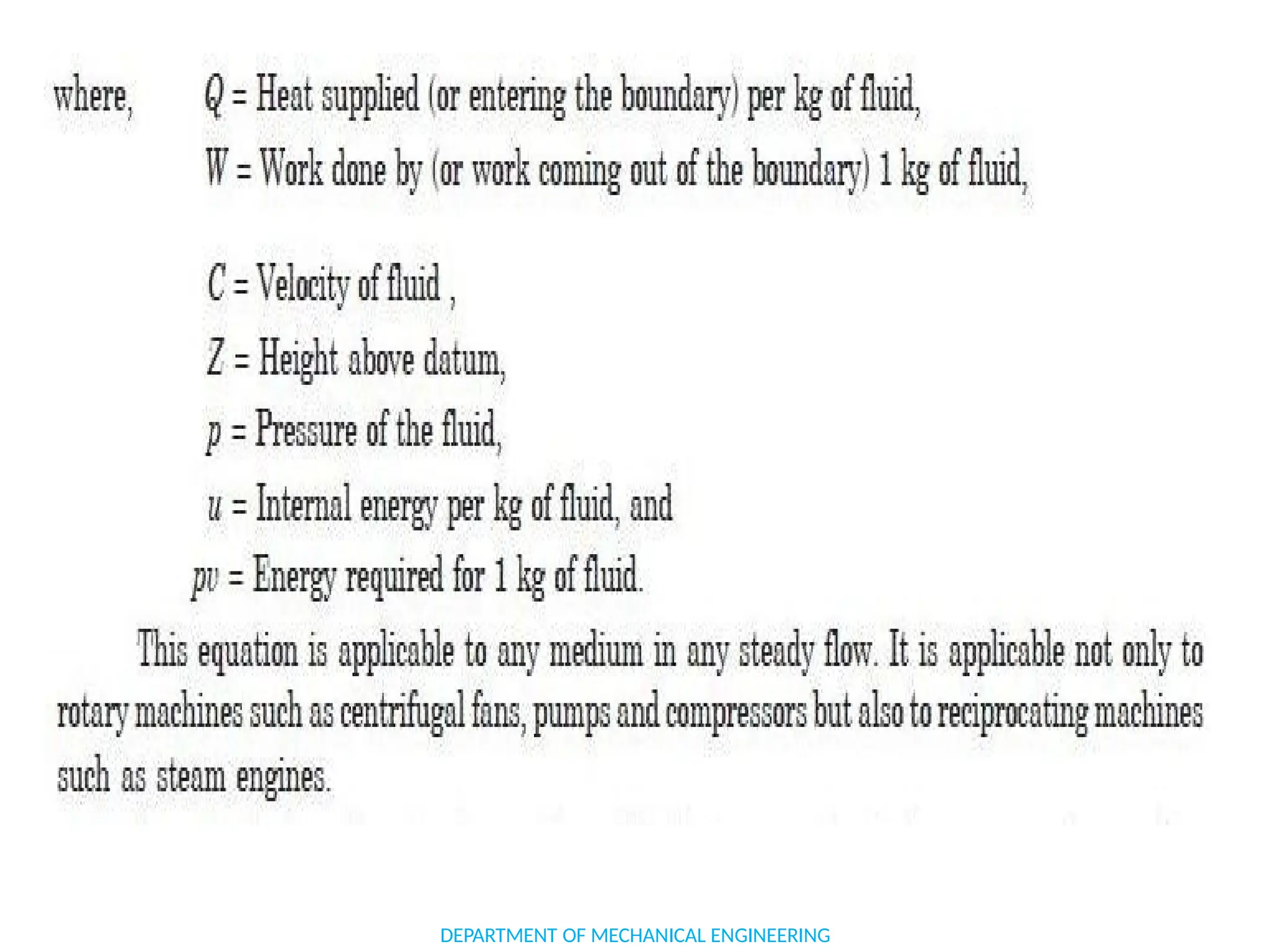
STEADY FLOW ENERGY EQUATION (S.F.E.E.)
APPLICATION OF FIRST LAW TO STEADY FLOW
PROCESS:
In many practical problems, the rate at which the
fluid flows through a machine or piece of apparatus
is constant. This type of flow is called steady flow.
Assumptions :
The following assumptions are made in the
system analysis :
DEPARTMENT OF MECHANICAL ENGINEERING
STEADY FLOW ENERGY EQUATION (S.F.E.E.)
DEPARTMENT OF MECHANICAL ENGINEERING
(i) The massflow through the
system remains constant.
(ii) Fluid is uniform in composition.
(iii)The only interaction between the system
and surroundings are work and heat.
(iv)The state of fluid at any point
remains constant with time.
(v)In the analysis only potential, kinetic and
flow energies are considered
DEPARTMENT OF MECHANICAL ENGINEERING
STEADY FLOW ENERGY EQUATION (S.F.E.E.)
DEPARTMENT OF MECHANICAL ENGINEERING
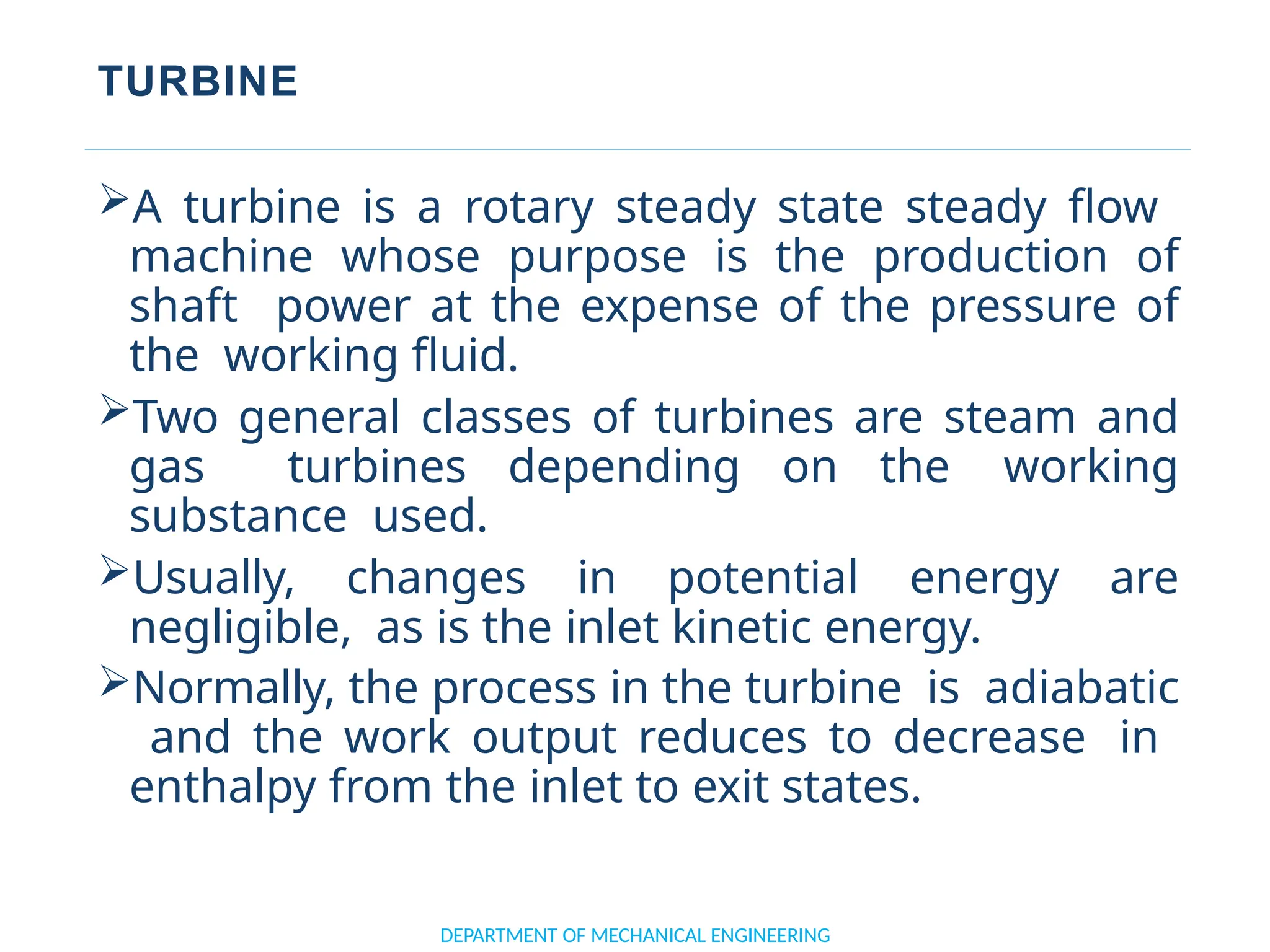
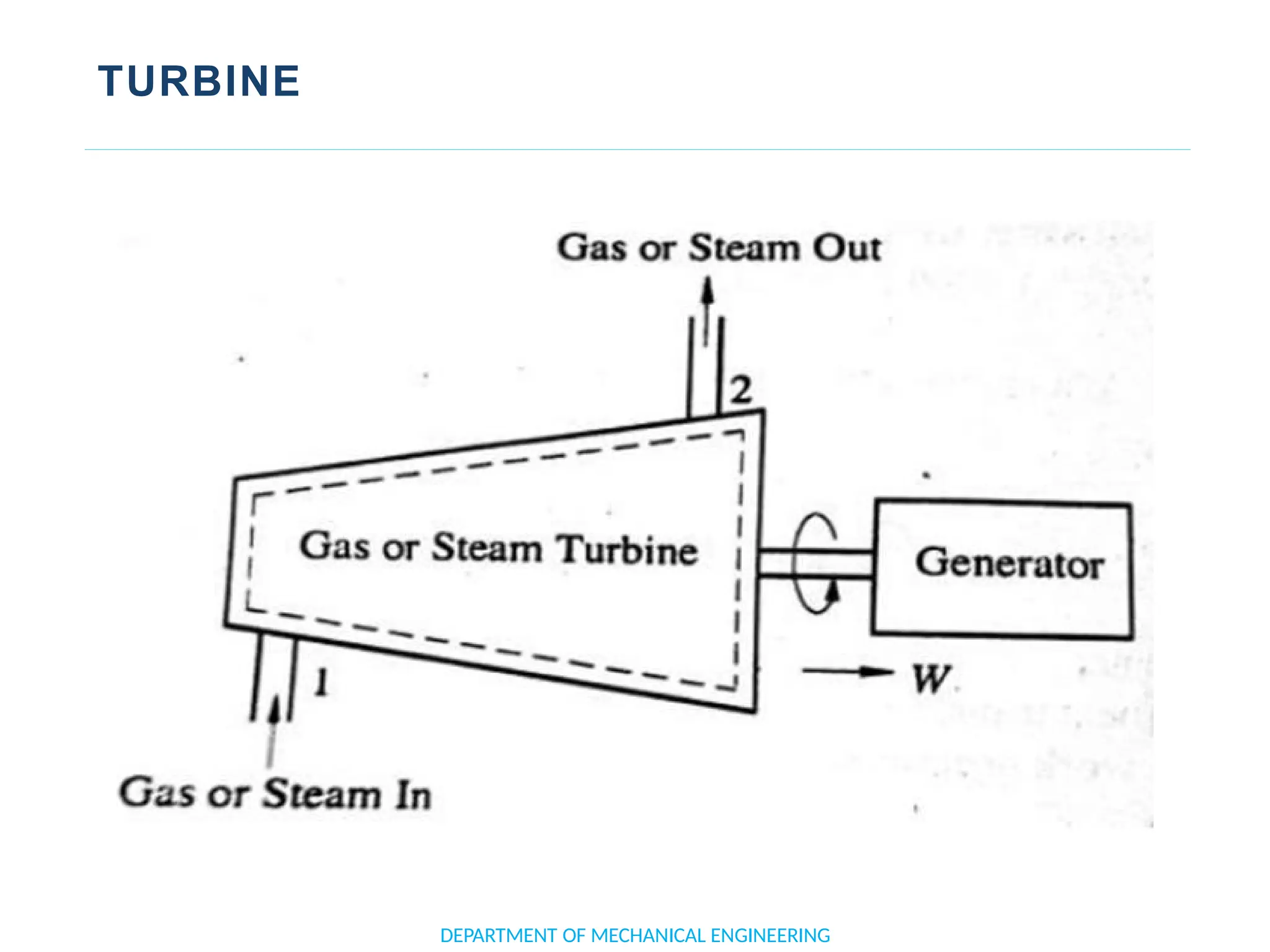
TURBINE
A turbine is a rotary steady state steady flow
machine whose purpose is the production of
shaft power at the expense of the pressure of
the working fluid.
Two general classes of turbines are steam and
gas turbines depending on the working
substance used.
Usually, changes in potential energy are
negligible, as is the inlet kinetic energy.
Normally, the process in the turbine is adiabatic
and the work output reduces to decrease in
enthalpy from the inlet to exit states.
DEPARTMENT OF MECHANICAL ENGINEERING
TURBINE
DEPARTMENT OF MECHANICAL ENGINEERING
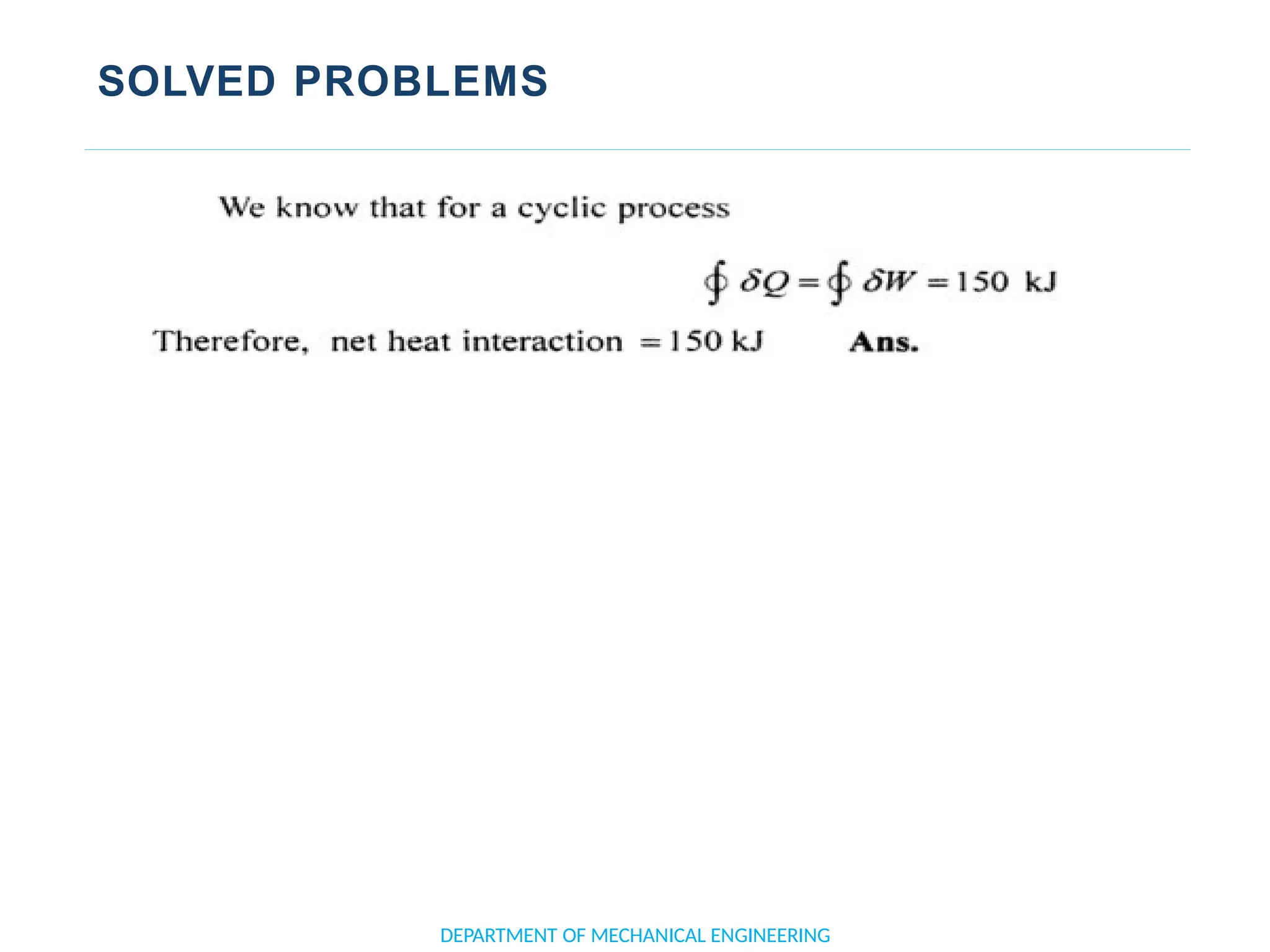
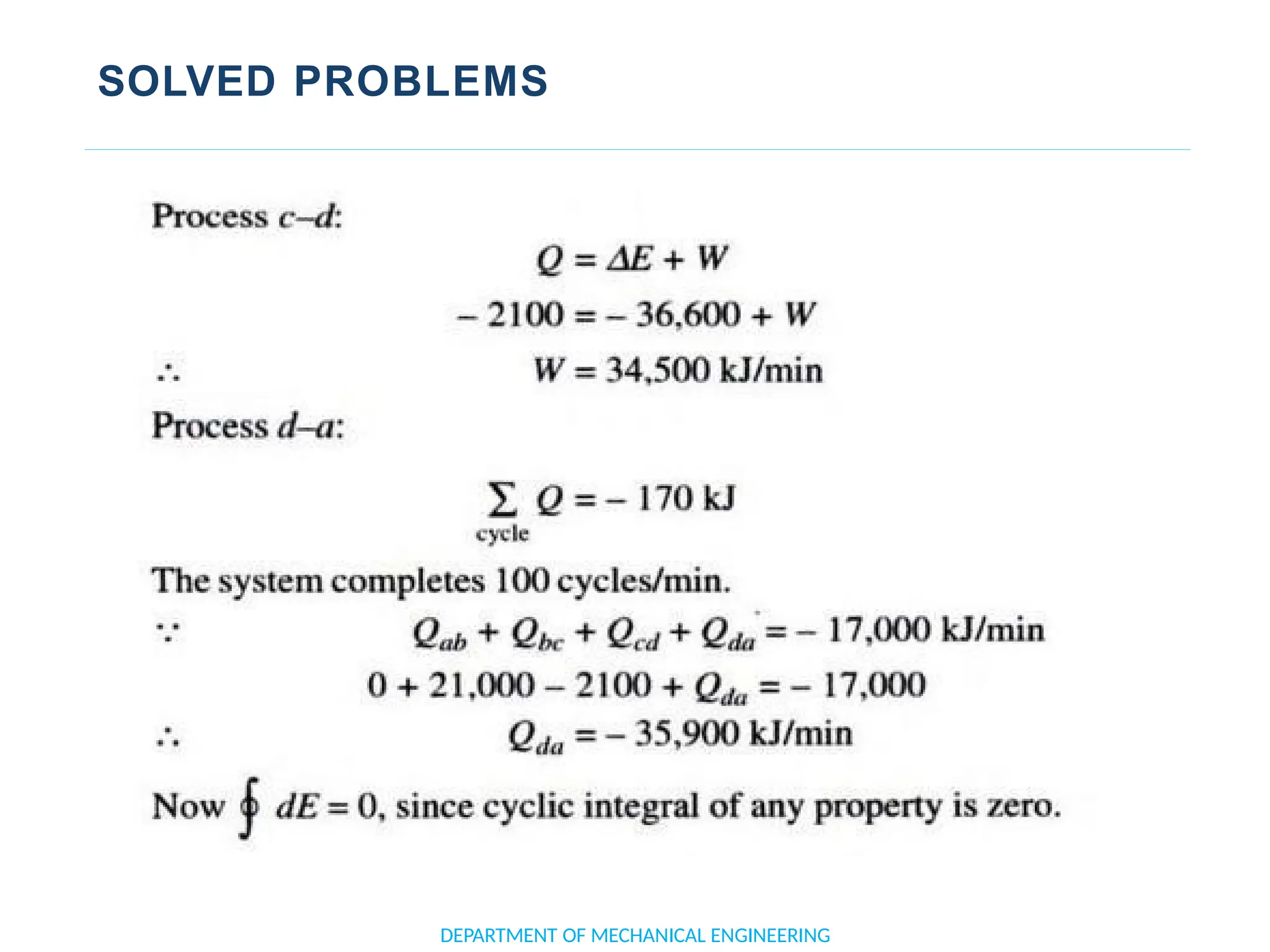
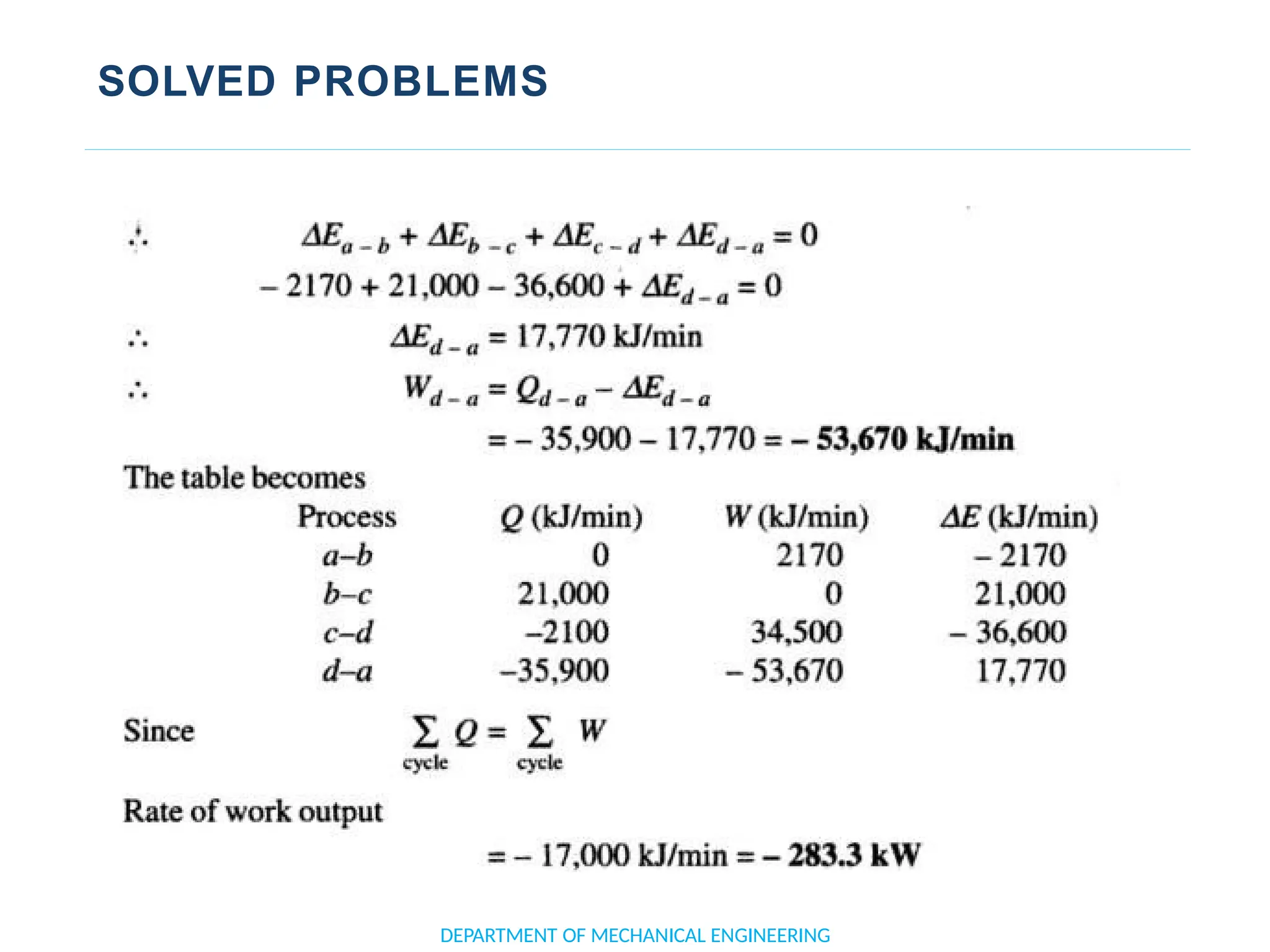
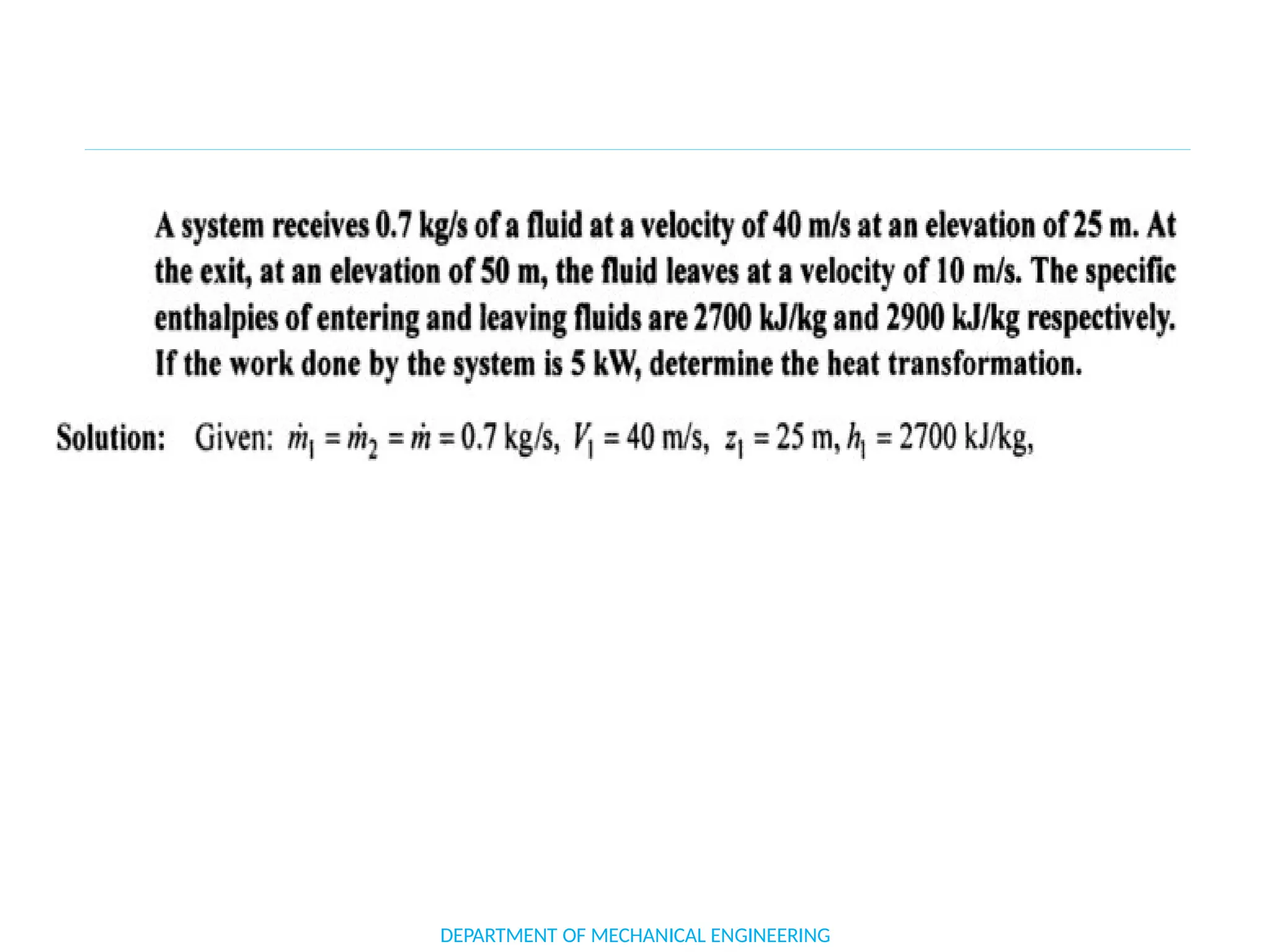
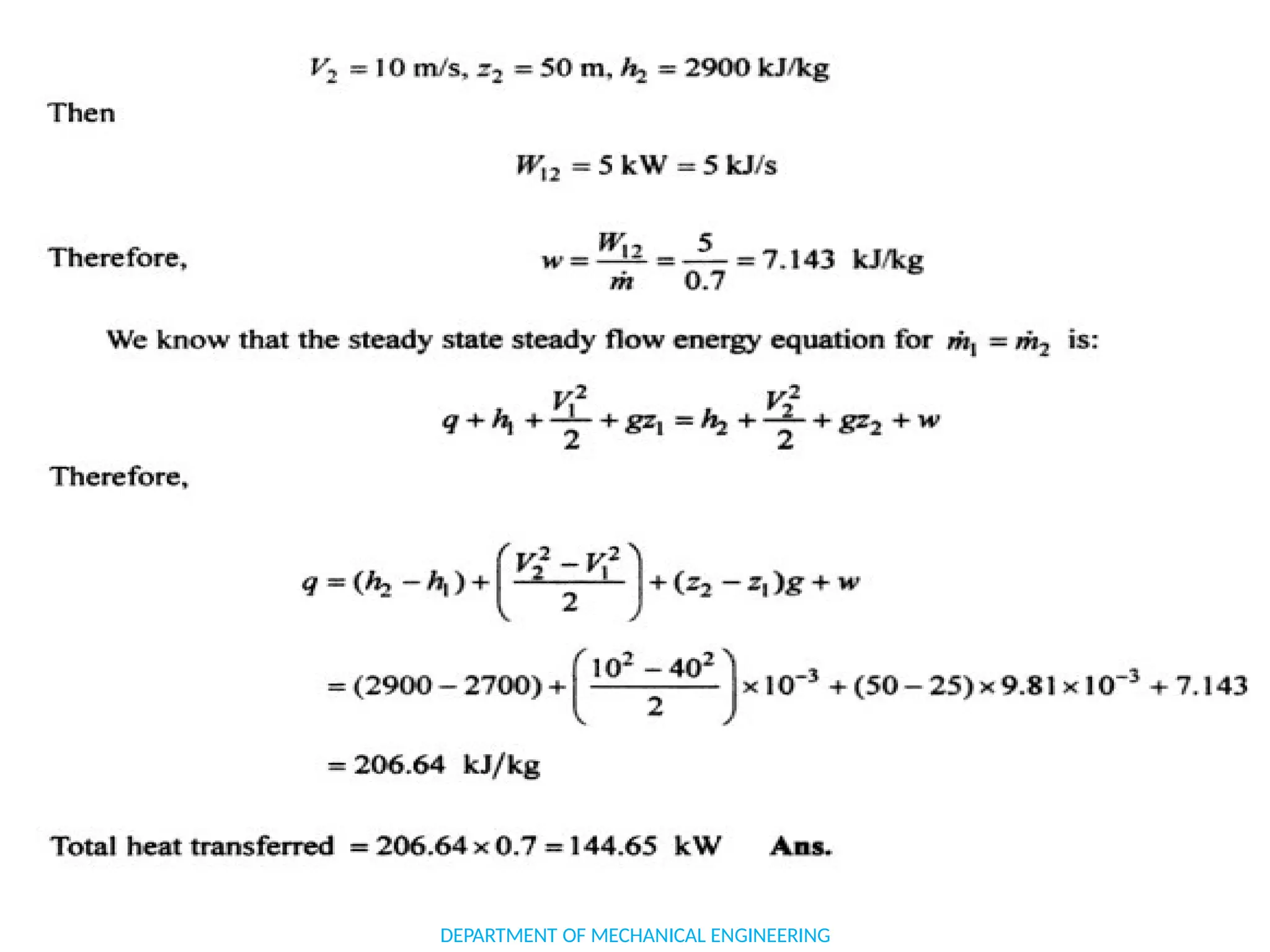
SOLVED PROBLEMS
DEPARTMENT OF MECHANICAL ENGINEERING
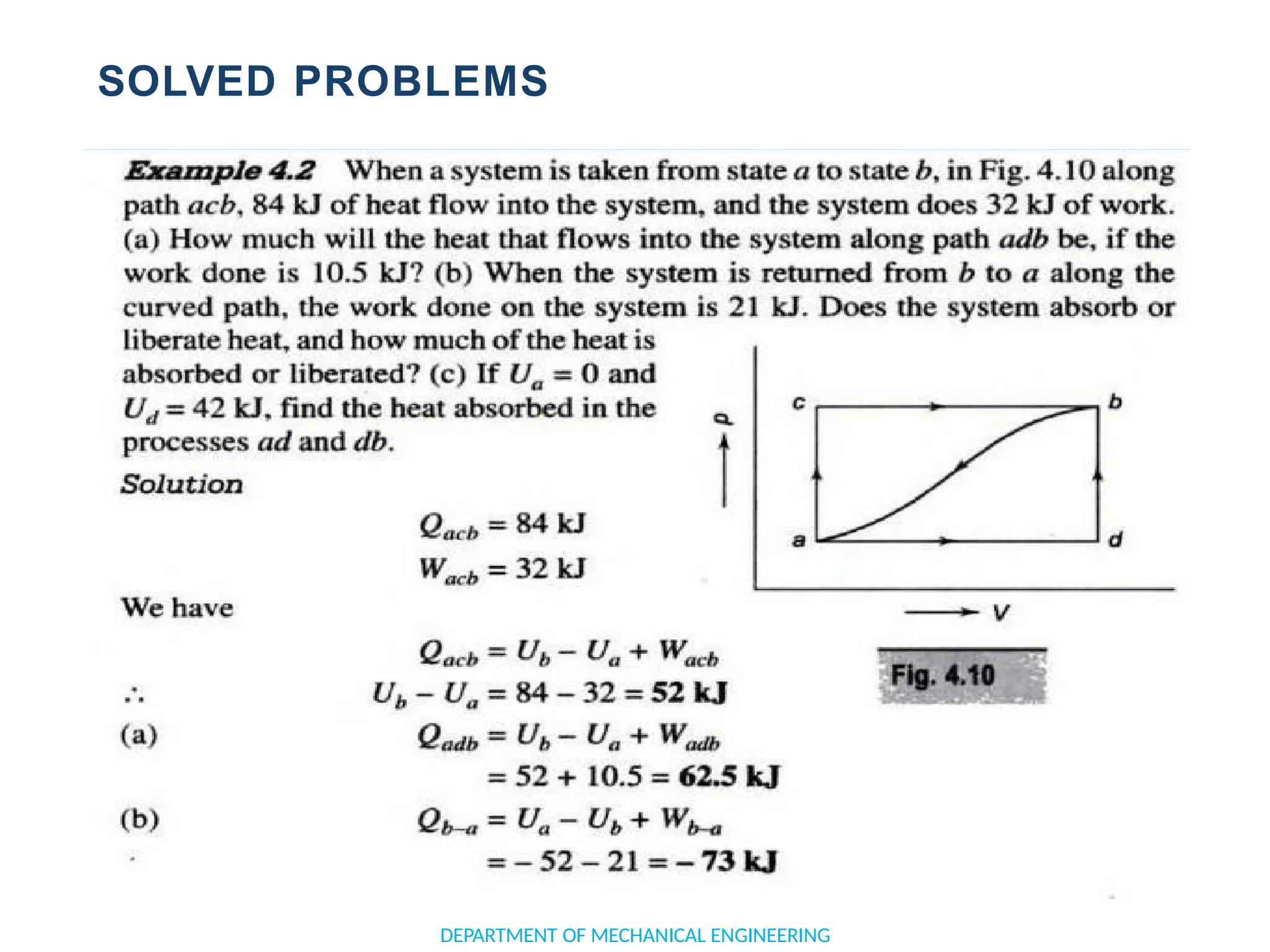
SOLVED PROBLEMS
DEPARTMENT OF MECHANICAL ENGINEERING
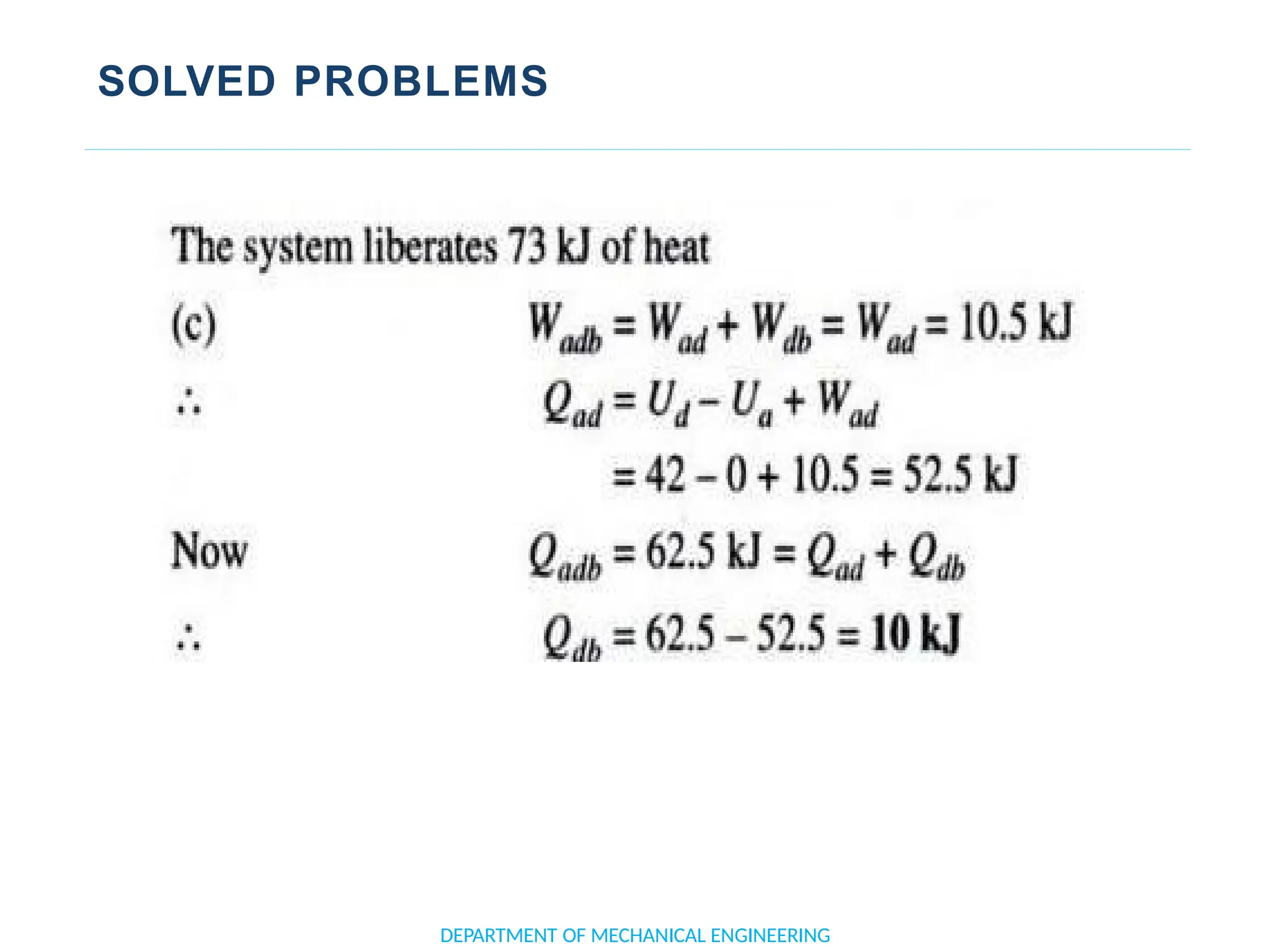
SOLVED PROBLEMS
DEPARTMENT OF MECHANICAL ENGINEERING
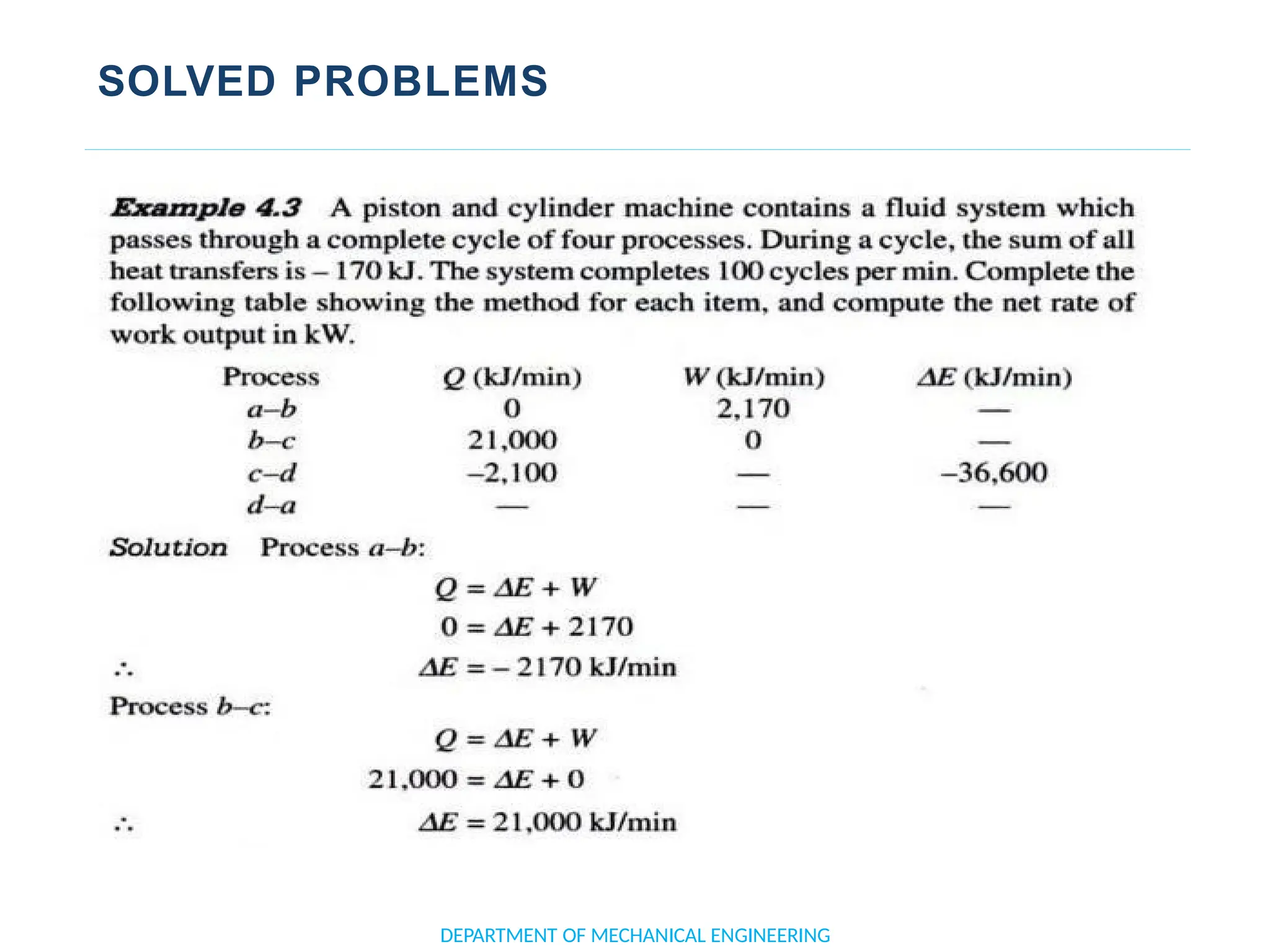
SOLVED PROBLEMS
DEPARTMENT OF MECHANICAL ENGINEERING
SOLVED PROBLEMS
DEPARTMENT OF MECHANICAL ENGINEERING
SOLVED PROBLEMS
DEPARTMENT OF MECHANICAL ENGINEERING
SOLVED PROBLEMS
DEPARTMENT OF MECHANICAL ENGINEERING
SOLVED PROBLEMS
DEPARTMENT OF MECHANICAL ENGINEERING
SOLVED PROBLEMS
DEPARTMENT OF MECHANICAL ENGINEERING
INDUSTRIAL APPLICATIONS
• Automobile industries.
• Refrigeration industries
• Air craft applications
• Defense industries
• Thermal power plants
• Chemical industries
• Textile industries etc.
DEPARTMENT OF MECHANICAL ENGINEERING
SELF LEARNING QUESTIONS
DEPARTMENT OF MECHANICAL ENGINEERING
• What is meant by thermodynamic equilibrium?
Explain
with the help of examples.
• What is meant by SFEE and derive it and reduce
it for the turbine.
• Write about constant volume gas Thermometer?
Why it is preferred over a constant pressure gas
Thermometer.
• Distinguish between macroscopic and
microscopic point of view?
ASSIGNMENT EXERCISES
DEPARTMENT OF MECHANICAL ENGINEERING
1. Discuss Quasi Static process, what are its
characteristics?
2. Discuss First law of thermodynamics, explain
Joule’s experiment.
3. A blower handles 1kg/s of air at 200C and consuming a
power of 15 kw. The inlet and outlet velocities of air
are 100 m/s and 150 m/s respectively. Find the exit air
temperature, assuming adiabatic conditions. Take Cp of
air as 1.005 kJ/kgk.
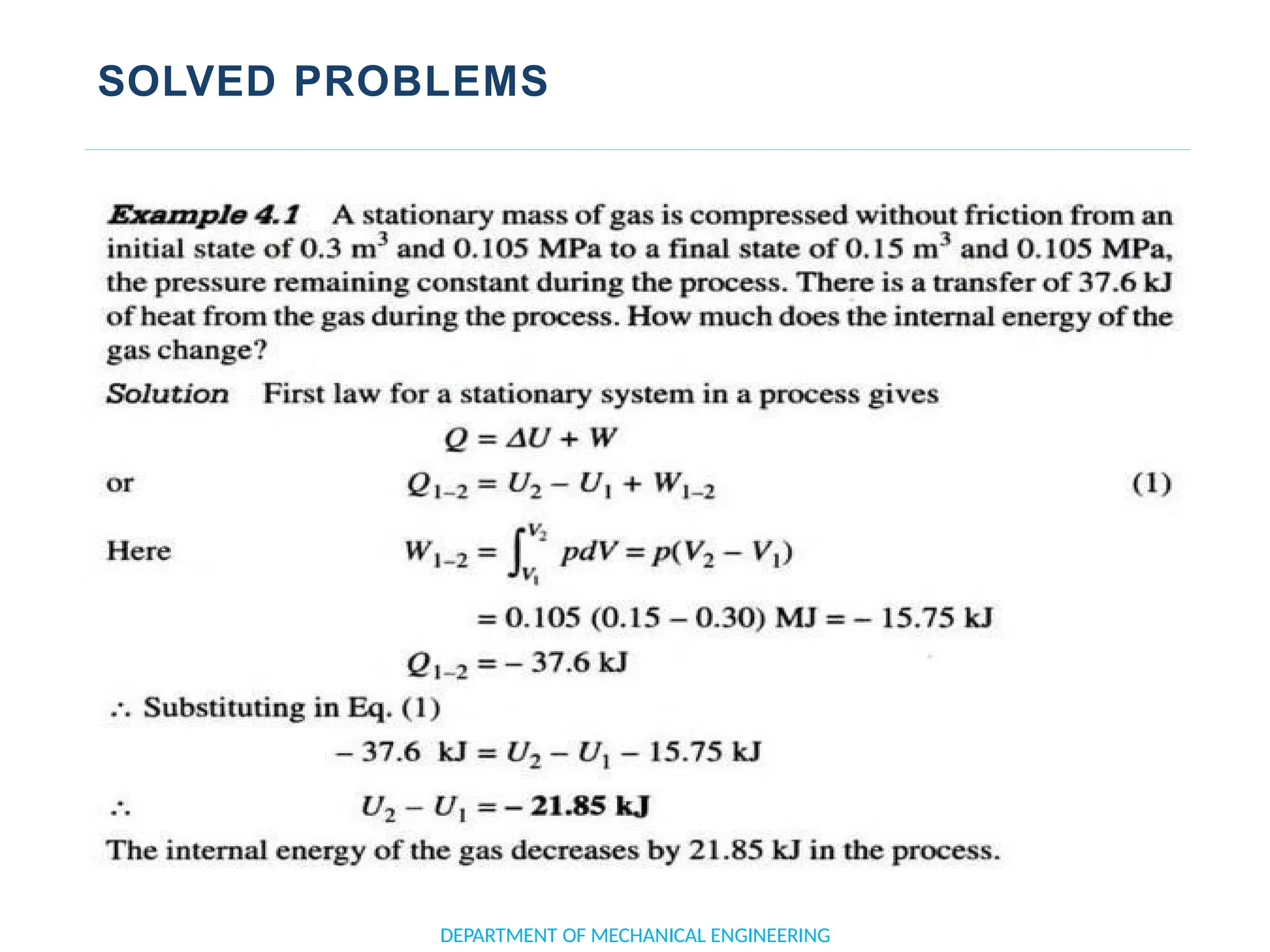
4. When a stationary mass of gas was compressed
without friction at constant pressure, its initial state of
0.4m3 and 0.105MPa was found to change to final
state of 0.20m3 and 0.105MPa. There was a transfer of
42.5kJ of heat from the gas during the process.
Determine the change in internal energy of the gas?
THANK YOU
E N GIN E E R IN G
THERMODYNAMICS
DEPARTMENT OF MECHANICAL ENGINEERING
COURSE OBJECTIVES
UNIT -
1
CO1:To understand the concepts of
energy transformation, conversion of
heat into work.
UNIT -
2
CO2:To acquire knowledge about the
fundamentals of thermodynamic laws, the
concept of entropy, and principles
UNIT -
3
CO3: To understand how the change of state
results in a process.
UNIT -
4
CO4: To understand the various gas
laws, psychrometric properties and
chart.
UNIT -
5
CO5: To learn the importance of
thermodynamic cycles, and the derivation of
efficiency.
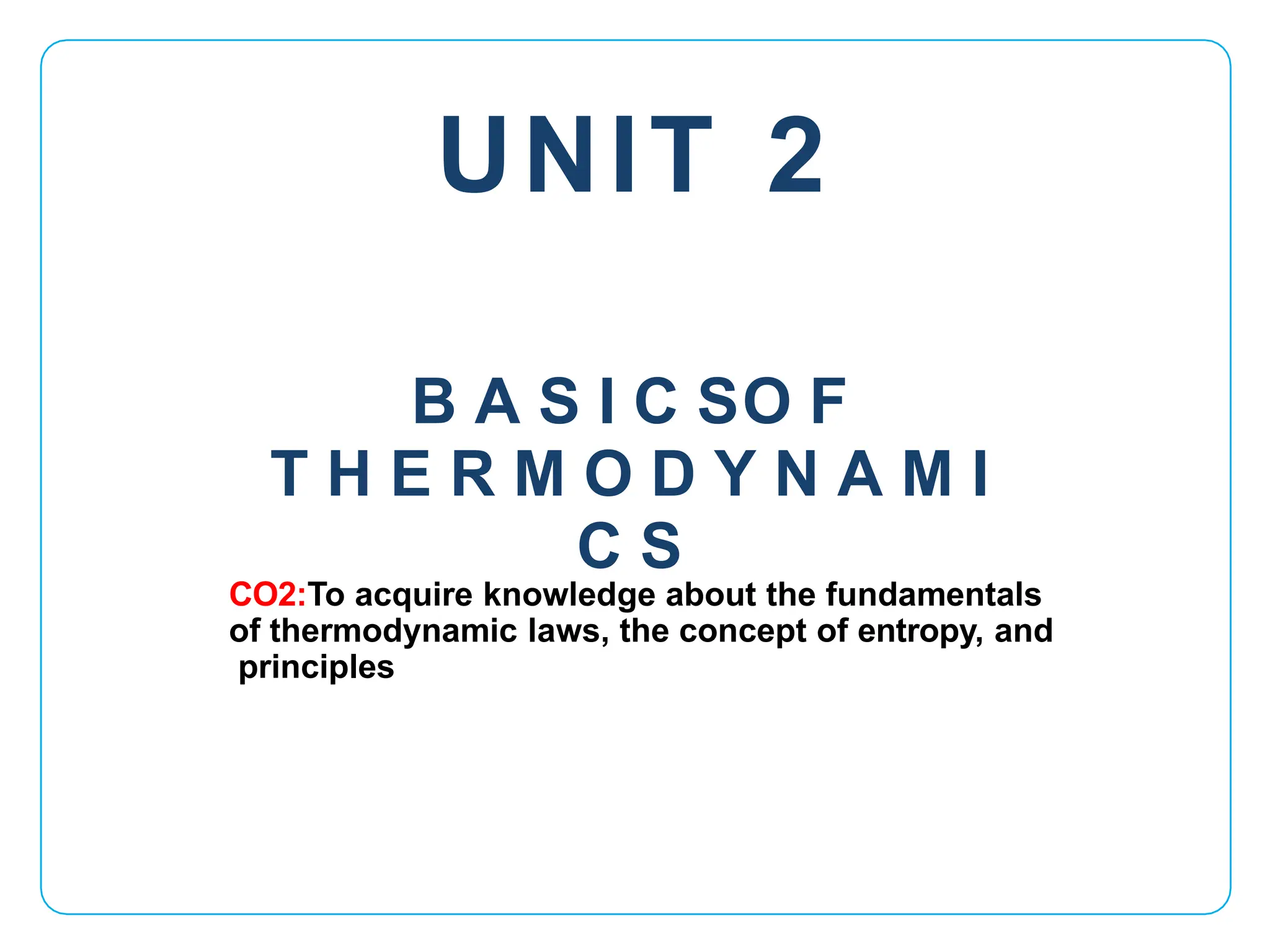
UNIT 2
CO2:To acquire knowledge about the fundamentals
of thermodynamic laws, the concept of entropy, and
principles
B A S I C SO F
T H E R M O D Y N A M I
C S
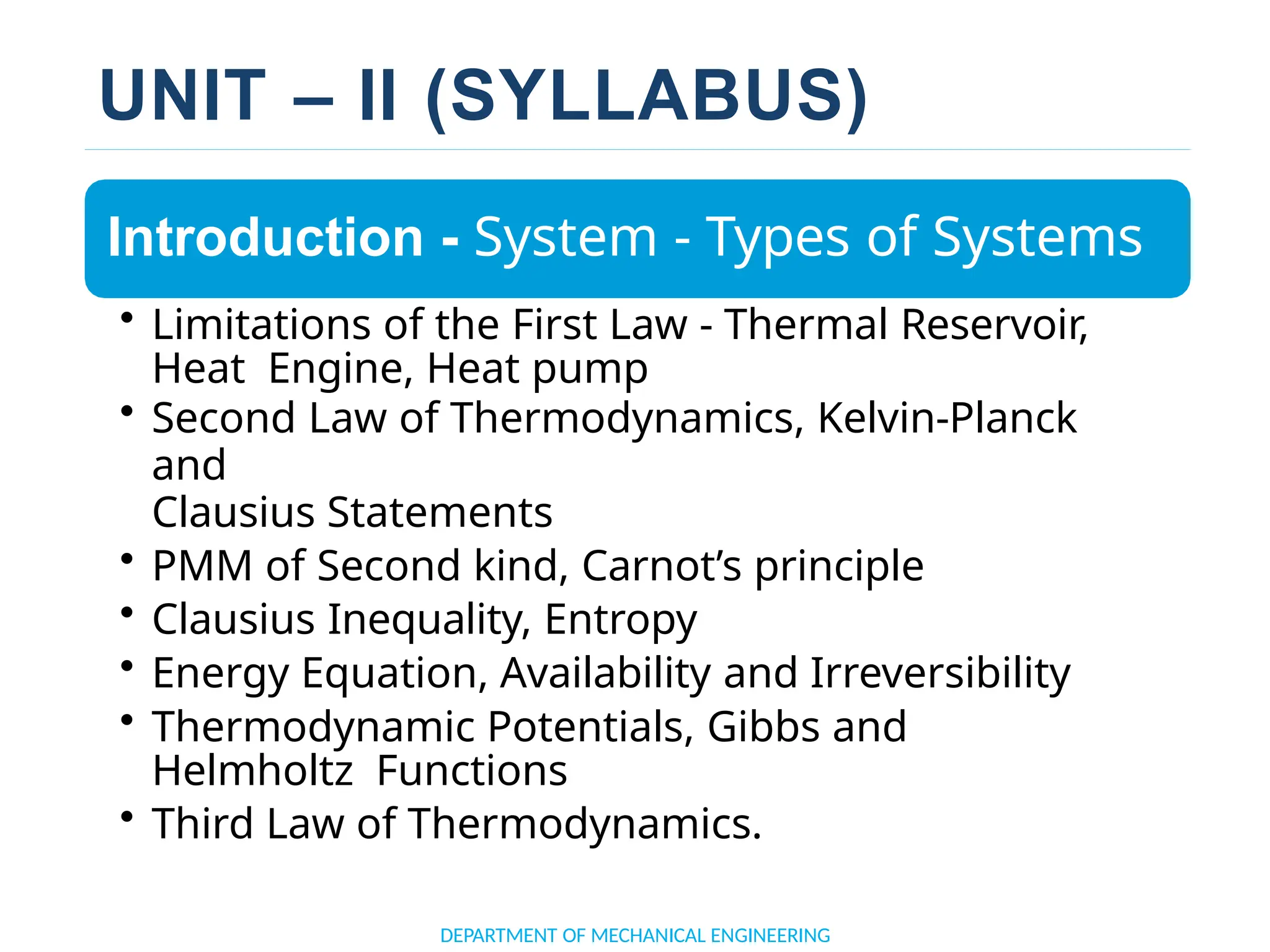
UNIT – II (SYLLABUS)
Introduction - System - Types of Systems
• Limitations of the First Law - Thermal Reservoir,
Heat Engine, Heat pump
• Second Law of Thermodynamics, Kelvin-Planck
and
Clausius Statements
• PMM of Second kind, Carnot’s principle
• Clausius Inequality, Entropy
• Energy Equation, Availability and Irreversibility
• Thermodynamic Potentials, Gibbs and
Helmholtz Functions
• Third Law of Thermodynamics.
DEPARTMENT OF MECHANICAL ENGINEERING
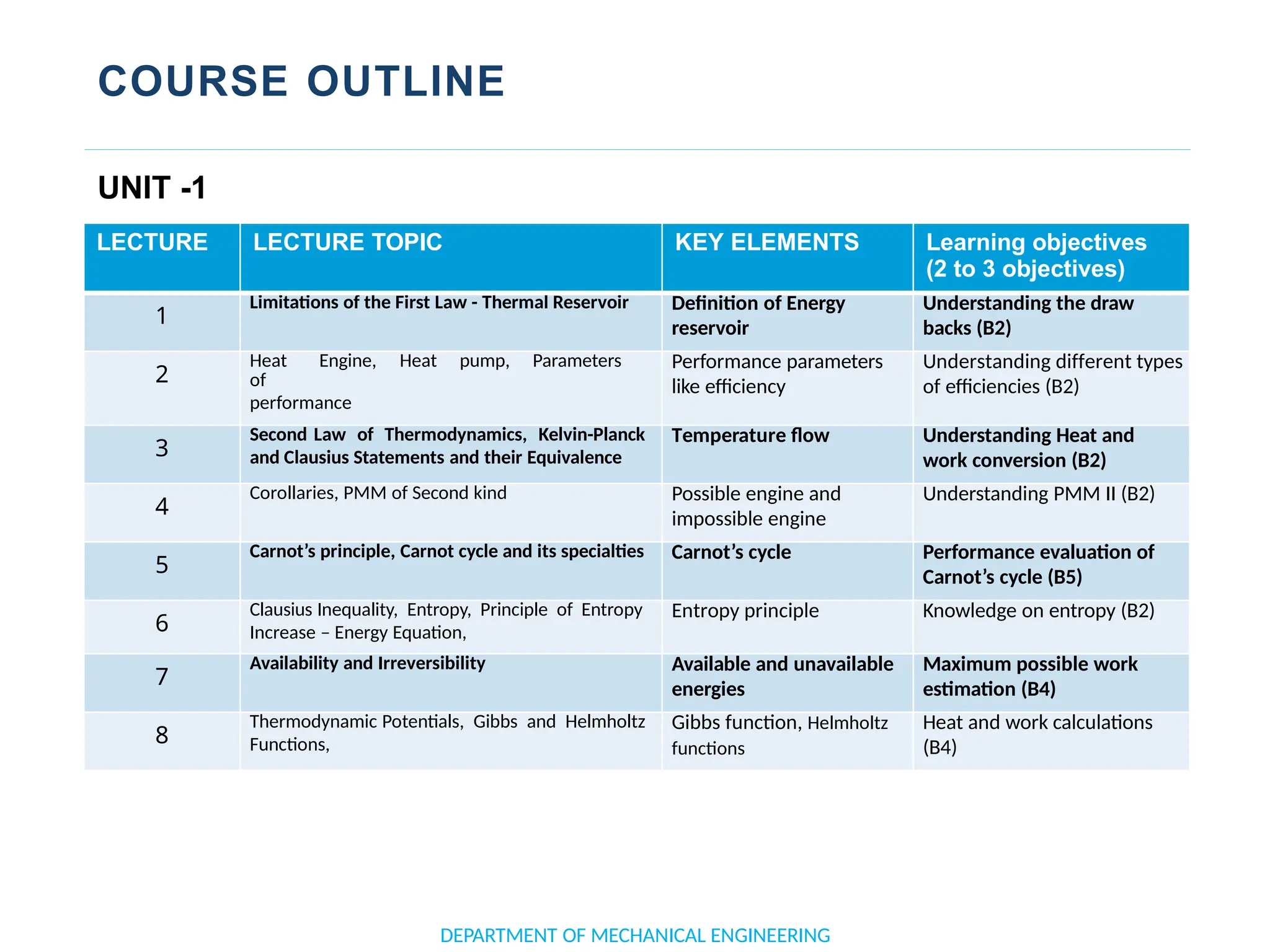
COURSE OUTLINE
DEPARTMENT OF MECHANICAL ENGINEERING
LECTURE LECTURE TOPIC KEY ELEMENTS Learning objectives
(2 to 3 objectives)
1
Limitations of the First Law - Thermal Reservoir Definition of Energy
reservoir
Understanding the draw
backs (B2)
2
Heat Engine, Heat pump, Parameters
of
performance
Performance parameters
like efficiency
Understanding different types
of efficiencies (B2)
3
Second Law of Thermodynamics, Kelvin-Planck
and Clausius Statements and their Equivalence
Temperature flow Understanding Heat and
work conversion (B2)
4
Corollaries, PMM of Second kind Possible engine and
impossible engine
Understanding PMM II (B2)
5
Carnot’s principle, Carnot cycle and its specialties Carnot’s cycle Performance evaluation of
Carnot’s cycle (B5)
6
Clausius Inequality, Entropy, Principle of Entropy
Increase – Energy Equation,
Entropy principle Knowledge on entropy (B2)
7
Availability and Irreversibility Available and unavailable
energies
Maximum possible work
estimation (B4)
8
Thermodynamic Potentials, Gibbs and Helmholtz
Functions,
Gibbs function, Helmholtz
functions
Heat and work calculations
(B4)
UNIT -1
LECTURE 2
Second law of thermodynamics - Entropy
LIMITATIONS OF FIRST LAW OF
THERMODYNAMICS
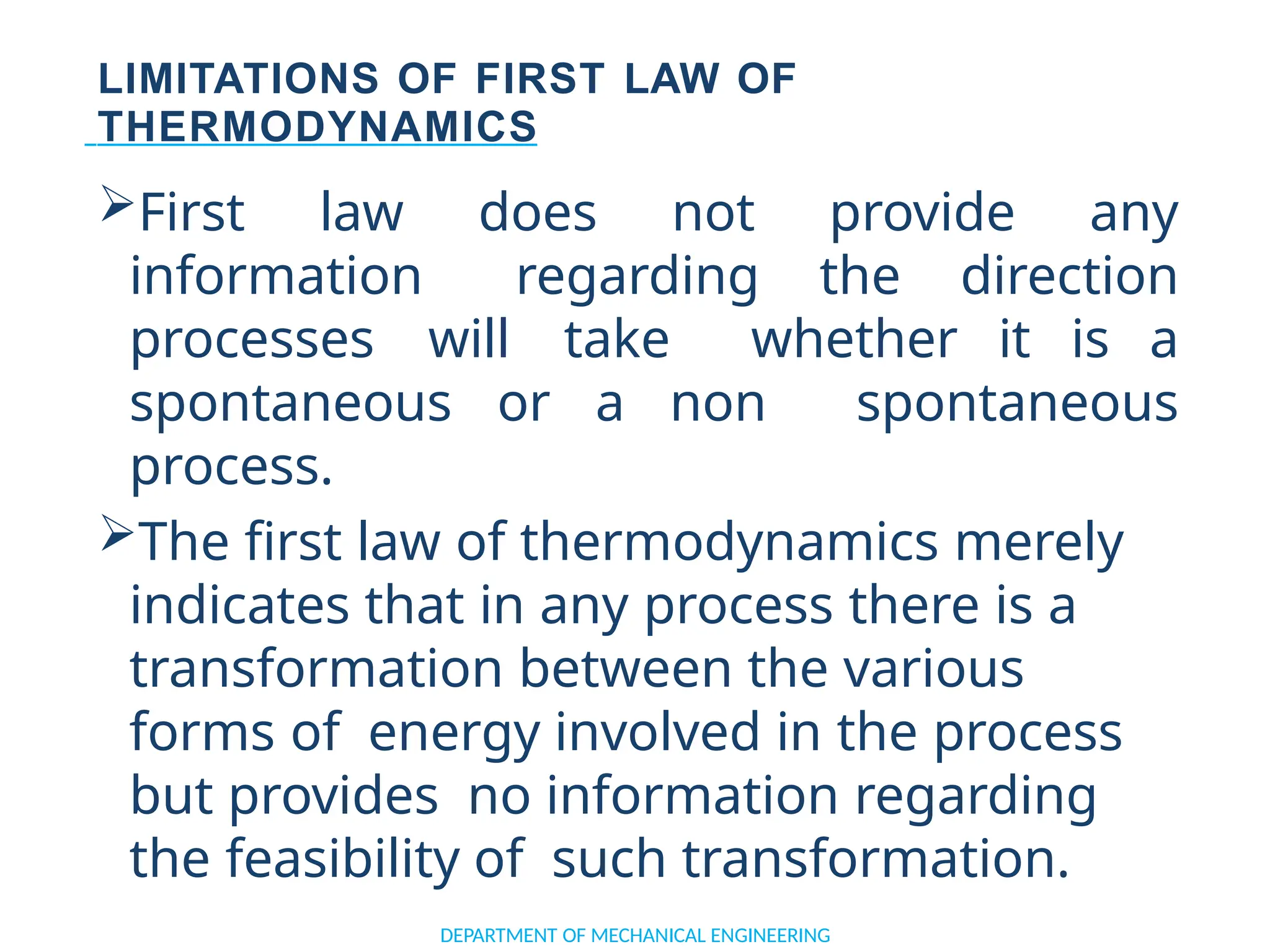
First law does not provide any
information regarding the direction
processes will take whether it is a
spontaneous or a non spontaneous
process.
The first law of thermodynamics merely
indicates that in any process there is a
transformation between the various
forms of energy involved in the process
but provides no information regarding
the feasibility of such transformation.
DEPARTMENT OF MECHANICAL ENGINEERING
LIMITATIONS OF FIRST LAW OF
THERMODYNAMICS
First law of thermodynamics has not
provided the information about the direction
of the process.
 First law of thermodynamics has not
provided
DEPARTMENT OF MECHANICAL ENGINEERING
complete energy of the system
will
the information that how much quantity
of
be
converted in to the work energy.
First law of thermodynamics has not
provided any information about the
conditions in which conversion of heat
energy in work energy is possible.
THERMAL ENERGY RESERVOIR
DEPARTMENT OF MECHANICAL ENGINEERING
THERMAL ENERGY RESERVOIR
DEPARTMENT OF MECHANICAL ENGINEERING
HEAT ENGINE
DEPARTMENT OF MECHANICAL ENGINEERING
HEAT ENGINE
DEPARTMENT OF MECHANICAL ENGINEERING
HEAT ENGINE
DEPARTMENT OF MECHANICAL ENGINEERING
HEAT ENGINE
DEPARTMENT OF MECHANICAL ENGINEERING
HEAT ENGINE
DEPARTMENT OF MECHANICAL ENGINEERING
PERFORMANCE PARAMETERS
DEPARTMENT OF MECHANICAL ENGINEERING
PERFORMANCE PARAMETERS
DEPARTMENT OF MECHANICAL ENGINEERING
PERFORMANCE PARAMETERS
DEPARTMENT OF MECHANICAL ENGINEERING
PERFORMANCE PARAMETERS
DEPARTMENT OF MECHANICAL ENGINEERING
HEAT PUMP
DEPARTMENT OF MECHANICAL ENGINEERING
HEAT PUMP
DEPARTMENT OF MECHANICAL ENGINEERING
HEAT PUMP
DEPARTMENT OF MECHANICAL ENGINEERING
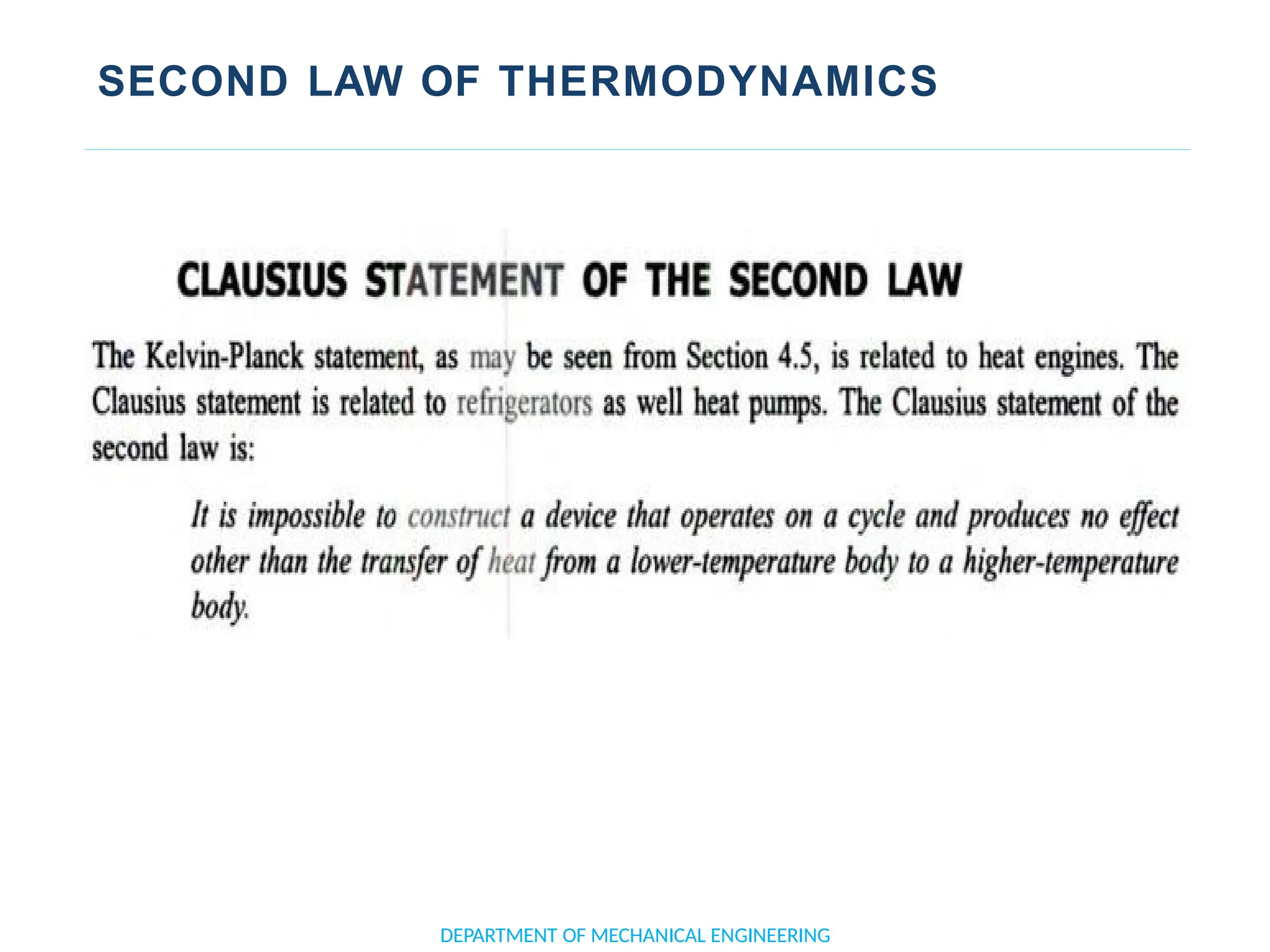
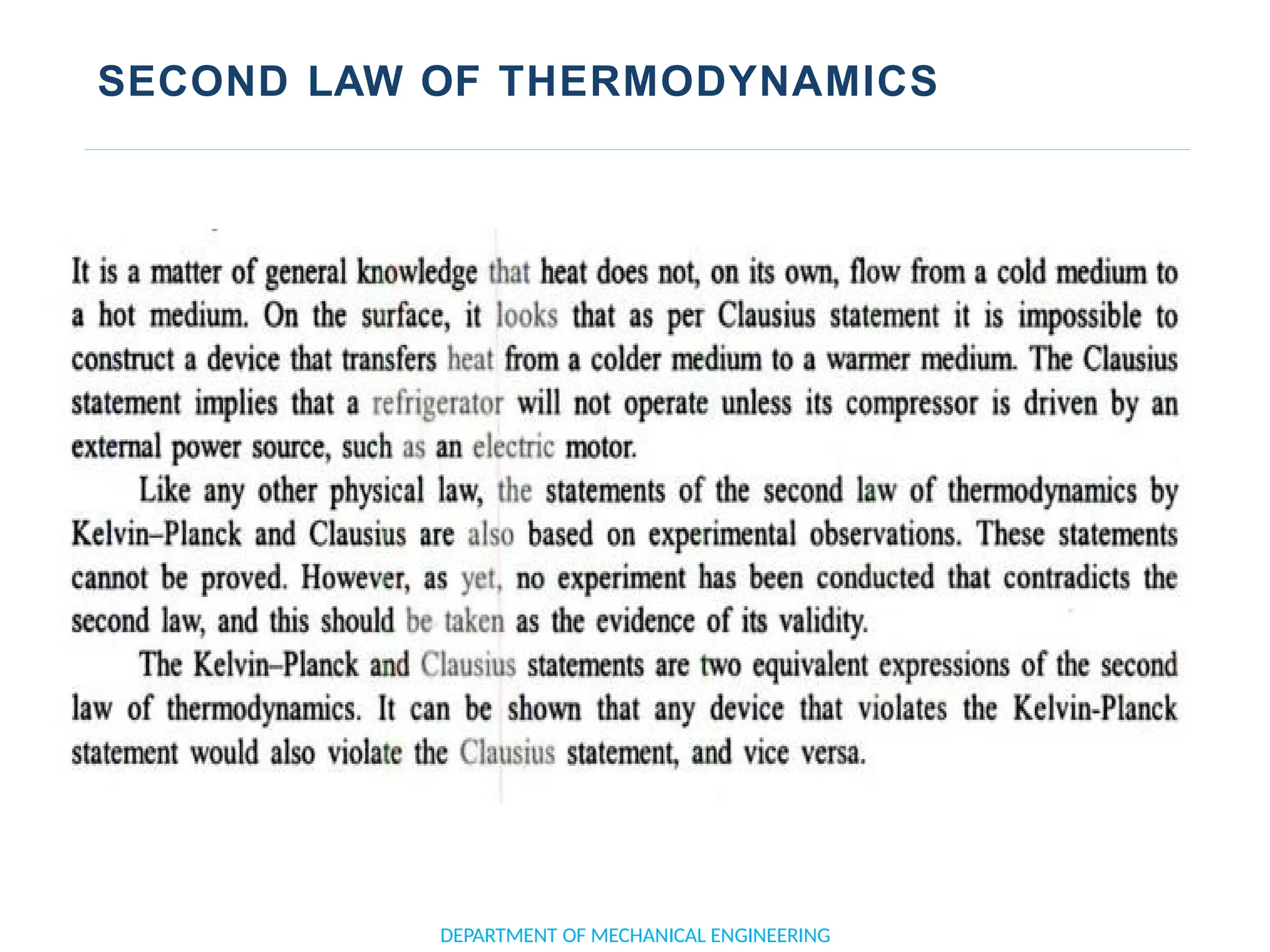
SECOND LAW OF THERMODYNAMICS
DEPARTMENT OF MECHANICAL ENGINEERING
SECOND LAW OF THERMODYNAMICS
DEPARTMENT OF MECHANICAL ENGINEERING
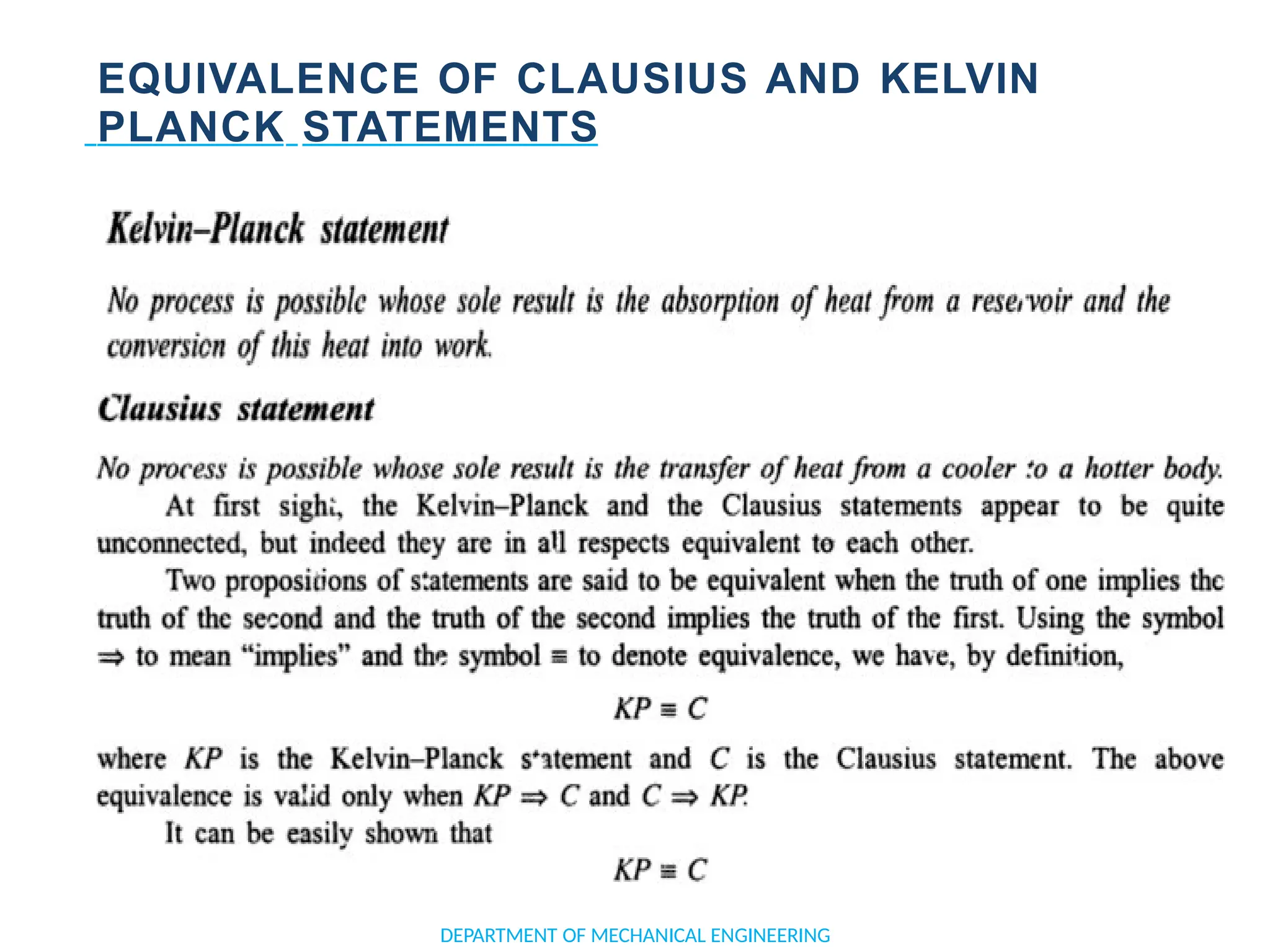
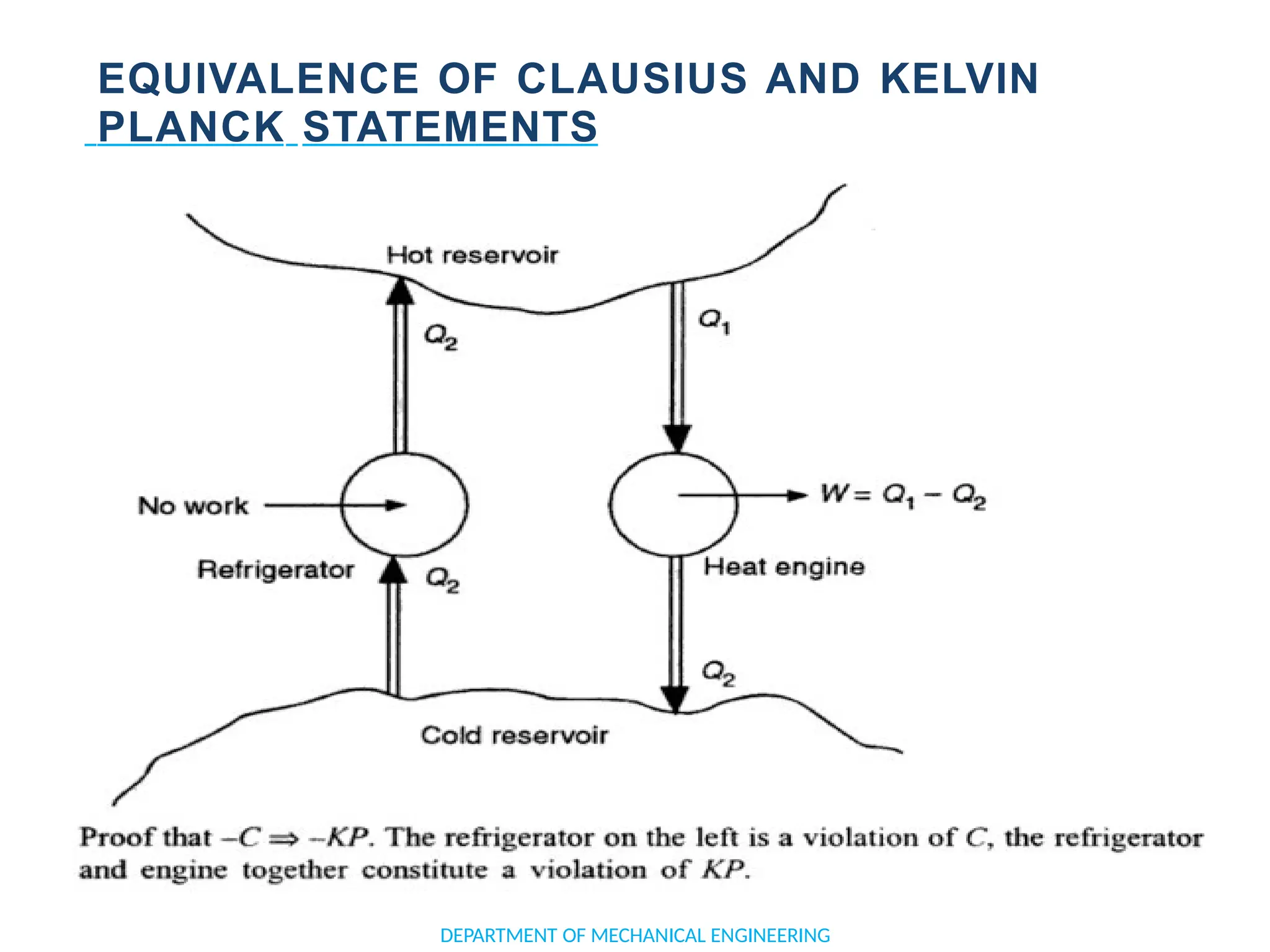
EQUIVALENCE OF CLAUSIUS AND KELVIN
PLANCK STATEMENTS
DEPARTMENT OF MECHANICAL ENGINEERING
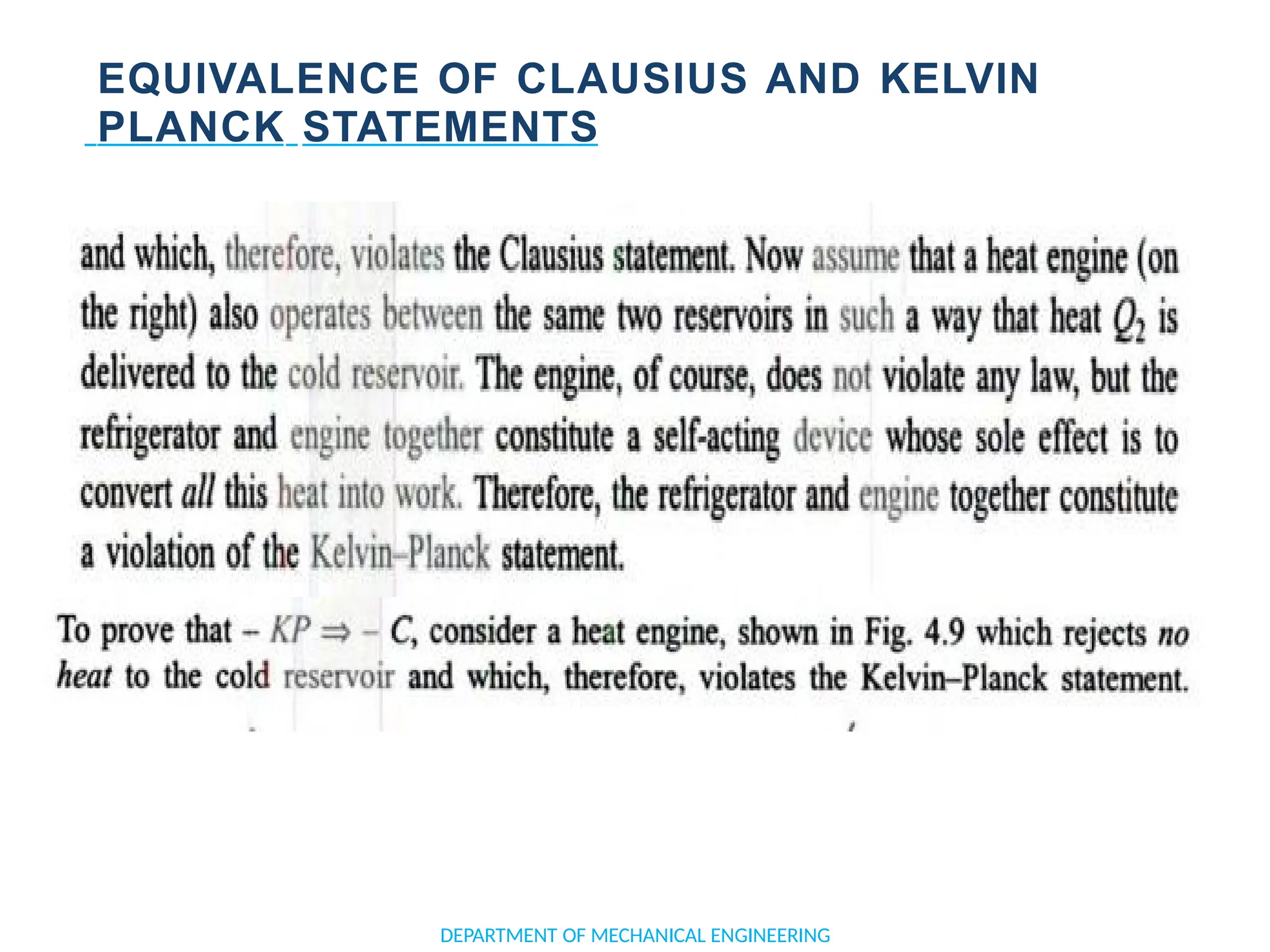
EQUIVALENCE OF CLAUSIUS AND KELVIN
PLANCK STATEMENTS
DEPARTMENT OF MECHANICAL ENGINEERING
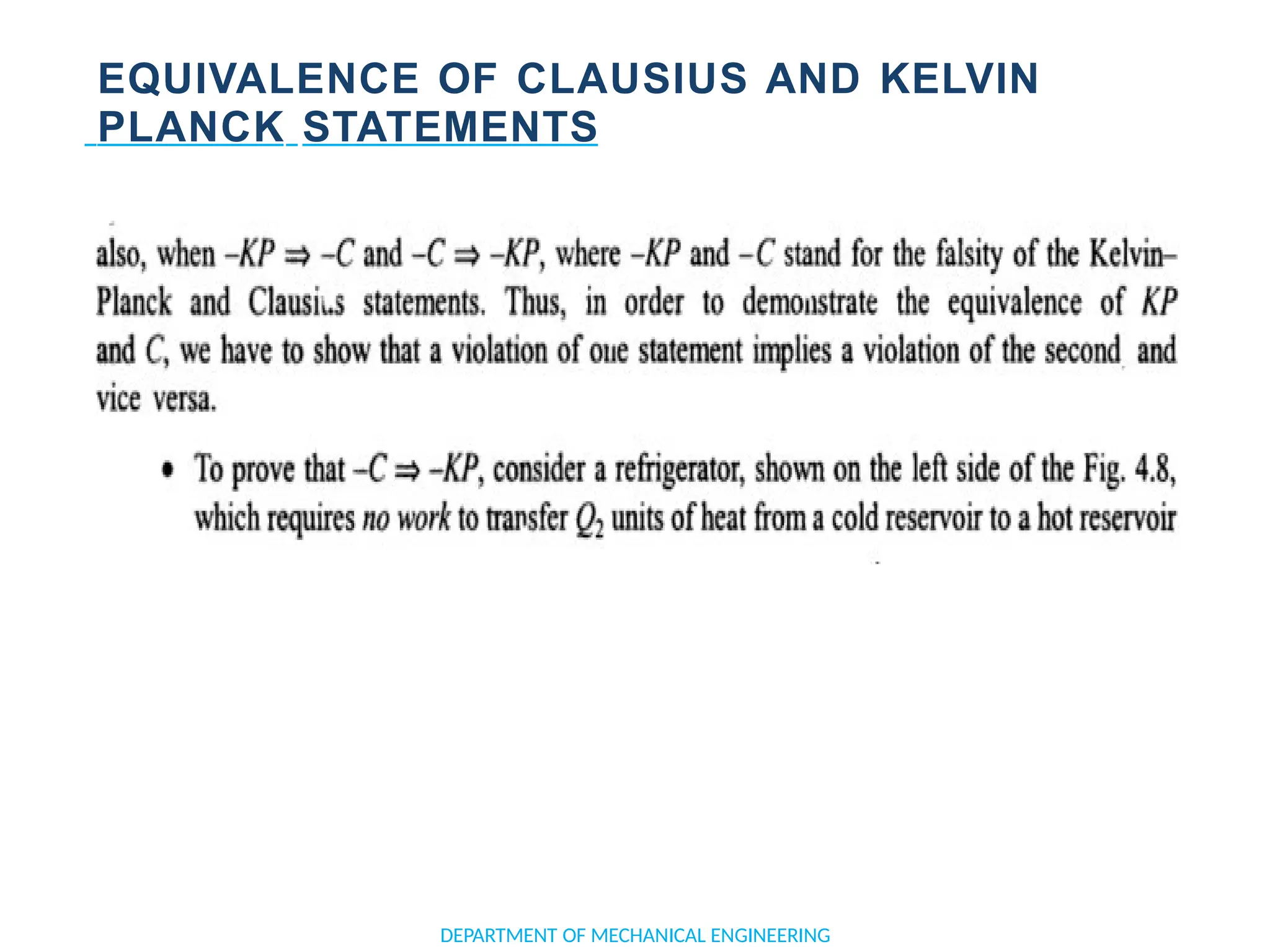
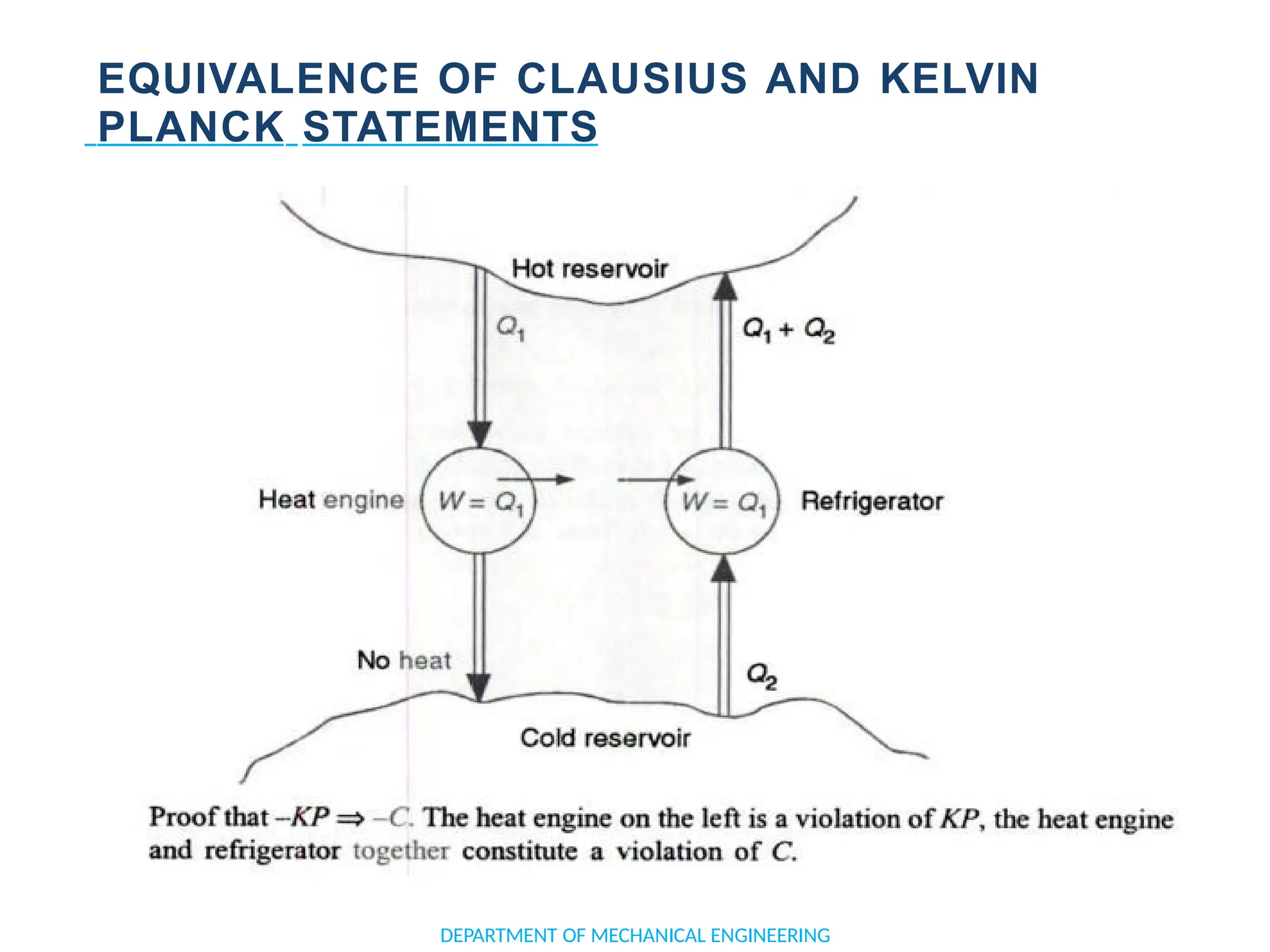
EQUIVALENCE OF CLAUSIUS AND KELVIN
PLANCK STATEMENTS
DEPARTMENT OF MECHANICAL ENGINEERING
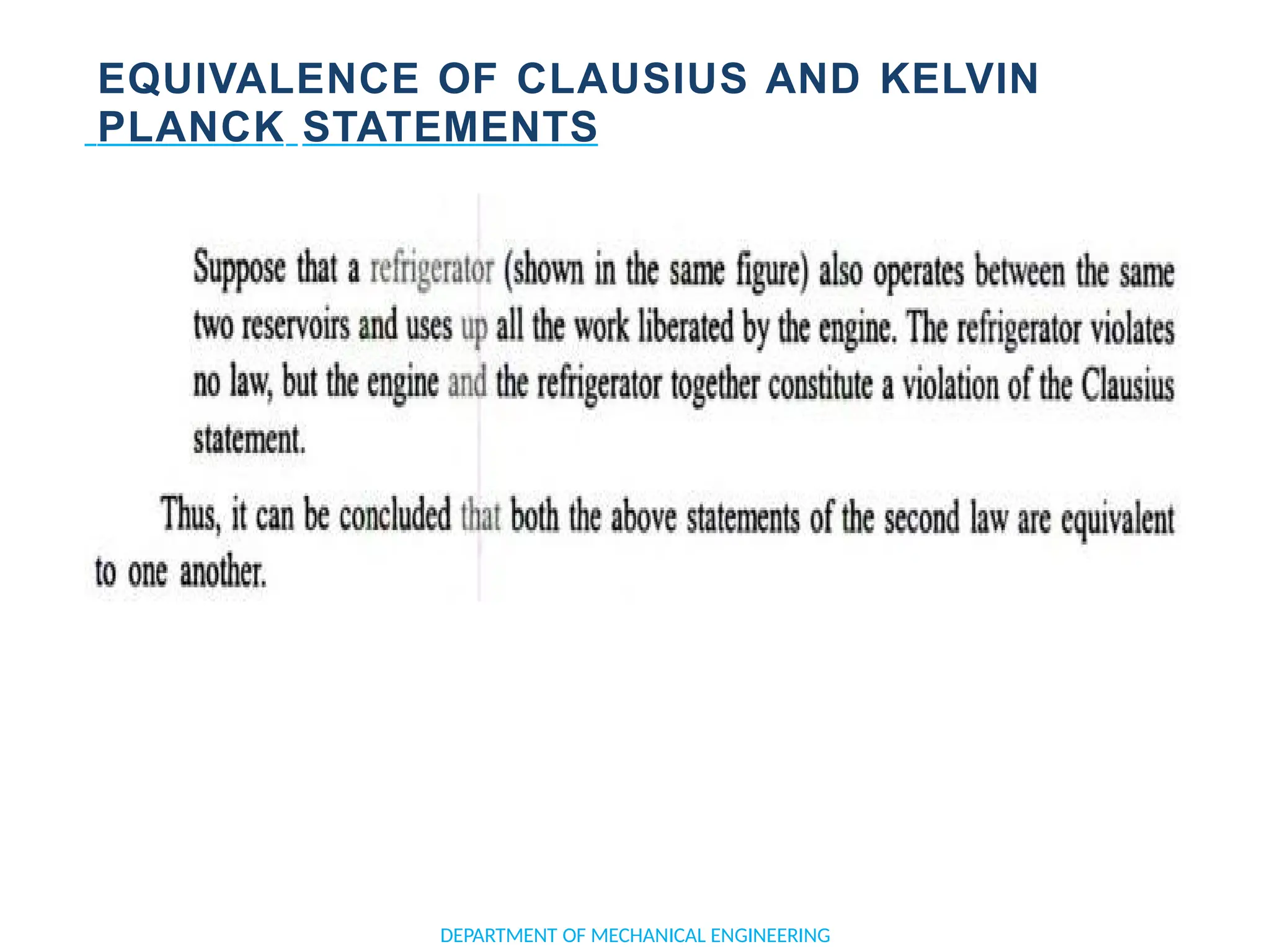
EQUIVALENCE OF CLAUSIUS AND KELVIN
PLANCK STATEMENTS
DEPARTMENT OF MECHANICAL ENGINEERING
EQUIVALENCE OF CLAUSIUS AND KELVIN
PLANCK STATEMENTS
DEPARTMENT OF MECHANICAL ENGINEERING
EQUIVALENCE OF CLAUSIUS AND KELVIN
PLANCK STATEMENTS
DEPARTMENT OF MECHANICAL ENGINEERING
CARNOT CYCLE
DEPARTMENT OF MECHANICAL ENGINEERING
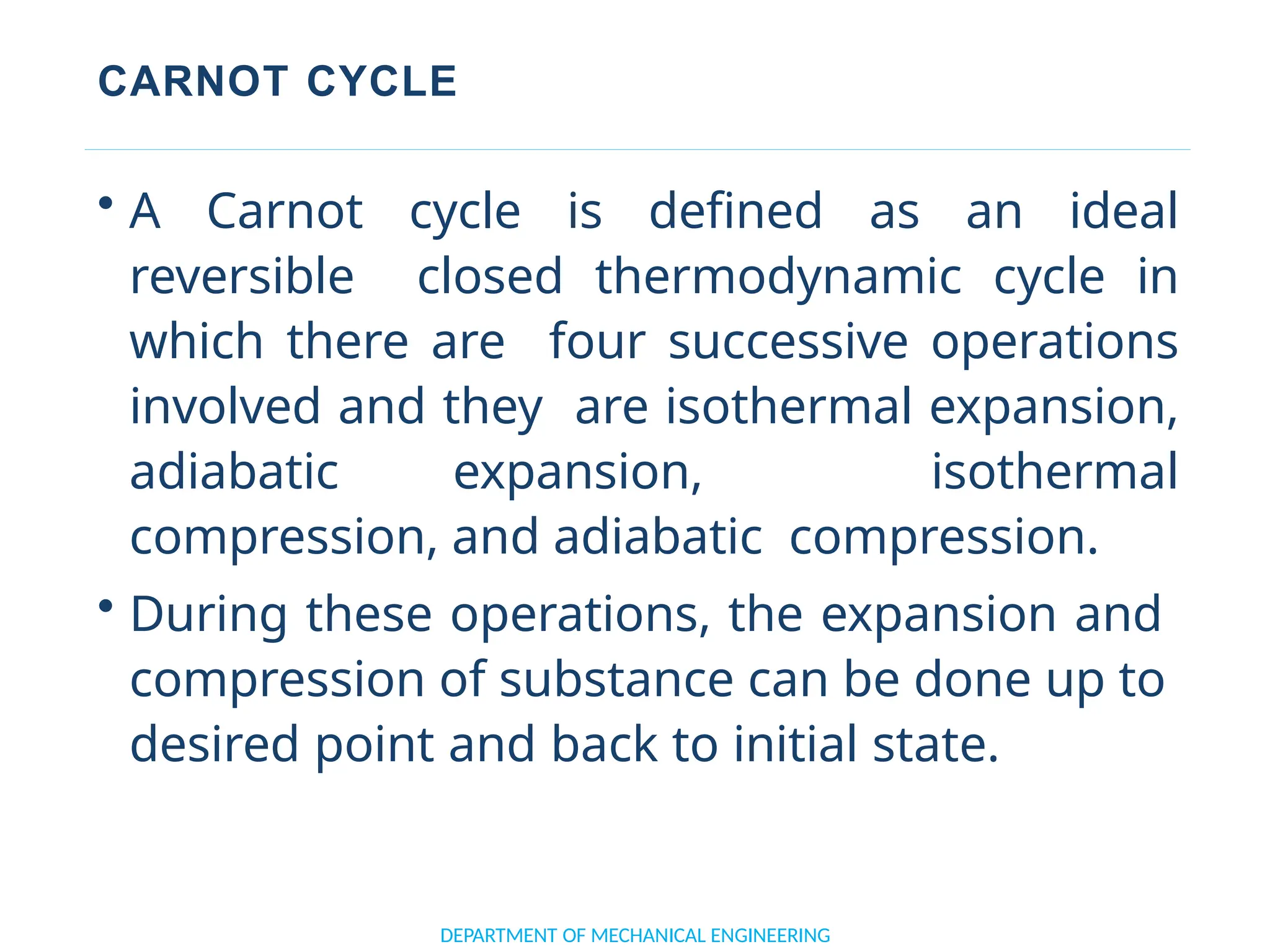
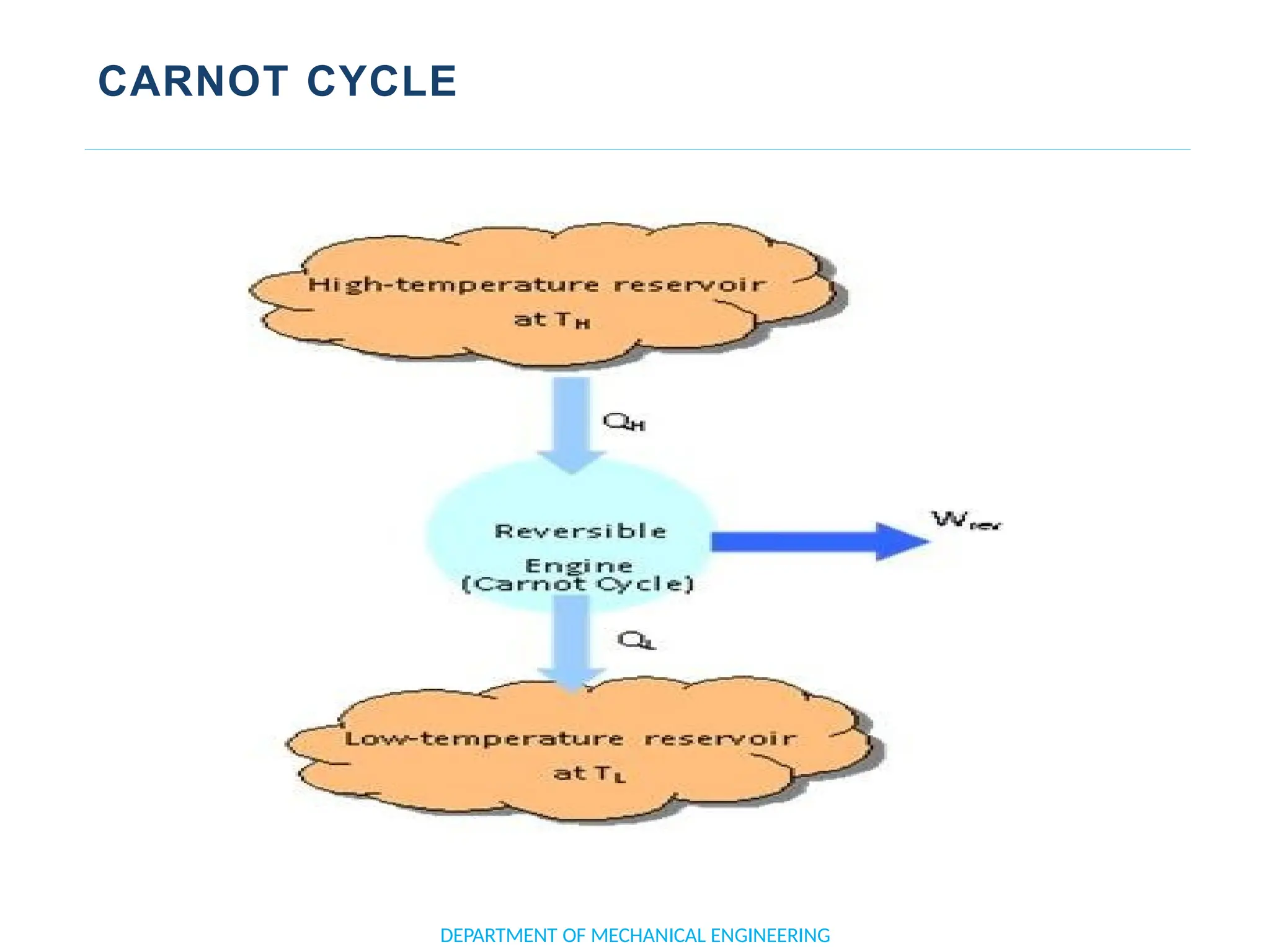
• A Carnot cycle is defined as an ideal
reversible closed thermodynamic cycle in
which there are four successive operations
involved and they are isothermal expansion,
adiabatic expansion, isothermal
compression, and adiabatic compression.
• During these operations, the expansion and
compression of substance can be done up to
desired point and back to initial state.
CARNOT CYCLE
DEPARTMENT OF MECHANICAL ENGINEERING
CARNOT CYCLE
DEPARTMENT OF MECHANICAL ENGINEERING
CARNOT CYCLE
DEPARTMENT OF MECHANICAL ENGINEERING
CARNOT CYCLE
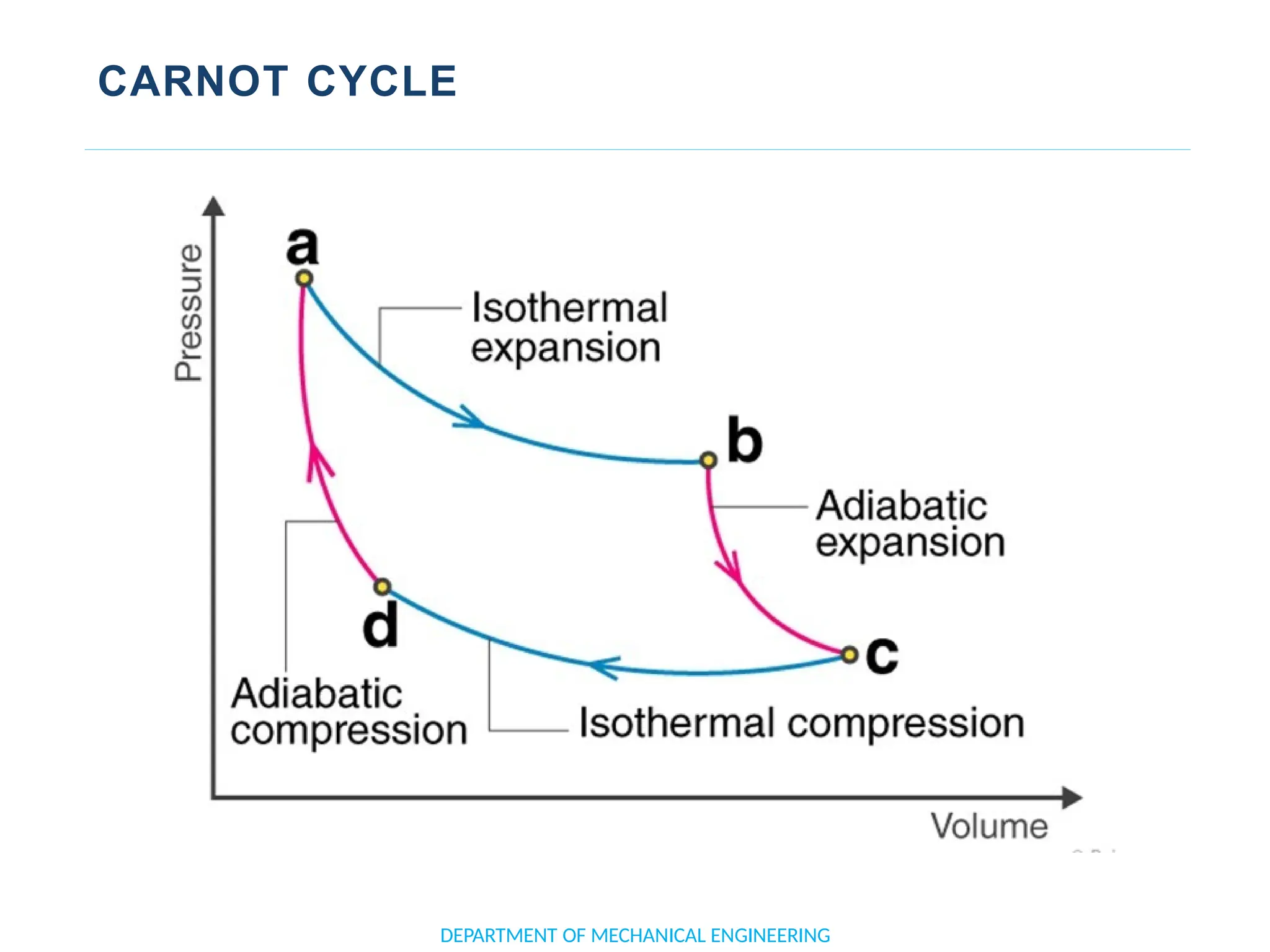
• Following are the four processes of Carnot cycle:
• In (a), the process is reversible isothermal
gas expansion. In this process, the amount
of heat absorbed by the ideal gas is qin from
the heat source which is at a temperature
of Th. The gas expands and does work on
the surroundings.
• In (b), the process is reversible adiabatic gas
expansion. Here, the system is thermally
insulated and the gas continues to expand and
work is done on the surroundings. Now the
temperature is lower, Tl.
DEPARTMENT OF MECHANICAL ENGINEERING
CARNOT CYCLE
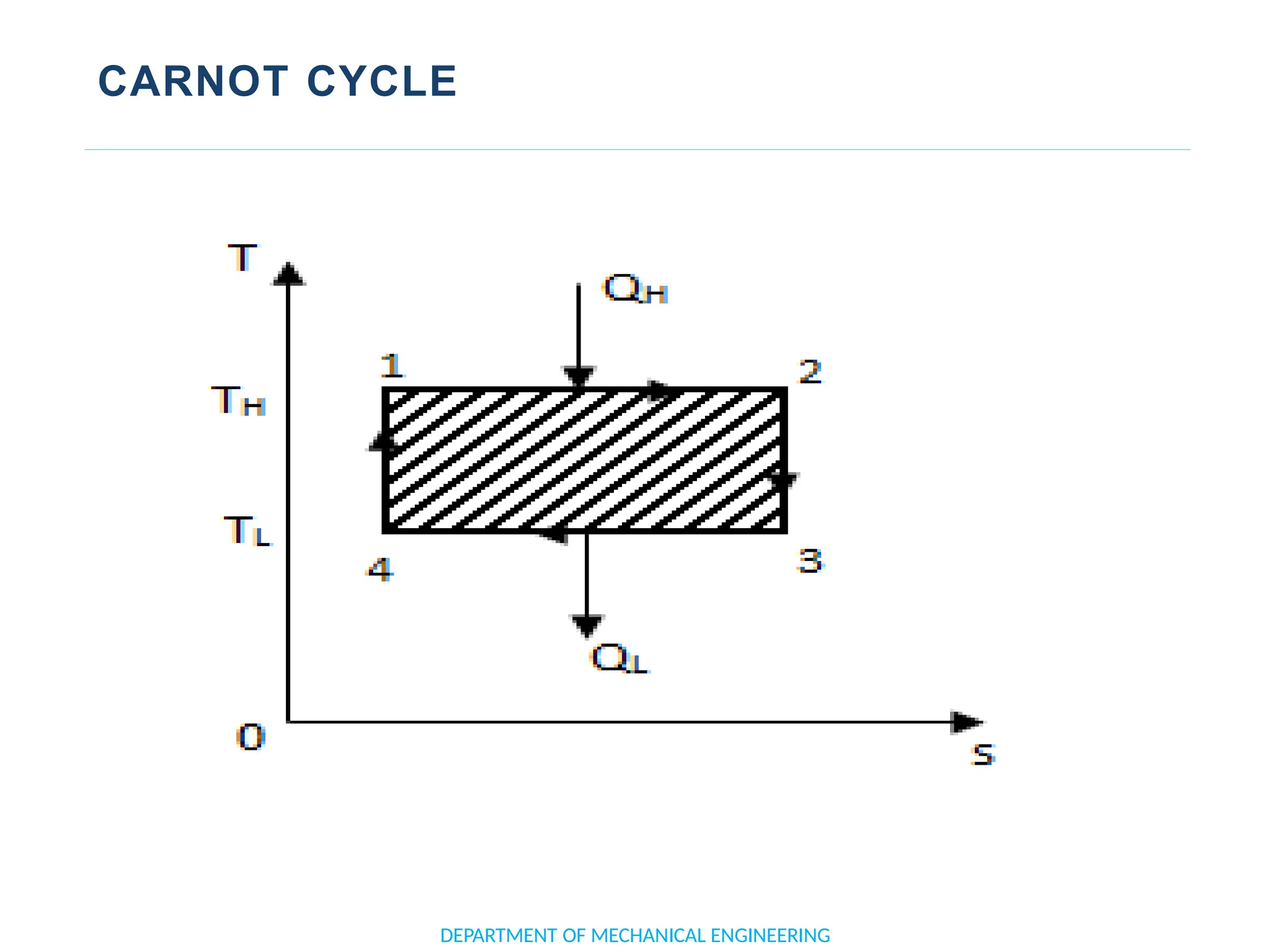
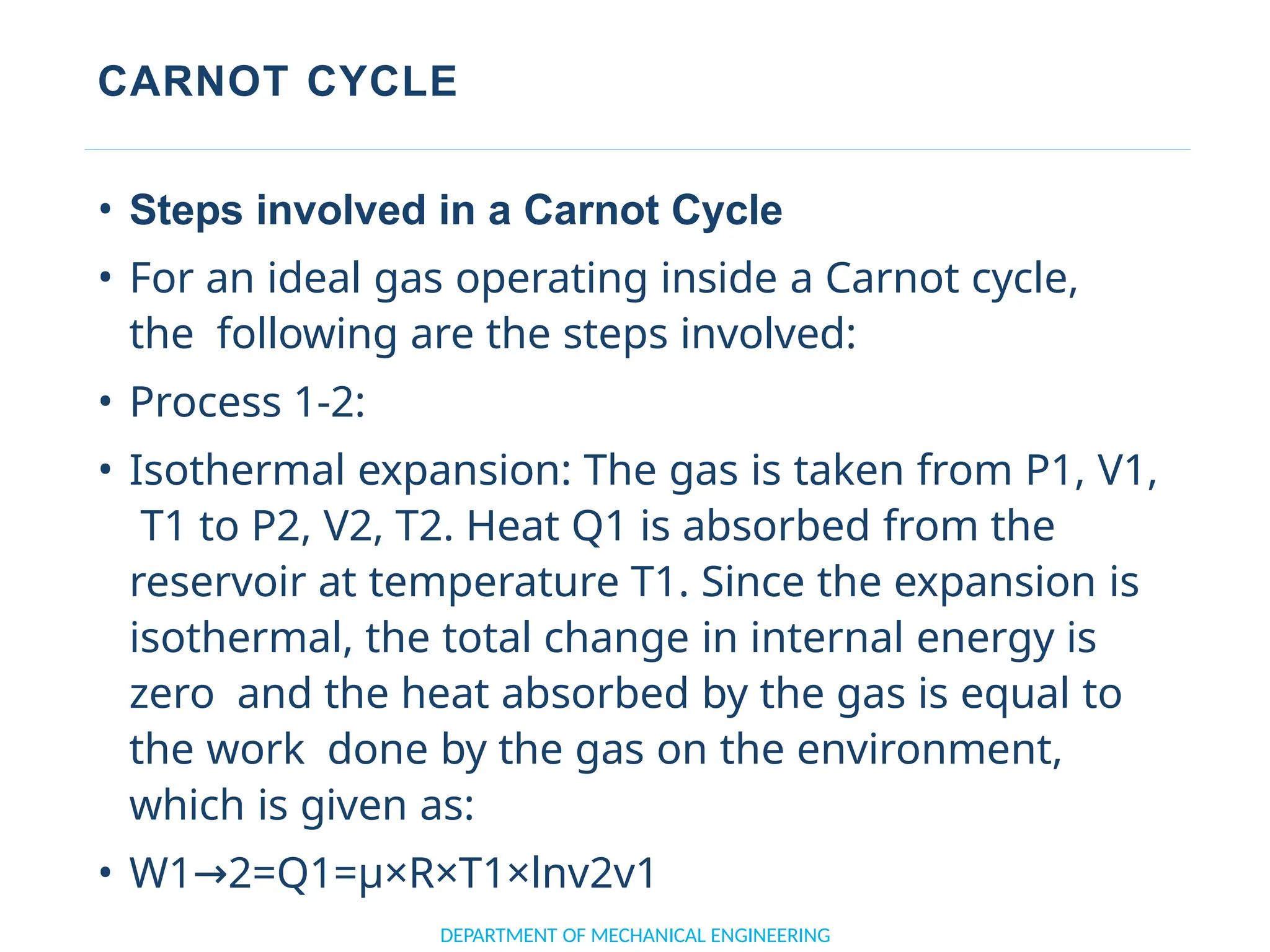
• Steps involved in a Carnot Cycle
• For an ideal gas operating inside a Carnot cycle,
the following are the steps involved:
• Process 1-2:
• Isothermal expansion: The gas is taken from P1, V1,
T1 to P2, V2, T2. Heat Q1 is absorbed from the
reservoir at temperature T1. Since the expansion is
isothermal, the total change in internal energy is
zero and the heat absorbed by the gas is equal to
the work done by the gas on the environment,
which is given as:
• W1 2=Q1=μ×R×T1×lnv2v1
→
DEPARTMENT OF MECHANICAL ENGINEERING
CARNOT CYCLE
DEPARTMENT OF MECHANICAL ENGINEERING
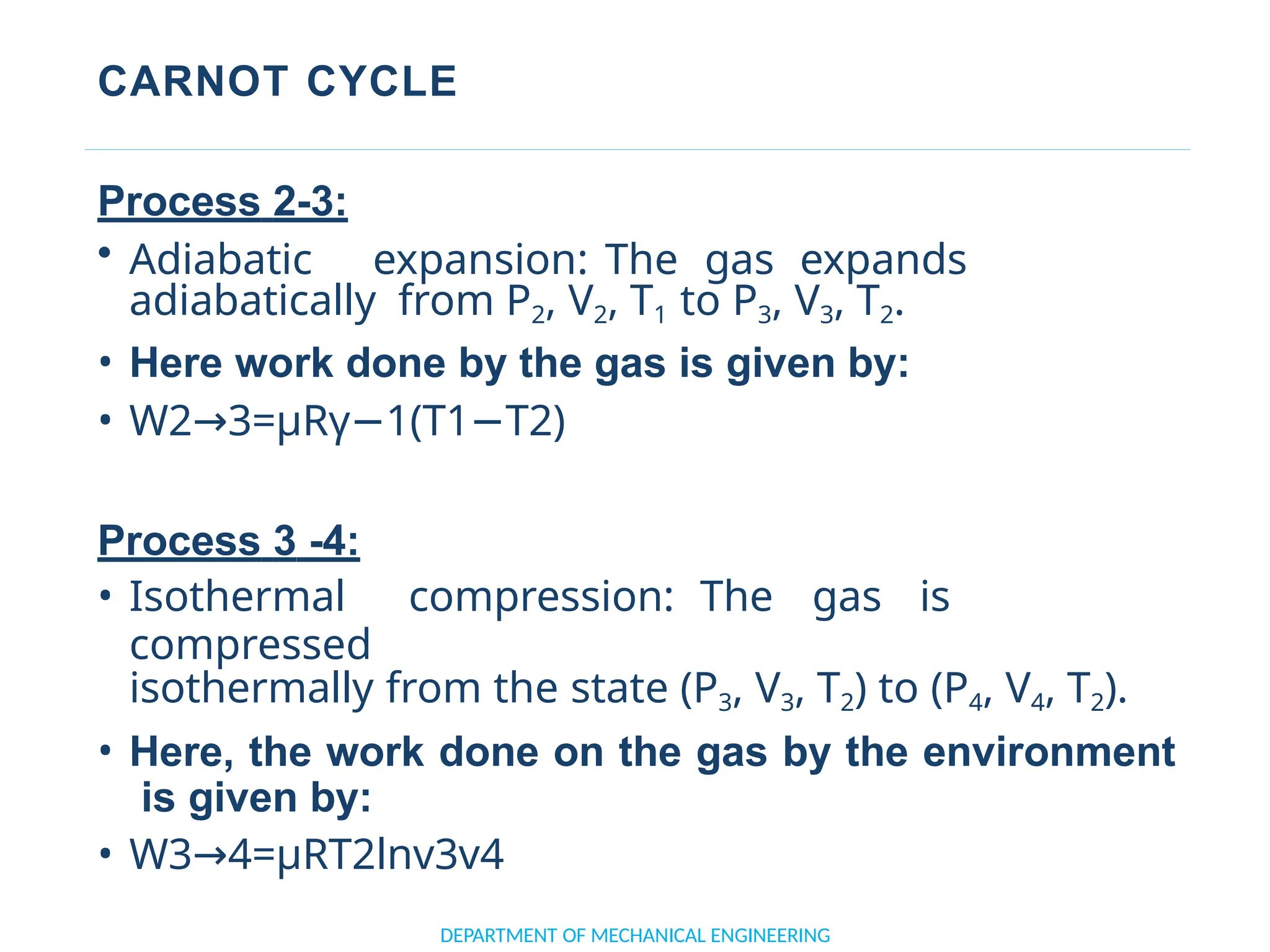
Process 2-3:
• Adiabatic expansion: The gas expands
adiabatically from P2, V2, T1 to P3, V3, T2.
• Here work done by the gas is given by:
• W2 3=μRγ 1(T1 T2)
→ − −
Process 3 -4:
• Isothermal compression: The gas is
compressed
isothermally from the state (P3, V3, T2) to (P4, V4, T2).
• Here, the work done on the gas by the environment
is given by:
• W3 4=μRT2lnv3v4
→
CARNOT CYCLE
DEPARTMENT OF MECHANICAL ENGINEERING
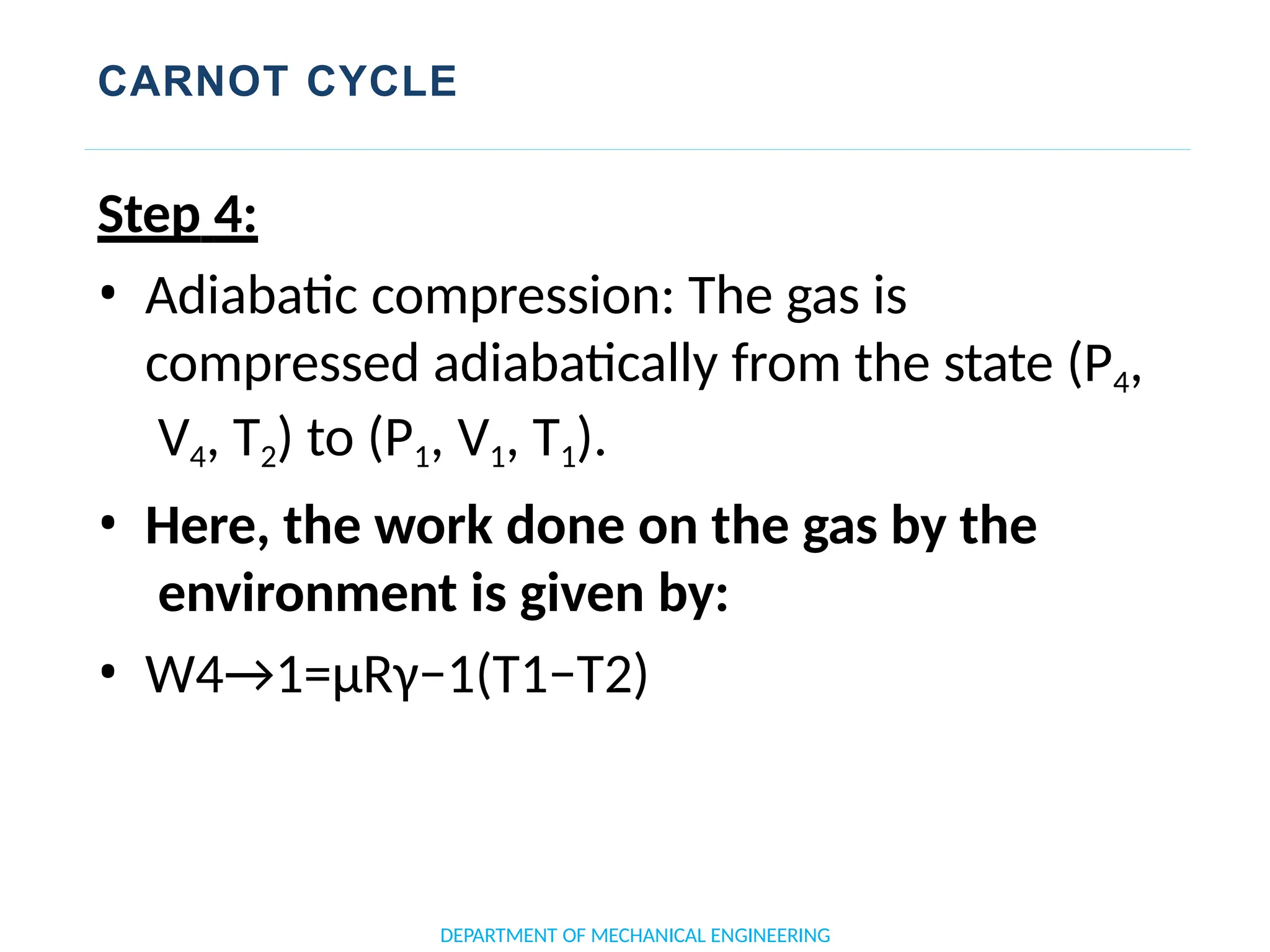
Step 4:
• Adiabatic compression: The gas is
compressed adiabatically from the state (P4,
V4, T2) to (P1, V1, T1).
• Here, the work done on the gas by the
environment is given by:
• W4→1=μRγ−1(T1−T2)
CARNOT CYCLE
• In (c), the process is reversible isothermal
gas compression process. Here, the heat
loss, qout occurs when the surroundings do
the work at temperature Tl.
• In (d), the process is reversible adiabatic gas
compression. Again the system is thermally
insulated. The temperature again rise back
to Th as the surrounding continue to do their
work on the gas.
DEPARTMENT OF MECHANICAL ENGINEERING
CARNOT CYCLE
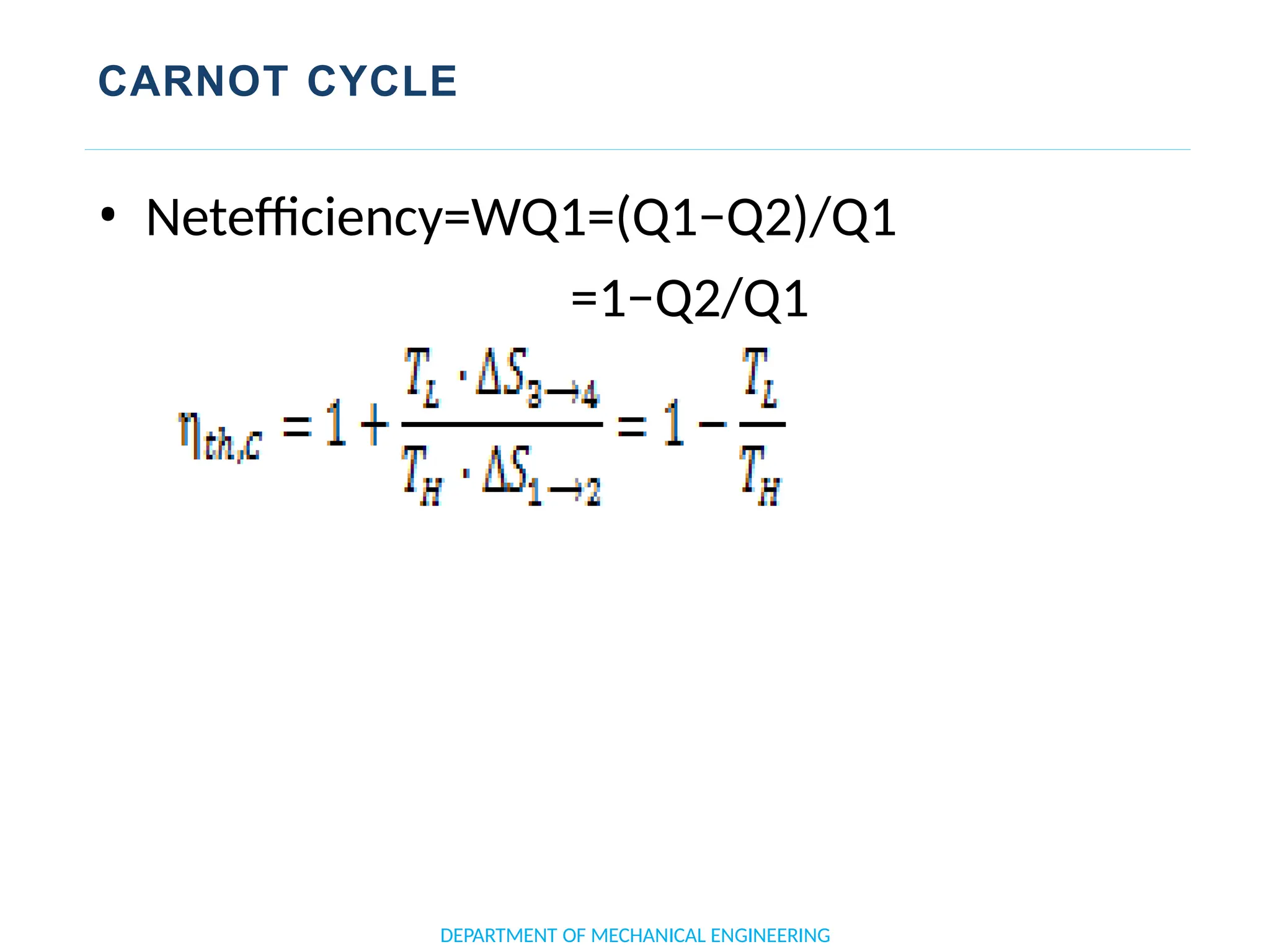
• Netefficiency=WQ1=(Q1−Q2)/Q1
=1−Q2/Q1
DEPARTMENT OF MECHANICAL ENGINEERING
CARNOT PRINCIPLE
DEPARTMENT OF MECHANICAL ENGINEERING
AVAILABILITY AND IRREVERSIBILITY
DEPARTMENT OF MECHANICAL ENGINEERING
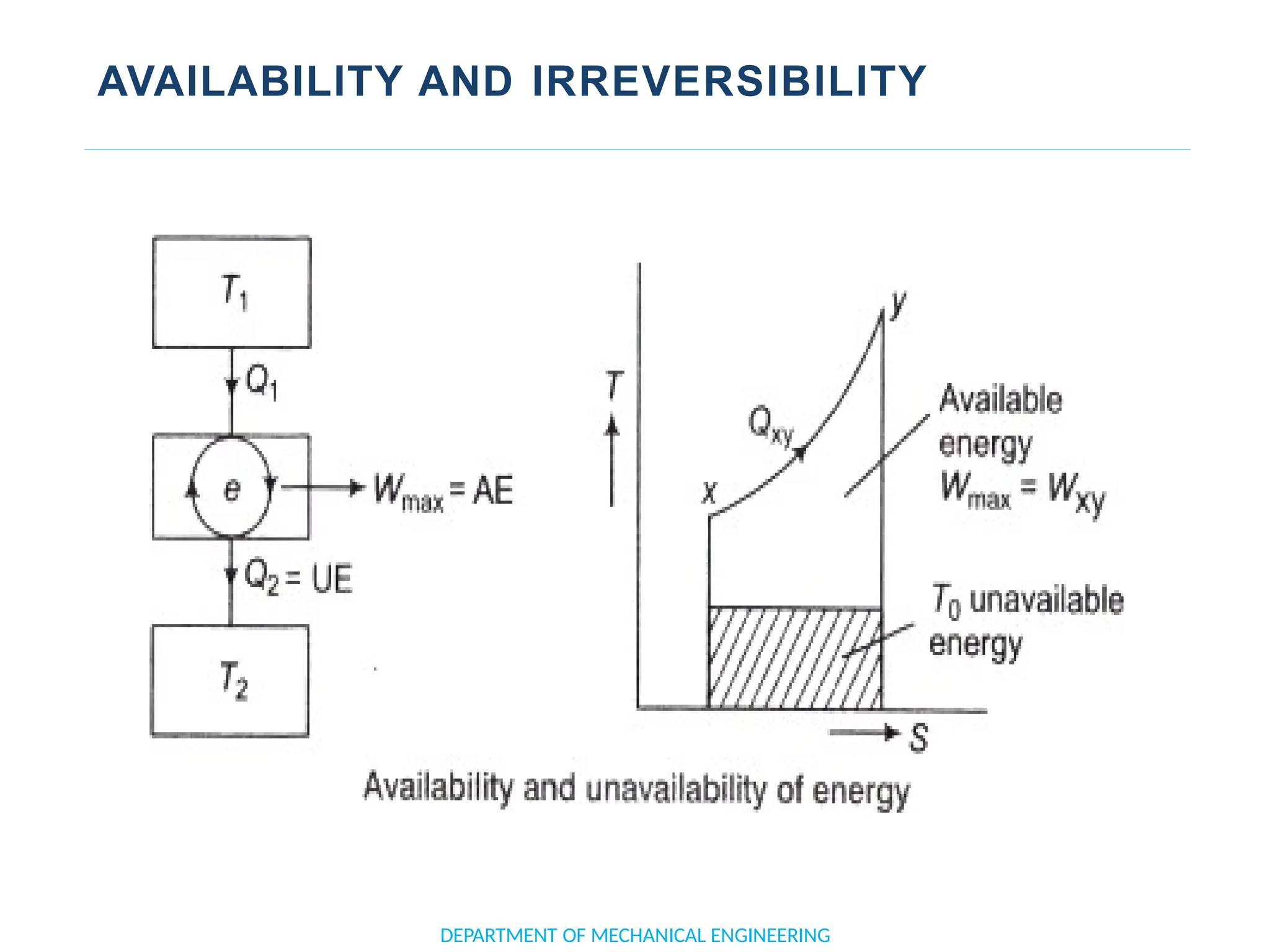
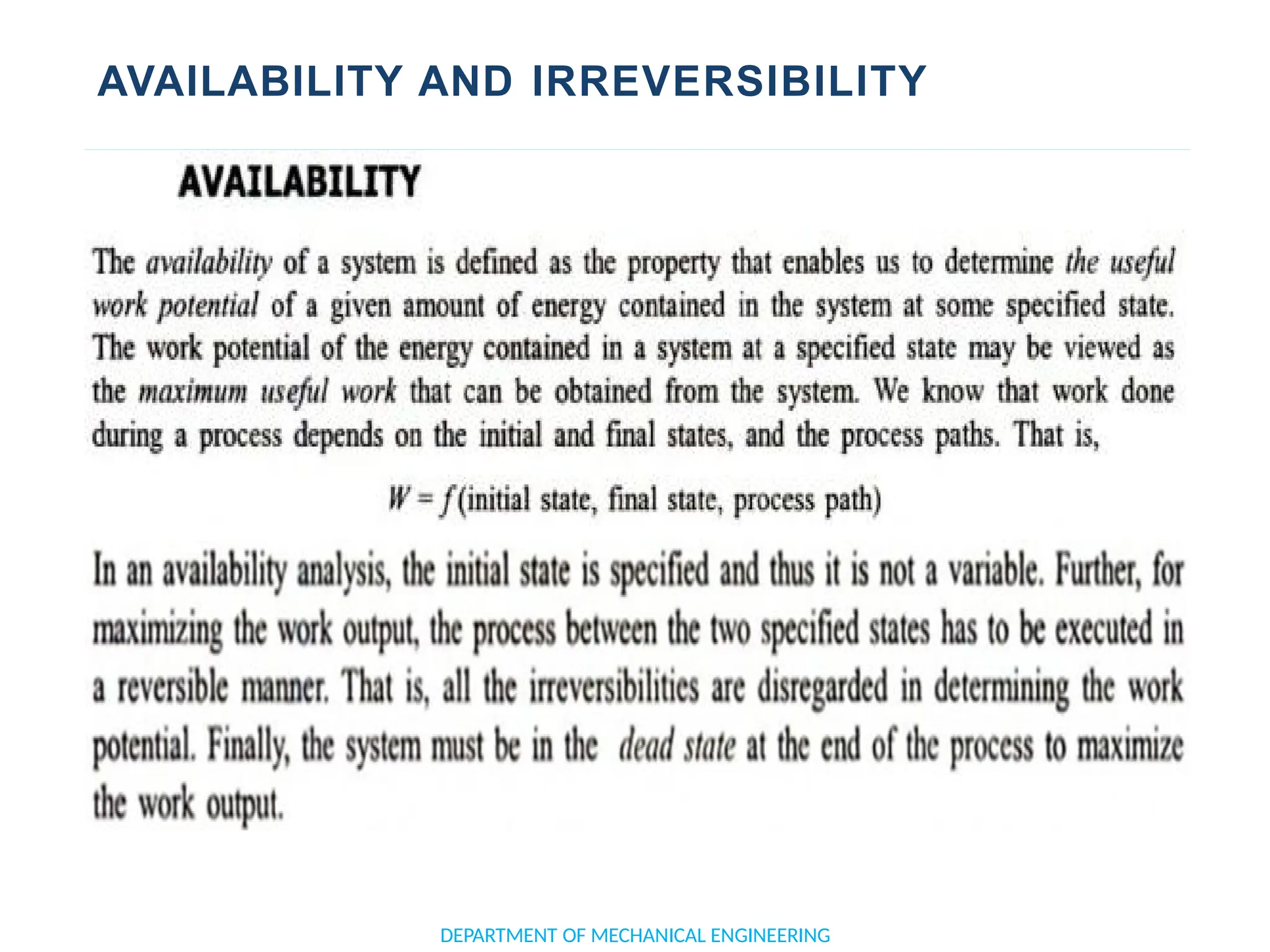
• Availability:
• When a system is subjected to a process
from its original state to dead state the
maximum amount of useful work that can be
achieved under ideal conditions is known as
available energy or availability of the system.
AVAILABILITY AND IRREVERSIBILITY
DEPARTMENT OF MECHANICAL ENGINEERING
AVAILABILITY AND IRREVERSIBILITY
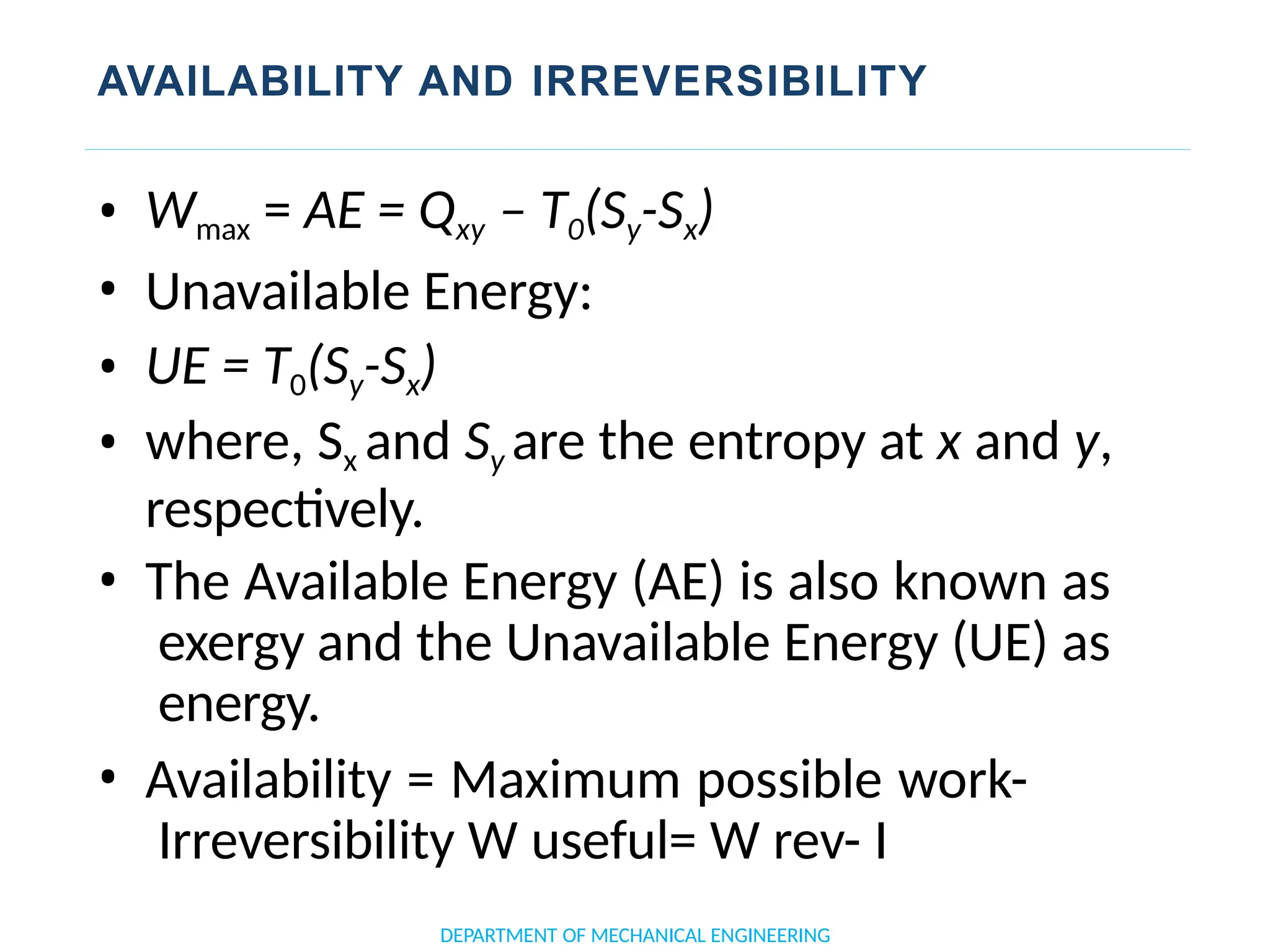
• Wmax = AE = Qxy – T0(Sy-Sx)
• Unavailable Energy:
• UE = T0(Sy-Sx)
• where, Sx and Sy are the entropy at x and y,
respectively.
• The Available Energy (AE) is also known as
exergy and the Unavailable Energy (UE) as
energy.
• Availability = Maximum possible work-
Irreversibility W useful= W rev- I
DEPARTMENT OF MECHANICAL ENGINEERING
AVAILABILITY AND IRREVERSIBILITY
DEPARTMENT OF MECHANICAL ENGINEERING
AVAILABILITY AND IRREVERSIBILITY
DEPARTMENT OF MECHANICAL ENGINEERING
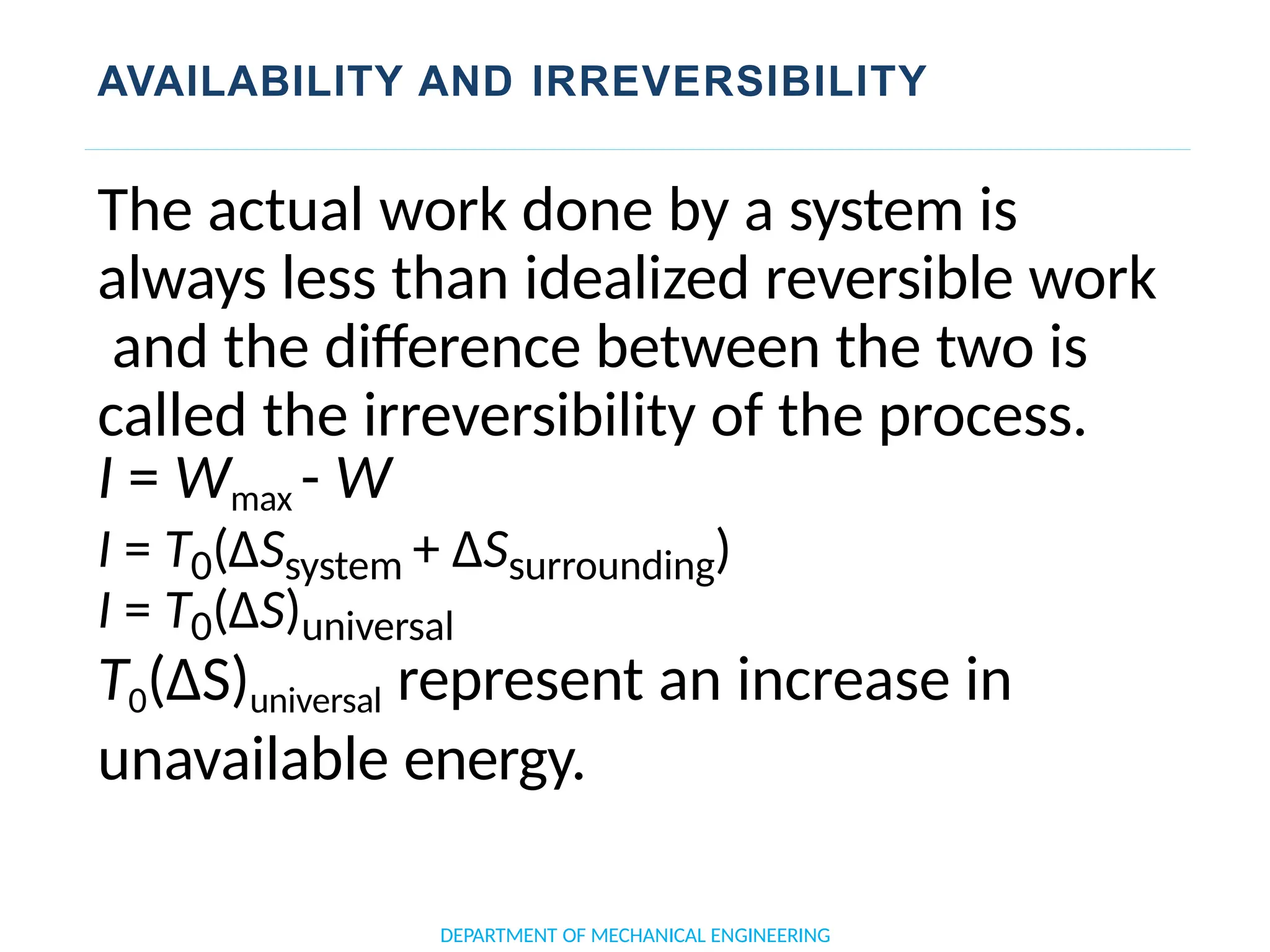
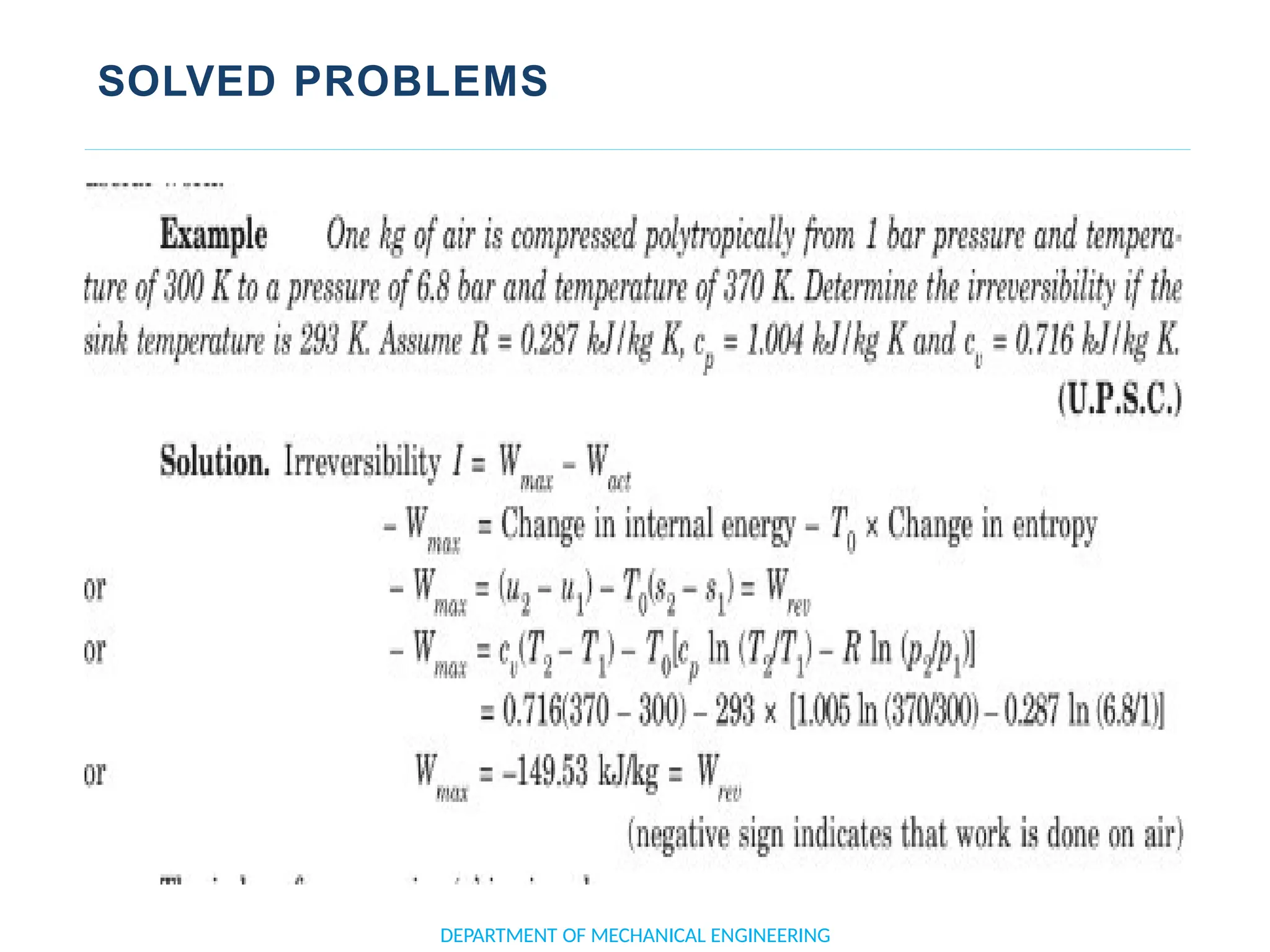
The actual work done by a system is
always less than idealized reversible work
and the difference between the two is
called the irreversibility of the process.
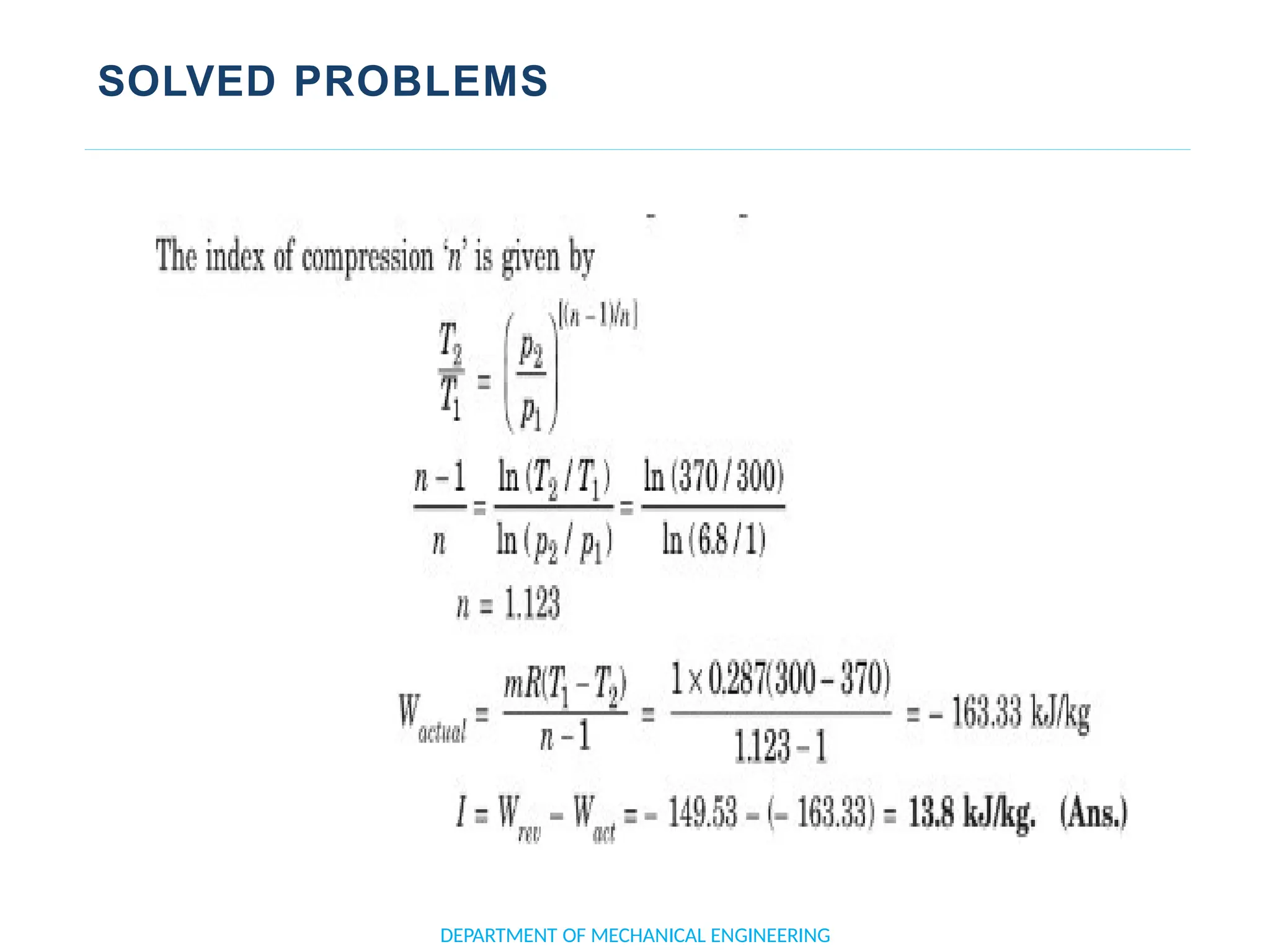
I = Wmax - W
I = T0(ΔSsystem + ΔSsurrounding)
I = T0(ΔS)universal
T0(ΔS)universal represent an increase in
unavailable energy.
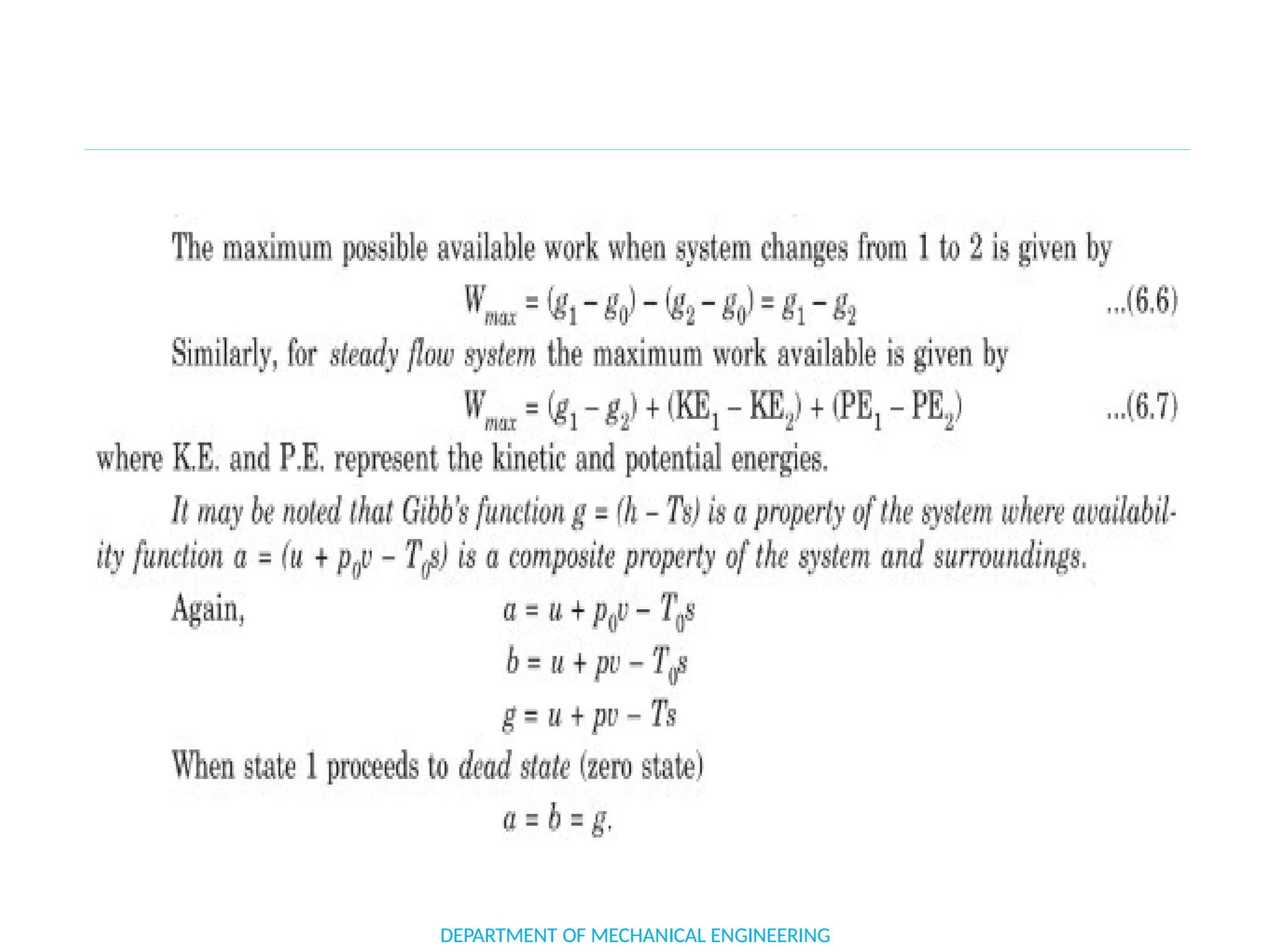
THERMODYNAMIC POTENTIALS, GIBBS AND
HELMHOLTZ FUNCTIONS
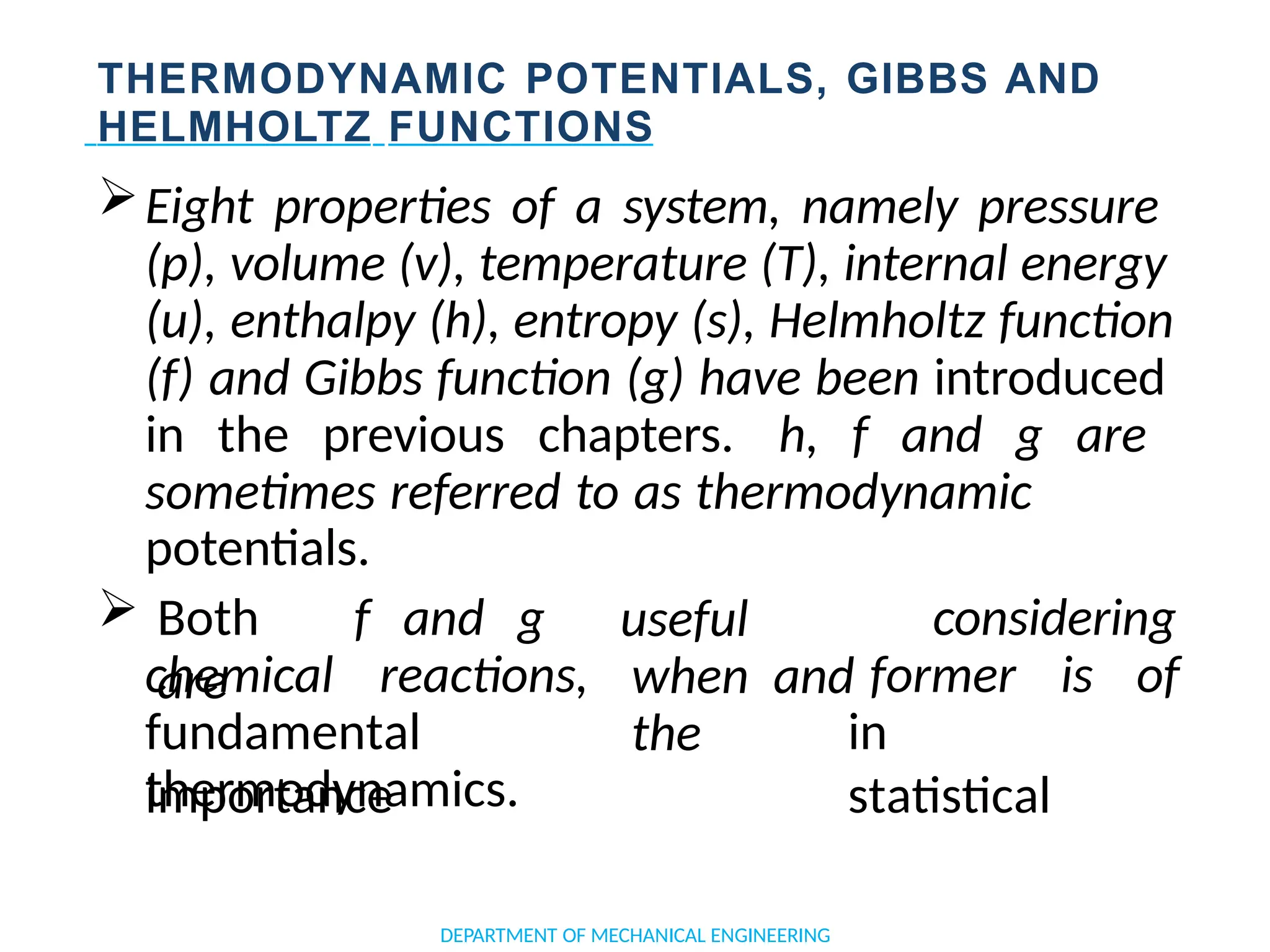
Eight properties of a system, namely pressure
(p), volume (v), temperature (T), internal energy
(u), enthalpy (h), entropy (s), Helmholtz function
(f) and Gibbs function (g) have been introduced
in the previous chapters. h, f and g are
sometimes referred to as thermodynamic
potentials.
DEPARTMENT OF MECHANICAL ENGINEERING
 Both f and g
are
considering
chemical reactions,
useful
when and
the
former is of
fundamental
importance
in
statistical
thermodynamics.
THERMODYNAMIC POTENTIALS, GIBBS AND
HELMHOLTZ FUNCTIONS
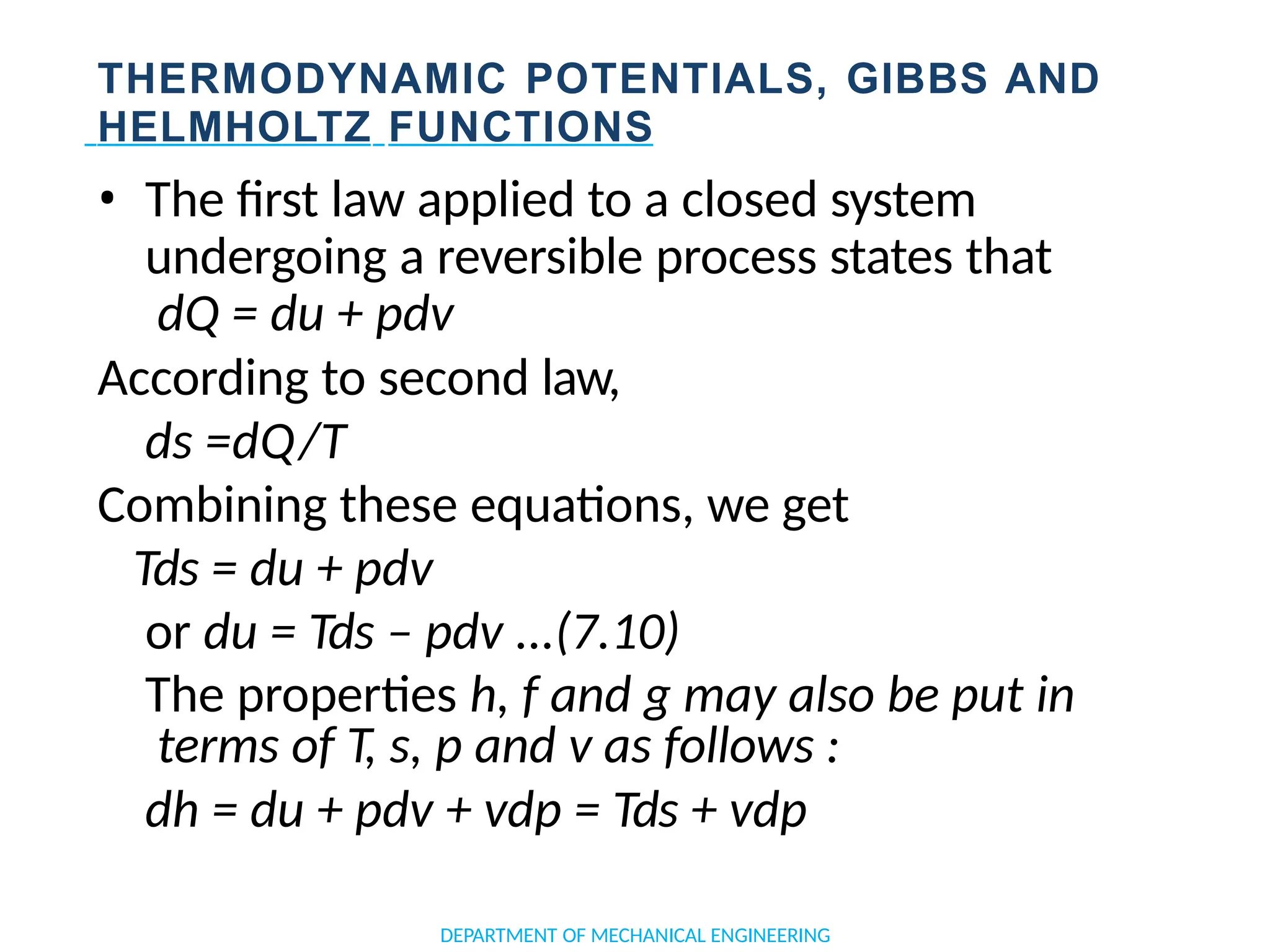
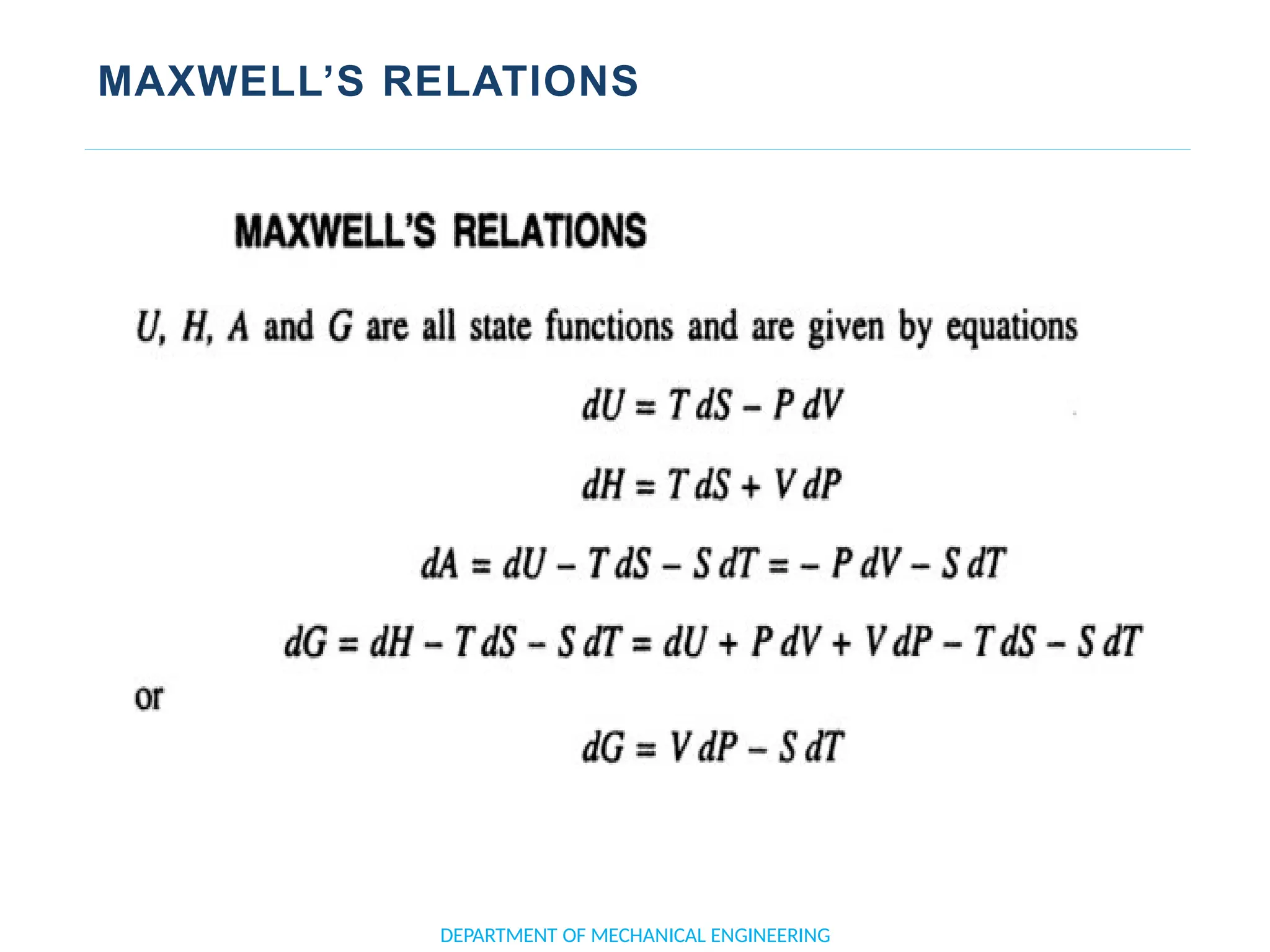
• The first law applied to a closed system
undergoing a reversible process states that
dQ = du + pdv
According to second law,
ds =dQ/T
Combining these equations, we get
Tds = du + pdv
or du = Tds – pdv ...(7.10)
The properties h, f and g may also be put in
terms of T, s, p and v as follows :
dh = du + pdv + vdp = Tds + vdp
DEPARTMENT OF MECHANICAL ENGINEERING
THERMODYNAMIC POTENTIALS, GIBBS AND
HELMHOLTZ FUNCTIONS
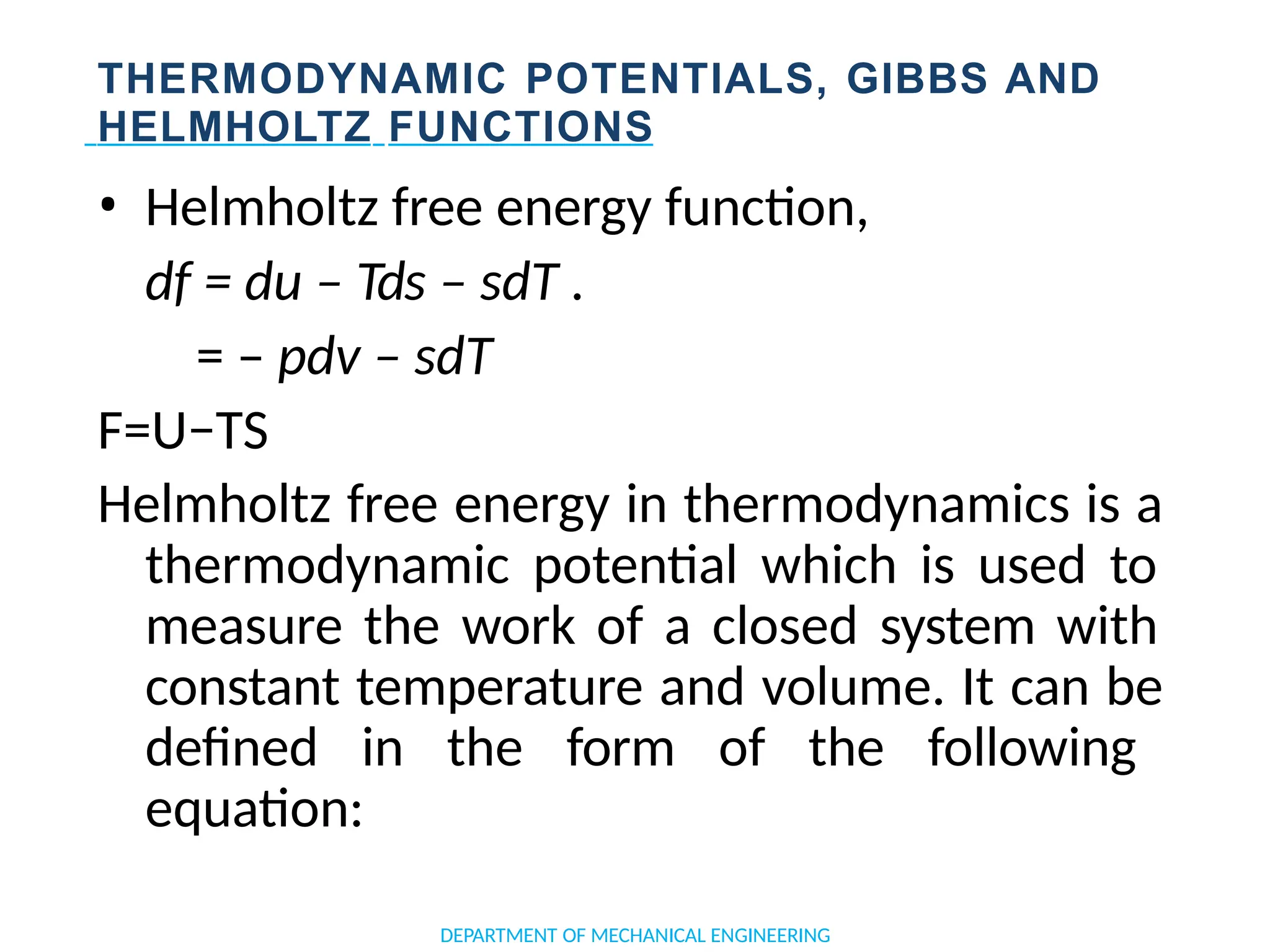
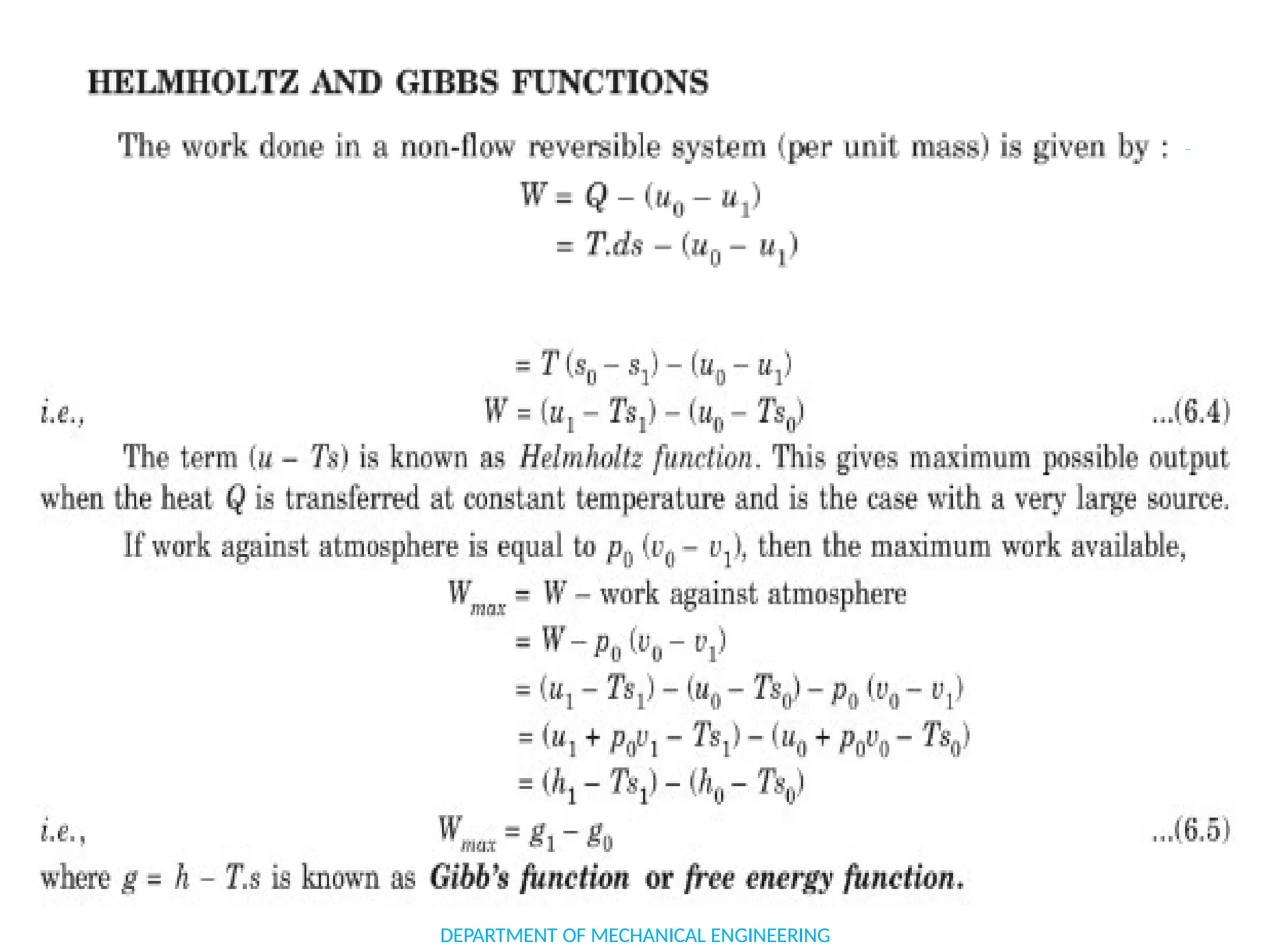
• Helmholtz free energy function,
df = du – Tds – sdT .
= – pdv – sdT
F=U−TS
Helmholtz free energy in thermodynamics is a
thermodynamic potential which is used to
measure the work of a closed system with
constant temperature and volume. It can be
defined in the form of the following
equation:
DEPARTMENT OF MECHANICAL ENGINEERING
THERMODYNAMIC POTENTIALS, GIBBS AND
HELMHOLTZ FUNCTIONS
• F=U−T
S
Where,
• F is the
Helmho
ltz free
energy
in
Joules
• U is the internal energy of the system in
Joules DEPARTMENT OF MECHANICAL ENGINEERING
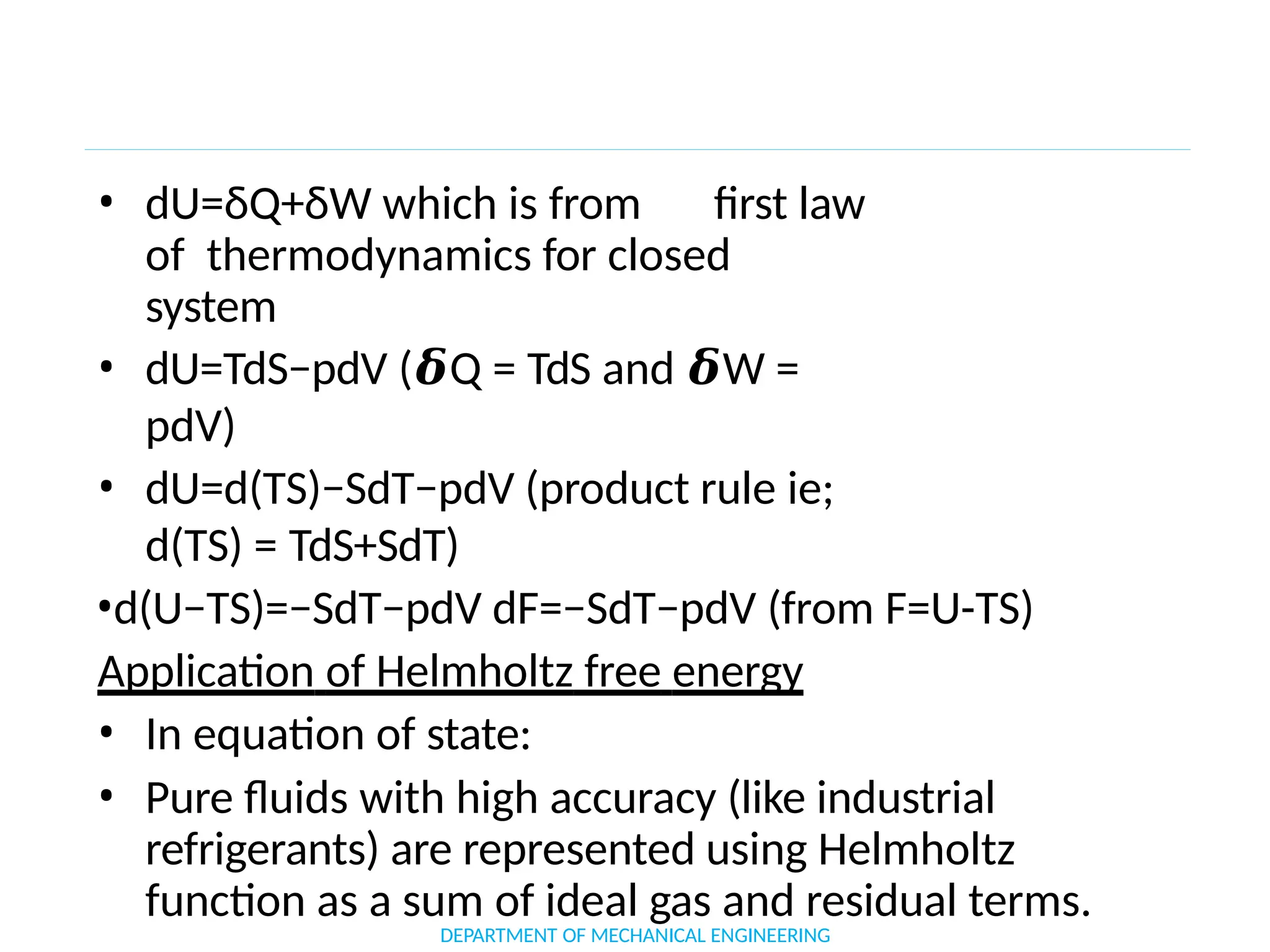
• dU=δQ+δW which is from first law
of thermodynamics for closed
system
• dU=TdS−pdV (𝜹Q = TdS and 𝜹W =
pdV)
• dU=d(TS)−SdT−pdV (product rule ie;
d(TS) = TdS+SdT)
•d(U−TS)=−SdT−pdV dF=−SdT−pdV (from F=U-TS)
Application of Helmholtz free energy
• In equation of state:
• Pure fluids with high accuracy (like industrial
refrigerants) are represented using Helmholtz
function as a sum of ideal gas and residual terms.
DEPARTMENT OF MECHANICAL ENGINEERING
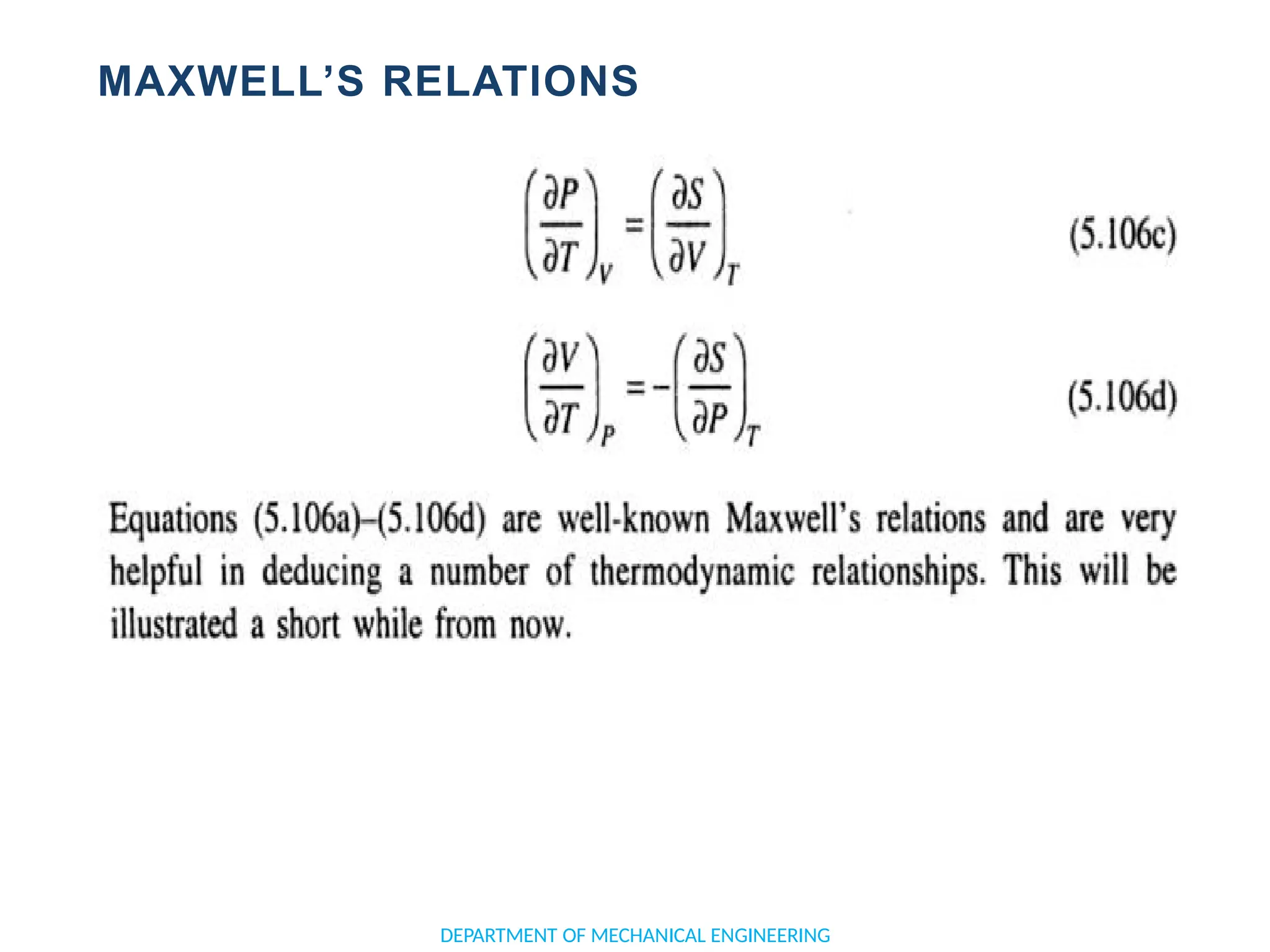
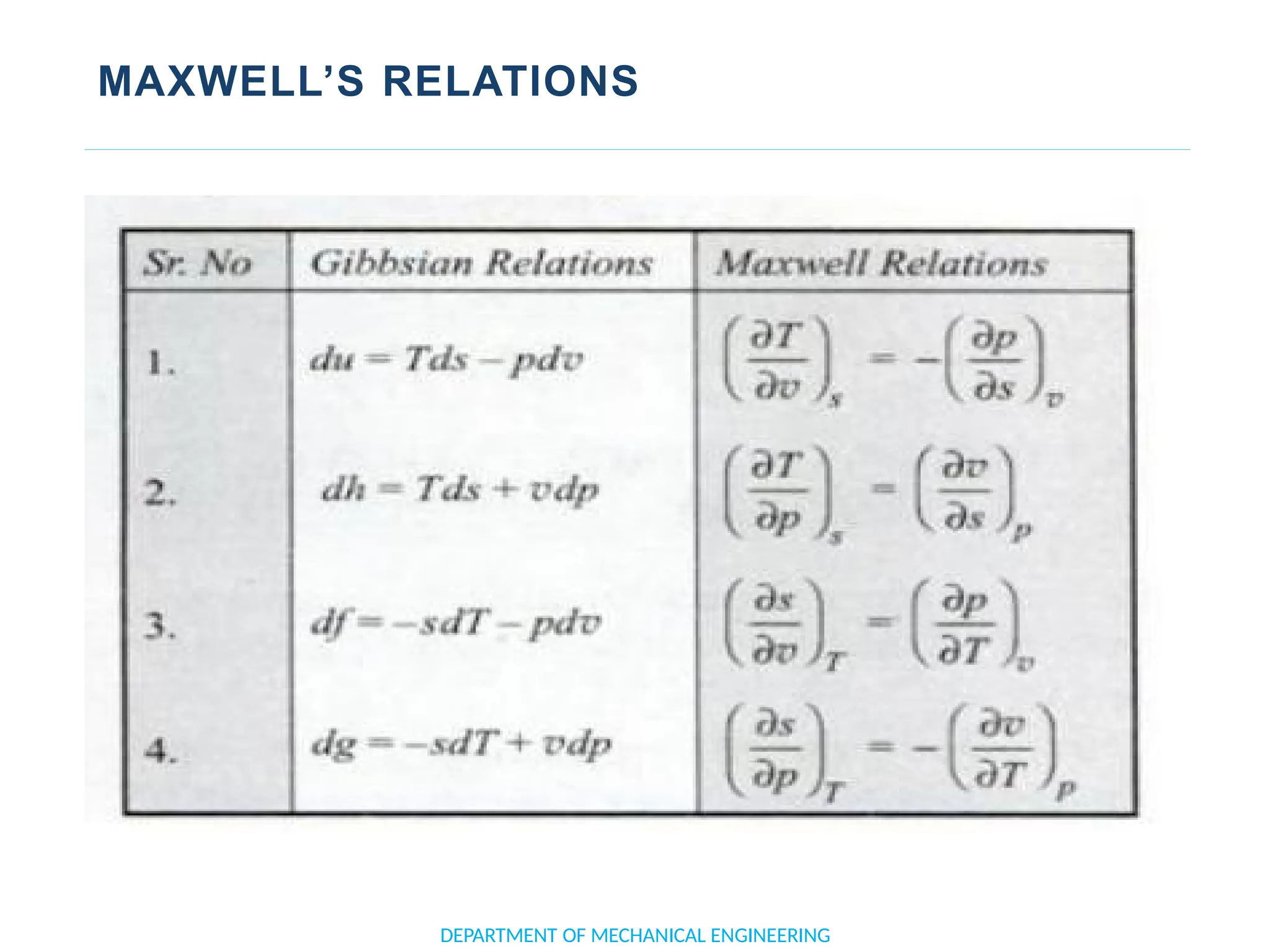
MAXWELL’S RELATIONS
DEPARTMENT OF MECHANICAL ENGINEERING
MAXWELL’S RELATIONS
DEPARTMENT OF MECHANICAL ENGINEERING
MAXWELL’S RELATIONS
DEPARTMENT OF MECHANICAL ENGINEERING
MAXWELL’S RELATIONS
DEPARTMENT OF MECHANICAL ENGINEERING
THIRD LAW OF THERMODYNAMICS
DEPARTMENT OF MECHANICAL ENGINEERING
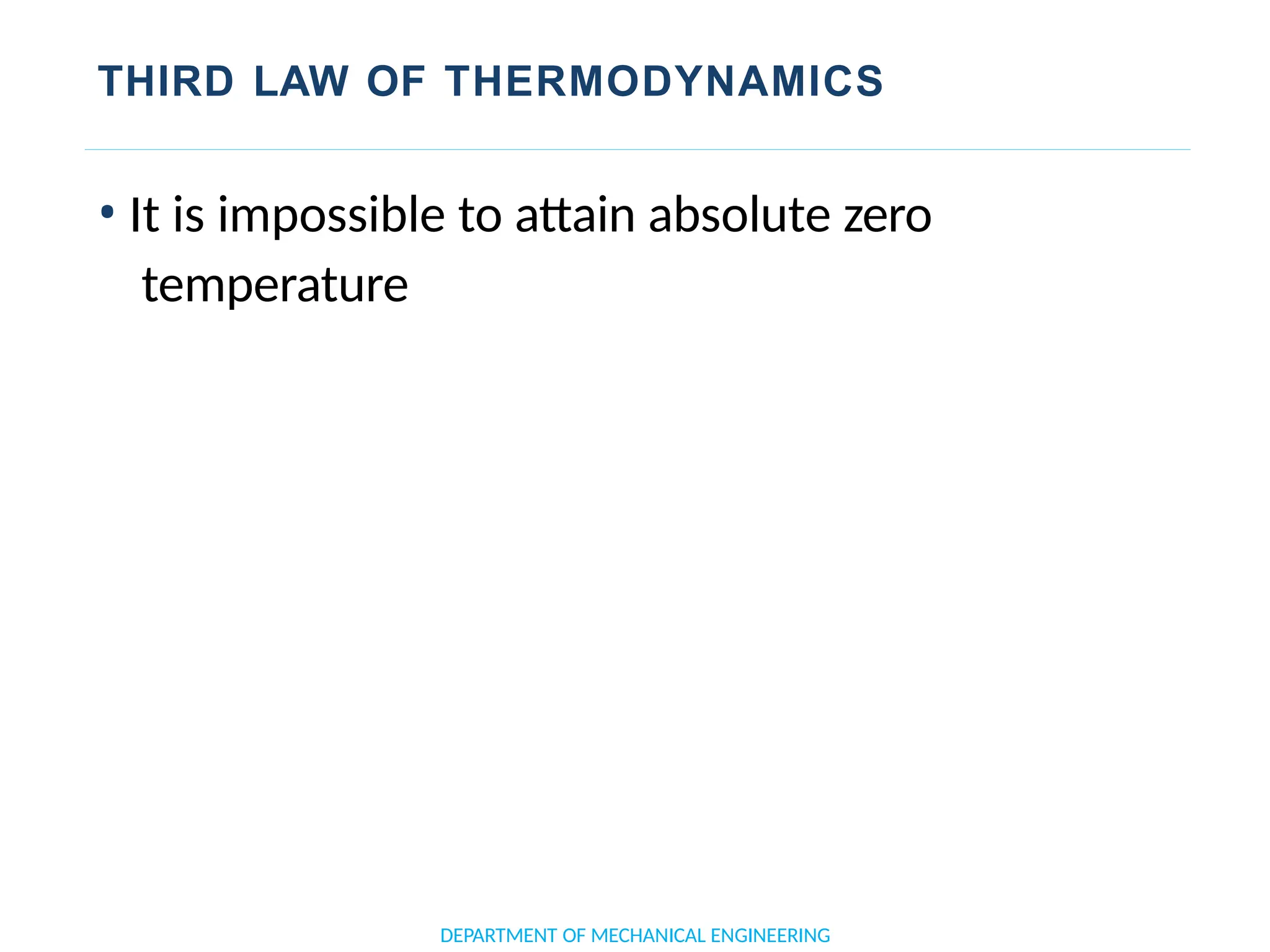
• It is impossible to attain absolute zero
temperature
SOLVED PROBLEMS
DEPARTMENT OF MECHANICAL ENGINEERING
SOLVED PROBLEMS
DEPARTMENT OF MECHANICAL ENGINEERING
SOLVED PROBLEMS
DEPARTMENT OF MECHANICAL ENGINEERING
SOLVED PROBLEMS
DEPARTMENT OF MECHANICAL ENGINEERING
SOLVED PROBLEMS
DEPARTMENT OF MECHANICAL ENGINEERING
SOLVED PROBLEMS
DEPARTMENT OF MECHANICAL ENGINEERING
SOLVED PROBLEMS
DEPARTMENT OF MECHANICAL ENGINEERING
SOLVED PROBLEMS
DEPARTMENT OF MECHANICAL ENGINEERING
SOLVED PROBLEMS
DEPARTMENT OF MECHANICAL ENGINEERING
SOLVED PROBLEMS
DEPARTMENT OF MECHANICAL ENGINEERING
SOLVED PROBLEMS
DEPARTMENT OF MECHANICAL ENGINEERING
SOLVED PROBLEMS
DEPARTMENT OF MECHANICAL ENGINEERING
SOLVED PROBLEMS
DEPARTMENT OF MECHANICAL ENGINEERING
SOLVED PROBLEMS
DEPARTMENT OF MECHANICAL ENGINEERING
SOLVED PROBLEMS
DEPARTMENT OF MECHANICAL ENGINEERING
SOLVED PROBLEMS
DEPARTMENT OF MECHANICAL ENGINEERING
SOLVED PROBLEMS
DEPARTMENT OF MECHANICAL ENGINEERING
SOLVED PROBLEMS
DEPARTMENT OF MECHANICAL ENGINEERING
INDUSTRIAL APPLICATIONS
• Automobile industries.
• Refrigeration industries
• Air craft applications
• Defense industries
• Thermal power plants
• Chemical industries
• Textile industries etc.
DEPARTMENT OF MECHANICAL ENGINEERING
SELF LEARNING QUESTIONS
• Describe briefly about the second law
of thermodynamics with its
corollaries.
• State the limitations of first law of
thermodynamics? State PMM 2?
• Discuss briefly about Clausius inequality.
• Discuss the significance of Third
law of thermodynamics
• Derive the expression for the efficiency of
Carnot cycle with p-V and T-s diagrams.
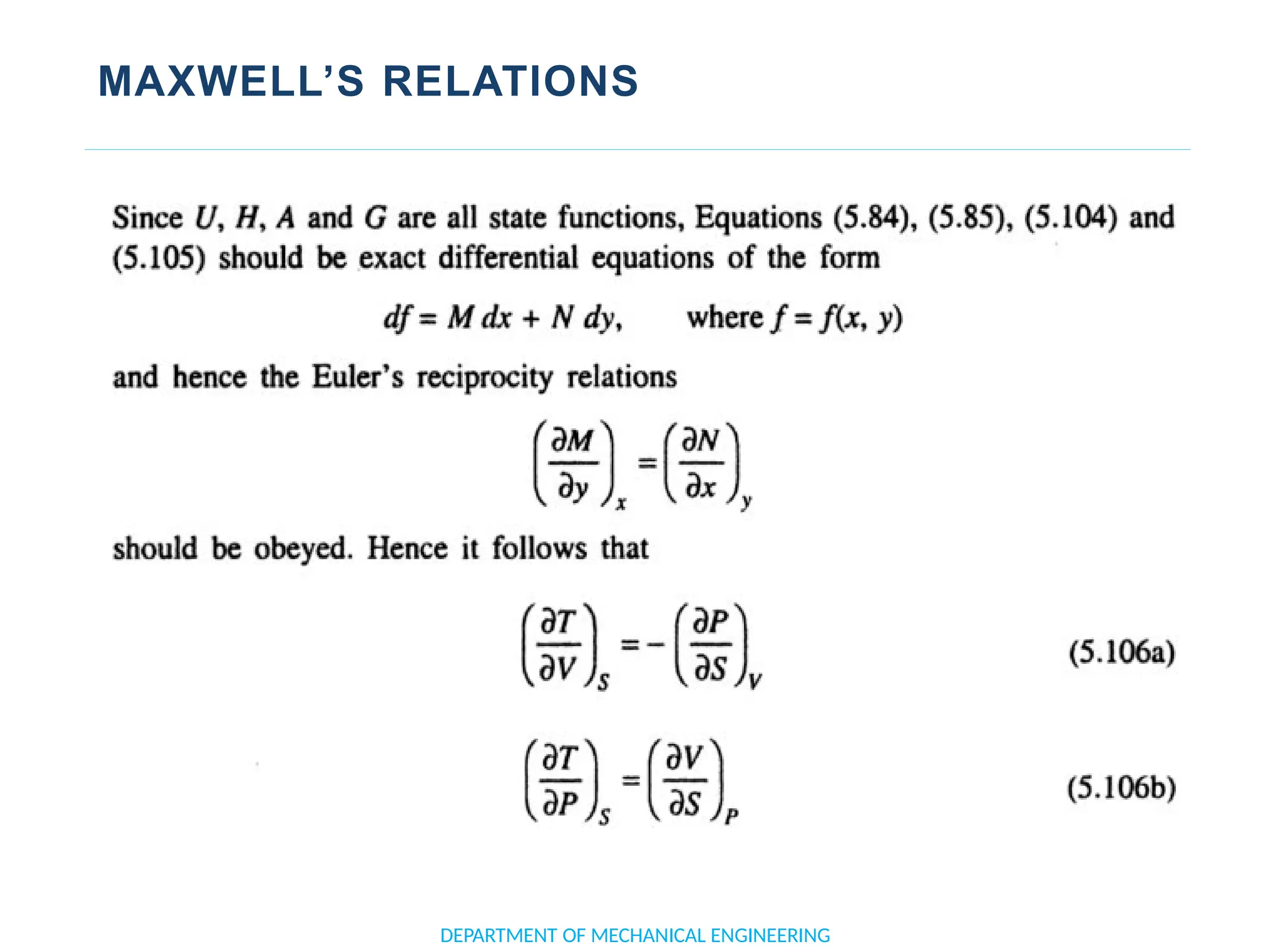
• Solve one T -dS equation by using
Maxwell’s relations?
DEPARTMENT OF MECHANICAL ENGINEERING
ASSIGNMENT EXERCISES
DEPARTMENT OF MECHANICAL ENGINEERING
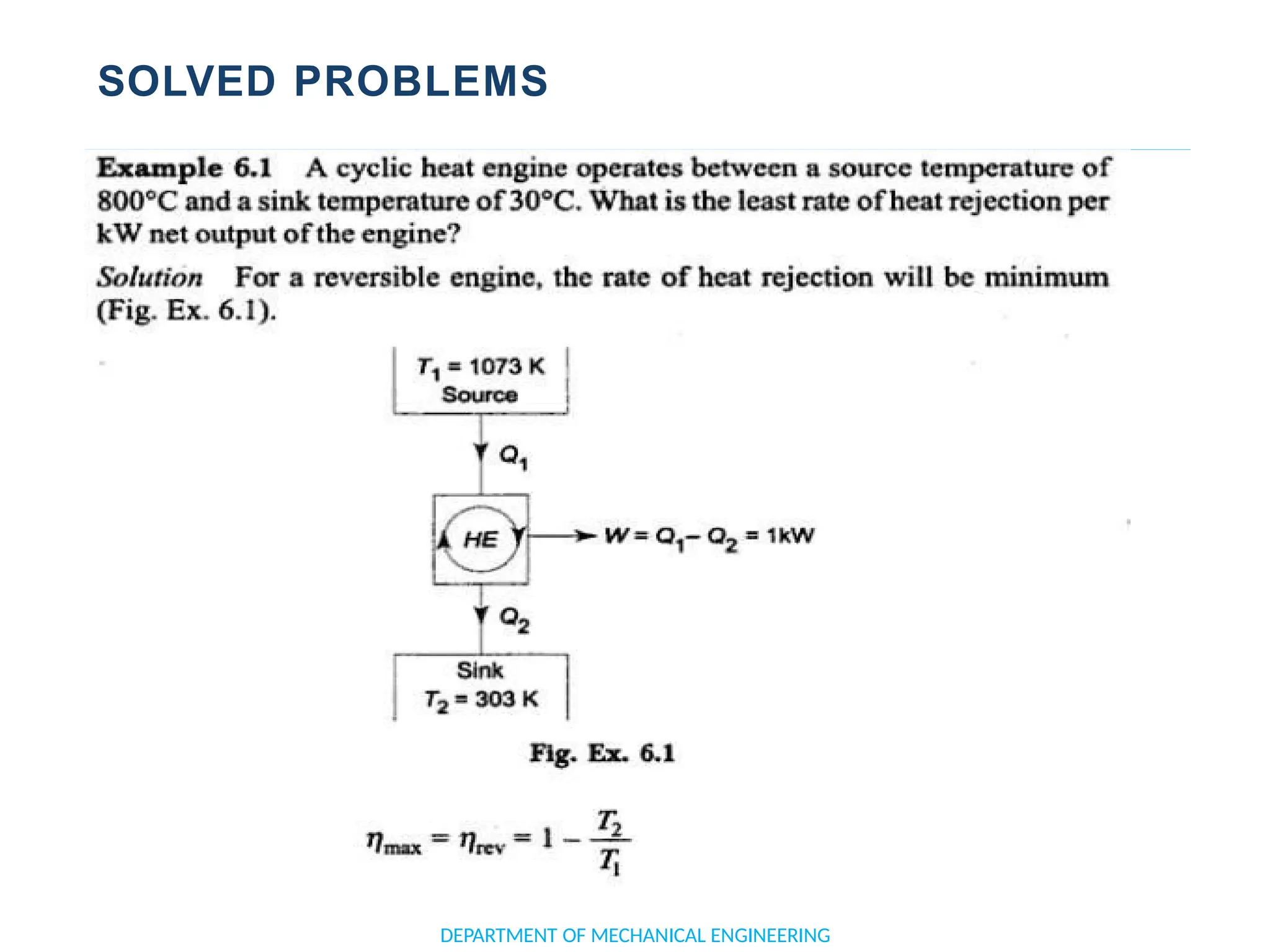
• 0.5 kg of air executes a Carnot power cycle having a
thermal efficiency of 50%. The heat transfer to the air
during isothermal expansion is 40 kJ. At the beginning of
the isothermal expansion the pressure is 7 bar and the
volume is
0.12 m3. Determine the maximum and minimum
temperatures for the cycle in Kelvin, the volume at the
end of isothermal expansion in m3 and the work, heat
transfer for each of the four processes in kJ. cp=1.008
kJ/kgK and cv=0.721 kJ/kgK for air.
• Water is heated at a constant pressure of 0.7 MPa. The
boiling point is 164.970C. The initial temperature of
water is 00C. The latent heat of evaporation is 2066.3
kJ/kg. Find the increase of entropy of water if the final
temperature is steam.
ASSIGNMENT EXERCISES
• 1kg of ice at -50C expose to the atmosphere which,
is at 200C. The ice melts and comes into thermal
equilibrium with the atmosphere. Determine the
entropy increase of Universe. Cp for ice is 2.039
kJ/kgK, and the enthalpy of fusion of ice is
333.3kJ/kg.
• A heat engine is operating between two reservoirs
1000K and 300K is used to drive a heat pump
which extracts heat from the reservoir at 300K at A
heat engine is operating between two reservoirs
1000K and 300K is used to drive a heat pump
which extracts heat from the reservoir at 300K.
The efficiency of both the engines is equal. What is
the value of temperature T2.
DEPARTMENT OF MECHANICAL ENGINEERING
THANK YOU
E N GIN E E R IN G
THERMODYNAMICS
DEPARTMENT OF MECHANICAL ENGINEERING
COURSE OBJECTIVES
UNIT -
1
CO1:To understand the concepts of
energy transformation, conversion of
heat into work.
UNIT -
2
CO2:To acquire knowledge about the
fundamentals of thermodynamic laws, the
concept of entropy, and principles
UNIT -
3
CO3: To understand how the change of state
results in a process.
UNIT -
4
CO4: To understand the various gas
laws, psychrometric properties and
chart.
UNIT -
5
CO5: To learn the importance of
thermodynamic cycles, and the derivation of
efficiency.
UNIT I I
I
CO3: To understand how the change of state
results in a process.
P U R E S U B S TA N C E
S
UNIT – III (SYLLABUS)
Properties of Pure Substances
• p-V-T- surfaces, T-S and h-s diagrams
• Mollier Charts, Phase Transformations
• Triple point at critical state properties
• Dryness Fraction energy Transfer
• Steam Calorimetry.
• Perfect Gas Laws – Equation of State
• Throttling and Free Expansion Processes
• Deviations from perfect Gas Model –
Vander Waals Equation of State.
DEPARTMENT OF MECHANICAL ENGINEERING
COURSE OUTLINE
DEPARTMENT OF MECHANICAL ENGINEERING
LECTURE LECTURE TOPIC KEY ELEMENTS Learning objectives
(2 to 3 objectives)
1
Pure Substances: p-V-T- surfaces Properties of pure
substances
Phase change properties
of pure substances (B2)
2
T-S and h-s diagrams, Phase Transformations Enthalpy and entropy
diagrams
Applications of Mollier
chart (B3)
3
Triple point at critical state properties during
change of phase
Concept of triple point Understanding triple
point temperature (B2)
4
Dryness Fraction – Mollier charts Concept of quality of
steam
Measurement of dryness
fraction (B3)
5
Various Thermodynamic processes and energy
Transfer
Isobaric process,
Isothermal process
Energy transfer in
different processes (B4)
6
Steam Calorimetry Throttling calorimeter Working principles of
different steam
calorimeters (B4)
7
Perfect Gas Laws, Equation of State Boyles law, Charles law Understanding of gas
laws (B2)
8
Flow processes – Deviations from perfect Gas
Model – Vander Waals Equation of State.
Vander Waals Equation Understanding different
flow processes (B2)
UNIT -3
LECTURE 3
Properties of Pure substances
PURE SUBSTANCE
DEPARTMENT OF MECHANICAL ENGINEERING
• A substance that has a fixed chemical
composition throughout the system is
called a pure substance.
• Water, hydrogen, nitrogen, and
carbon monoxide, for example, are
all pure substance.
• A pure substance can also be a mixture of
various chemical elements or
compounds as long as the mixture is
homogeneous.
PURE SUBSTANCE
• Air, a mixture of several compounds, is
often considered to be a pure substance
because it has a uniform chemical
composition.
• “A mixture of two or more phases of a
pure substance is still a pure substance as
long as the chemical composition of all
phases is the same.
• A mixture of ice and liquid water, for
example, is a pure substance because both
phases have
DEPARTMENT OF MECHANICAL ENGINEERING
PHASES OF A PURE SUBSTANCE
DEPARTMENT OF MECHANICAL ENGINEERING
PHASES OF A PURE SUBSTANCE
DEPARTMENT OF MECHANICAL ENGINEERING
PHASES OF A PURE SUBSTANCE
DEPARTMENT OF MECHANICAL ENGINEERING
PHASES OF A PURE SUBSTANCE
DEPARTMENT OF MECHANICAL ENGINEERING
PHASES OF A PURE SUBSTANCE
DEPARTMENT OF MECHANICAL ENGINEERING
PHASES OF A PURE SUBSTANCE
DEPARTMENT OF MECHANICAL ENGINEERING
PHASES OF A PURE SUBSTANCE
DEPARTMENT OF MECHANICAL ENGINEERING
PHASES OF A PURE SUBSTANCE
DEPARTMENT OF MECHANICAL ENGINEERING
TRIPLE POINT
DEPARTMENT OF MECHANICAL ENGINEERING
PHASES OF A PURE SUBSTANCE
DEPARTMENT OF MECHANICAL ENGINEERING
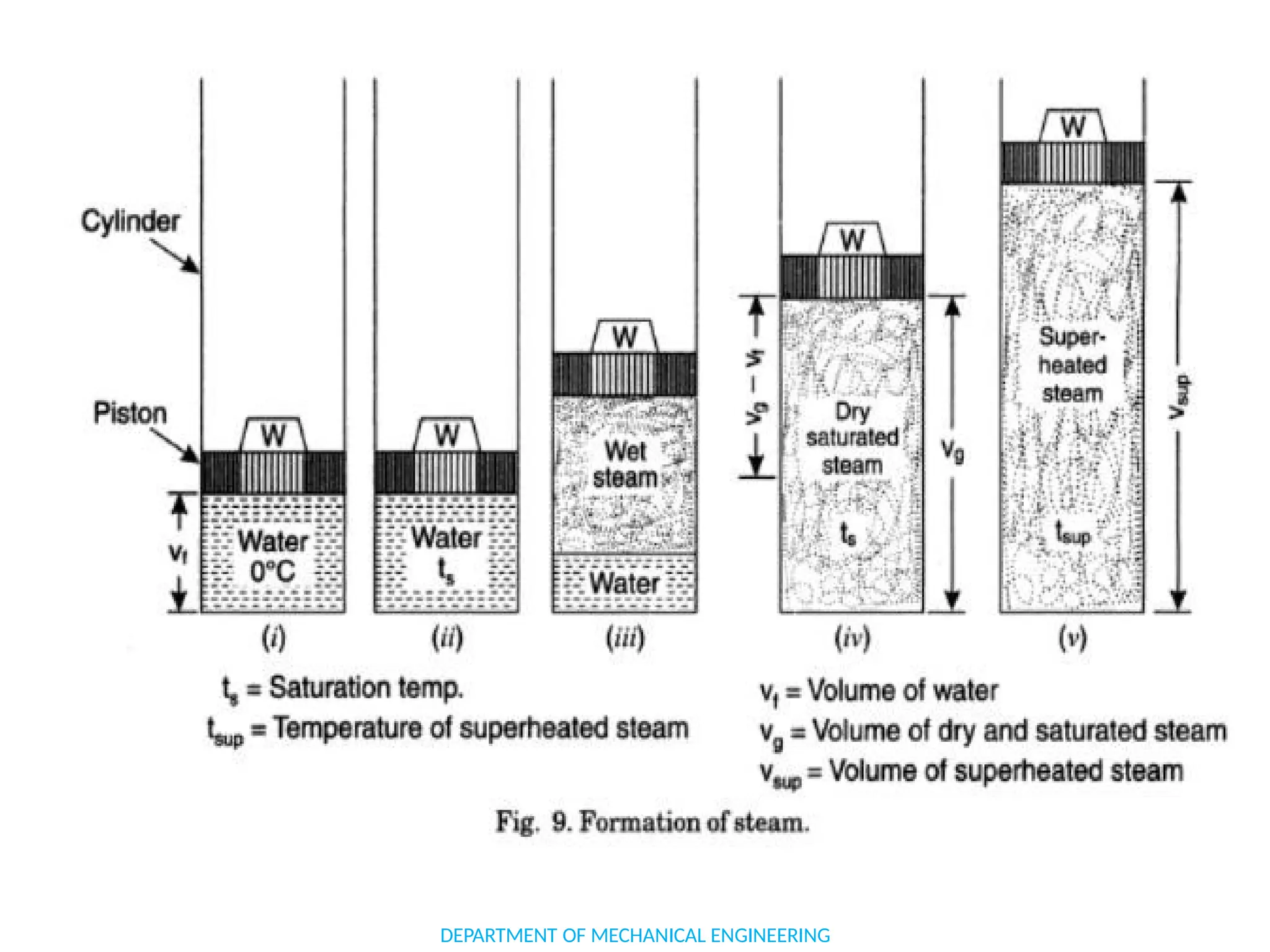
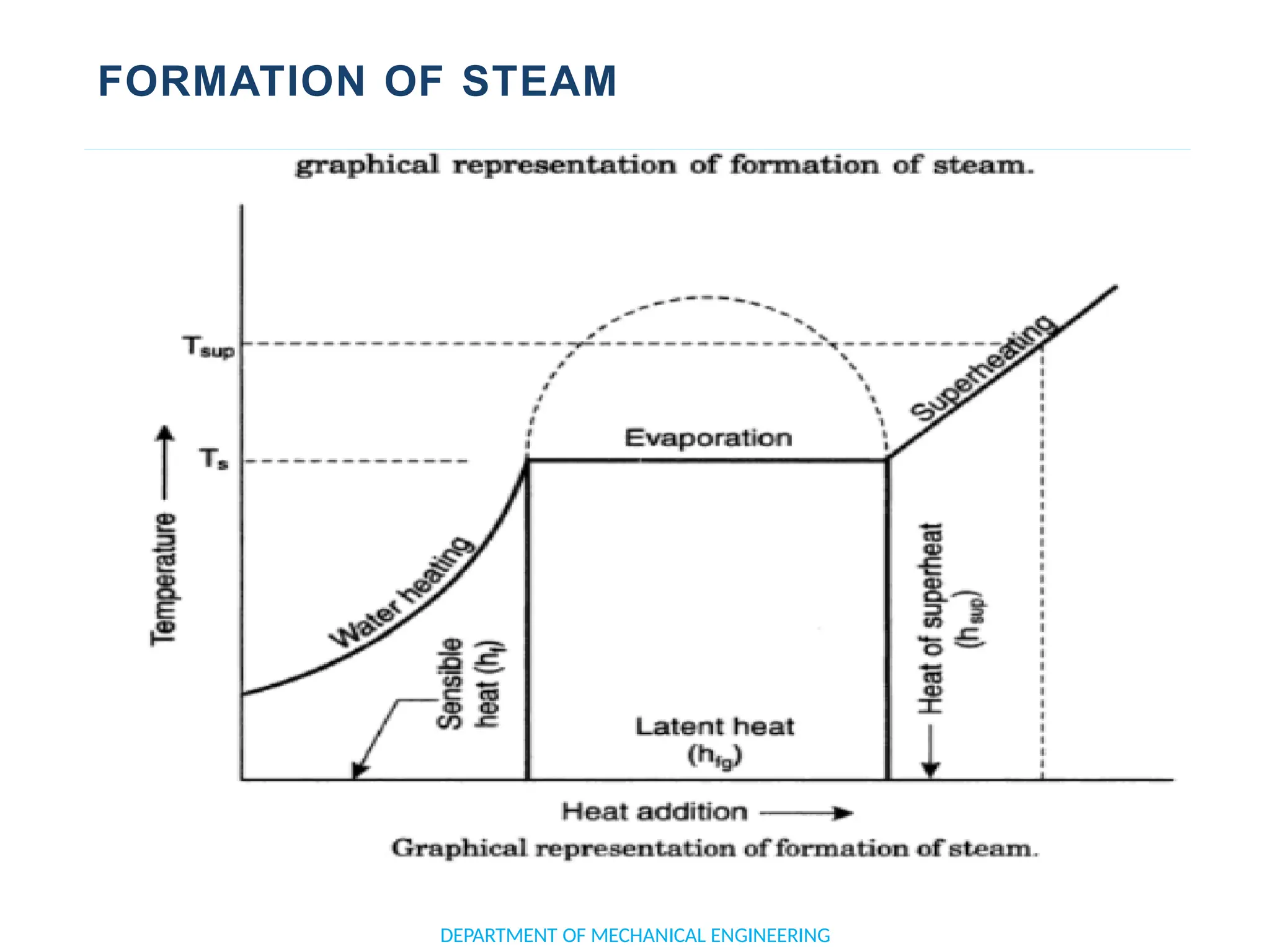
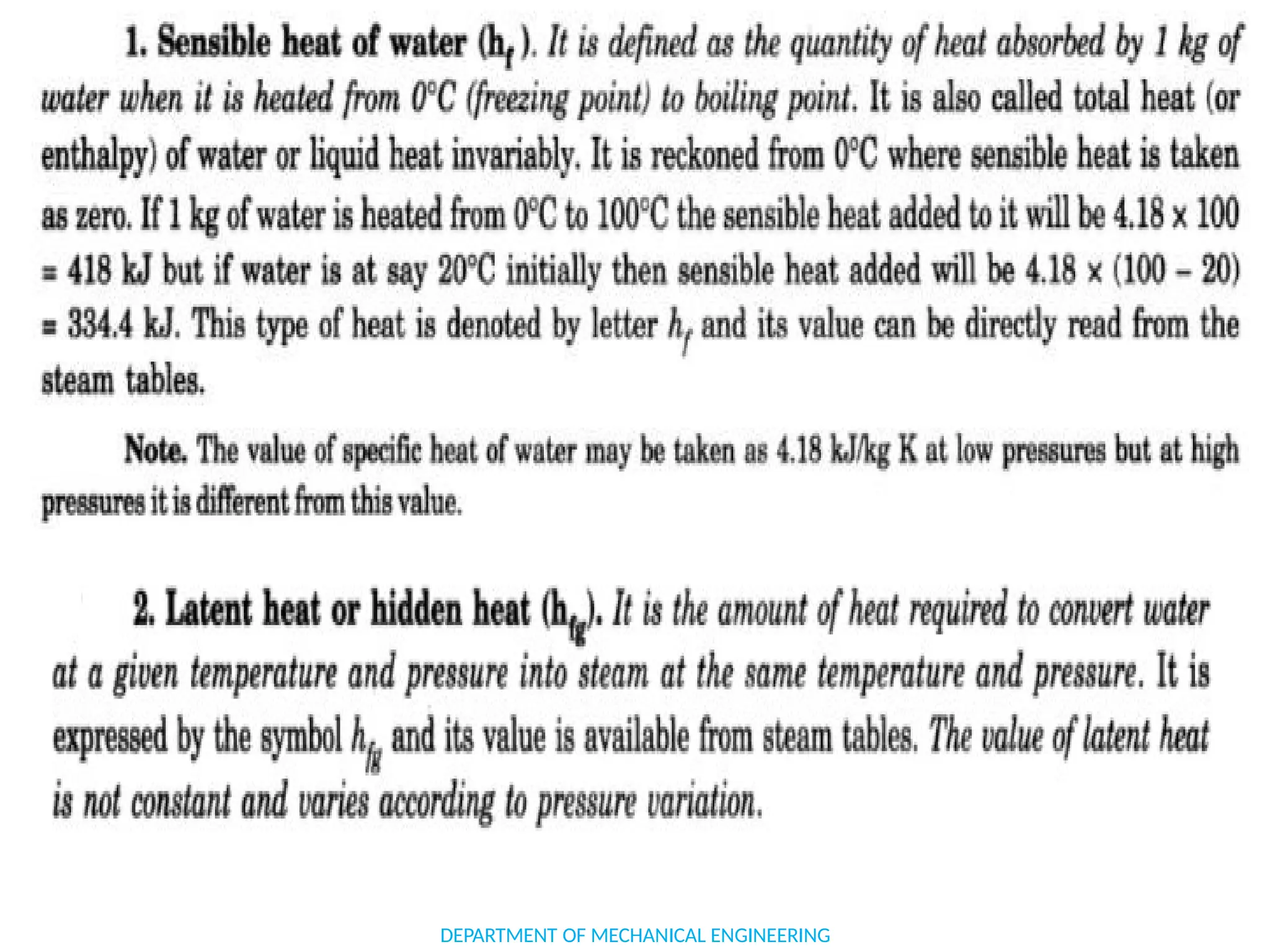
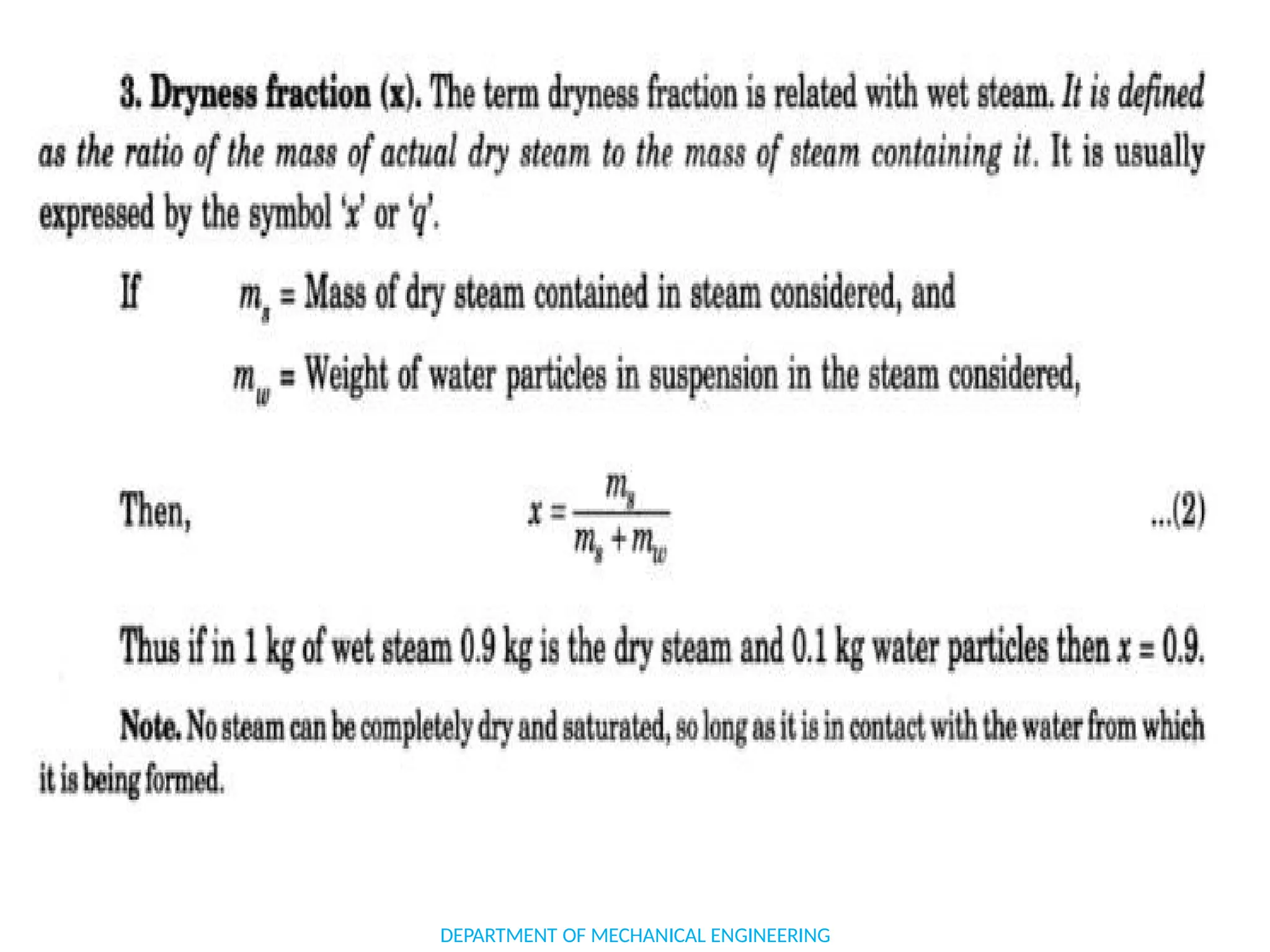
FORMATION OF STEAM
DEPARTMENT OF MECHANICAL ENGINEERING
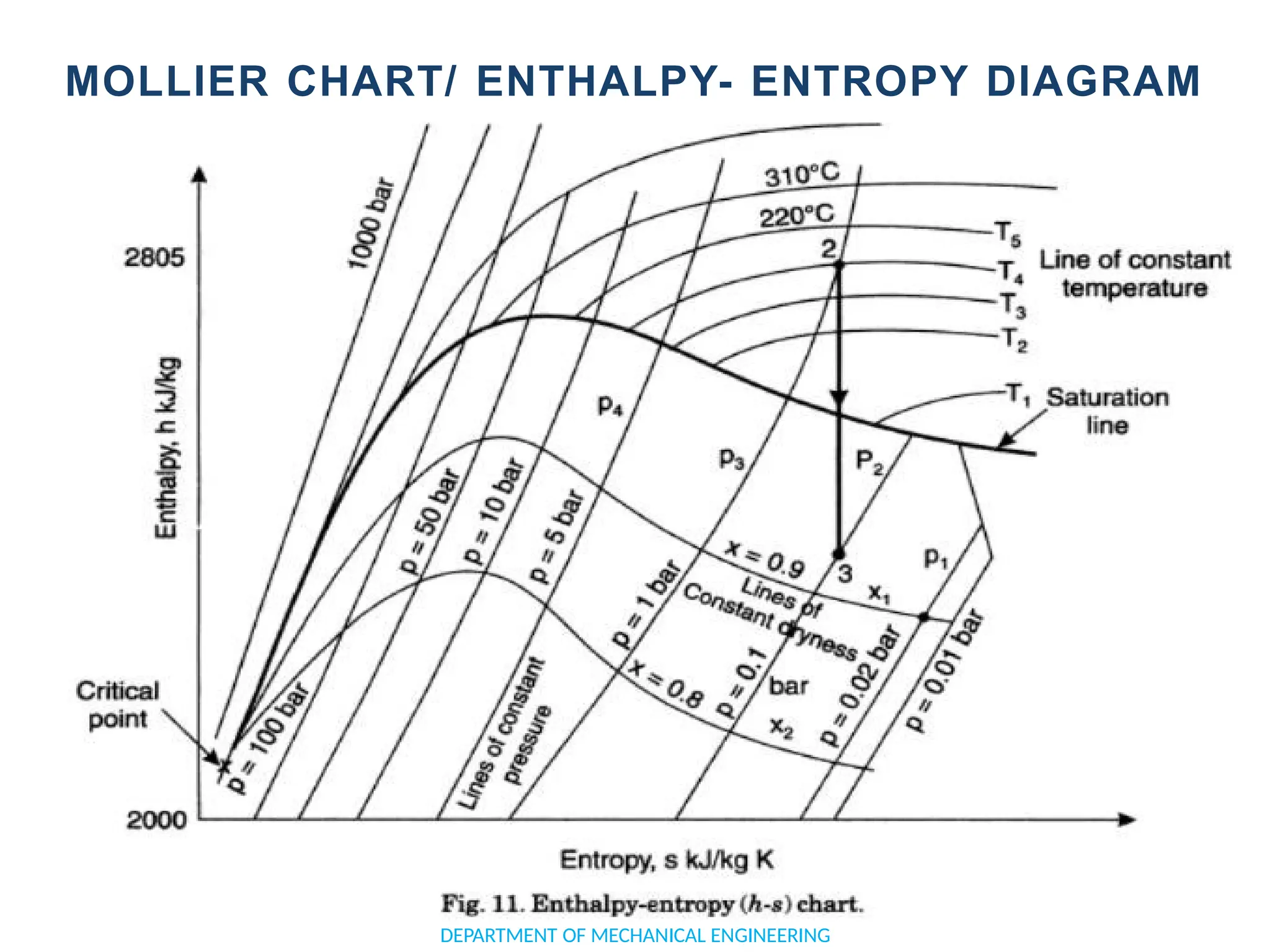
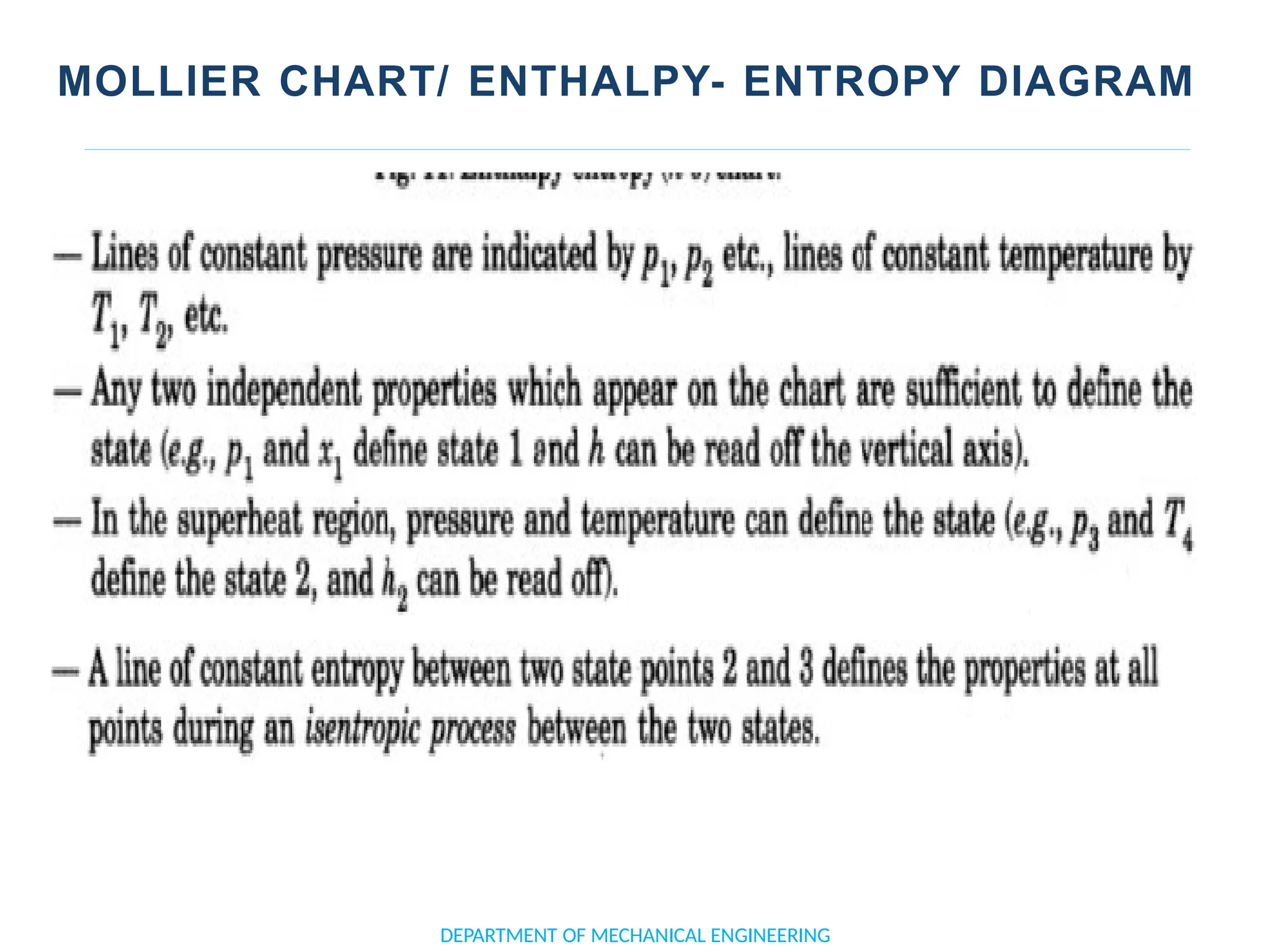
MOLLIER CHART/ ENTHALPY- ENTROPY DIAGRAM
DEPARTMENT OF MECHANICAL ENGINEERING
MOLLIER CHART/ ENTHALPY- ENTROPY DIAGRAM
DEPARTMENT OF MECHANICAL ENGINEERING
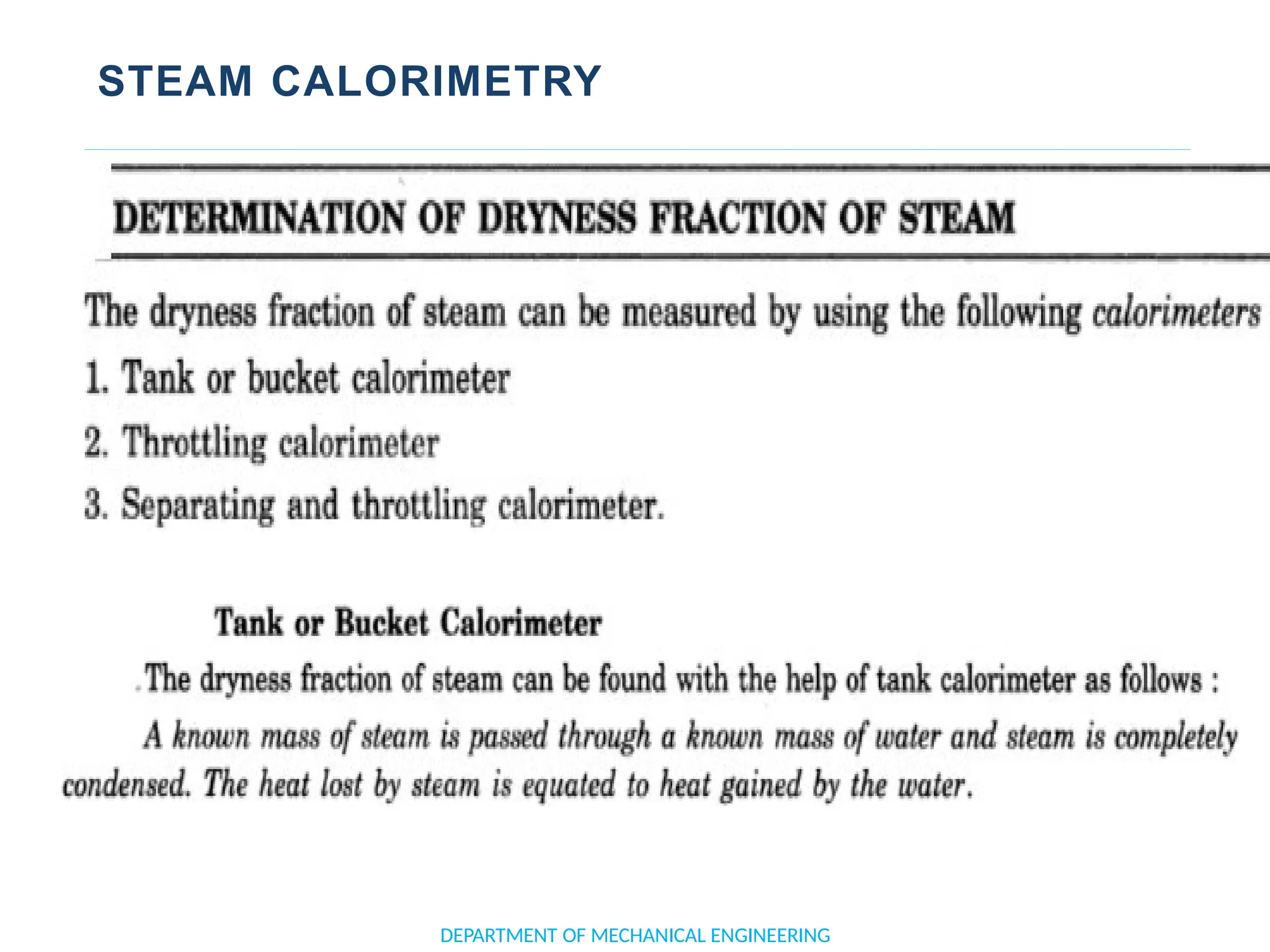
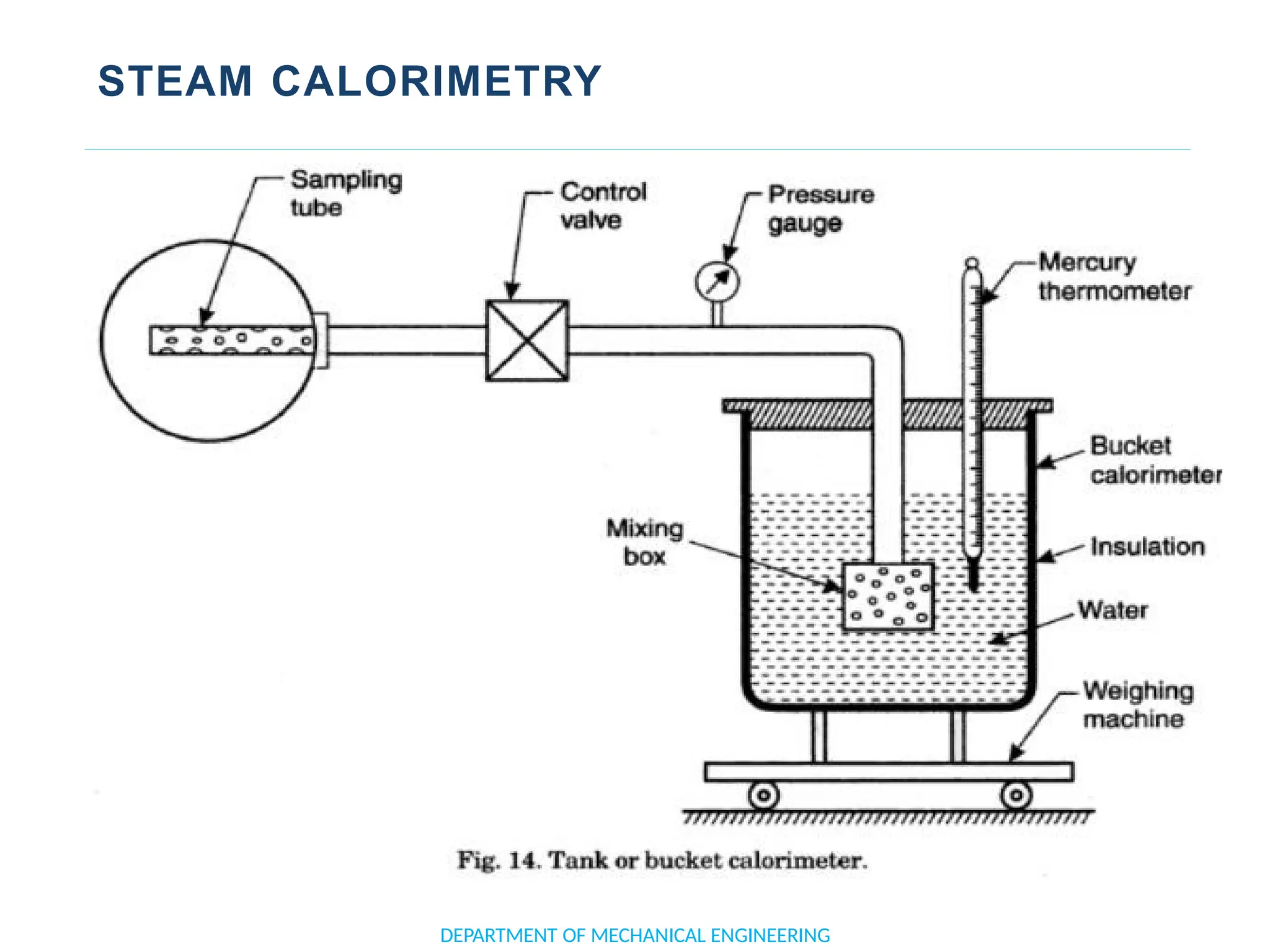
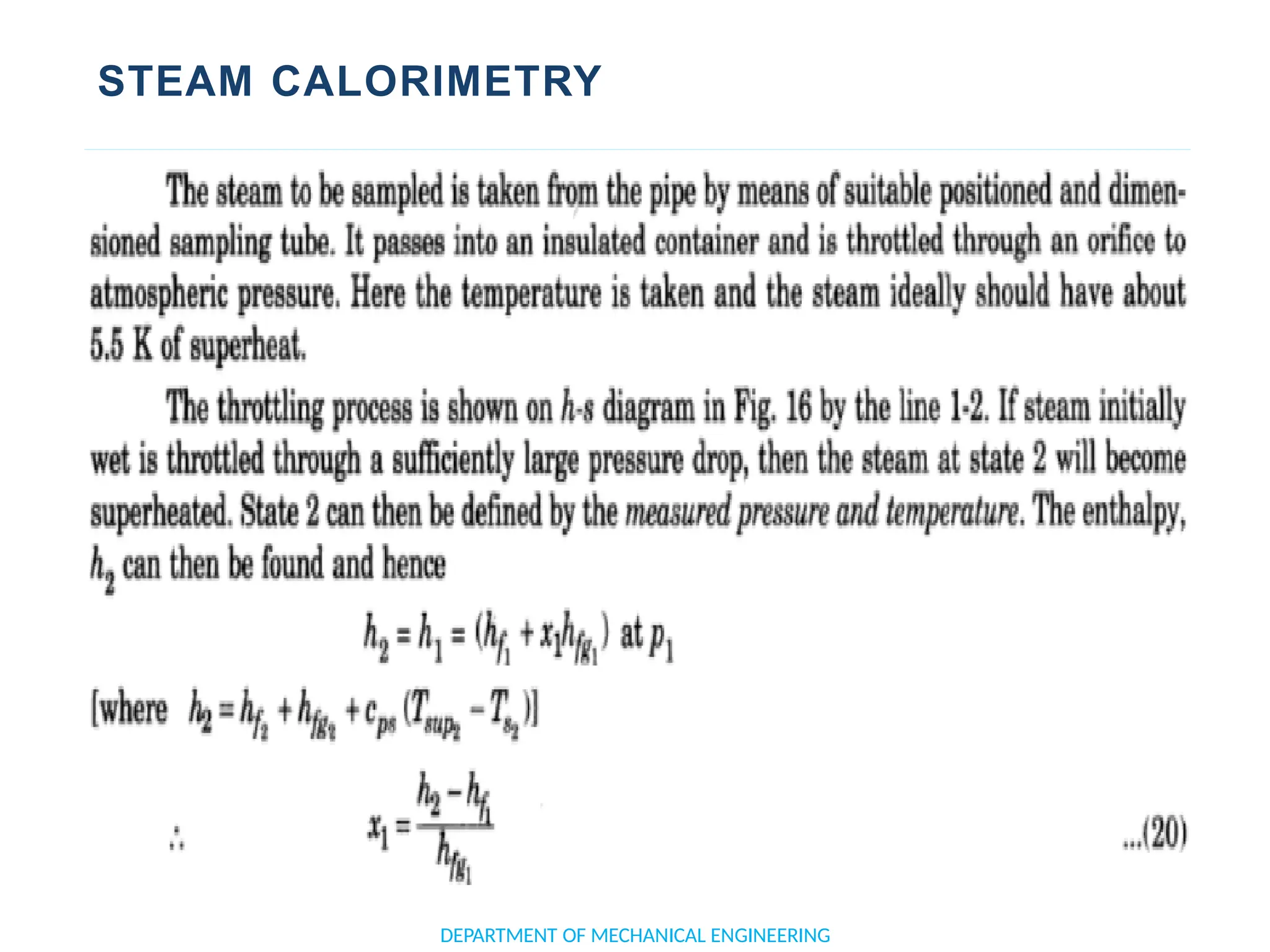
STEAM CALORIMETRY
DEPARTMENT OF MECHANICAL ENGINEERING
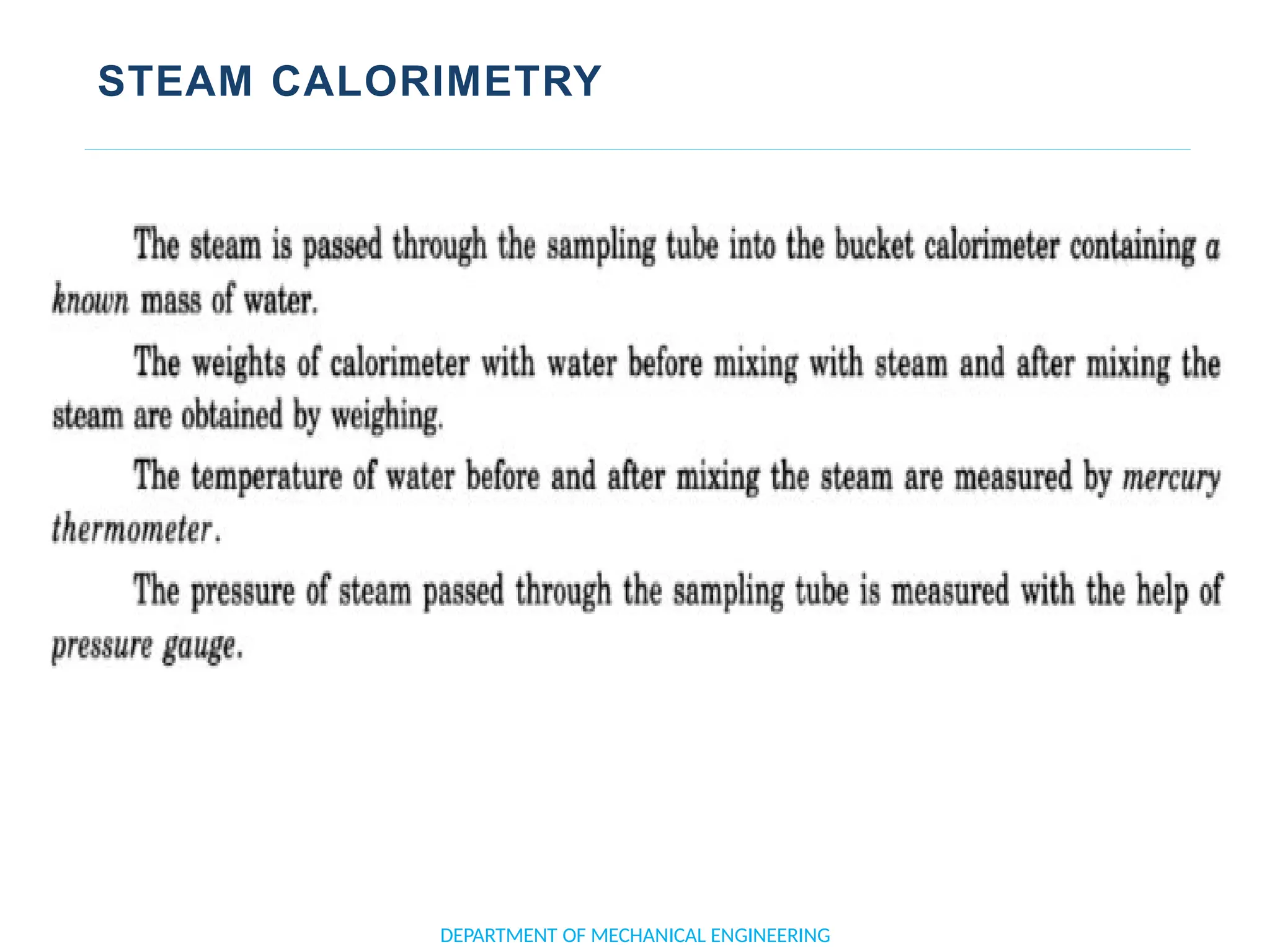
STEAM CALORIMETRY
DEPARTMENT OF MECHANICAL ENGINEERING
STEAM CALORIMETRY
DEPARTMENT OF MECHANICAL ENGINEERING
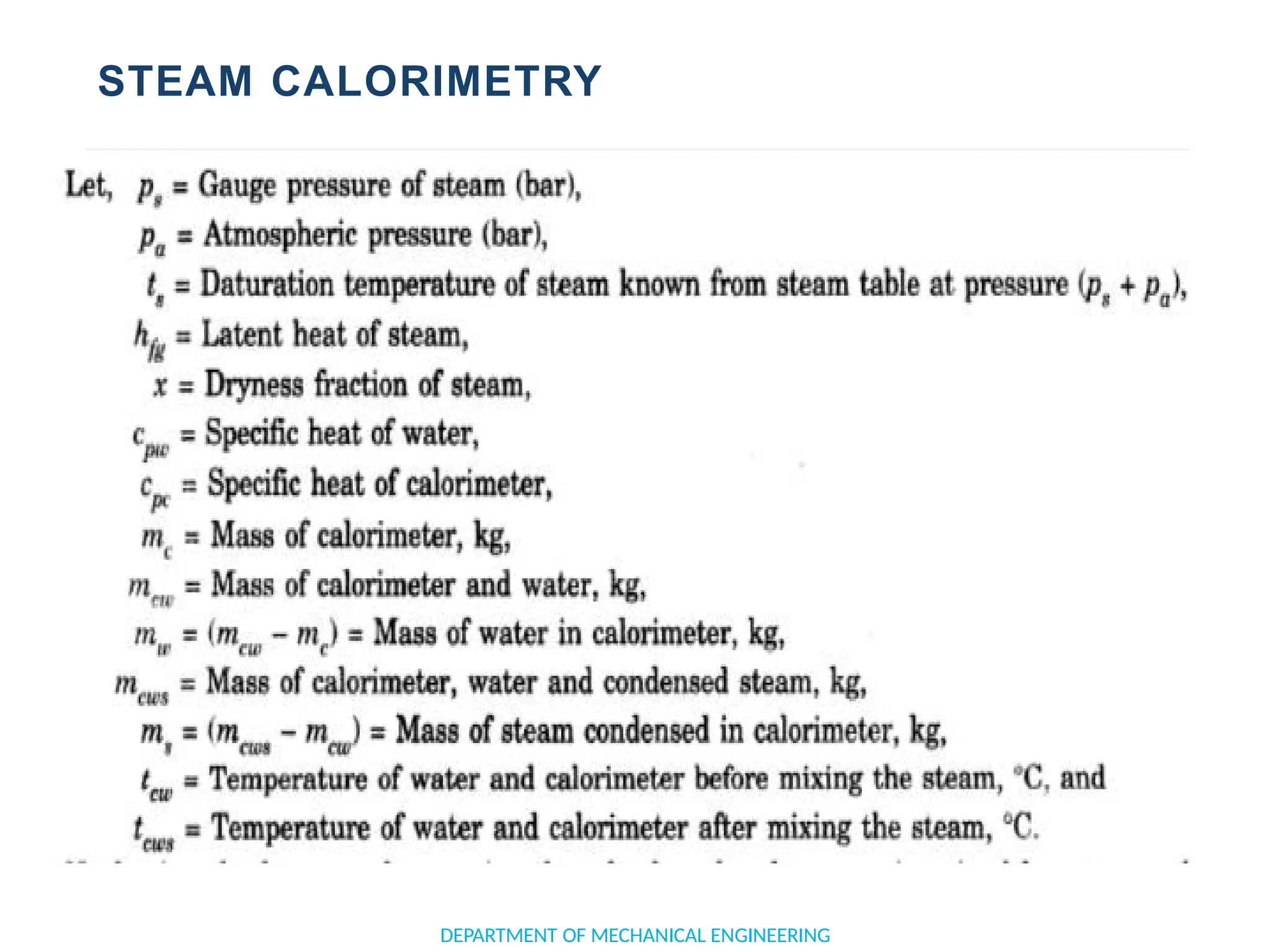
STEAM CALORIMETRY
DEPARTMENT OF MECHANICAL ENGINEERING
STEAM CALORIMETRY
DEPARTMENT OF MECHANICAL ENGINEERING
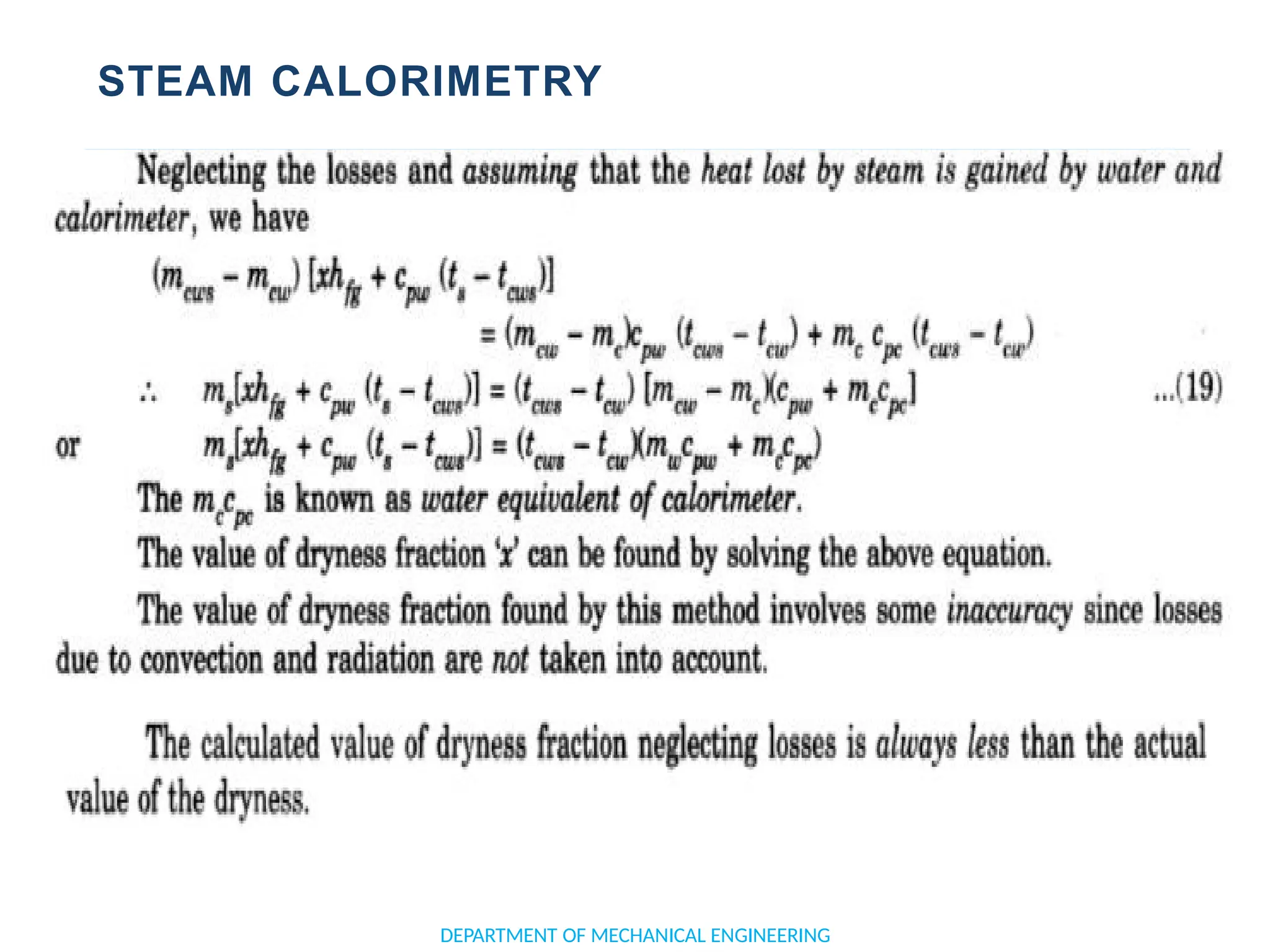
STEAM CALORIMETRY
DEPARTMENT OF MECHANICAL ENGINEERING
STEAM CALORIMETRY
DEPARTMENT OF MECHANICAL ENGINEERING
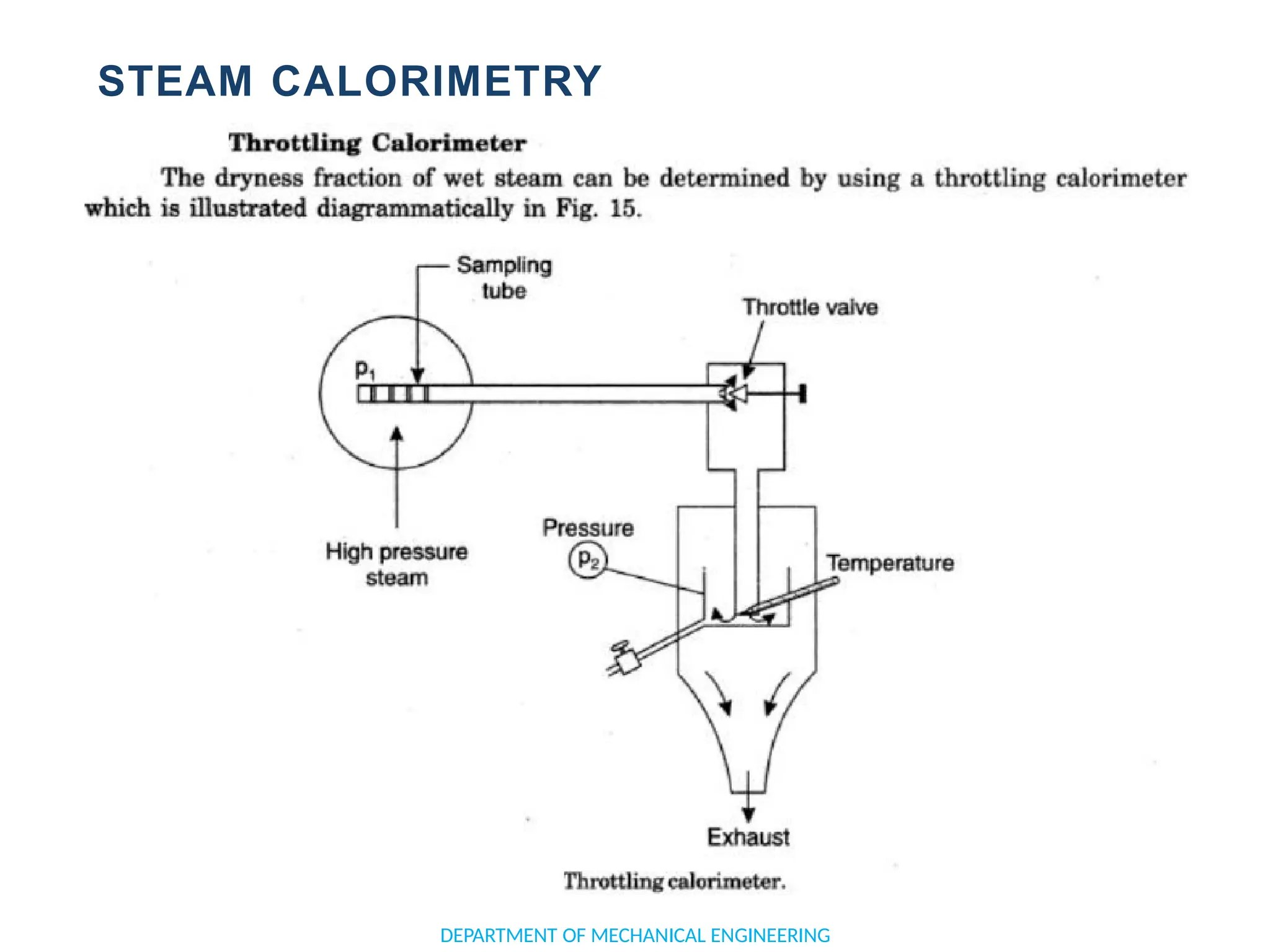
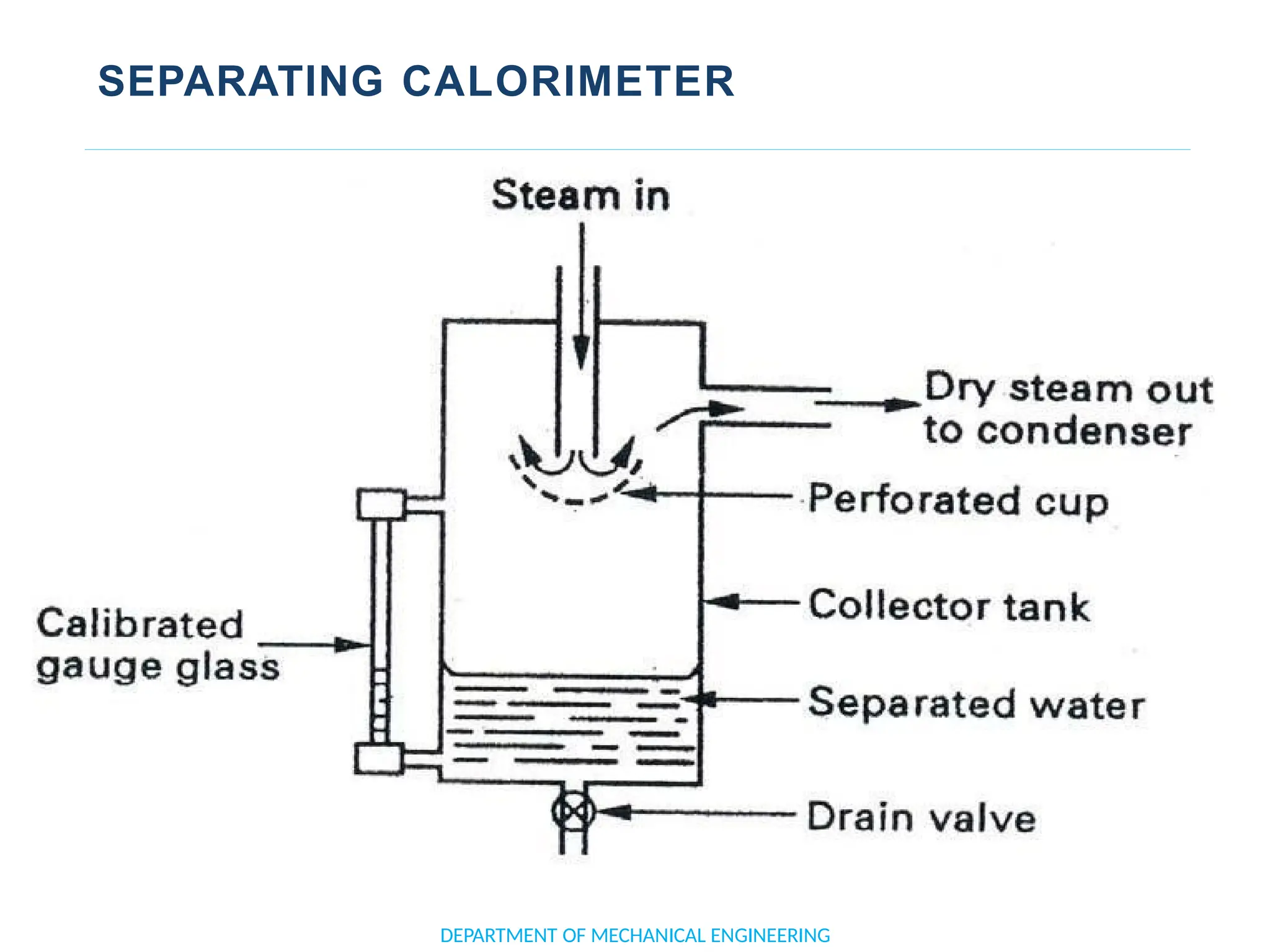
SEPARATING CALORIMETER
DEPARTMENT OF MECHANICAL ENGINEERING
SEPARATING CALORIMETER
DEPARTMENT OF MECHANICAL ENGINEERING
The wet steam enters at the top from the main
steam pipe through holes in the sampling pipe
facing up stream which should be as far as
possible downstream from elbows and valves to
ensure representative sample of steam when in
operation the wet steam entering passes down
the central passage and undergoes a sudden
reversal of direction of motion when strikes
perforated cup.
The weight of steam passing through the jacket
may also be readily determined by passing the
escaping steam into a bucket of water where it
is condensed, the increase in the weight of the
bucket and its contents giving the value of W.
SEPARATING CALORIMETER
DEPARTMENT OF MECHANICAL ENGINEERING
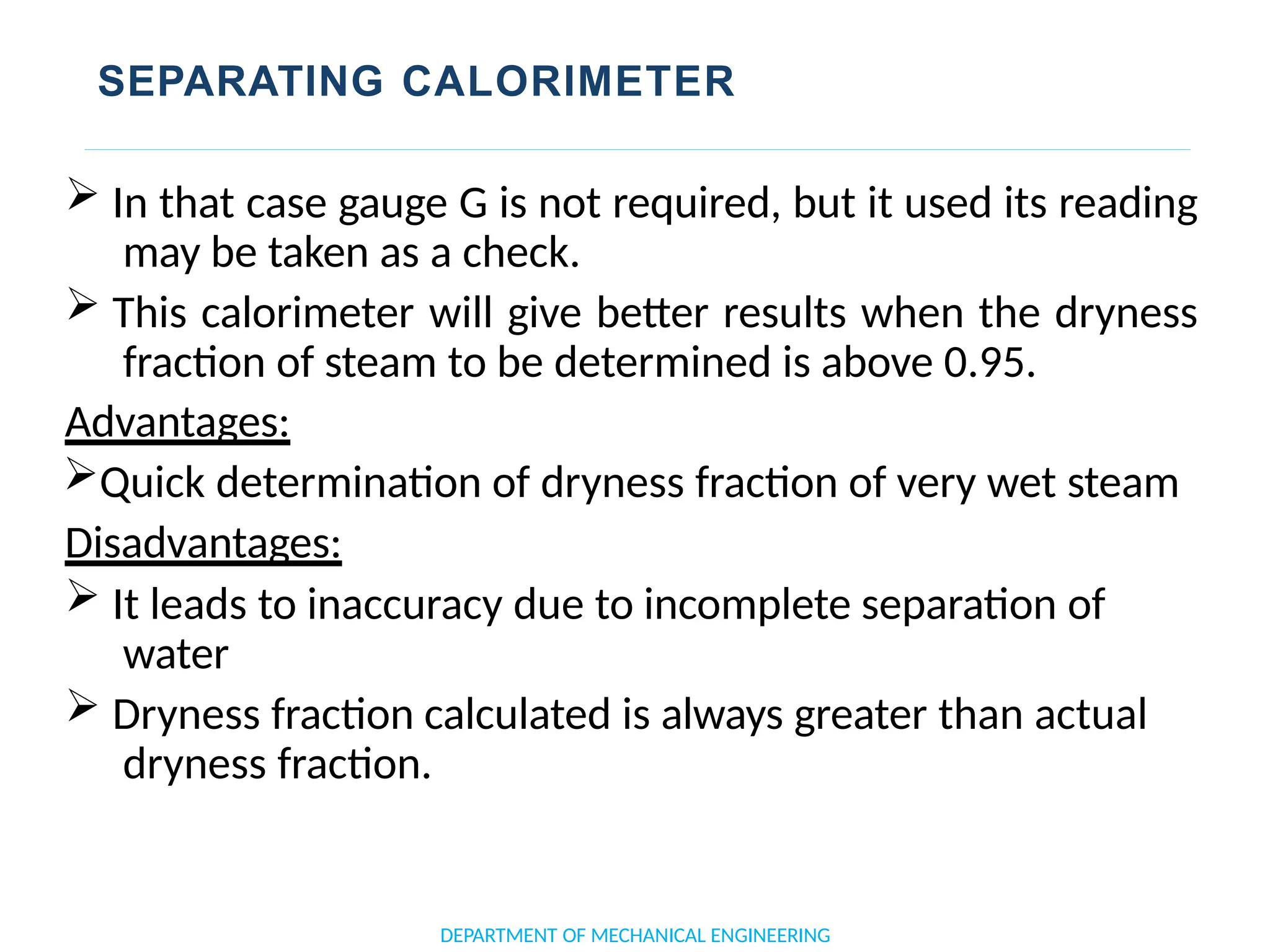
 In that case gauge G is not required, but it used its reading
may be taken as a check.
 This calorimeter will give better results when the dryness
fraction of steam to be determined is above 0.95.
Advantages:
Quick determination of dryness fraction of very wet steam
Disadvantages:
 It leads to inaccuracy due to incomplete separation of
water
 Dryness fraction calculated is always greater than actual
dryness fraction.
DEPARTMENT OF MECHANICAL ENGINEERING
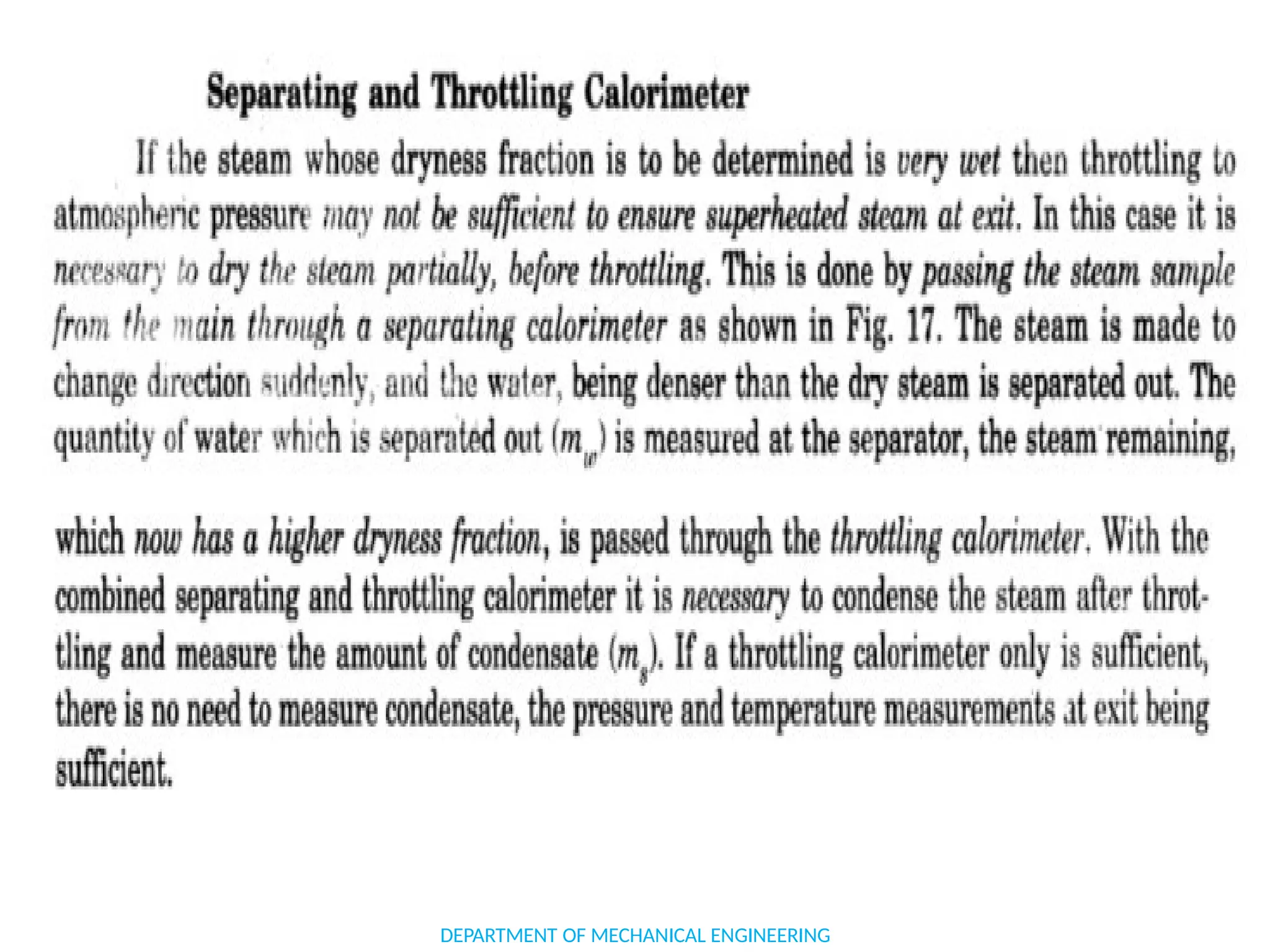
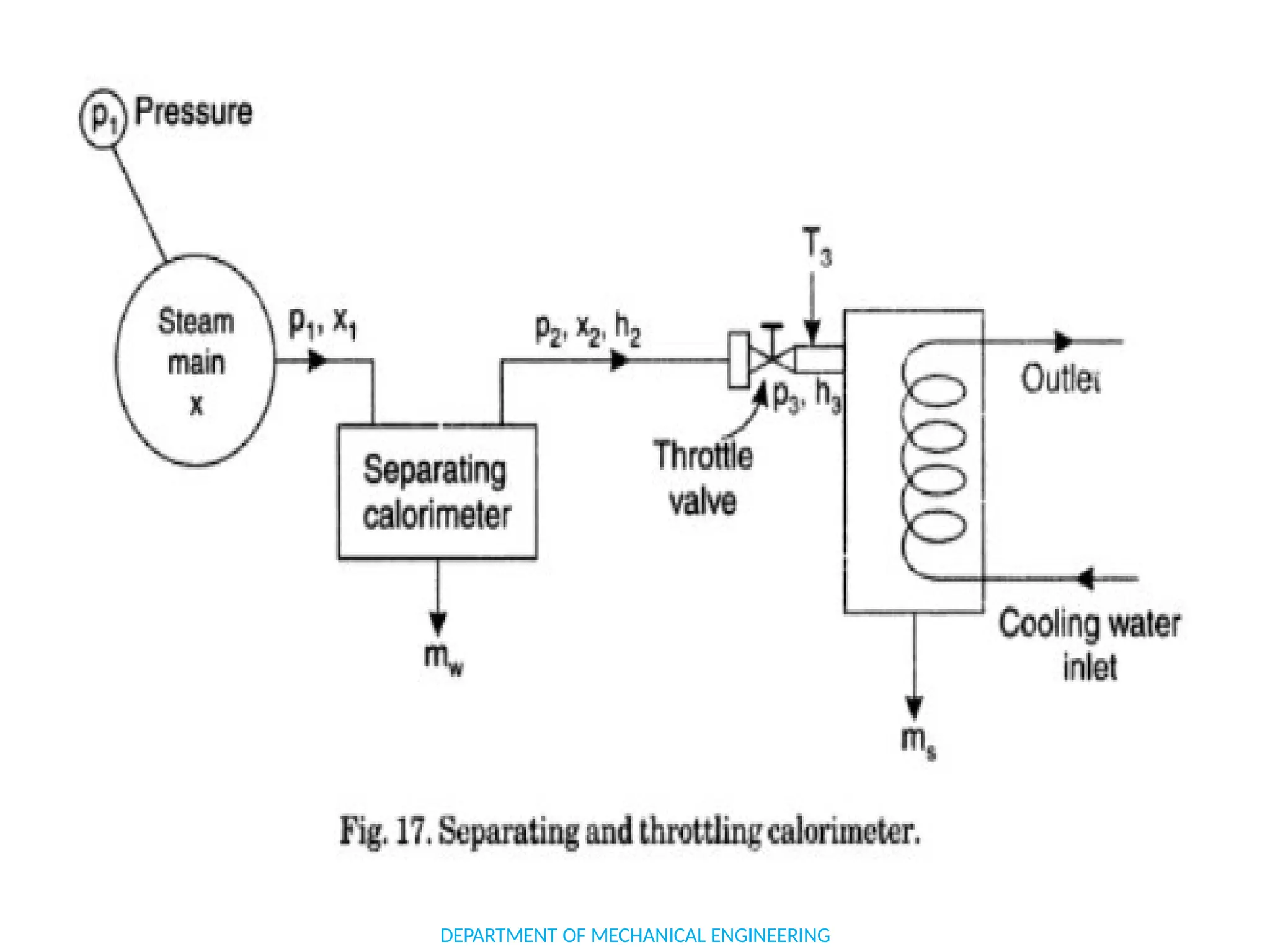
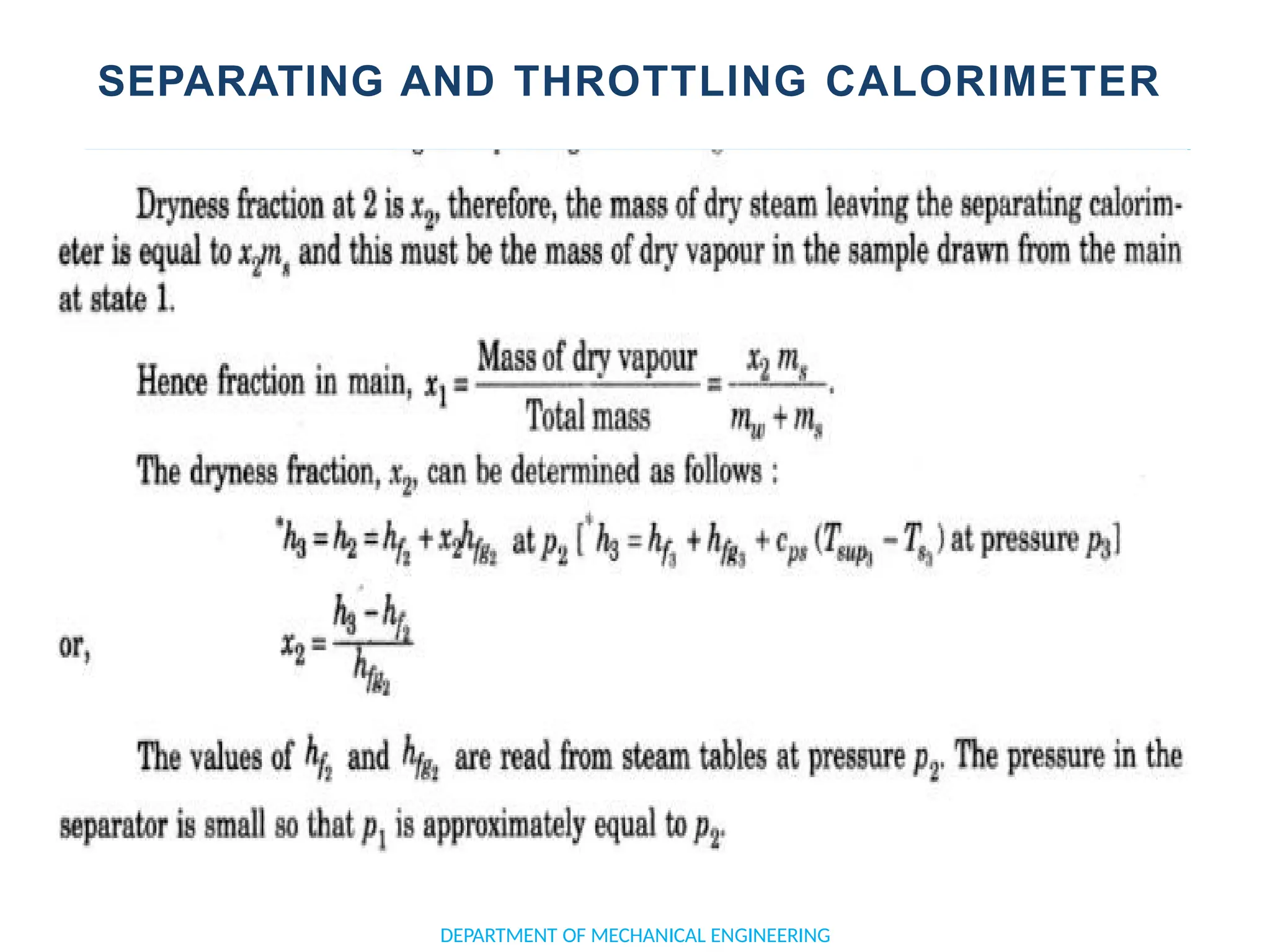
SEPARATING AND THROTTLING CALORIMETER
DEPARTMENT OF MECHANICAL ENGINEERING
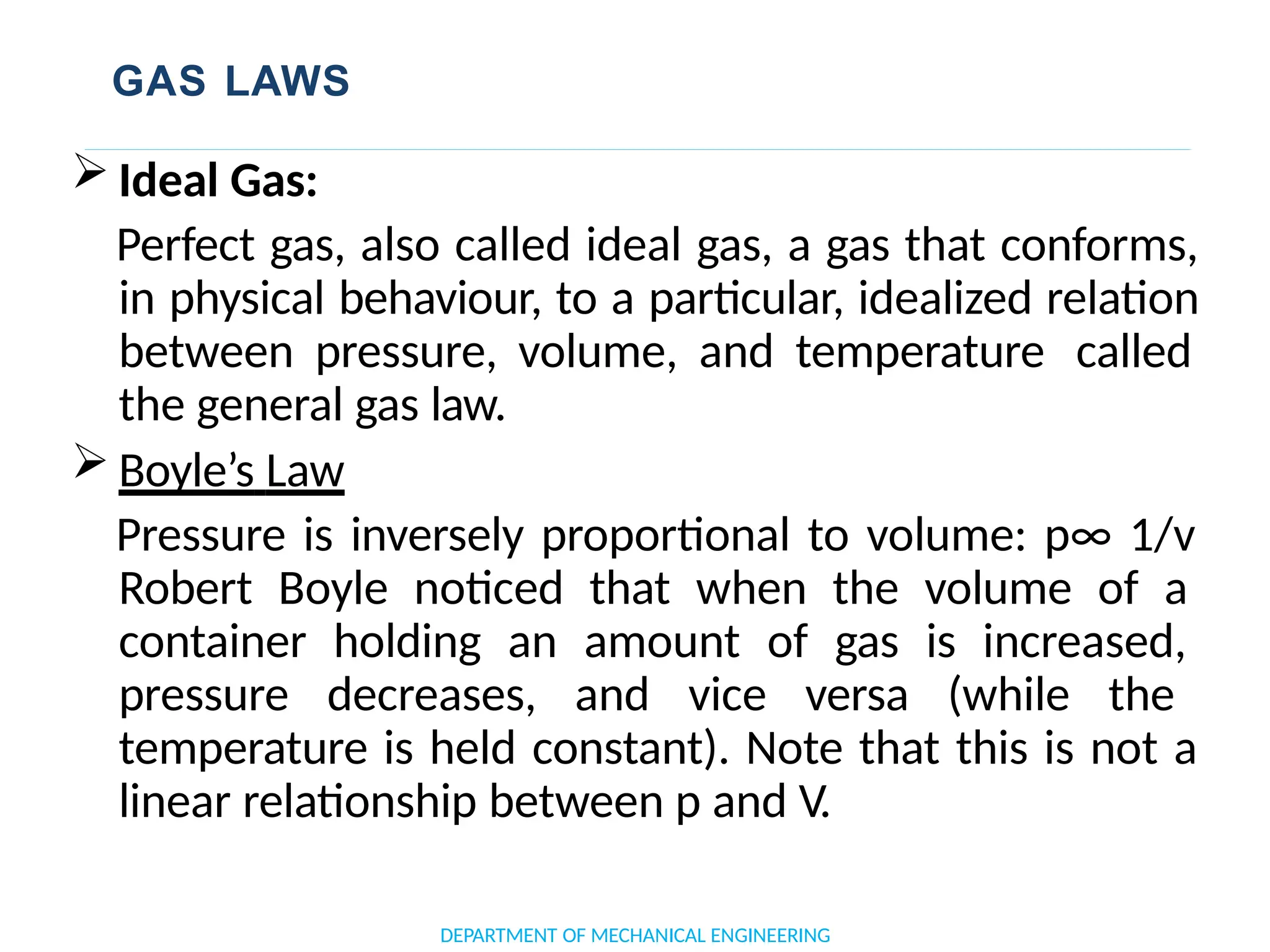
GAS LAWS
 Ideal Gas:
Perfect gas, also called ideal gas, a gas that conforms,
in physical behaviour, to a particular, idealized relation
between pressure, volume, and temperature called
the general gas law.
 Boyle’s Law
Pressure is inversely proportional to volume: p∞ 1/v
Robert Boyle noticed that when the volume of a
container holding an amount of gas is increased,
pressure decreases, and vice versa (while the
temperature is held constant). Note that this is not a
linear relationship between p and V.
DEPARTMENT OF MECHANICAL ENGINEERING
GAS LAWS
Charles’ Law:
Charles’ Law Volume is directly proportional to
temperature: V = cT, where c > 0 is constant.
Scientist Jacque Charles noticed that if air in a
balloon is heated, the balloon expands. For an
ideal gas, this relationship between V and T
should be linear (as long as pressure is
constant).
 Charles’ and Boyle’s Laws combined
Combine the two laws above: pV/T = K, where
k
is a constant, = pV=mRT
DEPARTMENT OF MECHANICAL ENGINEERING
GAS LAWS
DEPARTMENT OF MECHANICAL ENGINEERING
The Individual Gas Constant - R
• The Individual Gas Constant depends on the
particular gas and is related to the molecular
weight of the gas.
• The value is independent of temperature. The
induvidual gas constant, R, for a gas can be
calculated from the universal gas constant, Ru
below), and the
gas
(given in several
units molecular weight,
Mgas:
• R = Ru/Mgas
• In the SI system units are J/kg K.
GAS LAWS
• The Universal Gas Constant - Ru
• The Universal Gas Constant - Ru - appears in the ideal
gas law and can be expressed as the product between
the Individual Gas Constant - R - for the particular gas -
and the Molecular Weight - Mgas - for the gas, and is
the same for all ideal or perfect gases:
• Ru = MR
• The Molecular weight of a Gas Mixture
The average molecular weight of a gas mixture is equal
to the sum of the mole fractions of each gas
multiplied by the molecular weight of that particular
gas:
• gas R, kJ/(kmol.K) : 8.3144598
DEPARTMENT OF MECHANICAL ENGINEERING
THROTTLING PROCESS
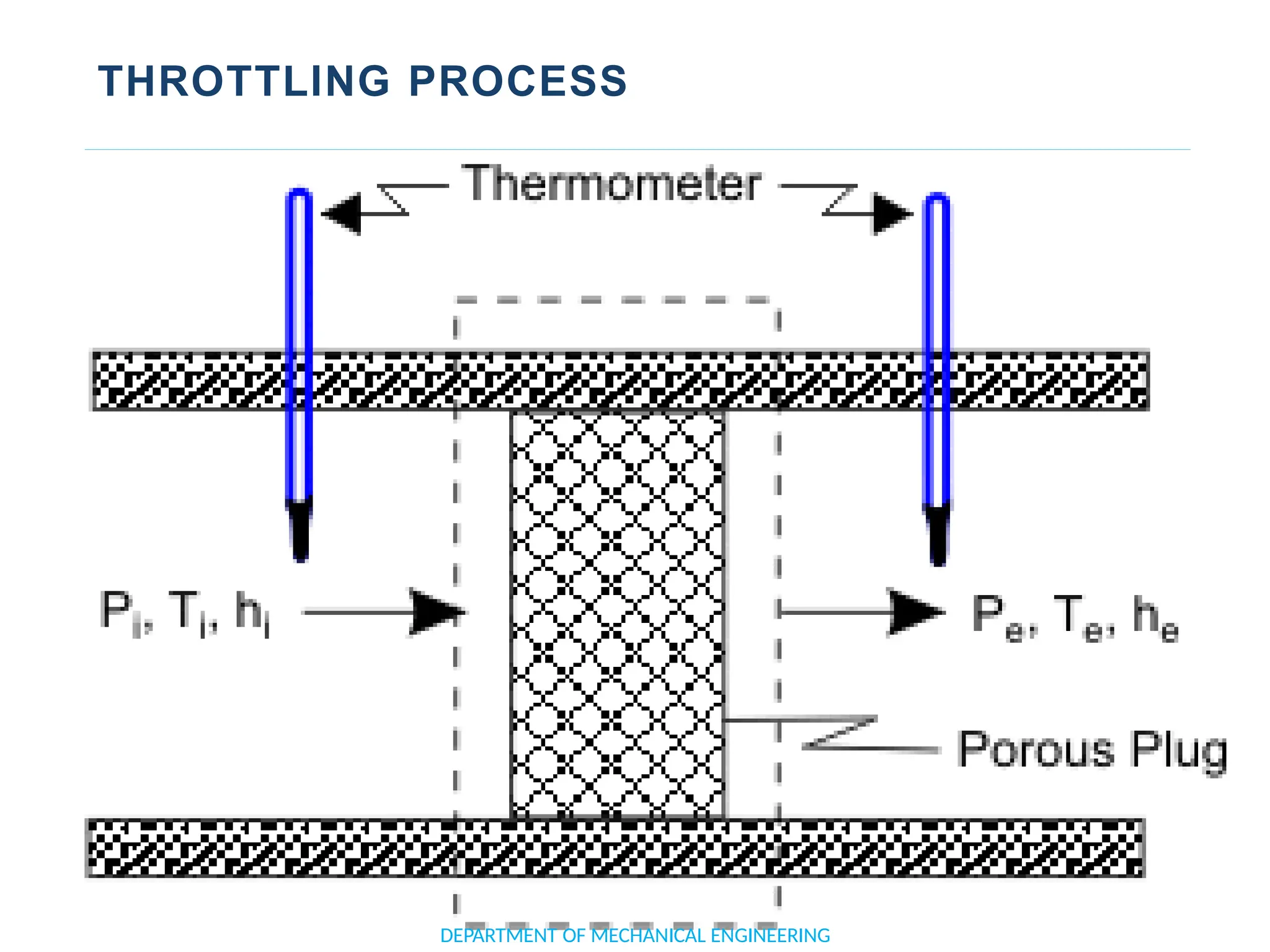
• The porous plug experiment was designed to
measure temperature changes when a fluid flows
steadily through a porous plug which is inserted in
a thermally insulated, horizontal pipe. The
apparatus used by Joule and Thomson is shown in
Figure
• A gas at pressure and temperature flows
continuously through a porous plug in a tube and
emerges into a space which is maintained at a
constant pressure. The device is thermally
insulated and kept horizontal. Consider the dotted
portion as control volume.
DEPARTMENT OF MECHANICAL ENGINEERING
THROTTLING PROCESS
DEPARTMENT OF MECHANICAL ENGINEERING
THROTTLING PROCESS
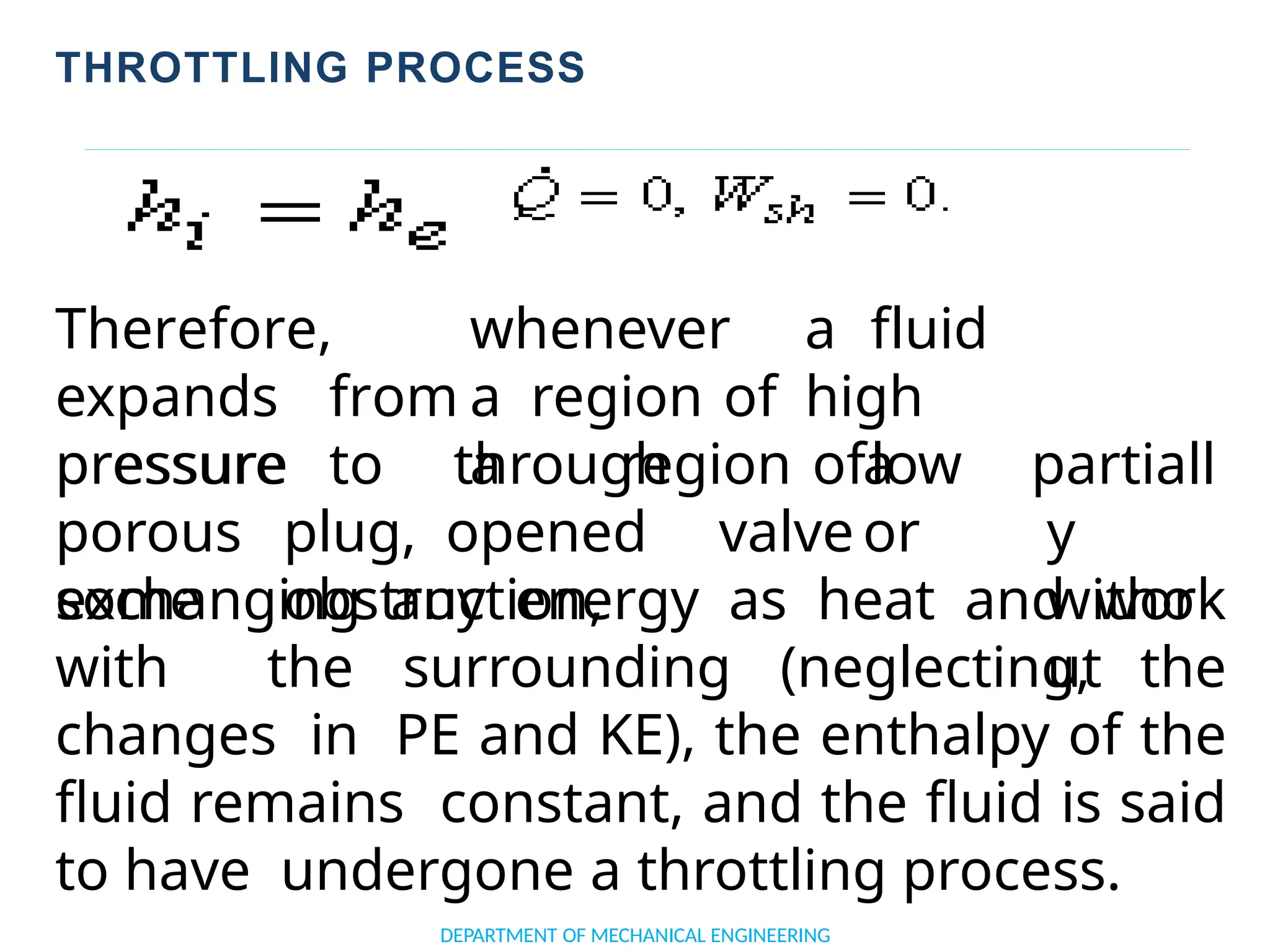
Therefore, whenever a fluid
expands from a region of high
pressure to a region oflow
DEPARTMENT OF MECHANICAL ENGINEERING
pressure through a
porous plug, opened valve or
some obstruction,
partiall
y
witho
ut
exchanging any energy as heat and work
with the surrounding (neglecting, the
changes in PE and KE), the enthalpy of the
fluid remains constant, and the fluid is said
to have undergone a throttling process.
FREE EXPANSION PROCESS
A free expansion occurs when a fluid is allowed
to expand suddenly into a vaccum chamber
through an orifice of large dimensions.
In this process, no heat is supplied or rejected
and no external work is done.
Hence the total heat of the fluid remains
constant. This type of expansion may also be
called as constant total heat expansion.
It is thus obvious, that in a free expansion
process,
Q1-2 = 0, W1-2 = 0 and dU = 0.
DEPARTMENT OF MECHANICAL ENGINEERING
VAN DER WAALS EQUATION OF STATE
• The ideal gas law treats the molecules of a gas
as point particles with perfectly elastic
collisions. This works well for dilute gases in
many experimental circumstances.
• But gas molecules are not point masses, and
there are circumstances where the properties
of the molecules have an experimentally
measurable effect. A modification of the ideal
gas law was proposed by van der Waal on
molecular size and molecular interaction forces.
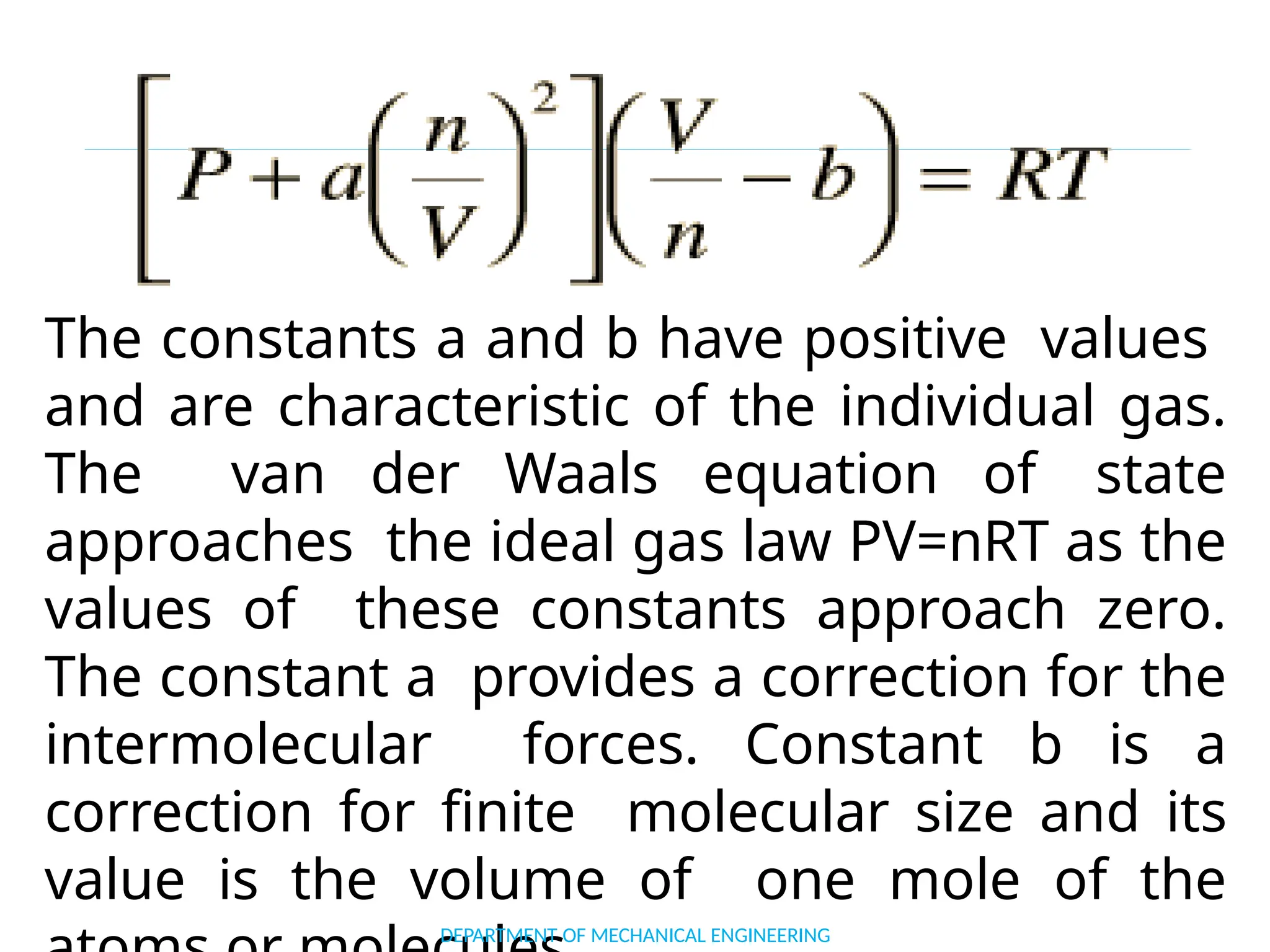
• It is usually referred to as the van der Waals
equation of state.
DEPARTMENT OF MECHANICAL ENGINEERING
The constants a and b have positive values
and are characteristic of the individual gas.
The van der Waals equation of state
approaches the ideal gas law PV=nRT as the
values of these constants approach zero.
The constant a provides a correction for the
intermolecular forces. Constant b is a
correction for finite molecular size and its
value is the volume of one mole of the
DEPARTMENT OF MECHANICAL ENGINEERING
INDUSTRIAL APPLICATIONS
• Automobile industries.
• Refrigeration industries
• Air craft applications
• Defense industries
• Thermal power plants
• Chemical industries
• Textile industries etc.
DEPARTMENT OF MECHANICAL ENGINEERING
SELF LEARNING QUESTIONS
DEPARTMENT OF MECHANICAL ENGINEERING
• Draw the phase equilibrium diagram for a pure
substance on T-s plot with relevant constant
property line?
• Define dryness fraction of steam. Describe method
of finding dryness fraction of steam using
separating and throttling calorimeter
• Describe briefly about throttling and free
expansion processes.
• Describe briefly about “Mollier diagram”.
• State Vander Waals equation, what is the
importance of it?
ASSIGNMENT EXERCISES
determine final dryness fraction ii)heat
transferred
iii)wor
k
don
e
DEPARTMENT OF MECHANICAL ENGINEERING
• Determine the enthalpy and entropy of steam and the
pressure is
2MPa and the specific volume is 0.09m3/kg.
• 10 kg of feed water is heated in a boiler at a constant
pressure of
1.5 MN/m2 from 40 C. Calculate the enthalpy required and
change of entropy when water is converted into following
qualities of steam in each case i) Wet steam at x=0.95 and ii)
Super heated steam at 300 C
• Air at 16oC and 1.2 bar occupies a volume of 0.03m3.the air is
heated at constant volume until the pressure is 4.3 bar and then
cooled at constant pressure back to the original temperature.
Calculate the net heat flow to or from the air and the net
entropy change.
• 5 kg of steam with a dryness fraction of 0.9 expands
adiabatically to
the Law PV1.13constant. from a pressure of 8 bar to 1.5
bar
THANK YOU
E N GIN E E R IN G
THERMODYNAMICS
DEPARTMENT OF MECHANICAL ENGINEERING
COURSE OBJECTIVES
UNIT -
1
CO1:To understand the concepts of
energy transformation, conversion of
heat into work.
UNIT -
2
CO2:To acquire knowledge about the
fundamentals of thermodynamic laws, the
concept of entropy, and principles
UNIT -
3
CO3: To understand how the change of state
results in a process.
UNIT -
4
CO4: To understand the various gas
laws, psychrometric properties and
chart.
UNIT -
5
CO5: To learn the importance of
thermodynamic cycles, and the derivation of
efficiency.
UNIT 1
CO4: To understand the various gas laws,
psychrometric properties and chart.
M I X T U R E S O F
P E R F E C T G A
S E S
UNIT – IV (SYLLABUS)
DEPARTMENT OF MECHANICAL ENGINEERING
Mixtures of perfect Gases
• Mole Fraction, Mass fraction
• Gravimetric and volumetric Analysis
• Dalton’s Law of partial pressure, Amagat’s Law
of additive volumes
• Enthalpy, sp. Heats and Entropy of Mixture of
perfect Gases
• Psychrometric Properties
• Thermodynamic Wet Bulb Temperature, Specific
Humidity, Relative Humidity
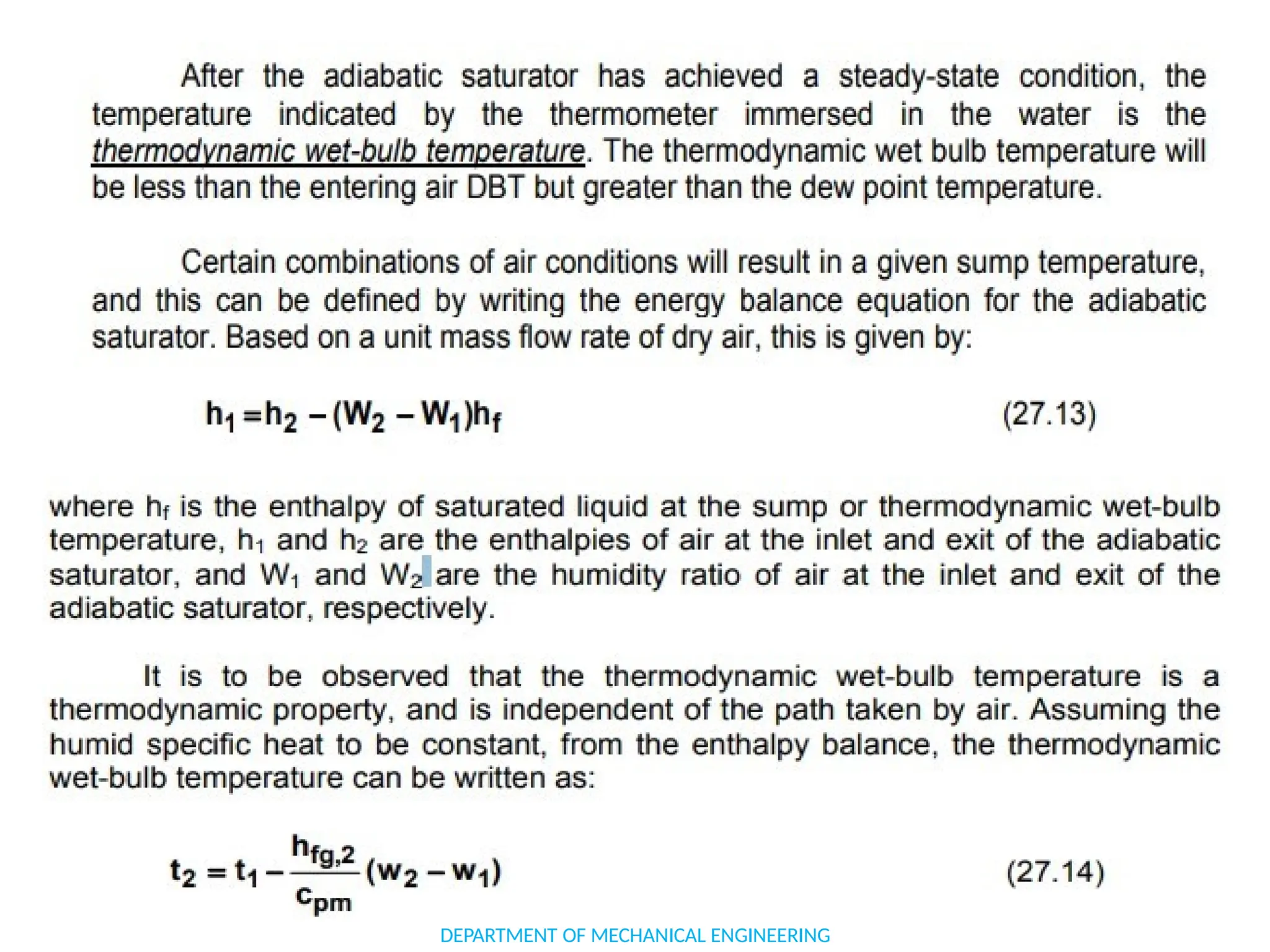
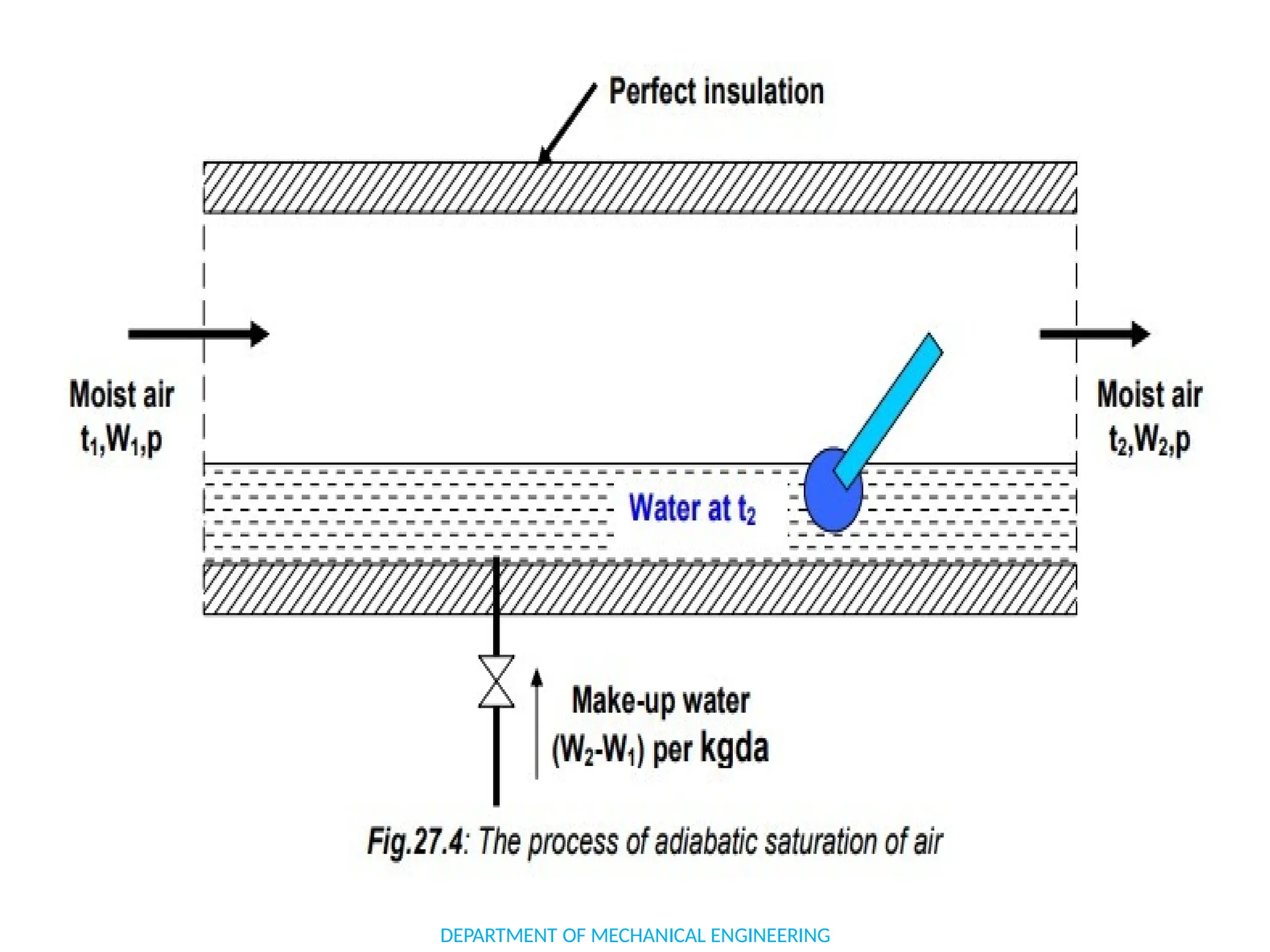
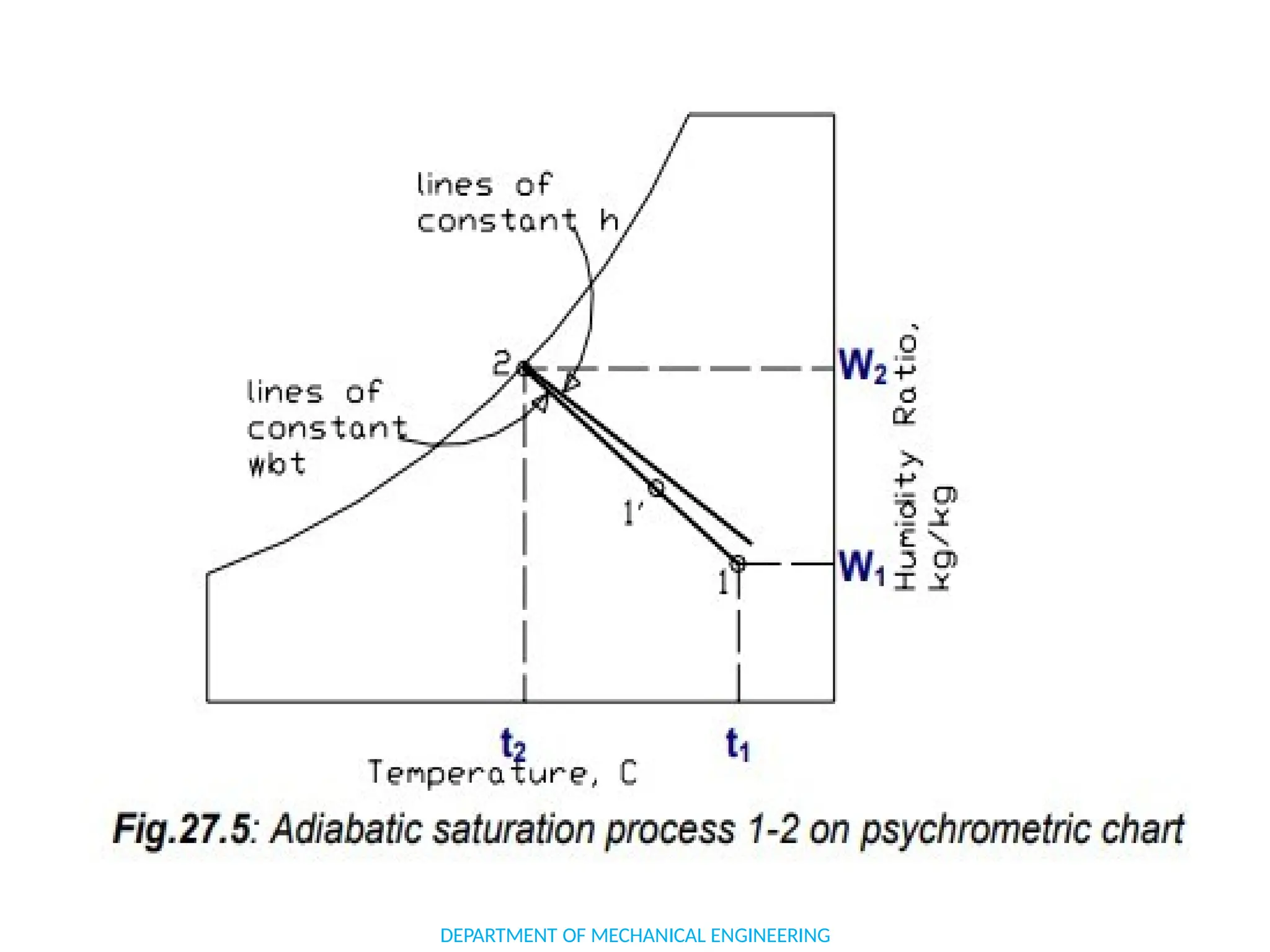
• Degree of saturation – Adiabatic
Saturation – Psychrometric chart.
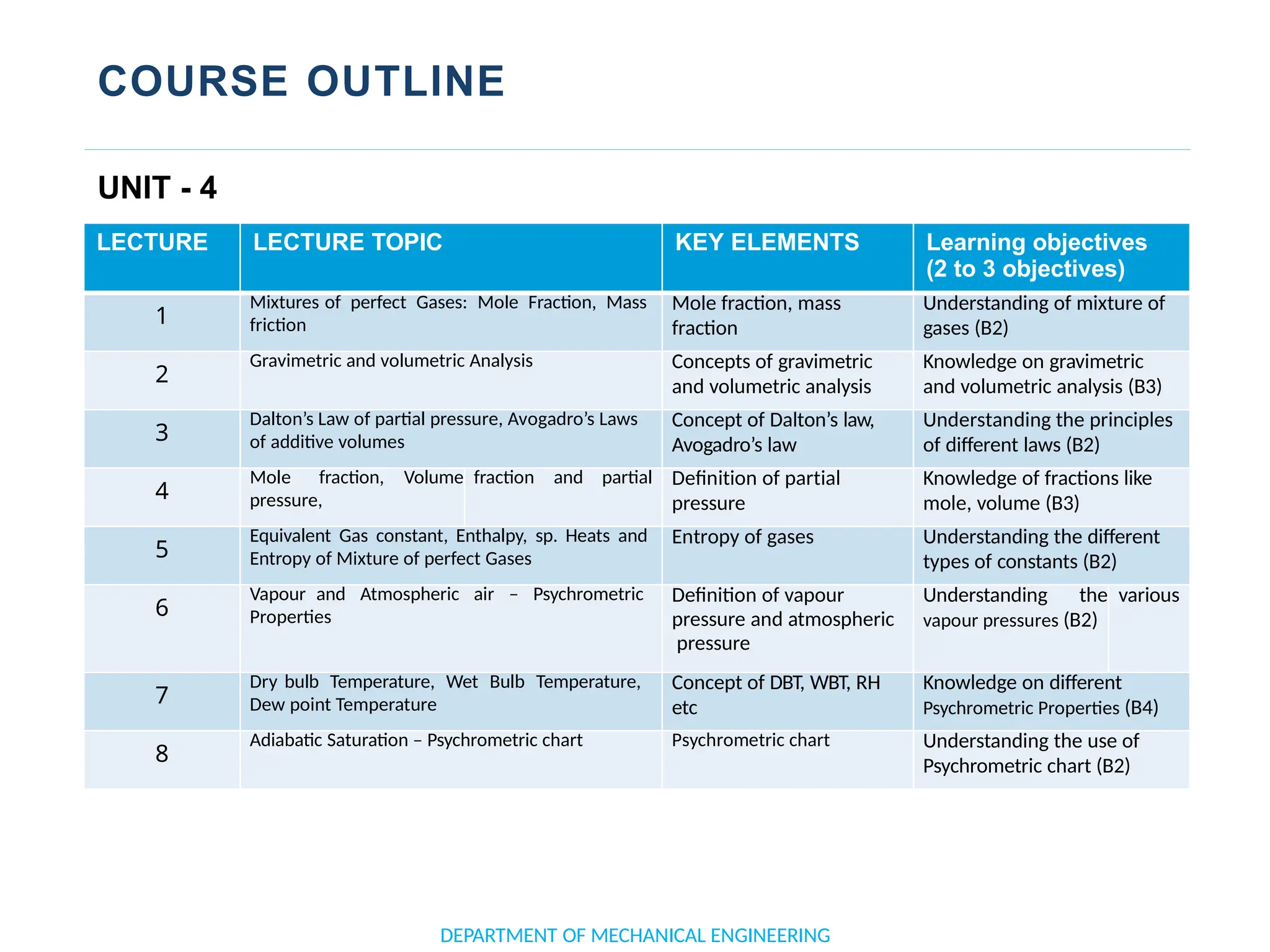
COURSE OUTLINE
DEPARTMENT OF MECHANICAL ENGINEERING
LECTURE LECTURE TOPIC KEY ELEMENTS Learning objectives
(2 to 3 objectives)
1
Mixtures of perfect Gases: Mole Fraction, Mass
friction
Mole fraction, mass
fraction
Understanding of mixture of
gases (B2)
2
Gravimetric and volumetric Analysis Concepts of gravimetric
and volumetric analysis
Knowledge on gravimetric
and volumetric analysis (B3)
3
Dalton’s Law of partial pressure, Avogadro’s Laws
of additive volumes
Concept of Dalton’s law,
Avogadro’s law
Understanding the principles
of different laws (B2)
4
Mole fraction, Volume
pressure,
fraction and partial Definition of partial
pressure
Knowledge of fractions like
mole, volume (B3)
5
Equivalent Gas constant, Enthalpy, sp. Heats and
Entropy of Mixture of perfect Gases
Entropy of gases Understanding the different
types of constants (B2)
6
Vapour and Atmospheric air – Psychrometric
Properties
Definition of vapour
pressure and atmospheric
pressure
Understanding the
vapour pressures (B2)
various
7
Dry bulb Temperature, Wet Bulb Temperature,
Dew point Temperature
Concept of DBT, WBT, RH
etc
Knowledge on different
Psychrometric Properties (B4)
8
Adiabatic Saturation – Psychrometric chart Psychrometric chart Understanding the use of
Psychrometric chart (B2)
UNIT - 4
LECTURE 4
Mixtures of perfect Gases
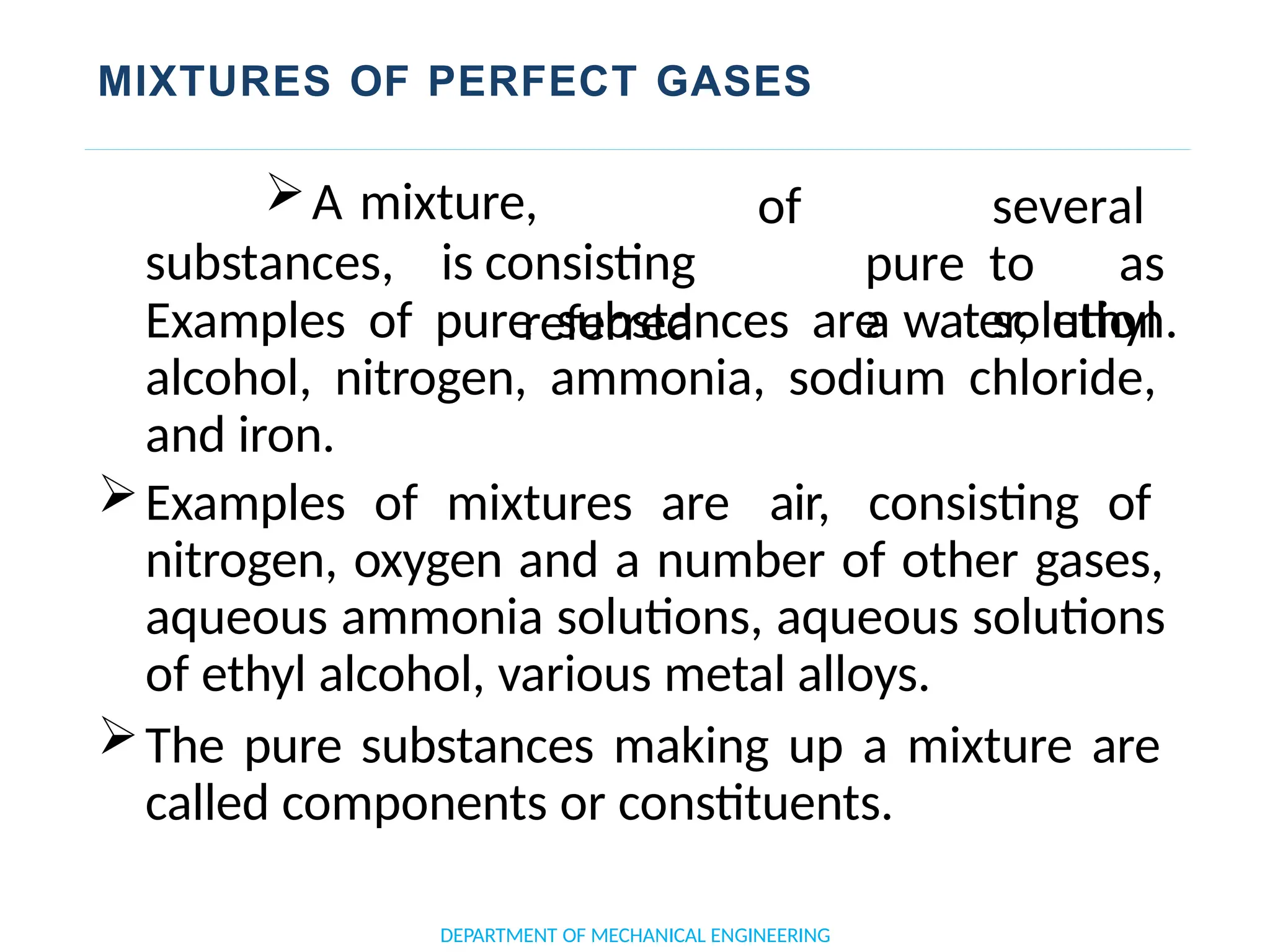
MIXTURES OF PERFECT GASES
DEPARTMENT OF MECHANICAL ENGINEERING
substances, is
A mixture,
consisting
referred
of several
pure to as
a solution.
Examples of pure substances are water, ethyl
alcohol, nitrogen, ammonia, sodium chloride,
and iron.
Examples of mixtures are air, consisting of
nitrogen, oxygen and a number of other gases,
aqueous ammonia solutions, aqueous solutions
of ethyl alcohol, various metal alloys.
The pure substances making up a mixture are
called components or constituents.
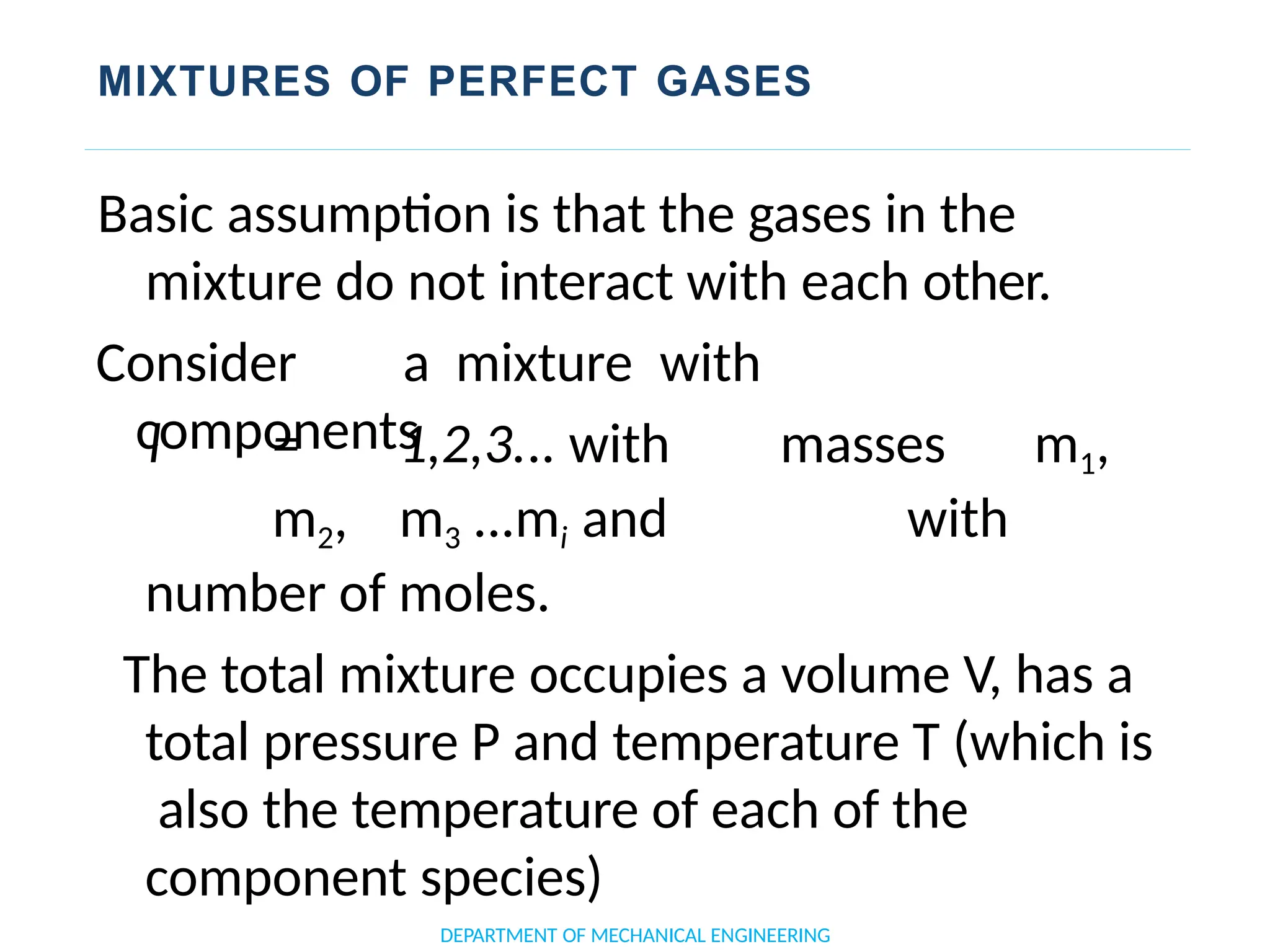
MIXTURES OF PERFECT GASES
DEPARTMENT OF MECHANICAL ENGINEERING
Basic assumption is that the gases in the
mixture do not interact with each other.
Consider a mixture with
components
l = 1,2,3... with masses m1,
m2, m3 ...mi and with
number of moles.
The total mixture occupies a volume V, has a
total pressure P and temperature T (which is
also the temperature of each of the
component species)
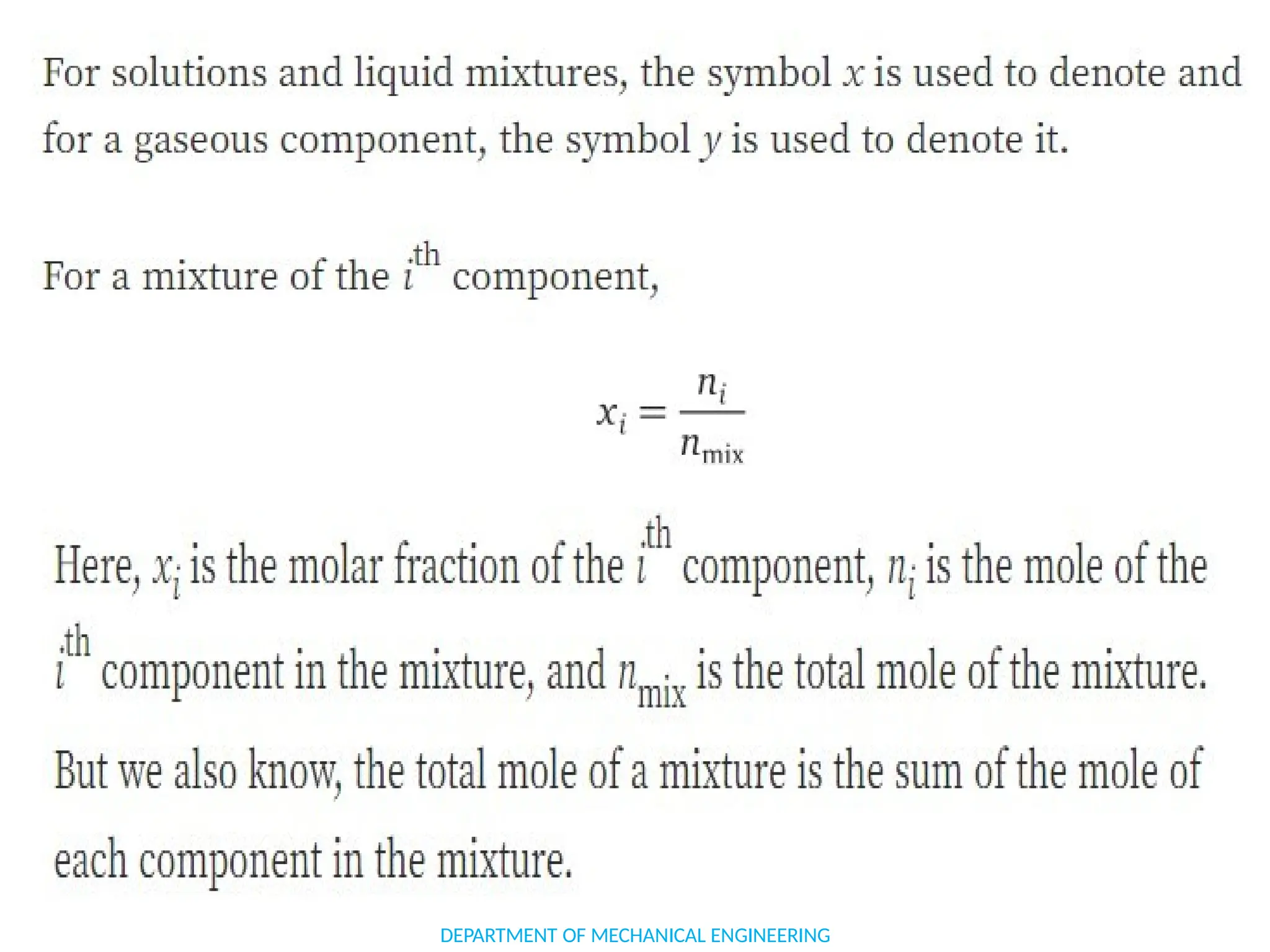
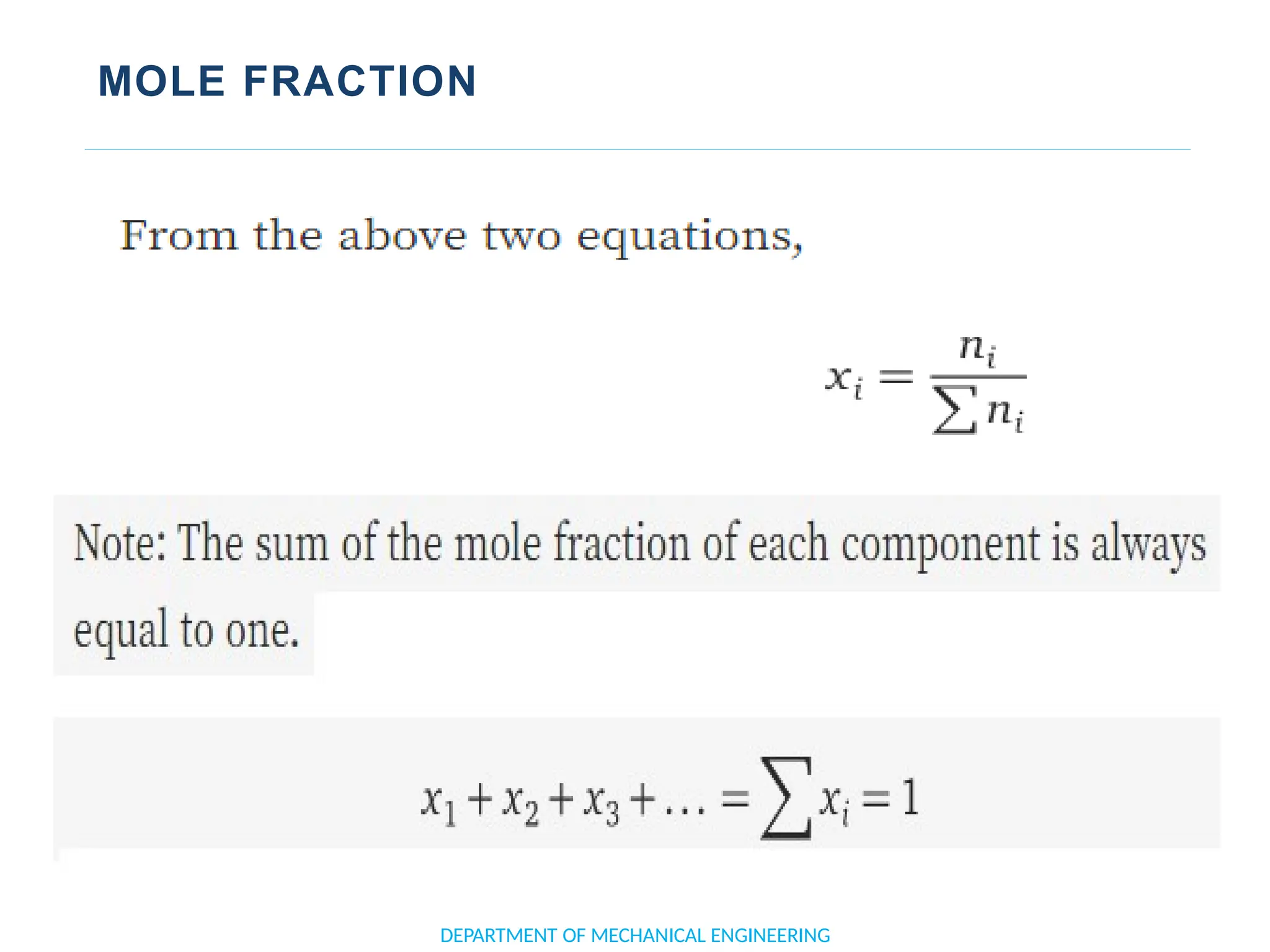
Mole Fraction
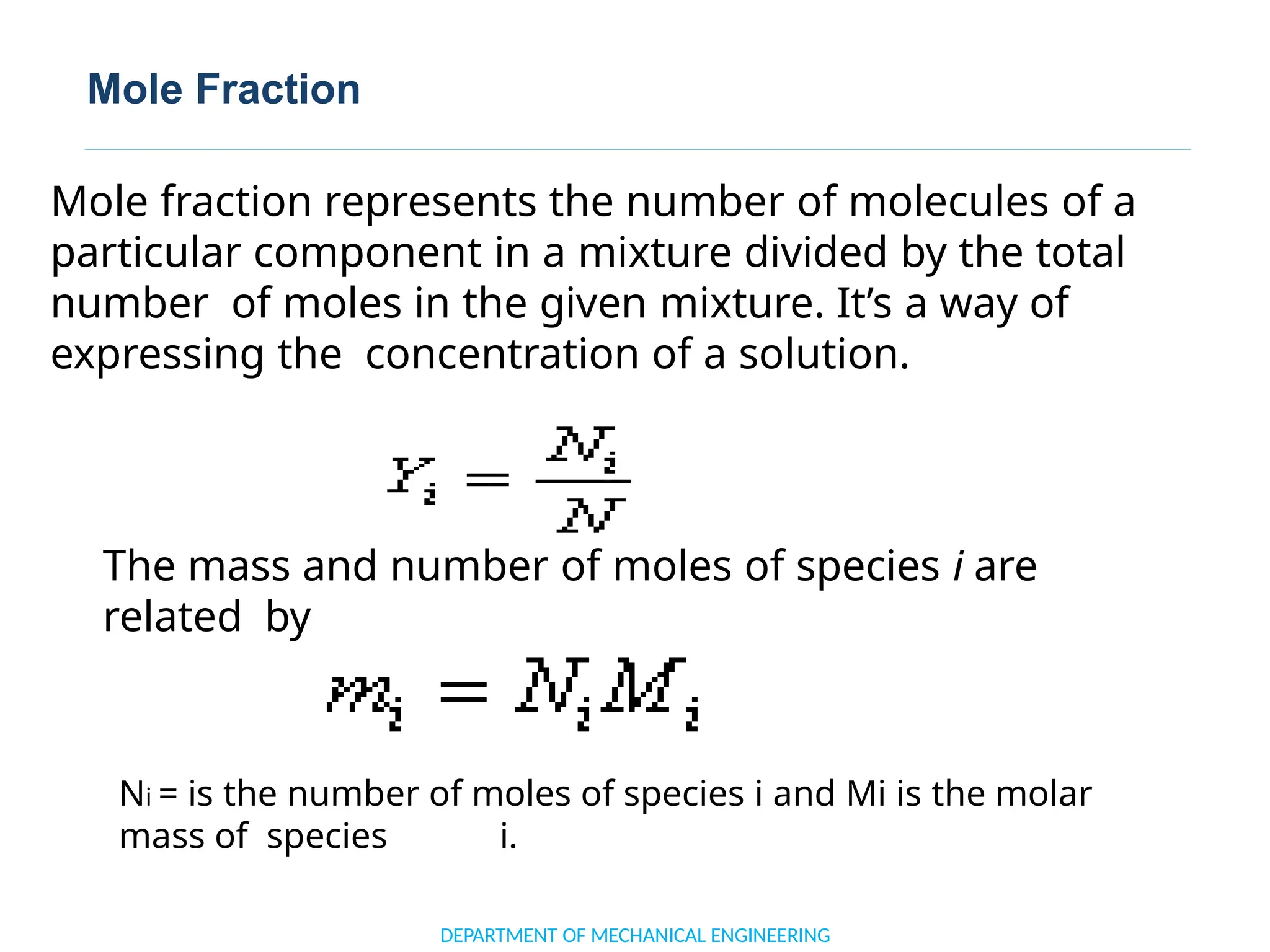
The mass and number of moles of species i are
related by
Ni = is the number of moles of species i and Mi is the molar
mass of species i.
DEPARTMENT OF MECHANICAL ENGINEERING
Mole fraction represents the number of molecules of a
particular component in a mixture divided by the total
number of moles in the given mixture. It’s a way of
expressing the concentration of a solution.
MOLE FRACTION
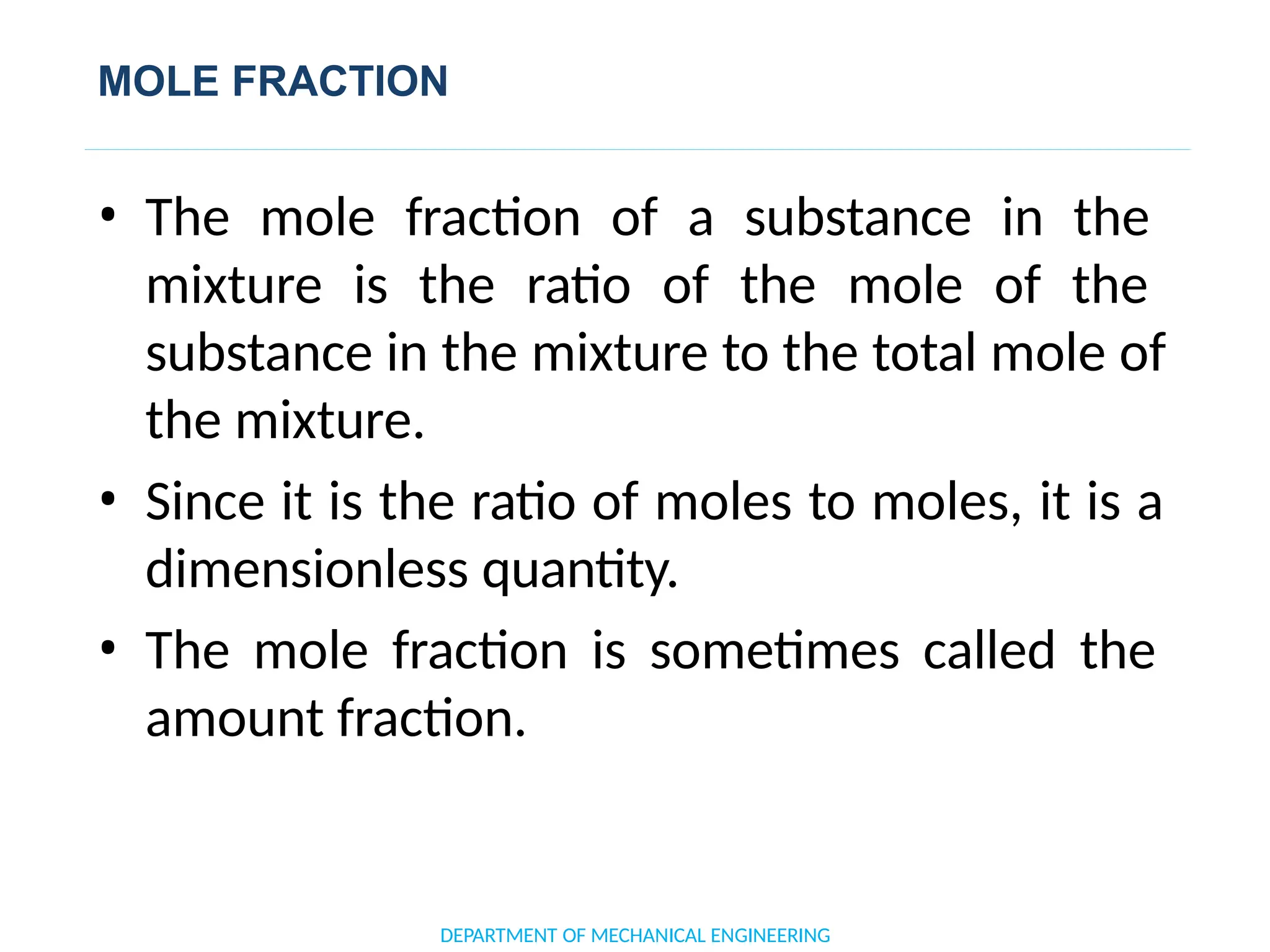
• The mole fraction of a substance in the
mixture is the ratio of the mole of the
substance in the mixture to the total mole of
the mixture.
• Since it is the ratio of moles to moles, it is a
dimensionless quantity.
• The mole fraction is sometimes called the
amount fraction.
DEPARTMENT OF MECHANICAL ENGINEERING
MOLE FRACTION
DEPARTMENT OF MECHANICAL ENGINEERING
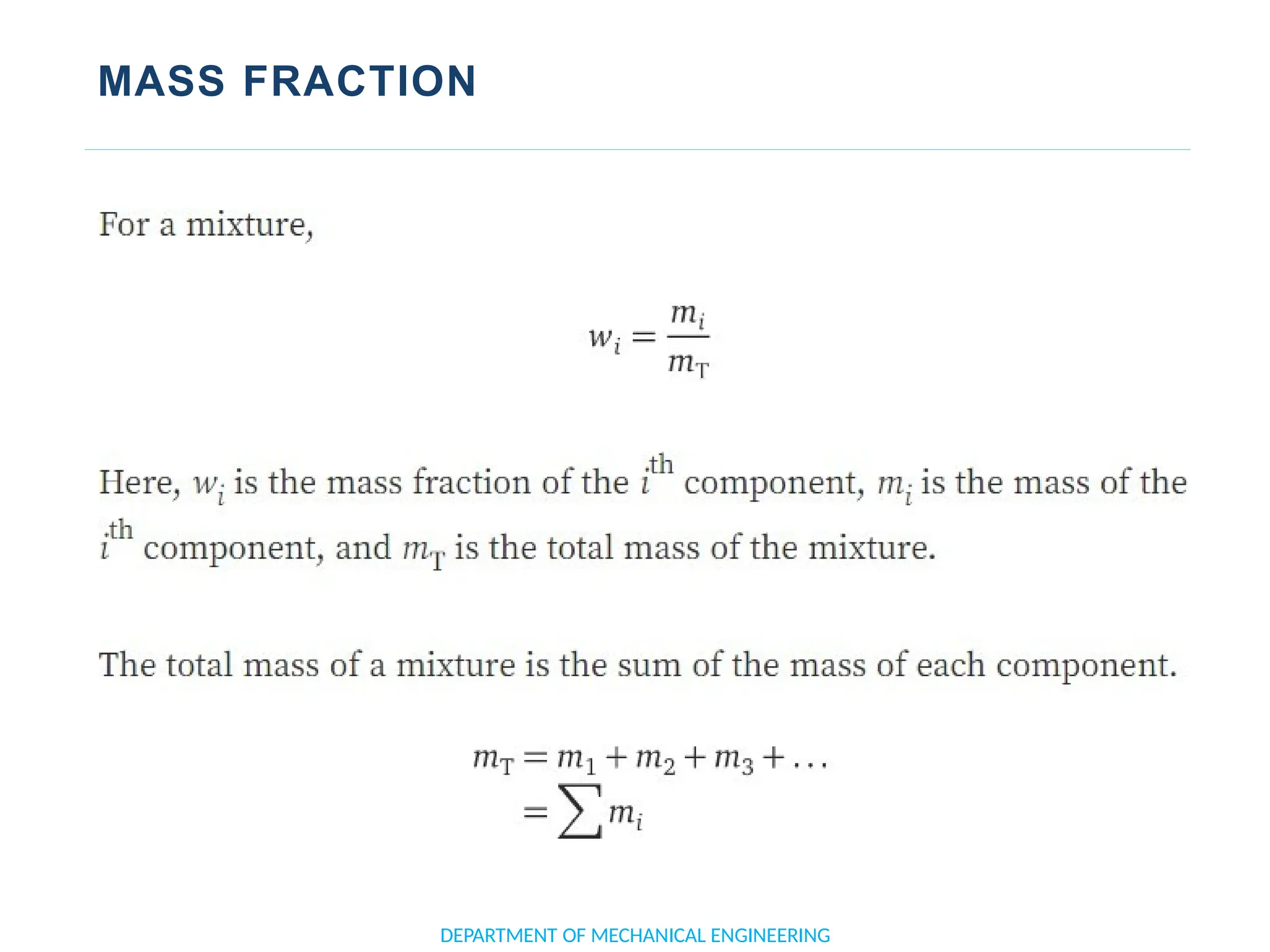
MASS FRACTION
DEPARTMENT OF MECHANICAL ENGINEERING
mixture is
• The mass
fraction
the
ratio
of a
substance in a of
the mass
of the
substance to the total mass of the mixture.
• It is also
known
as mass per cent or
in
percentage by mass when
expressing percentage.
• Since the mass fraction is a ratio of mass to
mass, it is a dimensionless quantity.
MASS FRACTION
DEPARTMENT OF MECHANICAL ENGINEERING
DALTON’S LAW OF PARTIAL PRESSURES
• Dalton’s law of partial pressures is a gas law
which states that the total pressure exerted
by a mixture of gases is equal to the sum of
the partial pressures exerted by each
individual gas in the mixture.
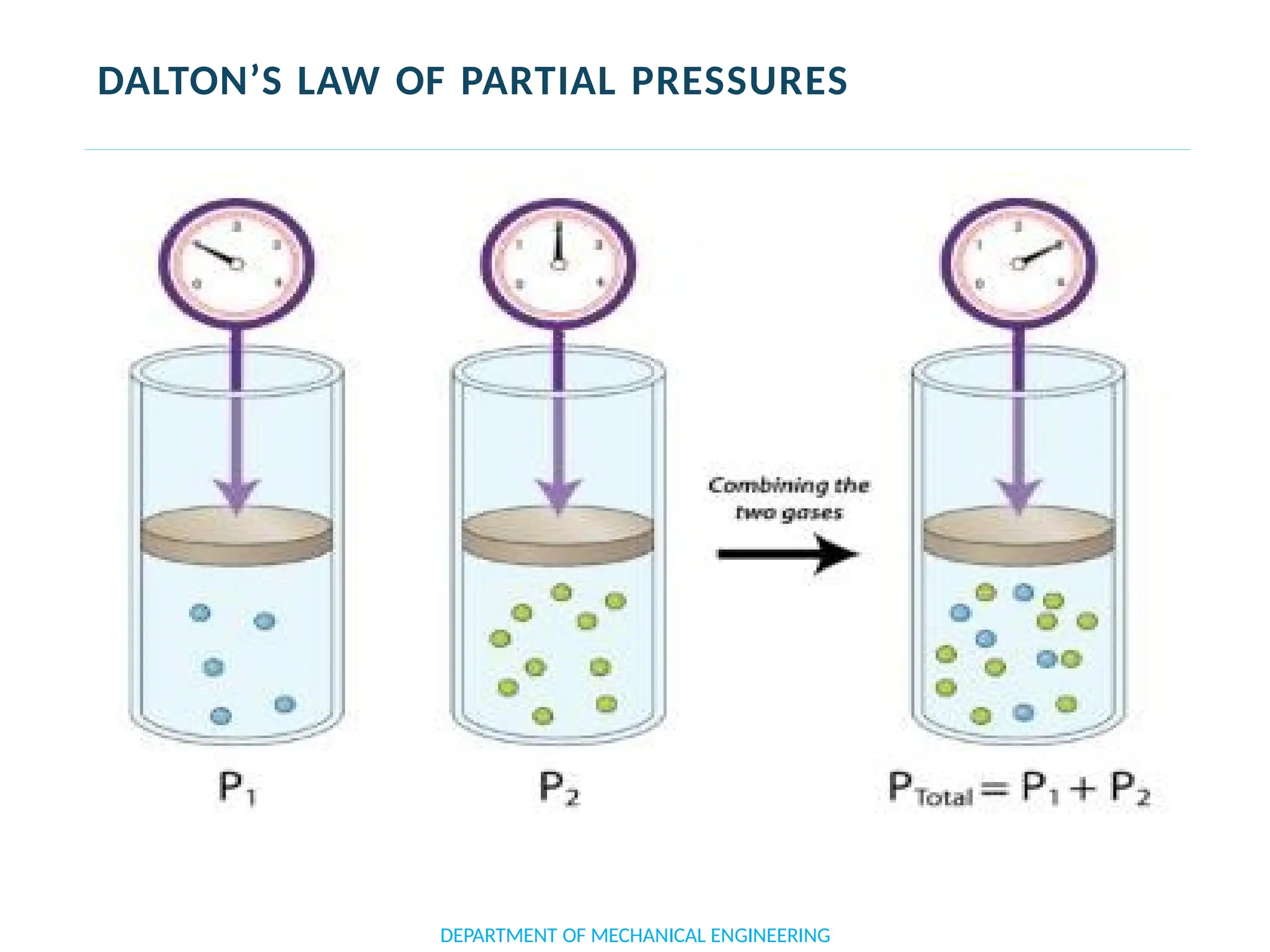
• For example, the total pressure exerted by a
mixture of two gases A and B is equal to the
sum of the individual partial pressures
exerted by gas A and gas B (as illustrated
below).
DEPARTMENT OF MECHANICAL ENGINEERING
DALTON’S LAW OF PARTIAL PRESSURES
DEPARTMENT OF MECHANICAL ENGINEERING
DALTON’S LAW OF PARTIAL PRESSURES
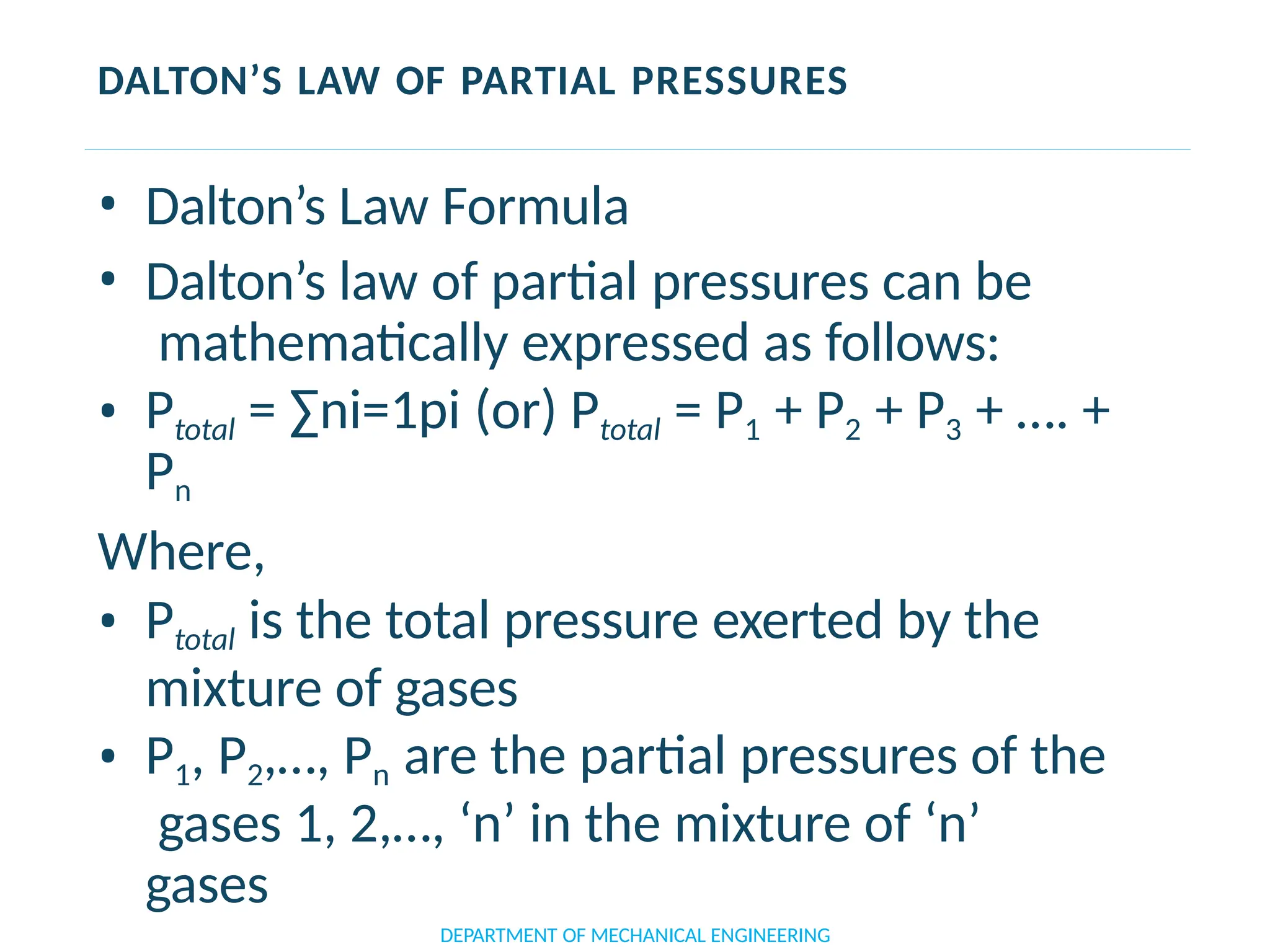
• Dalton’s Law Formula
• Dalton’s law of partial pressures can be
mathematically expressed as follows:
• Ptotal = ∑ni=1pi (or) Ptotal = P1 + P2 + P3 + …. +
Pn
Where,
• Ptotal is the total pressure exerted by the
mixture of gases
• P1, P2,…, Pn are the partial pressures of the
gases 1, 2,…, ‘n’ in the mixture of ‘n’
gases
DEPARTMENT OF MECHANICAL ENGINEERING
DALTON’S LAW OF PARTIAL PRESSURES
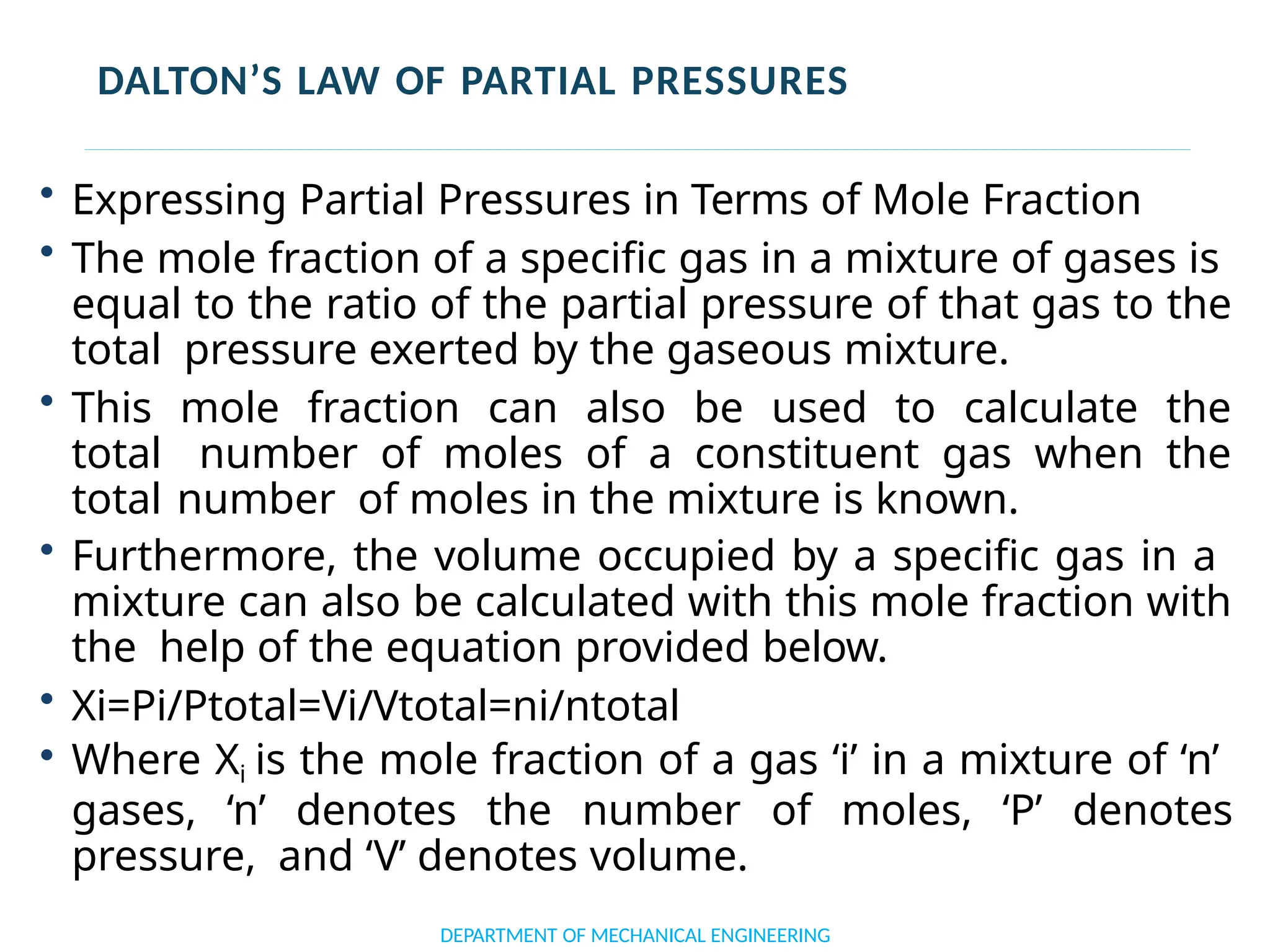
• Expressing Partial Pressures in Terms of Mole Fraction
• The mole fraction of a specific gas in a mixture of gases is
equal to the ratio of the partial pressure of that gas to the
total pressure exerted by the gaseous mixture.
• This mole fraction can also be used to calculate the
total number of moles of a constituent gas when the
total number of moles in the mixture is known.
• Furthermore, the volume occupied by a specific gas in a
mixture can also be calculated with this mole fraction with
the help of the equation provided below.
• Xi=Pi/Ptotal=Vi/Vtotal=ni/ntotal
• Where Xi is the mole fraction of a gas ‘i’ in a mixture of ‘n’
gases, ‘n’ denotes the number of moles, ‘P’ denotes
pressure, and ‘V’ denotes volume.
DEPARTMENT OF MECHANICAL ENGINEERING
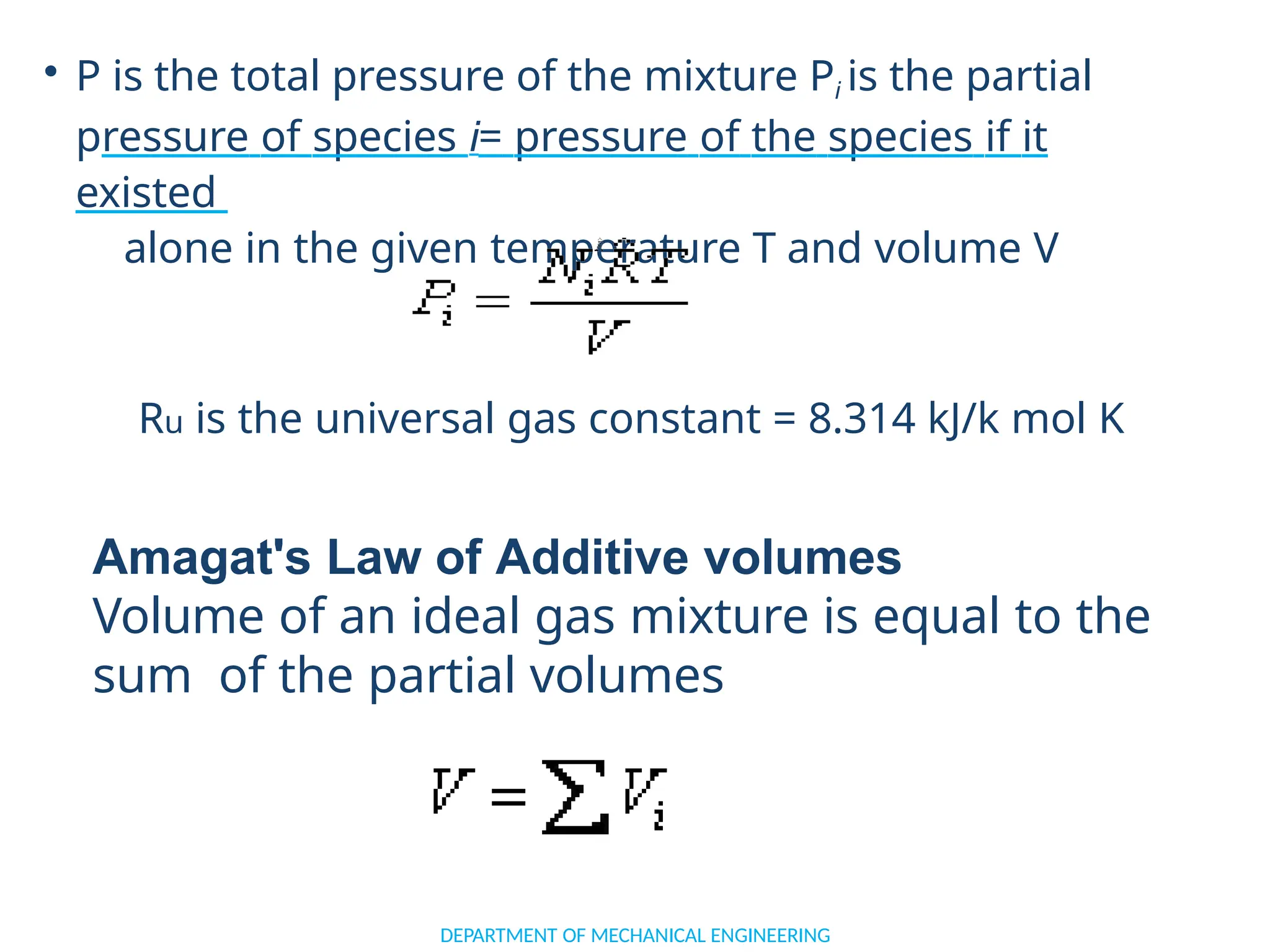
• P is the total pressure of the mixture Pi is the partial
pressure of species i= pressure of the species if it
existed
alone in the given temperature T and volume V
Ru is the universal gas constant = 8.314 kJ/k mol K
Amagat's Law of Additive volumes
Volume of an ideal gas mixture is equal to the
sum of the partial volumes
DEPARTMENT OF MECHANICAL ENGINEERING
AMAGAT'S LAW OF ADDITIVE VOLUMES
Amagat's law of additive volumes is the law
of partial volumes.
The law relates the total volume of a
mixture with the volumes of individual
components.
Amagat's law is very similar to Dalton's law
of partial pressure.
The law is only valid for ideal gases.
DEPARTMENT OF MECHANICAL ENGINEERING
Statement
• For a mixture of non-reacting ideal gases, the
total volume of the mixture equals the sum of the
partial volumes of individual components at
constant pressure and temperature.
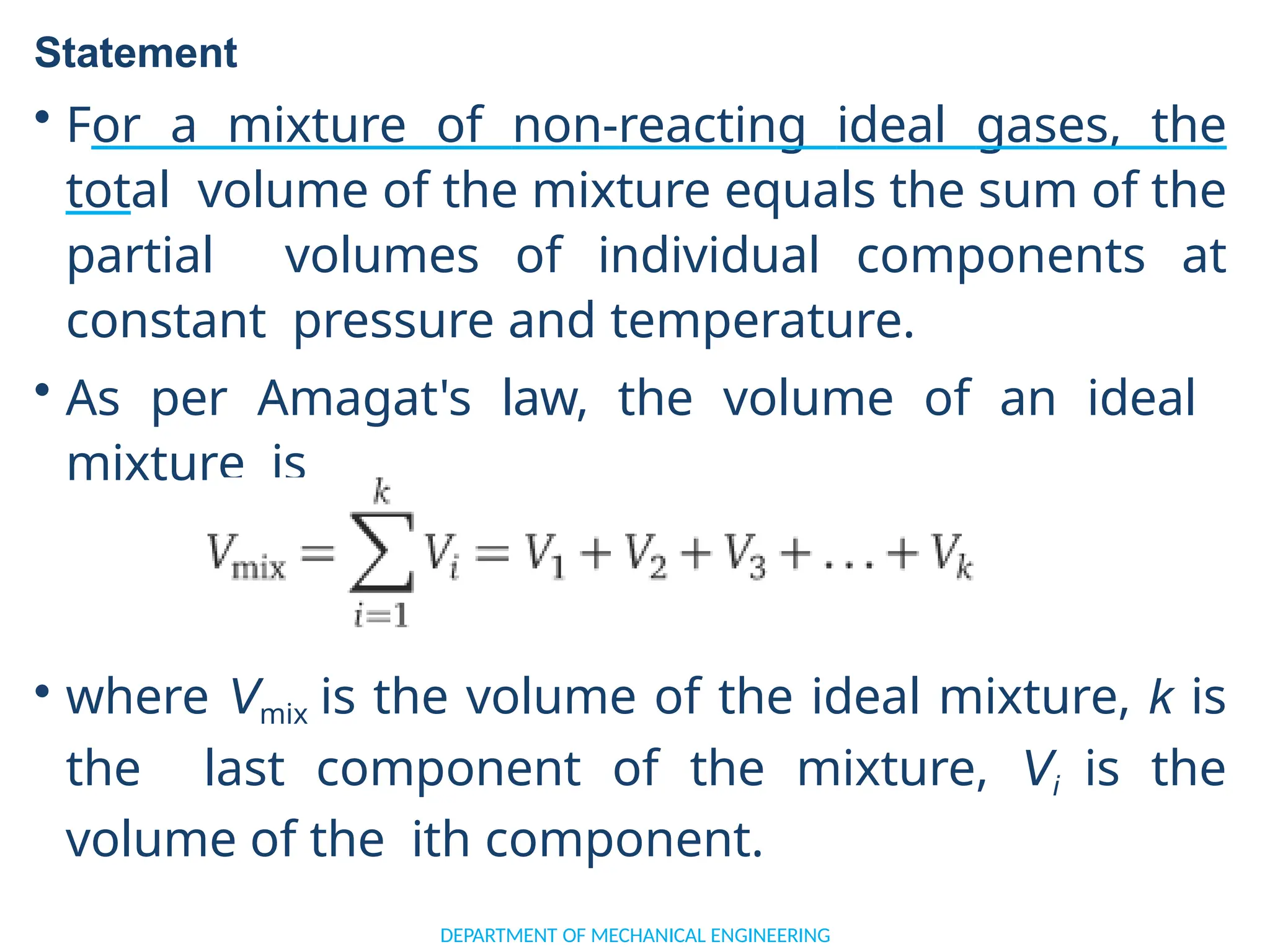
• As per Amagat's law, the volume of an ideal
mixture is
• where Vmix is the volume of the ideal mixture, k is
the last component of the mixture, Vi is the
volume of the ith component.
DEPARTMENT OF MECHANICAL ENGINEERING
IDEAL GAS LAW OR EQUATION OF STATE
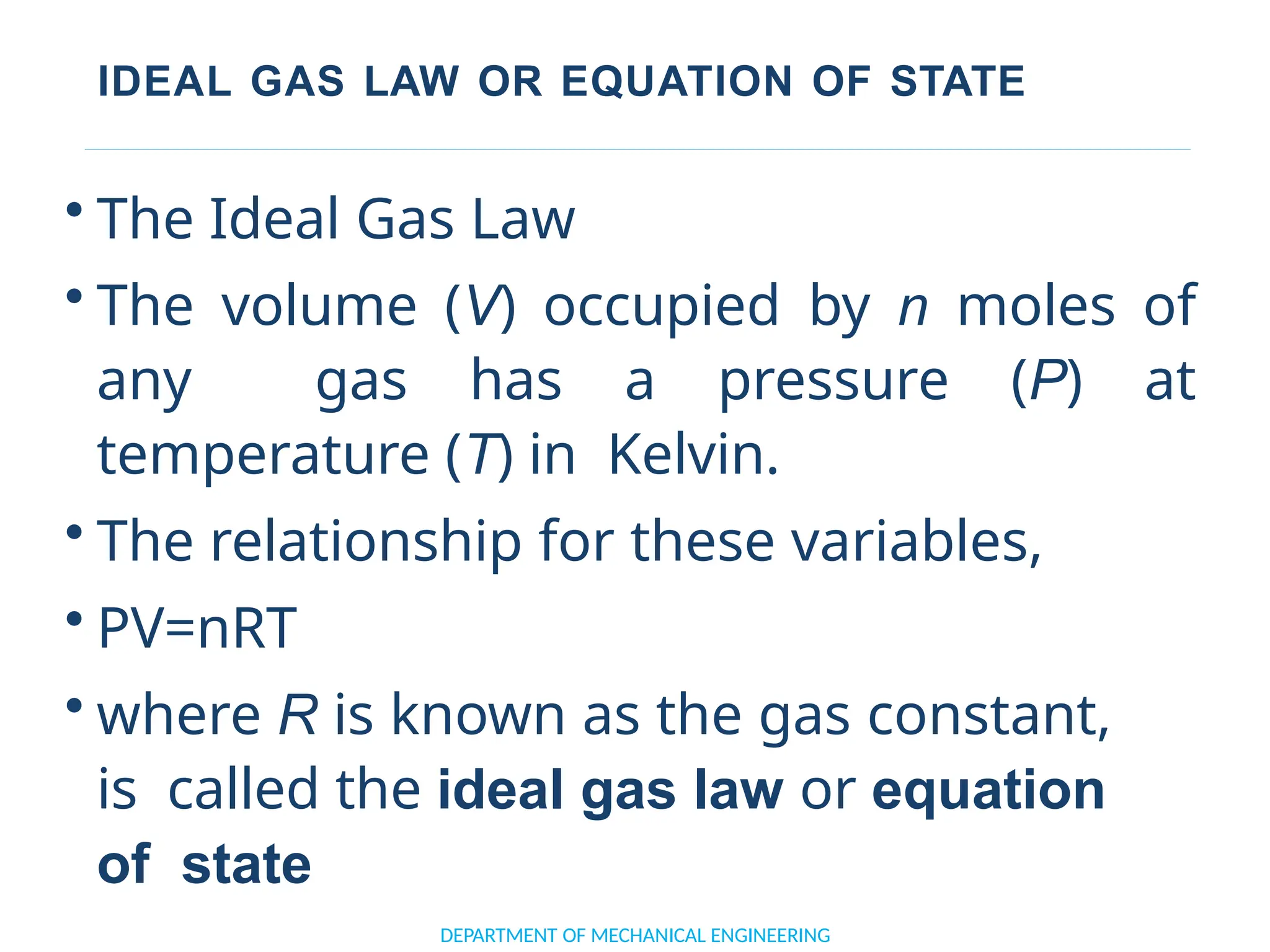
• The Ideal Gas Law
• The volume (V) occupied by n moles of
any gas has a pressure (P) at
temperature (T) in Kelvin.
• The relationship for these variables,
• PV=nRT
• where R is known as the gas constant,
is called the ideal gas law or equation
of state
DEPARTMENT OF MECHANICAL ENGINEERING
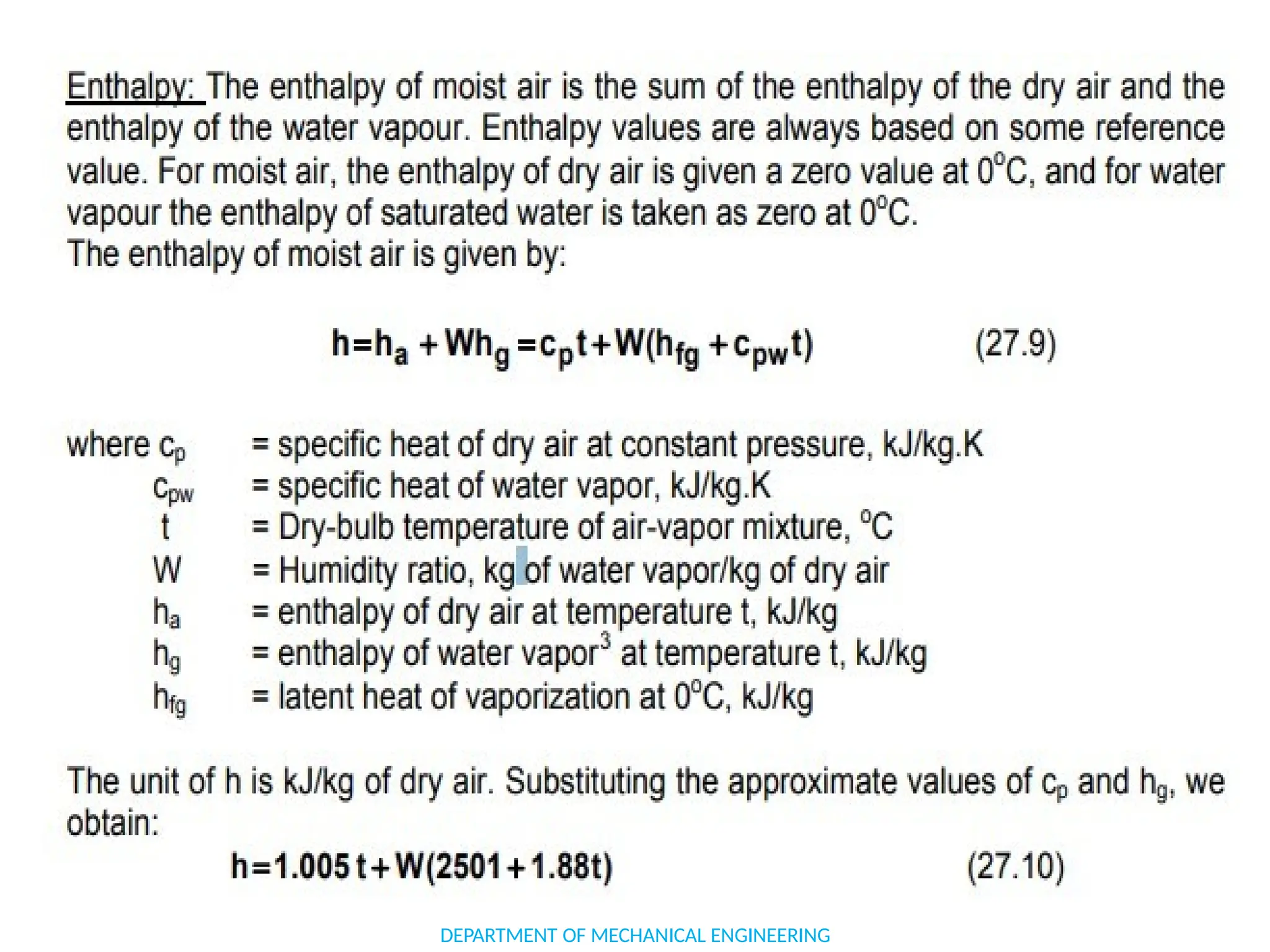
ENTHALPY
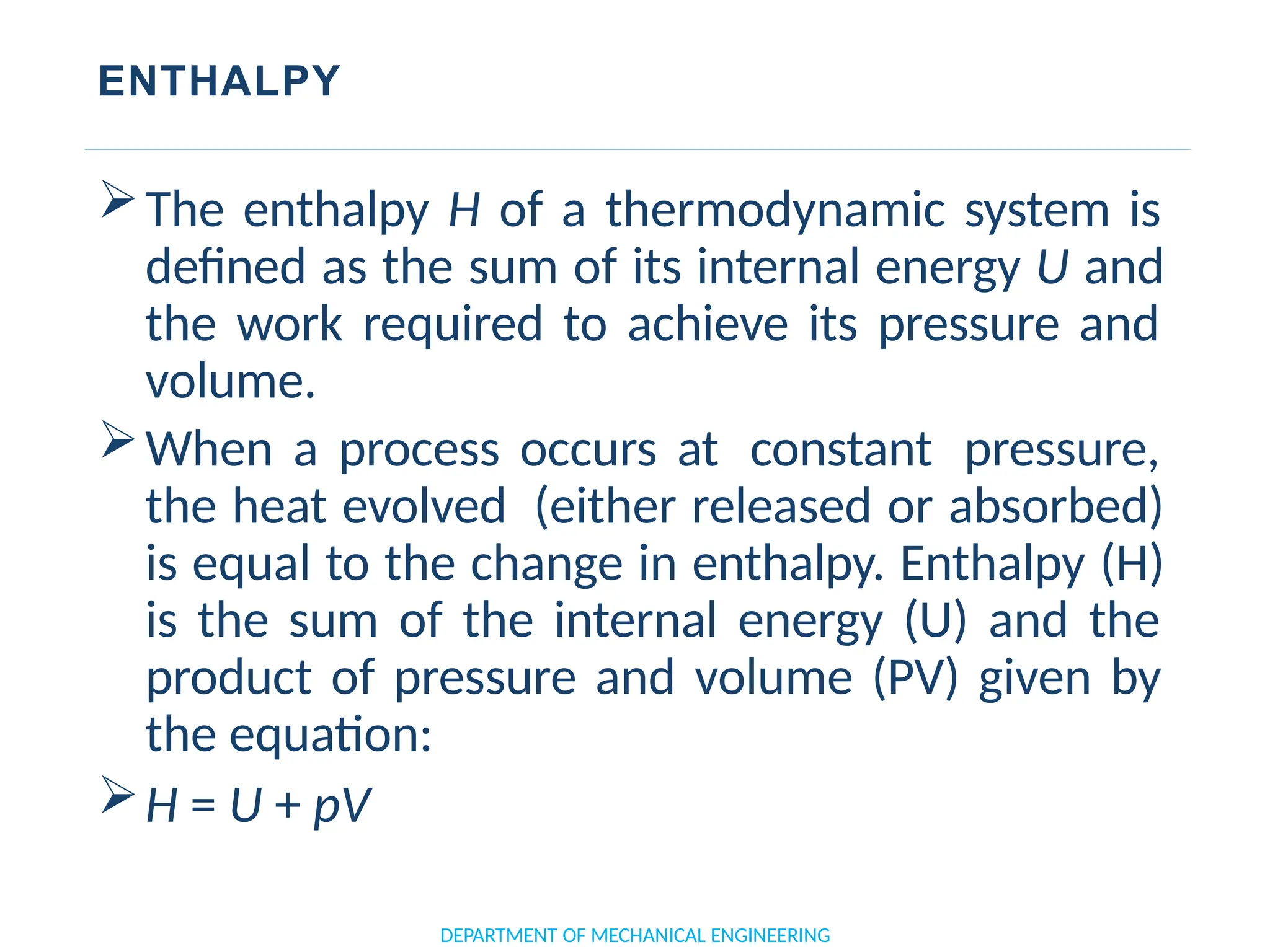
The enthalpy H of a thermodynamic system is
defined as the sum of its internal energy U and
the work required to achieve its pressure and
volume.
When a process occurs at constant pressure,
the heat evolved (either released or absorbed)
is equal to the change in enthalpy. Enthalpy (H)
is the sum of the internal energy (U) and the
product of pressure and volume (PV) given by
the equation:
H = U + pV
DEPARTMENT OF MECHANICAL ENGINEERING
ENTHALPY
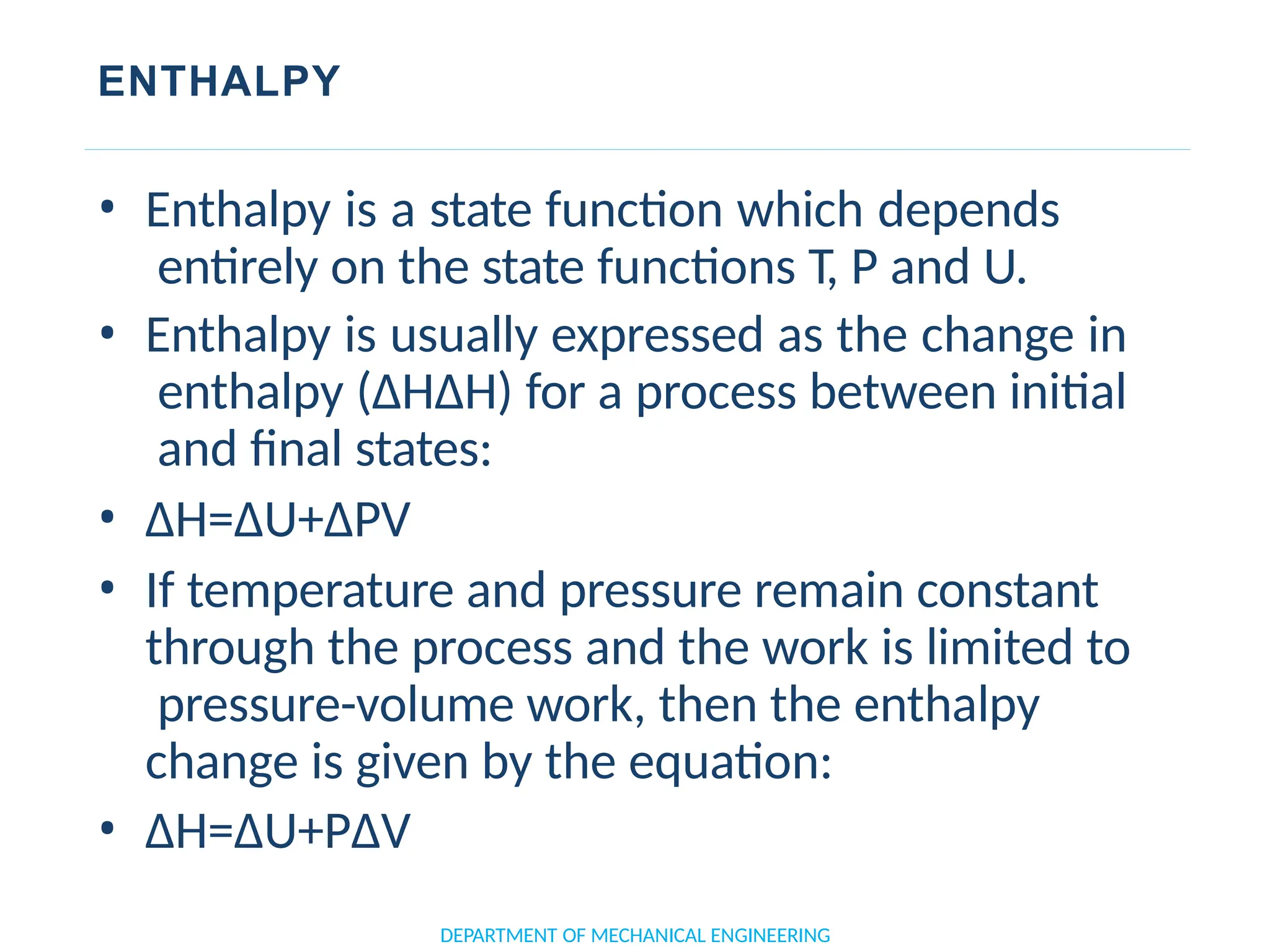
• Enthalpy is a state function which depends
entirely on the state functions T, P and U.
• Enthalpy is usually expressed as the change in
enthalpy (ΔHΔH) for a process between initial
and final states:
• ΔH=ΔU+ΔPV
• If temperature and pressure remain constant
through the process and the work is limited to
pressure-volume work, then the enthalpy
change is given by the equation:
• ΔH=ΔU+PΔV
DEPARTMENT OF MECHANICAL ENGINEERING
ENTHALPY
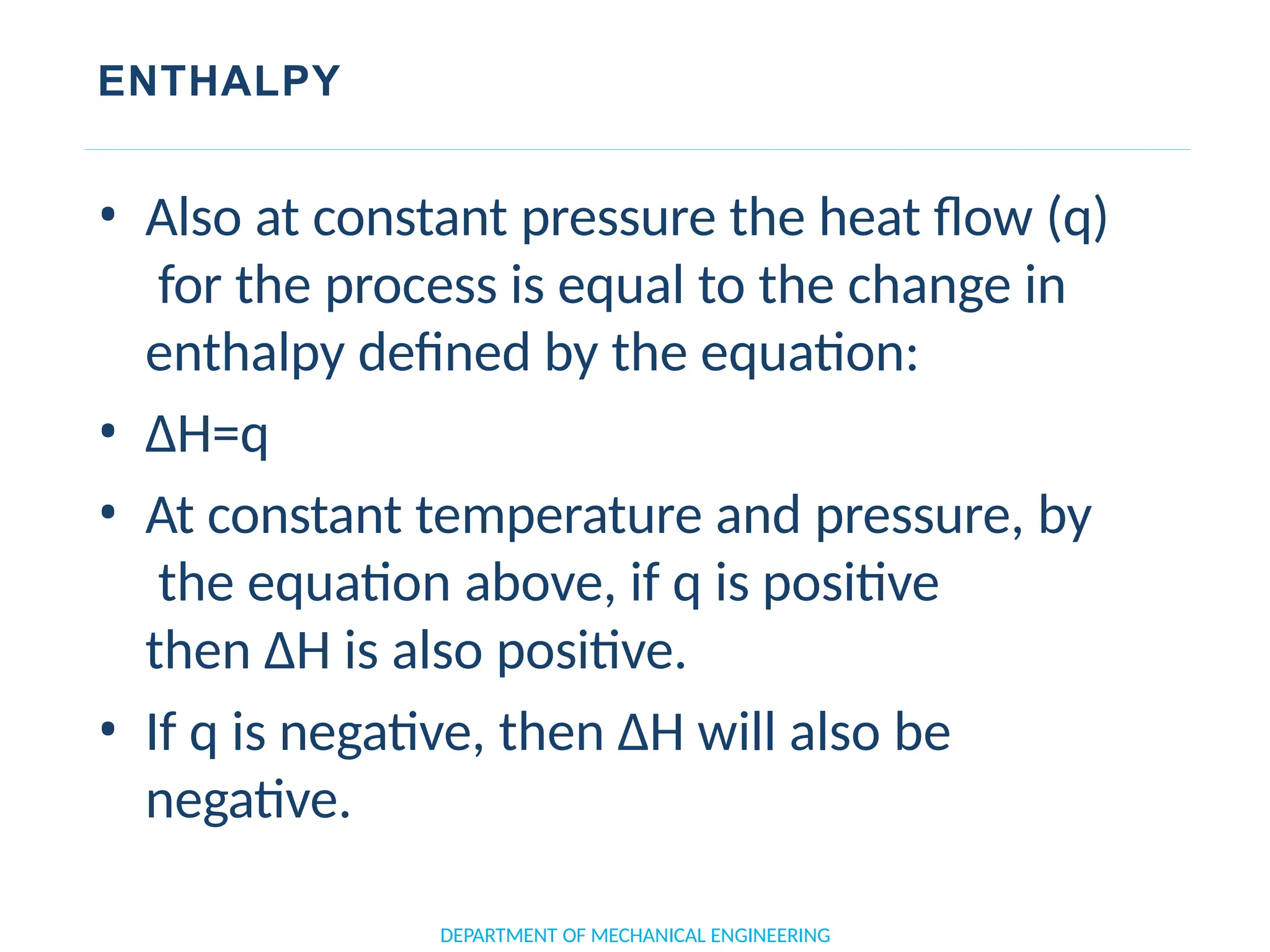
• Also at constant pressure the heat flow (q)
for the process is equal to the change in
enthalpy defined by the equation:
• ΔH=q
• At constant temperature and pressure, by
the equation above, if q is positive
then ΔH is also positive.
• If q is negative, then ΔH will also be
negative.
DEPARTMENT OF MECHANICAL ENGINEERING
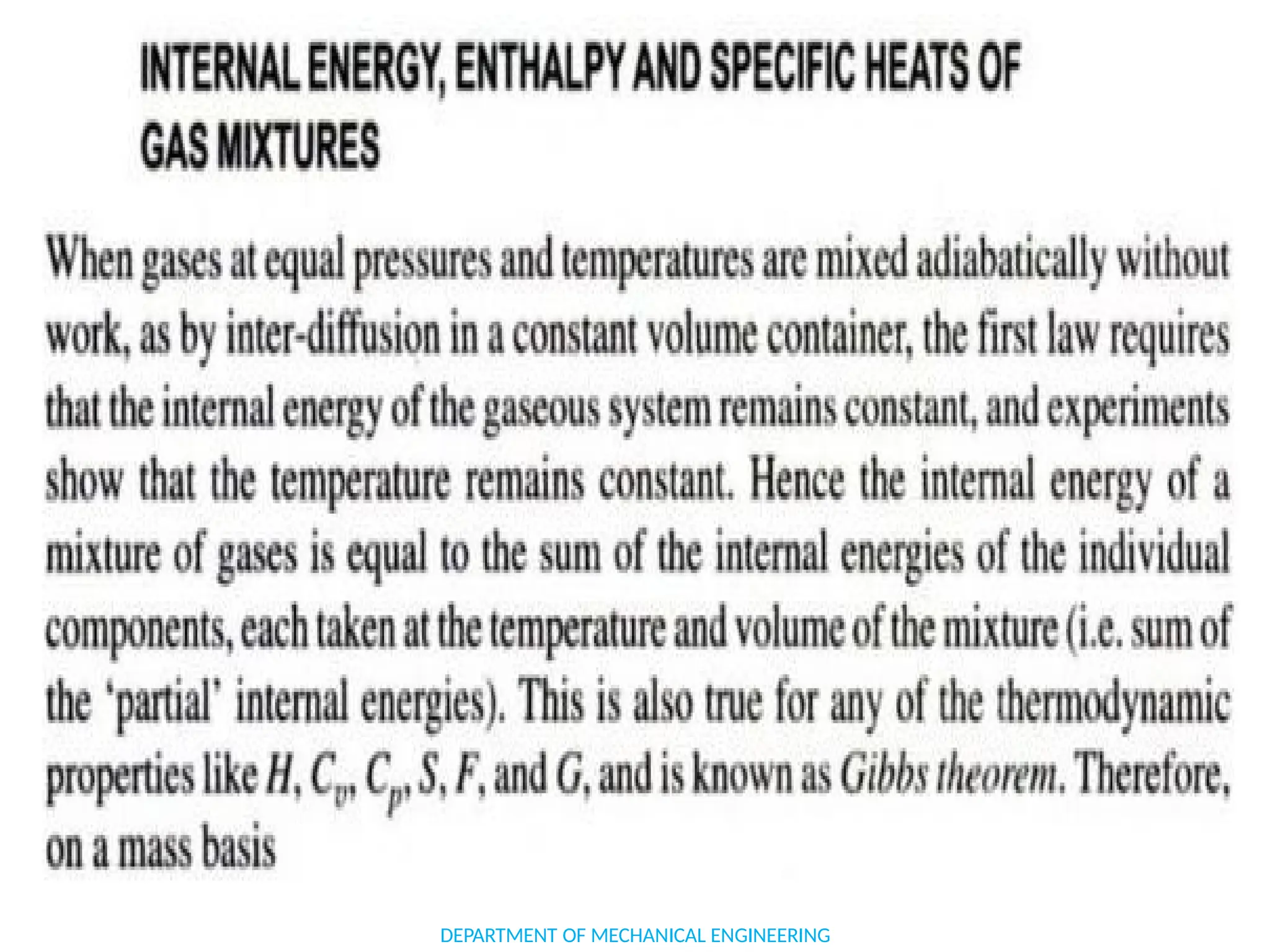
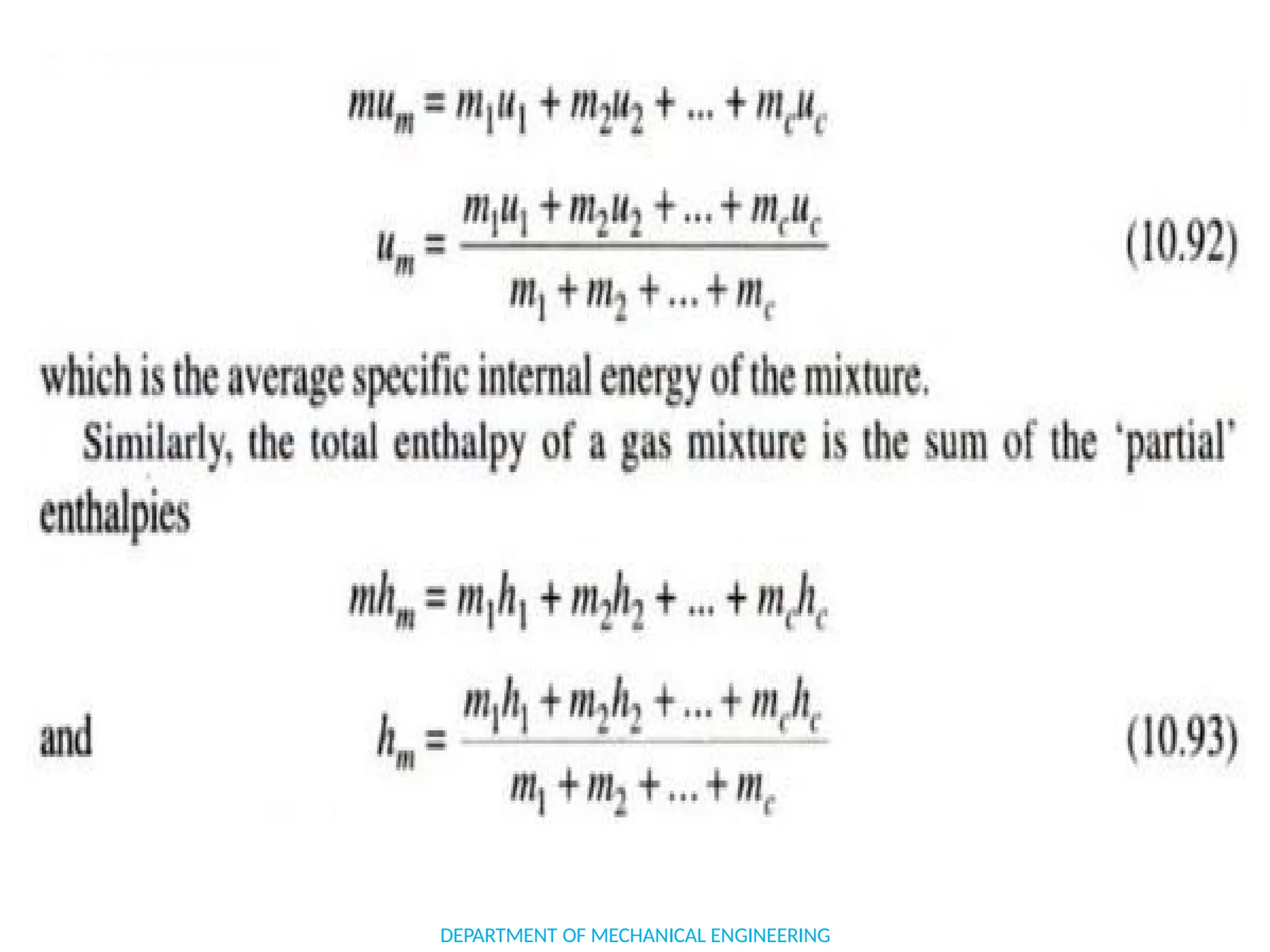
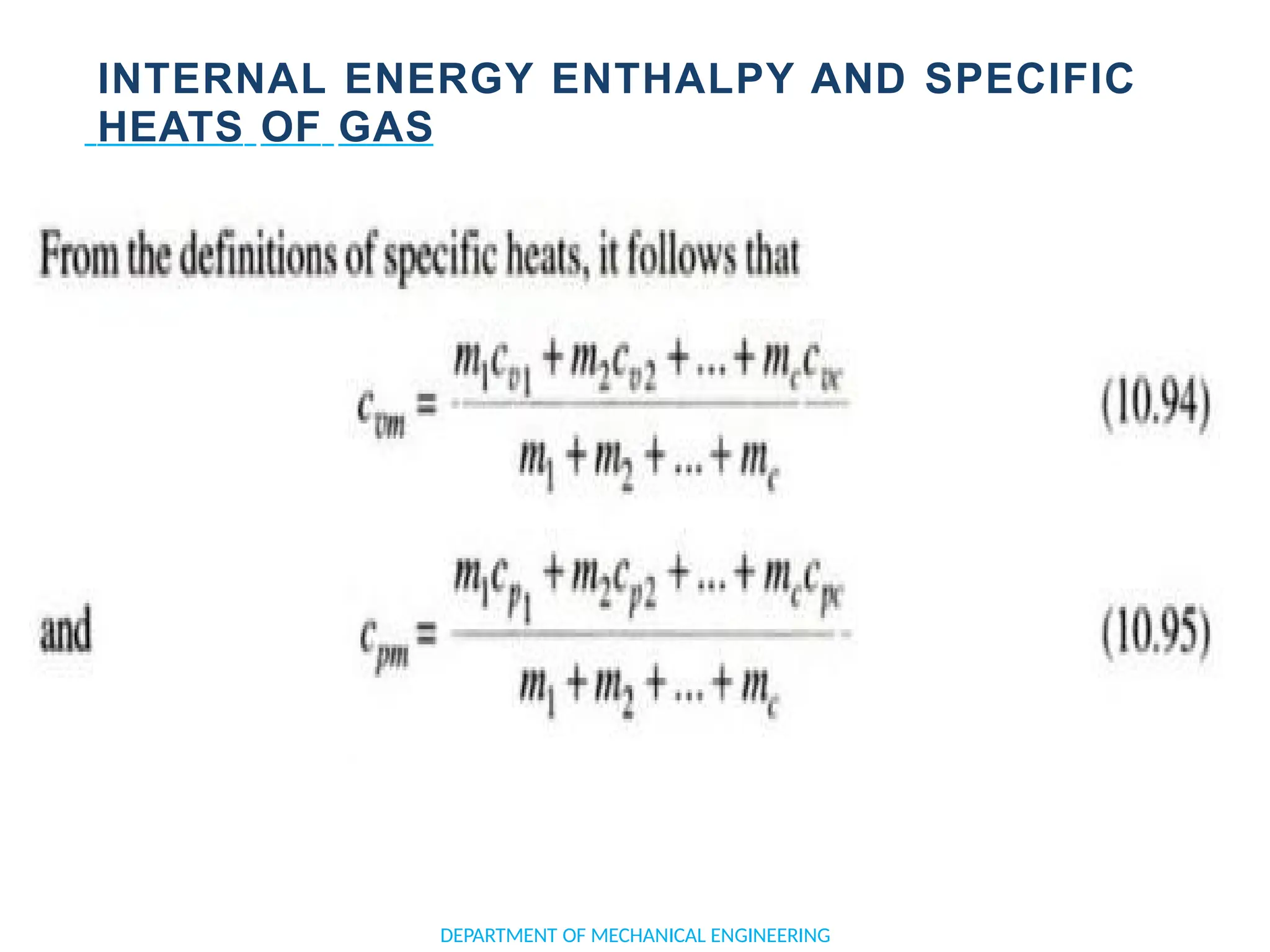
INTERNAL ENERGY ENTHALPY AND SPECIFIC
HEATS OF GAS
DEPARTMENT OF MECHANICAL ENGINEERING
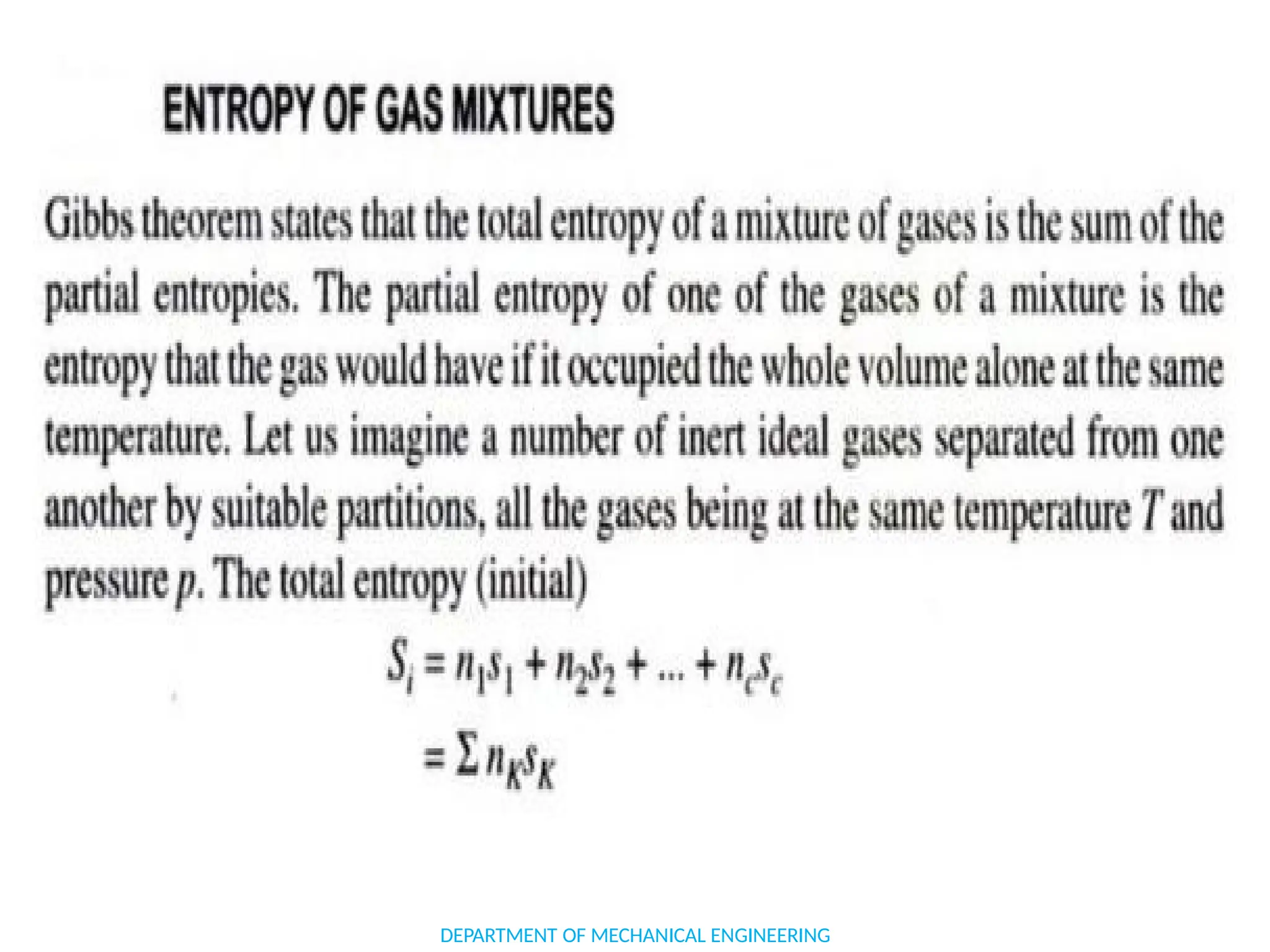
ENTROPY
When two pure substances mix under normal
conditions there is usually an increase in the
entropy of the system.
Since the molecules of ideal gases do not
interact the increase in entropy must simply
result from the extra volume available to each
gas on mixing.
Thus, for gas A the available volume has
increased from VA to (VA + VB).
 By calculating the entropy of expansion of
each gas we can calculate the entropy of mixing
as shown in the panel below.
DEPARTMENT OF MECHANICAL ENGINEERING
PSYCHROMETRY
• Atmospheric air makes up the environment in
almost every type of air conditioning system.
• Hence a thorough understanding of the
properties of atmospheric air and the ability to
analyze various processes involving air is
fundamental to air conditioning design.
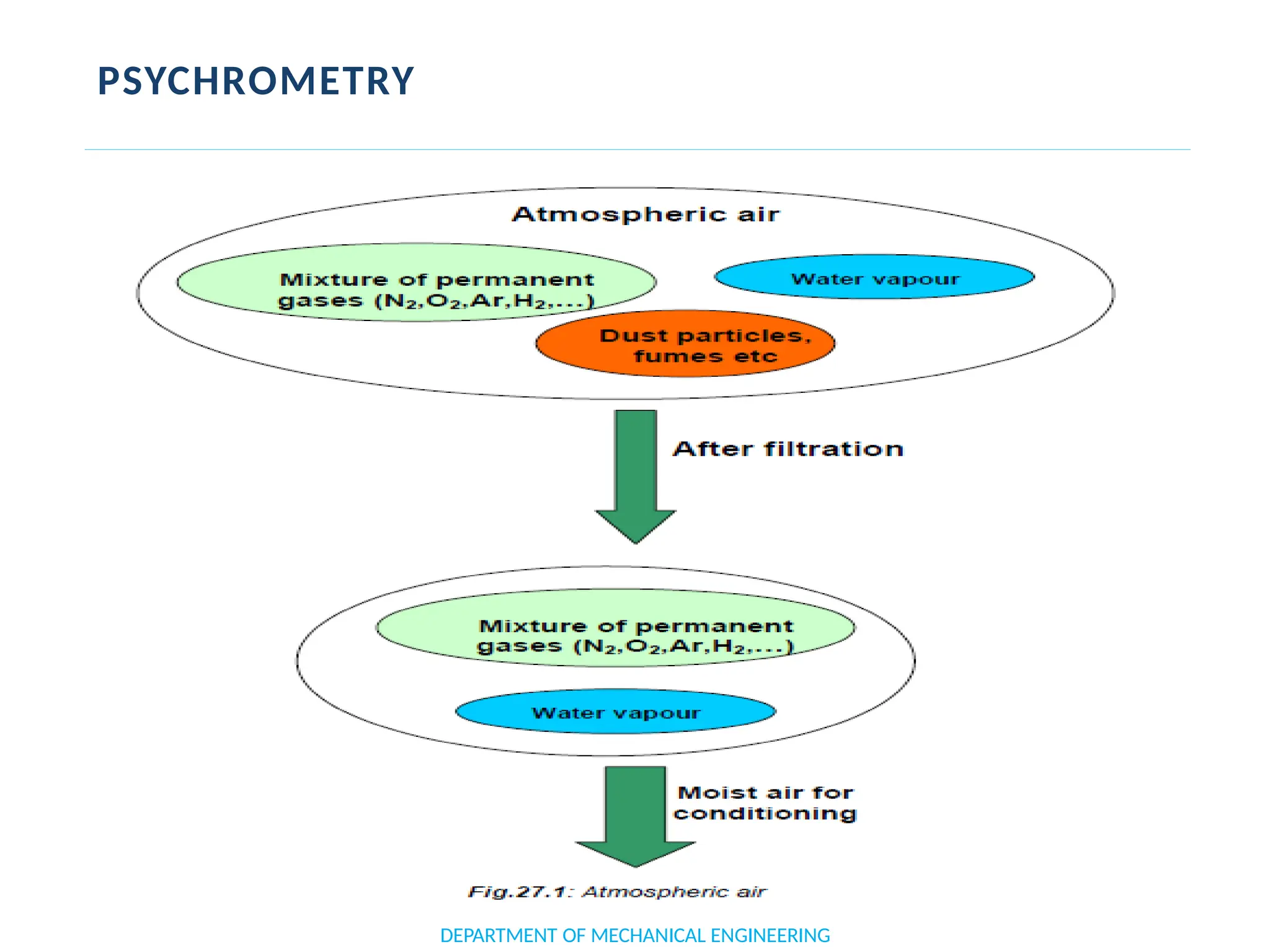
• Atmospheric air is a mixture of many gases plus
water vapour and a number of pollutants
• Psychrometry is the study of the properties of
mixtures of air and water vapour.
DEPARTMENT OF MECHANICAL ENGINEERING
PSYCHROMETRY
DEPARTMENT OF MECHANICAL ENGINEERING
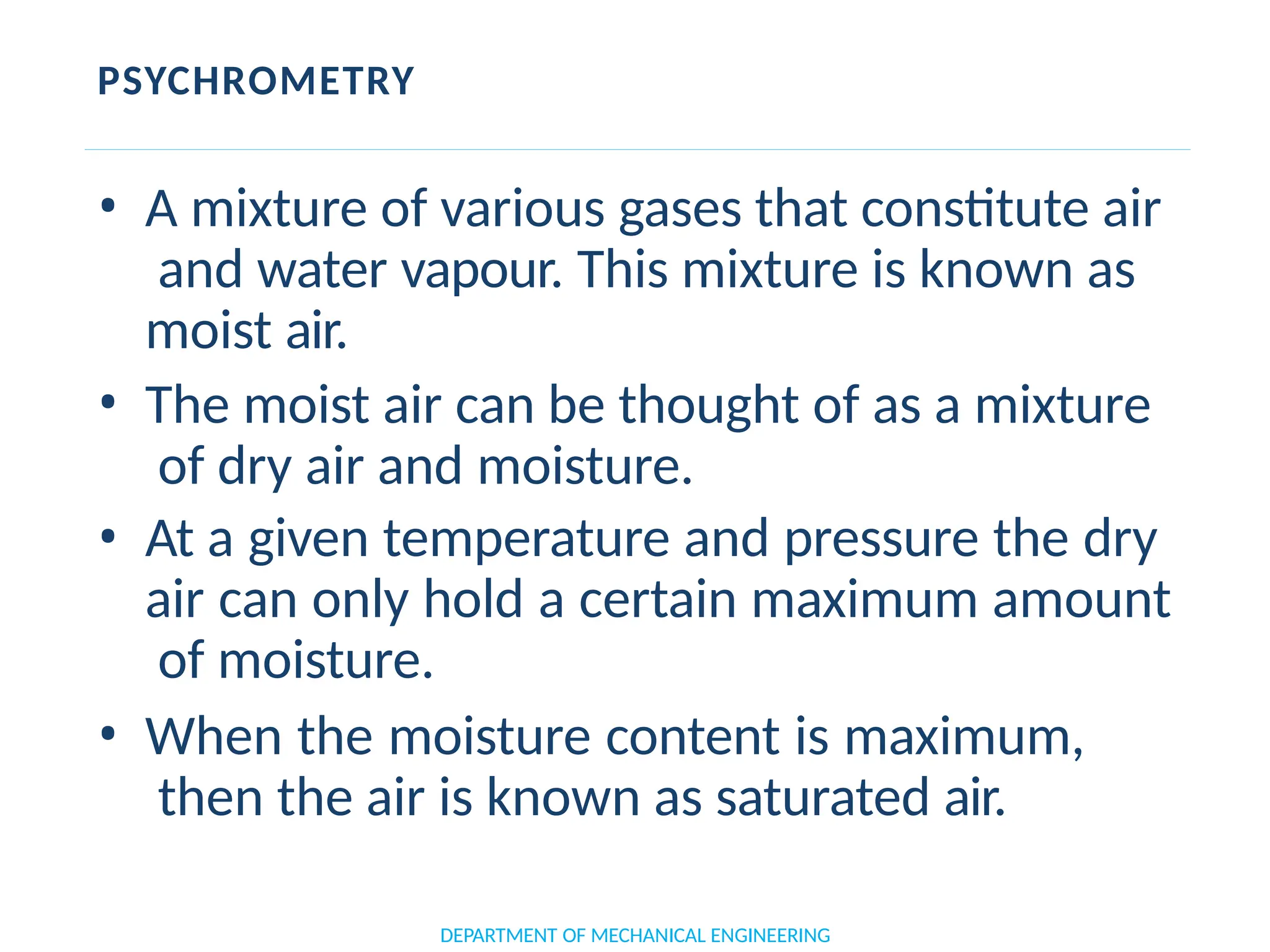
• A mixture of various gases that constitute air
and water vapour. This mixture is known as
moist air.
• The moist air can be thought of as a mixture
of dry air and moisture.
• At a given temperature and pressure the dry
air can only hold a certain maximum amount
of moisture.
• When the moisture content is maximum,
then the air is known as saturated air.
PSYCHROMETRY
DEPARTMENT OF MECHANICAL ENGINEERING
PSYCHROMETRY
DEPARTMENT OF MECHANICAL ENGINEERING
PSYCHROMETRIC PROPERTIES
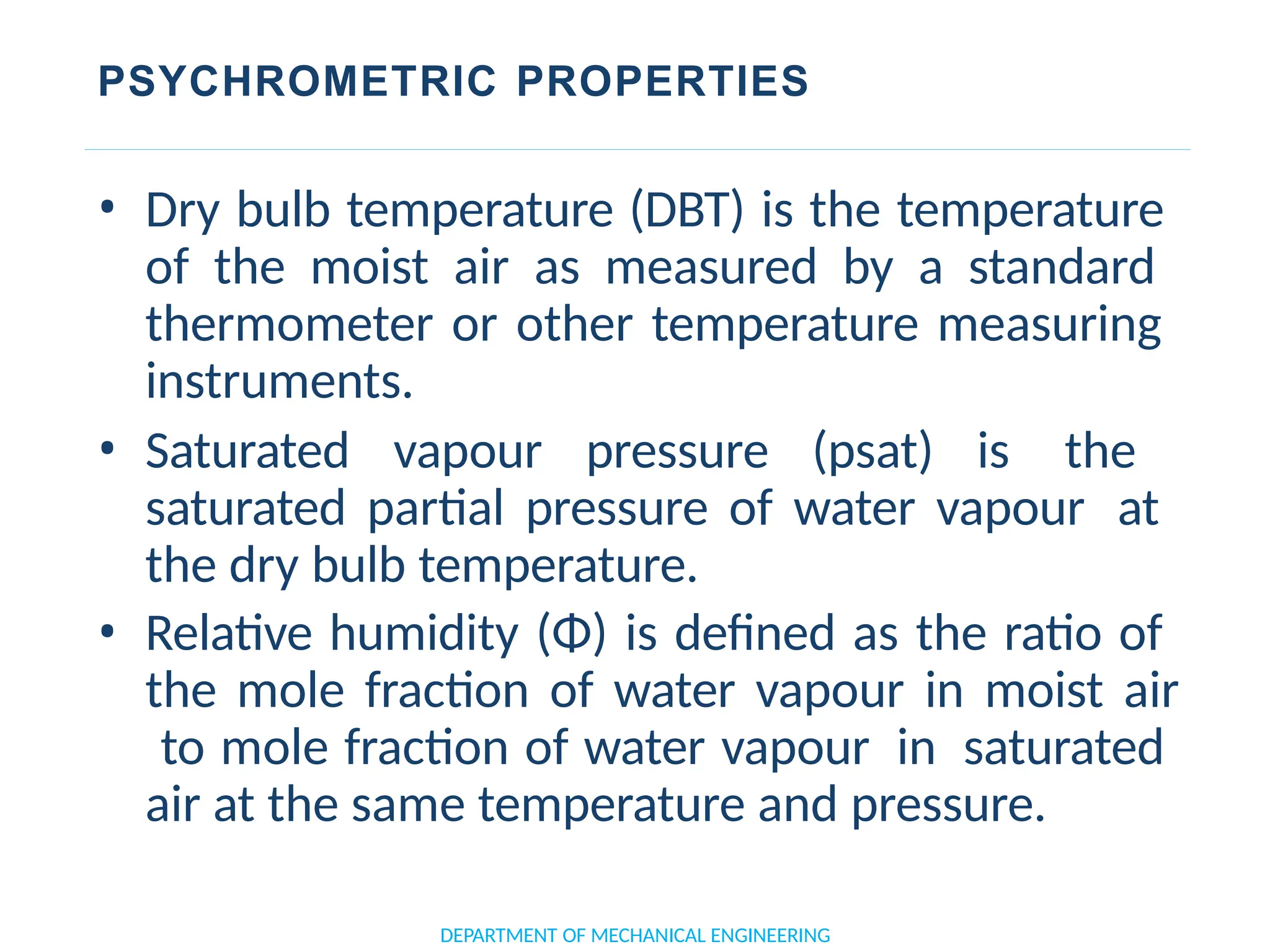
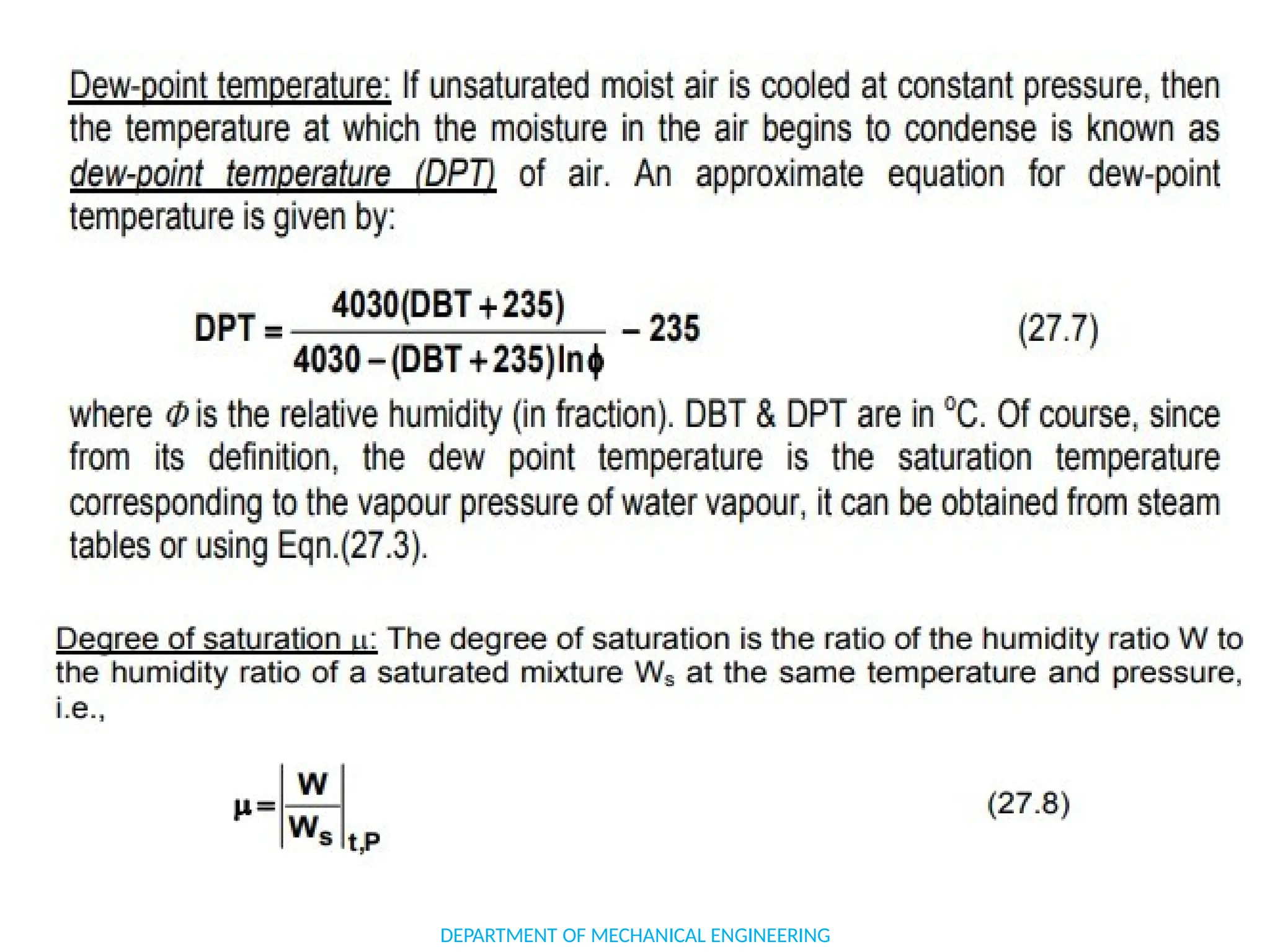
• Dry bulb temperature (DBT) is the temperature
of the moist air as measured by a standard
thermometer or other temperature measuring
instruments.
• Saturated vapour pressure (psat) is the
saturated partial pressure of water vapour at
the dry bulb temperature.
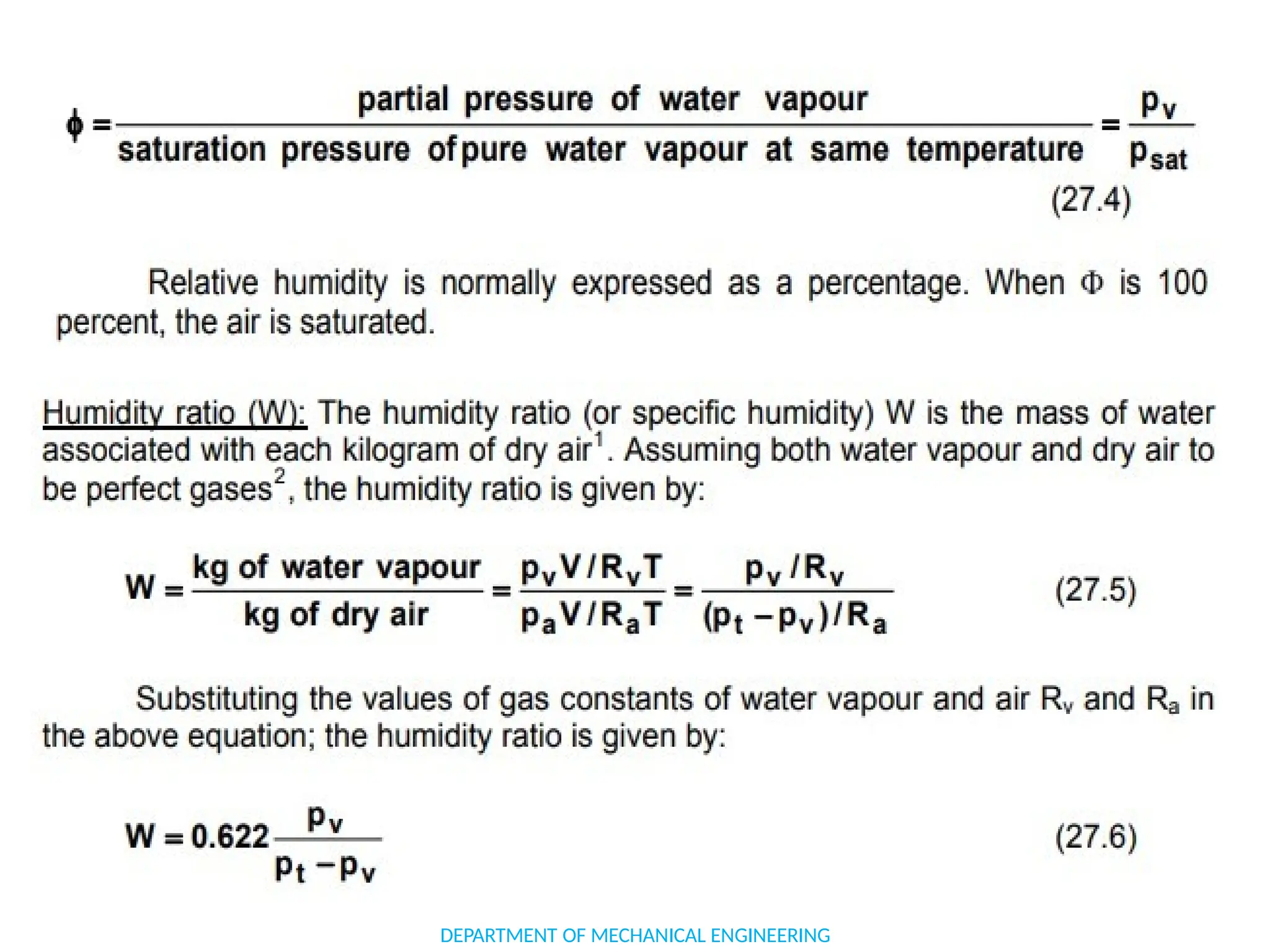
• Relative humidity (Φ) is defined as the ratio of
the mole fraction of water vapour in moist air
to mole fraction of water vapour in saturated
air at the same temperature and pressure.
DEPARTMENT OF MECHANICAL ENGINEERING
PSYCHROMETRIC PROPERTIES
DEPARTMENT OF MECHANICAL ENGINEERING
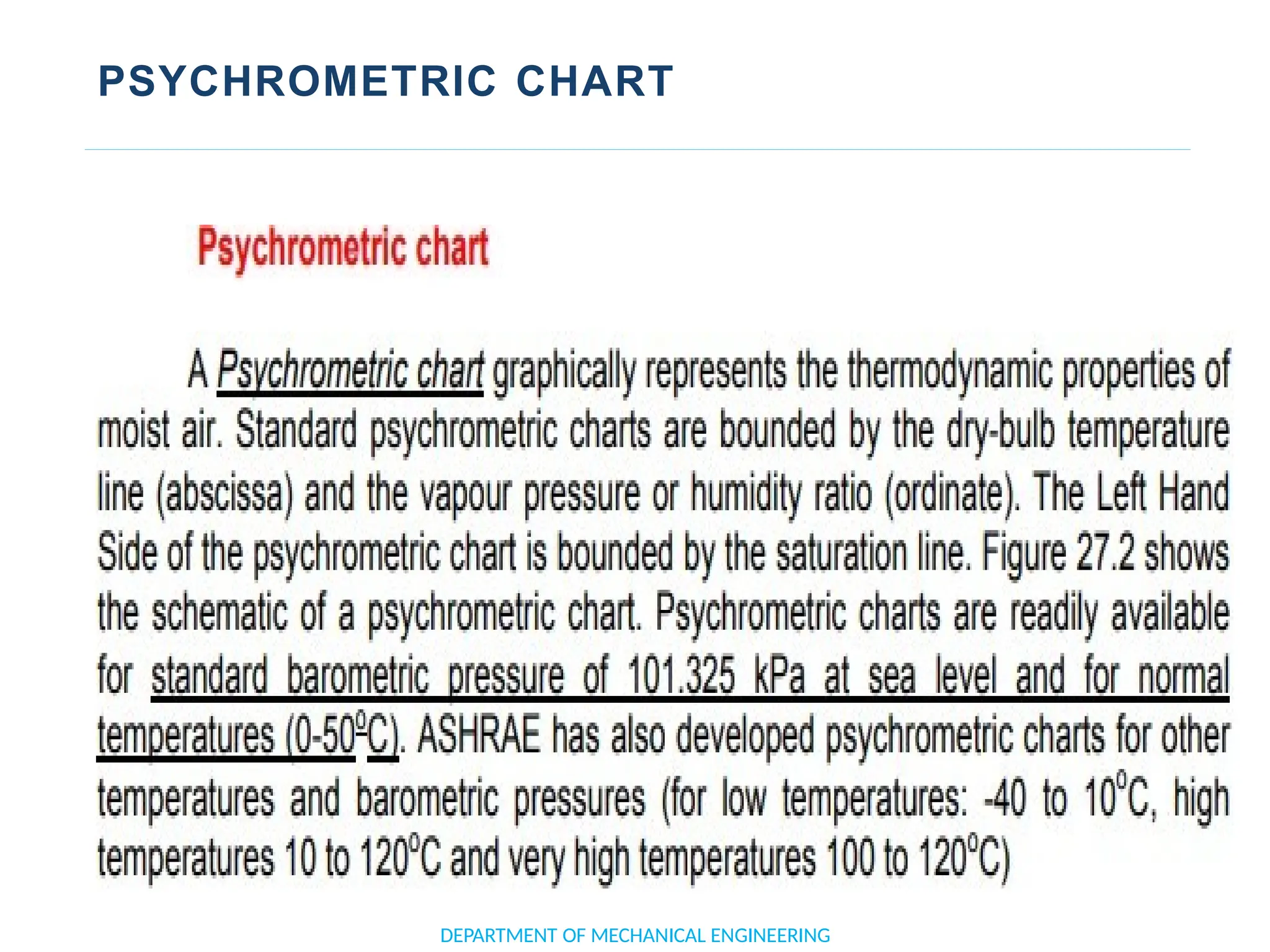
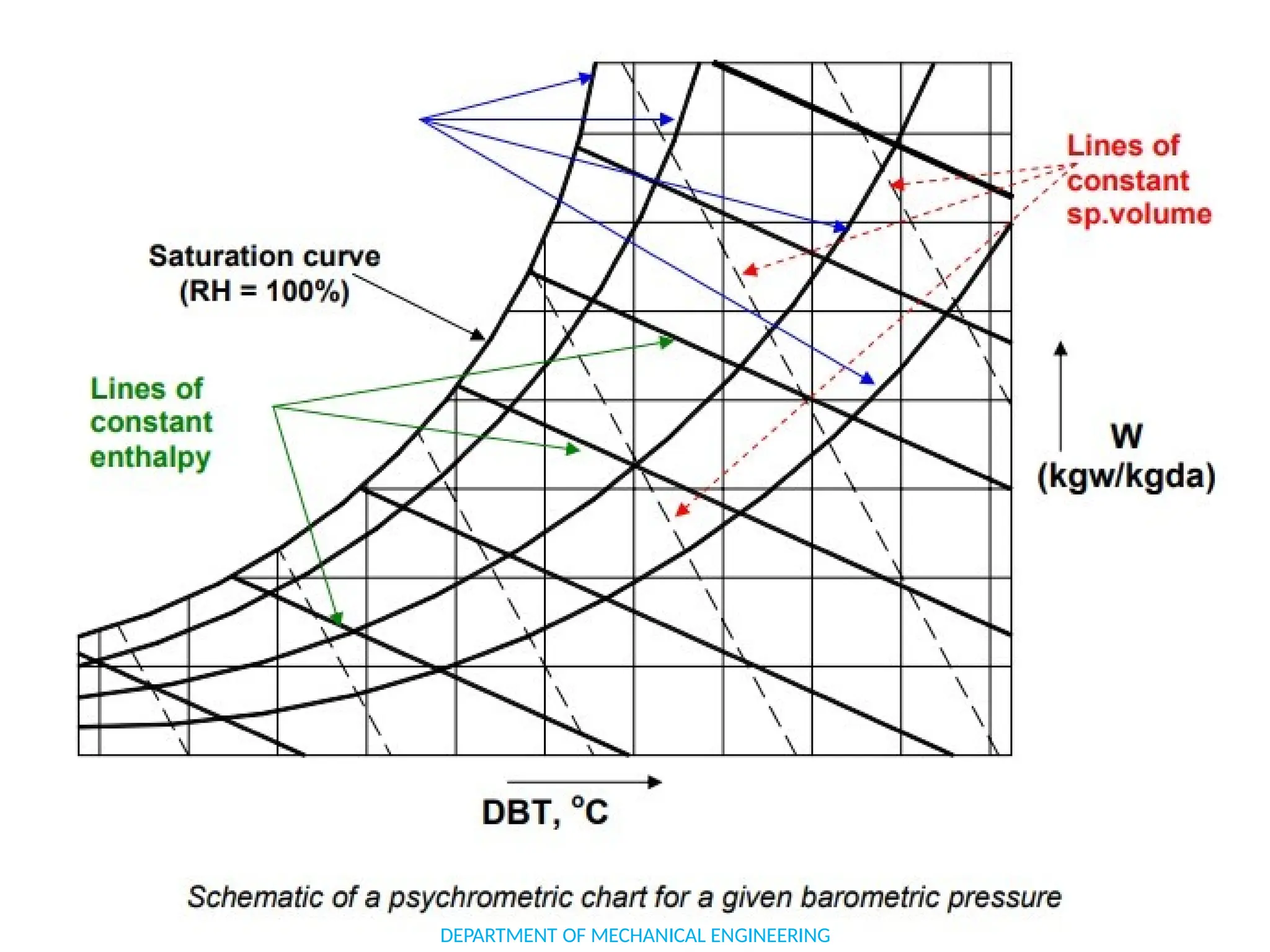
PSYCHROMETRIC CHART
DEPARTMENT OF MECHANICAL ENGINEERING
PSYCHROMETER
DEPARTMENT OF MECHANICAL ENGINEERING
Any instrument capable of measuring the
psychrometric state of air is called a
psychrometer.
As mentioned before, in order to measure
the psychrometric state of air, it is required
to measure three independent parameters.
Generally two of these are the barometric
pressure and air dry-bulb temperature as
they can be measured easily and with good
accuracy.
PSYCHROMETER
• The sling psychrometer is widely used for
measurements involving room air or other
applications where the air velocity inside the room
is small.
• The sling psychrometer consists of two
thermometers mounted side by side and fitted in a
frame with a handle for whirling the device through
air.
• The required air circulation (≈ 3 to 5 m/s) over the
sensing bulbs is obtained by whirling the
psychrometer (≈ 300 RPM).
• Readings are taken when both the thermometers
show steady-state readings.
DEPARTMENT OF MECHANICAL ENGINEERING
SOLVED PROBLEMS
DEPARTMENT OF MECHANICAL ENGINEERING
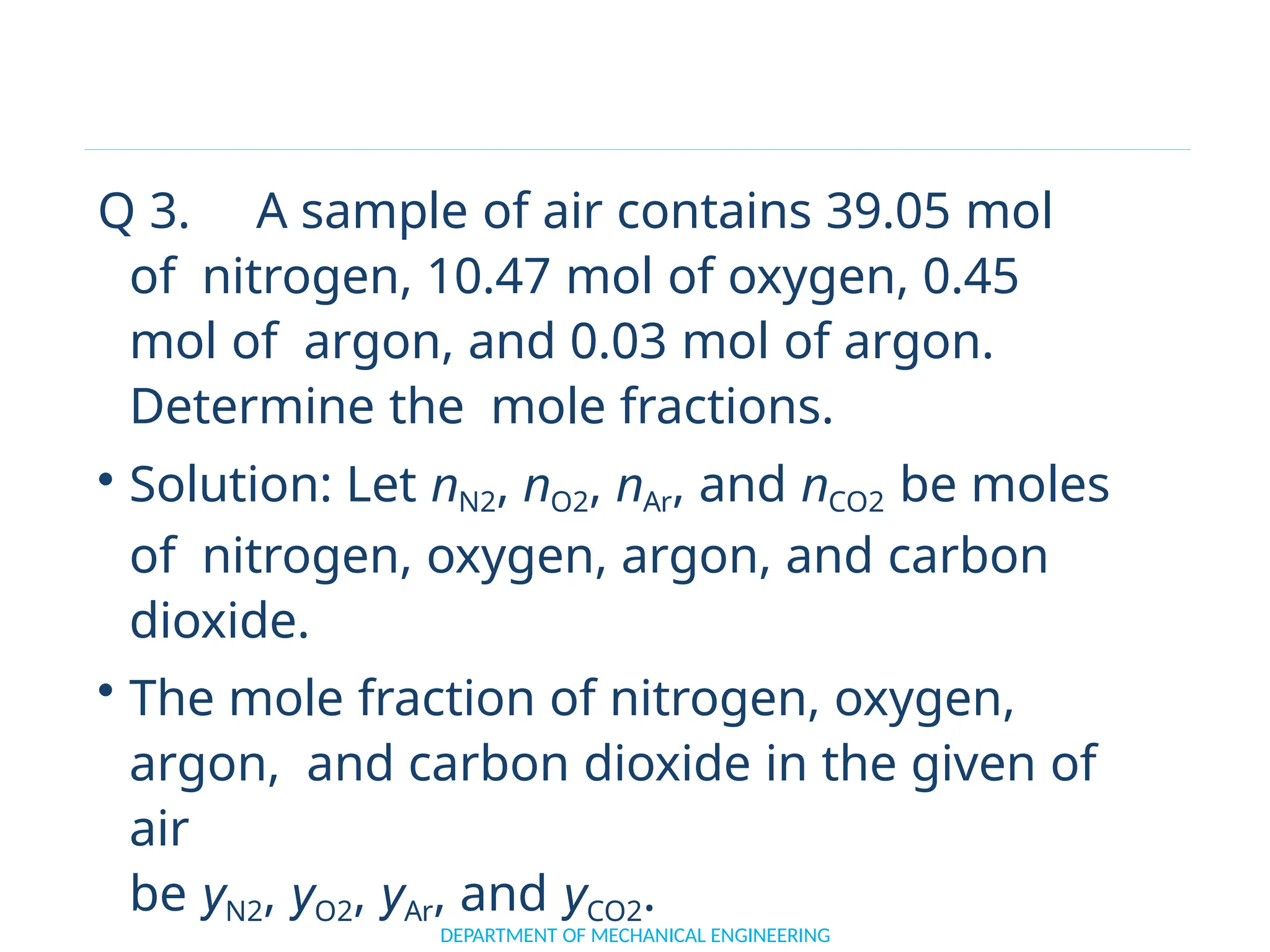
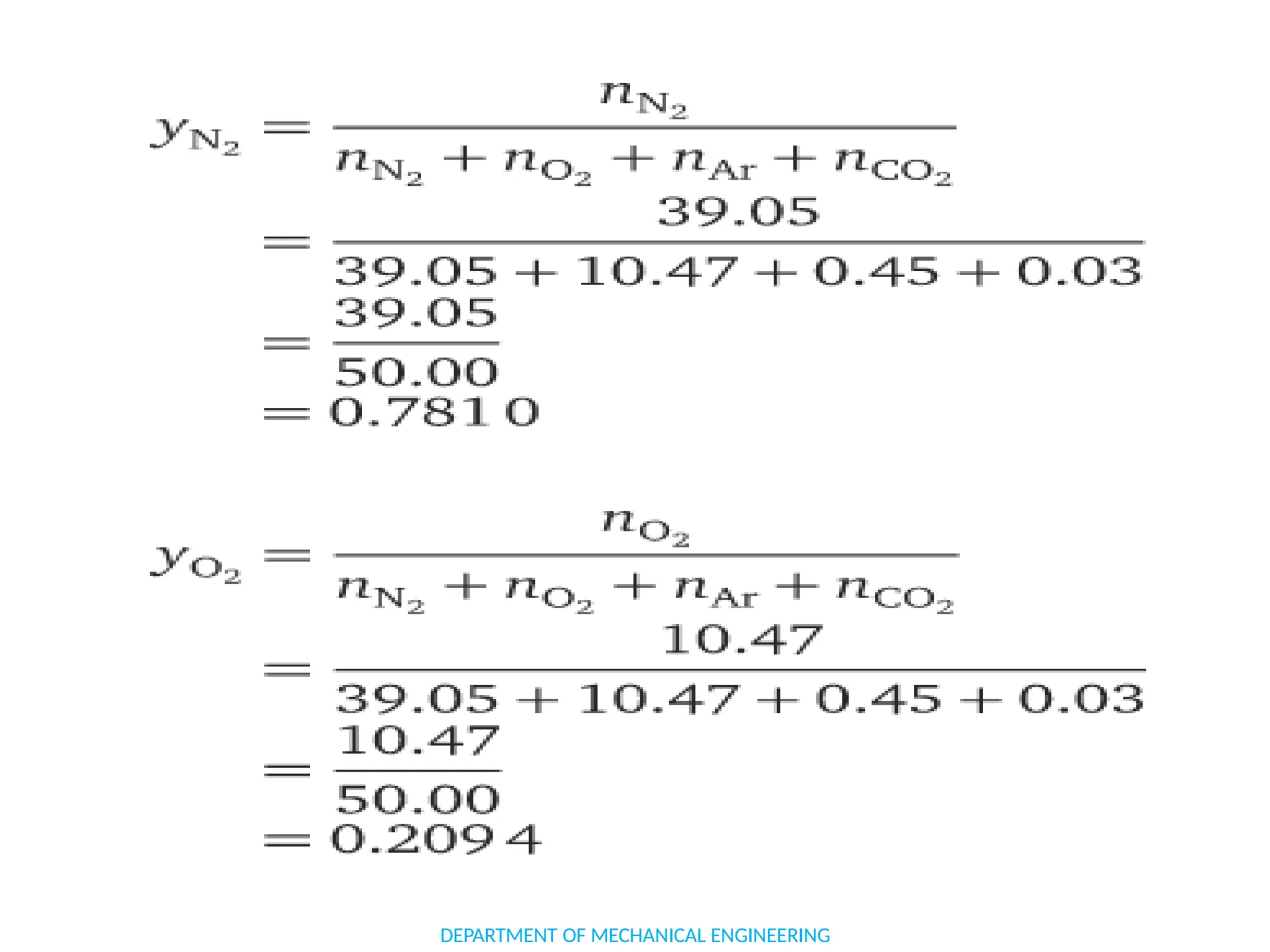
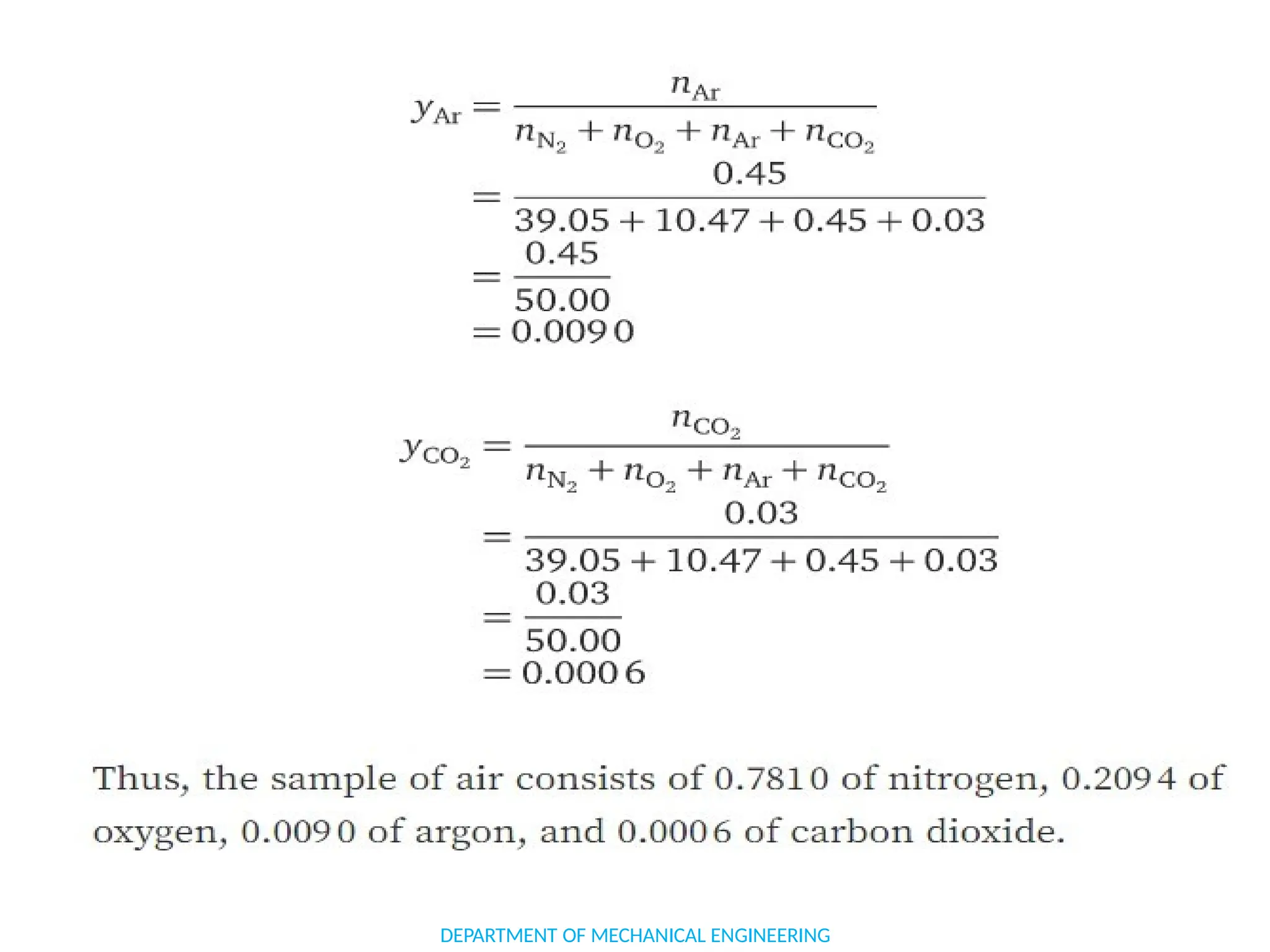
Q 3. A sample of air contains 39.05 mol
of nitrogen, 10.47 mol of oxygen, 0.45
mol of argon, and 0.03 mol of argon.
Determine the mole fractions.
• Solution: Let nN2, nO2, nAr, and nCO2 be moles
of nitrogen, oxygen, argon, and carbon
dioxide.
• The mole fraction of nitrogen, oxygen,
argon, and carbon dioxide in the given of
air
be yN2, yO2, yAr, and yCO2.
DEPARTMENT OF MECHANICAL ENGINEERING
SOLVED PROBLEMS
DEPARTMENT OF MECHANICAL ENGINEERING
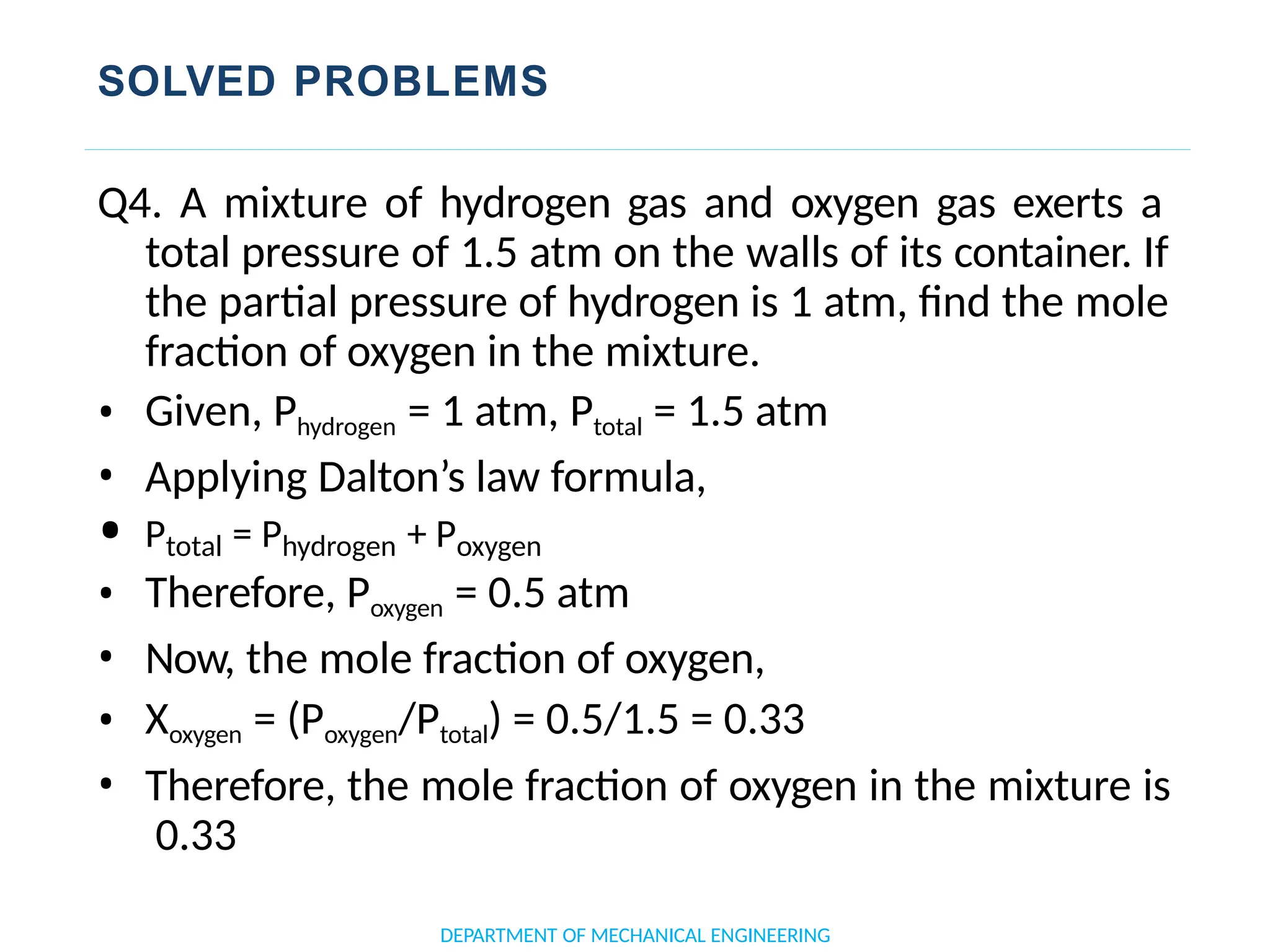
Q4. A mixture of hydrogen gas and oxygen gas exerts a
total pressure of 1.5 atm on the walls of its container. If
the partial pressure of hydrogen is 1 atm, find the mole
fraction of oxygen in the mixture.
• Given, Phydrogen = 1 atm, Ptotal = 1.5 atm
• Applying Dalton’s law formula,
• Ptotal = Phydrogen + Poxygen
• Therefore, Poxygen = 0.5 atm
• Now, the mole fraction of oxygen,
• Xoxygen = (Poxygen/Ptotal) = 0.5/1.5 = 0.33
• Therefore, the mole fraction of oxygen in the mixture is
0.33
INDUSTRIAL APPLICATIONS
• Automobile industries.
• Refrigeration industries
• Air craft applications
• Defense industries
• Thermal power plants
• Chemical industries
• Textile industries etc.
DEPARTMENT OF MECHANICAL ENGINEERING
SELF LEARNING QUESTIONS
DEPARTMENT OF MECHANICAL ENGINEERING
1. Define mole fraction, and mass fraction. Explain
about
volumetric and gravimetric analysis?
2. Explain adiabatic saturation temperature?
3. Explain psychrometric charts while representing all
the
properties?
4. Locate i) sensible heating ii) sensible cooling iii) heating
and
humidification iv) heating and dehumidification
on psychrometric chart?
5. Compare degree of saturation and adiabatic saturation.
ASSIGNMENT EXERCISES
DEPARTMENT OF MECHANICAL ENGINEERING
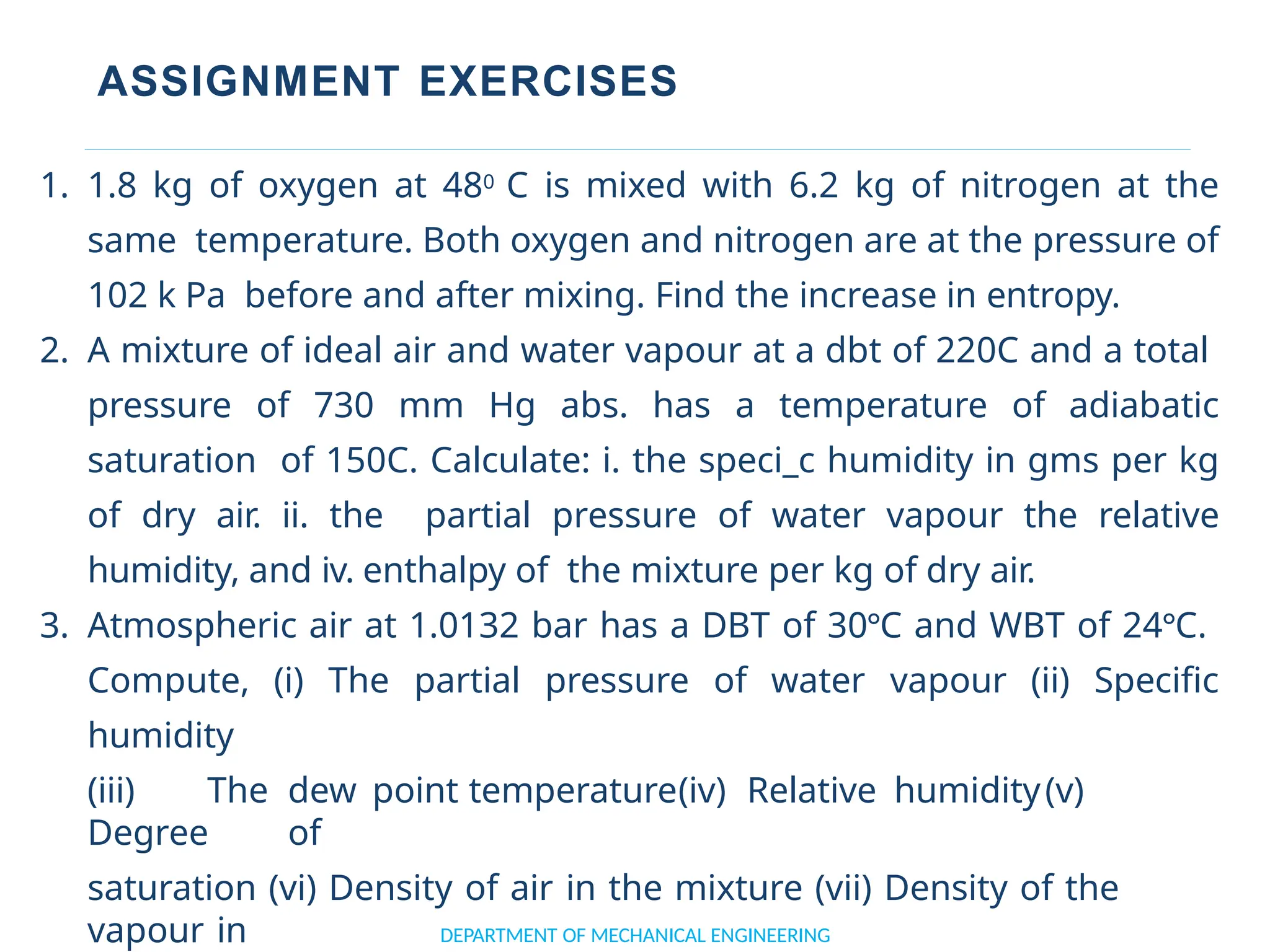
1. 1.8 kg of oxygen at 480 C is mixed with 6.2 kg of nitrogen at the
same temperature. Both oxygen and nitrogen are at the pressure of
102 k Pa before and after mixing. Find the increase in entropy.
2. A mixture of ideal air and water vapour at a dbt of 220C and a total
pressure of 730 mm Hg abs. has a temperature of adiabatic
saturation of 150C. Calculate: i. the speci_c humidity in gms per kg
of dry air. ii. the partial pressure of water vapour the relative
humidity, and iv. enthalpy of the mixture per kg of dry air.
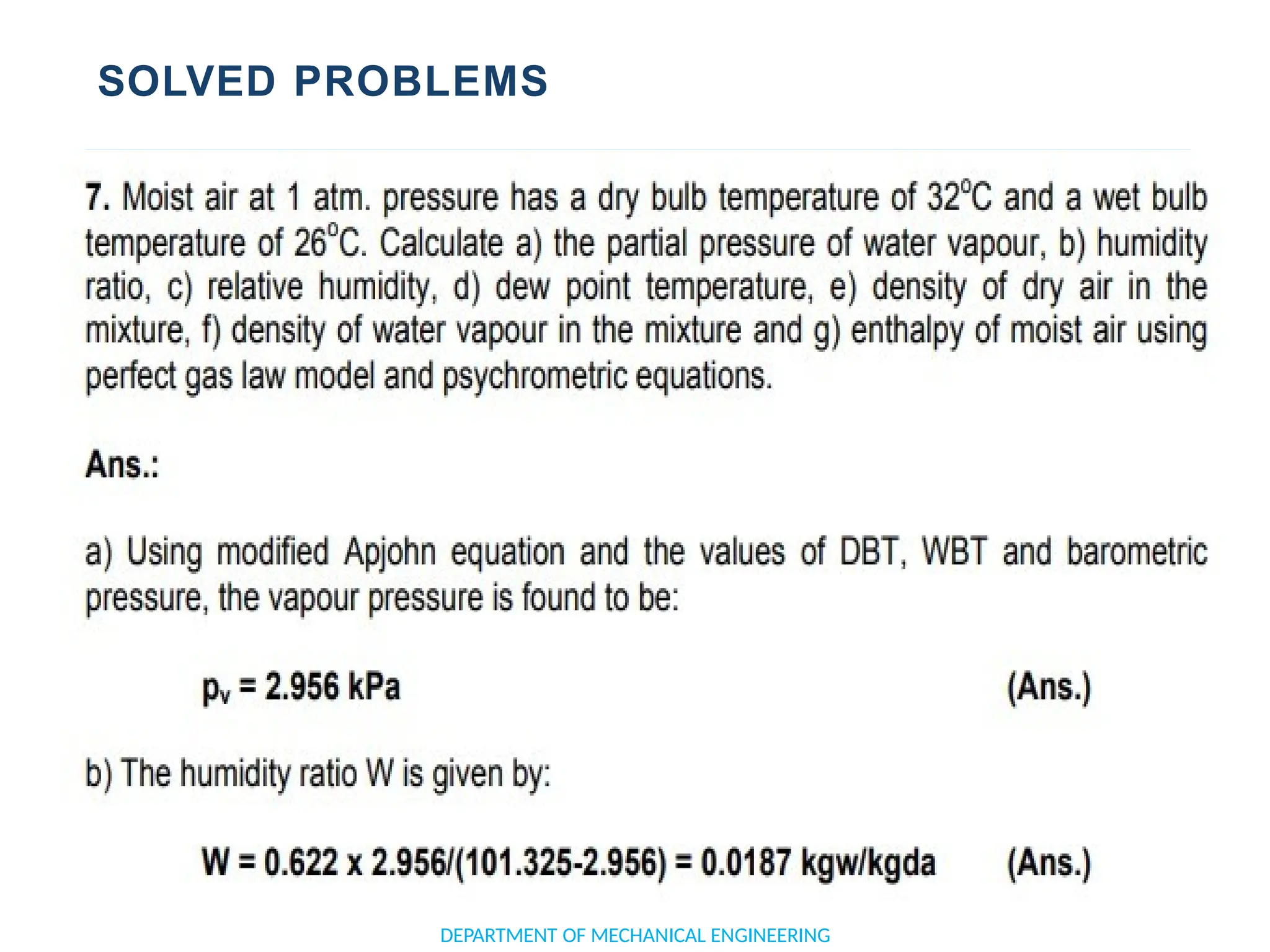
3. Atmospheric air at 1.0132 bar has a DBT of 30°C and WBT of 24°C.
Compute, (i) The partial pressure of water vapour (ii) Specific
humidity
(iii) The dew point temperature(iv) Relative humidity(v)
Degree of
saturation (vi) Density of air in the mixture (vii) Density of the
vapour in
THANK YOU
E N GIN E E R IN G
THERMODYNAMICS
DEPARTMENT OF MECHANICAL ENGINEERING
COURSE OBJECTIVES
UNIT -
1
CO1:To understand the concepts of
energy transformation, conversion of
heat into work.
UNIT -
2
CO2:To acquire knowledge about the
fundamentals of thermodynamic laws, the
concept of entropy, and principles
UNIT -
3
CO3: To understand how the change of state
results in a process.
UNIT -
4
CO4: To understand the various gas
laws, psychrometric properties and
chart.
UNIT -
5
CO5: To learn the importance of
thermodynamic cycles, and the derivation of
efficiency.
UNIT 5
CO5: To learn the importance of thermodynamic
cycles, and the derivation of efficiency.
B A S I C SO F
T H E R M O D Y N A M I
C S
UNIT – V (SYLLABUS)
Power Cycles
• Otto cycle
• Diesel cycle
• Dual Combustion
cycle
• P–V and T-S diagram
• Thermal Efficiency
• Comparison of Cycles
• Basic Rankine cycle
DEPARTMENT OF MECHANICAL ENGINEERING
COURSE OUTLINE
DEPARTMENT OF MECHANICAL ENGINEERING
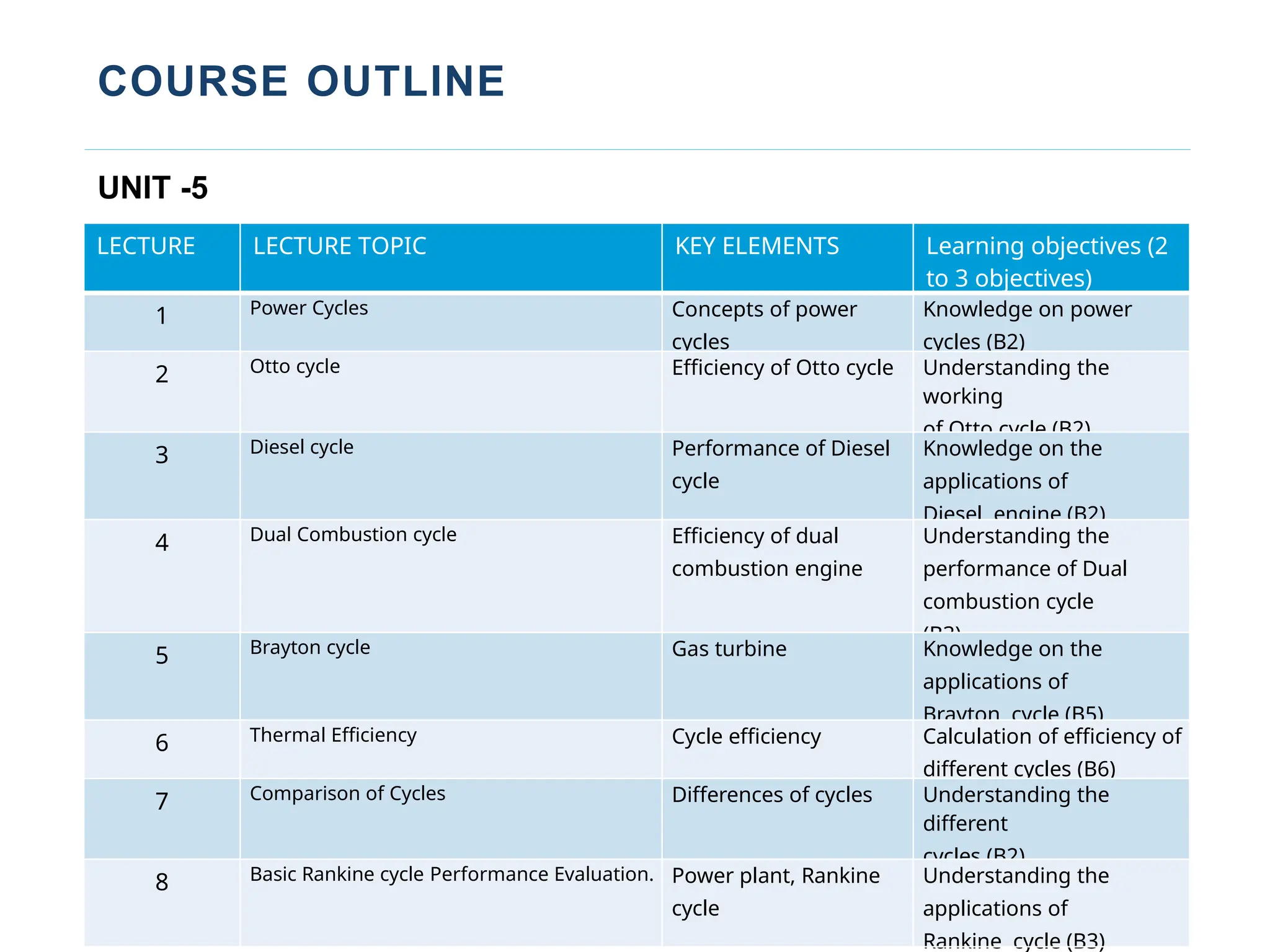
LECTURE LECTURE TOPIC KEY ELEMENTS Learning objectives (2
to 3 objectives)
1 Power Cycles Concepts of power
cycles
Knowledge on power
cycles (B2)
2 Otto cycle Efficiency of Otto cycle Understanding the
working
of Otto cycle (B2)
3 Diesel cycle Performance of Diesel
cycle
Knowledge on the
applications of
Diesel engine (B2)
4 Dual Combustion cycle Efficiency of dual
combustion engine
Understanding the
performance of Dual
combustion cycle
(B3)
5 Brayton cycle Gas turbine Knowledge on the
applications of
Brayton cycle (B5)
6 Thermal Efficiency Cycle efficiency Calculation of efficiency of
different cycles (B6)
7 Comparison of Cycles Differences of cycles Understanding the
different
cycles (B2)
8 Basic Rankine cycle Performance Evaluation. Power plant, Rankine
cycle
Understanding the
applications of
Rankine cycle (B3)
UNIT -5
LECTURE 5
Power Cycles
POWER CYCLES
• A cycle is defined as a repeated series of
operations occurring in a certain order.
• It may be repeated by repeating the processes
in the same order.
• The cycle may be of imaginary perfect engine or
actual engine.
• The former is called ideal cycle and the latter
actual cycle.
• In ideal cycle all accidental heat losses are
prevented and the working substance is
assumed to behave like a perfect working
substance.
DEPARTMENT OF MECHANICAL ENGINEERING
AIR STANDARD EFFICIENCY
DEPARTMENT OF MECHANICAL ENGINEERING
• To compare the effects of different cycles, it is
of paramount importance that the effect of the
calorific value of the fuel is altogether
eliminated and this can be achieved by
considering air (which is assumed to behave as
a perfect gas) as the working substance in the
engine cylinder. The efficiency of engine using
air as the working medium is known as an “Air
standard efficiency”.
• This efficiency is oftenly called ideal efficiency.
THERMAL EFFICIENCY
• The actual efficiency of a cycle is always less
than the air-standard efficiency of that cycle
under ideal conditions.
• This is taken into account by introducing a new
term “Relative efficiency”
which is defined as :
• ηrelative = Actual thermal efficiency/Air
standard efficiency
• Assumptions :
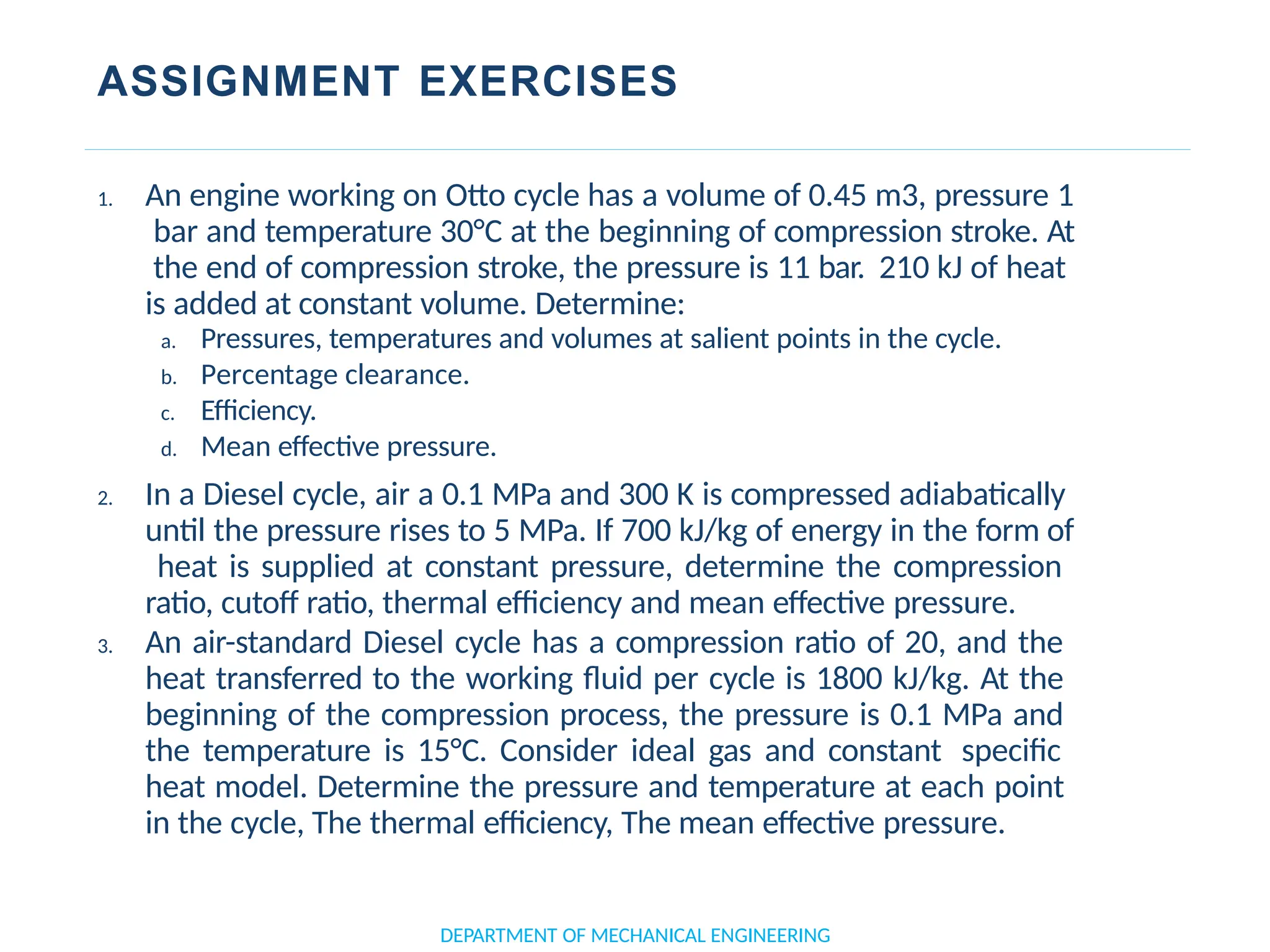
1. The gas in the engine cylinder is a perfect gas
i.e., it obeys the gas laws and has constant
specific heats.
DEPARTMENT OF MECHANICAL ENGINEERING
THERMAL EFFICIENCY
DEPARTMENT OF MECHANICAL ENGINEERING
2. The physical constants of the gas in the
cylinder are the same as those of air at
moderate temperatures i.e., the molecular
weight of cylinder gas is 29.
• cp = 1.005 kJ/kg-K, cv = 0.718 kJ/kg-K.
3. The compression and expansion processes
are adiabatic and they take place without
internal friction, i.e., these processes are
isentropic.
OTTO CYCLE OR CONSTANT VOLUME CYCLE
• Otto cycle is so named as it was conceived
by the scientist ‘Otto’. On this cycle, petrol,
gas and many types of oil engines work.
• It is the standard of comparison for
internal combustion engines.
• Figs. 13.5 (a) and (b) shows the theoretical p-
V diagram and T-s diagrams of this cycle
respectively.
DEPARTMENT OF MECHANICAL ENGINEERING
OTTO CYCLE OR CONSTANT VOLUME CYCLE
DEPARTMENT OF MECHANICAL ENGINEERING
Process 1-2 Adiabatic Compression:
• The piston moves from BDC to TDCV
compression of the fuel-air mixture
takes place.
• The compression causes the mixture
to increase slightly in pressure and
temperature—however, no heat is
exchanged.
• In terms of thermodynamics, this is
referred to as an adiabatic process.
OTTO CYCLE OR CONSTANT VOLUME CYCLE
DEPARTMENT OF MECHANICAL ENGINEERING
• When the cycle reaches point 2, that is
when the fuel is met by the spark plug to
be ignited.
• The point 1 represents that cylinder is
full of air with volume V1, pressure p1
and absolute temperature T1.
• Line 1-2 represents the adiabatic
compression of air due to which p1, V1 and
T1 change to p2, V2 and T2, respectively.
OTTO CYCLE OR CONSTANT VOLUME CYCLE
• Process 2-3 Constant volume heat addition:
• This is where combustion occurs due to the
ignition of fuel by the spark plug.
• The combustion of the gas is complete at point
3, which results in a highly pressurized
chamber that has a lot of heat (thermal
energy).
• In terms of thermodynamics, this is referred
to as an isochoric process.
• Line 2-3 shows the supply of heat to the air
at constant volume so that p2 and T2
change to
• p3 and T3 (V3 being the same as V2).
DEPARTMENT OF MECHANICAL ENGINEERING
OTTO CYCLE OR CONSTANT VOLUME CYCLE
DEPARTMENT OF MECHANICAL ENGINEERING
Process 3 to 4: Adiabatic Expansion
• The thermal energy in the chamber as a result
of combustion is used to do work on the
piston—which pushes the piston down—
increasing the volume of the chamber.
• This is also known as the power stoke because
it is when the thermal energy is turned into
motion to power the machine or vehicle.
• During expansion p3, V3 and T3
• change to a final value of p4, V4 or V1 and T4,
respectively.
OTTO CYCLE OR CONSTANT VOLUME CYCLE
DEPARTMENT OF MECHANICAL ENGINEERING
Process 4-1: Constant volume heat rejection
• All the waste heat is expelled from the
engine chamber.
• As the heat leaves the gas, the molecules
lose kinetic energy causing the decrease in
pressure.
• Then the exhaust phase occurs when the
remaining mixture in the chamber is
compressed by the piston to be "exhausted"
out, without changing the pressure.
OTTO CYCLE OR CONSTANT VOLUME CYCLE
DEPARTMENT OF MECHANICAL ENGINEERING
Total Cylinder Volume:
• It is the total volume (maximum volume) of
the cylinder in which Otto cycle takes place.
In Otto cycle,
• Total cylinder volume = V1 = V4 = Vc + s
• (Refer p-V diagram above)
• where,
• Vc → Clearance Volume
• Vs → Stroke Volume
OTTO CYCLE OR CONSTANT VOLUME CYCLE
• Clearance Volume, Vc = V2
DEPARTMENT OF MECHANICAL ENGINEERING
Clearance Volume (Vc):
• At the end of the compression stroke, the
piston approaches the Top Dead Center
(TDC) position. The minimum volume of the
space inside the cylinder, at the end of the
stroke, is called clearance
compression
volume (Vc).
• In Otto cycle,
Stroke Volume (Vs):
• In Otto cycle, stroke volume is the difference
between total cylinder volume and clearance
volume.
• Stroke Volume, Vs = Total Cylinder Volume –
Clearance Volume = V1 – V2 = V4 – V3
Compression Ratio:
• Compression ratio (r) is the ratio of total
cylinder volume to the clearance volume.
OTTO CYCLE OR CONSTANT VOLUME CYCLE
DEPARTMENT OF MECHANICAL ENGINEERING
OTTO CYCLE OR CONSTANT VOLUME CYCLE
DEPARTMENT OF MECHANICAL ENGINEERING
OTTO CYCLE OR CONSTANT VOLUME CYCLE
DEPARTMENT OF MECHANICAL ENGINEERING
DIESEL CYCLE OR CONSTANT PRESSURE
• This cycle was introduced by Dr. R. Diesel in
1897. It differs from Otto cycle in that heat is
supplied at constant pressure instead of at
constant volume. Fig. 13.15 (a and b) shows the
p-v and T-s diagrams of this cycle respectively.
This cycle comprises of the following operations :
(i) 1-2......Adiabatic compression.
(ii) 2-3......Addition of heat at constant
pressure.
(iii) 3-4......Adiabatic expansion.
(iv) 4-1......Rejection of heat at constant
volume. DEPARTMENT OF MECHANICAL ENGINEERING
DIESEL CYCLE OR CONSTANT PRESSURE
Diesel cycle is an ideal cycle for Diesel
engines or compression ignition engines.
There is no fuel in the cylinder at the
beginning of the compression stroke,
therefore an autoignition does not occur in
Diesel engines.
DEPARTMENT OF MECHANICAL ENGINEERING
DIESEL CYCLE OR CONSTANT PRESSURE
DEPARTMENT OF MECHANICAL ENGINEERING
DIESEL CYCLE OR CONSTANT PRESSURE
DEPARTMENT OF MECHANICAL ENGINEERING
DIESEL CYCLE OR CONSTANT PRESSURE
DEPARTMENT OF MECHANICAL ENGINEERING
DIESEL CYCLE OR CONSTANT PRESSURE
DEPARTMENT OF MECHANICAL ENGINEERING
DIESEL CYCLE OR CONSTANT PRESSURE
DEPARTMENT OF MECHANICAL ENGINEERING
SOLVED PROBLEMS
DEPARTMENT OF MECHANICAL ENGINEERING
SOLVED PROBLEMS
DEPARTMENT OF MECHANICAL ENGINEERING
DUAL COMBUSTION CYCLE
DEPARTMENT OF MECHANICAL ENGINEERING
DUAL COMBUSTION CYCLE
DEPARTMENT OF MECHANICAL ENGINEERING
COMPARISON OF THE CYCLES
DEPARTMENT OF MECHANICAL ENGINEERING
• comparison of the cycles (Otto, Diesel and
Dual) on the p-v and T-s diagrams for the
same compression ratio and heat supplied is
shown in the Fig.
• Since all the cycles reject their heat at the
same specific volume, process line from
state 4 to 1, the quantity of heat rejected
from each cycle is represented by the
appropriate area under the line 4 to 1 on the
T-s diagram.
COMPARISON OF THE CYCLES
• The least heat rejected will have the highest
efficiency.
• Thus, Otto cycle is the most efficient and
Diesel cycle is the least efficient of the three
cycles.
• ηotto > ηdual > ηdiesel
• For a given compression ratio Otto cycle is
the most efficient while the Diesel cycle is
the least efficient
DEPARTMENT OF MECHANICAL ENGINEERING
BRAYTON CYCLE
• Brayton cycle is a constant pressure cycle for a
perfect gas. It is also called Joule cycle.
• The heat transfers are achieved in reversible
constant pressure heat exchangers. An ideal gas
• turbine plant would perform the processes that
make up a Brayton cycle. The cycle is shown in
the
• Fig. 13.33 (a) and it is represented on p-v and T-
s diagrams as shown in Figs. 13.33 (b) and (c).
DEPARTMENT OF MECHANICAL ENGINEERING
BRAYTON CYCLE
DEPARTMENT OF MECHANICAL ENGINEERING
The various operations are as
follows : Process 1-2:
The air is compressed isentropically from
the lower pressure p1 to the upper pressure
p2, the temperature rising from T1 to T2.
No heat flow occurs.
Process 2-3:
Heat flows into the system increasing the
volume from V2 to V3 and temperature from
T2 to T3 whilst the pressure remains constant at
p2.
Heat received = mcp (T3 – T2).
BRAYTON CYCLE
DEPARTMENT OF MECHANICAL ENGINEERING
Process 3-4:
• The air is expanded isentropically from p2 to
p1, the temperature falling from T3 to T4.
• No heat flow occurs.
Process 4-1:
• Heat is rejected from the system as the
volume decreases from V4 to V1 and the
temperature from T4 to T1 whilst the
pressure remains constant at p1.
• Heat rejected = mcp(T4 – T1)
BRAYTON CYCLE
DEPARTMENT OF MECHANICAL ENGINEERING
BRAYTON CYCLE
DEPARTMENT OF MECHANICAL ENGINEERING
BRAYTON CYCLE
• The above equation shows that the efficiency of
the ideal joule cycle increases with the pressure
ratio.
• The absolute limit of upper pressure is
determined by the limiting temperature of the
material of the turbine at the point at which this
temperature is reached by the compression
process alone, no further heating of the gas in
the combustion chamber would be permissible
and the work of expansion would ideally just
balance the work of compression so that no
excess work would be available for external use.
DEPARTMENT OF MECHANICAL ENGINEERING
RANKINE CYCLE
DEPARTMENT OF MECHANICAL ENGINEERING
RANKINE CYCLE
DEPARTMENT OF MECHANICAL ENGINEERING
RANKINE CYCLE
DEPARTMENT OF MECHANICAL ENGINEERING
• Rankine cycle is the theoretical cycle on which the
steam
turbine (or engine) works.
• The Rankine cycle is shown in Fig. 12.2. It comprises of
the following processes :
Process 1-2 :
• Reversible adiabatic expansion in the turbine (or
steam engine).
Process 2-3 :
• Constant-pressure transfer of heat in the
condenser.
Process 3-4 :
•Reversible adiabatic pumping process in the feed
pump. Process 4-1 :
• Constant-pressure transfer of heat in the boiler.
RANKINE CYCLE
DEPARTMENT OF MECHANICAL ENGINEERING
• Fig. 12.3 shows the Rankine cycle on p-v, T-s and h-s
diagrams (when the saturated steam enters the turbine, the
steam can be wet or superheated
• Considering 1 kg of fluid :
• Applying steady flow energy equation (S.F.E.E.) to boiler,
turbine,
condenser and pump :
(i) For boiler (as control volume),
we get hf4 + Q1 = h1
∴ Q1 = h1 – hf4...(12.2)
(ii) For turbine (as control volume), we get
h1 = WT + h2, where WT = turbine work
∴ WT = h1 – h2ated also).
RANKINE CYCLE
DEPARTMENT OF MECHANICAL ENGINEERING
SOLVED PROBLEMS
DEPARTMENT OF MECHANICAL ENGINEERING
SOLVED PROBLEMS
DEPARTMENT OF MECHANICAL ENGINEERING
SOLVED PROBLEMS
DEPARTMENT OF MECHANICAL ENGINEERING
SOLVED PROBLEMS
DEPARTMENT OF MECHANICAL ENGINEERING
SOLVED PROBLEMS
DEPARTMENT OF MECHANICAL ENGINEERING
INDUSTRIAL APPLICATIONS
• Automobile industries.
• Refrigeration industries
• Air craft applications
• Defense industries
• Thermal power plants
• Chemical industries
• Textile industries etc.
DEPARTMENT OF MECHANICAL ENGINEERING
SELF LEARNING QUESTIONS
DEPARTMENT OF MECHANICAL ENGINEERING
1. With p-V and T-s diagrams derive the efficiency
of otto cycle.
2. With p-V and T-s diagrams derive the
efficiency of Diesel cycle.
3. With p-V and T-s diagrams derive the
efficiency of dual combustion cycle.
4. Differentiate between Otto cycle, diesel
cycle and dual combustion cycle.
5. With p-V and T-s diagrams derive the
efficiency of Rankine cycle.
ASSIGNMENT EXERCISES
DEPARTMENT OF MECHANICAL ENGINEERING
1. An engine working on Otto cycle has a volume of 0.45 m3, pressure 1
bar and temperature 30°C at the beginning of compression stroke. At
the end of compression stroke, the pressure is 11 bar. 210 kJ of heat
is added at constant volume. Determine:
a. Pressures, temperatures and volumes at salient points in the cycle.
b. Percentage clearance.
c. Efficiency.
d. Mean effective pressure.
2. In a Diesel cycle, air a 0.1 MPa and 300 K is compressed adiabatically
until the pressure rises to 5 MPa. If 700 kJ/kg of energy in the form of
heat is supplied at constant pressure, determine the compression
ratio, cutoff ratio, thermal efficiency and mean effective pressure.
3. An air-standard Diesel cycle has a compression ratio of 20, and the
heat transferred to the working fluid per cycle is 1800 kJ/kg. At the
beginning of the compression process, the pressure is 0.1 MPa and
the temperature is 15°C. Consider ideal gas and constant specific
heat model. Determine the pressure and temperature at each point
in the cycle, The thermal efficiency, The mean effective pressure.
THANK YOU

Thermodynamics Digital Material complete course

  • 1.
    E N GINE E R IN G THERMODYNAMICS
  • 2.
    DEPARTMENT OF MECHANICALENGINEERING COURSE OBJECTIVES UNIT - 1 CO1:To understand the concepts of energy transformation, conversion of heat into work. UNIT - 2 CO2:To acquire knowledge about the fundamentals of thermodynamic laws, the concept of entropy, and principles UNIT - 3 CO3: To understand how the change of state results in a process. UNIT - 4 CO4: To understand the various gas laws, psychrometric properties and chart. UNIT - 5 CO5: To learn the importance of thermodynamic cycles, and the derivation of efficiency.
  • 3.
    UNIT 1 CO1: Tounderstand the concepts of energy transformation, conversion of heat into work. B A S I C SO F T H E R M O D Y N A M I C S
  • 4.
    UNIT – I(SYLLABUS) Introduction - System - Types of Systems • System - Types of Systems - Control Volume - Macroscopic and Microscopic viewpoints • Thermodynamic Equilibrium- State, Property, Process, Cycle • Reversibility – Quasi static Process, Irreversible Process, First law of Thermodynamics • PMM I - Joule’s Experiment • First law applied to a Process • Steady Flow Energy Equation. DEPARTMENT OF MECHANICAL ENGINEERING
  • 5.
    COURSE OUTLINE DEPARTMENT OFMECHANICAL ENGINEERING LECTURE LECTURE TOPIC KEY ELEMENTS Learning objectives (2 to 3 objectives) 1 Basic Concepts – Types of systems Definition of system. Understanding of basics of systems (B2) 2 Macroscopic and Microscopic viewpoints Study or view points • Statistical thermodynami cs (B2) 3 Thermodynamic Equilibrium- State, Property, Process, Cycle Intensive properties Understanding of properties, process and cycle (B2) 4 Reversibility – Quasi static Process, Irreversible Process, Causes of Irreversibility Reversible process and irreversible processes Understanding of reversibility (B2) 5 Work and Heat, Point and Path functions Differences between heat and work Knowledge on heat and work (B4) 6 Zeroth Law of Thermodynamics – Principles of Thermometry Principle of zeroth law Measurement of temperature (B1) 7 PMM I - Joule’s Experiment – First law of Thermodynamics Conversion of Heat and work Efficiency calculation (B4) 8 Steady Flow Energy Equation. Continuity system Knowledge of Nozzle, turbine, boiler etc (B2) UNIT -1
  • 6.
    LECTURE 1 Introduction -Types of systems
  • 7.
    INTRODUCTION: UNITS DEPARTMENT OFMECHANICAL ENGINEERING
  • 8.
    INTRODUCTION: UNITS DEPARTMENT OFMECHANICAL ENGINEERING
  • 9.
    INTRODUCTION: DEPARTMENT OF MECHANICALENGINEERING • Thermodynamics is the branch of science that deals with the relationships between heat and other forms of energy. • It describes how thermal energy is converted to and from other forms of energy and how it affects matter. • Temperature is "a measure of the average kinetic energy of the particles in a sample of matter, expressed in terms of units or degrees.
  • 10.
    BASIC CONCEPTS • Temperatureis "a measure of the average kinetic energy of the particles in a sample of matter, expressed in terms of units or degrees. • Heat is a form of energy which is transferred by virtue of temperature difference. • Energy of a body is its capacity to do work. DEPARTMENT OF MECHANICAL ENGINEERING
  • 11.
    BASIC CONCEPTS • Workis said to be done by a force when a body moves in the direction of force. Work done = Force * Displacement • Specific heat is the amount of heat required to increase the temperature of a certain mass of a substance by unit degree. • The fundamental concepts of heat capacity and latent heat, which were necessary for the development of thermodynamics. DEPARTMENT OF MECHANICAL ENGINEERING
  • 12.
    SYSTEM DEPARTMENT OF MECHANICALENGINEERING System: • A thermodynamic system is defined as a quantity of matter or a region in space which is selected for the study. Surroundings: • The mass or region outside the system is called surroundings. Boundary: • The real or imaginary surfaces which separates the system and surroundings is called boundary. The real or imaginary surfaces which separates the system and surroundings is called boundary.
  • 13.
  • 14.
    TYPES OF THERMODYNAMICSYSTEM • On the basis of mass and energy transfer the thermodynamic system is divided into three types. Closed system Open system Isolated system DEPARTMENT OF MECHANICAL ENGINEERING
  • 15.
    TYPES OF THERMODYNAMICSYSTEM DEPARTMENT OF MECHANICAL ENGINEERING
  • 16.
    TYPES OF THERMODYNAMICSYSTEM DEPARTMENT OF MECHANICAL ENGINEERING • Closed system: A system in which the transfer of energy but not mass can takes place across the boundary is called closed system. The mass inside the closed system remains constant. • Open system: A system in which the transfer of both mass and energy takes place is called an open system. This system is also known as control volume. • Isolated system: A system in which the transfer of mass and energy cannot takes place is called an isolated system.
  • 17.
    MICROSCOPIC VIEW ORSTUDY: DEPARTMENT OF MECHANICAL ENGINEERING The approach considers that the system is made up of a very large number of discrete particles known as molecules. These molecules have different velocities are energies. The values of these energies are constantly changing with time. This approach to thermodynamics, which is concerned directly with the structure of the matter, is known as statistical thermodynamics.
  • 18.
    MICROSCOPIC VIEW ORSTUDY: DEPARTMENT OF MECHANICAL ENGINEERING • The behavior of the system is found by using statistical methods, as the number of molecules is very large. • So advanced statistical and mathematical methods are needed to explain the changes in the system. • The properties like velocity, momentum, impulse, kinetic energy and instruments cannot easily measure force of impact etc. that describe the molecule.
  • 19.
    MACROSCOPIC VIEW ORSTUDY: In this approach a certain quantity of matter is considered without taking into account the DEPARTMENT OF MECHANICAL ENGINEERING thermodynamicsis concerned with gross events occurring at molecular level. In other words this approach to or overall behavior. This is known as classical thermodynamics. The analysis of macroscopic system requires simple mathematical formula.
  • 20.
    MACROSCOPIC VIEW ORSTUDY: DEPARTMENT OF MECHANICAL ENGINEERING The value of the properties of the system are their average values. For examples consider a sample of gas in a closed container. The pressure of the gas is the average value of the pressure exerted by millions of individual molecules. In order to describe a system only a few properties are needed.
  • 21.
    HEAT AND WORK DEPARTMENTOF MECHANICAL ENGINEERING Similarities : Both are path functions and inexact differentials. Both are boundary phenomenon i.e., both are recognized at the boundaries of the system as they cross them. Both are associated with a process, not a state. Unlike properties, work or heat has no meaning at a state.
  • 22.
    HEAT AND WORK DEPARTMENTOF MECHANICAL ENGINEERING Dissimilarities : In heat transfer required. temperature difference is In a stable system there cannot be work transfer, however, there is no restriction for the transfer of heat. The sole effect external to the system could be reduced to rise of a weight but in the case of a heat transfer other effects are also observed.
  • 23.
    THERMODYNAMIC EQUILIBRIUM A thermodynamicsystem is said to exist in a state of thermodynamic equilibrium when no change in any macroscopic property is registered if the system is isolated from its surroundings. An isolated system always reaches in the DEPARTMENT OF MECHANICAL ENGINEERING course of equilibriu m time a state of thermodynamic and can never depart from it spontaneousl y.
  • 24.
    THERMODYNAMIC EQUILIBRIUM DEPARTMENT OFMECHANICAL ENGINEERING Mechanical equilibrium: The criteriafor Mechanical equilibrium are the equality of pressures. Chemical equilibrium: The criteria for Chemical equilibriumare the equality of chemical potentials. Thermal equilibrium: The criterion for Thermal equilibriumis the equality of temperatures.
  • 25.
    STATE AND PROPERTY DEPARTMENTOF MECHANICAL ENGINEERING State: The thermodynamic state of defined by specifyingvalues a system is of a set of measurable properties sufficient to determine all other properties. For fluid systems, typical properties are pressure, volume and temperature. Property: Properties may be extensive or intensive.
  • 26.
    TYPES OF PROPERTIES DEPARTMENTOF MECHANICAL ENGINEERING Intensive properties: • The properties which are independent of the mass of the system. • For example: Temperature, pressure and density are the intensive properties. Extensive properties: The properties which depend on the size or extent of the system are called extensive properties. • For example: Total mass, total volume and total momentum.
  • 27.
    THERMODYNAMIC PROCESS • Whenthe system undergoes change from one thermodynamic state to final state due change in properties like temperature, pressure, volume etc, the system is said to have undergone thermodynamic process. • Various types of thermodynamic processes are: DEPARTMENT OF MECHANICAL ENGINEERING isotherm al isochoric process, adiabatic process, process, isobaric process and reversible process.
  • 28.
    THERMODYNAMIC CYCLE DEPARTMENT OFMECHANICAL ENGINEERING • Thermodynamic cycle refers to any closed system that undergoes various changes due to temperature, pressure, and volume, however, its final and initial state are equal. • In the process of going through this cycle, the system may perform work on its surroundings, thereby acting as a heat engine
  • 29.
    THERMODYNAMIC CYCLE DEPARTMENT OFMECHANICAL ENGINEERING
  • 30.
    REVERSIBLE PROCESSES DEPARTMENT OFMECHANICAL ENGINEERING • A thermodynamic process (state i → state f ) is said to be reversible if the process can be turned back such that both the system and the surroundings return to their original states, with no other change anywhere else in the universe. • As we know, in reality, no such processes as reversible processes can exist, thus, the reversible processes can easily be defined as idealizations or models of real processes, on which the limits of the system or device are to be defined. They help maximum efficiency a system us in incurring the can provide in ideal working conditions and thus the target design that can be set.
  • 31.
    REVERSIBLE PROCESSES • Theyhelp us in incurring the maximum efficiency a system can provide in ideal working conditions and thus the target design that can be set. Examples of Reversible Process slow adiabatic compression or expansion of gases. slow isothermal compression or expansion of gases DEPARTMENT OF MECHANICAL ENGINEERING
  • 32.
    IRREVERSIBLE PROCESS DEPARTMENT OFMECHANICAL ENGINEERING • An irreversible process can be defined as a process in which the system and the surroundings do not return to their original condition once the process is initiated. • Taking an example of an automobile engine, that has travelled a distance with the aid of fuel equal to an amount ‘x’. During the process, the fuel burns to provide energy to the engine, converting itself into smoke and heat energy.
  • 33.
  • 34.
    IRREVERSIBLE PROCESS DEPARTMENT OFMECHANICAL ENGINEERING • We cannot retrieve the energy lost by the fuel and cannot get back the original form. There are many factors due to which the irreversibility of a process occurs, namely: The friction that converts the energy of the fuel to heat energy. • Mixing of two different substances which cannot be separated as the process of intermixing is again spontaneous in nature, the reverse of which is not feasible.
  • 35.
    EXAMPLES OF IRREVERSIBLEPROCESSES Relative motion with friction Throttling Heat transfer Diffusion Electricity flow through a resistance DEPARTMENT OF MECHANICAL ENGINEERING
  • 36.
    QUASI-STATIC PROCESS DEPARTMENT OFMECHANICAL ENGINEERING
  • 37.
    QUASI-STATIC PROCESS When theprocess is carried out in such a way that at every instant, the system deviation from the thermodynamic equilibrium is infinitesimal, then the process is known as quasi-static or quasi- equilibrium process and each state in the process may be considered as an equilibrium state. In simple words, we can say that if system is going DEPARTMENT OF MECHANICAL ENGINEERING succession of thermodynamic under a thermodynamic process through states and each state is equilibrium statethen the process will be termed as quasi static process.
  • 38.
    ZEROTH LAW OFTHERMODYNAMICS DEPARTMENT OF MECHANICAL ENGINEERING
  • 39.
    ZEROTH LAW OFTHERMODYNAMICS • If objects ‘A’ and ‘C’ are in thermal equilibrium with ‘B’, then object ‘A’ is in thermal equilibrium with object ‘C’. Practically this means all three objects are at the same temperature and it forms the basis for comparison of temperatures. • If a=b; b=c then a=c DEPARTMENT OF MECHANICAL ENGINEERING
  • 40.
    PRINCIPLES OF THERMOMETRY •Thermometry is the science and practice of temperature measurement. • Any measurable change in a thermometric probe (e.g. the dilatation of a liquid in a capillary tube, variation of electrical resistance of a conductor, of refractive index of a transparent material, and so on) can be used to mark temperature levels, that should later be calibrated against an internationally agreed unit if the measure is to be related to other thermodynamic variables. DEPARTMENT OF MECHANICAL ENGINEERING
  • 41.
    PRINCIPLES OF THERMOMETRY DEPARTMENTOF MECHANICAL ENGINEERING • Thermometry is sometimes split in metrological studies in two subfields: contact thermometry and noncontact thermometry. • As there can never be complete thermal uniformity at large, thermometry is always associated to a heat transfer problem with some space-time coordinates of measurement, given rise to time-series plots and temperature maps.
  • 42.
    CONSTANT VOLUME GASTHERMOMETER DEPARTMENT OF MECHANICAL ENGINEERING
  • 43.
    CONSTANT VOLUME GASTHERMOMETER • Thermometers are working examples of the zeroth law of thermodynamics. • The significance of constant volume gas thermometers is that they are used to calibrate other th • A constant volume gas thermometer is composed of a bulb filled with a fixed amount of a dilute gas that is attached to a mercury manometer. DEPARTMENT OF MECHANICAL ENGINEERING
  • 44.
    CONSTANT VOLUME GASTHERMOMETER • A manometer is a device used to measure pressure. • The mercury manometer has a column partially filled with mercury that is connected to a flexible tube that has another partially filled column of mercury, called a reservoir, attached to the other end. • The height of the mercury in the first column is set to a reference point or pressure P that it must stay at, while the mercury in the reservoir is allowed to move up and down in relation to a scale or ruler. DEPARTMENT OF MECHANICAL ENGINEERING
  • 45.
    CONSTANT VOLUME GASTHERMOMETER  the constant volume gas thermometer uses values from the triple point of water to calibrate other thermometers.  To recall, 273.16 K (Kelvin) is the temperature where water exists in an equilibrium state as a gas, liquid, and solid.  T = 273.16 K (P/Ptp)  For low pressure and high temperatures, where real gases behave like ideal gases, equation 1 becomes:  T = 273.16 K lim P/Ptp as Ptp → 0 DEPARTMENT OF MECHANICAL ENGINEERING
  • 46.
    SCALES OF TEMPERATURE DEPARTMENTOF MECHANICAL ENGINEERING • There are three temperature scales in use today, Fahrenheit, Celsius and Kelvin. • Fahrenheit temperature scale is a scale based on 32 for the freezing point of water and 212 for the boiling point of water, the interval between the two being divided into 180 parts. • The conversion formula for a temperature that is expressed on the Celsius (C) scale to its Fahrenheit (F) representation is: F = 9/5C + 32.
  • 47.
    SCALES OF TEMPERATURE DEPARTMENTOF MECHANICAL ENGINEERING
  • 48.
    JOULES EXPERIMENT DEPARTMENT OFMECHANICAL ENGINEERING
  • 49.
    JOULES EXPERIMENT DEPARTMENT OFMECHANICAL ENGINEERING
  • 50.
    FIRST LAW OFTHERMODYNAMICS DEPARTMENT OF MECHANICAL ENGINEERING
  • 51.
    FIRST LAW OFTHERMODYNAMICS DEPARTMENT OF MECHANICAL ENGINEERING
  • 52.
    PDV WORK DEPARTMENT OFMECHANICAL ENGINEERING
  • 53.
    PDV WORK DEPARTMENT OFMECHANICAL ENGINEERING
  • 54.
  • 55.
    PDV WORK DEPARTMENT OFMECHANICAL ENGINEERING
  • 56.
    SHAFT WORK DEPARTMENT OFMECHANICAL ENGINEERING
  • 57.
    FLOW WORK DEPARTMENT OFMECHANICAL ENGINEERING
  • 58.
    FIRST LAW OFTHERMODYNAMICS DEPARTMENT OF MECHANICAL ENGINEERING • The work input to the paddle wheel is measured by the fall of weight, while the corresponding temperature rise of liquid in the insulated container is measured by the thermometer. by heat transfer. The experiments show : (i)A definite quantity of work is always required to accomplish the same temperature rise obtained with a unit amount of heat. (ii) Regardless of whether the temperature of liquid is raised by work transfer or heat transfer, the liquid can be returned by heat transfer in opposite direction to the identical state from which it started.
  • 59.
    JOULES EXPERIMENT DEPARTMENT OFMECHANICAL ENGINEERING
  • 60.
    FIRST LAW OFTHERMODYNAMICS • It can be stated as an invariable experience that whenever a physical system passes through a complete cycle the algebraic sum of the work transfers during the cycle dW bears a definite ratio to the algebraic sum of the heat transfers during the cycle, dQ . • This may be expressed by the equation, dW = JdQ • where J is the proportionality constant and is known as Mechanical Equivalent of heat. • In S.I. units its value is unity, i.e., 1 Nm/J. DEPARTMENT OF MECHANICAL ENGINEERING
  • 61.
    APPLICATION OF FIRSTLAW TO A PROCESS • When a process is executed by a system, the change in stored energy of the system is numerically equal to the net heat interactions minus the net work interaction during the process. • ∴ E2 – E1 = Q – W • ∴ ΔE = Q – W [or Q = Δ E + W] • Or d(Q −W) 12 = Δ E = E2 – E1 • Where E represents the total internal energy. DEPARTMENT OF MECHANICAL ENGINEERING
  • 62.
    APPLICATION OF FIRSTLAW TO A PROCESS • If the electric, magnetic and chemical energies are absent and changes in potential and kinetic energy for a closed system are neglected, the above equation can be written as d(Q − W) 12 = ΔU = U2 – U1 • ∴ Q – W = ΔU = U2 – U1 • Generally, when heat is added to a system its temperature rises and external work is performed due to increase in volume of DEPARTMENT OF MECHANICAL ENGINEERING
  • 63.
    APPLICATION OF FIRSTLAW TO A PROCESS • The rise in temperature is an indication of increase of internal energy. • Heat added to the system will be considered as positive and the heat removed or rejected, from the system, as negative. • Thus energy is conserved in the operation. • The first law of thermodynamics is a particular formulation of the law of conservation of energy. DEPARTMENT OF MECHANICAL ENGINEERING
  • 64.
    PMM 1 • Therecan be no machine which would continuously supply mechanical work without some form of energy disappearing simultaneously. • Such a fictitious machine is called a perpetual motion machine of the first kind, or in brief, PMM 1. A PMM 1 is thus impossible. DEPARTMENT OF MECHANICAL ENGINEERING
  • 65.
    INTERNAL ENERGY—A PROPERTYOF SYSTEM DEPARTMENT OF MECHANICAL ENGINEERING
  • 66.
    INTERNAL ENERGY—A PROPERTYOF SYSTEM DEPARTMENT OF MECHANICAL ENGINEERING
  • 67.
    INTERNAL ENERGY—A PROPERTYOF SYSTEM DEPARTMENT OF MECHANICAL ENGINEERING
  • 68.
    INTERNAL ENERGY—A PROPERTYOF SYSTEM DEPARTMENT OF MECHANICAL ENGINEERING
  • 69.
    STEADY FLOW ENERGYEQUATION (S.F.E.E.) APPLICATION OF FIRST LAW TO STEADY FLOW PROCESS: In many practical problems, the rate at which the fluid flows through a machine or piece of apparatus is constant. This type of flow is called steady flow. Assumptions : The following assumptions are made in the system analysis : DEPARTMENT OF MECHANICAL ENGINEERING
  • 70.
    STEADY FLOW ENERGYEQUATION (S.F.E.E.) DEPARTMENT OF MECHANICAL ENGINEERING (i) The massflow through the system remains constant. (ii) Fluid is uniform in composition. (iii)The only interaction between the system and surroundings are work and heat. (iv)The state of fluid at any point remains constant with time. (v)In the analysis only potential, kinetic and flow energies are considered
  • 71.
  • 72.
    STEADY FLOW ENERGYEQUATION (S.F.E.E.) DEPARTMENT OF MECHANICAL ENGINEERING
  • 73.
  • 74.
  • 75.
    TURBINE A turbine isa rotary steady state steady flow machine whose purpose is the production of shaft power at the expense of the pressure of the working fluid. Two general classes of turbines are steam and gas turbines depending on the working substance used. Usually, changes in potential energy are negligible, as is the inlet kinetic energy. Normally, the process in the turbine is adiabatic and the work output reduces to decrease in enthalpy from the inlet to exit states. DEPARTMENT OF MECHANICAL ENGINEERING
  • 76.
  • 77.
    SOLVED PROBLEMS DEPARTMENT OFMECHANICAL ENGINEERING
  • 78.
    SOLVED PROBLEMS DEPARTMENT OFMECHANICAL ENGINEERING
  • 79.
    SOLVED PROBLEMS DEPARTMENT OFMECHANICAL ENGINEERING
  • 80.
    SOLVED PROBLEMS DEPARTMENT OFMECHANICAL ENGINEERING
  • 81.
    SOLVED PROBLEMS DEPARTMENT OFMECHANICAL ENGINEERING
  • 82.
    SOLVED PROBLEMS DEPARTMENT OFMECHANICAL ENGINEERING
  • 83.
    SOLVED PROBLEMS DEPARTMENT OFMECHANICAL ENGINEERING
  • 84.
    SOLVED PROBLEMS DEPARTMENT OFMECHANICAL ENGINEERING
  • 85.
    SOLVED PROBLEMS DEPARTMENT OFMECHANICAL ENGINEERING
  • 86.
  • 87.
  • 88.
    INDUSTRIAL APPLICATIONS • Automobileindustries. • Refrigeration industries • Air craft applications • Defense industries • Thermal power plants • Chemical industries • Textile industries etc. DEPARTMENT OF MECHANICAL ENGINEERING
  • 89.
  • 90.
    SELF LEARNING QUESTIONS DEPARTMENTOF MECHANICAL ENGINEERING • What is meant by thermodynamic equilibrium? Explain with the help of examples. • What is meant by SFEE and derive it and reduce it for the turbine. • Write about constant volume gas Thermometer? Why it is preferred over a constant pressure gas Thermometer. • Distinguish between macroscopic and microscopic point of view?
  • 91.
    ASSIGNMENT EXERCISES DEPARTMENT OFMECHANICAL ENGINEERING 1. Discuss Quasi Static process, what are its characteristics? 2. Discuss First law of thermodynamics, explain Joule’s experiment. 3. A blower handles 1kg/s of air at 200C and consuming a power of 15 kw. The inlet and outlet velocities of air are 100 m/s and 150 m/s respectively. Find the exit air temperature, assuming adiabatic conditions. Take Cp of air as 1.005 kJ/kgk. 4. When a stationary mass of gas was compressed without friction at constant pressure, its initial state of 0.4m3 and 0.105MPa was found to change to final state of 0.20m3 and 0.105MPa. There was a transfer of 42.5kJ of heat from the gas during the process. Determine the change in internal energy of the gas?
  • 92.
  • 93.
    E N GINE E R IN G THERMODYNAMICS
  • 94.
    DEPARTMENT OF MECHANICALENGINEERING COURSE OBJECTIVES UNIT - 1 CO1:To understand the concepts of energy transformation, conversion of heat into work. UNIT - 2 CO2:To acquire knowledge about the fundamentals of thermodynamic laws, the concept of entropy, and principles UNIT - 3 CO3: To understand how the change of state results in a process. UNIT - 4 CO4: To understand the various gas laws, psychrometric properties and chart. UNIT - 5 CO5: To learn the importance of thermodynamic cycles, and the derivation of efficiency.
  • 95.
    UNIT 2 CO2:To acquireknowledge about the fundamentals of thermodynamic laws, the concept of entropy, and principles B A S I C SO F T H E R M O D Y N A M I C S
  • 96.
    UNIT – II(SYLLABUS) Introduction - System - Types of Systems • Limitations of the First Law - Thermal Reservoir, Heat Engine, Heat pump • Second Law of Thermodynamics, Kelvin-Planck and Clausius Statements • PMM of Second kind, Carnot’s principle • Clausius Inequality, Entropy • Energy Equation, Availability and Irreversibility • Thermodynamic Potentials, Gibbs and Helmholtz Functions • Third Law of Thermodynamics. DEPARTMENT OF MECHANICAL ENGINEERING
  • 97.
    COURSE OUTLINE DEPARTMENT OFMECHANICAL ENGINEERING LECTURE LECTURE TOPIC KEY ELEMENTS Learning objectives (2 to 3 objectives) 1 Limitations of the First Law - Thermal Reservoir Definition of Energy reservoir Understanding the draw backs (B2) 2 Heat Engine, Heat pump, Parameters of performance Performance parameters like efficiency Understanding different types of efficiencies (B2) 3 Second Law of Thermodynamics, Kelvin-Planck and Clausius Statements and their Equivalence Temperature flow Understanding Heat and work conversion (B2) 4 Corollaries, PMM of Second kind Possible engine and impossible engine Understanding PMM II (B2) 5 Carnot’s principle, Carnot cycle and its specialties Carnot’s cycle Performance evaluation of Carnot’s cycle (B5) 6 Clausius Inequality, Entropy, Principle of Entropy Increase – Energy Equation, Entropy principle Knowledge on entropy (B2) 7 Availability and Irreversibility Available and unavailable energies Maximum possible work estimation (B4) 8 Thermodynamic Potentials, Gibbs and Helmholtz Functions, Gibbs function, Helmholtz functions Heat and work calculations (B4) UNIT -1
  • 98.
    LECTURE 2 Second lawof thermodynamics - Entropy
  • 99.
    LIMITATIONS OF FIRSTLAW OF THERMODYNAMICS First law does not provide any information regarding the direction processes will take whether it is a spontaneous or a non spontaneous process. The first law of thermodynamics merely indicates that in any process there is a transformation between the various forms of energy involved in the process but provides no information regarding the feasibility of such transformation. DEPARTMENT OF MECHANICAL ENGINEERING
  • 100.
    LIMITATIONS OF FIRSTLAW OF THERMODYNAMICS First law of thermodynamics has not provided the information about the direction of the process.  First law of thermodynamics has not provided DEPARTMENT OF MECHANICAL ENGINEERING complete energy of the system will the information that how much quantity of be converted in to the work energy. First law of thermodynamics has not provided any information about the conditions in which conversion of heat energy in work energy is possible.
  • 101.
    THERMAL ENERGY RESERVOIR DEPARTMENTOF MECHANICAL ENGINEERING
  • 102.
    THERMAL ENERGY RESERVOIR DEPARTMENTOF MECHANICAL ENGINEERING
  • 103.
    HEAT ENGINE DEPARTMENT OFMECHANICAL ENGINEERING
  • 104.
    HEAT ENGINE DEPARTMENT OFMECHANICAL ENGINEERING
  • 105.
    HEAT ENGINE DEPARTMENT OFMECHANICAL ENGINEERING
  • 106.
    HEAT ENGINE DEPARTMENT OFMECHANICAL ENGINEERING
  • 107.
    HEAT ENGINE DEPARTMENT OFMECHANICAL ENGINEERING
  • 108.
  • 109.
  • 110.
  • 111.
  • 112.
    HEAT PUMP DEPARTMENT OFMECHANICAL ENGINEERING
  • 113.
    HEAT PUMP DEPARTMENT OFMECHANICAL ENGINEERING
  • 114.
    HEAT PUMP DEPARTMENT OFMECHANICAL ENGINEERING
  • 115.
    SECOND LAW OFTHERMODYNAMICS DEPARTMENT OF MECHANICAL ENGINEERING
  • 116.
    SECOND LAW OFTHERMODYNAMICS DEPARTMENT OF MECHANICAL ENGINEERING
  • 117.
    EQUIVALENCE OF CLAUSIUSAND KELVIN PLANCK STATEMENTS DEPARTMENT OF MECHANICAL ENGINEERING
  • 118.
    EQUIVALENCE OF CLAUSIUSAND KELVIN PLANCK STATEMENTS DEPARTMENT OF MECHANICAL ENGINEERING
  • 119.
    EQUIVALENCE OF CLAUSIUSAND KELVIN PLANCK STATEMENTS DEPARTMENT OF MECHANICAL ENGINEERING
  • 120.
    EQUIVALENCE OF CLAUSIUSAND KELVIN PLANCK STATEMENTS DEPARTMENT OF MECHANICAL ENGINEERING
  • 121.
    EQUIVALENCE OF CLAUSIUSAND KELVIN PLANCK STATEMENTS DEPARTMENT OF MECHANICAL ENGINEERING
  • 122.
    EQUIVALENCE OF CLAUSIUSAND KELVIN PLANCK STATEMENTS DEPARTMENT OF MECHANICAL ENGINEERING
  • 123.
    CARNOT CYCLE DEPARTMENT OFMECHANICAL ENGINEERING • A Carnot cycle is defined as an ideal reversible closed thermodynamic cycle in which there are four successive operations involved and they are isothermal expansion, adiabatic expansion, isothermal compression, and adiabatic compression. • During these operations, the expansion and compression of substance can be done up to desired point and back to initial state.
  • 124.
    CARNOT CYCLE DEPARTMENT OFMECHANICAL ENGINEERING
  • 125.
    CARNOT CYCLE DEPARTMENT OFMECHANICAL ENGINEERING
  • 126.
    CARNOT CYCLE DEPARTMENT OFMECHANICAL ENGINEERING
  • 127.
    CARNOT CYCLE • Followingare the four processes of Carnot cycle: • In (a), the process is reversible isothermal gas expansion. In this process, the amount of heat absorbed by the ideal gas is qin from the heat source which is at a temperature of Th. The gas expands and does work on the surroundings. • In (b), the process is reversible adiabatic gas expansion. Here, the system is thermally insulated and the gas continues to expand and work is done on the surroundings. Now the temperature is lower, Tl. DEPARTMENT OF MECHANICAL ENGINEERING
  • 128.
    CARNOT CYCLE • Stepsinvolved in a Carnot Cycle • For an ideal gas operating inside a Carnot cycle, the following are the steps involved: • Process 1-2: • Isothermal expansion: The gas is taken from P1, V1, T1 to P2, V2, T2. Heat Q1 is absorbed from the reservoir at temperature T1. Since the expansion is isothermal, the total change in internal energy is zero and the heat absorbed by the gas is equal to the work done by the gas on the environment, which is given as: • W1 2=Q1=μ×R×T1×lnv2v1 → DEPARTMENT OF MECHANICAL ENGINEERING
  • 129.
    CARNOT CYCLE DEPARTMENT OFMECHANICAL ENGINEERING Process 2-3: • Adiabatic expansion: The gas expands adiabatically from P2, V2, T1 to P3, V3, T2. • Here work done by the gas is given by: • W2 3=μRγ 1(T1 T2) → − − Process 3 -4: • Isothermal compression: The gas is compressed isothermally from the state (P3, V3, T2) to (P4, V4, T2). • Here, the work done on the gas by the environment is given by: • W3 4=μRT2lnv3v4 →
  • 130.
    CARNOT CYCLE DEPARTMENT OFMECHANICAL ENGINEERING Step 4: • Adiabatic compression: The gas is compressed adiabatically from the state (P4, V4, T2) to (P1, V1, T1). • Here, the work done on the gas by the environment is given by: • W4→1=μRγ−1(T1−T2)
  • 131.
    CARNOT CYCLE • In(c), the process is reversible isothermal gas compression process. Here, the heat loss, qout occurs when the surroundings do the work at temperature Tl. • In (d), the process is reversible adiabatic gas compression. Again the system is thermally insulated. The temperature again rise back to Th as the surrounding continue to do their work on the gas. DEPARTMENT OF MECHANICAL ENGINEERING
  • 132.
  • 133.
    CARNOT PRINCIPLE DEPARTMENT OFMECHANICAL ENGINEERING
  • 134.
    AVAILABILITY AND IRREVERSIBILITY DEPARTMENTOF MECHANICAL ENGINEERING • Availability: • When a system is subjected to a process from its original state to dead state the maximum amount of useful work that can be achieved under ideal conditions is known as available energy or availability of the system.
  • 135.
  • 136.
    AVAILABILITY AND IRREVERSIBILITY •Wmax = AE = Qxy – T0(Sy-Sx) • Unavailable Energy: • UE = T0(Sy-Sx) • where, Sx and Sy are the entropy at x and y, respectively. • The Available Energy (AE) is also known as exergy and the Unavailable Energy (UE) as energy. • Availability = Maximum possible work- Irreversibility W useful= W rev- I DEPARTMENT OF MECHANICAL ENGINEERING
  • 137.
  • 138.
    AVAILABILITY AND IRREVERSIBILITY DEPARTMENTOF MECHANICAL ENGINEERING The actual work done by a system is always less than idealized reversible work and the difference between the two is called the irreversibility of the process. I = Wmax - W I = T0(ΔSsystem + ΔSsurrounding) I = T0(ΔS)universal T0(ΔS)universal represent an increase in unavailable energy.
  • 139.
    THERMODYNAMIC POTENTIALS, GIBBSAND HELMHOLTZ FUNCTIONS Eight properties of a system, namely pressure (p), volume (v), temperature (T), internal energy (u), enthalpy (h), entropy (s), Helmholtz function (f) and Gibbs function (g) have been introduced in the previous chapters. h, f and g are sometimes referred to as thermodynamic potentials. DEPARTMENT OF MECHANICAL ENGINEERING  Both f and g are considering chemical reactions, useful when and the former is of fundamental importance in statistical thermodynamics.
  • 140.
    THERMODYNAMIC POTENTIALS, GIBBSAND HELMHOLTZ FUNCTIONS • The first law applied to a closed system undergoing a reversible process states that dQ = du + pdv According to second law, ds =dQ/T Combining these equations, we get Tds = du + pdv or du = Tds – pdv ...(7.10) The properties h, f and g may also be put in terms of T, s, p and v as follows : dh = du + pdv + vdp = Tds + vdp DEPARTMENT OF MECHANICAL ENGINEERING
  • 141.
    THERMODYNAMIC POTENTIALS, GIBBSAND HELMHOLTZ FUNCTIONS • Helmholtz free energy function, df = du – Tds – sdT . = – pdv – sdT F=U−TS Helmholtz free energy in thermodynamics is a thermodynamic potential which is used to measure the work of a closed system with constant temperature and volume. It can be defined in the form of the following equation: DEPARTMENT OF MECHANICAL ENGINEERING
  • 142.
    THERMODYNAMIC POTENTIALS, GIBBSAND HELMHOLTZ FUNCTIONS • F=U−T S Where, • F is the Helmho ltz free energy in Joules • U is the internal energy of the system in Joules DEPARTMENT OF MECHANICAL ENGINEERING
  • 143.
    • dU=δQ+δW whichis from first law of thermodynamics for closed system • dU=TdS−pdV (𝜹Q = TdS and 𝜹W = pdV) • dU=d(TS)−SdT−pdV (product rule ie; d(TS) = TdS+SdT) •d(U−TS)=−SdT−pdV dF=−SdT−pdV (from F=U-TS) Application of Helmholtz free energy • In equation of state: • Pure fluids with high accuracy (like industrial refrigerants) are represented using Helmholtz function as a sum of ideal gas and residual terms. DEPARTMENT OF MECHANICAL ENGINEERING
  • 144.
  • 145.
  • 146.
  • 147.
  • 148.
  • 149.
  • 150.
    THIRD LAW OFTHERMODYNAMICS DEPARTMENT OF MECHANICAL ENGINEERING • It is impossible to attain absolute zero temperature
  • 151.
    SOLVED PROBLEMS DEPARTMENT OFMECHANICAL ENGINEERING
  • 152.
    SOLVED PROBLEMS DEPARTMENT OFMECHANICAL ENGINEERING
  • 153.
    SOLVED PROBLEMS DEPARTMENT OFMECHANICAL ENGINEERING
  • 154.
    SOLVED PROBLEMS DEPARTMENT OFMECHANICAL ENGINEERING
  • 155.
    SOLVED PROBLEMS DEPARTMENT OFMECHANICAL ENGINEERING
  • 156.
    SOLVED PROBLEMS DEPARTMENT OFMECHANICAL ENGINEERING
  • 157.
    SOLVED PROBLEMS DEPARTMENT OFMECHANICAL ENGINEERING
  • 158.
    SOLVED PROBLEMS DEPARTMENT OFMECHANICAL ENGINEERING
  • 159.
    SOLVED PROBLEMS DEPARTMENT OFMECHANICAL ENGINEERING
  • 160.
    SOLVED PROBLEMS DEPARTMENT OFMECHANICAL ENGINEERING
  • 161.
    SOLVED PROBLEMS DEPARTMENT OFMECHANICAL ENGINEERING
  • 162.
    SOLVED PROBLEMS DEPARTMENT OFMECHANICAL ENGINEERING
  • 163.
    SOLVED PROBLEMS DEPARTMENT OFMECHANICAL ENGINEERING
  • 164.
    SOLVED PROBLEMS DEPARTMENT OFMECHANICAL ENGINEERING
  • 165.
    SOLVED PROBLEMS DEPARTMENT OFMECHANICAL ENGINEERING
  • 166.
    SOLVED PROBLEMS DEPARTMENT OFMECHANICAL ENGINEERING
  • 167.
    SOLVED PROBLEMS DEPARTMENT OFMECHANICAL ENGINEERING
  • 168.
    SOLVED PROBLEMS DEPARTMENT OFMECHANICAL ENGINEERING
  • 169.
    INDUSTRIAL APPLICATIONS • Automobileindustries. • Refrigeration industries • Air craft applications • Defense industries • Thermal power plants • Chemical industries • Textile industries etc. DEPARTMENT OF MECHANICAL ENGINEERING
  • 170.
    SELF LEARNING QUESTIONS •Describe briefly about the second law of thermodynamics with its corollaries. • State the limitations of first law of thermodynamics? State PMM 2? • Discuss briefly about Clausius inequality. • Discuss the significance of Third law of thermodynamics • Derive the expression for the efficiency of Carnot cycle with p-V and T-s diagrams. • Solve one T -dS equation by using Maxwell’s relations? DEPARTMENT OF MECHANICAL ENGINEERING
  • 171.
    ASSIGNMENT EXERCISES DEPARTMENT OFMECHANICAL ENGINEERING • 0.5 kg of air executes a Carnot power cycle having a thermal efficiency of 50%. The heat transfer to the air during isothermal expansion is 40 kJ. At the beginning of the isothermal expansion the pressure is 7 bar and the volume is 0.12 m3. Determine the maximum and minimum temperatures for the cycle in Kelvin, the volume at the end of isothermal expansion in m3 and the work, heat transfer for each of the four processes in kJ. cp=1.008 kJ/kgK and cv=0.721 kJ/kgK for air. • Water is heated at a constant pressure of 0.7 MPa. The boiling point is 164.970C. The initial temperature of water is 00C. The latent heat of evaporation is 2066.3 kJ/kg. Find the increase of entropy of water if the final temperature is steam.
  • 172.
    ASSIGNMENT EXERCISES • 1kgof ice at -50C expose to the atmosphere which, is at 200C. The ice melts and comes into thermal equilibrium with the atmosphere. Determine the entropy increase of Universe. Cp for ice is 2.039 kJ/kgK, and the enthalpy of fusion of ice is 333.3kJ/kg. • A heat engine is operating between two reservoirs 1000K and 300K is used to drive a heat pump which extracts heat from the reservoir at 300K at A heat engine is operating between two reservoirs 1000K and 300K is used to drive a heat pump which extracts heat from the reservoir at 300K. The efficiency of both the engines is equal. What is the value of temperature T2. DEPARTMENT OF MECHANICAL ENGINEERING
  • 173.
  • 174.
    E N GINE E R IN G THERMODYNAMICS
  • 175.
    DEPARTMENT OF MECHANICALENGINEERING COURSE OBJECTIVES UNIT - 1 CO1:To understand the concepts of energy transformation, conversion of heat into work. UNIT - 2 CO2:To acquire knowledge about the fundamentals of thermodynamic laws, the concept of entropy, and principles UNIT - 3 CO3: To understand how the change of state results in a process. UNIT - 4 CO4: To understand the various gas laws, psychrometric properties and chart. UNIT - 5 CO5: To learn the importance of thermodynamic cycles, and the derivation of efficiency.
  • 176.
    UNIT I I I CO3:To understand how the change of state results in a process. P U R E S U B S TA N C E S
  • 177.
    UNIT – III(SYLLABUS) Properties of Pure Substances • p-V-T- surfaces, T-S and h-s diagrams • Mollier Charts, Phase Transformations • Triple point at critical state properties • Dryness Fraction energy Transfer • Steam Calorimetry. • Perfect Gas Laws – Equation of State • Throttling and Free Expansion Processes • Deviations from perfect Gas Model – Vander Waals Equation of State. DEPARTMENT OF MECHANICAL ENGINEERING
  • 178.
    COURSE OUTLINE DEPARTMENT OFMECHANICAL ENGINEERING LECTURE LECTURE TOPIC KEY ELEMENTS Learning objectives (2 to 3 objectives) 1 Pure Substances: p-V-T- surfaces Properties of pure substances Phase change properties of pure substances (B2) 2 T-S and h-s diagrams, Phase Transformations Enthalpy and entropy diagrams Applications of Mollier chart (B3) 3 Triple point at critical state properties during change of phase Concept of triple point Understanding triple point temperature (B2) 4 Dryness Fraction – Mollier charts Concept of quality of steam Measurement of dryness fraction (B3) 5 Various Thermodynamic processes and energy Transfer Isobaric process, Isothermal process Energy transfer in different processes (B4) 6 Steam Calorimetry Throttling calorimeter Working principles of different steam calorimeters (B4) 7 Perfect Gas Laws, Equation of State Boyles law, Charles law Understanding of gas laws (B2) 8 Flow processes – Deviations from perfect Gas Model – Vander Waals Equation of State. Vander Waals Equation Understanding different flow processes (B2) UNIT -3
  • 179.
    LECTURE 3 Properties ofPure substances
  • 180.
    PURE SUBSTANCE DEPARTMENT OFMECHANICAL ENGINEERING • A substance that has a fixed chemical composition throughout the system is called a pure substance. • Water, hydrogen, nitrogen, and carbon monoxide, for example, are all pure substance. • A pure substance can also be a mixture of various chemical elements or compounds as long as the mixture is homogeneous.
  • 181.
    PURE SUBSTANCE • Air,a mixture of several compounds, is often considered to be a pure substance because it has a uniform chemical composition. • “A mixture of two or more phases of a pure substance is still a pure substance as long as the chemical composition of all phases is the same. • A mixture of ice and liquid water, for example, is a pure substance because both phases have DEPARTMENT OF MECHANICAL ENGINEERING
  • 182.
    PHASES OF APURE SUBSTANCE DEPARTMENT OF MECHANICAL ENGINEERING
  • 183.
  • 184.
    PHASES OF APURE SUBSTANCE DEPARTMENT OF MECHANICAL ENGINEERING
  • 185.
    PHASES OF APURE SUBSTANCE DEPARTMENT OF MECHANICAL ENGINEERING
  • 186.
    PHASES OF APURE SUBSTANCE DEPARTMENT OF MECHANICAL ENGINEERING
  • 187.
    PHASES OF APURE SUBSTANCE DEPARTMENT OF MECHANICAL ENGINEERING
  • 188.
    PHASES OF APURE SUBSTANCE DEPARTMENT OF MECHANICAL ENGINEERING
  • 189.
    PHASES OF APURE SUBSTANCE DEPARTMENT OF MECHANICAL ENGINEERING
  • 190.
  • 191.
    PHASES OF APURE SUBSTANCE DEPARTMENT OF MECHANICAL ENGINEERING
  • 192.
    TRIPLE POINT DEPARTMENT OFMECHANICAL ENGINEERING
  • 193.
  • 194.
    PHASES OF APURE SUBSTANCE DEPARTMENT OF MECHANICAL ENGINEERING
  • 195.
  • 196.
  • 197.
    FORMATION OF STEAM DEPARTMENTOF MECHANICAL ENGINEERING
  • 198.
  • 199.
  • 200.
  • 201.
  • 202.
  • 203.
  • 204.
    MOLLIER CHART/ ENTHALPY-ENTROPY DIAGRAM DEPARTMENT OF MECHANICAL ENGINEERING
  • 205.
    MOLLIER CHART/ ENTHALPY-ENTROPY DIAGRAM DEPARTMENT OF MECHANICAL ENGINEERING
  • 206.
    STEAM CALORIMETRY DEPARTMENT OFMECHANICAL ENGINEERING
  • 207.
    STEAM CALORIMETRY DEPARTMENT OFMECHANICAL ENGINEERING
  • 208.
    STEAM CALORIMETRY DEPARTMENT OFMECHANICAL ENGINEERING
  • 209.
    STEAM CALORIMETRY DEPARTMENT OFMECHANICAL ENGINEERING
  • 210.
    STEAM CALORIMETRY DEPARTMENT OFMECHANICAL ENGINEERING
  • 211.
    STEAM CALORIMETRY DEPARTMENT OFMECHANICAL ENGINEERING
  • 212.
    STEAM CALORIMETRY DEPARTMENT OFMECHANICAL ENGINEERING
  • 213.
  • 214.
  • 215.
    SEPARATING CALORIMETER DEPARTMENT OFMECHANICAL ENGINEERING The wet steam enters at the top from the main steam pipe through holes in the sampling pipe facing up stream which should be as far as possible downstream from elbows and valves to ensure representative sample of steam when in operation the wet steam entering passes down the central passage and undergoes a sudden reversal of direction of motion when strikes perforated cup. The weight of steam passing through the jacket may also be readily determined by passing the escaping steam into a bucket of water where it is condensed, the increase in the weight of the bucket and its contents giving the value of W.
  • 216.
    SEPARATING CALORIMETER DEPARTMENT OFMECHANICAL ENGINEERING  In that case gauge G is not required, but it used its reading may be taken as a check.  This calorimeter will give better results when the dryness fraction of steam to be determined is above 0.95. Advantages: Quick determination of dryness fraction of very wet steam Disadvantages:  It leads to inaccuracy due to incomplete separation of water  Dryness fraction calculated is always greater than actual dryness fraction.
  • 217.
  • 218.
    SEPARATING AND THROTTLINGCALORIMETER DEPARTMENT OF MECHANICAL ENGINEERING
  • 219.
    GAS LAWS  IdealGas: Perfect gas, also called ideal gas, a gas that conforms, in physical behaviour, to a particular, idealized relation between pressure, volume, and temperature called the general gas law.  Boyle’s Law Pressure is inversely proportional to volume: p∞ 1/v Robert Boyle noticed that when the volume of a container holding an amount of gas is increased, pressure decreases, and vice versa (while the temperature is held constant). Note that this is not a linear relationship between p and V. DEPARTMENT OF MECHANICAL ENGINEERING
  • 220.
    GAS LAWS Charles’ Law: Charles’Law Volume is directly proportional to temperature: V = cT, where c > 0 is constant. Scientist Jacque Charles noticed that if air in a balloon is heated, the balloon expands. For an ideal gas, this relationship between V and T should be linear (as long as pressure is constant).  Charles’ and Boyle’s Laws combined Combine the two laws above: pV/T = K, where k is a constant, = pV=mRT DEPARTMENT OF MECHANICAL ENGINEERING
  • 221.
    GAS LAWS DEPARTMENT OFMECHANICAL ENGINEERING The Individual Gas Constant - R • The Individual Gas Constant depends on the particular gas and is related to the molecular weight of the gas. • The value is independent of temperature. The induvidual gas constant, R, for a gas can be calculated from the universal gas constant, Ru below), and the gas (given in several units molecular weight, Mgas: • R = Ru/Mgas • In the SI system units are J/kg K.
  • 222.
    GAS LAWS • TheUniversal Gas Constant - Ru • The Universal Gas Constant - Ru - appears in the ideal gas law and can be expressed as the product between the Individual Gas Constant - R - for the particular gas - and the Molecular Weight - Mgas - for the gas, and is the same for all ideal or perfect gases: • Ru = MR • The Molecular weight of a Gas Mixture The average molecular weight of a gas mixture is equal to the sum of the mole fractions of each gas multiplied by the molecular weight of that particular gas: • gas R, kJ/(kmol.K) : 8.3144598 DEPARTMENT OF MECHANICAL ENGINEERING
  • 223.
    THROTTLING PROCESS • Theporous plug experiment was designed to measure temperature changes when a fluid flows steadily through a porous plug which is inserted in a thermally insulated, horizontal pipe. The apparatus used by Joule and Thomson is shown in Figure • A gas at pressure and temperature flows continuously through a porous plug in a tube and emerges into a space which is maintained at a constant pressure. The device is thermally insulated and kept horizontal. Consider the dotted portion as control volume. DEPARTMENT OF MECHANICAL ENGINEERING
  • 224.
    THROTTLING PROCESS DEPARTMENT OFMECHANICAL ENGINEERING
  • 225.
    THROTTLING PROCESS Therefore, whenevera fluid expands from a region of high pressure to a region oflow DEPARTMENT OF MECHANICAL ENGINEERING pressure through a porous plug, opened valve or some obstruction, partiall y witho ut exchanging any energy as heat and work with the surrounding (neglecting, the changes in PE and KE), the enthalpy of the fluid remains constant, and the fluid is said to have undergone a throttling process.
  • 226.
    FREE EXPANSION PROCESS Afree expansion occurs when a fluid is allowed to expand suddenly into a vaccum chamber through an orifice of large dimensions. In this process, no heat is supplied or rejected and no external work is done. Hence the total heat of the fluid remains constant. This type of expansion may also be called as constant total heat expansion. It is thus obvious, that in a free expansion process, Q1-2 = 0, W1-2 = 0 and dU = 0. DEPARTMENT OF MECHANICAL ENGINEERING
  • 227.
    VAN DER WAALSEQUATION OF STATE • The ideal gas law treats the molecules of a gas as point particles with perfectly elastic collisions. This works well for dilute gases in many experimental circumstances. • But gas molecules are not point masses, and there are circumstances where the properties of the molecules have an experimentally measurable effect. A modification of the ideal gas law was proposed by van der Waal on molecular size and molecular interaction forces. • It is usually referred to as the van der Waals equation of state. DEPARTMENT OF MECHANICAL ENGINEERING
  • 228.
    The constants aand b have positive values and are characteristic of the individual gas. The van der Waals equation of state approaches the ideal gas law PV=nRT as the values of these constants approach zero. The constant a provides a correction for the intermolecular forces. Constant b is a correction for finite molecular size and its value is the volume of one mole of the DEPARTMENT OF MECHANICAL ENGINEERING
  • 229.
    INDUSTRIAL APPLICATIONS • Automobileindustries. • Refrigeration industries • Air craft applications • Defense industries • Thermal power plants • Chemical industries • Textile industries etc. DEPARTMENT OF MECHANICAL ENGINEERING
  • 230.
    SELF LEARNING QUESTIONS DEPARTMENTOF MECHANICAL ENGINEERING • Draw the phase equilibrium diagram for a pure substance on T-s plot with relevant constant property line? • Define dryness fraction of steam. Describe method of finding dryness fraction of steam using separating and throttling calorimeter • Describe briefly about throttling and free expansion processes. • Describe briefly about “Mollier diagram”. • State Vander Waals equation, what is the importance of it?
  • 231.
    ASSIGNMENT EXERCISES determine finaldryness fraction ii)heat transferred iii)wor k don e DEPARTMENT OF MECHANICAL ENGINEERING • Determine the enthalpy and entropy of steam and the pressure is 2MPa and the specific volume is 0.09m3/kg. • 10 kg of feed water is heated in a boiler at a constant pressure of 1.5 MN/m2 from 40 C. Calculate the enthalpy required and change of entropy when water is converted into following qualities of steam in each case i) Wet steam at x=0.95 and ii) Super heated steam at 300 C • Air at 16oC and 1.2 bar occupies a volume of 0.03m3.the air is heated at constant volume until the pressure is 4.3 bar and then cooled at constant pressure back to the original temperature. Calculate the net heat flow to or from the air and the net entropy change. • 5 kg of steam with a dryness fraction of 0.9 expands adiabatically to the Law PV1.13constant. from a pressure of 8 bar to 1.5 bar
  • 232.
  • 233.
    E N GINE E R IN G THERMODYNAMICS
  • 234.
    DEPARTMENT OF MECHANICALENGINEERING COURSE OBJECTIVES UNIT - 1 CO1:To understand the concepts of energy transformation, conversion of heat into work. UNIT - 2 CO2:To acquire knowledge about the fundamentals of thermodynamic laws, the concept of entropy, and principles UNIT - 3 CO3: To understand how the change of state results in a process. UNIT - 4 CO4: To understand the various gas laws, psychrometric properties and chart. UNIT - 5 CO5: To learn the importance of thermodynamic cycles, and the derivation of efficiency.
  • 235.
    UNIT 1 CO4: Tounderstand the various gas laws, psychrometric properties and chart. M I X T U R E S O F P E R F E C T G A S E S
  • 236.
    UNIT – IV(SYLLABUS) DEPARTMENT OF MECHANICAL ENGINEERING Mixtures of perfect Gases • Mole Fraction, Mass fraction • Gravimetric and volumetric Analysis • Dalton’s Law of partial pressure, Amagat’s Law of additive volumes • Enthalpy, sp. Heats and Entropy of Mixture of perfect Gases • Psychrometric Properties • Thermodynamic Wet Bulb Temperature, Specific Humidity, Relative Humidity • Degree of saturation – Adiabatic Saturation – Psychrometric chart.
  • 237.
    COURSE OUTLINE DEPARTMENT OFMECHANICAL ENGINEERING LECTURE LECTURE TOPIC KEY ELEMENTS Learning objectives (2 to 3 objectives) 1 Mixtures of perfect Gases: Mole Fraction, Mass friction Mole fraction, mass fraction Understanding of mixture of gases (B2) 2 Gravimetric and volumetric Analysis Concepts of gravimetric and volumetric analysis Knowledge on gravimetric and volumetric analysis (B3) 3 Dalton’s Law of partial pressure, Avogadro’s Laws of additive volumes Concept of Dalton’s law, Avogadro’s law Understanding the principles of different laws (B2) 4 Mole fraction, Volume pressure, fraction and partial Definition of partial pressure Knowledge of fractions like mole, volume (B3) 5 Equivalent Gas constant, Enthalpy, sp. Heats and Entropy of Mixture of perfect Gases Entropy of gases Understanding the different types of constants (B2) 6 Vapour and Atmospheric air – Psychrometric Properties Definition of vapour pressure and atmospheric pressure Understanding the vapour pressures (B2) various 7 Dry bulb Temperature, Wet Bulb Temperature, Dew point Temperature Concept of DBT, WBT, RH etc Knowledge on different Psychrometric Properties (B4) 8 Adiabatic Saturation – Psychrometric chart Psychrometric chart Understanding the use of Psychrometric chart (B2) UNIT - 4
  • 238.
    LECTURE 4 Mixtures ofperfect Gases
  • 239.
    MIXTURES OF PERFECTGASES DEPARTMENT OF MECHANICAL ENGINEERING substances, is A mixture, consisting referred of several pure to as a solution. Examples of pure substances are water, ethyl alcohol, nitrogen, ammonia, sodium chloride, and iron. Examples of mixtures are air, consisting of nitrogen, oxygen and a number of other gases, aqueous ammonia solutions, aqueous solutions of ethyl alcohol, various metal alloys. The pure substances making up a mixture are called components or constituents.
  • 240.
    MIXTURES OF PERFECTGASES DEPARTMENT OF MECHANICAL ENGINEERING Basic assumption is that the gases in the mixture do not interact with each other. Consider a mixture with components l = 1,2,3... with masses m1, m2, m3 ...mi and with number of moles. The total mixture occupies a volume V, has a total pressure P and temperature T (which is also the temperature of each of the component species)
  • 241.
    Mole Fraction The massand number of moles of species i are related by Ni = is the number of moles of species i and Mi is the molar mass of species i. DEPARTMENT OF MECHANICAL ENGINEERING Mole fraction represents the number of molecules of a particular component in a mixture divided by the total number of moles in the given mixture. It’s a way of expressing the concentration of a solution.
  • 242.
    MOLE FRACTION • Themole fraction of a substance in the mixture is the ratio of the mole of the substance in the mixture to the total mole of the mixture. • Since it is the ratio of moles to moles, it is a dimensionless quantity. • The mole fraction is sometimes called the amount fraction. DEPARTMENT OF MECHANICAL ENGINEERING
  • 243.
  • 244.
    MOLE FRACTION DEPARTMENT OFMECHANICAL ENGINEERING
  • 245.
    MASS FRACTION DEPARTMENT OFMECHANICAL ENGINEERING mixture is • The mass fraction the ratio of a substance in a of the mass of the substance to the total mass of the mixture. • It is also known as mass per cent or in percentage by mass when expressing percentage. • Since the mass fraction is a ratio of mass to mass, it is a dimensionless quantity.
  • 246.
    MASS FRACTION DEPARTMENT OFMECHANICAL ENGINEERING
  • 247.
    DALTON’S LAW OFPARTIAL PRESSURES • Dalton’s law of partial pressures is a gas law which states that the total pressure exerted by a mixture of gases is equal to the sum of the partial pressures exerted by each individual gas in the mixture. • For example, the total pressure exerted by a mixture of two gases A and B is equal to the sum of the individual partial pressures exerted by gas A and gas B (as illustrated below). DEPARTMENT OF MECHANICAL ENGINEERING
  • 248.
    DALTON’S LAW OFPARTIAL PRESSURES DEPARTMENT OF MECHANICAL ENGINEERING
  • 249.
    DALTON’S LAW OFPARTIAL PRESSURES • Dalton’s Law Formula • Dalton’s law of partial pressures can be mathematically expressed as follows: • Ptotal = ∑ni=1pi (or) Ptotal = P1 + P2 + P3 + …. + Pn Where, • Ptotal is the total pressure exerted by the mixture of gases • P1, P2,…, Pn are the partial pressures of the gases 1, 2,…, ‘n’ in the mixture of ‘n’ gases DEPARTMENT OF MECHANICAL ENGINEERING
  • 250.
    DALTON’S LAW OFPARTIAL PRESSURES • Expressing Partial Pressures in Terms of Mole Fraction • The mole fraction of a specific gas in a mixture of gases is equal to the ratio of the partial pressure of that gas to the total pressure exerted by the gaseous mixture. • This mole fraction can also be used to calculate the total number of moles of a constituent gas when the total number of moles in the mixture is known. • Furthermore, the volume occupied by a specific gas in a mixture can also be calculated with this mole fraction with the help of the equation provided below. • Xi=Pi/Ptotal=Vi/Vtotal=ni/ntotal • Where Xi is the mole fraction of a gas ‘i’ in a mixture of ‘n’ gases, ‘n’ denotes the number of moles, ‘P’ denotes pressure, and ‘V’ denotes volume. DEPARTMENT OF MECHANICAL ENGINEERING
  • 251.
    • P isthe total pressure of the mixture Pi is the partial pressure of species i= pressure of the species if it existed alone in the given temperature T and volume V Ru is the universal gas constant = 8.314 kJ/k mol K Amagat's Law of Additive volumes Volume of an ideal gas mixture is equal to the sum of the partial volumes DEPARTMENT OF MECHANICAL ENGINEERING
  • 252.
    AMAGAT'S LAW OFADDITIVE VOLUMES Amagat's law of additive volumes is the law of partial volumes. The law relates the total volume of a mixture with the volumes of individual components. Amagat's law is very similar to Dalton's law of partial pressure. The law is only valid for ideal gases. DEPARTMENT OF MECHANICAL ENGINEERING
  • 253.
    Statement • For amixture of non-reacting ideal gases, the total volume of the mixture equals the sum of the partial volumes of individual components at constant pressure and temperature. • As per Amagat's law, the volume of an ideal mixture is • where Vmix is the volume of the ideal mixture, k is the last component of the mixture, Vi is the volume of the ith component. DEPARTMENT OF MECHANICAL ENGINEERING
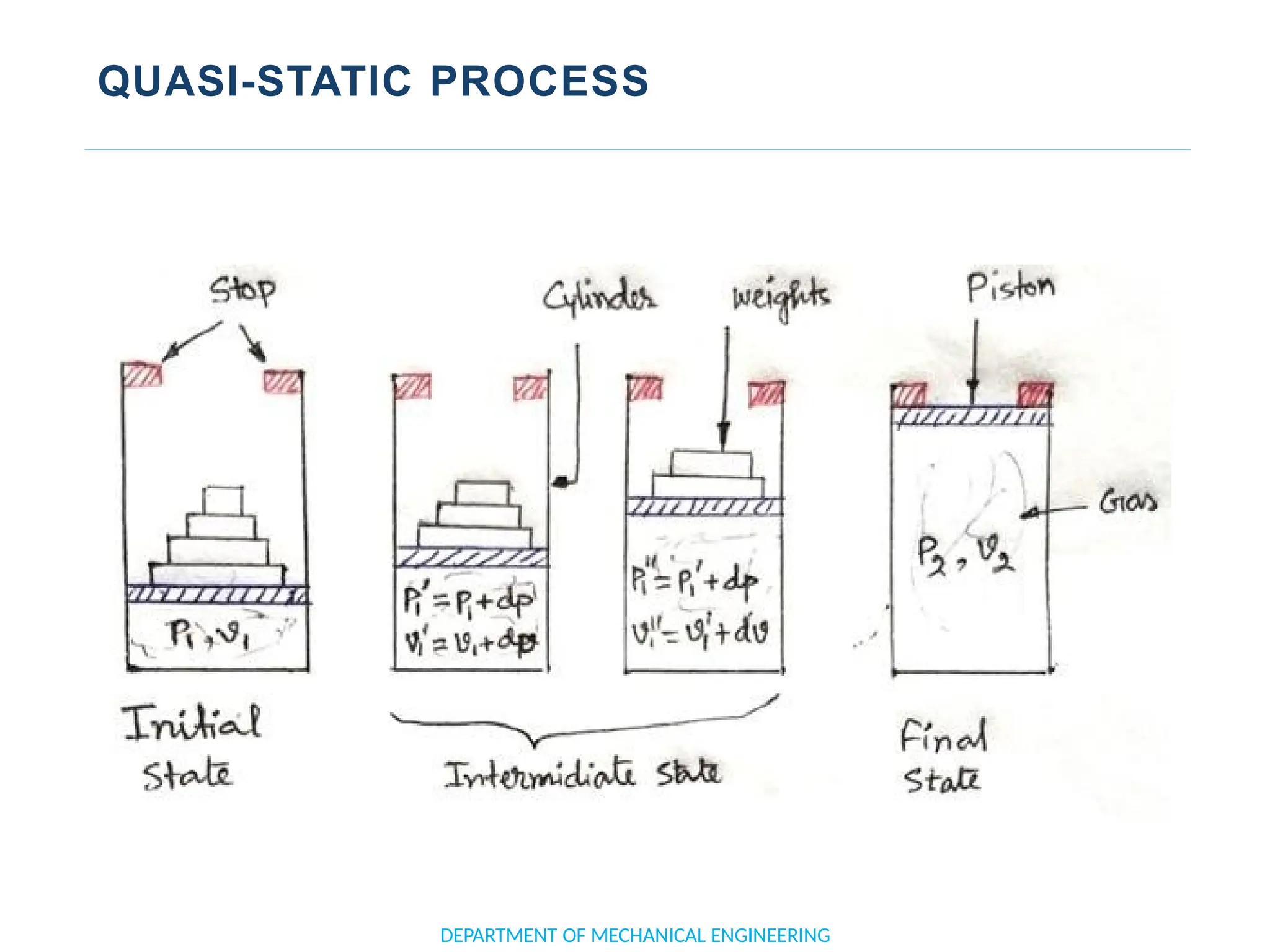
  • 254.
    IDEAL GAS LAWOR EQUATION OF STATE • The Ideal Gas Law • The volume (V) occupied by n moles of any gas has a pressure (P) at temperature (T) in Kelvin. • The relationship for these variables, • PV=nRT • where R is known as the gas constant, is called the ideal gas law or equation of state DEPARTMENT OF MECHANICAL ENGINEERING
  • 255.
    ENTHALPY The enthalpy Hof a thermodynamic system is defined as the sum of its internal energy U and the work required to achieve its pressure and volume. When a process occurs at constant pressure, the heat evolved (either released or absorbed) is equal to the change in enthalpy. Enthalpy (H) is the sum of the internal energy (U) and the product of pressure and volume (PV) given by the equation: H = U + pV DEPARTMENT OF MECHANICAL ENGINEERING
  • 256.
    ENTHALPY • Enthalpy isa state function which depends entirely on the state functions T, P and U. • Enthalpy is usually expressed as the change in enthalpy (ΔHΔH) for a process between initial and final states: • ΔH=ΔU+ΔPV • If temperature and pressure remain constant through the process and the work is limited to pressure-volume work, then the enthalpy change is given by the equation: • ΔH=ΔU+PΔV DEPARTMENT OF MECHANICAL ENGINEERING
  • 257.
    ENTHALPY • Also atconstant pressure the heat flow (q) for the process is equal to the change in enthalpy defined by the equation: • ΔH=q • At constant temperature and pressure, by the equation above, if q is positive then ΔH is also positive. • If q is negative, then ΔH will also be negative. DEPARTMENT OF MECHANICAL ENGINEERING
  • 258.
  • 259.
  • 260.
    INTERNAL ENERGY ENTHALPYAND SPECIFIC HEATS OF GAS DEPARTMENT OF MECHANICAL ENGINEERING
  • 261.
  • 262.
    ENTROPY When two puresubstances mix under normal conditions there is usually an increase in the entropy of the system. Since the molecules of ideal gases do not interact the increase in entropy must simply result from the extra volume available to each gas on mixing. Thus, for gas A the available volume has increased from VA to (VA + VB).  By calculating the entropy of expansion of each gas we can calculate the entropy of mixing as shown in the panel below. DEPARTMENT OF MECHANICAL ENGINEERING
  • 263.
    PSYCHROMETRY • Atmospheric airmakes up the environment in almost every type of air conditioning system. • Hence a thorough understanding of the properties of atmospheric air and the ability to analyze various processes involving air is fundamental to air conditioning design. • Atmospheric air is a mixture of many gases plus water vapour and a number of pollutants • Psychrometry is the study of the properties of mixtures of air and water vapour. DEPARTMENT OF MECHANICAL ENGINEERING
  • 264.
    PSYCHROMETRY DEPARTMENT OF MECHANICALENGINEERING • A mixture of various gases that constitute air and water vapour. This mixture is known as moist air. • The moist air can be thought of as a mixture of dry air and moisture. • At a given temperature and pressure the dry air can only hold a certain maximum amount of moisture. • When the moisture content is maximum, then the air is known as saturated air.
  • 265.
  • 266.
  • 267.
    PSYCHROMETRIC PROPERTIES • Drybulb temperature (DBT) is the temperature of the moist air as measured by a standard thermometer or other temperature measuring instruments. • Saturated vapour pressure (psat) is the saturated partial pressure of water vapour at the dry bulb temperature. • Relative humidity (Φ) is defined as the ratio of the mole fraction of water vapour in moist air to mole fraction of water vapour in saturated air at the same temperature and pressure. DEPARTMENT OF MECHANICAL ENGINEERING
  • 268.
  • 269.
  • 270.
  • 271.
    PSYCHROMETRIC CHART DEPARTMENT OFMECHANICAL ENGINEERING
  • 272.
  • 273.
  • 274.
  • 275.
  • 276.
  • 277.
    PSYCHROMETER DEPARTMENT OF MECHANICALENGINEERING Any instrument capable of measuring the psychrometric state of air is called a psychrometer. As mentioned before, in order to measure the psychrometric state of air, it is required to measure three independent parameters. Generally two of these are the barometric pressure and air dry-bulb temperature as they can be measured easily and with good accuracy.
  • 278.
    PSYCHROMETER • The slingpsychrometer is widely used for measurements involving room air or other applications where the air velocity inside the room is small. • The sling psychrometer consists of two thermometers mounted side by side and fitted in a frame with a handle for whirling the device through air. • The required air circulation (≈ 3 to 5 m/s) over the sensing bulbs is obtained by whirling the psychrometer (≈ 300 RPM). • Readings are taken when both the thermometers show steady-state readings. DEPARTMENT OF MECHANICAL ENGINEERING
  • 279.
    SOLVED PROBLEMS DEPARTMENT OFMECHANICAL ENGINEERING
  • 280.
  • 281.
  • 282.
    Q 3. Asample of air contains 39.05 mol of nitrogen, 10.47 mol of oxygen, 0.45 mol of argon, and 0.03 mol of argon. Determine the mole fractions. • Solution: Let nN2, nO2, nAr, and nCO2 be moles of nitrogen, oxygen, argon, and carbon dioxide. • The mole fraction of nitrogen, oxygen, argon, and carbon dioxide in the given of air be yN2, yO2, yAr, and yCO2. DEPARTMENT OF MECHANICAL ENGINEERING
  • 283.
  • 284.
  • 285.
    SOLVED PROBLEMS DEPARTMENT OFMECHANICAL ENGINEERING Q4. A mixture of hydrogen gas and oxygen gas exerts a total pressure of 1.5 atm on the walls of its container. If the partial pressure of hydrogen is 1 atm, find the mole fraction of oxygen in the mixture. • Given, Phydrogen = 1 atm, Ptotal = 1.5 atm • Applying Dalton’s law formula, • Ptotal = Phydrogen + Poxygen • Therefore, Poxygen = 0.5 atm • Now, the mole fraction of oxygen, • Xoxygen = (Poxygen/Ptotal) = 0.5/1.5 = 0.33 • Therefore, the mole fraction of oxygen in the mixture is 0.33
  • 286.
    INDUSTRIAL APPLICATIONS • Automobileindustries. • Refrigeration industries • Air craft applications • Defense industries • Thermal power plants • Chemical industries • Textile industries etc. DEPARTMENT OF MECHANICAL ENGINEERING
  • 287.
    SELF LEARNING QUESTIONS DEPARTMENTOF MECHANICAL ENGINEERING 1. Define mole fraction, and mass fraction. Explain about volumetric and gravimetric analysis? 2. Explain adiabatic saturation temperature? 3. Explain psychrometric charts while representing all the properties? 4. Locate i) sensible heating ii) sensible cooling iii) heating and humidification iv) heating and dehumidification on psychrometric chart? 5. Compare degree of saturation and adiabatic saturation.
  • 288.
    ASSIGNMENT EXERCISES DEPARTMENT OFMECHANICAL ENGINEERING 1. 1.8 kg of oxygen at 480 C is mixed with 6.2 kg of nitrogen at the same temperature. Both oxygen and nitrogen are at the pressure of 102 k Pa before and after mixing. Find the increase in entropy. 2. A mixture of ideal air and water vapour at a dbt of 220C and a total pressure of 730 mm Hg abs. has a temperature of adiabatic saturation of 150C. Calculate: i. the speci_c humidity in gms per kg of dry air. ii. the partial pressure of water vapour the relative humidity, and iv. enthalpy of the mixture per kg of dry air. 3. Atmospheric air at 1.0132 bar has a DBT of 30°C and WBT of 24°C. Compute, (i) The partial pressure of water vapour (ii) Specific humidity (iii) The dew point temperature(iv) Relative humidity(v) Degree of saturation (vi) Density of air in the mixture (vii) Density of the vapour in
  • 289.
  • 290.
    E N GINE E R IN G THERMODYNAMICS
  • 291.
    DEPARTMENT OF MECHANICALENGINEERING COURSE OBJECTIVES UNIT - 1 CO1:To understand the concepts of energy transformation, conversion of heat into work. UNIT - 2 CO2:To acquire knowledge about the fundamentals of thermodynamic laws, the concept of entropy, and principles UNIT - 3 CO3: To understand how the change of state results in a process. UNIT - 4 CO4: To understand the various gas laws, psychrometric properties and chart. UNIT - 5 CO5: To learn the importance of thermodynamic cycles, and the derivation of efficiency.
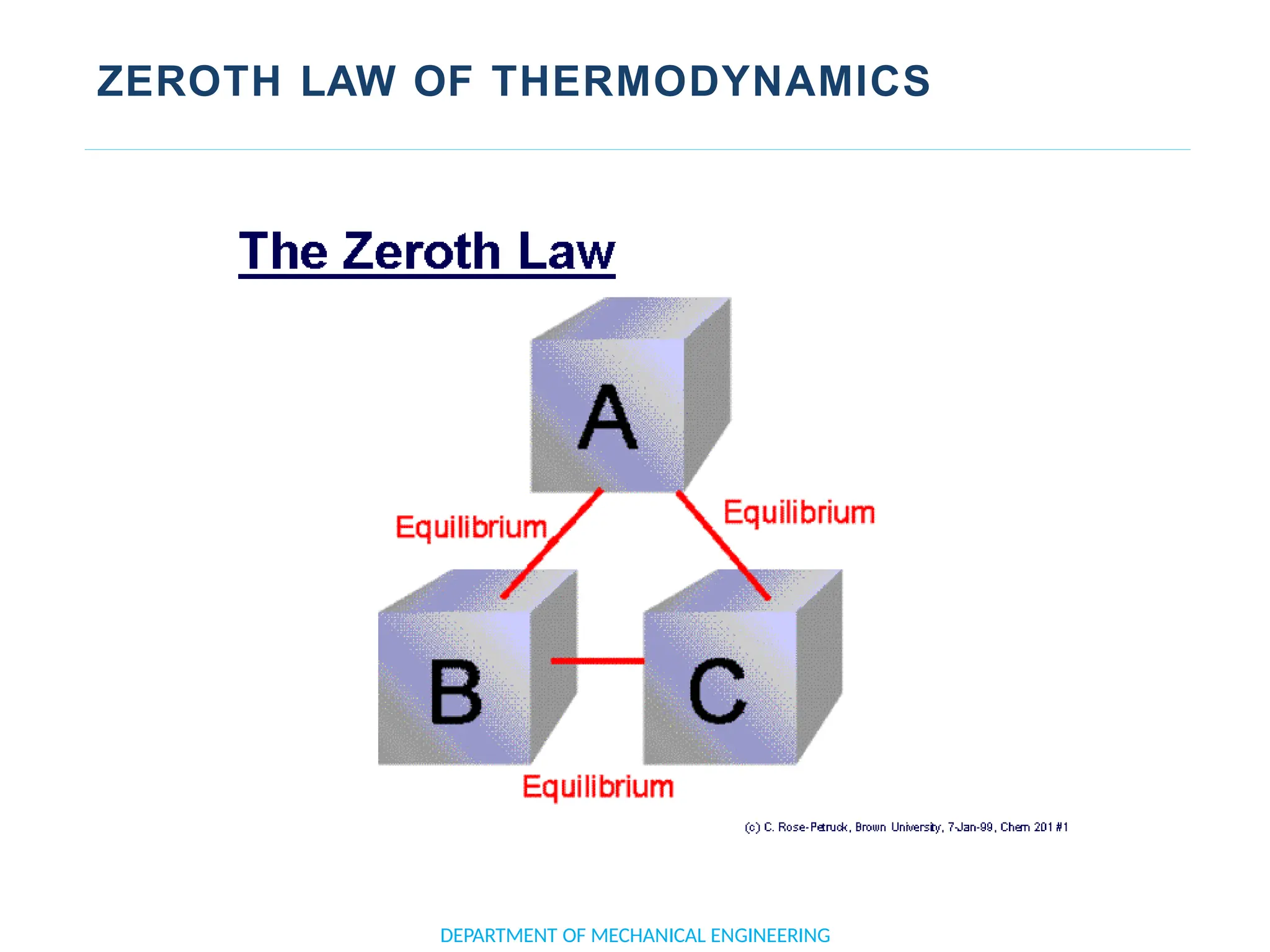
  • 292.
    UNIT 5 CO5: Tolearn the importance of thermodynamic cycles, and the derivation of efficiency. B A S I C SO F T H E R M O D Y N A M I C S
  • 293.
    UNIT – V(SYLLABUS) Power Cycles • Otto cycle • Diesel cycle • Dual Combustion cycle • P–V and T-S diagram • Thermal Efficiency • Comparison of Cycles • Basic Rankine cycle DEPARTMENT OF MECHANICAL ENGINEERING
  • 294.
    COURSE OUTLINE DEPARTMENT OFMECHANICAL ENGINEERING LECTURE LECTURE TOPIC KEY ELEMENTS Learning objectives (2 to 3 objectives) 1 Power Cycles Concepts of power cycles Knowledge on power cycles (B2) 2 Otto cycle Efficiency of Otto cycle Understanding the working of Otto cycle (B2) 3 Diesel cycle Performance of Diesel cycle Knowledge on the applications of Diesel engine (B2) 4 Dual Combustion cycle Efficiency of dual combustion engine Understanding the performance of Dual combustion cycle (B3) 5 Brayton cycle Gas turbine Knowledge on the applications of Brayton cycle (B5) 6 Thermal Efficiency Cycle efficiency Calculation of efficiency of different cycles (B6) 7 Comparison of Cycles Differences of cycles Understanding the different cycles (B2) 8 Basic Rankine cycle Performance Evaluation. Power plant, Rankine cycle Understanding the applications of Rankine cycle (B3) UNIT -5
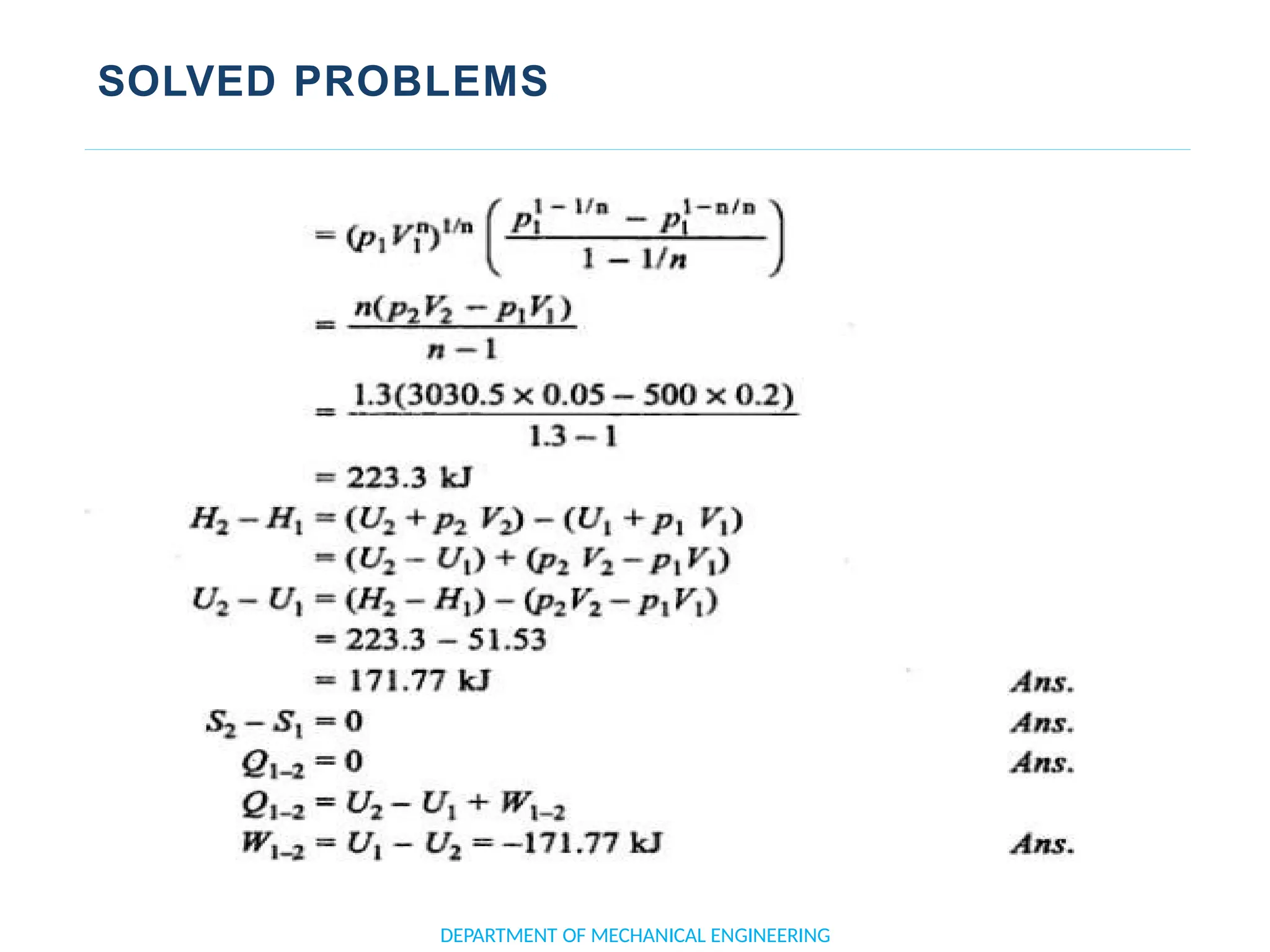
  • 295.
  • 296.
    POWER CYCLES • Acycle is defined as a repeated series of operations occurring in a certain order. • It may be repeated by repeating the processes in the same order. • The cycle may be of imaginary perfect engine or actual engine. • The former is called ideal cycle and the latter actual cycle. • In ideal cycle all accidental heat losses are prevented and the working substance is assumed to behave like a perfect working substance. DEPARTMENT OF MECHANICAL ENGINEERING
  • 297.
    AIR STANDARD EFFICIENCY DEPARTMENTOF MECHANICAL ENGINEERING • To compare the effects of different cycles, it is of paramount importance that the effect of the calorific value of the fuel is altogether eliminated and this can be achieved by considering air (which is assumed to behave as a perfect gas) as the working substance in the engine cylinder. The efficiency of engine using air as the working medium is known as an “Air standard efficiency”. • This efficiency is oftenly called ideal efficiency.
  • 298.
    THERMAL EFFICIENCY • Theactual efficiency of a cycle is always less than the air-standard efficiency of that cycle under ideal conditions. • This is taken into account by introducing a new term “Relative efficiency” which is defined as : • ηrelative = Actual thermal efficiency/Air standard efficiency • Assumptions : 1. The gas in the engine cylinder is a perfect gas i.e., it obeys the gas laws and has constant specific heats. DEPARTMENT OF MECHANICAL ENGINEERING
  • 299.
    THERMAL EFFICIENCY DEPARTMENT OFMECHANICAL ENGINEERING 2. The physical constants of the gas in the cylinder are the same as those of air at moderate temperatures i.e., the molecular weight of cylinder gas is 29. • cp = 1.005 kJ/kg-K, cv = 0.718 kJ/kg-K. 3. The compression and expansion processes are adiabatic and they take place without internal friction, i.e., these processes are isentropic.
  • 300.
    OTTO CYCLE ORCONSTANT VOLUME CYCLE • Otto cycle is so named as it was conceived by the scientist ‘Otto’. On this cycle, petrol, gas and many types of oil engines work. • It is the standard of comparison for internal combustion engines. • Figs. 13.5 (a) and (b) shows the theoretical p- V diagram and T-s diagrams of this cycle respectively. DEPARTMENT OF MECHANICAL ENGINEERING
  • 301.
  • 302.
    OTTO CYCLE ORCONSTANT VOLUME CYCLE DEPARTMENT OF MECHANICAL ENGINEERING Process 1-2 Adiabatic Compression: • The piston moves from BDC to TDCV compression of the fuel-air mixture takes place. • The compression causes the mixture to increase slightly in pressure and temperature—however, no heat is exchanged. • In terms of thermodynamics, this is referred to as an adiabatic process.
  • 303.
    OTTO CYCLE ORCONSTANT VOLUME CYCLE DEPARTMENT OF MECHANICAL ENGINEERING • When the cycle reaches point 2, that is when the fuel is met by the spark plug to be ignited. • The point 1 represents that cylinder is full of air with volume V1, pressure p1 and absolute temperature T1. • Line 1-2 represents the adiabatic compression of air due to which p1, V1 and T1 change to p2, V2 and T2, respectively.
  • 304.
    OTTO CYCLE ORCONSTANT VOLUME CYCLE • Process 2-3 Constant volume heat addition: • This is where combustion occurs due to the ignition of fuel by the spark plug. • The combustion of the gas is complete at point 3, which results in a highly pressurized chamber that has a lot of heat (thermal energy). • In terms of thermodynamics, this is referred to as an isochoric process. • Line 2-3 shows the supply of heat to the air at constant volume so that p2 and T2 change to • p3 and T3 (V3 being the same as V2). DEPARTMENT OF MECHANICAL ENGINEERING
  • 305.
    OTTO CYCLE ORCONSTANT VOLUME CYCLE DEPARTMENT OF MECHANICAL ENGINEERING Process 3 to 4: Adiabatic Expansion • The thermal energy in the chamber as a result of combustion is used to do work on the piston—which pushes the piston down— increasing the volume of the chamber. • This is also known as the power stoke because it is when the thermal energy is turned into motion to power the machine or vehicle. • During expansion p3, V3 and T3 • change to a final value of p4, V4 or V1 and T4, respectively.
  • 306.
    OTTO CYCLE ORCONSTANT VOLUME CYCLE DEPARTMENT OF MECHANICAL ENGINEERING Process 4-1: Constant volume heat rejection • All the waste heat is expelled from the engine chamber. • As the heat leaves the gas, the molecules lose kinetic energy causing the decrease in pressure. • Then the exhaust phase occurs when the remaining mixture in the chamber is compressed by the piston to be "exhausted" out, without changing the pressure.
  • 307.
    OTTO CYCLE ORCONSTANT VOLUME CYCLE DEPARTMENT OF MECHANICAL ENGINEERING Total Cylinder Volume: • It is the total volume (maximum volume) of the cylinder in which Otto cycle takes place. In Otto cycle, • Total cylinder volume = V1 = V4 = Vc + s • (Refer p-V diagram above) • where, • Vc → Clearance Volume • Vs → Stroke Volume
  • 308.
    OTTO CYCLE ORCONSTANT VOLUME CYCLE • Clearance Volume, Vc = V2 DEPARTMENT OF MECHANICAL ENGINEERING Clearance Volume (Vc): • At the end of the compression stroke, the piston approaches the Top Dead Center (TDC) position. The minimum volume of the space inside the cylinder, at the end of the stroke, is called clearance compression volume (Vc). • In Otto cycle,
  • 309.
    Stroke Volume (Vs): •In Otto cycle, stroke volume is the difference between total cylinder volume and clearance volume. • Stroke Volume, Vs = Total Cylinder Volume – Clearance Volume = V1 – V2 = V4 – V3 Compression Ratio: • Compression ratio (r) is the ratio of total cylinder volume to the clearance volume.
  • 310.
    OTTO CYCLE ORCONSTANT VOLUME CYCLE DEPARTMENT OF MECHANICAL ENGINEERING
  • 311.
    OTTO CYCLE ORCONSTANT VOLUME CYCLE DEPARTMENT OF MECHANICAL ENGINEERING
  • 312.
    OTTO CYCLE ORCONSTANT VOLUME CYCLE DEPARTMENT OF MECHANICAL ENGINEERING
  • 313.
    DIESEL CYCLE ORCONSTANT PRESSURE • This cycle was introduced by Dr. R. Diesel in 1897. It differs from Otto cycle in that heat is supplied at constant pressure instead of at constant volume. Fig. 13.15 (a and b) shows the p-v and T-s diagrams of this cycle respectively. This cycle comprises of the following operations : (i) 1-2......Adiabatic compression. (ii) 2-3......Addition of heat at constant pressure. (iii) 3-4......Adiabatic expansion. (iv) 4-1......Rejection of heat at constant volume. DEPARTMENT OF MECHANICAL ENGINEERING
  • 314.
    DIESEL CYCLE ORCONSTANT PRESSURE Diesel cycle is an ideal cycle for Diesel engines or compression ignition engines. There is no fuel in the cylinder at the beginning of the compression stroke, therefore an autoignition does not occur in Diesel engines. DEPARTMENT OF MECHANICAL ENGINEERING
  • 315.
    DIESEL CYCLE ORCONSTANT PRESSURE DEPARTMENT OF MECHANICAL ENGINEERING
  • 316.
    DIESEL CYCLE ORCONSTANT PRESSURE DEPARTMENT OF MECHANICAL ENGINEERING
  • 317.
    DIESEL CYCLE ORCONSTANT PRESSURE DEPARTMENT OF MECHANICAL ENGINEERING
  • 318.
    DIESEL CYCLE ORCONSTANT PRESSURE DEPARTMENT OF MECHANICAL ENGINEERING
  • 319.
    DIESEL CYCLE ORCONSTANT PRESSURE DEPARTMENT OF MECHANICAL ENGINEERING
  • 320.
  • 321.
    SOLVED PROBLEMS DEPARTMENT OFMECHANICAL ENGINEERING
  • 322.
    SOLVED PROBLEMS DEPARTMENT OFMECHANICAL ENGINEERING
  • 323.
    DUAL COMBUSTION CYCLE DEPARTMENTOF MECHANICAL ENGINEERING
  • 324.
  • 325.
  • 326.
  • 327.
    DUAL COMBUSTION CYCLE DEPARTMENTOF MECHANICAL ENGINEERING
  • 328.
  • 329.
  • 330.
    COMPARISON OF THECYCLES DEPARTMENT OF MECHANICAL ENGINEERING • comparison of the cycles (Otto, Diesel and Dual) on the p-v and T-s diagrams for the same compression ratio and heat supplied is shown in the Fig. • Since all the cycles reject their heat at the same specific volume, process line from state 4 to 1, the quantity of heat rejected from each cycle is represented by the appropriate area under the line 4 to 1 on the T-s diagram.
  • 331.
    COMPARISON OF THECYCLES • The least heat rejected will have the highest efficiency. • Thus, Otto cycle is the most efficient and Diesel cycle is the least efficient of the three cycles. • ηotto > ηdual > ηdiesel • For a given compression ratio Otto cycle is the most efficient while the Diesel cycle is the least efficient DEPARTMENT OF MECHANICAL ENGINEERING
  • 332.
    BRAYTON CYCLE • Braytoncycle is a constant pressure cycle for a perfect gas. It is also called Joule cycle. • The heat transfers are achieved in reversible constant pressure heat exchangers. An ideal gas • turbine plant would perform the processes that make up a Brayton cycle. The cycle is shown in the • Fig. 13.33 (a) and it is represented on p-v and T- s diagrams as shown in Figs. 13.33 (b) and (c). DEPARTMENT OF MECHANICAL ENGINEERING
  • 333.
  • 334.
  • 335.
    BRAYTON CYCLE DEPARTMENT OFMECHANICAL ENGINEERING The various operations are as follows : Process 1-2: The air is compressed isentropically from the lower pressure p1 to the upper pressure p2, the temperature rising from T1 to T2. No heat flow occurs. Process 2-3: Heat flows into the system increasing the volume from V2 to V3 and temperature from T2 to T3 whilst the pressure remains constant at p2. Heat received = mcp (T3 – T2).
  • 336.
    BRAYTON CYCLE DEPARTMENT OFMECHANICAL ENGINEERING Process 3-4: • The air is expanded isentropically from p2 to p1, the temperature falling from T3 to T4. • No heat flow occurs. Process 4-1: • Heat is rejected from the system as the volume decreases from V4 to V1 and the temperature from T4 to T1 whilst the pressure remains constant at p1. • Heat rejected = mcp(T4 – T1)
  • 337.
    BRAYTON CYCLE DEPARTMENT OFMECHANICAL ENGINEERING
  • 338.
    BRAYTON CYCLE DEPARTMENT OFMECHANICAL ENGINEERING
  • 339.
    BRAYTON CYCLE • Theabove equation shows that the efficiency of the ideal joule cycle increases with the pressure ratio. • The absolute limit of upper pressure is determined by the limiting temperature of the material of the turbine at the point at which this temperature is reached by the compression process alone, no further heating of the gas in the combustion chamber would be permissible and the work of expansion would ideally just balance the work of compression so that no excess work would be available for external use. DEPARTMENT OF MECHANICAL ENGINEERING
  • 340.
    RANKINE CYCLE DEPARTMENT OFMECHANICAL ENGINEERING
  • 341.
    RANKINE CYCLE DEPARTMENT OFMECHANICAL ENGINEERING
  • 342.
  • 343.
    RANKINE CYCLE DEPARTMENT OFMECHANICAL ENGINEERING • Rankine cycle is the theoretical cycle on which the steam turbine (or engine) works. • The Rankine cycle is shown in Fig. 12.2. It comprises of the following processes : Process 1-2 : • Reversible adiabatic expansion in the turbine (or steam engine). Process 2-3 : • Constant-pressure transfer of heat in the condenser. Process 3-4 : •Reversible adiabatic pumping process in the feed pump. Process 4-1 : • Constant-pressure transfer of heat in the boiler.
  • 344.
    RANKINE CYCLE DEPARTMENT OFMECHANICAL ENGINEERING • Fig. 12.3 shows the Rankine cycle on p-v, T-s and h-s diagrams (when the saturated steam enters the turbine, the steam can be wet or superheated • Considering 1 kg of fluid : • Applying steady flow energy equation (S.F.E.E.) to boiler, turbine, condenser and pump : (i) For boiler (as control volume), we get hf4 + Q1 = h1 ∴ Q1 = h1 – hf4...(12.2) (ii) For turbine (as control volume), we get h1 = WT + h2, where WT = turbine work ∴ WT = h1 – h2ated also).
  • 345.
    RANKINE CYCLE DEPARTMENT OFMECHANICAL ENGINEERING
  • 346.
  • 347.
    SOLVED PROBLEMS DEPARTMENT OFMECHANICAL ENGINEERING
  • 348.
    SOLVED PROBLEMS DEPARTMENT OFMECHANICAL ENGINEERING
  • 349.
    SOLVED PROBLEMS DEPARTMENT OFMECHANICAL ENGINEERING
  • 350.
    SOLVED PROBLEMS DEPARTMENT OFMECHANICAL ENGINEERING
  • 351.
    SOLVED PROBLEMS DEPARTMENT OFMECHANICAL ENGINEERING
  • 352.
  • 353.
    INDUSTRIAL APPLICATIONS • Automobileindustries. • Refrigeration industries • Air craft applications • Defense industries • Thermal power plants • Chemical industries • Textile industries etc. DEPARTMENT OF MECHANICAL ENGINEERING
  • 354.
    SELF LEARNING QUESTIONS DEPARTMENTOF MECHANICAL ENGINEERING 1. With p-V and T-s diagrams derive the efficiency of otto cycle. 2. With p-V and T-s diagrams derive the efficiency of Diesel cycle. 3. With p-V and T-s diagrams derive the efficiency of dual combustion cycle. 4. Differentiate between Otto cycle, diesel cycle and dual combustion cycle. 5. With p-V and T-s diagrams derive the efficiency of Rankine cycle.
  • 355.
    ASSIGNMENT EXERCISES DEPARTMENT OFMECHANICAL ENGINEERING 1. An engine working on Otto cycle has a volume of 0.45 m3, pressure 1 bar and temperature 30°C at the beginning of compression stroke. At the end of compression stroke, the pressure is 11 bar. 210 kJ of heat is added at constant volume. Determine: a. Pressures, temperatures and volumes at salient points in the cycle. b. Percentage clearance. c. Efficiency. d. Mean effective pressure. 2. In a Diesel cycle, air a 0.1 MPa and 300 K is compressed adiabatically until the pressure rises to 5 MPa. If 700 kJ/kg of energy in the form of heat is supplied at constant pressure, determine the compression ratio, cutoff ratio, thermal efficiency and mean effective pressure. 3. An air-standard Diesel cycle has a compression ratio of 20, and the heat transferred to the working fluid per cycle is 1800 kJ/kg. At the beginning of the compression process, the pressure is 0.1 MPa and the temperature is 15°C. Consider ideal gas and constant specific heat model. Determine the pressure and temperature at each point in the cycle, The thermal efficiency, The mean effective pressure.
  • 356.