P a g e | 1
MICRO PROJECT
Academic year
2019-20
A study of controlling methods
Program: Computer Technology Program code: CM6I
Course: Management Course code: 22509
P a g e | 2
MAHARASHTRA STATE BOARD OF TECHNICAL EDUCATION
Certificate
This is to certify that Mr. /Ms. Tushar Singh, Pankaj Yadav, Yogi Shah Roll No. 34, 35, 36 of
Fourth Semester of Diploma in Computer Engineering Of Institute, VES POLYTECHNIC
(Code: 0004) has completed the Micro Project satisfactorily in Subject Management (22509)
for the academic year 2019- 2020. As prescribed in the curriculum.
Exam Seat No: ……………………… Enrollment No: 1700040135,36,37
Date: ……………………… Place: Chembur, Mumbai.
Subject Teacher Head of the Department Principal
P a g e | 3
INDEX
Academic year: 2019-20 Name of the faculty: Mr. Mangesh Patil
Program code: CM6I Course & course code: Management (22509)
Name of the candidate: Tushar, Pankaj, Yogi Roll No. 34, 35, 36
Enrollment No. 1700040135, 1700040136, 1700040137
Sr.
No
Content Page No.
1
Micro-Project Proposal-
Annexure – I
2
Micro-Project Report-
Annexure – II
3
Suggested Rubric for Assessment of Micro-
Project-
Annexure –III
4
Micro Project Evaluation Sheet-
Annexure –IV
P a g e | 4
Annexure – I
Micro-Project Proposal
A study of controlling methods
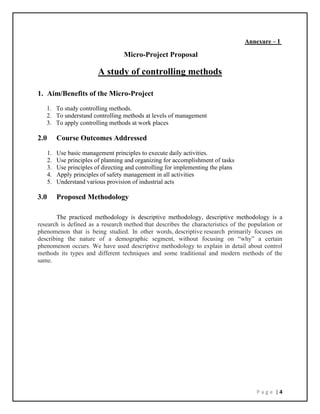
1. Aim/Benefits of the Micro-Project
1. To study controlling methods.
2. To understand controlling methods at levels of management
3. To apply controlling methods at work places
2.0 Course Outcomes Addressed
1. Use basic management principles to execute daily activities.
2. Use principles of planning and organizing for accomplishment of tasks
3. Use principles of directing and controlling for implementing the plans
4. Apply principles of safety management in all activities
5. Understand various provision of industrial acts
3.0 Proposed Methodology
The practiced methodology is descriptive methodology, descriptive methodology is a
research is defined as a research method that describes the characteristics of the population or
phenomenon that is being studied. In other words, descriptive research primarily focuses on
describing the nature of a demographic segment, without focusing on “why” a certain
phenomenon occurs. We have used descriptive methodology to explain in detail about control
methods its types and different techniques and some traditional and modern methods of the
same.
P a g e | 5
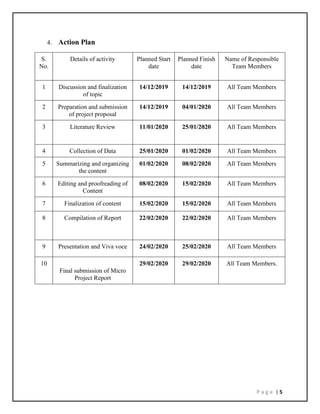
4. Action Plan
S.
No.
Details of activity Planned Start
date
Planned Finish
date
Name of Responsible
Team Members
1 Discussion and finalization
of topic
14/12/2019 14/12/2019 All Team Members
2 Preparation and submission
of project proposal
14/12/2019 04/01/2020 All Team Members
3 Literature Review 11/01/2020 25/01/2020 All Team Members
4 Collection of Data 25/01/2020 01/02/2020 All Team Members
5 Summarizing and organizing
the content
01/02/2020 08/02/2020 All Team Members
6 Editing and proofreading of
Content
08/02/2020 15/02/2020 All Team Members
7 Finalization of content 15/02/2020 15/02/2020 All Team Members
8 Compilation of Report 22/02/2020 22/02/2020 All Team Members
9 Presentation and Viva voce 24/02/2020 25/02/2020 All Team Members
10
Final submission of Micro
Project Report
29/02/2020 29/02/2020 All Team Members.
P a g e | 6
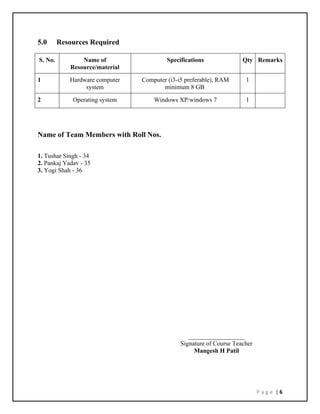
5.0 Resources Required
S. No. Name of
Resource/material
Specifications Qty Remarks
1 Hardware computer
system
Computer (i3-i5 preferable), RAM
minimum 8 GB
1
2 Operating system Windows XP/windows 7 1
Name of Team Members with Roll Nos.
1. Tushar Singh - 34
2. Pankaj Yadav - 35
3. Yogi Shah - 36
__________________
Signature of Course Teacher
Mangesh H Patil
P a g e | 7
Annexure – II
Micro-Project Report
A study of controlling methods
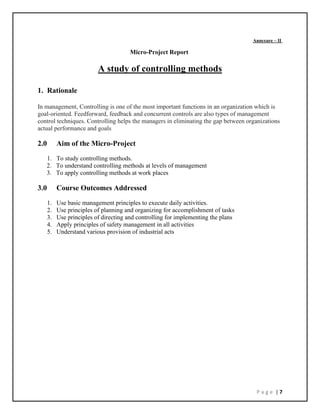
1. Rationale
In management, Controlling is one of the most important functions in an organization which is
goal-oriented. Feedforward, feedback and concurrent controls are also types of management
control techniques. Controlling helps the managers in eliminating the gap between organizations
actual performance and goals
2.0 Aim of the Micro-Project
1. To study controlling methods.
2. To understand controlling methods at levels of management
3. To apply controlling methods at work places
3.0 Course Outcomes Addressed
1. Use basic management principles to execute daily activities.
2. Use principles of planning and organizing for accomplishment of tasks
3. Use principles of directing and controlling for implementing the plans
4. Apply principles of safety management in all activities
5. Understand various provision of industrial acts
P a g e | 8
4.0 Literature Review
A literature review was done using a survey of scholarly sources such as books, journal articles,
and theses related to our topic control methods in management. We tried to situate our work in
relation to existing knowledge.
5.0 Actual Procedure Followed.
1. The first step was that we finalized our topic with our respective guide.
2. We divided the project work equally between all the members of our group.
3. Then we researched on our topic via google as well as in books
4. Then we collect information related to topic
5. We edited all the information with given respected format
6. And finally we made our report.
6.0 Actual Resources Used
S.
No.
Name of
Resource/material
Specifications Qty Remarks
1 Hardware computer
system
Computer (i3-i5 preferable), RAM
minimum 8 GB
1
2 Operating system Windows XP/windows 7 1
7.0 Outputs of the Micro-Projects-
Control in management
Control is a function of management which helps to check errors in order to take corrective
actions. This is done to minimize deviation from standards and ensure that the stated goals of the
organization are achieved in a desired manner.
P a g e | 9
According to modern concepts, control is a foreseeing action; earlier concepts of control were
only used when errors were detected. Control in management includes setting standards,
measuring actual performance and taking corrective action the decision making.
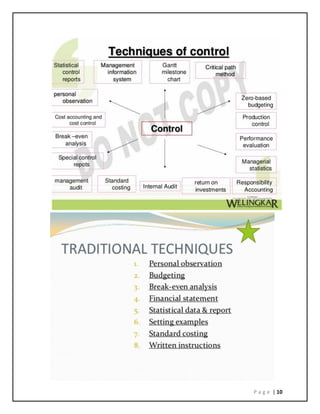
Control methods
METHODS of control Control techniques or methods are generally described as either
quantitative or non quantitative. Quantitative Methods Quantitative methods use data and various
quantitative tools to monitor and control production output. Two common quantitative tools are
budgets and audits
Managers can use six different control methods to regulate the behavior of individuals
and units within their organization: personal controls, bureaucratic controls, output controls,
cultural controls, incentive controls, and market controls. In practice, few managers rely on just
one control method
The 3 types of control
A manager's toolbox should be equipped with three types of controls: feed forward controls,
concurrent controls and feedback controls. Controls can focus on issues before, during or after a
process
P a g e | 10
W
h
a
t
a
r
e
D
i
f
f
e
r
e
n
t
t
D
i
f
P a g e | 11
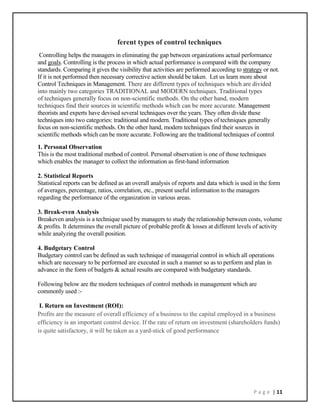
ferent types of control techniques
Controlling helps the managers in eliminating the gap between organizations actual performance
and goals. Controlling is the process in which actual performance is compared with the company
standards. Comparing it gives the visibility that activities are performed according to strategy or not.
If it is not performed then necessary corrective action should be taken. Let us learn more about
Control Techniques in Management. There are different types of techniques which are divided
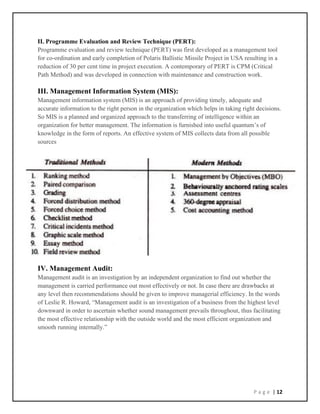
into mainly two categories TRADITIONAL and MODERN techniques. Traditional types
of techniques generally focus on non-scientific methods. On the other hand, modern
techniques find their sources in scientific methods which can be more accurate. Management
theorists and experts have devised several techniques over the years. They often divide these
techniques into two categories: traditional and modern. Traditional types of techniques generally
focus on non-scientific methods. On the other hand, modern techniques find their sources in
scientific methods which can be more accurate. Following are the traditional techniques of control
1. Personal Observation
This is the most traditional method of control. Personal observation is one of those techniques
which enables the manager to collect the information as first-hand information
2. Statistical Reports
Statistical reports can be defined as an overall analysis of reports and data which is used in the form
of averages, percentage, ratios, correlation, etc., present useful information to the managers
regarding the performance of the organization in various areas.
3. Break-even Analysis
Breakeven analysis is a technique used by managers to study the relationship between costs, volume
& profits. It determines the overall picture of probable profit & losses at different levels of activity
while analyzing the overall position.
4. Budgetary Control
Budgetary control can be defined as such technique of managerial control in which all operations
which are necessary to be performed are executed in such a manner so as to perform and plan in
advance in the form of budgets & actual results are compared with budgetary standards.
Following below are the modern techniques of control methods in management which are
commonly used :-
I. Return on Investment (ROI):
Profits are the measure of overall efficiency of a business to the capital employed in a business
efficiency is an important control device. If the rate of return on investment (shareholders funds)
is quite satisfactory, it will be taken as a yard-stick of good performance
P a g e | 12
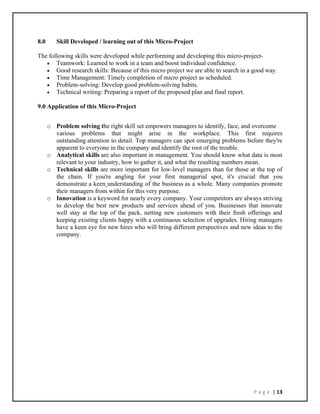
II. Programme Evaluation and Review Technique (PERT):
Programme evaluation and review technique (PERT) was first developed as a management tool
for co-ordination and early completion of Polaris Ballistic Missile Project in USA resulting in a
reduction of 30 per cent time in project execution. A contemporary of PERT is CPM (Critical
Path Method) and was developed in connection with maintenance and construction work.
III. Management Information System (MIS):
Management information system (MIS) is an approach of providing timely, adequate and
accurate information to the right person in the organization which helps in taking right decisions.
So MIS is a planned and organized approach to the transferring of intelligence within an
organization for better management. The information is furnished into useful quantum’s of
knowledge in the form of reports. An effective system of MIS collects data from all possible
sources
IV. Management Audit:
Management audit is an investigation by an independent organization to find out whether the
management is carried performance out most effectively or not. In case there are drawbacks at
any level then recommendations should be given to improve managerial efficiency. In the words
of Leslie R. Howard, “Management audit is an investigation of a business from the highest level
downward in order to ascertain whether sound management prevails throughout, thus facilitating
the most effective relationship with the outside world and the most efficient organization and
smooth running internally.”
P a g e | 13
8.0 Skill Developed / learning out of this Micro-Project
The following skills were developed while performing and developing this micro-project-
• Teamwork: Learned to work in a team and boost individual confidence.
• Good research skills: Because of this micro project we are able to search in a good way.
• Time Management: Timely completion of micro project as scheduled.
• Problem-solving: Develop good problem-solving habits.
• Technical writing: Preparing a report of the proposed plan and final report.
9.0 Application of this Micro-Project
o Problem solving the right skill set empowers managers to identify, face, and overcome
various problems that might arise in the workplace. This first requires
outstanding attention to detail. Top managers can spot emerging problems before they're
apparent to everyone in the company and identify the root of the trouble.
o Analytical skills are also important in management. You should know what data is most
relevant to your industry, how to gather it, and what the resulting numbers mean.
o Technical skills are more important for low-level managers than for those at the top of
the chain. If you're angling for your first managerial spot, it's crucial that you
demonstrate a keen understanding of the business as a whole. Many companies promote
their managers from within for this very purpose.
o Innovation is a keyword for nearly every company. Your competitors are always striving
to develop the best new products and services ahead of you. Businesses that innovate
well stay at the top of the pack, netting new customers with their fresh offerings and
keeping existing clients happy with a continuous selection of upgrades. Hiring managers
have a keen eye for new hires who will bring different perspectives and new ideas to the
company.
P a g e | 14
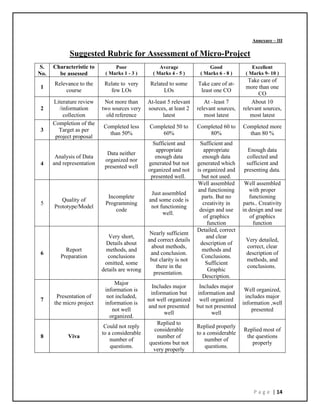
Annexure – III
Suggested Rubric for Assessment of Micro-Project
S.
No.
Characteristic to
be assessed
Poor
( Marks 1 - 3 )
Average
( Marks 4 - 5 )
Good
( Marks 6 - 8 )
Excellent
( Marks 9- 10 )
1
Relevance to the
course
Relate to very
few LOs
Related to some
LOs
Take care of at-
least one CO
Take care of
more than one
CO
2
Literature review
/information
collection
Not more than
two sources very
old reference
At-least 5 relevant
sources, at least 2
latest
At –least 7
relevant sources,
most latest
About 10
relevant sources,
most latest
3
Completion of the
Target as per
project proposal
Completed less
than 50%
Completed 50 to
60%
Completed 60 to
80%
Completed more
than 80 %
4
Analysis of Data
and representation
Data neither
organized nor
presented well
Sufficient and
appropriate
enough data
generated but not
organized and not
presented well.
Sufficient and
appropriate
enough data
generated which
is organized and
but not used.
Enough data
collected and
sufficient and
presenting data.
5
Quality of
Prototype/Model
Incomplete
Programming
code
Just assembled
and some code is
not functioning
well.
Well assembled
and functioning
parts. But no
creativity in
design and use
of graphics
function
Well assembled
with proper
functioning
parts.. Creativity
in design and use
of graphics
function
6
Report
Preparation
Very short,
Details about
methods, and
conclusions
omitted, some
details are wrong
Nearly sufficient
and correct details
about methods,
and conclusion.
but clarity is not
there in the
presentation.
Detailed, correct
and clear
description of
methods and
Conclusions.
Sufficient
Graphic
Description.
Very detailed,
correct, clear
description of
methods, and
conclusions.
7
Presentation of
the micro project
Major
information is
not included,
information is
not well
organized.
Includes major
information but
not well organized
and not presented
well
Includes major
information and
well organized
but not presented
well
Well organized,
includes major
information ,well
presented
8 Viva
Could not reply
to a considerable
number of
questions.
Replied to
considerable
number of
questions but not
very properly
Replied properly
to a considerable
number of
questions.
Replied most of
the questions
properly
P a g e | 15
Annexure – IV
Micro Project Evaluation Sheet
Name of Student: Tushar, Pankaj, Yogi Enrollment No: 1700040135 - 1700040137
Name of Program: Computer Engineering Semester: Sixth
Course Title: Management Course Code: 22509
Title of the Micro-Project: To Study The Managerial Skills.
Cos addressed by Micro Project:
1. Use basic management principles to execute daily activities. [ ✓ ]
2. Use principles of planning and organizing for accomplishment of tasks [ ✓ ]
3. Use principles of directing and controlling for implementing the plans [ ✓ ]
4. Apply principles of safety management in all activities [ ✓ ]
5. Understand various provision of industrial acts [ ✓ ]
Sr.
No.
Characteristic to be assessed
Poor
( Marks1-
3 )
Average
(Marks 4-
5 )
Good
(Marks 6-
8)
Excellent
( Marks9-
10)
Sub
Total
A. Process and Product Assessment (Convert Above Total marks out of 6 Marks)
1 Relevance to the course
2 Information Collection
3
Completion of the Target as per
project proposal
4
Analysis of Data and
representation
5 Quality of Prototype/Model
6 Report Preparation
B. Individual Presentation / Viva (Convert above total marks out of 4 marks)
7 Presentation
8 Defense
P a g e | 16
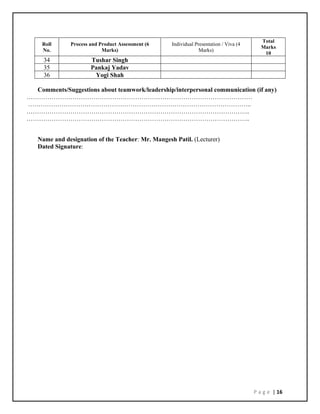
Roll
No.
Process and Product Assessment (6
Marks)
Individual Presentation / Viva (4
Marks)
Total
Marks
10
34 Tushar Singh
35 Pankaj Yadav
36 Yogi Shah
Comments/Suggestions about teamwork/leadership/interpersonal communication (if any)
………………………………………………………………………………………………
……………………………………………………………………………………………..
……………………………………………………………………………………………..
……………………………………………………………………………………………..
Name and designation of the Teacher: Mr. Mangesh Patil. (Lecturer)
Dated Signature:

MICRO_PROJECT_MGT.pdf

  • 1.
    P a ge | 1 MICRO PROJECT Academic year 2019-20 A study of controlling methods Program: Computer Technology Program code: CM6I Course: Management Course code: 22509
  • 2.
    P a ge | 2 MAHARASHTRA STATE BOARD OF TECHNICAL EDUCATION Certificate This is to certify that Mr. /Ms. Tushar Singh, Pankaj Yadav, Yogi Shah Roll No. 34, 35, 36 of Fourth Semester of Diploma in Computer Engineering Of Institute, VES POLYTECHNIC (Code: 0004) has completed the Micro Project satisfactorily in Subject Management (22509) for the academic year 2019- 2020. As prescribed in the curriculum. Exam Seat No: ……………………… Enrollment No: 1700040135,36,37 Date: ……………………… Place: Chembur, Mumbai. Subject Teacher Head of the Department Principal
  • 3.
    P a ge | 3 INDEX Academic year: 2019-20 Name of the faculty: Mr. Mangesh Patil Program code: CM6I Course & course code: Management (22509) Name of the candidate: Tushar, Pankaj, Yogi Roll No. 34, 35, 36 Enrollment No. 1700040135, 1700040136, 1700040137 Sr. No Content Page No. 1 Micro-Project Proposal- Annexure – I 2 Micro-Project Report- Annexure – II 3 Suggested Rubric for Assessment of Micro- Project- Annexure –III 4 Micro Project Evaluation Sheet- Annexure –IV
  • 4.
    P a ge | 4 Annexure – I Micro-Project Proposal A study of controlling methods 1. Aim/Benefits of the Micro-Project 1. To study controlling methods. 2. To understand controlling methods at levels of management 3. To apply controlling methods at work places 2.0 Course Outcomes Addressed 1. Use basic management principles to execute daily activities. 2. Use principles of planning and organizing for accomplishment of tasks 3. Use principles of directing and controlling for implementing the plans 4. Apply principles of safety management in all activities 5. Understand various provision of industrial acts 3.0 Proposed Methodology The practiced methodology is descriptive methodology, descriptive methodology is a research is defined as a research method that describes the characteristics of the population or phenomenon that is being studied. In other words, descriptive research primarily focuses on describing the nature of a demographic segment, without focusing on “why” a certain phenomenon occurs. We have used descriptive methodology to explain in detail about control methods its types and different techniques and some traditional and modern methods of the same.
  • 5.
    P a ge | 5 4. Action Plan S. No. Details of activity Planned Start date Planned Finish date Name of Responsible Team Members 1 Discussion and finalization of topic 14/12/2019 14/12/2019 All Team Members 2 Preparation and submission of project proposal 14/12/2019 04/01/2020 All Team Members 3 Literature Review 11/01/2020 25/01/2020 All Team Members 4 Collection of Data 25/01/2020 01/02/2020 All Team Members 5 Summarizing and organizing the content 01/02/2020 08/02/2020 All Team Members 6 Editing and proofreading of Content 08/02/2020 15/02/2020 All Team Members 7 Finalization of content 15/02/2020 15/02/2020 All Team Members 8 Compilation of Report 22/02/2020 22/02/2020 All Team Members 9 Presentation and Viva voce 24/02/2020 25/02/2020 All Team Members 10 Final submission of Micro Project Report 29/02/2020 29/02/2020 All Team Members.
  • 6.
    P a ge | 6 5.0 Resources Required S. No. Name of Resource/material Specifications Qty Remarks 1 Hardware computer system Computer (i3-i5 preferable), RAM minimum 8 GB 1 2 Operating system Windows XP/windows 7 1 Name of Team Members with Roll Nos. 1. Tushar Singh - 34 2. Pankaj Yadav - 35 3. Yogi Shah - 36 __________________ Signature of Course Teacher Mangesh H Patil
  • 7.
    P a ge | 7 Annexure – II Micro-Project Report A study of controlling methods 1. Rationale In management, Controlling is one of the most important functions in an organization which is goal-oriented. Feedforward, feedback and concurrent controls are also types of management control techniques. Controlling helps the managers in eliminating the gap between organizations actual performance and goals 2.0 Aim of the Micro-Project 1. To study controlling methods. 2. To understand controlling methods at levels of management 3. To apply controlling methods at work places 3.0 Course Outcomes Addressed 1. Use basic management principles to execute daily activities. 2. Use principles of planning and organizing for accomplishment of tasks 3. Use principles of directing and controlling for implementing the plans 4. Apply principles of safety management in all activities 5. Understand various provision of industrial acts
  • 8.
    P a ge | 8 4.0 Literature Review A literature review was done using a survey of scholarly sources such as books, journal articles, and theses related to our topic control methods in management. We tried to situate our work in relation to existing knowledge. 5.0 Actual Procedure Followed. 1. The first step was that we finalized our topic with our respective guide. 2. We divided the project work equally between all the members of our group. 3. Then we researched on our topic via google as well as in books 4. Then we collect information related to topic 5. We edited all the information with given respected format 6. And finally we made our report. 6.0 Actual Resources Used S. No. Name of Resource/material Specifications Qty Remarks 1 Hardware computer system Computer (i3-i5 preferable), RAM minimum 8 GB 1 2 Operating system Windows XP/windows 7 1 7.0 Outputs of the Micro-Projects- Control in management Control is a function of management which helps to check errors in order to take corrective actions. This is done to minimize deviation from standards and ensure that the stated goals of the organization are achieved in a desired manner.
  • 9.
    P a ge | 9 According to modern concepts, control is a foreseeing action; earlier concepts of control were only used when errors were detected. Control in management includes setting standards, measuring actual performance and taking corrective action the decision making. Control methods METHODS of control Control techniques or methods are generally described as either quantitative or non quantitative. Quantitative Methods Quantitative methods use data and various quantitative tools to monitor and control production output. Two common quantitative tools are budgets and audits Managers can use six different control methods to regulate the behavior of individuals and units within their organization: personal controls, bureaucratic controls, output controls, cultural controls, incentive controls, and market controls. In practice, few managers rely on just one control method The 3 types of control A manager's toolbox should be equipped with three types of controls: feed forward controls, concurrent controls and feedback controls. Controls can focus on issues before, during or after a process
  • 10.
    P a ge | 10 W h a t a r e D i f f e r e n t t D i f
  • 11.
    P a ge | 11 ferent types of control techniques Controlling helps the managers in eliminating the gap between organizations actual performance and goals. Controlling is the process in which actual performance is compared with the company standards. Comparing it gives the visibility that activities are performed according to strategy or not. If it is not performed then necessary corrective action should be taken. Let us learn more about Control Techniques in Management. There are different types of techniques which are divided into mainly two categories TRADITIONAL and MODERN techniques. Traditional types of techniques generally focus on non-scientific methods. On the other hand, modern techniques find their sources in scientific methods which can be more accurate. Management theorists and experts have devised several techniques over the years. They often divide these techniques into two categories: traditional and modern. Traditional types of techniques generally focus on non-scientific methods. On the other hand, modern techniques find their sources in scientific methods which can be more accurate. Following are the traditional techniques of control 1. Personal Observation This is the most traditional method of control. Personal observation is one of those techniques which enables the manager to collect the information as first-hand information 2. Statistical Reports Statistical reports can be defined as an overall analysis of reports and data which is used in the form of averages, percentage, ratios, correlation, etc., present useful information to the managers regarding the performance of the organization in various areas. 3. Break-even Analysis Breakeven analysis is a technique used by managers to study the relationship between costs, volume & profits. It determines the overall picture of probable profit & losses at different levels of activity while analyzing the overall position. 4. Budgetary Control Budgetary control can be defined as such technique of managerial control in which all operations which are necessary to be performed are executed in such a manner so as to perform and plan in advance in the form of budgets & actual results are compared with budgetary standards. Following below are the modern techniques of control methods in management which are commonly used :- I. Return on Investment (ROI): Profits are the measure of overall efficiency of a business to the capital employed in a business efficiency is an important control device. If the rate of return on investment (shareholders funds) is quite satisfactory, it will be taken as a yard-stick of good performance
  • 12.
    P a ge | 12 II. Programme Evaluation and Review Technique (PERT): Programme evaluation and review technique (PERT) was first developed as a management tool for co-ordination and early completion of Polaris Ballistic Missile Project in USA resulting in a reduction of 30 per cent time in project execution. A contemporary of PERT is CPM (Critical Path Method) and was developed in connection with maintenance and construction work. III. Management Information System (MIS): Management information system (MIS) is an approach of providing timely, adequate and accurate information to the right person in the organization which helps in taking right decisions. So MIS is a planned and organized approach to the transferring of intelligence within an organization for better management. The information is furnished into useful quantum’s of knowledge in the form of reports. An effective system of MIS collects data from all possible sources IV. Management Audit: Management audit is an investigation by an independent organization to find out whether the management is carried performance out most effectively or not. In case there are drawbacks at any level then recommendations should be given to improve managerial efficiency. In the words of Leslie R. Howard, “Management audit is an investigation of a business from the highest level downward in order to ascertain whether sound management prevails throughout, thus facilitating the most effective relationship with the outside world and the most efficient organization and smooth running internally.”
  • 13.
    P a ge | 13 8.0 Skill Developed / learning out of this Micro-Project The following skills were developed while performing and developing this micro-project- • Teamwork: Learned to work in a team and boost individual confidence. • Good research skills: Because of this micro project we are able to search in a good way. • Time Management: Timely completion of micro project as scheduled. • Problem-solving: Develop good problem-solving habits. • Technical writing: Preparing a report of the proposed plan and final report. 9.0 Application of this Micro-Project o Problem solving the right skill set empowers managers to identify, face, and overcome various problems that might arise in the workplace. This first requires outstanding attention to detail. Top managers can spot emerging problems before they're apparent to everyone in the company and identify the root of the trouble. o Analytical skills are also important in management. You should know what data is most relevant to your industry, how to gather it, and what the resulting numbers mean. o Technical skills are more important for low-level managers than for those at the top of the chain. If you're angling for your first managerial spot, it's crucial that you demonstrate a keen understanding of the business as a whole. Many companies promote their managers from within for this very purpose. o Innovation is a keyword for nearly every company. Your competitors are always striving to develop the best new products and services ahead of you. Businesses that innovate well stay at the top of the pack, netting new customers with their fresh offerings and keeping existing clients happy with a continuous selection of upgrades. Hiring managers have a keen eye for new hires who will bring different perspectives and new ideas to the company.
  • 14.
    P a ge | 14 Annexure – III Suggested Rubric for Assessment of Micro-Project S. No. Characteristic to be assessed Poor ( Marks 1 - 3 ) Average ( Marks 4 - 5 ) Good ( Marks 6 - 8 ) Excellent ( Marks 9- 10 ) 1 Relevance to the course Relate to very few LOs Related to some LOs Take care of at- least one CO Take care of more than one CO 2 Literature review /information collection Not more than two sources very old reference At-least 5 relevant sources, at least 2 latest At –least 7 relevant sources, most latest About 10 relevant sources, most latest 3 Completion of the Target as per project proposal Completed less than 50% Completed 50 to 60% Completed 60 to 80% Completed more than 80 % 4 Analysis of Data and representation Data neither organized nor presented well Sufficient and appropriate enough data generated but not organized and not presented well. Sufficient and appropriate enough data generated which is organized and but not used. Enough data collected and sufficient and presenting data. 5 Quality of Prototype/Model Incomplete Programming code Just assembled and some code is not functioning well. Well assembled and functioning parts. But no creativity in design and use of graphics function Well assembled with proper functioning parts.. Creativity in design and use of graphics function 6 Report Preparation Very short, Details about methods, and conclusions omitted, some details are wrong Nearly sufficient and correct details about methods, and conclusion. but clarity is not there in the presentation. Detailed, correct and clear description of methods and Conclusions. Sufficient Graphic Description. Very detailed, correct, clear description of methods, and conclusions. 7 Presentation of the micro project Major information is not included, information is not well organized. Includes major information but not well organized and not presented well Includes major information and well organized but not presented well Well organized, includes major information ,well presented 8 Viva Could not reply to a considerable number of questions. Replied to considerable number of questions but not very properly Replied properly to a considerable number of questions. Replied most of the questions properly
  • 15.
    P a ge | 15 Annexure – IV Micro Project Evaluation Sheet Name of Student: Tushar, Pankaj, Yogi Enrollment No: 1700040135 - 1700040137 Name of Program: Computer Engineering Semester: Sixth Course Title: Management Course Code: 22509 Title of the Micro-Project: To Study The Managerial Skills. Cos addressed by Micro Project: 1. Use basic management principles to execute daily activities. [ ✓ ] 2. Use principles of planning and organizing for accomplishment of tasks [ ✓ ] 3. Use principles of directing and controlling for implementing the plans [ ✓ ] 4. Apply principles of safety management in all activities [ ✓ ] 5. Understand various provision of industrial acts [ ✓ ] Sr. No. Characteristic to be assessed Poor ( Marks1- 3 ) Average (Marks 4- 5 ) Good (Marks 6- 8) Excellent ( Marks9- 10) Sub Total A. Process and Product Assessment (Convert Above Total marks out of 6 Marks) 1 Relevance to the course 2 Information Collection 3 Completion of the Target as per project proposal 4 Analysis of Data and representation 5 Quality of Prototype/Model 6 Report Preparation B. Individual Presentation / Viva (Convert above total marks out of 4 marks) 7 Presentation 8 Defense
  • 16.
    P a ge | 16 Roll No. Process and Product Assessment (6 Marks) Individual Presentation / Viva (4 Marks) Total Marks 10 34 Tushar Singh 35 Pankaj Yadav 36 Yogi Shah Comments/Suggestions about teamwork/leadership/interpersonal communication (if any) ……………………………………………………………………………………………… …………………………………………………………………………………………….. …………………………………………………………………………………………….. …………………………………………………………………………………………….. Name and designation of the Teacher: Mr. Mangesh Patil. (Lecturer) Dated Signature: