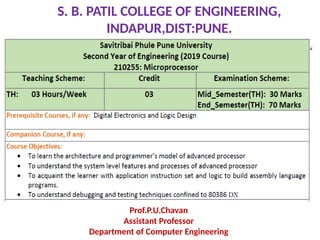
S. B. PATIL COLLEGE OF ENGINEERING,
INDAPUR,DIST:PUNE.
Prof.P.U.Chavan
Assistant Professor
Department of Computer Engineering
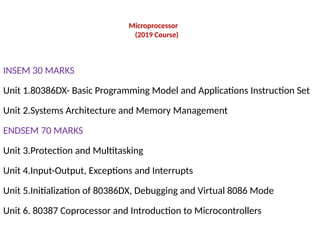
Microprocessor
(2019 Course)
INSEM 30 MARKS
Unit 1.80386DX- Basic Programming Model and Applications Instruction Set
Unit 2.Systems Architecture and Memory Management
ENDSEM 70 MARKS
Unit 3.Protection and Multitasking
Unit 4.Input-Output, Exceptions and Interrupts
Unit 5.Initialization of 80386DX, Debugging and Virtual 8086 Mode
Unit 6. 80387 Coprocessor and Introduction to Microcontrollers
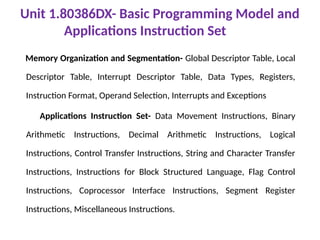
Unit 1.80386DX- Basic Programming Model and
Applications Instruction Set
Memory Organization and Segmentation- Global Descriptor Table, Local
Descriptor Table, Interrupt Descriptor Table, Data Types, Registers,
Instruction Format, Operand Selection, Interrupts and Exceptions
Applications Instruction Set- Data Movement Instructions, Binary
Arithmetic Instructions, Decimal Arithmetic Instructions, Logical
Instructions, Control Transfer Instructions, String and Character Transfer
Instructions, Instructions for Block Structured Language, Flag Control
Instructions, Coprocessor Interface Instructions, Segment Register
Instructions, Miscellaneous Instructions.
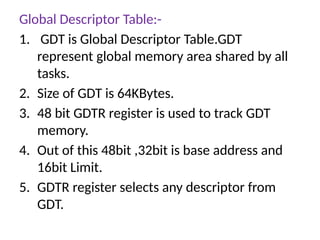
Global Descriptor Table:-
1. GDT is Global Descriptor Table.GDT
represent global memory area shared by all
tasks.
2. Size of GDT is 64KBytes.
3. 48 bit GDTR register is used to track GDT
memory.
4. Out of this 48bit ,32bit is base address and
16bit Limit.
5. GDTR register selects any descriptor from
GDT.
Local Descriptor Table:-
• LDT represents local memory area shared by
different tasks.
• LDT is not defined as independent table. LDT
Descriptor is defined inside GDT.
• LDTR provide index of LDT Descriptor into
GDT.
• It Changes as task Changes. It is not like GDT.
Unit 2.Systems Architecture and Memory
Management
• Systems Architecture- Systems Registers, Systems Instructions.
• Memory Management- Segment Translation, Page Translation,
Combining Segment and Page Translation.
Unit 3.Protection and Multitasking
• Protection- Need of Protection, Overview of 80386DX
Protection Mechanisms, Segment Level Protection, Page Level
Protection, Combining Segment and Page Level Protection.
• Multitasking- Task State Segment, TSS Descriptor, Task
Register, Task Gate Descriptor, Task Switching, Task Linking,
Task Address Space.
Protection Mechanism
• The protection hardware of the 80386 is an
integral part of the memory management
hardware. Protection applies both to segment
translation and to page translation.
• User can not currupt file in interface .
Unit 4.Input-Output, Exceptions and Interrupts
• Input-Output- I/O Addressing, I/O Instructions, Protection and
I/O
• Exceptions and Interrupts- Identifying Interrupts, Enabling and
Disabling Interrupts, Priority among Simultaneous Interrupts
and Exceptions, Interrupt Descriptor Table (IDT), IDT
Descriptors, Interrupt Tasks and Interrupt Procedures, Error
Code, and Exception Conditions.
Unit 5.Initialization of 80386DX, Debugging and
Virtual 8086 Mode
• Initialization- Processor State after Reset, Software Initialization
for Real Address Mode, Switching to Protected Mode, Software
Initialization for Protected Mode, Initialization Example, TLB
Testing
• Debugging- Debugging Features of the Architecture, Debug
Registers, Debug Exceptions, Breakpoint Exception
• Virtual 8086 Mode- Executing 8086 Code, Structure of V86
Stack, Entering and Leaving Virtual 8086 Mode.
Unit 6.80387 Coprocessor and Introduction to
Microcontrollers
• 80387 NDP- Control Register bits for Coprocessor support,
80387 Register Stack, Data Types, Load and Store Instructions,
Trigonometric and Transcendental Instructions, Interfacing
signals of 80386DX with 80387.
• Introduction to Microcontrollers: Architecture of typical
Microcontroller, Difference between Microprocessor and
Microcontroller, Characteristics of 8 bit and 16 bit
microcontrollers, Application of Microcontrollers
MICROPROCESSOR.pptx micro processor ppt first

MICROPROCESSOR.pptx micro processor ppt first

  • 1.
    S. B. PATILCOLLEGE OF ENGINEERING, INDAPUR,DIST:PUNE. Prof.P.U.Chavan Assistant Professor Department of Computer Engineering
  • 2.
    Microprocessor (2019 Course) INSEM 30MARKS Unit 1.80386DX- Basic Programming Model and Applications Instruction Set Unit 2.Systems Architecture and Memory Management ENDSEM 70 MARKS Unit 3.Protection and Multitasking Unit 4.Input-Output, Exceptions and Interrupts Unit 5.Initialization of 80386DX, Debugging and Virtual 8086 Mode Unit 6. 80387 Coprocessor and Introduction to Microcontrollers
  • 3.
    Unit 1.80386DX- BasicProgramming Model and Applications Instruction Set Memory Organization and Segmentation- Global Descriptor Table, Local Descriptor Table, Interrupt Descriptor Table, Data Types, Registers, Instruction Format, Operand Selection, Interrupts and Exceptions Applications Instruction Set- Data Movement Instructions, Binary Arithmetic Instructions, Decimal Arithmetic Instructions, Logical Instructions, Control Transfer Instructions, String and Character Transfer Instructions, Instructions for Block Structured Language, Flag Control Instructions, Coprocessor Interface Instructions, Segment Register Instructions, Miscellaneous Instructions.
  • 4.
    Global Descriptor Table:- 1.GDT is Global Descriptor Table.GDT represent global memory area shared by all tasks. 2. Size of GDT is 64KBytes. 3. 48 bit GDTR register is used to track GDT memory. 4. Out of this 48bit ,32bit is base address and 16bit Limit. 5. GDTR register selects any descriptor from GDT.
  • 5.
    Local Descriptor Table:- •LDT represents local memory area shared by different tasks. • LDT is not defined as independent table. LDT Descriptor is defined inside GDT. • LDTR provide index of LDT Descriptor into GDT. • It Changes as task Changes. It is not like GDT.
  • 6.
    Unit 2.Systems Architectureand Memory Management • Systems Architecture- Systems Registers, Systems Instructions. • Memory Management- Segment Translation, Page Translation, Combining Segment and Page Translation.
  • 7.
    Unit 3.Protection andMultitasking • Protection- Need of Protection, Overview of 80386DX Protection Mechanisms, Segment Level Protection, Page Level Protection, Combining Segment and Page Level Protection. • Multitasking- Task State Segment, TSS Descriptor, Task Register, Task Gate Descriptor, Task Switching, Task Linking, Task Address Space.
  • 8.
    Protection Mechanism • Theprotection hardware of the 80386 is an integral part of the memory management hardware. Protection applies both to segment translation and to page translation. • User can not currupt file in interface .
  • 9.
    Unit 4.Input-Output, Exceptionsand Interrupts • Input-Output- I/O Addressing, I/O Instructions, Protection and I/O • Exceptions and Interrupts- Identifying Interrupts, Enabling and Disabling Interrupts, Priority among Simultaneous Interrupts and Exceptions, Interrupt Descriptor Table (IDT), IDT Descriptors, Interrupt Tasks and Interrupt Procedures, Error Code, and Exception Conditions.
  • 10.
    Unit 5.Initialization of80386DX, Debugging and Virtual 8086 Mode • Initialization- Processor State after Reset, Software Initialization for Real Address Mode, Switching to Protected Mode, Software Initialization for Protected Mode, Initialization Example, TLB Testing • Debugging- Debugging Features of the Architecture, Debug Registers, Debug Exceptions, Breakpoint Exception • Virtual 8086 Mode- Executing 8086 Code, Structure of V86 Stack, Entering and Leaving Virtual 8086 Mode.
  • 11.
    Unit 6.80387 Coprocessorand Introduction to Microcontrollers • 80387 NDP- Control Register bits for Coprocessor support, 80387 Register Stack, Data Types, Load and Store Instructions, Trigonometric and Transcendental Instructions, Interfacing signals of 80386DX with 80387. • Introduction to Microcontrollers: Architecture of typical Microcontroller, Difference between Microprocessor and Microcontroller, Characteristics of 8 bit and 16 bit microcontrollers, Application of Microcontrollers