Introduction to music production
 Hello everyone, I am Joel Corella from Hermosillo,
Mexico. This is my presentation for week 2 of
Introduction to music production at Coursera.org. I
made it about microphone basics and I hope you find
it useful.
 A microphone converts sound pressure variations in
the air into voltage variations in a wire.
Singer (sound pressure variations) Voltage variations (audio signal)
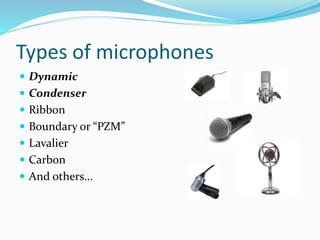
Types of microphones
 Dynamic
 Condenser
 Ribbon
 Boundary or “PZM”
 Lavalier
 Carbon
 And others...
Dynamic Microphones
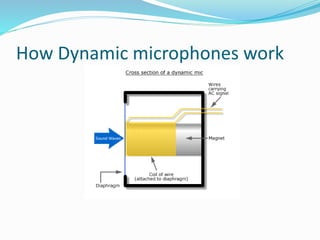
How Dynamic microphones work
 The sound pressure variations move a diaphragm that
is a attached to a coil.
 The diaphragm vibrates and the coil moves backwards
and forwards past a magnet.
 This creates a current in the coil wich is channeled
from the microphone along a wire.
How Dynamic microphones work
Dynamic microphones
Characteristics:
 Very good for onstage
 Construction in simple
 No power supply is required
 Relatively inexpensive
• It is rugged
• It doesn’t pick up a
large area
Condenser Microphones
How Condenser microphones work
 A capacitor has two plates with a voltage between
them.
 In the condenser mic, one of these plates is made of
very light material and acts as the diaphragm.
How Condenser microphones work
 The diaphragm vibrates when struck by sound waves,
changing the distance between the two plates and
therefore changing the capacitance.
 When the plates are closer together, capacitance
increases and a charge current occurs. When the plates
are further apart, capacitance decreases and a
discharge current occurs.
How Condenser microphones work
 A voltage is required across the capacitor for this to
work. This voltage is supplied either by a battery in
the mic or by external Phantom power.
Condenser microphones
Characteristics:
 Pick up things very
accurately
 Useful in the widest range
of situations
 Good sensitivity at all
frequencies
 It might require a “pop
shield filter” for vocals
• Power supply is required
(phantom power)
• Vulnerable to structural
vibration and humidity
Polar pattern
 Polar pattern is the graphic representation of how
sensitive a microphone is in different directions.
Types of polar pattern
Directional: Cardioid
 A cardioid microphone is most sensitive on the front
axis It reduces unwanted ambient sound from the
sides and back and is much more resistant to feedback
than other polar patterns.
Directional: Shotgun
 Line and Gradient or Shotgun microphones use a
complex design that makes their polar pattern highly
directional.
 Shotgun microphones are excellent for film and
theatre work to pick up sound while keeping the
microphone out of the camera’s view.
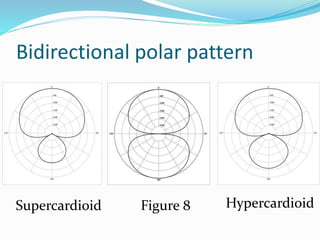
Bidirectional polar pattern
Figure 8Supercardioid Hypercardioid
Bidirectional: HyperCardioid
 Hyper cardioid microphones offer a narrower pickup
on the front axis than cardioids and a greater rejection
of ambient sound from the sides. Hyper cardioids are
most suitable for single sound sources that need to be
picked up in loud environments.
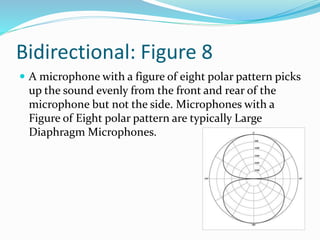
Bidirectional: Figure 8
 A microphone with a figure of eight polar pattern picks
up the sound evenly from the front and rear of the
microphone but not the side. Microphones with a
Figure of Eight polar pattern are typically Large
Diaphragm Microphones.
Omnidirectional
 An omnidirectional microphone picks up sounds from
all directions evenly and can be useful when picking
up the entire room ambience / performance.
Frequency response
 The frequency response is the output level or
sensitivity of a microphone over its operating range
from lowest to highest frequencies. Generally two
types exist:
 Flat
 Tailored
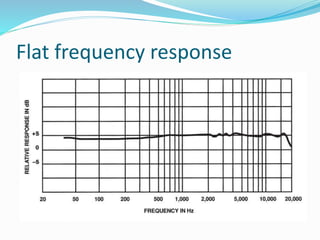
Flat frequency response
 All audible frequencies (20 Hz – 20 kHz) have the
same output level.
 This is most suitable for applications where the sound
source has to be reproduced without changing or
“coloring” the original sound.
Flat frequency response
Tailored frequency response
 Usually designed to enhance a sound source in a
particular application.
 For instance, a microphone may have a peak in the 2 –
8 kHz range to increase intelligibility for live vocals.
Tailored frequency response
Sources
 https://shurebenelux.wordpress.com/2015/01/14/micropho
ne-basics-frequency-response/
 http://gasolinemedia.jalbum.net/Sennheiser_MK4/slides/
MK4%20Frequency%20Response%20Curve.html
 http://www.prosoundweb.com/article/microphone_charac
teristics_for_live_sound_reinforcement/P2/
 http://www.buzzle.com/articles/types-of-microphones-
and-their-uses.html
 http://www.shure.co.uk/support_download/educational_c
ontent/microphones-
basics/microphones_frequency_response
 http://musictechstudent.co.uk/microphones/microphone-
polar-patterns/

Microphone basics

  • 1.
    Introduction to musicproduction  Hello everyone, I am Joel Corella from Hermosillo, Mexico. This is my presentation for week 2 of Introduction to music production at Coursera.org. I made it about microphone basics and I hope you find it useful.
  • 3.
     A microphoneconverts sound pressure variations in the air into voltage variations in a wire. Singer (sound pressure variations) Voltage variations (audio signal)
  • 4.
    Types of microphones Dynamic  Condenser  Ribbon  Boundary or “PZM”  Lavalier  Carbon  And others...
  • 5.
  • 6.
    How Dynamic microphoneswork  The sound pressure variations move a diaphragm that is a attached to a coil.  The diaphragm vibrates and the coil moves backwards and forwards past a magnet.  This creates a current in the coil wich is channeled from the microphone along a wire.
  • 7.
  • 8.
    Dynamic microphones Characteristics:  Verygood for onstage  Construction in simple  No power supply is required  Relatively inexpensive • It is rugged • It doesn’t pick up a large area
  • 9.
  • 10.
    How Condenser microphoneswork  A capacitor has two plates with a voltage between them.  In the condenser mic, one of these plates is made of very light material and acts as the diaphragm.
  • 11.
    How Condenser microphoneswork  The diaphragm vibrates when struck by sound waves, changing the distance between the two plates and therefore changing the capacitance.  When the plates are closer together, capacitance increases and a charge current occurs. When the plates are further apart, capacitance decreases and a discharge current occurs.
  • 12.
    How Condenser microphoneswork  A voltage is required across the capacitor for this to work. This voltage is supplied either by a battery in the mic or by external Phantom power.
  • 13.
    Condenser microphones Characteristics:  Pickup things very accurately  Useful in the widest range of situations  Good sensitivity at all frequencies  It might require a “pop shield filter” for vocals • Power supply is required (phantom power) • Vulnerable to structural vibration and humidity
  • 14.
    Polar pattern  Polarpattern is the graphic representation of how sensitive a microphone is in different directions.
  • 15.
  • 16.
    Directional: Cardioid  Acardioid microphone is most sensitive on the front axis It reduces unwanted ambient sound from the sides and back and is much more resistant to feedback than other polar patterns.
  • 17.
    Directional: Shotgun  Lineand Gradient or Shotgun microphones use a complex design that makes their polar pattern highly directional.  Shotgun microphones are excellent for film and theatre work to pick up sound while keeping the microphone out of the camera’s view.
  • 18.
    Bidirectional polar pattern Figure8Supercardioid Hypercardioid
  • 19.
    Bidirectional: HyperCardioid  Hypercardioid microphones offer a narrower pickup on the front axis than cardioids and a greater rejection of ambient sound from the sides. Hyper cardioids are most suitable for single sound sources that need to be picked up in loud environments.
  • 20.
    Bidirectional: Figure 8 A microphone with a figure of eight polar pattern picks up the sound evenly from the front and rear of the microphone but not the side. Microphones with a Figure of Eight polar pattern are typically Large Diaphragm Microphones.
  • 21.
    Omnidirectional  An omnidirectionalmicrophone picks up sounds from all directions evenly and can be useful when picking up the entire room ambience / performance.
  • 22.
    Frequency response  Thefrequency response is the output level or sensitivity of a microphone over its operating range from lowest to highest frequencies. Generally two types exist:  Flat  Tailored
  • 23.
    Flat frequency response All audible frequencies (20 Hz – 20 kHz) have the same output level.  This is most suitable for applications where the sound source has to be reproduced without changing or “coloring” the original sound.
  • 24.
  • 25.
    Tailored frequency response Usually designed to enhance a sound source in a particular application.  For instance, a microphone may have a peak in the 2 – 8 kHz range to increase intelligibility for live vocals.
  • 26.
  • 27.
    Sources  https://shurebenelux.wordpress.com/2015/01/14/micropho ne-basics-frequency-response/  http://gasolinemedia.jalbum.net/Sennheiser_MK4/slides/ MK4%20Frequency%20Response%20Curve.html http://www.prosoundweb.com/article/microphone_charac teristics_for_live_sound_reinforcement/P2/  http://www.buzzle.com/articles/types-of-microphones- and-their-uses.html  http://www.shure.co.uk/support_download/educational_c ontent/microphones- basics/microphones_frequency_response  http://musictechstudent.co.uk/microphones/microphone- polar-patterns/