Putting the ‘Social’ into Performance Management in Microfinance Lalaine M. Joyas Microfinance Council of the Philippines, Inc. (MCPI) PACAP Microfinance Development Forum 30 January 2009
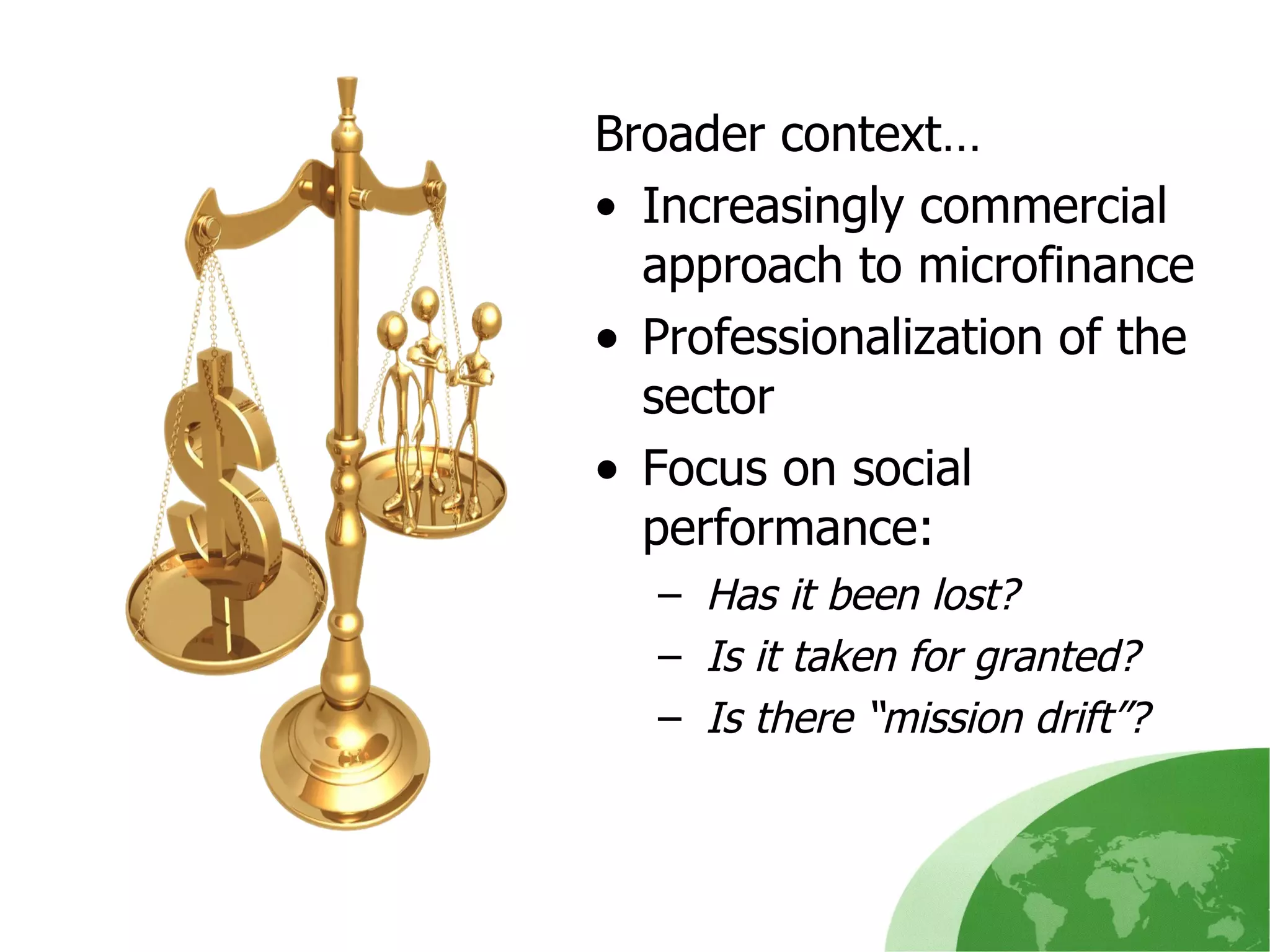
Broader context… Increasingly commercial approach to microfinance  Professionalization of the sector Focus on social performance :  Has it been lost ?  Is it taken for granted ?  Is there “mission drift ”?
Social Performance The effective translation of one’s social mission into practice, in line with accepted social values that relate to… reaching poorer and excluded clients; improving the lives of clients and their families; widening the range of opportunities for communities.
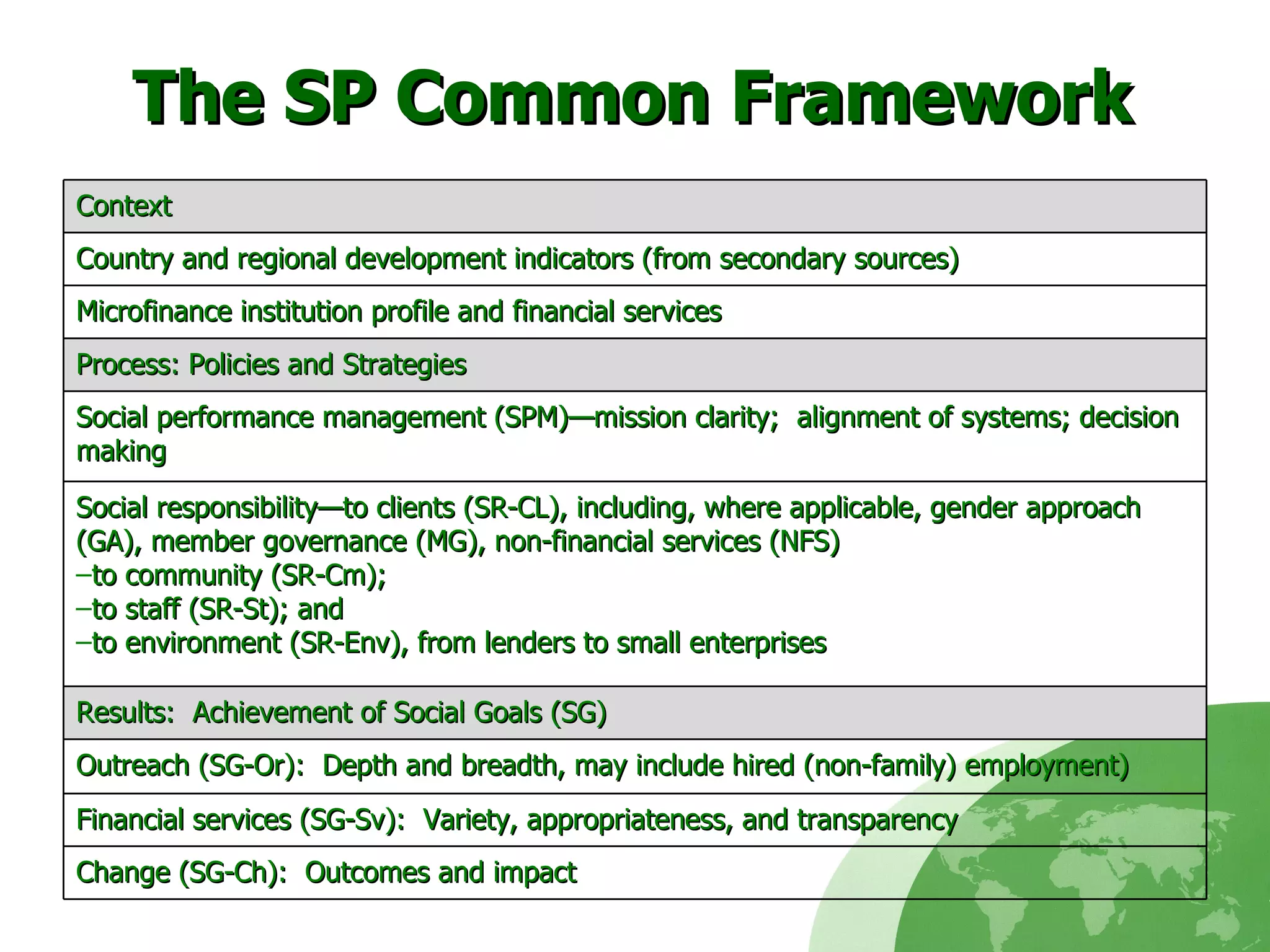
The SP Common Framework Context Country and regional development indicators (from secondary sources) Microfinance institution profile and financial services Process: Policies and Strategies  Social performance management (SPM)—mission clarity;  alignment of systems; decision making Social responsibility—to clients (SR-CL), including, where applicable, gender approach (GA), member governance (MG), non-financial services (NFS)  to community (SR-Cm); to staff (SR-St); and  to environment (SR-Env), from lenders to small enterprises Results:  Achievement of Social Goals (SG) Outreach (SG-Or):  Depth and breadth, may include hired (non-family) employment)  Financial services (SG-Sv):  Variety, appropriateness, and transparency  Change (SG-Ch):  Outcomes and impact
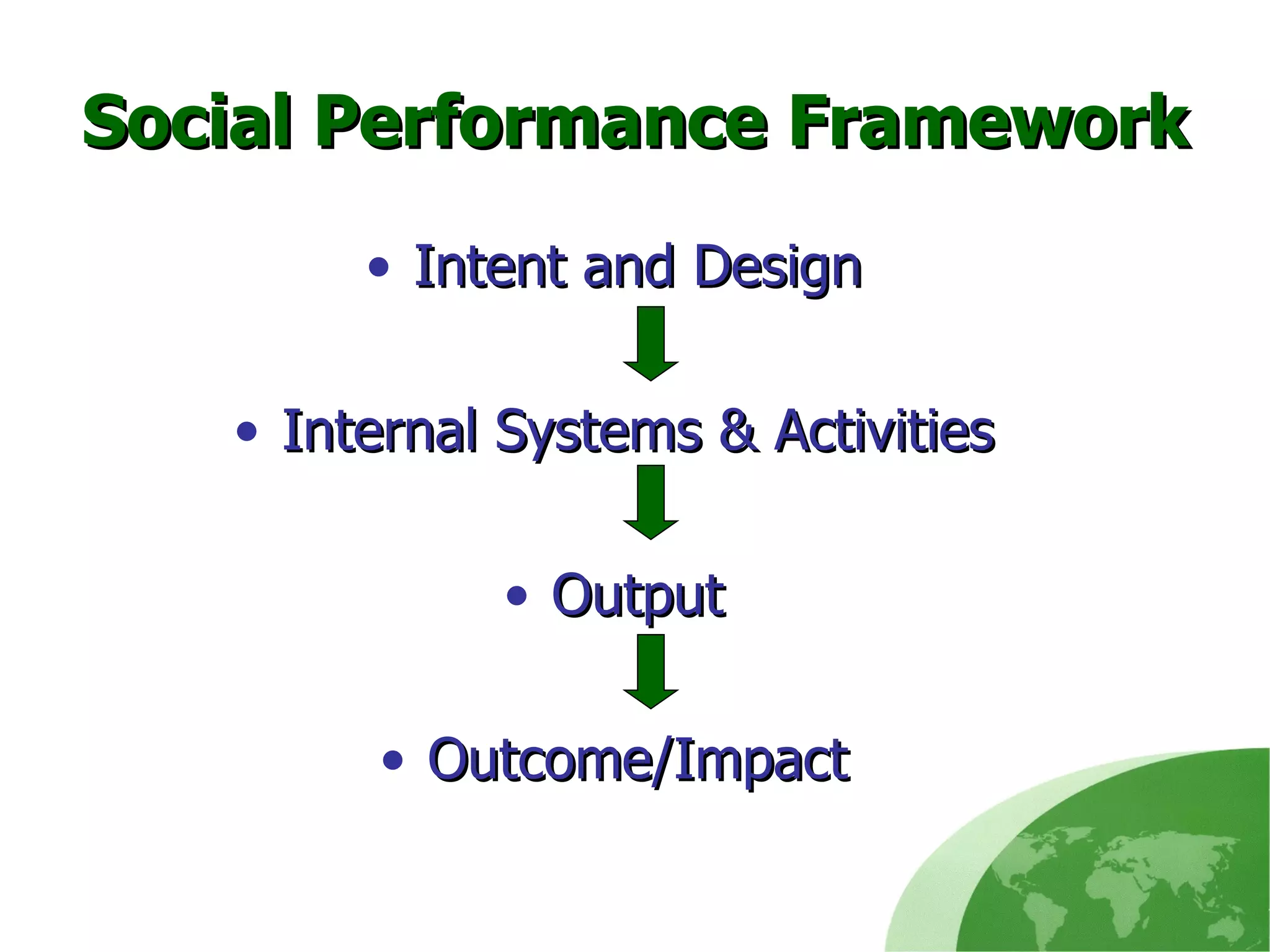
Social Performance Framework Intent and Design Internal Systems & Activities Output Outcome/Impact
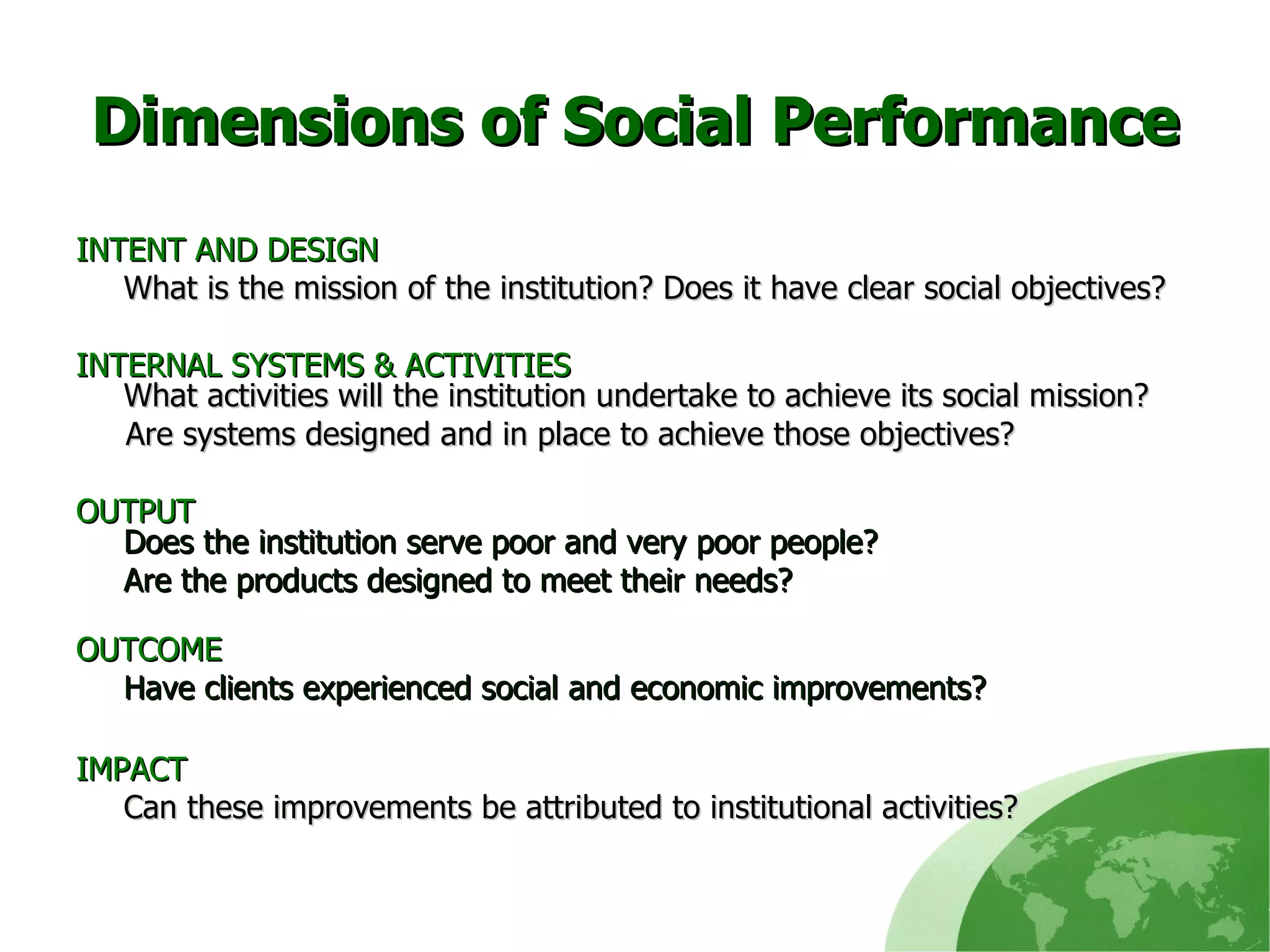
Dimensions of Social Performance INTENT AND DESIGN What is the mission of the institution? Does it have clear social objectives? INTERNAL SYSTEMS & ACTIVITIES What activities will the institution undertake to achieve its social mission? Are systems designed and in place to achieve those objectives? OUTPUT Does the institution serve poor and very poor people? Are the products designed to meet their needs?  OUTCOME Have clients experienced social and economic improvements? IMPACT Can these improvements be attributed to institutional activities?
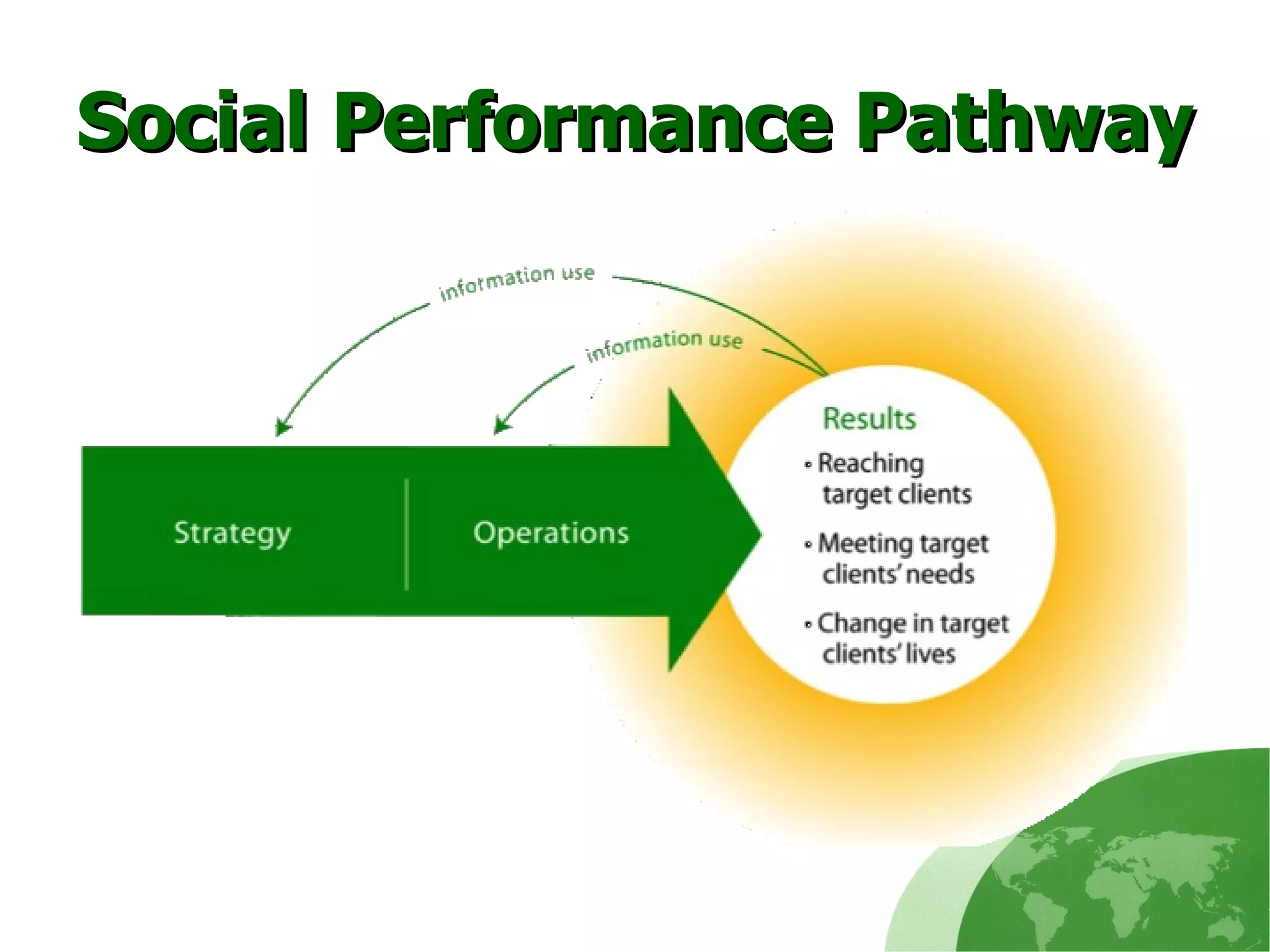
Social Performance Pathway
Social Performance is defined in terms of both processes and results Translating mission into practice is a deliberate and intentional process Desired change in the lives of clients is the goal of this process and it is not automatic
Social Performance Management The process of translating mission into practice, including setting social objectives, tracking Social Performance, and using information to improve practice.
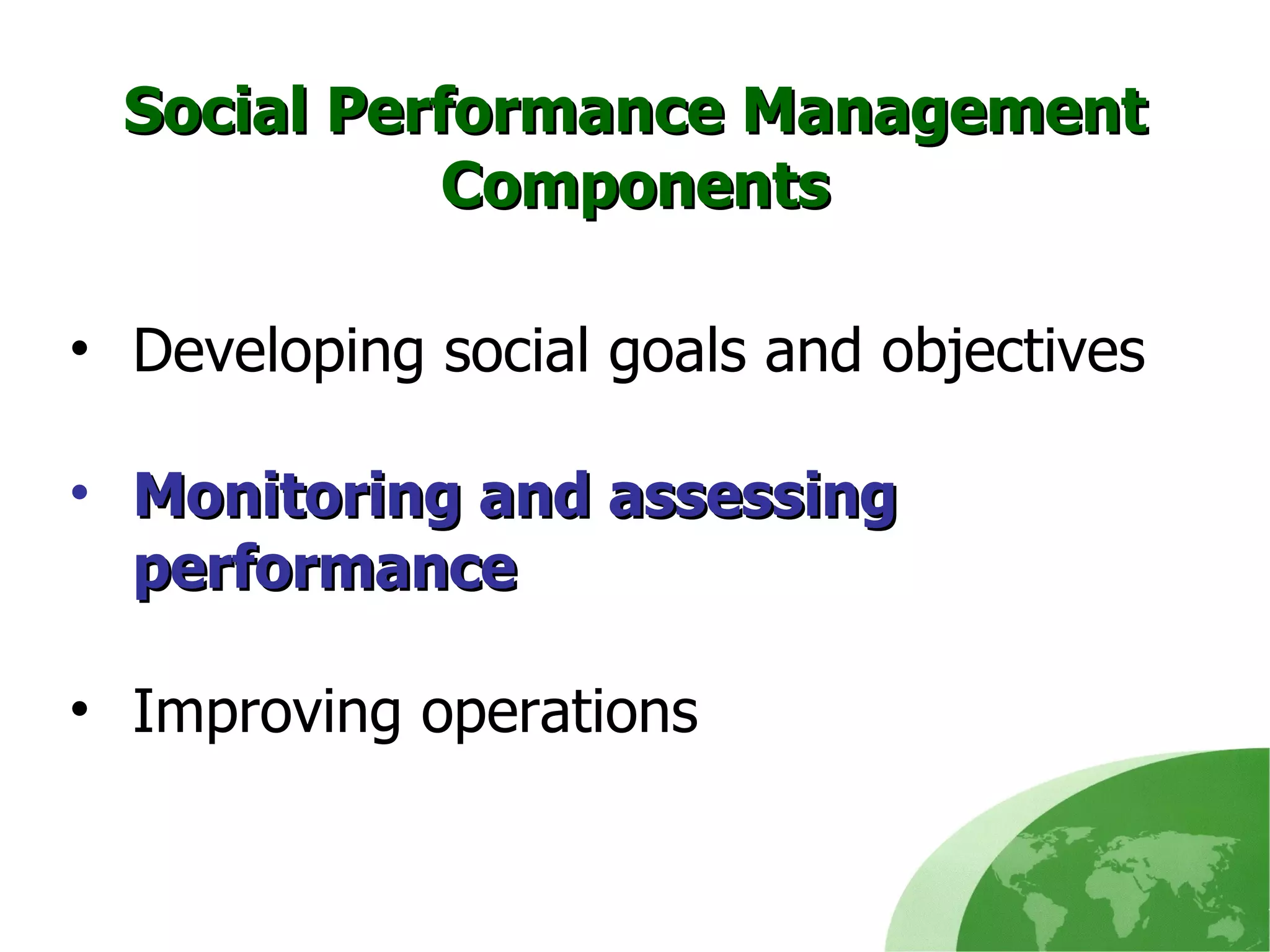
Developing social goals and objectives   Monitoring and assessing performance  Improving operations  Social Performance Management Components
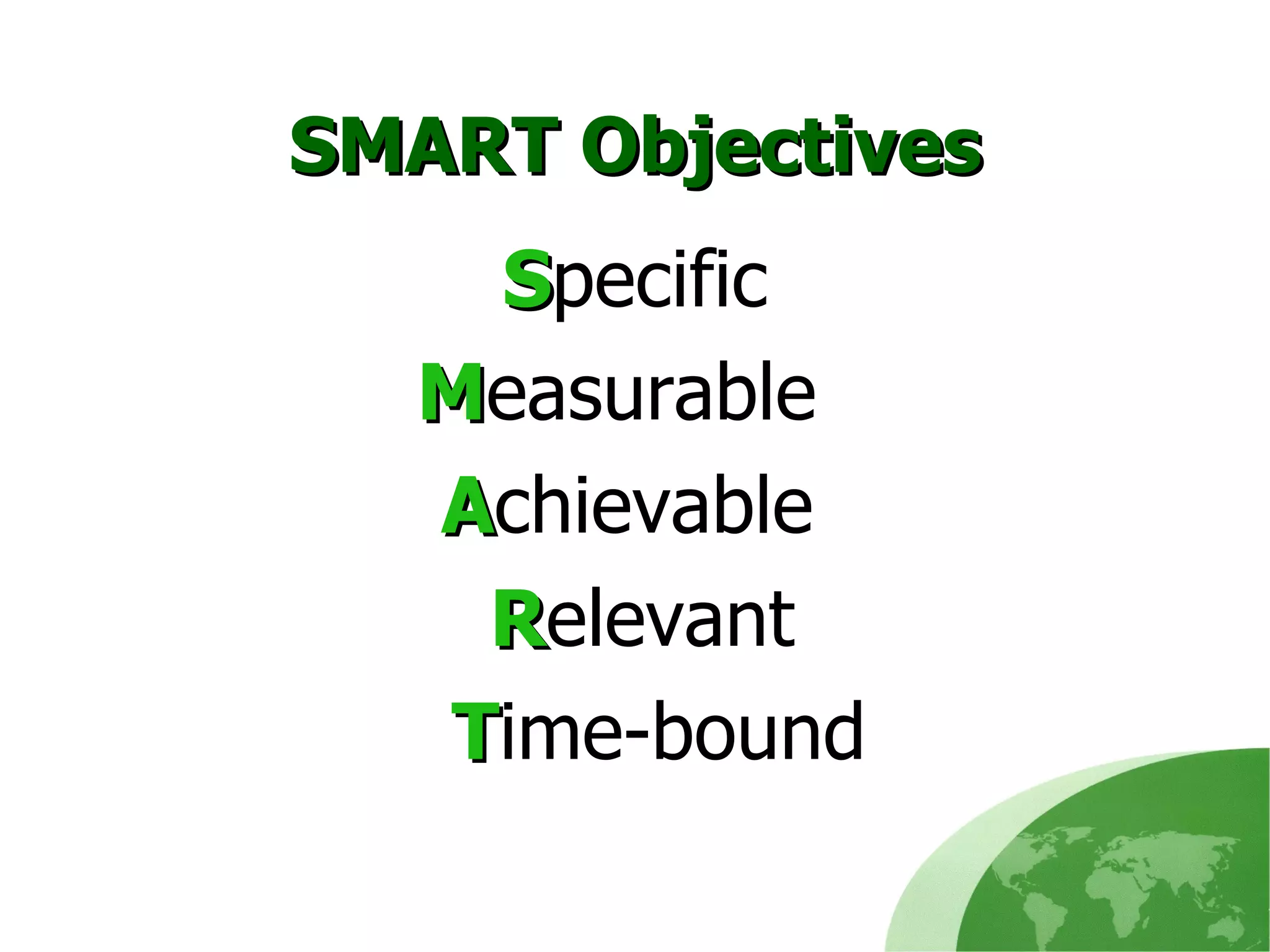
SMART Objectives S pec if ic M easurable A chievable R elevant   T ime-bound
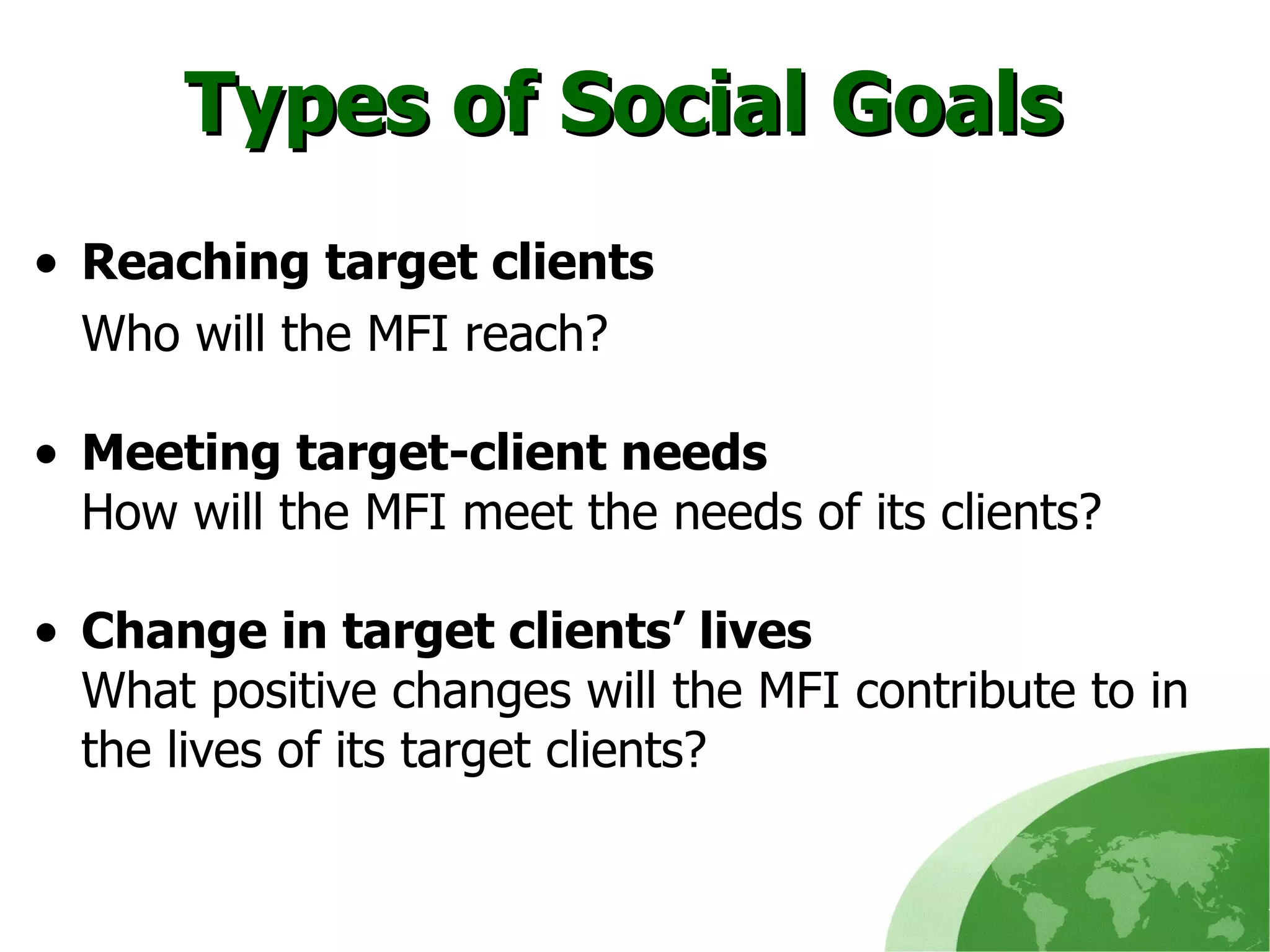
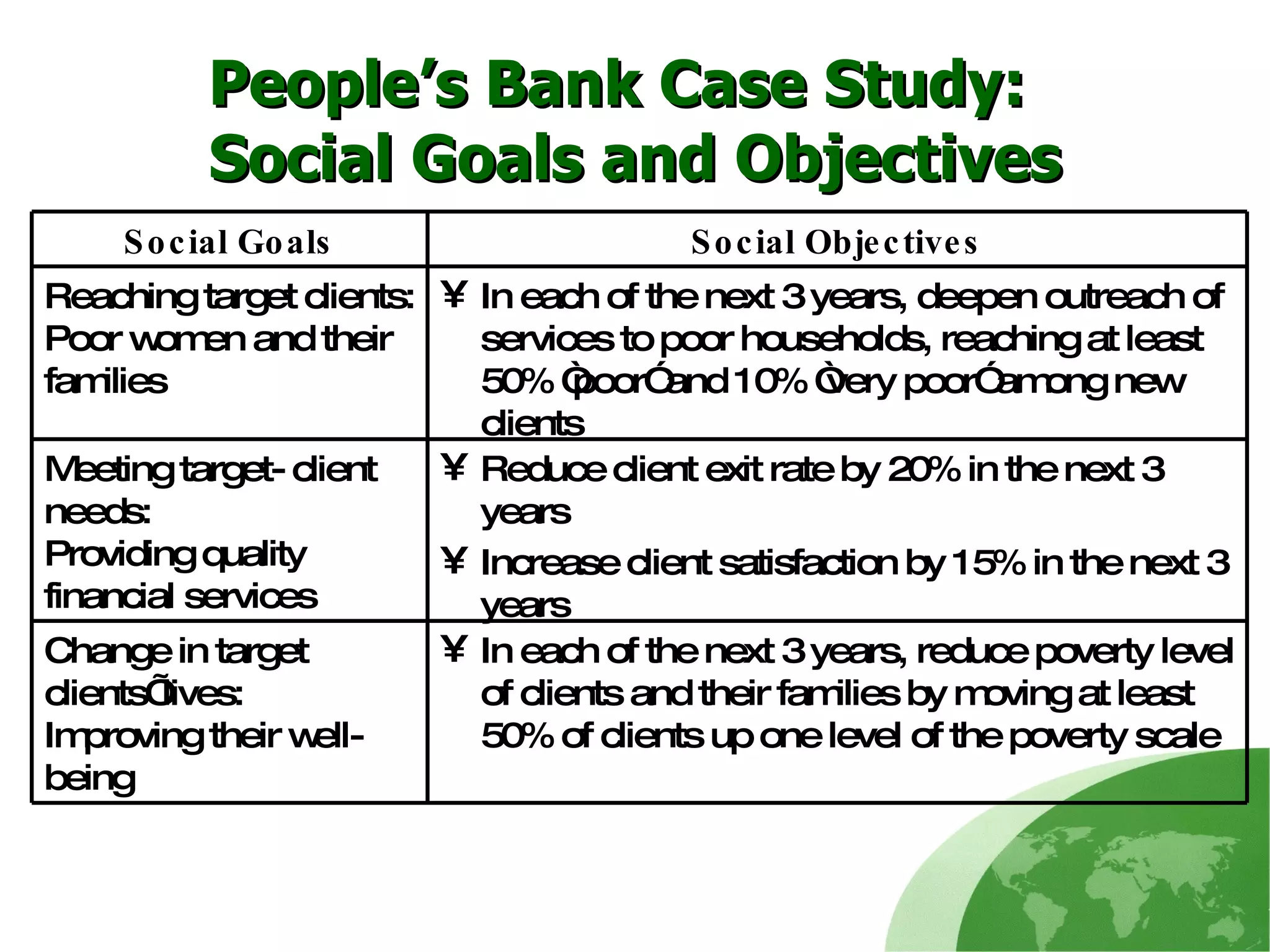
Types of Social Goals  Reaching target clients Who will the MFI reach? Meeting target-client needs How will the MFI meet the needs of its clients? Change in target clients’ lives What positive changes will the MFI contribute to in the lives of its target clients?
People’s Bank Case Study:  Social Goals and Objectives In each of the next 3 years, reduce poverty level of clients and their families by moving at least 50% of clients up one level of the poverty scale Change in target clients’ lives:  Improving their well-being  Reduce client exit rate by 20% in the next 3 years  Increase client satisfaction by 15% in the next 3 years  Meeting target- client needs: Providing quality financial services  In each of the next 3 years, deepen outreach of services to poor households, reaching at least 50% “poor” and 10% “very poor” among new clients  Reaching target clients: Poor women and their families  Social Objectives Social Goals
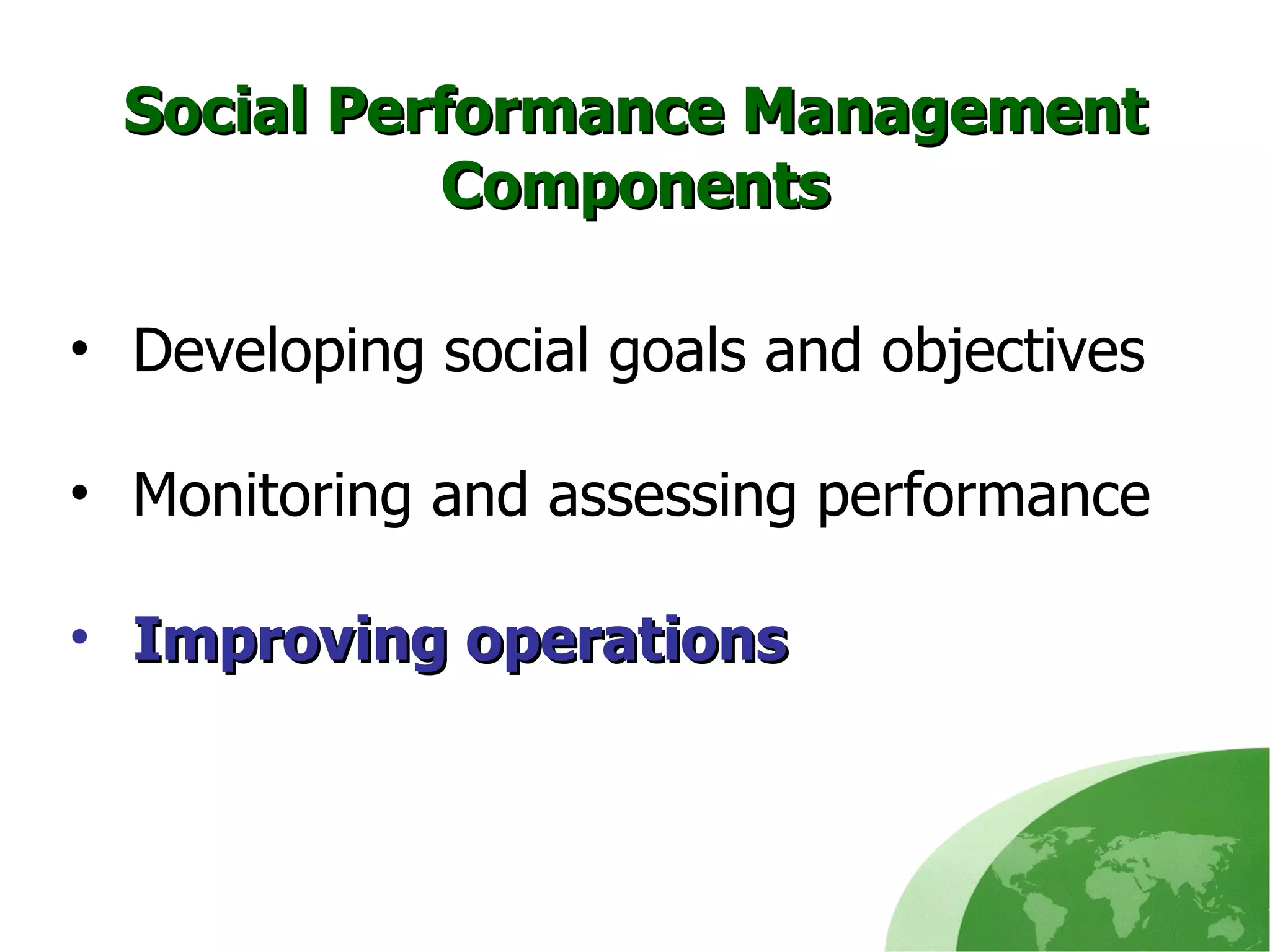
Developing social goals and objectives  Monitoring and assessing performance   Improving operations  Social Performance Management Components
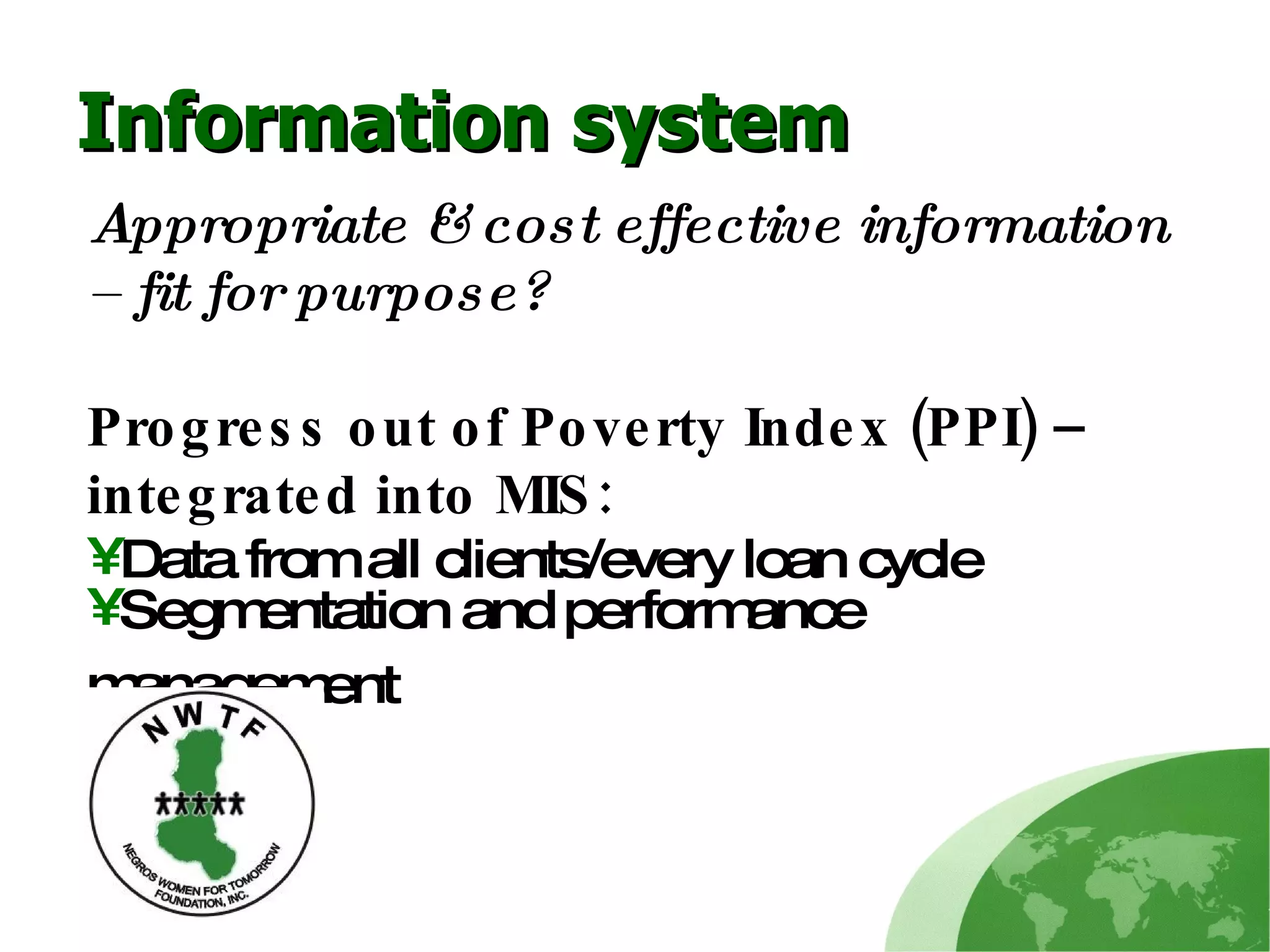
Information system Appropriate & cost effective information – fit for purpose? Progress out of Poverty Index (PPI) – integrated into MIS: Data from all clients/every loan cycle Segmentation and performance management
Developing social goals and objectives  Monitoring and assessing performance  Improving operations  Social Performance Management Components
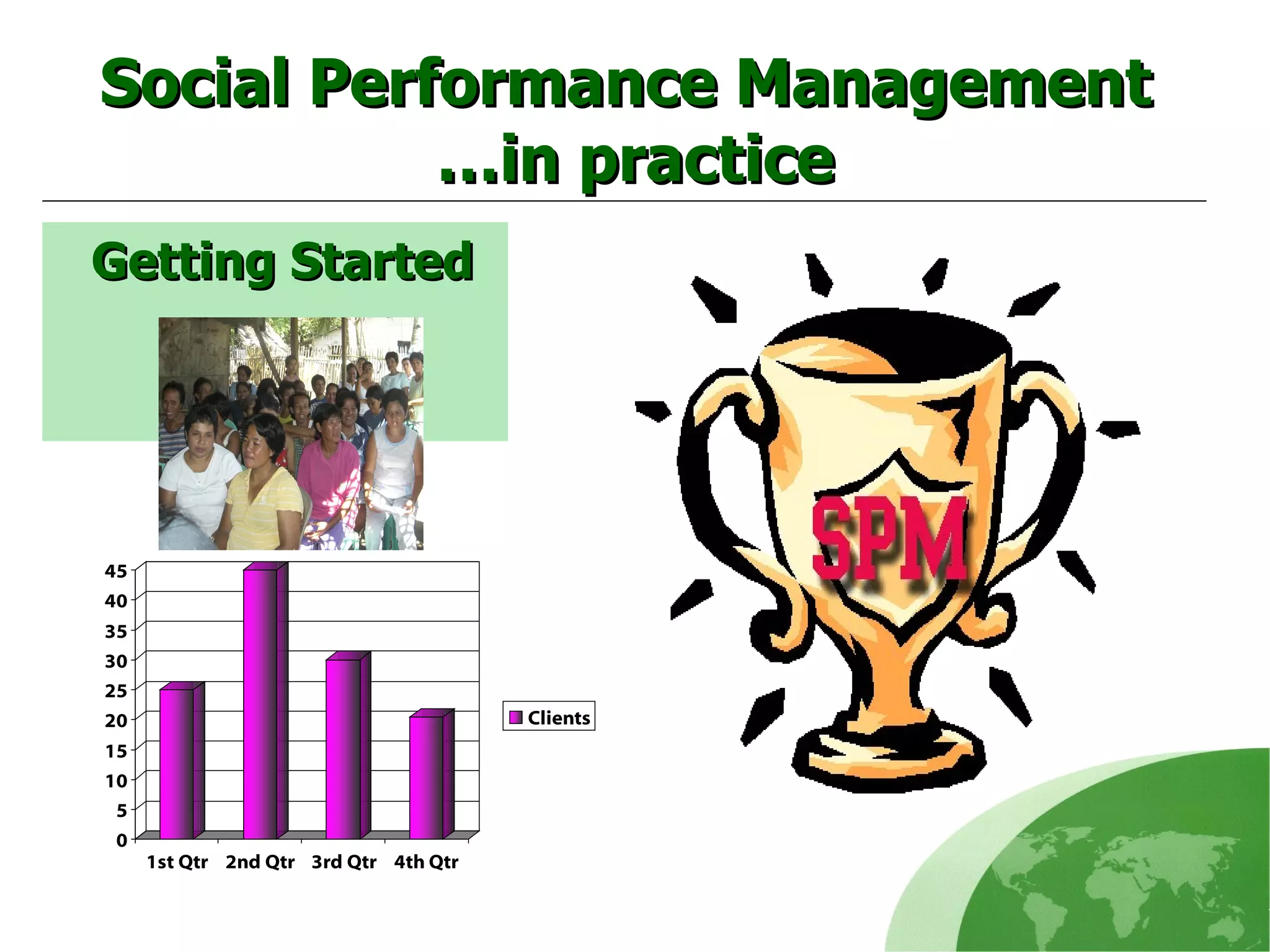
Social Performance Management  …in practice Getting Started
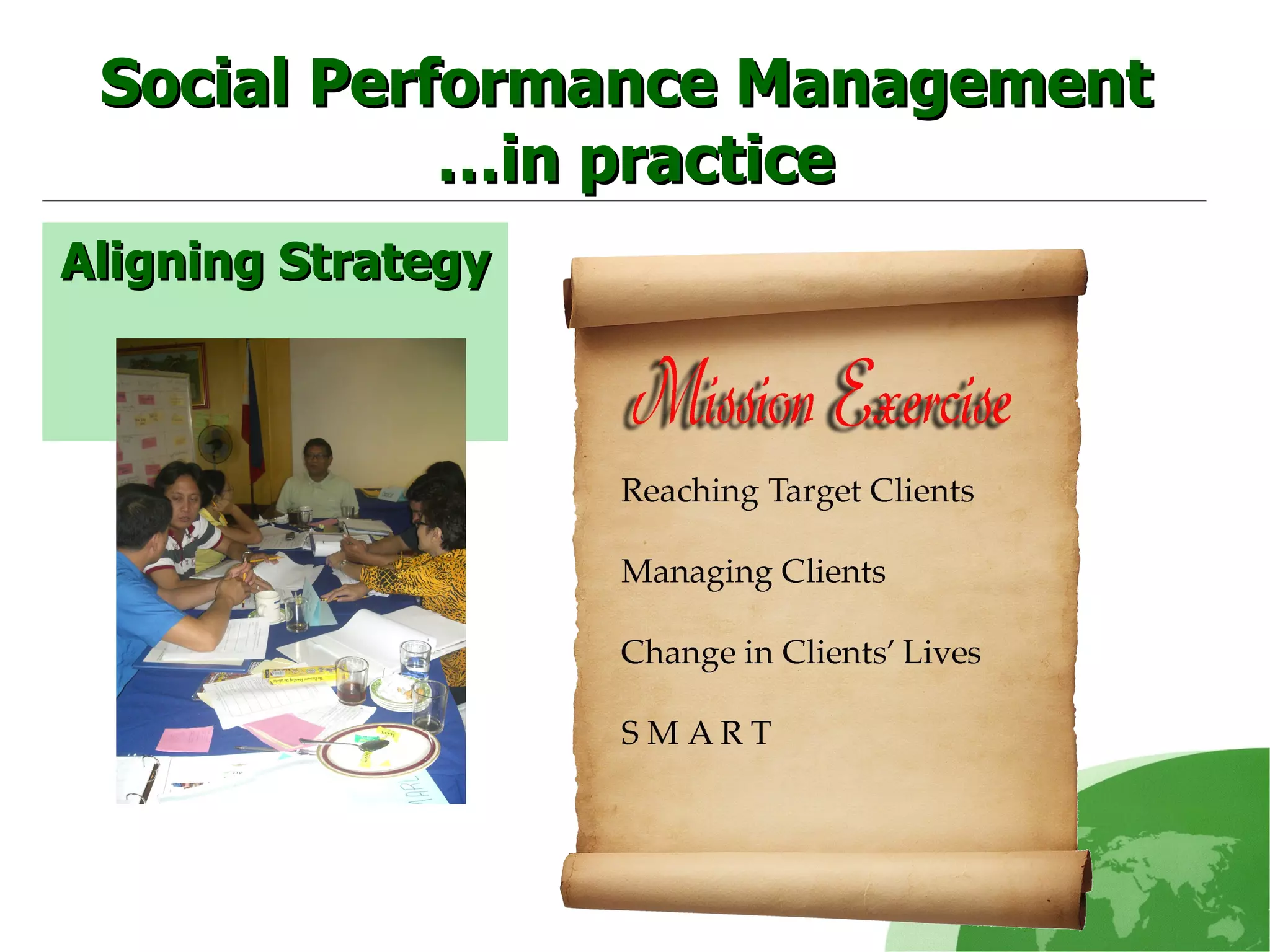
Social Performance Management  …in practice Aligning Strategy
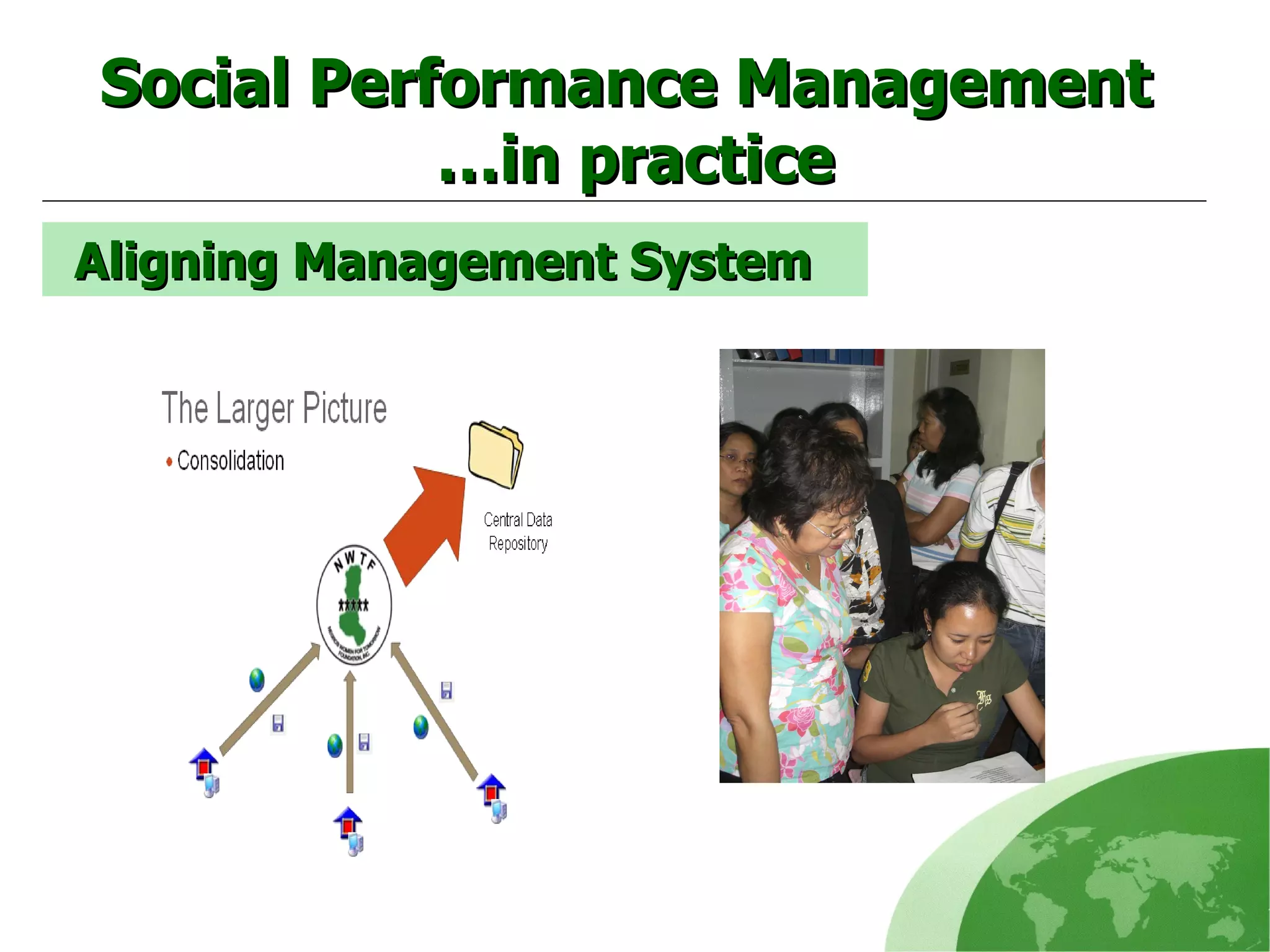
Social Performance Management  …in practice Aligning Management System
Leadership and culture Does ‘passion for mission’ compensate for lack of systems? Organisational leadership and culture is key Commitment and leadership is not enough –  needs to be systematised Many of partners have strong founder-   leaders
Social Performance Management (SPM):   …what are the benefits? and what are the costs?
Benefits… More appropriate products and services for clients Better service for clients Higher retention of clients Program growth Lower operational costs Demonstrate Social Performance to  external stakeholders
Costs… The cost of what? Management processes Information systems Product development: (Health protection: $15,000) Mini-surveys: Costs part of operations Monitoring: Costs part of operations Market research (Health protection: $3,000) Impact assessments: $4,500; $20,000
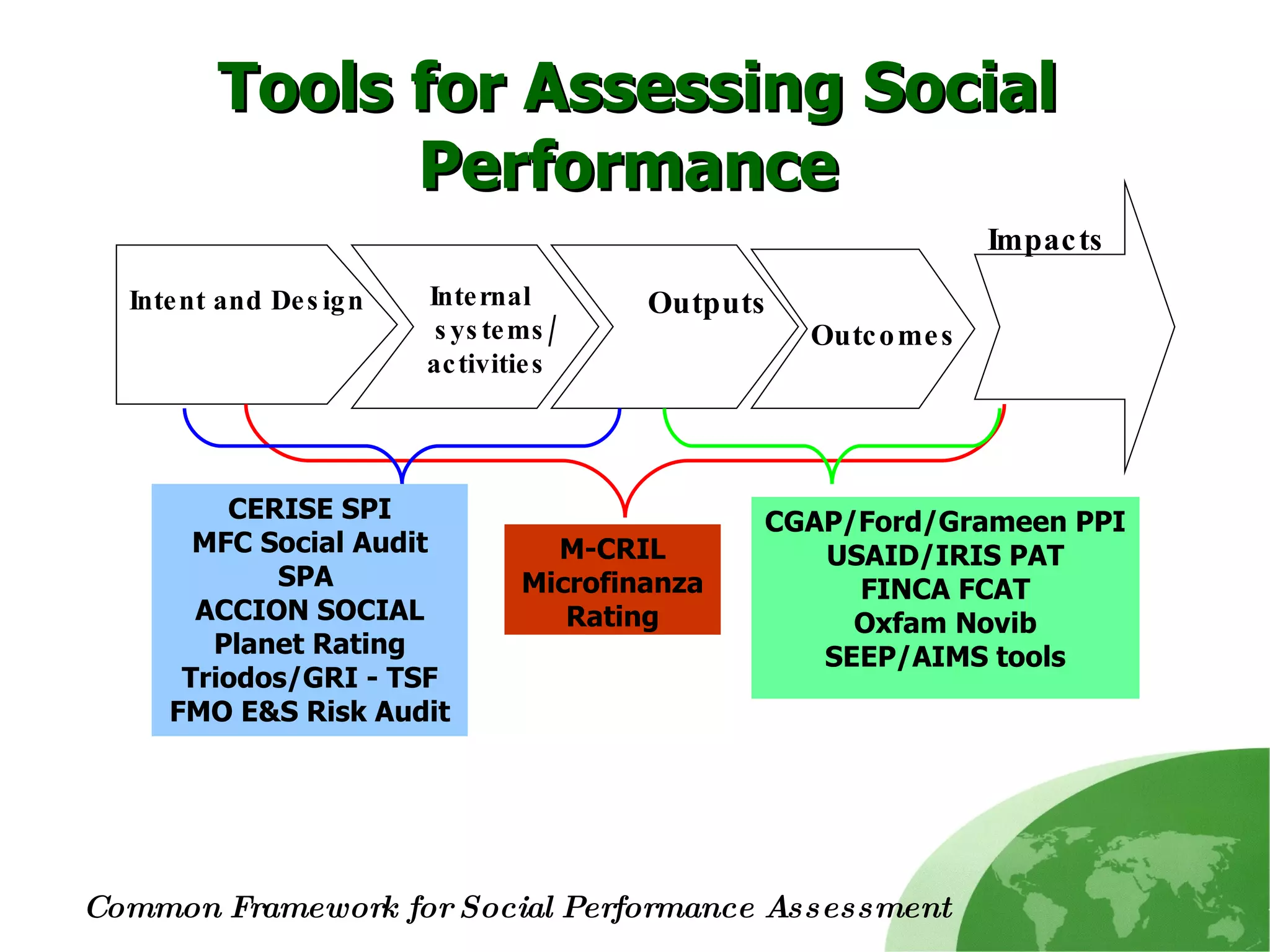
Tools for Assessing Social Performance  Intent and Design Internal  systems/  activities Outputs Outcomes Impacts CERISE SPI MFC Social Audit SPA  ACCION SOCIAL Planet Rating Triodos/GRI - TSF FMO E&S Risk Audit M-CRIL Microfinanza Rating CGAP/Ford/Grameen PPI USAID/IRIS PAT FINCA FCAT Oxfam Novib SEEP/AIMS tools Common Framework for Social Performance Assessment
 

Putting the ‘Social’ into Performance Management in Microfinance

  • 1.
    Putting the ‘Social’into Performance Management in Microfinance Lalaine M. Joyas Microfinance Council of the Philippines, Inc. (MCPI) PACAP Microfinance Development Forum 30 January 2009
  • 2.
    Broader context… Increasinglycommercial approach to microfinance Professionalization of the sector Focus on social performance : Has it been lost ? Is it taken for granted ? Is there “mission drift ”?
  • 3.
    Social Performance Theeffective translation of one’s social mission into practice, in line with accepted social values that relate to… reaching poorer and excluded clients; improving the lives of clients and their families; widening the range of opportunities for communities.
  • 4.
    The SP CommonFramework Context Country and regional development indicators (from secondary sources) Microfinance institution profile and financial services Process: Policies and Strategies Social performance management (SPM)—mission clarity; alignment of systems; decision making Social responsibility—to clients (SR-CL), including, where applicable, gender approach (GA), member governance (MG), non-financial services (NFS) to community (SR-Cm); to staff (SR-St); and to environment (SR-Env), from lenders to small enterprises Results: Achievement of Social Goals (SG) Outreach (SG-Or): Depth and breadth, may include hired (non-family) employment) Financial services (SG-Sv): Variety, appropriateness, and transparency Change (SG-Ch): Outcomes and impact
  • 5.
    Social Performance FrameworkIntent and Design Internal Systems & Activities Output Outcome/Impact
  • 6.
    Dimensions of SocialPerformance INTENT AND DESIGN What is the mission of the institution? Does it have clear social objectives? INTERNAL SYSTEMS & ACTIVITIES What activities will the institution undertake to achieve its social mission? Are systems designed and in place to achieve those objectives? OUTPUT Does the institution serve poor and very poor people? Are the products designed to meet their needs? OUTCOME Have clients experienced social and economic improvements? IMPACT Can these improvements be attributed to institutional activities?
  • 7.
  • 8.
    Social Performance isdefined in terms of both processes and results Translating mission into practice is a deliberate and intentional process Desired change in the lives of clients is the goal of this process and it is not automatic
  • 9.
    Social Performance ManagementThe process of translating mission into practice, including setting social objectives, tracking Social Performance, and using information to improve practice.
  • 10.
    Developing social goalsand objectives Monitoring and assessing performance Improving operations Social Performance Management Components
  • 11.
    SMART Objectives Spec if ic M easurable A chievable R elevant T ime-bound
  • 12.
    Types of SocialGoals Reaching target clients Who will the MFI reach? Meeting target-client needs How will the MFI meet the needs of its clients? Change in target clients’ lives What positive changes will the MFI contribute to in the lives of its target clients?
  • 13.
    People’s Bank CaseStudy: Social Goals and Objectives In each of the next 3 years, reduce poverty level of clients and their families by moving at least 50% of clients up one level of the poverty scale Change in target clients’ lives: Improving their well-being Reduce client exit rate by 20% in the next 3 years Increase client satisfaction by 15% in the next 3 years Meeting target- client needs: Providing quality financial services In each of the next 3 years, deepen outreach of services to poor households, reaching at least 50% “poor” and 10% “very poor” among new clients Reaching target clients: Poor women and their families Social Objectives Social Goals
  • 14.
    Developing social goalsand objectives Monitoring and assessing performance Improving operations Social Performance Management Components
  • 15.
    Information system Appropriate& cost effective information – fit for purpose? Progress out of Poverty Index (PPI) – integrated into MIS: Data from all clients/every loan cycle Segmentation and performance management
  • 16.
    Developing social goalsand objectives Monitoring and assessing performance Improving operations Social Performance Management Components
  • 17.
    Social Performance Management …in practice Getting Started
  • 18.
    Social Performance Management …in practice Aligning Strategy
  • 19.
    Social Performance Management …in practice Aligning Management System
  • 20.
    Social Performance Management …in practice Aligning Management System
  • 21.
    Leadership and cultureDoes ‘passion for mission’ compensate for lack of systems? Organisational leadership and culture is key Commitment and leadership is not enough – needs to be systematised Many of partners have strong founder- leaders
  • 22.
    Social Performance Management(SPM): …what are the benefits? and what are the costs?
  • 23.
    Benefits… More appropriateproducts and services for clients Better service for clients Higher retention of clients Program growth Lower operational costs Demonstrate Social Performance to external stakeholders
  • 24.
    Costs… The costof what? Management processes Information systems Product development: (Health protection: $15,000) Mini-surveys: Costs part of operations Monitoring: Costs part of operations Market research (Health protection: $3,000) Impact assessments: $4,500; $20,000
  • 25.
    Tools for AssessingSocial Performance Intent and Design Internal systems/ activities Outputs Outcomes Impacts CERISE SPI MFC Social Audit SPA ACCION SOCIAL Planet Rating Triodos/GRI - TSF FMO E&S Risk Audit M-CRIL Microfinanza Rating CGAP/Ford/Grameen PPI USAID/IRIS PAT FINCA FCAT Oxfam Novib SEEP/AIMS tools Common Framework for Social Performance Assessment
  • 26.

Editor's Notes

  • #2 Can be started by asking the following questions: When you go back to your MFIs, what do you usually expect from loan officers? For Donors: what do you expect from organizations whom you have given your grants with? Answers. Outreach Ask but how clients do cope with loans? Do they pay loans out of loans from other people (resorting back to “5-6”) Do they choose being hungry for them to pay loans? Then begin with SPM…
  • #3 - Is your institution a case like this (look at the slide) – imbalance between money and people  social
  • #9 So what have we learned so far...?
  • #11 The first component of Social Performance Management is to develop social goals and objectives.
  • #12 When defining social objectives, it is important to apply the SMART principle.
  • #13 To manage the SPM process, an MFI must first define in specific terms the results that it wants to achieve. Earlier we identified the 3 common types of results that all MFIs seek to achieve. These results represent the social goals that can be traced back directly to the organization’s mission. Social goals are a broad description of what you want to achieve. You can extract these social goals from the mission by asking these specific questions. <…refer to slide…>
  • #14 <…read slide…> If you want to deliberately manage Social Performance, you need to develop specific objectives for each social goal. Without SMART objectives, you have no specific information against which to measure your progress and, therefore, it would be difficult to know whether or not you are achieving your mission. Perhaps this is where your MFI is now. However, if objectives are SMART, they are more easy to manage because they are clear. Objectives are specific accomplishments that must be realized to achieve social goals. They represent achievements along the Social Performance Pathway that indicate progress towards the changes envisioned for your clients. Sometimes more than 1 objective can be linked to the same goal.  
  • #15 The first component of Social Performance Management is to develop social goals and objectives.
  • #17 The first component of Social Performance Management is to develop social goals and objectives.
  • #18 Not serving the targeted clients (case of NWTF) based on PPI Identifying of an SPM Champion –Case of CARD, CMEDFI, PBC, NWTF and other members of the SPM Working Group Donors: SPM begins as a requirement case of Oikocredit
  • #19 Not serving the targeted clients (case of NWTF) based on PPI Identifying of an SPM Champion –Case of CARD, CMEDFI, PBC, NWTF and other members of the SPM Working Group Donors: SPM begins as a requirement case of Oikocredit
  • #20 Not serving the targeted clients (case of NWTF) based on PPI Identifying of an SPM Champion –Case of CARD, CMEDFI, PBC, NWTF and other members of the SPM Working Group Donors: SPM begins as a requirement case of Oikocredit
  • #21 Not serving the targeted clients (case of NWTF) based on PPI Identifying of an SPM Champion –Case of CARD, CMEDFI, PBC, NWTF and other members of the SPM Working Group Donors: SPM begins as a requirement case of Oikocredit
  • #22 Organizational leadership and focus – strong Social Performance focus Commitment and leadership not enough – easy to say institution is strong in terms of social responsibility, but there are no policies to translate this commitment.
  • #24 Social Performance Management provides many benefits, including the following: Ability to segment the market and correct the design of products and services for target clientele. – for better service for clients and improve retention of clients. Ability to adjust delivery methods or the prices of products and services to better meet the preferences of any given segment. Information to pilot a new product in response to demand. Ability to have more consistent, timely and accurate reporting. Better mechanisms for internal control and efficiency --- leading to lower operational costs. Ability to manage multiple products and increase outreach. Ability of branches to monitor branch and loan officer performance, portfolio quality and/or other organizational or client information --- in order to manage and achieve program growth Ability to serve the needs of target clients more effectively, which can lead to greater competitiveness. Be able to demonstrate social performance to external stakeholders, such as funders, donors, networks, policy makers.
  • #26 What this slide is telling you is that when managing and assessing Social Performance, there are tools available. Along the Social Performance Pathway, there are tools that MFIs can adopt and use. But it is important to remember that as we talk about tools and indicators, we need to USE the information that is collected with these tools to improve practice. Assessing is not the end goal of social performance – improving practice is…so how do we take the information we learn and do something with it?
  • #27 SPM wants to achieve the balance. Going back to the very essence of Microfinance.