1
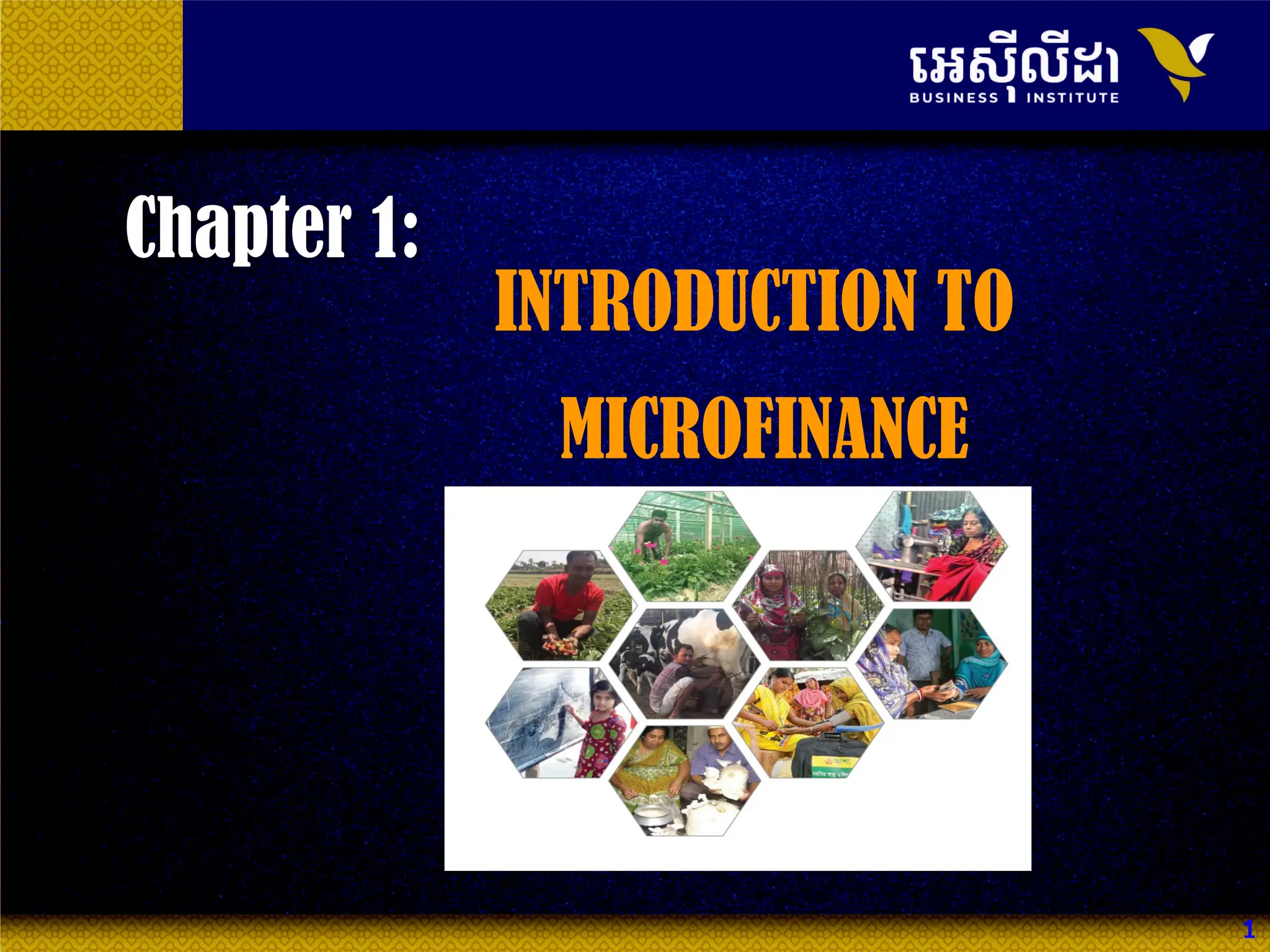
INTRODUCTION TO
MICROFINANCE
Chapter 1:
2
 Define what microfinance is.
LEARNING OUTCOME
By the end of the course, students will be able to
 Explain microfinance background.
 Describe how microfinance has developed in Cambodia.
 Recognize the challenges of microfinance in Cambodian.
 Explain the impact of microfinance on poverty reduction.
Microfinance Definition
Background of Microfinance
1
2
4
3
5
CONTENTS
Development of Cambodian Microfinance
Challenges of Microfinance Industry
Microfinance and Poverty Reduction.
CONTEN
TS
3
4
I. Microfinance Definition
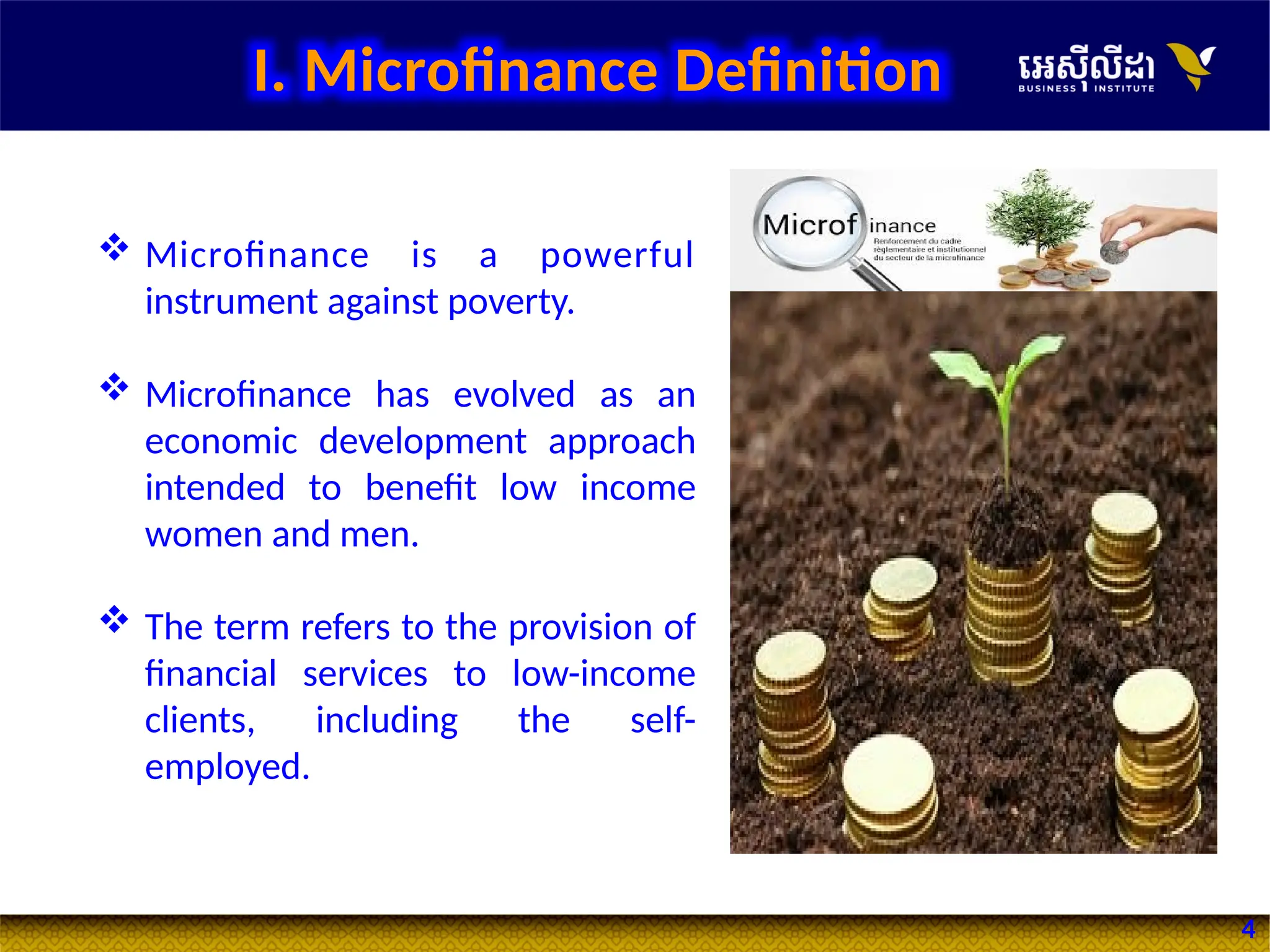
 Microfinance is a powerful
instrument against poverty.
 Microfinance has evolved as an
economic development approach
intended to benefit low income
women and men.
 The term refers to the provision of
financial services to low-income
clients, including the self-
employed.
5
Financial Intermediation Social Intermediation
 Savings;
 Credit;
 Insurance;
 Payment services.
 Group formation;
 Developmentofself-confidence;
 Training in financial literacy;
 Management capabilities
among members of a group.
The definition of microfinance often includes both financial intermediation
and social intermediation.
The main idea seems straightforward: micro = really small, so
microfinance is financial service in small amounts for poor
people.
I. Microfinance Definition
6
Microcredit Microfinance
 Only, provide credit services
to the poor.
 Provide credit and other
additional financial services
such as savings, insurance,
payment services etc., to the
poor.
The terms Microcredit and Microfinance are often used interchangeably,
but it is important to highlight the difference between them.
I. Microfinance Definition
7
 Microfinance activities initiated by the government agencies in
the following beliefs:
- The people have no pervious access to credit facilities.
- The people had been forced to pay usurious interest rate.
- The people were subject to rent seeking behaviors.
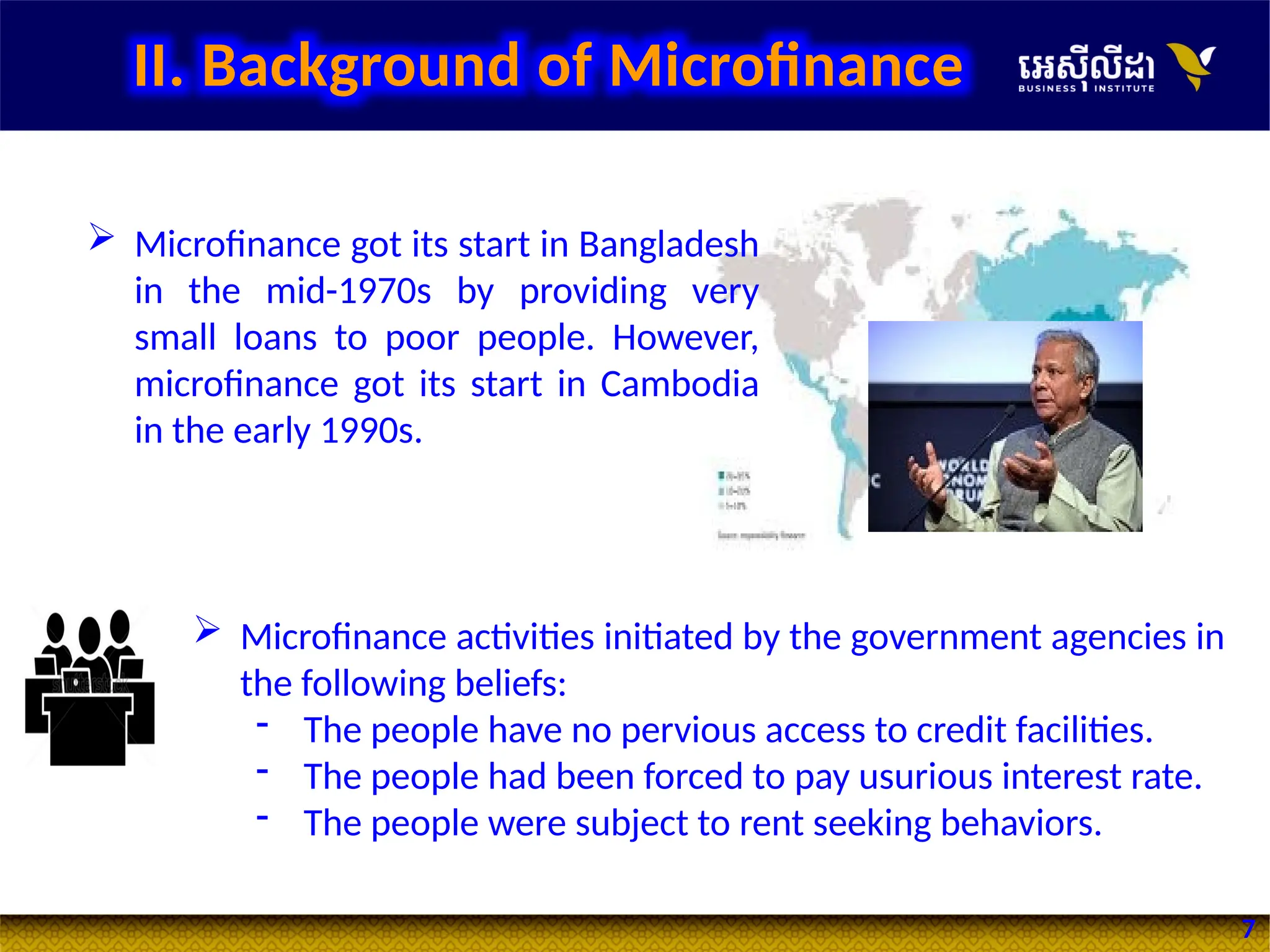
 Microfinance got its start in Bangladesh
in the mid-1970s by providing very
small loans to poor people. However,
microfinance got its start in Cambodia
in the early 1990s.
II. Background of Microfinance
8
 Since then Governments worked with international donors to
provide the poor microfinance services such as cheap credit
and subsidized credit in the purpose of promoting agricultural
production.
 Additionally donors set up credit unions by applying the
Reiffeisen model developed in Germany in 1864. The model
focus not only credit but also on savings mobilization in rural
areas in an attempt to teach poor famers how to save.
II. Background of Microfinance
9
 Governments and donors were not successful in microfinance
operation because most programs accumulated large loan losses
and required frequent recapitalization to continue operating.
 Due to the failure of governments and donors, it became more
and more evident that market-based solution were required.
Local NGOs began to look for a more long-term approach than
the unsustainable income generation approaches to community
development.
 In Asia, Dr. Mohammad Yunus of Bangladesh led the way with a
pilot group lending scheme for landless people which later
became the Grameen Bank is the model for many countries.
 Other successful microfinance model developed a solidarity
group in Latin America ACCION International and developed a
successful credit and training system for individual micro-
entrepreneurs.
II. Background of Microfinance
10
 Since the 1980s the field of microfinance has grown
substantially. Donors actively support and encourage
microfinance activities that are committed to achieving
substantial outreach and financial sustainability.
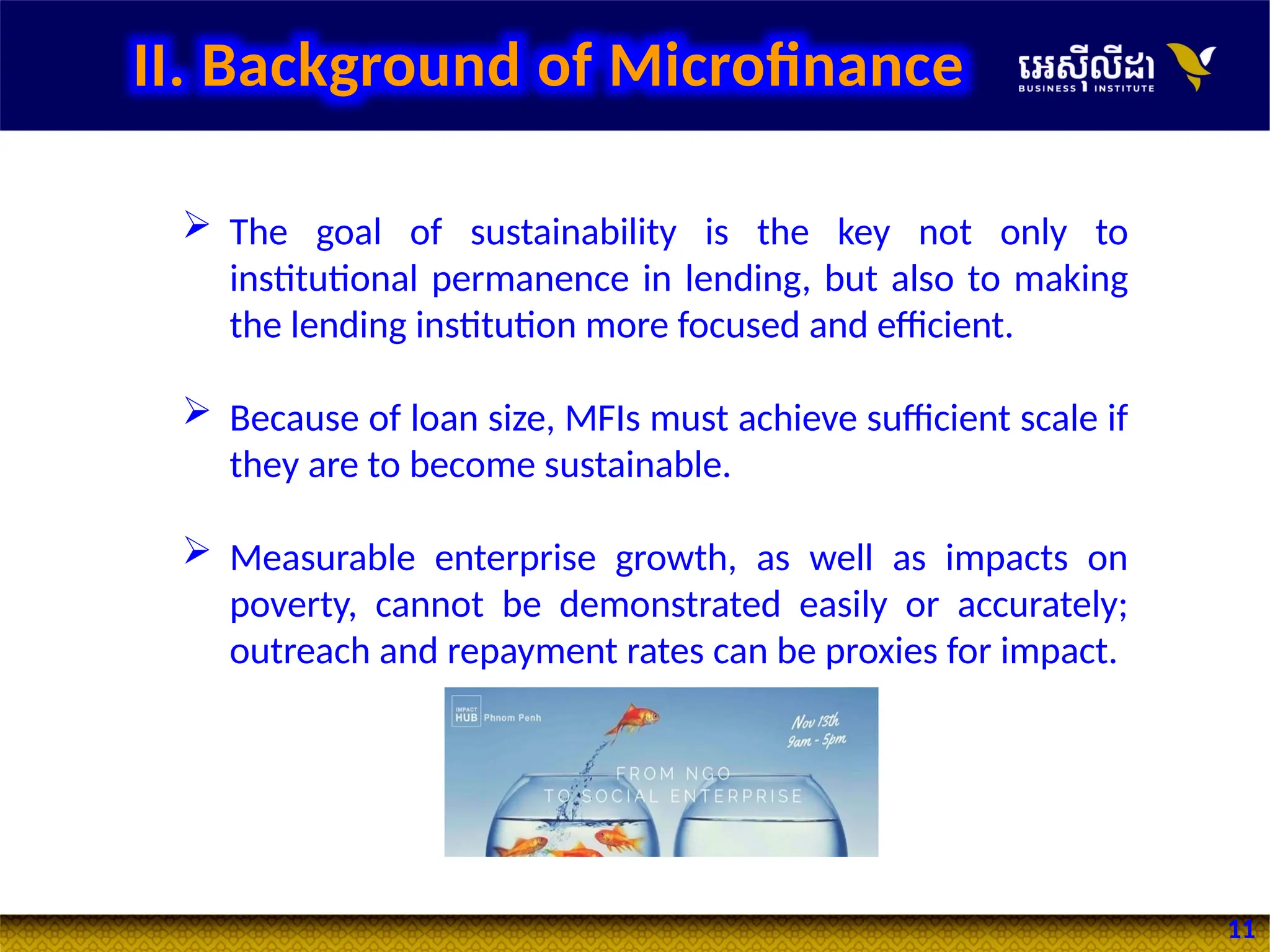
 For instance, microfinance NGOs have begun transforming
into formal financial institutions that recognize the need to
provide savings services to their clients and to access market
funding sources, rather than rely on donor funds.
 The transformation is indicated by the following beliefs:
 Subsidized credit undermines development.
 Poor people can pay interest rates high enough to
cover transaction costs and the consequences of the
imperfect information markets in which lenders
operate.
II. Background of Microfinance
11
 The goal of sustainability is the key not only to
institutional permanence in lending, but also to making
the lending institution more focused and efficient.
 Because of loan size, MFIs must achieve sufficient scale if
they are to become sustainable.
 Measurable enterprise growth, as well as impacts on
poverty, cannot be demonstrated easily or accurately;
outreach and repayment rates can be proxies for impact.
II. Background of Microfinance
12
III. Development of Microfinance
in Cambodia
Before 1990: Limited Financial Service
 Financial services were only provided by commercial
banks in Cambodia’s urban centers.
 Cambodians typically relied on informal money lenders
1990-1995: The first microcredit seeds are planted
 microfinance emerged in Cambodia from non-profit
microcredit projects initiated by international donors,
NGOs and other institutions such as GRET (1991), World
Relief (1992), ACLEDA and CRS(Catholic Relief Services)
(1993).
 This initiative was lately recognized by the new Cambodia
Government and international aid started to pour into the
country. However, it failed to reach the population on a big
scale .
13
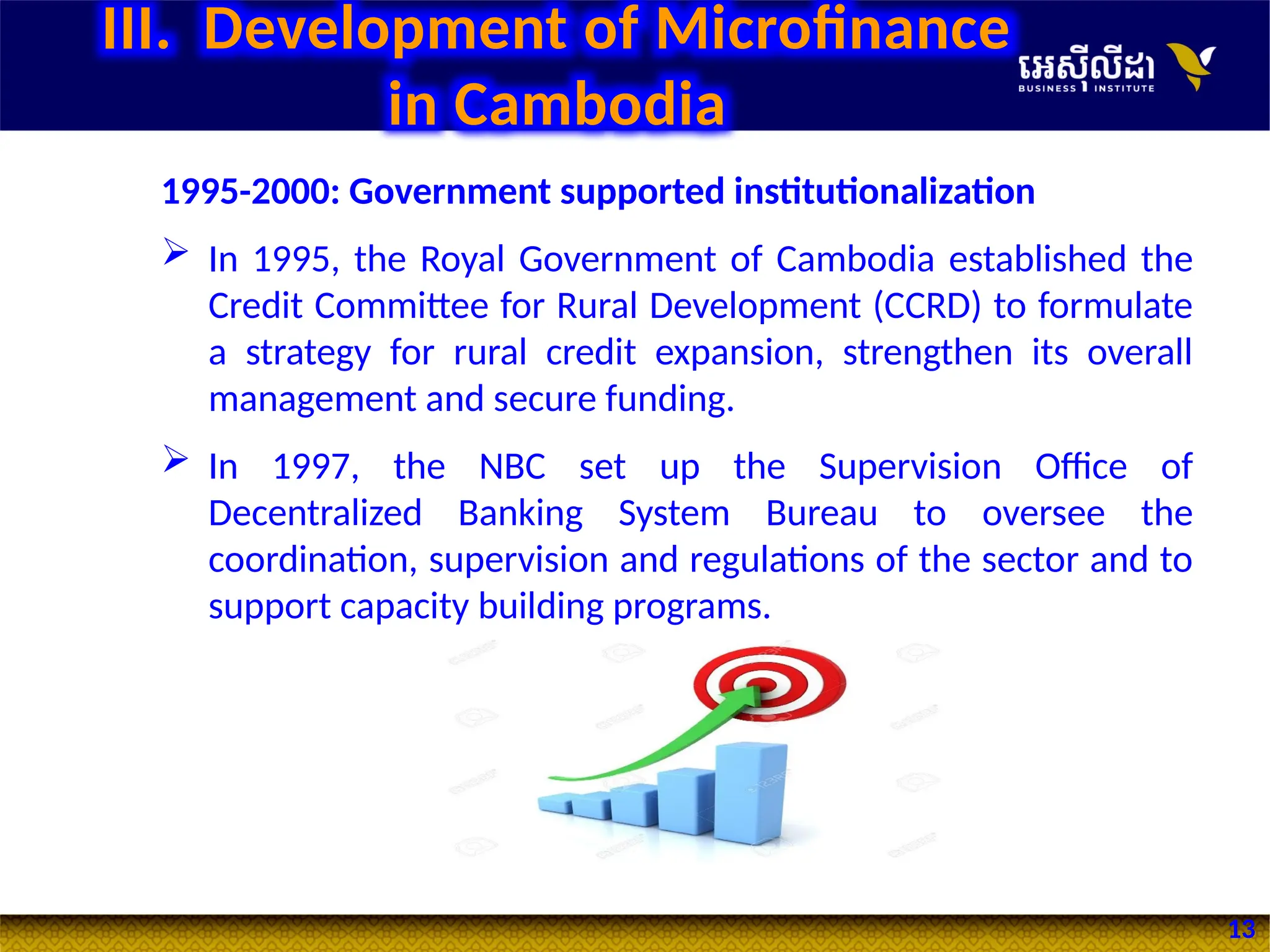
1995-2000: Government supported institutionalization
 In 1995, the Royal Government of Cambodia established the
Credit Committee for Rural Development (CCRD) to formulate
a strategy for rural credit expansion, strengthen its overall
management and secure funding.
 In 1997, the NBC set up the Supervision Office of
Decentralized Banking System Bureau to oversee the
coordination, supervision and regulations of the sector and to
support capacity building programs.
III. Development of Microfinance
in Cambodia
14
2000-2005: Commercialization drives the sector up a notch
 Prakas on microfinance regulation was enacted and
implemented by the NBC.
 the Government support of a free-market economy and a
more stable political environment allowed MFIs to attract an
increasing number of foreign private investors.
 NGOs started to transform into commercial MFIs. This
eventually led to stronger growth of the sector and increased
competition.
 the establishment of CMA by seven MFIs in 2004 encouraged
internal collaboration among the sector’s main actors,
including information sharing and the design of tailored
training programs .
III. Development of Microfinance
in Cambodia
15
2005-2015: Microfinance as an integral economic player
 Established a Credit Information System (CIS) designed to
collect and share negative credit information.
 Eligible MFIs received the authorization to attract deposits
from the general public, which provided MFIs with cheaper
sources of funds primarily in the local currency.
 Cambodia’s credit growth ratio has started to substantially
diverge from a path considered as sustainable.
 In 2015, the number of loans kept on increasing by 13.5% and
the portfolio volume by 39.6% .
III. Development of Microfinance
in Cambodia
16
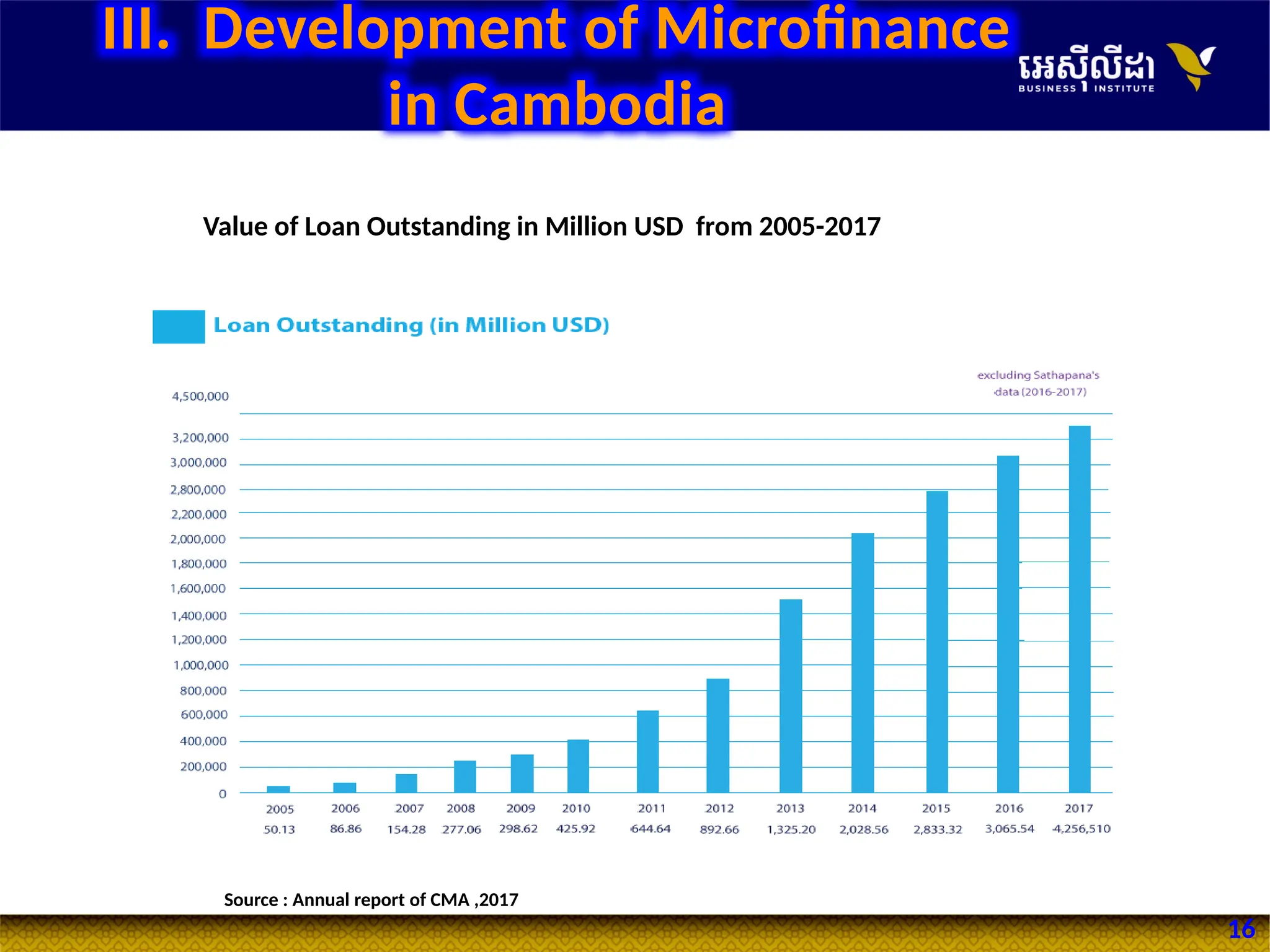
Value of Loan Outstanding in Million USD from 2005-2017
Source : Annual report of CMA ,2017
III. Development of Microfinance
in Cambodia
17
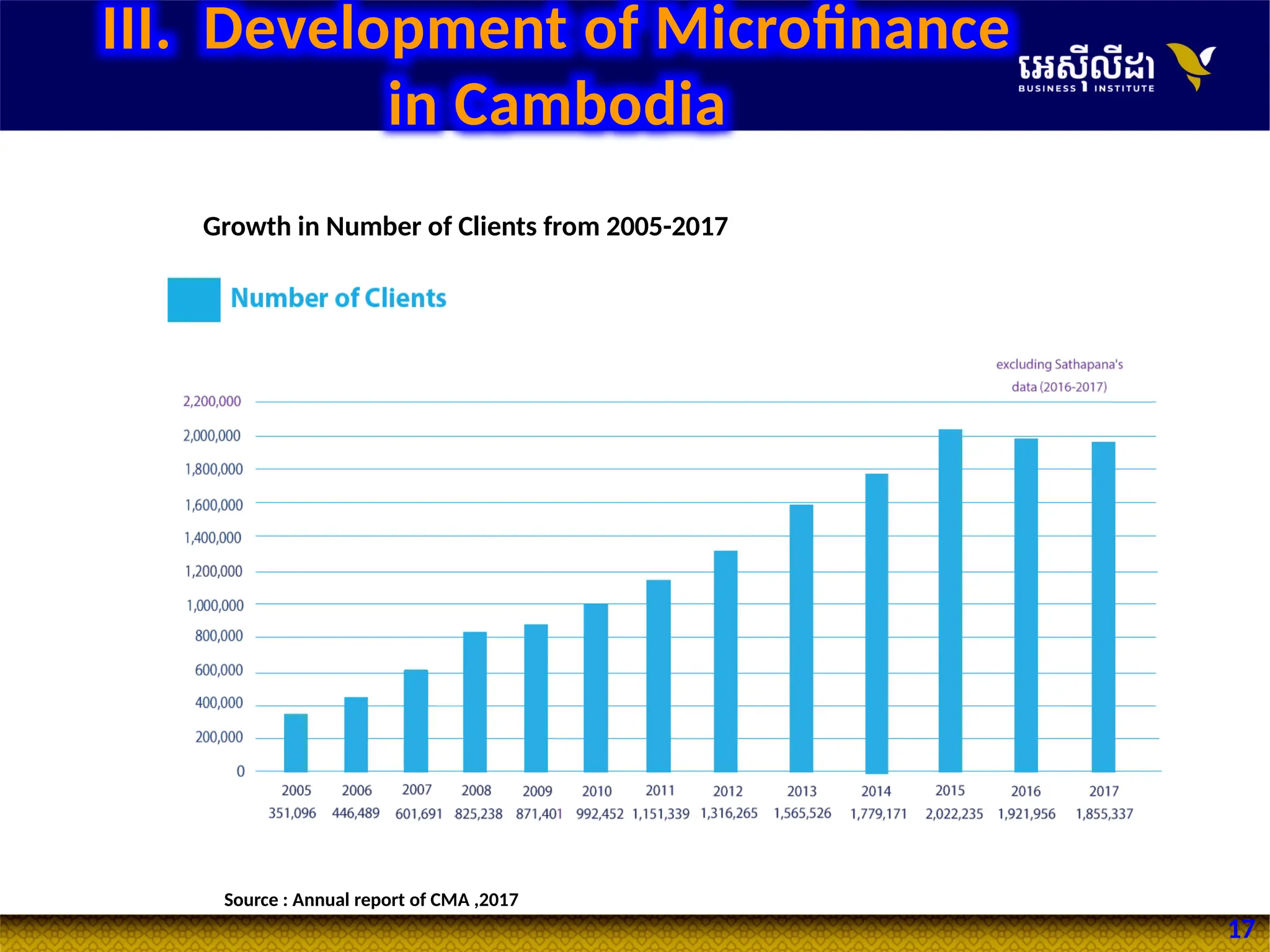
Growth in Number of Clients from 2005-2017
Source : Annual report of CMA ,2017
III. Development of Microfinance
in Cambodia
18
2010 2011 2012 2013 2014 2015 2016
0
10
20
30
40
50
60
70
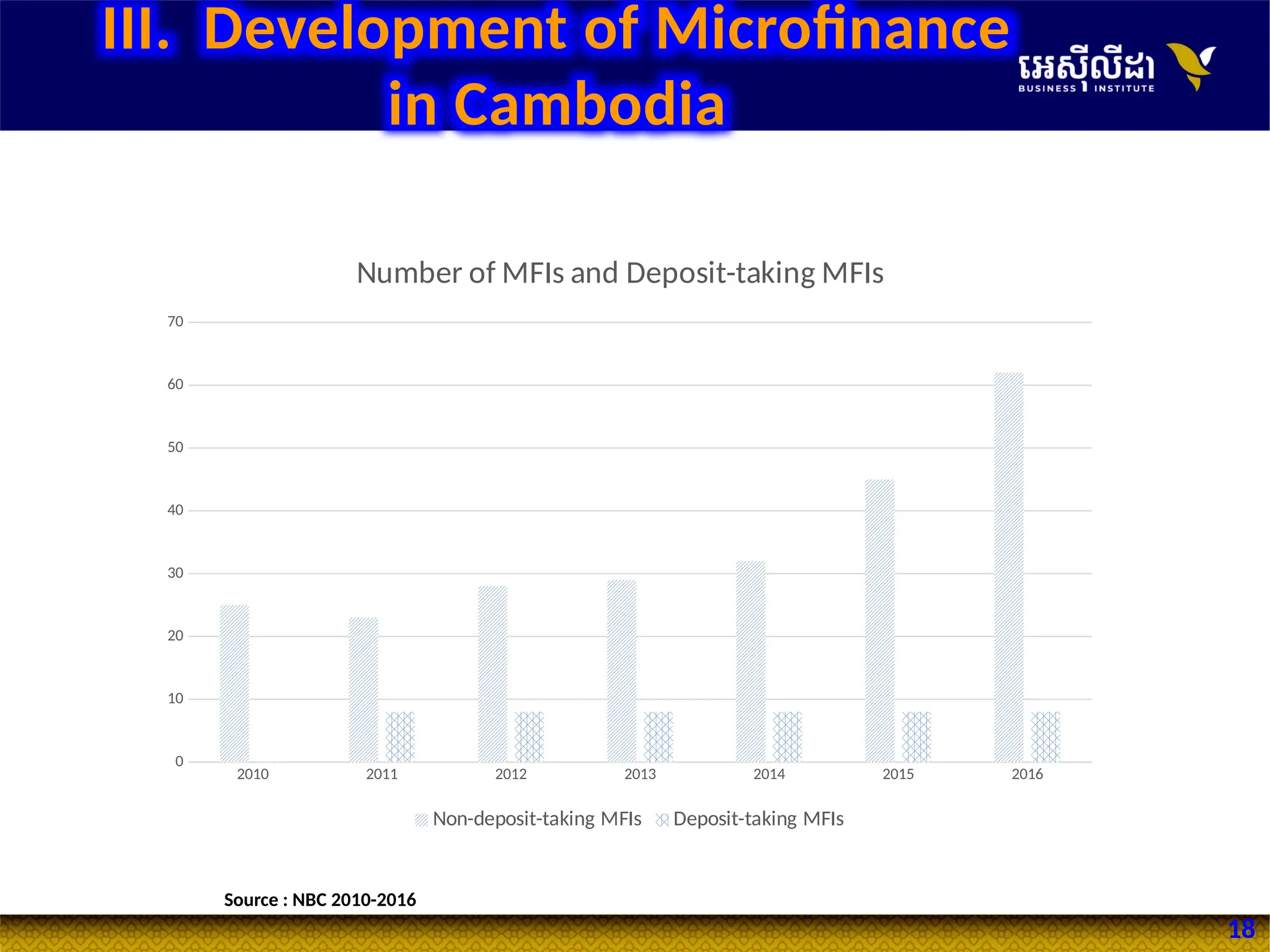
Number of MFIs and Deposit-taking MFIs
Non-deposit-taking MFIs Deposit-taking MFIs
Source : NBC 2010-2016
III. Development of Microfinance
in Cambodia
19
2011 2012 2013 2014 2015 2016
0
500
1000
1500
2000
2500
3000
3500
4000
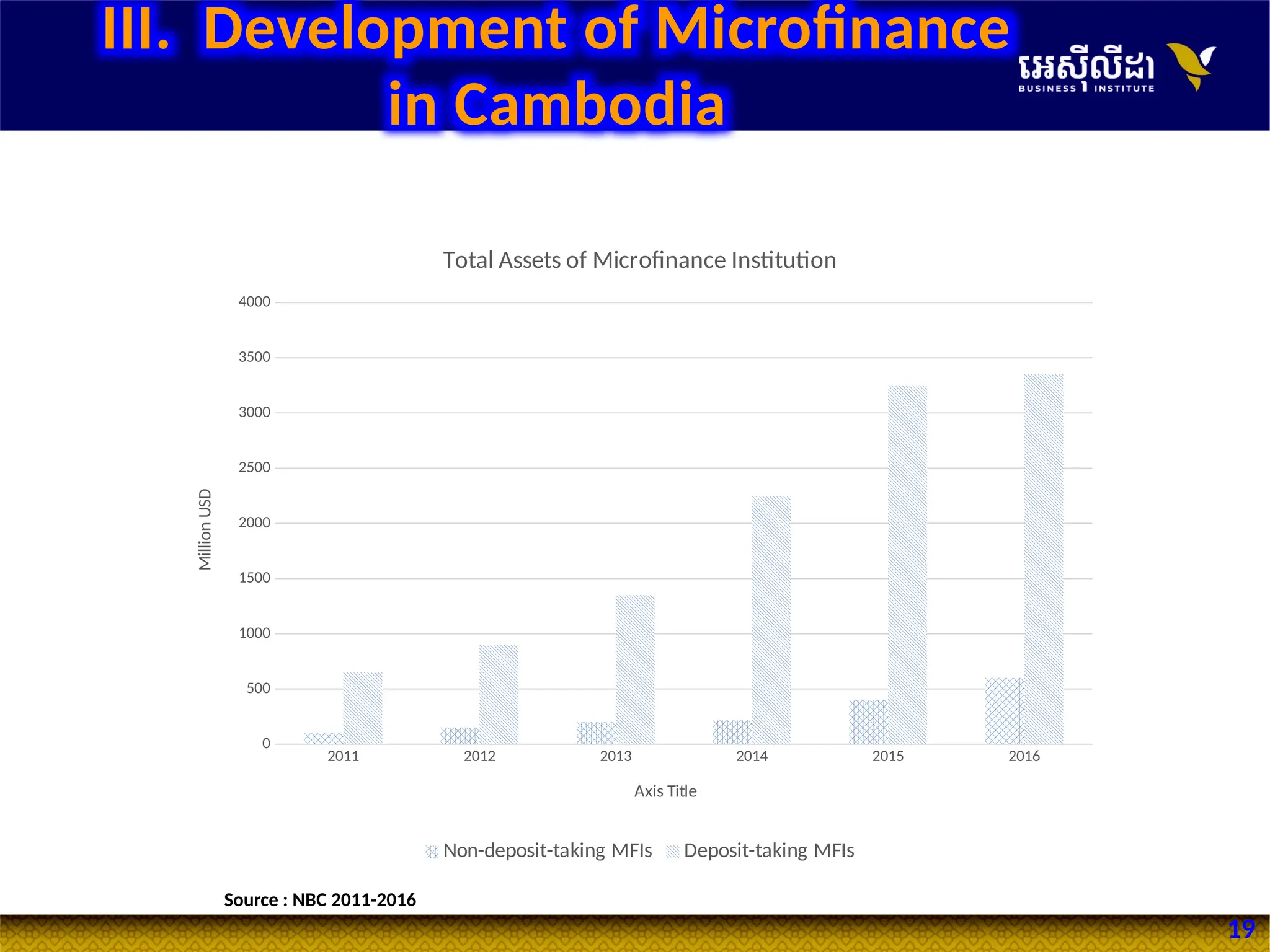
Total Assets of Microfinance Institution
Non-deposit-taking MFIs Deposit-taking MFIs
Axis Title
Million
USD
Source : NBC 2011-2016
III. Development of Microfinance
in Cambodia
20
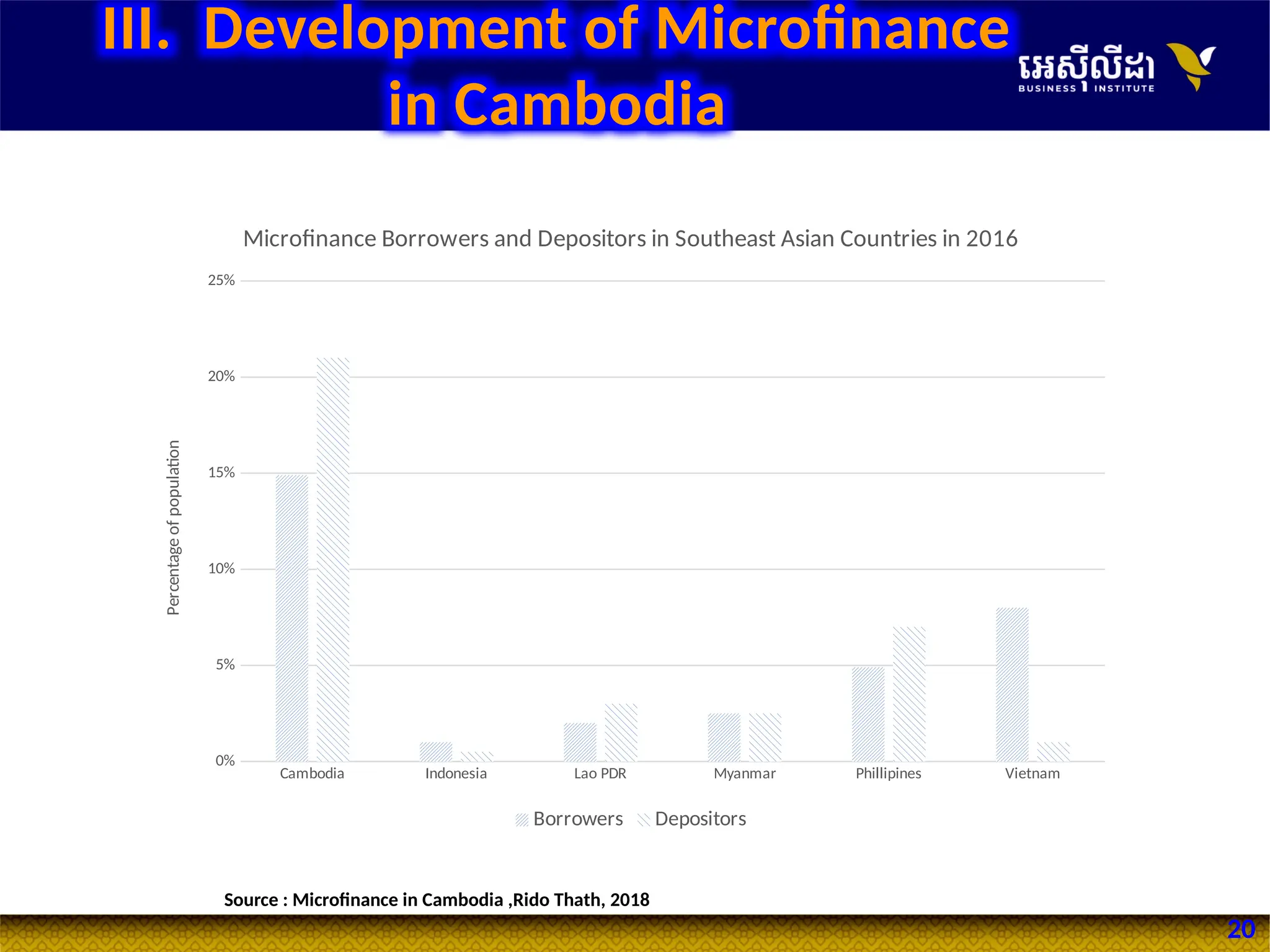
Source : Microfinance in Cambodia ,Rido Thath, 2018
Cambodia Indonesia Lao PDR Myanmar Phillipines Vietnam
0%
5%
10%
15%
20%
25%
Microfinance Borrowers and Depositors in Southeast Asian Countries in 2016
Borrowers Depositors
Percentage
of
population
III. Development of Microfinance
in Cambodia
21
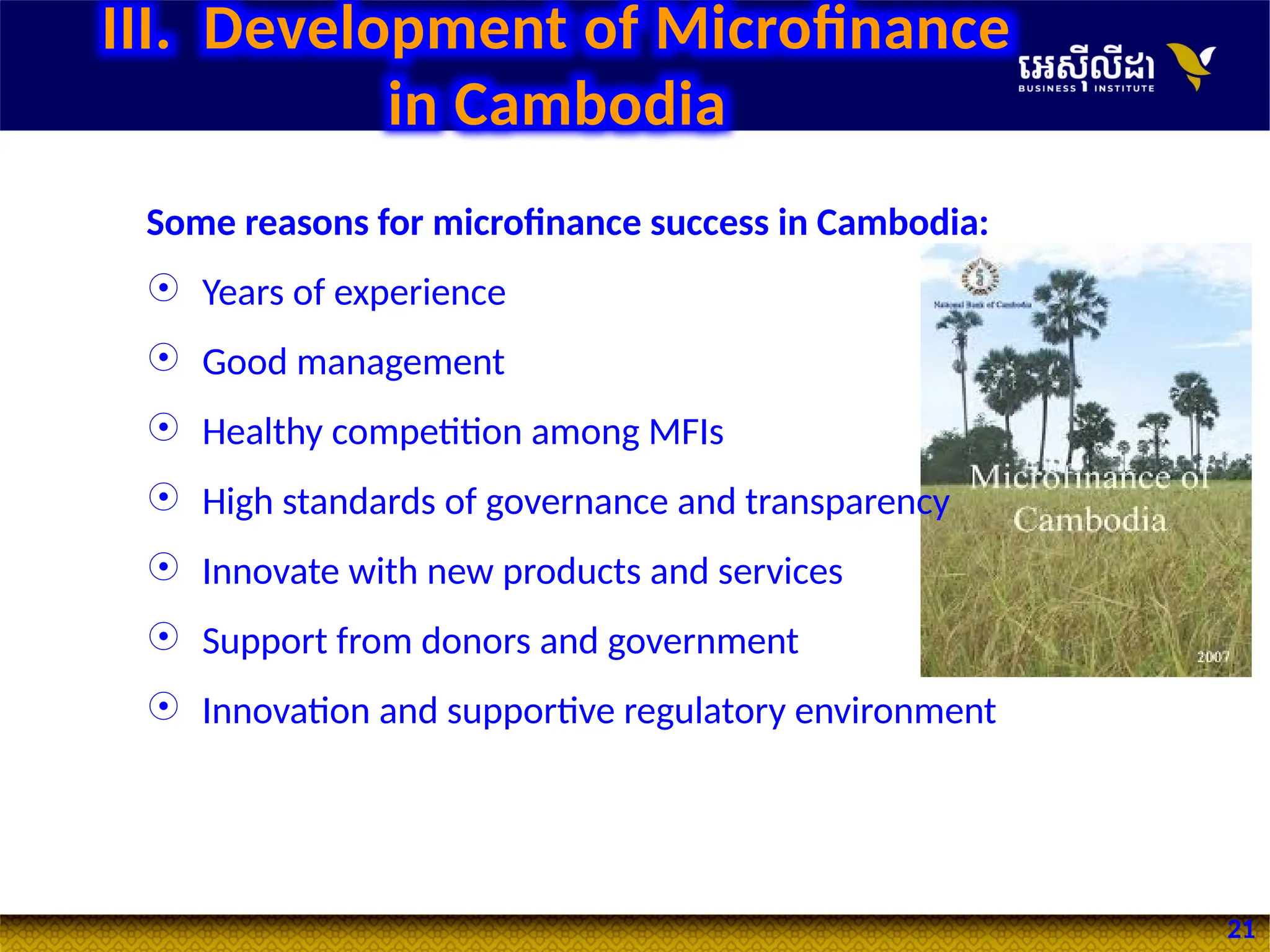
Some reasons for microfinance success in Cambodia:
 Years of experience
 Good management
 Healthy competition among MFIs
 High standards of governance and transparency
 Innovate with new products and services
 Support from donors and government
 Innovation and supportive regulatory environment
III. Development of Microfinance
in Cambodia
22
IV. Challenges of the Microfinance
Industry
Over-indebtedness
 Not scrutinize the creditworthiness
 Multiple borrowing
 Insufficient capacity
 Limited financial literacy
 Education level
Interest cap
 Reduce the availability of small loans
 Unable to access formal microfinance
 Reduce the outreach
 High cost institution
23
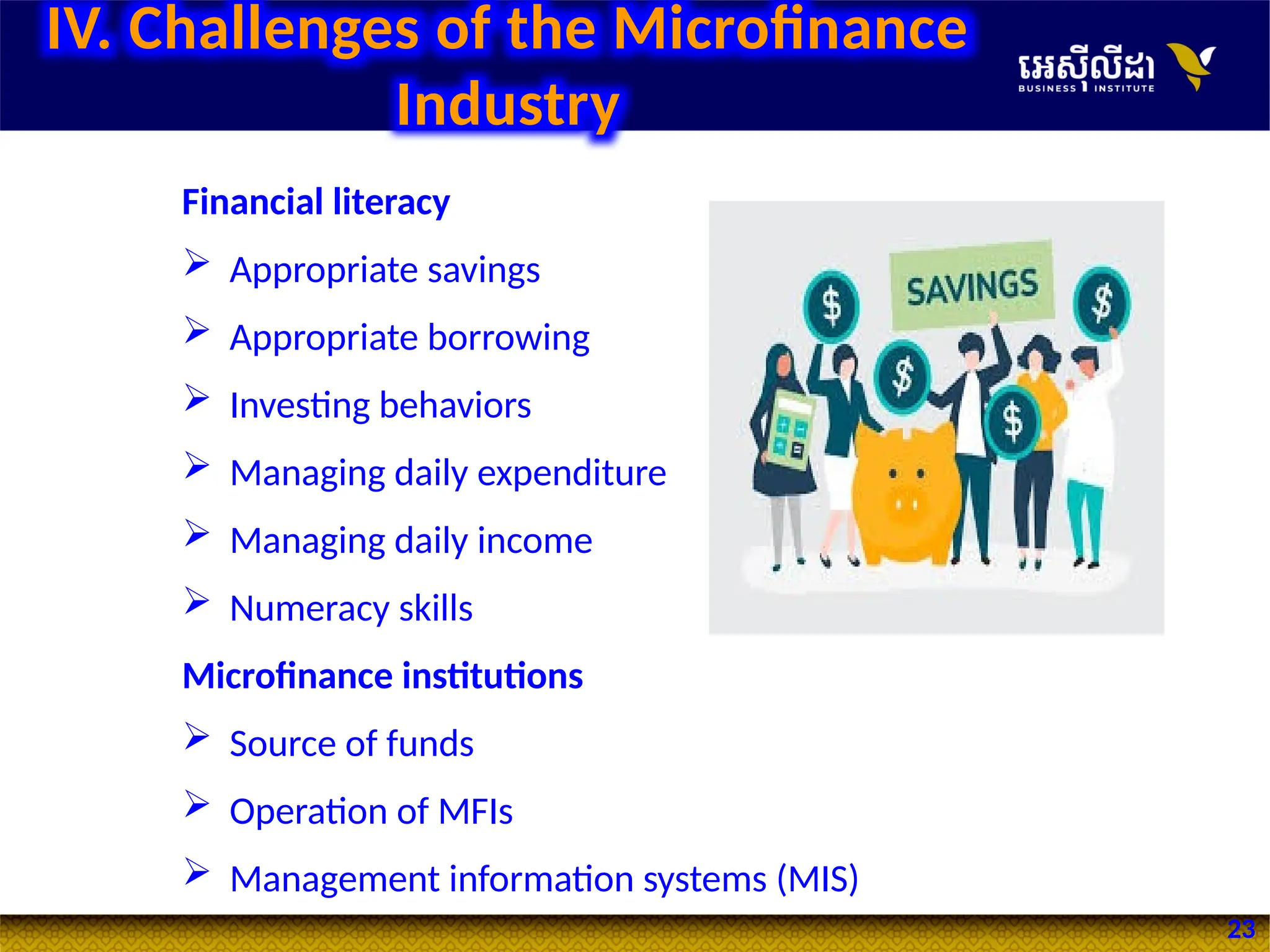
Financial literacy
 Appropriate savings
 Appropriate borrowing
 Investing behaviors
 Managing daily expenditure
 Managing daily income
 Numeracy skills
Microfinance institutions
 Source of funds
 Operation of MFIs
 Management information systems (MIS)
IV. Challenges of the Microfinance
Industry
24
V. Microfinance and Poverty Reduction
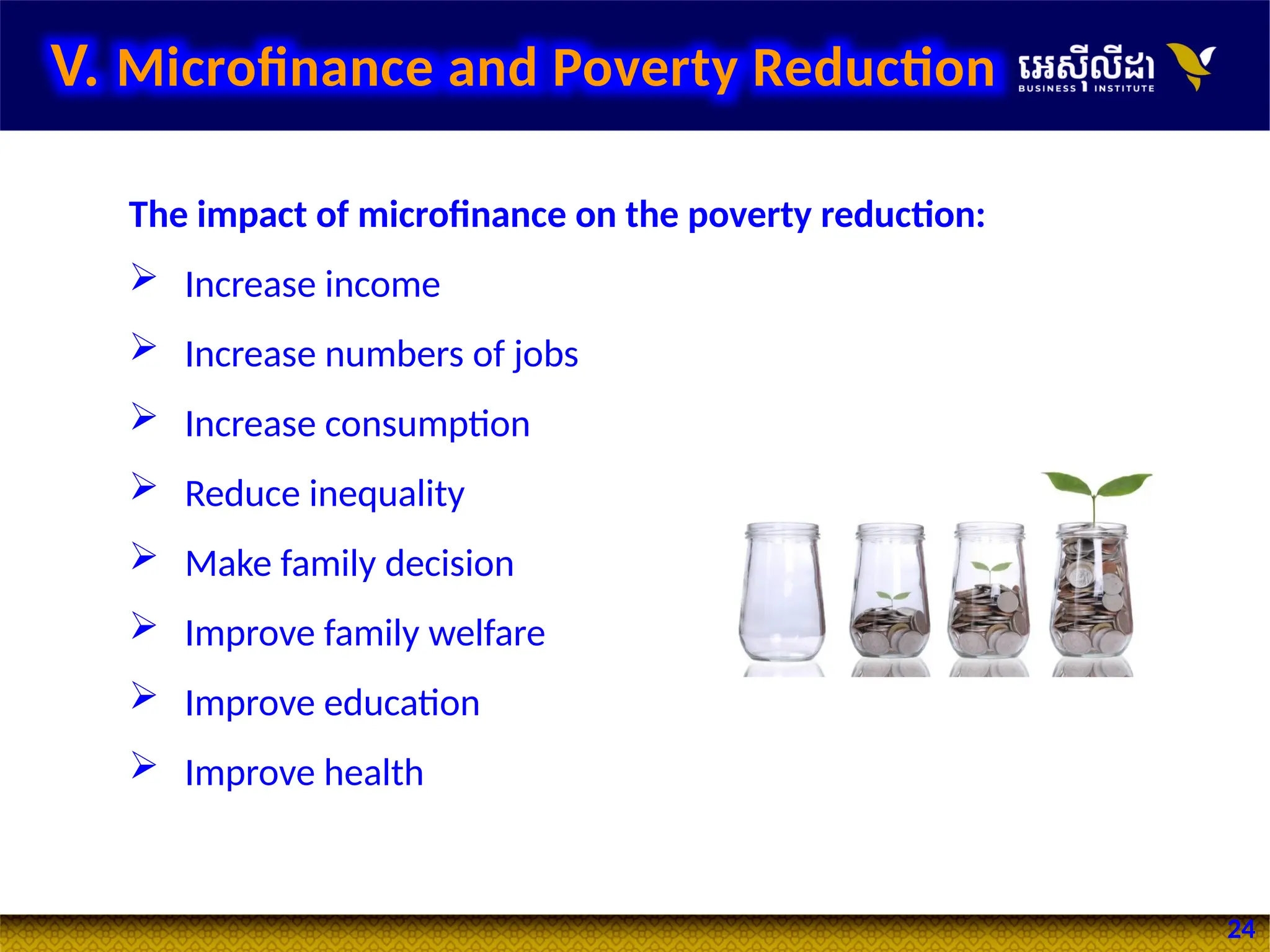
The impact of microfinance on the poverty reduction:
 Increase income
 Increase numbers of jobs
 Increase consumption
 Reduce inequality
 Make family decision
 Improve family welfare
 Improve education
 Improve health
25

Introduction to microfinance is the reason why NGOs transform to microfinance

  • 1.
  • 2.
    2  Define whatmicrofinance is. LEARNING OUTCOME By the end of the course, students will be able to  Explain microfinance background.  Describe how microfinance has developed in Cambodia.  Recognize the challenges of microfinance in Cambodian.  Explain the impact of microfinance on poverty reduction.
  • 3.
    Microfinance Definition Background ofMicrofinance 1 2 4 3 5 CONTENTS Development of Cambodian Microfinance Challenges of Microfinance Industry Microfinance and Poverty Reduction. CONTEN TS 3
  • 4.
    4 I. Microfinance Definition Microfinance is a powerful instrument against poverty.  Microfinance has evolved as an economic development approach intended to benefit low income women and men.  The term refers to the provision of financial services to low-income clients, including the self- employed.
  • 5.
    5 Financial Intermediation SocialIntermediation  Savings;  Credit;  Insurance;  Payment services.  Group formation;  Developmentofself-confidence;  Training in financial literacy;  Management capabilities among members of a group. The definition of microfinance often includes both financial intermediation and social intermediation. The main idea seems straightforward: micro = really small, so microfinance is financial service in small amounts for poor people. I. Microfinance Definition
  • 6.
    6 Microcredit Microfinance  Only,provide credit services to the poor.  Provide credit and other additional financial services such as savings, insurance, payment services etc., to the poor. The terms Microcredit and Microfinance are often used interchangeably, but it is important to highlight the difference between them. I. Microfinance Definition
  • 7.
    7  Microfinance activitiesinitiated by the government agencies in the following beliefs: - The people have no pervious access to credit facilities. - The people had been forced to pay usurious interest rate. - The people were subject to rent seeking behaviors.  Microfinance got its start in Bangladesh in the mid-1970s by providing very small loans to poor people. However, microfinance got its start in Cambodia in the early 1990s. II. Background of Microfinance
  • 8.
    8  Since thenGovernments worked with international donors to provide the poor microfinance services such as cheap credit and subsidized credit in the purpose of promoting agricultural production.  Additionally donors set up credit unions by applying the Reiffeisen model developed in Germany in 1864. The model focus not only credit but also on savings mobilization in rural areas in an attempt to teach poor famers how to save. II. Background of Microfinance
  • 9.
    9  Governments anddonors were not successful in microfinance operation because most programs accumulated large loan losses and required frequent recapitalization to continue operating.  Due to the failure of governments and donors, it became more and more evident that market-based solution were required. Local NGOs began to look for a more long-term approach than the unsustainable income generation approaches to community development.  In Asia, Dr. Mohammad Yunus of Bangladesh led the way with a pilot group lending scheme for landless people which later became the Grameen Bank is the model for many countries.  Other successful microfinance model developed a solidarity group in Latin America ACCION International and developed a successful credit and training system for individual micro- entrepreneurs. II. Background of Microfinance
  • 10.
    10  Since the1980s the field of microfinance has grown substantially. Donors actively support and encourage microfinance activities that are committed to achieving substantial outreach and financial sustainability.  For instance, microfinance NGOs have begun transforming into formal financial institutions that recognize the need to provide savings services to their clients and to access market funding sources, rather than rely on donor funds.  The transformation is indicated by the following beliefs:  Subsidized credit undermines development.  Poor people can pay interest rates high enough to cover transaction costs and the consequences of the imperfect information markets in which lenders operate. II. Background of Microfinance
  • 11.
    11  The goalof sustainability is the key not only to institutional permanence in lending, but also to making the lending institution more focused and efficient.  Because of loan size, MFIs must achieve sufficient scale if they are to become sustainable.  Measurable enterprise growth, as well as impacts on poverty, cannot be demonstrated easily or accurately; outreach and repayment rates can be proxies for impact. II. Background of Microfinance
  • 12.
    12 III. Development ofMicrofinance in Cambodia Before 1990: Limited Financial Service  Financial services were only provided by commercial banks in Cambodia’s urban centers.  Cambodians typically relied on informal money lenders 1990-1995: The first microcredit seeds are planted  microfinance emerged in Cambodia from non-profit microcredit projects initiated by international donors, NGOs and other institutions such as GRET (1991), World Relief (1992), ACLEDA and CRS(Catholic Relief Services) (1993).  This initiative was lately recognized by the new Cambodia Government and international aid started to pour into the country. However, it failed to reach the population on a big scale .
  • 13.
    13 1995-2000: Government supportedinstitutionalization  In 1995, the Royal Government of Cambodia established the Credit Committee for Rural Development (CCRD) to formulate a strategy for rural credit expansion, strengthen its overall management and secure funding.  In 1997, the NBC set up the Supervision Office of Decentralized Banking System Bureau to oversee the coordination, supervision and regulations of the sector and to support capacity building programs. III. Development of Microfinance in Cambodia
  • 14.
    14 2000-2005: Commercialization drivesthe sector up a notch  Prakas on microfinance regulation was enacted and implemented by the NBC.  the Government support of a free-market economy and a more stable political environment allowed MFIs to attract an increasing number of foreign private investors.  NGOs started to transform into commercial MFIs. This eventually led to stronger growth of the sector and increased competition.  the establishment of CMA by seven MFIs in 2004 encouraged internal collaboration among the sector’s main actors, including information sharing and the design of tailored training programs . III. Development of Microfinance in Cambodia
  • 15.
    15 2005-2015: Microfinance asan integral economic player  Established a Credit Information System (CIS) designed to collect and share negative credit information.  Eligible MFIs received the authorization to attract deposits from the general public, which provided MFIs with cheaper sources of funds primarily in the local currency.  Cambodia’s credit growth ratio has started to substantially diverge from a path considered as sustainable.  In 2015, the number of loans kept on increasing by 13.5% and the portfolio volume by 39.6% . III. Development of Microfinance in Cambodia
  • 16.
    16 Value of LoanOutstanding in Million USD from 2005-2017 Source : Annual report of CMA ,2017 III. Development of Microfinance in Cambodia
  • 17.
    17 Growth in Numberof Clients from 2005-2017 Source : Annual report of CMA ,2017 III. Development of Microfinance in Cambodia
  • 18.
    18 2010 2011 20122013 2014 2015 2016 0 10 20 30 40 50 60 70 Number of MFIs and Deposit-taking MFIs Non-deposit-taking MFIs Deposit-taking MFIs Source : NBC 2010-2016 III. Development of Microfinance in Cambodia
  • 19.
    19 2011 2012 20132014 2015 2016 0 500 1000 1500 2000 2500 3000 3500 4000 Total Assets of Microfinance Institution Non-deposit-taking MFIs Deposit-taking MFIs Axis Title Million USD Source : NBC 2011-2016 III. Development of Microfinance in Cambodia
  • 20.
    20 Source : Microfinancein Cambodia ,Rido Thath, 2018 Cambodia Indonesia Lao PDR Myanmar Phillipines Vietnam 0% 5% 10% 15% 20% 25% Microfinance Borrowers and Depositors in Southeast Asian Countries in 2016 Borrowers Depositors Percentage of population III. Development of Microfinance in Cambodia
  • 21.
    21 Some reasons formicrofinance success in Cambodia:  Years of experience  Good management  Healthy competition among MFIs  High standards of governance and transparency  Innovate with new products and services  Support from donors and government  Innovation and supportive regulatory environment III. Development of Microfinance in Cambodia
  • 22.
    22 IV. Challenges ofthe Microfinance Industry Over-indebtedness  Not scrutinize the creditworthiness  Multiple borrowing  Insufficient capacity  Limited financial literacy  Education level Interest cap  Reduce the availability of small loans  Unable to access formal microfinance  Reduce the outreach  High cost institution
  • 23.
    23 Financial literacy  Appropriatesavings  Appropriate borrowing  Investing behaviors  Managing daily expenditure  Managing daily income  Numeracy skills Microfinance institutions  Source of funds  Operation of MFIs  Management information systems (MIS) IV. Challenges of the Microfinance Industry
  • 24.
    24 V. Microfinance andPoverty Reduction The impact of microfinance on the poverty reduction:  Increase income  Increase numbers of jobs  Increase consumption  Reduce inequality  Make family decision  Improve family welfare  Improve education  Improve health
  • 25.

Editor's Notes

  • #7 The Grameen Bank is a community development bank started in Bangladesh. They give small loans (known as microcredit or "grameencredit" [1]) to poor people without asking for money before the loan is given. The word "Grameen", is made of the word "gram" or "village", and means "of the village". The system of this bank is based on the idea that the poor have skills but have no chance to use their skills without some money. The bank also controls some businesses, such as fabric, telephone and energy companies. Most of the banks loans go to women. The Grameen Bank was started 1976 when Professor Muhammad Yunus, a Fulbright scholar and Professor at University of Chittagong, researched how to provide banking for the rural poor. In October 1983, the Grameen Bank Project was made into an independent bank by the government. The group and its first member, Muhammad Yunus, were awarded the Nobel Peace Prize in 2006. Accion International (Americans for Community Cooperation In Other Nations) was founded as a grassroots community development organization in 1961 by Joseph Blatchford. In the beginning, young, college-educated Americans volunteered in Venezuela, and then Brazil, on community-development projects.[7] The objective was to enable people living in poverty to help themselves by organizing their own efforts and talents. Early projects included building schools, community centers, and roads. In 1973, Accion began experimenting with microlending – the provision of credit to small-scale, informal economy entrepreneurs – in Recife, Brazil. Following this pilot, the organization increasingly focused its efforts on developing microfinance institutions, and the microfinance industry. In 1983, Accion founded Red Accion – the first international network of microfinance institutions – in order to strengthen and develop the microfinance community in Latin America. Organización Carvajal was founded in 1904, in Cali, Colombia. A dream of the Carvajal Family that has grown generation after generation, giving the organization its current shape: A multi - latin company committed to the results and quality of its various products, services and solutions that has around 19,000 associates in 14 countries in the Americas.