KIIT COLLEGE OF ENGINEERING
Submitted by: Gaurav Bisht, Prateek Gaur & Pradeep Sheet
Group 1
B.Tech (CSE) 6th Sem
Name of The Topic:
Contents:
 Microcomputer
 Block Diagram of microcomputer
 Components of microcomputer
 RAM
 Types of RAM
 VHDL Code for RAM
Microcomputer:
 A microprocessor embedded in a computer is called microcomputer often with the use of SoC
(System on a Chip).
 The microprocessor is also known as the CPU of the microcomputer.
 Microcomputers are generally meant to run full-fledged Operating Systems, so they often rely on
external RAM and ROM and use common I/O peripherals and ports such as USB or RJ45
(Ethernet).
Block Diagram of Microcomputer:
Components of Microcomputer:
 CPU
- Contains Control Unit and Arithmetic Logic Unit.
- Organizes correct sequence of the processes.
- Performs all the mathematical and logical operations of the system.
 RAM
- Stores the instructions and data needed during processing and execution of programs or
commands.
 ROM
- It serves as permanent storage of data used by microprocessor.
 Interface Circuitry
- An interface between the input devices and the CPU.
 Peripheral Devices
- These are the devices which add functionality.
RAM:
 A microcomputer contains several types of primary memory.
 RAM (Random Access Memory) is used for storing information that changes.
 This memory in a computer is accessible to the user.
 RAM is used to store user programs that control what the CPU does.
 It stores the data used by these programs and the results of operations performed by these
programs.
Types of RAM:
 Integrated RAM chips are available in two forms:
1. SRAM (Static RAM):
The SRAM memories consist of circuits capable of retaining the stored information as long as the power is applied.
2. DRAM (Dynamic RAM):
DRAM stores the binary information in the form of electric charges that applied to capacitors.
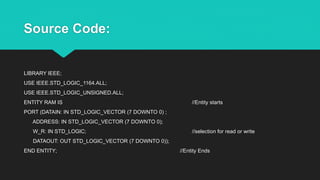
Source Code:
LIBRARY IEEE;
USE IEEE.STD_LOGIC_1164.ALL;
USE IEEE.STD_LOGIC_UNSIGNED.ALL;
ENTITY RAM IS //Entity starts
PORT (DATAIN: IN STD_LOGIC_VECTOR (7 DOWNTO 0) ;
ADDRESS: IN STD_LOGIC_VECTOR (7 DOWNTO 0);
W_R: IN STD_LOGIC; //selection for read or write
DATAOUT: OUT STD_LOGIC_VECTOR (7 DOWNTO 0));
END ENTITY; //Entity Ends
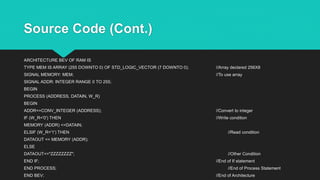
Source Code (Cont.)
ARCHITECTURE BEV OF RAM IS
TYPE MEM IS ARRAY (255 DOWNTO 0) OF STD_LOGIC_VECTOR (7 DOWNTO 0); //Array declared 256X8
SIGNAL MEMORY: MEM; //To use array
SIGNAL ADDR: INTEGER RANGE 0 TO 255;
BEGIN
PROCESS (ADDRESS, DATAIN, W_R)
BEGIN
ADDR<=CONV_INTEGER (ADDRESS); //Convert to integer
IF (W_R='0') THEN //Write condition
MEMORY (ADDR) <=DATAIN;
ELSIF (W_R='1') THEN //Read condition
DATAOUT <= MEMORY (ADDR);
ELSE
DATAOUT<="ZZZZZZZZ"; //Other Condition
END IF; //End of If statement
END PROCESS; //End of Process Statement
END BEV; //End of Architecture
Microcomputer & RAM Model

Microcomputer & RAM Model

  • 1.
    KIIT COLLEGE OFENGINEERING Submitted by: Gaurav Bisht, Prateek Gaur & Pradeep Sheet Group 1 B.Tech (CSE) 6th Sem
  • 2.
  • 3.
    Contents:  Microcomputer  BlockDiagram of microcomputer  Components of microcomputer  RAM  Types of RAM  VHDL Code for RAM
  • 4.
    Microcomputer:  A microprocessorembedded in a computer is called microcomputer often with the use of SoC (System on a Chip).  The microprocessor is also known as the CPU of the microcomputer.  Microcomputers are generally meant to run full-fledged Operating Systems, so they often rely on external RAM and ROM and use common I/O peripherals and ports such as USB or RJ45 (Ethernet).
  • 5.
    Block Diagram ofMicrocomputer:
  • 6.
    Components of Microcomputer: CPU - Contains Control Unit and Arithmetic Logic Unit. - Organizes correct sequence of the processes. - Performs all the mathematical and logical operations of the system.  RAM - Stores the instructions and data needed during processing and execution of programs or commands.  ROM - It serves as permanent storage of data used by microprocessor.  Interface Circuitry - An interface between the input devices and the CPU.  Peripheral Devices - These are the devices which add functionality.
  • 7.
    RAM:  A microcomputercontains several types of primary memory.  RAM (Random Access Memory) is used for storing information that changes.  This memory in a computer is accessible to the user.  RAM is used to store user programs that control what the CPU does.  It stores the data used by these programs and the results of operations performed by these programs.
  • 8.
    Types of RAM: Integrated RAM chips are available in two forms: 1. SRAM (Static RAM): The SRAM memories consist of circuits capable of retaining the stored information as long as the power is applied. 2. DRAM (Dynamic RAM): DRAM stores the binary information in the form of electric charges that applied to capacitors.
  • 9.
    Source Code: LIBRARY IEEE; USEIEEE.STD_LOGIC_1164.ALL; USE IEEE.STD_LOGIC_UNSIGNED.ALL; ENTITY RAM IS //Entity starts PORT (DATAIN: IN STD_LOGIC_VECTOR (7 DOWNTO 0) ; ADDRESS: IN STD_LOGIC_VECTOR (7 DOWNTO 0); W_R: IN STD_LOGIC; //selection for read or write DATAOUT: OUT STD_LOGIC_VECTOR (7 DOWNTO 0)); END ENTITY; //Entity Ends
  • 10.
    Source Code (Cont.) ARCHITECTUREBEV OF RAM IS TYPE MEM IS ARRAY (255 DOWNTO 0) OF STD_LOGIC_VECTOR (7 DOWNTO 0); //Array declared 256X8 SIGNAL MEMORY: MEM; //To use array SIGNAL ADDR: INTEGER RANGE 0 TO 255; BEGIN PROCESS (ADDRESS, DATAIN, W_R) BEGIN ADDR<=CONV_INTEGER (ADDRESS); //Convert to integer IF (W_R='0') THEN //Write condition MEMORY (ADDR) <=DATAIN; ELSIF (W_R='1') THEN //Read condition DATAOUT <= MEMORY (ADDR); ELSE DATAOUT<="ZZZZZZZZ"; //Other Condition END IF; //End of If statement END PROCESS; //End of Process Statement END BEV; //End of Architecture