Medical microbiology
CLS 212
Introduction
• What is microbiology?
the branch of biology that studies microorganisms and their effects on
humans
• Microorganisms
a collection of organisms that share the characteristic of being visible only
with a microscope
• contribute to the quality of human life
o maintain the balance of chemical elements in nature
o breakdown the remains of all that die
o recycle carbon, nitrogen, sulfur, phosphorus and other elements
• some cause infectious disease called Pathogenic
o overwhelm body systems by sheer force of numbers
o produce powerful toxins that interfere with body physiology
o viruses inflict damage by replicating themselves within tissue cells
causing tissue degeneration
Classification of Microorganisms
• Taxonomy - the science of classification
• Kingdom (5 major divisions)
• Phylum (groups of related Classes)
• Class (groups of related Orders)
• Order (groups of related Families)
• Family (groups of related Genera)
• Genus (groups of related Species)
• Species (living organisms that are alike)
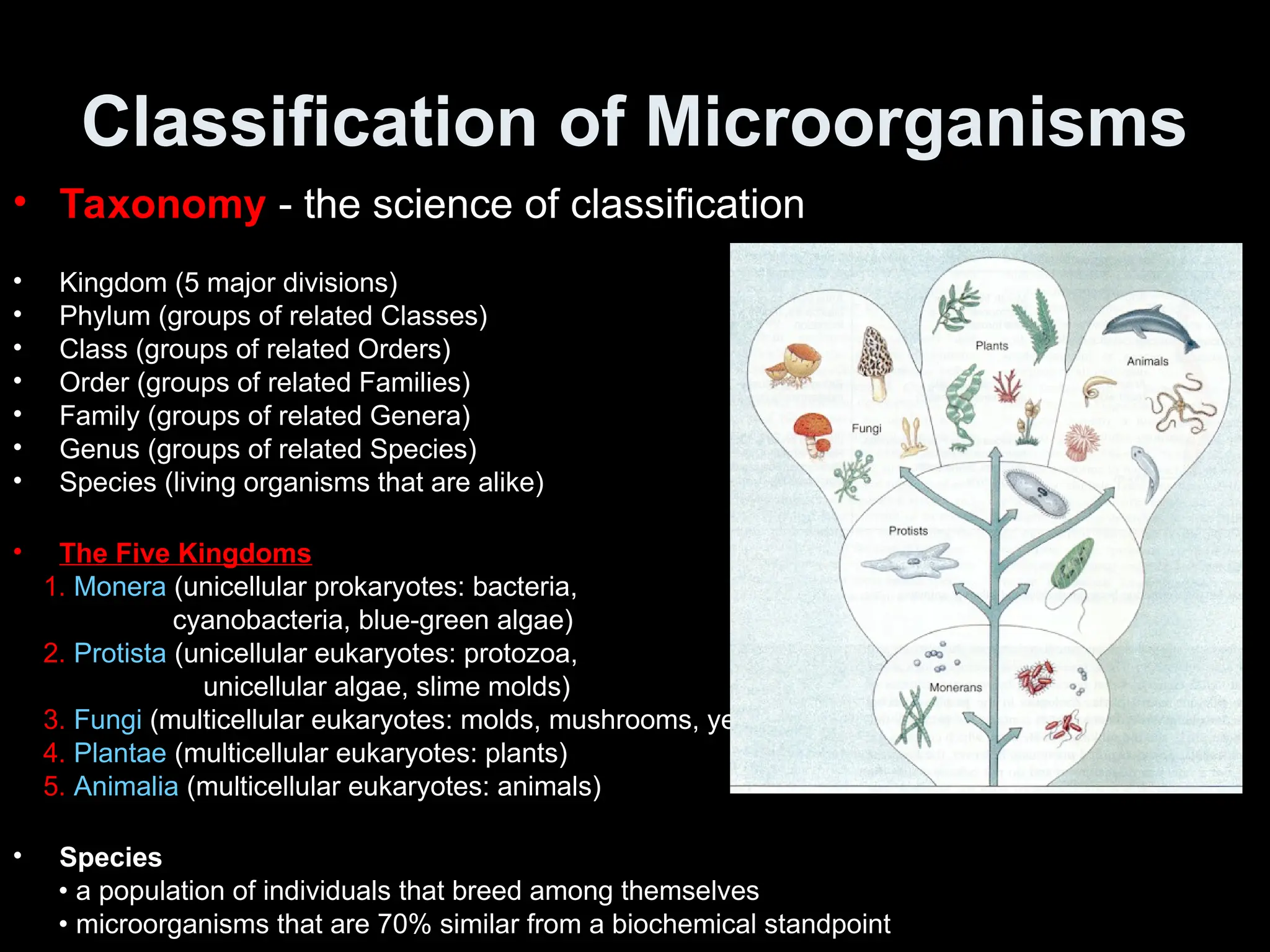
• The Five Kingdoms
1. Monera (unicellular prokaryotes: bacteria,
cyanobacteria, blue-green algae)
2. Protista (unicellular eukaryotes: protozoa,
unicellular algae, slime molds)
3. Fungi (multicellular eukaryotes: molds, mushrooms, yeasts)
4. Plantae (multicellular eukaryotes: plants)
5. Animalia (multicellular eukaryotes: animals)
• Species
• a population of individuals that breed among themselves
• microorganisms that are 70% similar from a biochemical standpoint
Classification of Microorganisms
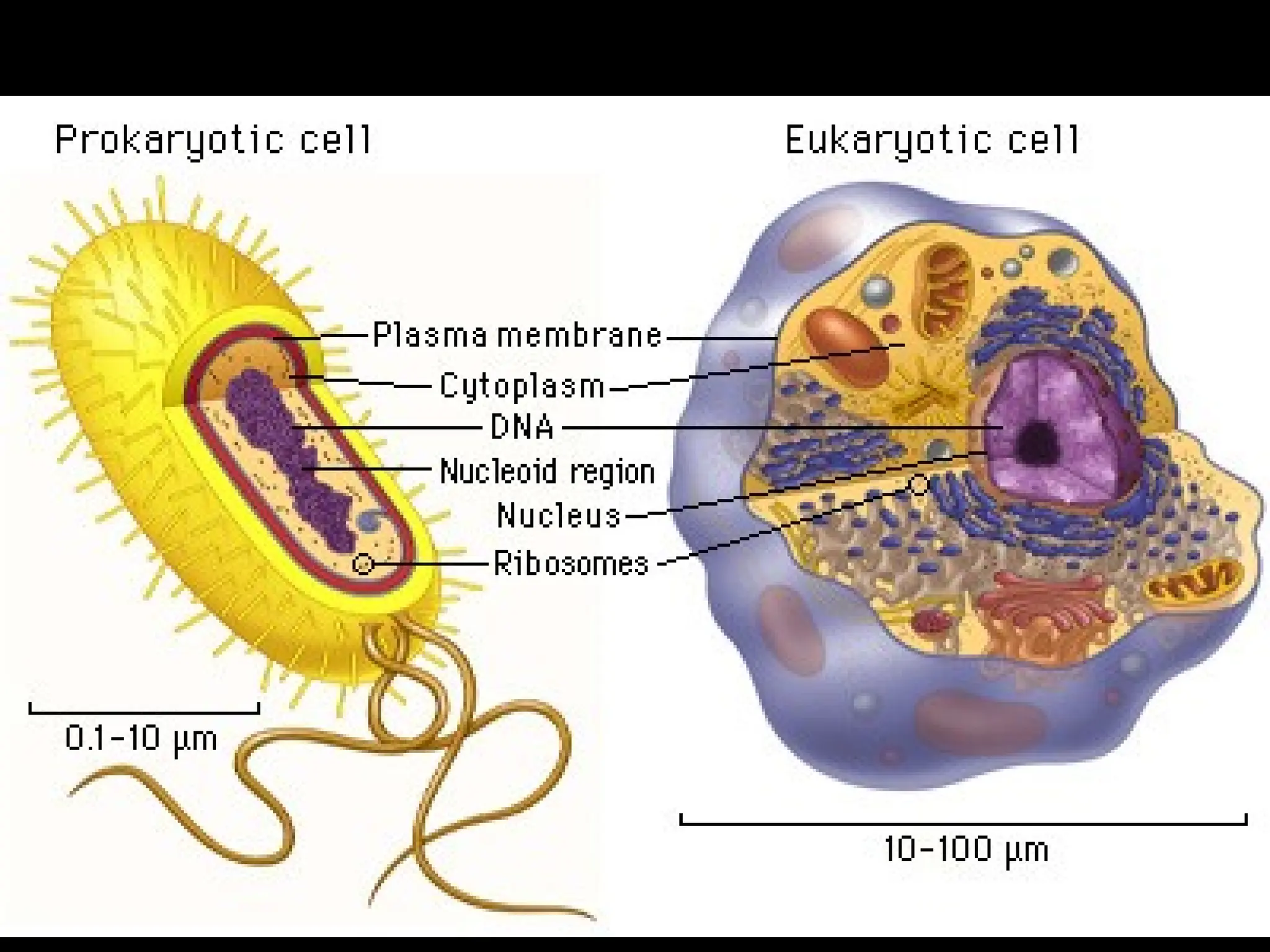
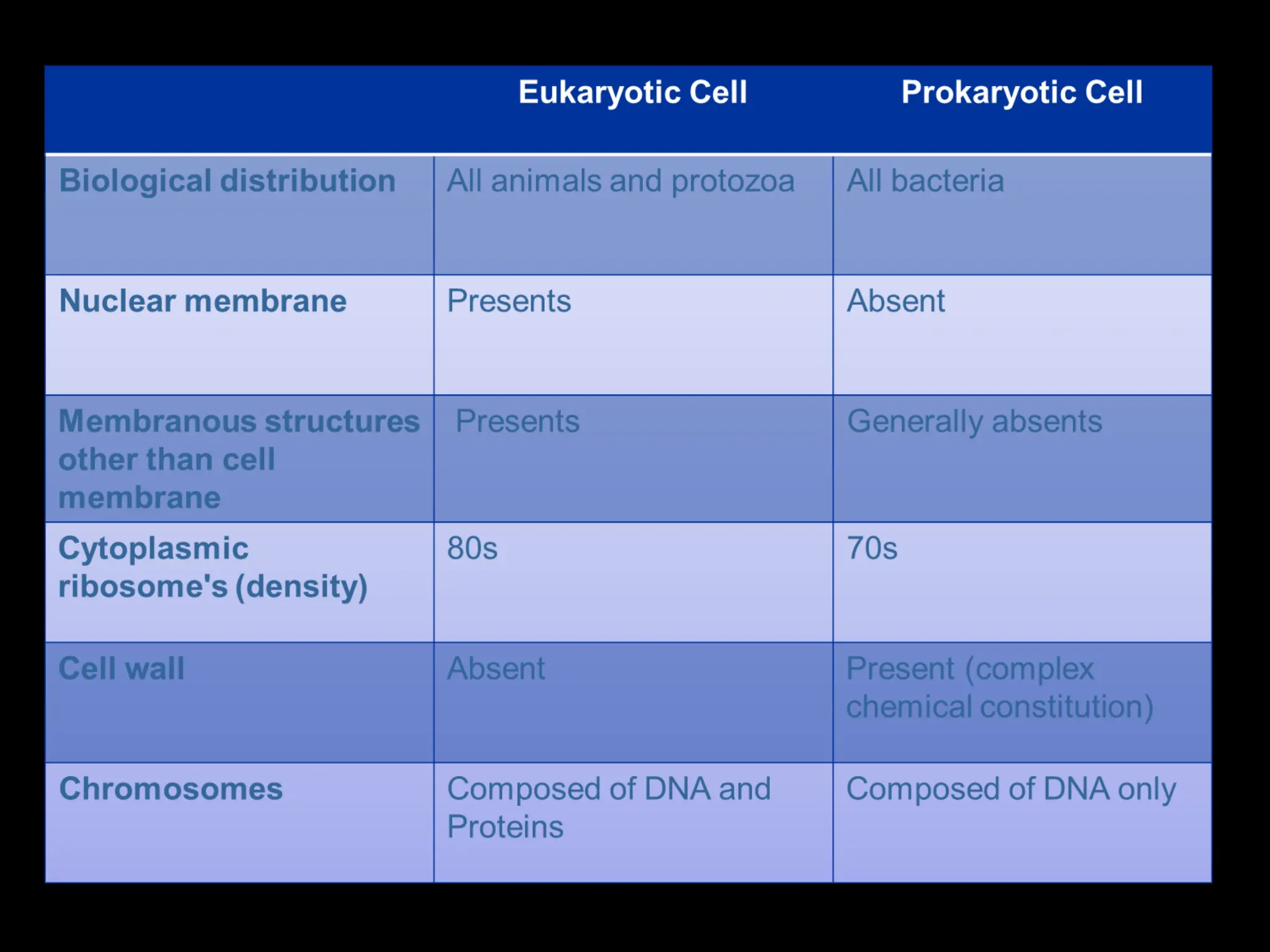
Microorganisms and all other living organisms are classified as
Prokaryotes and Eukaryotes. They are distinguished on the
basis of their cellular characteristics.
• Prokaryotes and Eukaryotes
􀂃 enclosed by cell (plasma) membranes
􀂃 use DNA for genetic information
• Prokaryotes
􀂃 lack a nucleus
􀂃 lack organelles
􀂃 include bacteria and cyanobacteria (blue-green algae)
• Eukaryotes
􀂃 have a nucleus
􀂃 have organelles
􀂃 include fungi, protozoa and simple algae
• Viruses
􀂃 are neither Prokaryotes or Eukaryotes
􀂃 lack the characteristics of living things
􀂃 are able to replicate only in their host (living cells)
Historical Background
• mid 1600s – English scientist Robert Hooke viewed cells and
observed strands of fungi
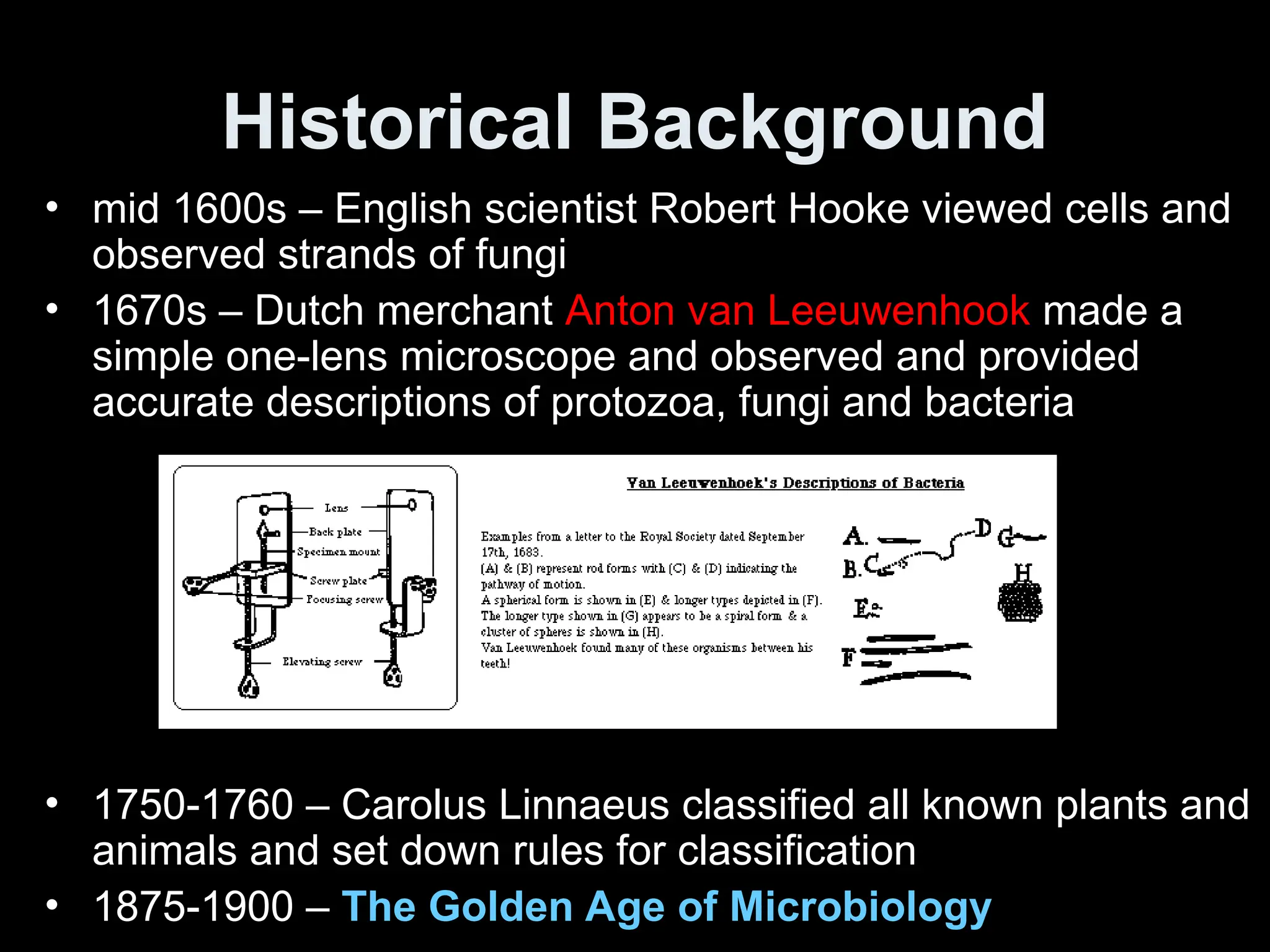
• 1670s – Dutch merchant Anton van Leeuwenhook made a
simple one-lens microscope and observed and provided
accurate descriptions of protozoa, fungi and bacteria
• 1750-1760 – Carolus Linnaeus classified all known plants and
animals and set down rules for classification
• 1875-1900 – The Golden Age of Microbiology
Historical Theories
• The Theory of Spontaneous Generation
a long-held theory that life springs up from non-living or decaying organic
matter, was based on observations of rotting food seemingly producing
living organisms. Francesco Redi (1626-1678) was an Italian physician who
showed that rotting meat carefully kept from flies will not spontaneously
produce maggots.
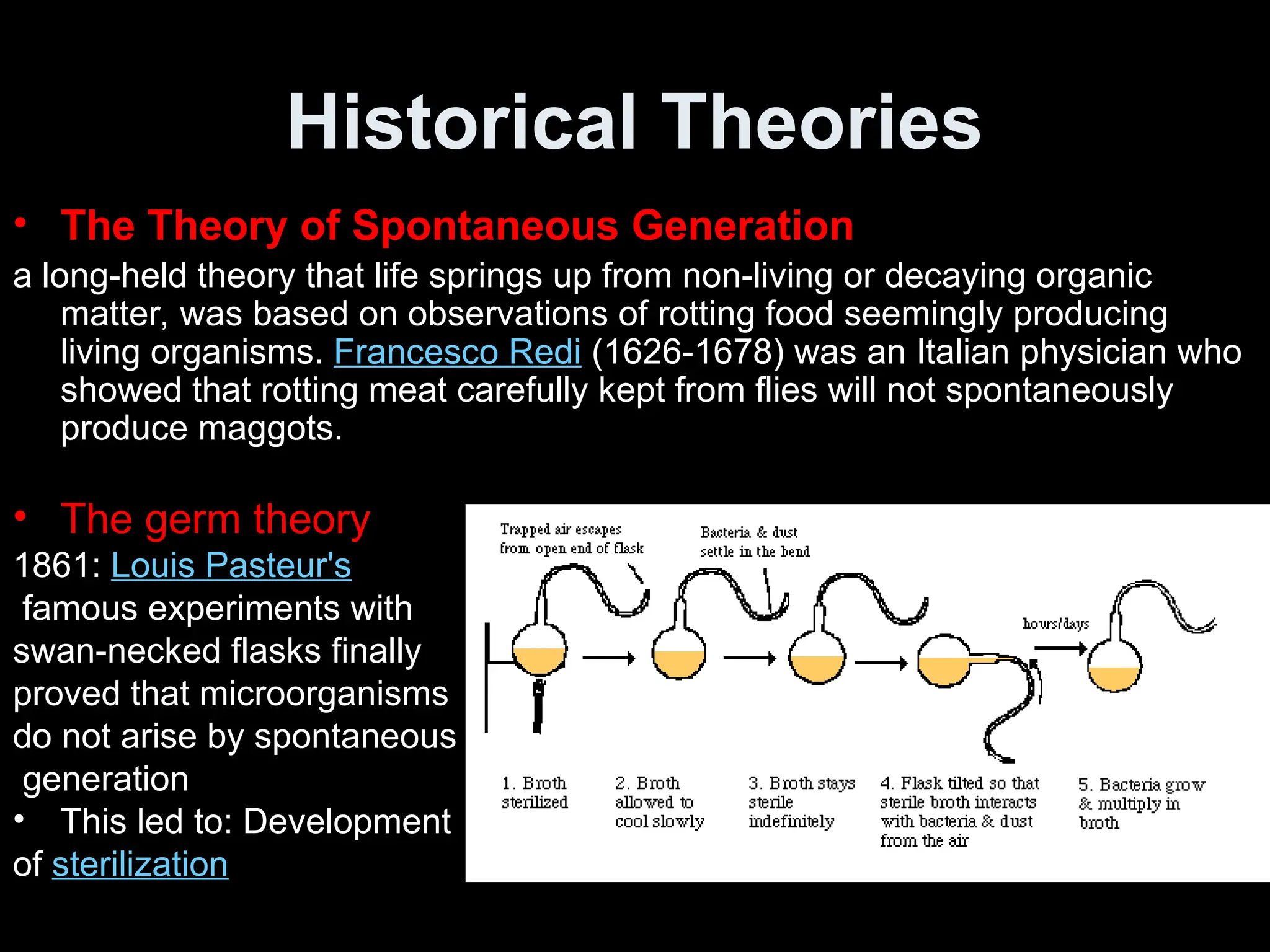
• The germ theory
1861: Louis Pasteur's
famous experiments with
swan-necked flasks finally
proved that microorganisms
do not arise by spontaneous
generation
• This led to: Development
of sterilization
Historical Theories
• Koch’s postulates
1890s: Robert Koch sets guidelines for how to prove that a
particular microbial agent is responsible for a particular
disease. Koch's postulates state that:
• The suspect microorganism must be routinely isolated
from patients with a particular illness;
• The microorganism must be grown in pure culture in
vitro;
• When the pure culture is inoculated into a new host, it
must cause the same illness;
• The same microorganisms must be reisolated from new
host.
assdssfvdgdghhghghhghdgdb_Intrduction.ppt

assdssfvdgdghhghghhghdgdb_Intrduction.ppt

  • 1.
  • 2.
    Introduction • What ismicrobiology? the branch of biology that studies microorganisms and their effects on humans • Microorganisms a collection of organisms that share the characteristic of being visible only with a microscope • contribute to the quality of human life o maintain the balance of chemical elements in nature o breakdown the remains of all that die o recycle carbon, nitrogen, sulfur, phosphorus and other elements • some cause infectious disease called Pathogenic o overwhelm body systems by sheer force of numbers o produce powerful toxins that interfere with body physiology o viruses inflict damage by replicating themselves within tissue cells causing tissue degeneration
  • 3.
    Classification of Microorganisms •Taxonomy - the science of classification • Kingdom (5 major divisions) • Phylum (groups of related Classes) • Class (groups of related Orders) • Order (groups of related Families) • Family (groups of related Genera) • Genus (groups of related Species) • Species (living organisms that are alike) • The Five Kingdoms 1. Monera (unicellular prokaryotes: bacteria, cyanobacteria, blue-green algae) 2. Protista (unicellular eukaryotes: protozoa, unicellular algae, slime molds) 3. Fungi (multicellular eukaryotes: molds, mushrooms, yeasts) 4. Plantae (multicellular eukaryotes: plants) 5. Animalia (multicellular eukaryotes: animals) • Species • a population of individuals that breed among themselves • microorganisms that are 70% similar from a biochemical standpoint
  • 4.
    Classification of Microorganisms Microorganismsand all other living organisms are classified as Prokaryotes and Eukaryotes. They are distinguished on the basis of their cellular characteristics. • Prokaryotes and Eukaryotes 􀂃 enclosed by cell (plasma) membranes 􀂃 use DNA for genetic information • Prokaryotes 􀂃 lack a nucleus 􀂃 lack organelles 􀂃 include bacteria and cyanobacteria (blue-green algae) • Eukaryotes 􀂃 have a nucleus 􀂃 have organelles 􀂃 include fungi, protozoa and simple algae • Viruses 􀂃 are neither Prokaryotes or Eukaryotes 􀂃 lack the characteristics of living things 􀂃 are able to replicate only in their host (living cells)
  • 7.
    Historical Background • mid1600s – English scientist Robert Hooke viewed cells and observed strands of fungi • 1670s – Dutch merchant Anton van Leeuwenhook made a simple one-lens microscope and observed and provided accurate descriptions of protozoa, fungi and bacteria • 1750-1760 – Carolus Linnaeus classified all known plants and animals and set down rules for classification • 1875-1900 – The Golden Age of Microbiology
  • 8.
    Historical Theories • TheTheory of Spontaneous Generation a long-held theory that life springs up from non-living or decaying organic matter, was based on observations of rotting food seemingly producing living organisms. Francesco Redi (1626-1678) was an Italian physician who showed that rotting meat carefully kept from flies will not spontaneously produce maggots. • The germ theory 1861: Louis Pasteur's famous experiments with swan-necked flasks finally proved that microorganisms do not arise by spontaneous generation • This led to: Development of sterilization
  • 9.
    Historical Theories • Koch’spostulates 1890s: Robert Koch sets guidelines for how to prove that a particular microbial agent is responsible for a particular disease. Koch's postulates state that: • The suspect microorganism must be routinely isolated from patients with a particular illness; • The microorganism must be grown in pure culture in vitro; • When the pure culture is inoculated into a new host, it must cause the same illness; • The same microorganisms must be reisolated from new host.

Editor's Notes

  • #8 In The Canon of Medicine (1020), Abū Alī ibn Sīnā (Avicenna) stated that bodily secretion is contaminated by foul foreign earthly bodies before being infected.[3] He also discovered the contagious nature of tuberculosis and other infectious diseases, and introduced quarantine as a means of limiting the spread of contagious diseases.[4] When the Black Death bubonic plague reached al-Andalus in the 14th century, hypothesized that infectious diseases are caused by "minute bodies" which enter the human body and cause disease. Another 14th century Andalusian physician, Ibn al-Khatib, wrote a treatise called On the Plague, in which he stated:[3] The existence of contagion is established by experience, investigation, the evidence of the senses and trustworthy reports. These facts constitute a sound argument. The fact of infection becomes clear to the investigator who notices how he who establishes contact with the afflicted gets the disease, whereas he who is not in contact remains safe, and how transmission is affected through garments, vessels and earrings."