Microbial genetics
Bio 433
By
Dr. Mona Othman Albureikan
Gene Expression and Gene Regulation
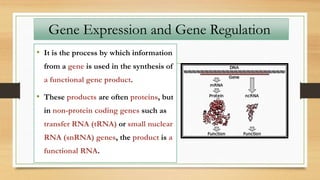
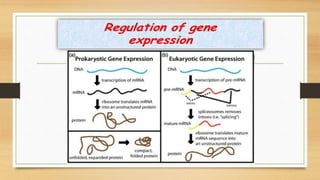
• It is the process by which information
from a gene is used in the synthesis of
a functional gene product.
• These products are often proteins, but
in non-protein coding genes such as
transfer RNA (tRNA) or small nuclear
RNA (snRNA) genes, the product is a
functional RNA.
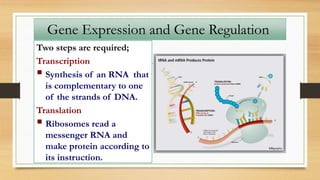
Two steps are required;
Transcription
 Synthesis of an RNA that
is complementary to one
of the strands of DNA.
Translation
 Ribosomes read a
messenger RNA and
make protein according to
its instruction.
Gene Expression and Gene Regulation
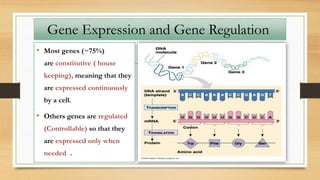
• Most genes (~75%)
are constitutive ( house
keeping), meaning that they
are expressed continuously
by a cell.
• Others genes are regulated
(Controllable) so that they
are expressed only when
needed .
Gene Expression and Gene Regulation
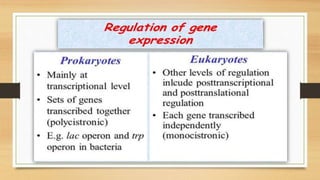
• Regulation of gene expression includes a wide range of mechanisms that are
used by cells to increase or decrease the production of specific gene
products (protein or RNA), and is informally termed gene regulation.
• Gene regulation is essential for viruses, prokaryotes and eukaryotes as it
increases the versatility and adaptability of an organism by allowing the cell
to express protein when needed.
• Most bacteria are unicellular and do not have the ability to turn genes on or
off to produce different kinds of cells as more complex organisms do.
Gene Expression and Gene Regulation
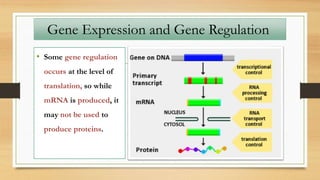
• Some gene regulation
occurs at the level of
translation, so while
mRNA is produced, it
may not be used to
produce proteins.
Gene Expression and Gene Regulation
Types of Regulation of gene
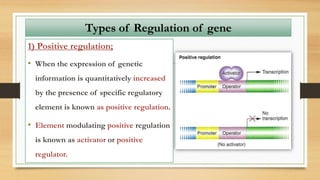
1) Positive regulation;
• When the expression of genetic
information is quantitatively increased
by the presence of specific regulatory
element is known as positive regulation.
• Element modulating positive regulation
is known as activator or positive
regulator.
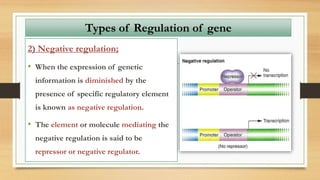
2) Negative regulation;
• When the expression of genetic
information is diminished by the
presence of specific regulatory element
is known as negative regulation.
• The element or molecule mediating the
negative regulation is said to be
repressor or negative regulator.
Types of Regulation of gene
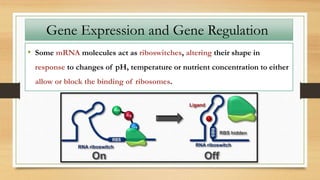
• Some mRNA molecules act as riboswitches, altering their shape in
response to changes of pH, temperature or nutrient concentration to either
allow or block the binding of ribosomes.
Gene Expression and Gene Regulation
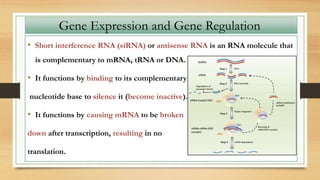
• Short interference RNA (siRNA) or antisense RNA is an RNA molecule that
is complementary to mRNA, tRNA or DNA.
• It functions by binding to its complementary
nucleotide base to silence it (become inactive).
• It functions by causing mRNA to be broken
down after transcription, resulting in no
translation.
Gene Expression and Gene Regulation
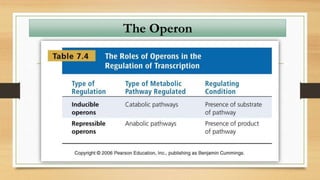
The Operon ( Gene Expression )
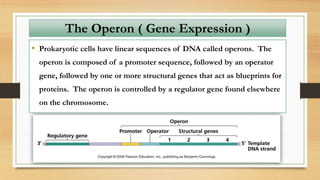
• Prokaryotic cells have linear sequences of DNA called operons. The
operon is composed of a promoter sequence, followed by an operator
gene, followed by one or more structural genes that act as blueprints for
proteins. The operon is controlled by a regulator gene found elsewhere
on the chromosome.
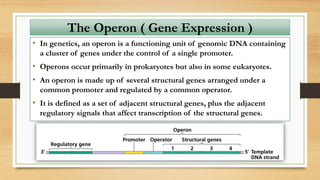
• In genetics, an operon is a functioning unit of genomic DNA containing
a cluster of genes under the control of a single promoter.
• Operons occur primarily in prokaryotes but also in some eukaryotes.
• An operon is made up of several structural genes arranged under a
common promoter and regulated by a common operator.
• It is defined as a set of adjacent structural genes, plus the adjacent
regulatory signals that affect transcription of the structural genes.
The Operon ( Gene Expression )
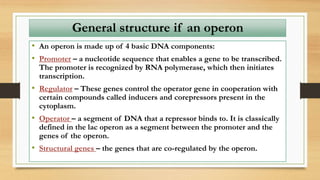
• An operon is made up of 4 basic DNA components:
• Promoter – a nucleotide sequence that enables a gene to be transcribed.
The promoter is recognized by RNA polymerase, which then initiates
transcription.
• Regulator – These genes control the operator gene in cooperation with
certain compounds called inducers and corepressors present in the
cytoplasm.
• Operator – a segment of DNA that a repressor binds to. It is classically
defined in the lac operon as a segment between the promoter and the
genes of the operon.
• Structural genes – the genes that are co-regulated by the operon.
General structure if an operon
Types of Operon; inducible (turned on by a substrate)
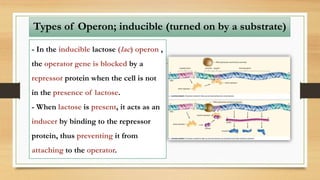
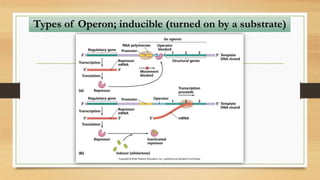
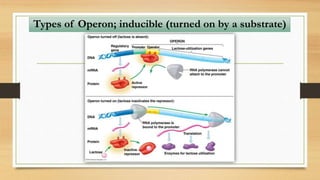
- In the inducible lactose (lac) operon ,
the operator gene is blocked by a
repressor protein when the cell is not
in the presence of lactose.
- When lactose is present, it acts as an
inducer by binding to the repressor
protein, thus preventing it from
attaching to the operator.
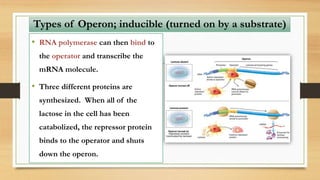
• RNA polymerase can then bind to
the operator and transcribe the
mRNA molecule.
• Three different proteins are
synthesized. When all of the
lactose in the cell has been
catabolized, the repressor protein
binds to the operator and shuts
down the operon.
Types of Operon; inducible (turned on by a substrate)
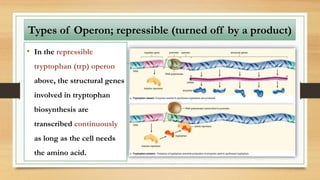
• In the repressible
tryptophan (trp) operon
above, the structural genes
involved in tryptophan
biosynthesis are
transcribed continuously
as long as the cell needs
the amino acid.
Types of Operon; repressible (turned off by a product)
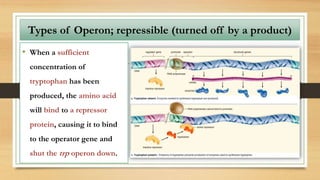
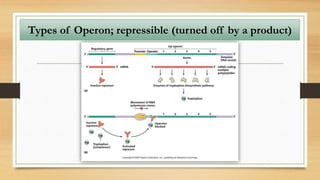
• When a sufficient
concentration of
tryptophan has been
produced, the amino acid
will bind to a repressor
protein, causing it to bind
to the operator gene and
shut the trp operon down.
Types of Operon; repressible (turned off by a product)
The Operon
References
 Molecular Genetics of Bacteria ( 4th Edition ) (2013), Larry Snyder , Joseph E. Peters , Tina M. Henkin , Wendy
Champness ISBN 10: 1555816274 ISBN 13: 9781555816278.
 Molecular Genetics of Bacteria, 5th Edition, by Jeremy W. Dale, Simon F. Park ,April 2010, ©2010.
 Genetics of Bacteria, Sheela Srivastava,(2013) ISBN: 978-81-322-1089-4
 Microbial Genetics. (1994). Jones and Bartlett Series in Biology. Jones and Bartlett Publishers, Inc.; 2nd
edition, ISBN-10: 0867202483, ISBN-13: 978-0867202489, 484 pages.
 Microbial genetics. (2008). Jones and Bartlett series in biology
Series of books in biology. David Freifelder, publisher, Jones and Bartlett, 1987. 601 pages.
 Molecular Biology: Genes to Proteins Hardcover . (2007). Burton E. Tropp, Publisher: Jones & Bartlett Publishers; 3
edition, ISBN-10: 0763709166, ISBN-13: 978-0763709167, 1000 pages .

Microbial genetics lectures 13,14, and 15

  • 1.
    Microbial genetics Bio 433 By Dr.Mona Othman Albureikan
  • 2.
    Gene Expression andGene Regulation • It is the process by which information from a gene is used in the synthesis of a functional gene product. • These products are often proteins, but in non-protein coding genes such as transfer RNA (tRNA) or small nuclear RNA (snRNA) genes, the product is a functional RNA.
  • 3.
    Two steps arerequired; Transcription  Synthesis of an RNA that is complementary to one of the strands of DNA. Translation  Ribosomes read a messenger RNA and make protein according to its instruction. Gene Expression and Gene Regulation
  • 4.
    • Most genes(~75%) are constitutive ( house keeping), meaning that they are expressed continuously by a cell. • Others genes are regulated (Controllable) so that they are expressed only when needed . Gene Expression and Gene Regulation
  • 5.
    • Regulation ofgene expression includes a wide range of mechanisms that are used by cells to increase or decrease the production of specific gene products (protein or RNA), and is informally termed gene regulation. • Gene regulation is essential for viruses, prokaryotes and eukaryotes as it increases the versatility and adaptability of an organism by allowing the cell to express protein when needed. • Most bacteria are unicellular and do not have the ability to turn genes on or off to produce different kinds of cells as more complex organisms do. Gene Expression and Gene Regulation
  • 6.
    • Some generegulation occurs at the level of translation, so while mRNA is produced, it may not be used to produce proteins. Gene Expression and Gene Regulation
  • 7.
    Types of Regulationof gene 1) Positive regulation; • When the expression of genetic information is quantitatively increased by the presence of specific regulatory element is known as positive regulation. • Element modulating positive regulation is known as activator or positive regulator.
  • 8.
    2) Negative regulation; •When the expression of genetic information is diminished by the presence of specific regulatory element is known as negative regulation. • The element or molecule mediating the negative regulation is said to be repressor or negative regulator. Types of Regulation of gene
  • 9.
    • Some mRNAmolecules act as riboswitches, altering their shape in response to changes of pH, temperature or nutrient concentration to either allow or block the binding of ribosomes. Gene Expression and Gene Regulation
  • 10.
    • Short interferenceRNA (siRNA) or antisense RNA is an RNA molecule that is complementary to mRNA, tRNA or DNA. • It functions by binding to its complementary nucleotide base to silence it (become inactive). • It functions by causing mRNA to be broken down after transcription, resulting in no translation. Gene Expression and Gene Regulation
  • 11.
    The Operon (Gene Expression ) • Prokaryotic cells have linear sequences of DNA called operons. The operon is composed of a promoter sequence, followed by an operator gene, followed by one or more structural genes that act as blueprints for proteins. The operon is controlled by a regulator gene found elsewhere on the chromosome.
  • 12.
    • In genetics,an operon is a functioning unit of genomic DNA containing a cluster of genes under the control of a single promoter. • Operons occur primarily in prokaryotes but also in some eukaryotes. • An operon is made up of several structural genes arranged under a common promoter and regulated by a common operator. • It is defined as a set of adjacent structural genes, plus the adjacent regulatory signals that affect transcription of the structural genes. The Operon ( Gene Expression )
  • 13.
    • An operonis made up of 4 basic DNA components: • Promoter – a nucleotide sequence that enables a gene to be transcribed. The promoter is recognized by RNA polymerase, which then initiates transcription. • Regulator – These genes control the operator gene in cooperation with certain compounds called inducers and corepressors present in the cytoplasm. • Operator – a segment of DNA that a repressor binds to. It is classically defined in the lac operon as a segment between the promoter and the genes of the operon. • Structural genes – the genes that are co-regulated by the operon. General structure if an operon
  • 14.
    Types of Operon;inducible (turned on by a substrate) - In the inducible lactose (lac) operon , the operator gene is blocked by a repressor protein when the cell is not in the presence of lactose. - When lactose is present, it acts as an inducer by binding to the repressor protein, thus preventing it from attaching to the operator.
  • 15.
    • RNA polymerasecan then bind to the operator and transcribe the mRNA molecule. • Three different proteins are synthesized. When all of the lactose in the cell has been catabolized, the repressor protein binds to the operator and shuts down the operon. Types of Operon; inducible (turned on by a substrate)
  • 16.
    Types of Operon;inducible (turned on by a substrate)
  • 17.
    Types of Operon;inducible (turned on by a substrate)
  • 18.
    • In therepressible tryptophan (trp) operon above, the structural genes involved in tryptophan biosynthesis are transcribed continuously as long as the cell needs the amino acid. Types of Operon; repressible (turned off by a product)
  • 19.
    • When asufficient concentration of tryptophan has been produced, the amino acid will bind to a repressor protein, causing it to bind to the operator gene and shut the trp operon down. Types of Operon; repressible (turned off by a product)
  • 20.
    Types of Operon;repressible (turned off by a product)
  • 21.
  • 24.
    References  Molecular Geneticsof Bacteria ( 4th Edition ) (2013), Larry Snyder , Joseph E. Peters , Tina M. Henkin , Wendy Champness ISBN 10: 1555816274 ISBN 13: 9781555816278.  Molecular Genetics of Bacteria, 5th Edition, by Jeremy W. Dale, Simon F. Park ,April 2010, ©2010.  Genetics of Bacteria, Sheela Srivastava,(2013) ISBN: 978-81-322-1089-4  Microbial Genetics. (1994). Jones and Bartlett Series in Biology. Jones and Bartlett Publishers, Inc.; 2nd edition, ISBN-10: 0867202483, ISBN-13: 978-0867202489, 484 pages.  Microbial genetics. (2008). Jones and Bartlett series in biology Series of books in biology. David Freifelder, publisher, Jones and Bartlett, 1987. 601 pages.  Molecular Biology: Genes to Proteins Hardcover . (2007). Burton E. Tropp, Publisher: Jones & Bartlett Publishers; 3 edition, ISBN-10: 0763709166, ISBN-13: 978-0763709167, 1000 pages .