






MICROBIAL
CONTAMINATION
Presented By,
Dr Anitha M
1st MD Scholar
Non – intended or accidental introduction of
microbes such as bacteria, yeast, mould, fungi,
virus, prions, protozoa or their toxins & byproducts
GROWTH
the presence & presumed proliferation of viable
micro-organisms
SOURCES
✓ The raw materials including water from which the product is manufactured
✓ The manufacturing environment including the atmosphere, equipment and
work surfaces
✓ Manufacturing personnel
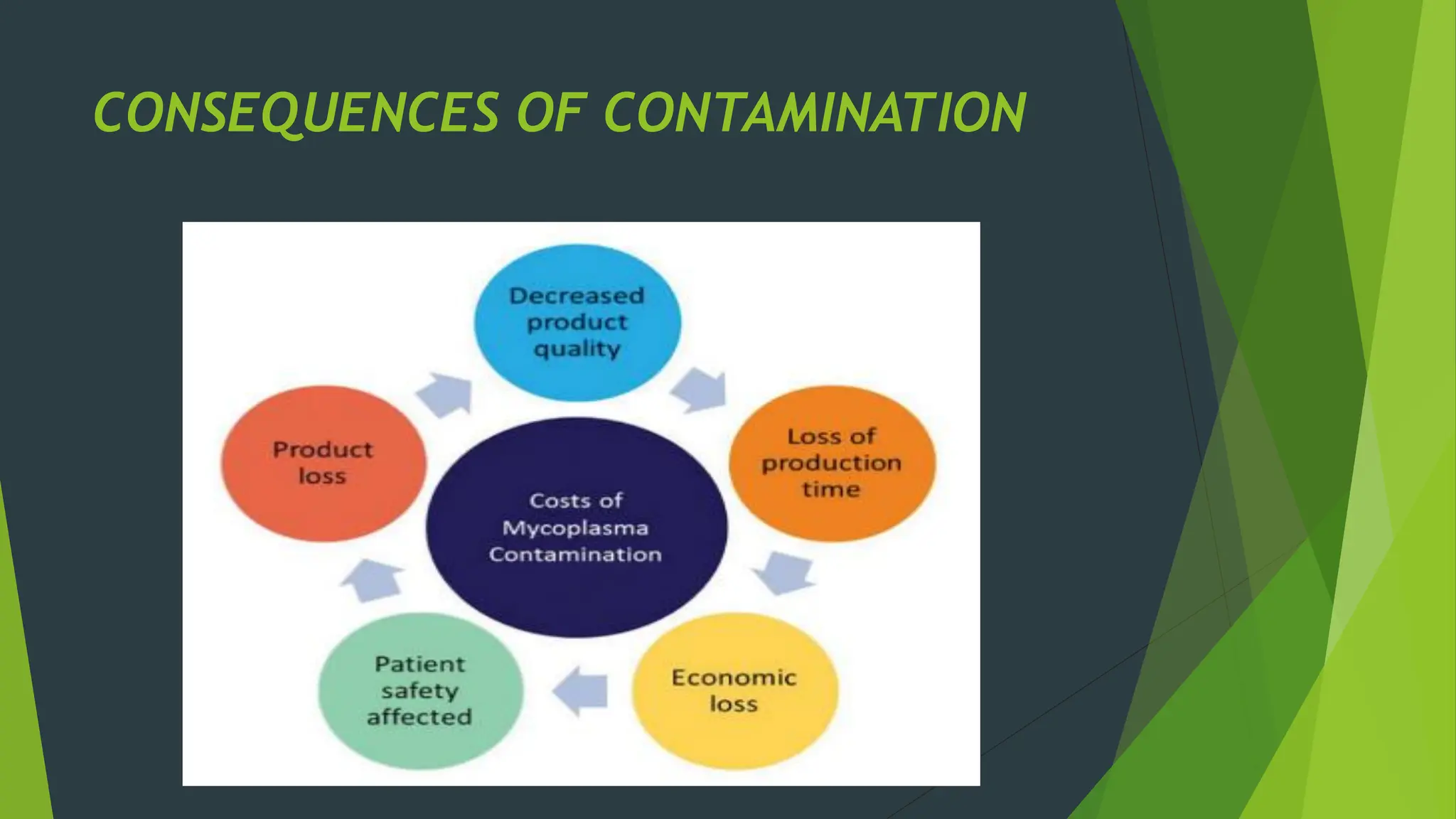
CONSEQUENCES OF CONTAMINATION
OBJECTIVES OF ANALYSIS
✓ To determine the nature of microbial contamination of the herbal medicines
✓ To determine the extent of such contamination
✓ To perform limit tests for the total viable aerobic bacteria and fungi
indicating the quality of herbal preparations
ANALYTIC PARAMETERS
✓ Limits of E-coli & molds
✓ Total viable aerobic count
✓ Total enterobacteria & their count
✓ Alatoxin analysis
PROCEDURE
✓ Collect the samples each containing 1gm of finished products in a sterile
bottle
✓ Label the bottles based on the time interval between which the procedure
has to be carried out ( eg. 2 , 4 , 5, 7days or 1 , 6 months )
✓ Prepare the cultures of suspecting microbes in solid and liquid medias
✓ Medias have to be selected according to micro-organisms ( MacConkey agar
medium, nutrient broth medium for bacteria, sabouraud dextrose agar
medium for fungi )
✓ Temperature should be regulated (incubation ) based on microbes ( bacteria -
30 to 35 ( 37) degree Celsius , fungi – 20 to 25 (room T or 26) degree Celsius )
✓ After specific period of time (24 - 48 hrs to 5 days for bacteria , 4 – 5 days for
fungi) examine the plate of cultured microbe microscopically and
observations are noted
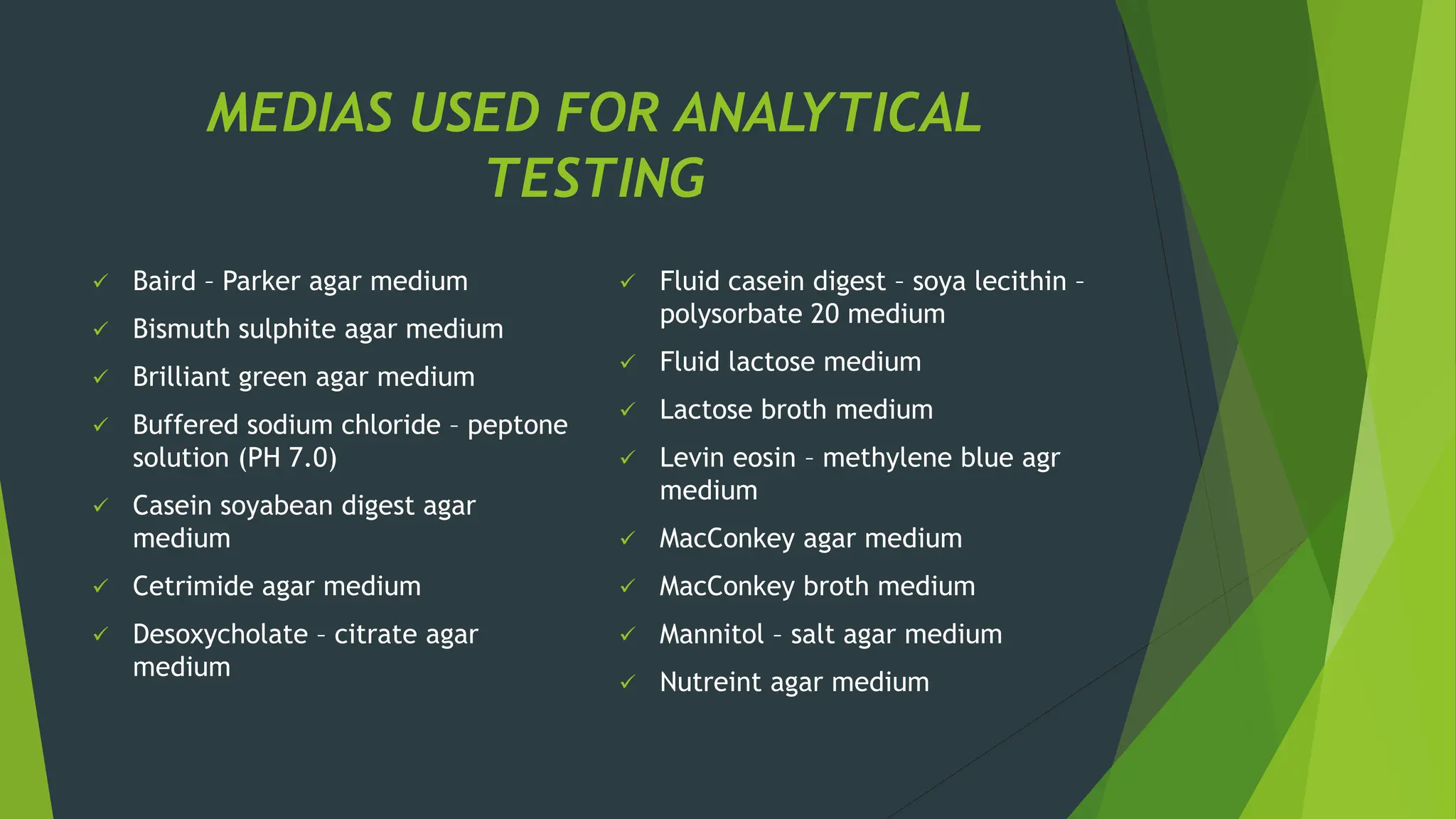
MEDIAS USED FOR ANALYTICAL
TESTING
✓ Baird – Parker agar medium
✓ Bismuth sulphite agar medium
✓ Brilliant green agar medium
✓ Buffered sodium chloride – peptone
solution (PH 7.0)
✓ Casein soyabean digest agar
medium
✓ Cetrimide agar medium
✓ Desoxycholate – citrate agar
medium
✓ Fluid casein digest – soya lecithin –
polysorbate 20 medium
✓ Fluid lactose medium
✓ Lactose broth medium
✓ Levin eosin – methylene blue agr
medium
✓ MacConkey agar medium
✓ MacConkey broth medium
✓ Mannitol – salt agar medium
✓ Nutreint agar medium
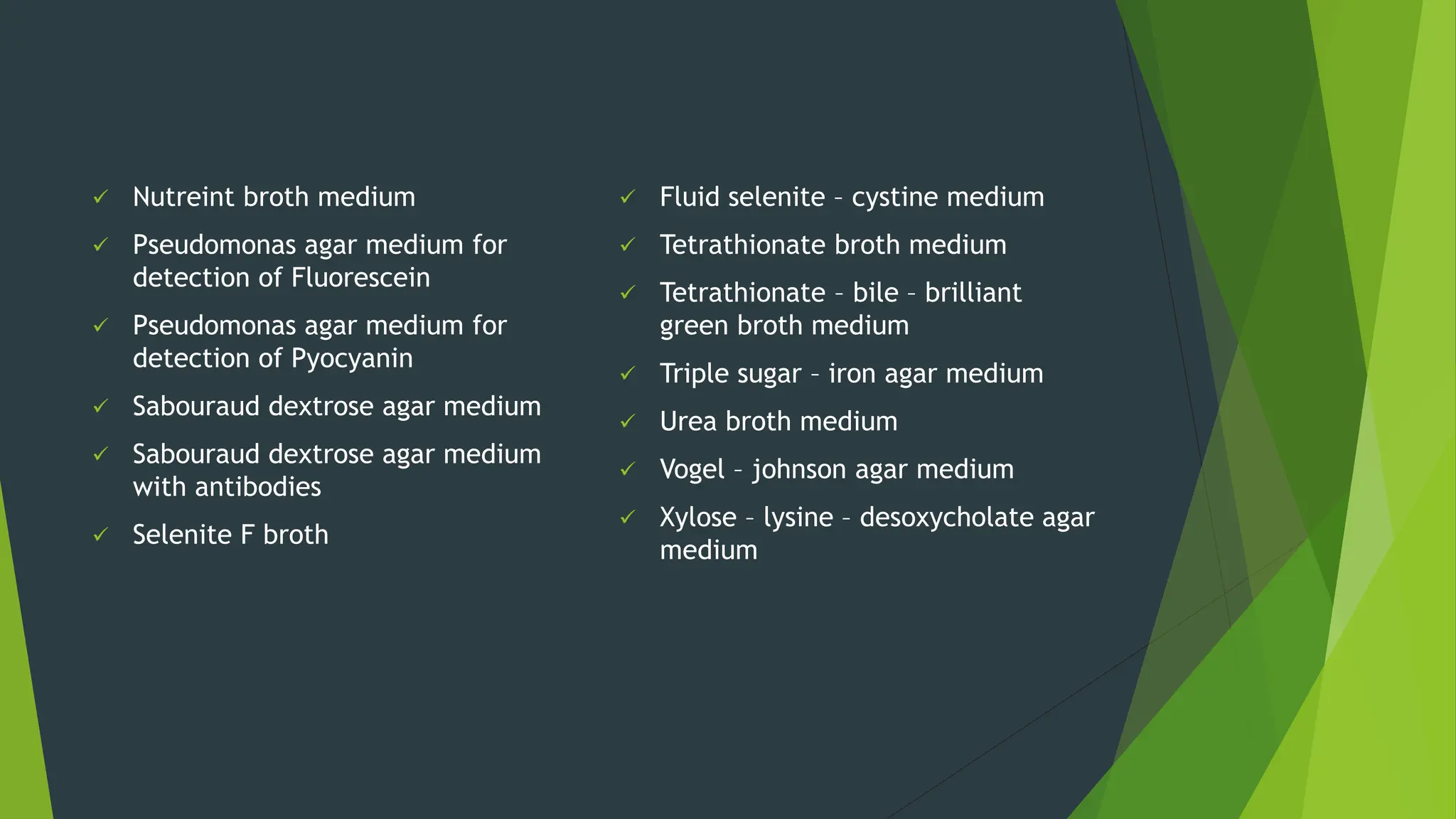
✓ Nutreint broth medium
✓ Pseudomonas agar medium for
detection of Fluorescein
✓ Pseudomonas agar medium for
detection of Pyocyanin
✓ Sabouraud dextrose agar medium
with antibodies
✓ Selenite F broth
✓ Fluid selenite – cystine medium
✓ Tetrathionate broth medium
✓ Tetrathionate – bile – brilliant
green broth medium
✓ Triple sugar – iron agar medium
✓ Urea broth medium
✓ Vogel – johnson agar medium
✓ Xylose – lysine – desoxycholate agar
medium
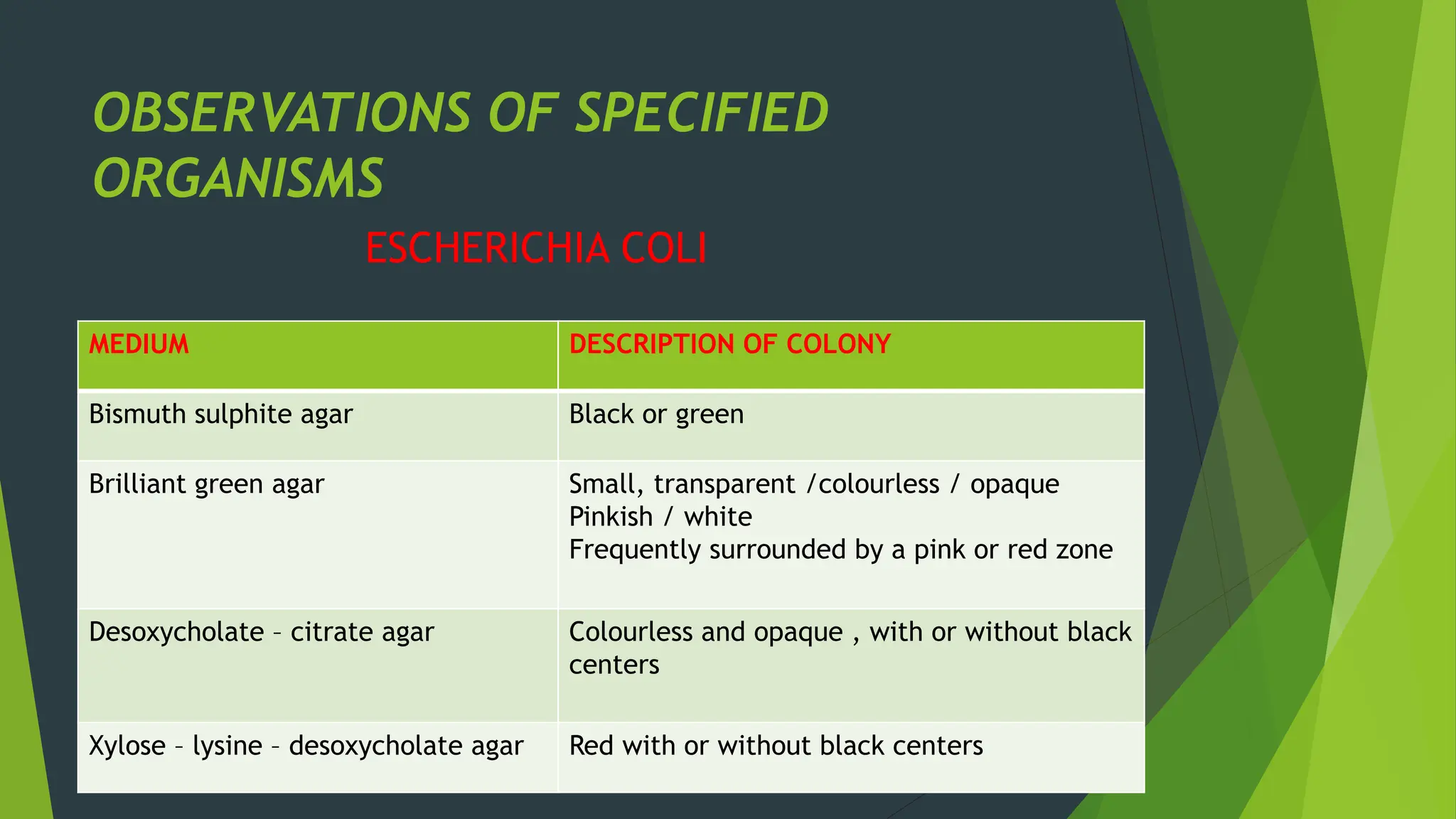
OBSERVATIONS OF SPECIFIED
ORGANISMS
ESCHERICHIA COLI
MEDIUM DESCRIPTION OF COLONY
Bismuth sulphite agar Black or green
Brilliant green agar Small, transparent /colourless / opaque
Pinkish / white
Frequently surrounded by a pink or red zone
Desoxycholate – citrate agar Colourless and opaque , with or without black
centers
Xylose – lysine – desoxycholate agar Red with or without black centers
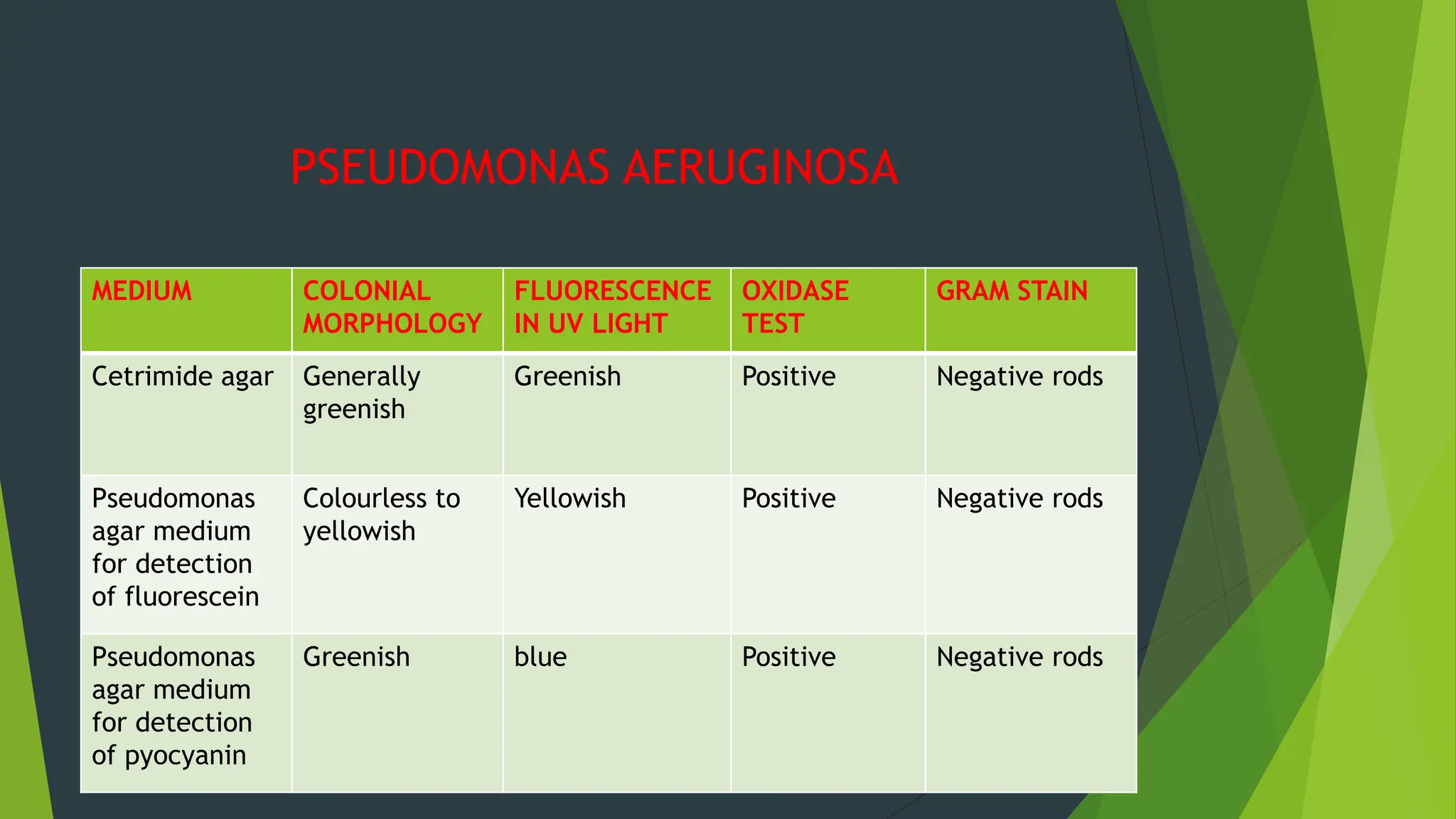
PSEUDOMONAS AERUGINOSA
MEDIUM COLONIAL
MORPHOLOGY
FLUORESCENCE
IN UV LIGHT
OXIDASE
TEST
GRAM STAIN
Cetrimide agar Generally
greenish
Greenish Positive Negative rods
Pseudomonas
agar medium
for detection
of fluorescein
Colourless to
yellowish
Yellowish Positive Negative rods
Pseudomonas
agar medium
for detection
of pyocyanin
Greenish blue Positive Negative rods
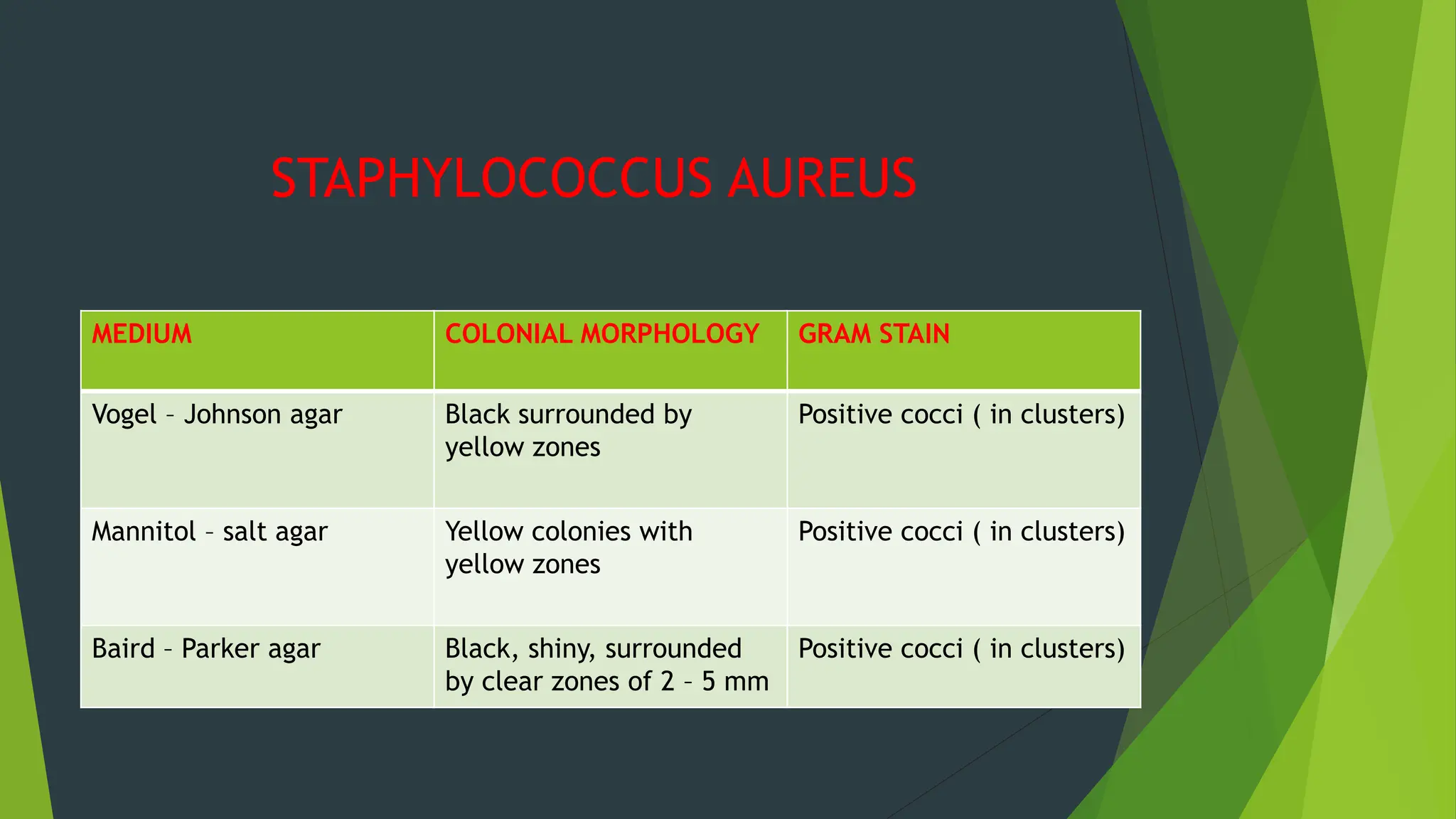
STAPHYLOCOCCUS AUREUS
MEDIUM COLONIAL MORPHOLOGY GRAM STAIN
Vogel – Johnson agar Black surrounded by
yellow zones
Positive cocci ( in clusters)
Mannitol – salt agar Yellow colonies with
yellow zones
Positive cocci ( in clusters)
Baird – Parker agar Black, shiny, surrounded
by clear zones of 2 – 5 mm
Positive cocci ( in clusters)
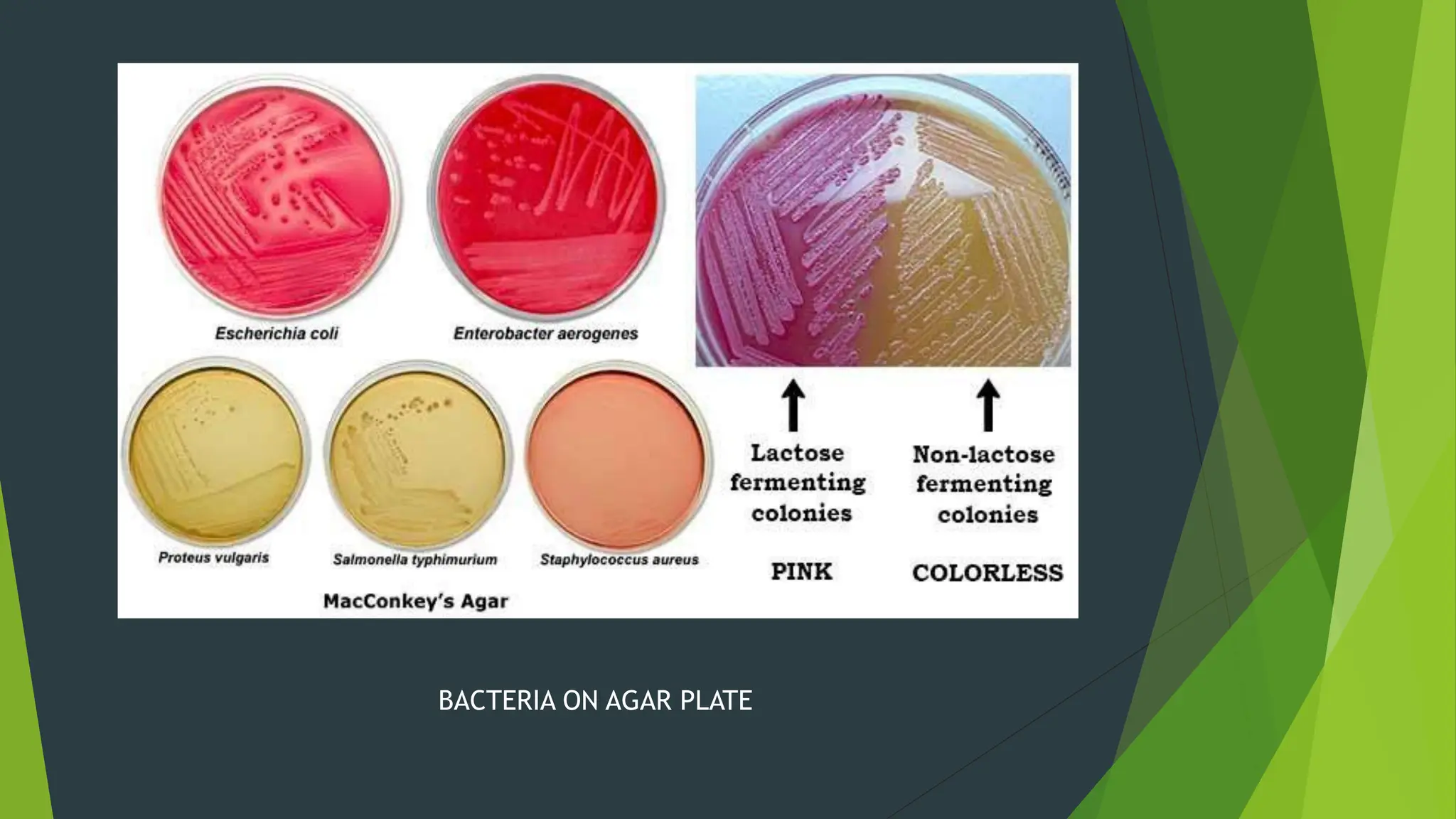
BACTERIA ON AGAR PLATE
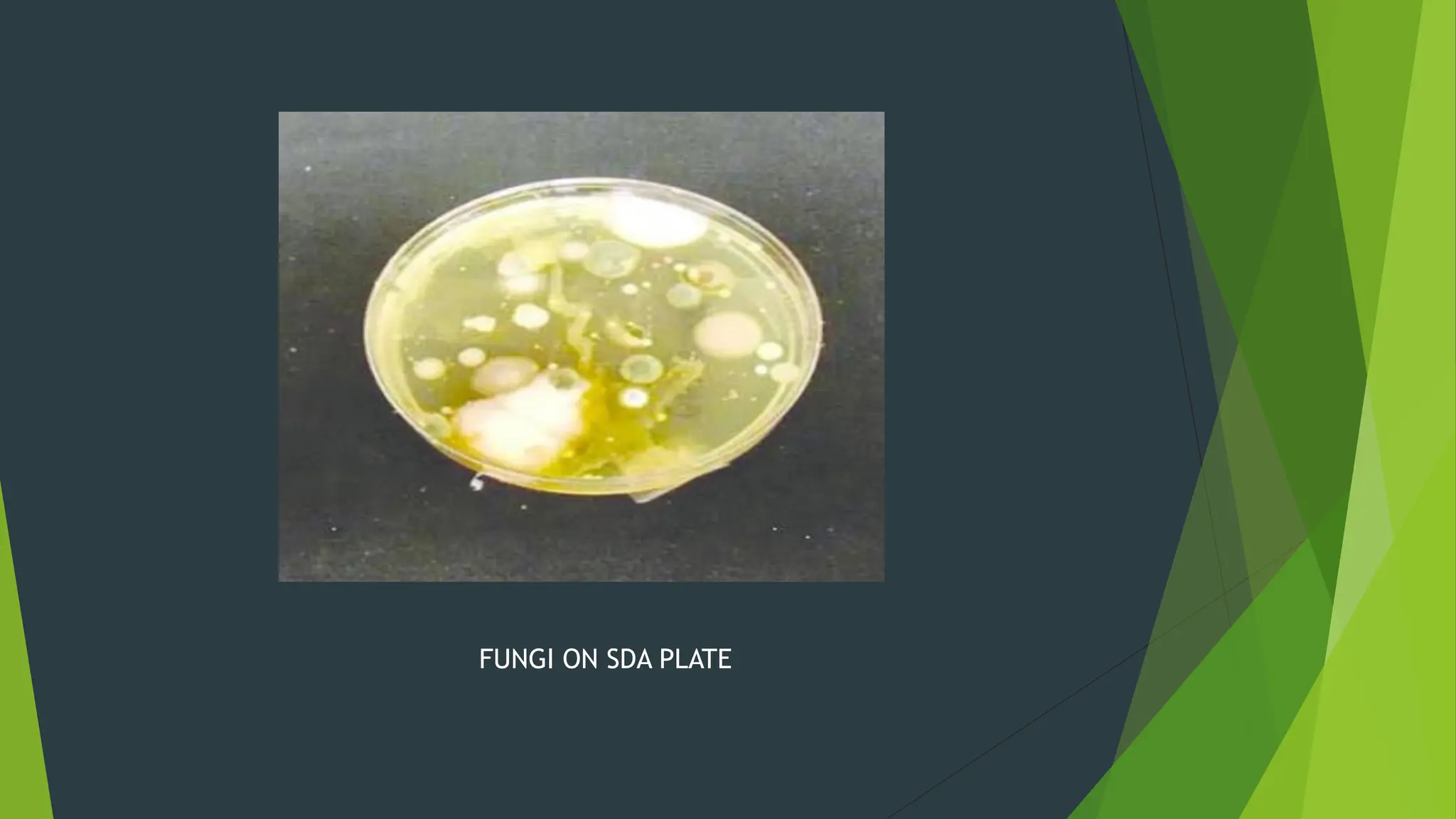
FUNGI ON SDA PLATE
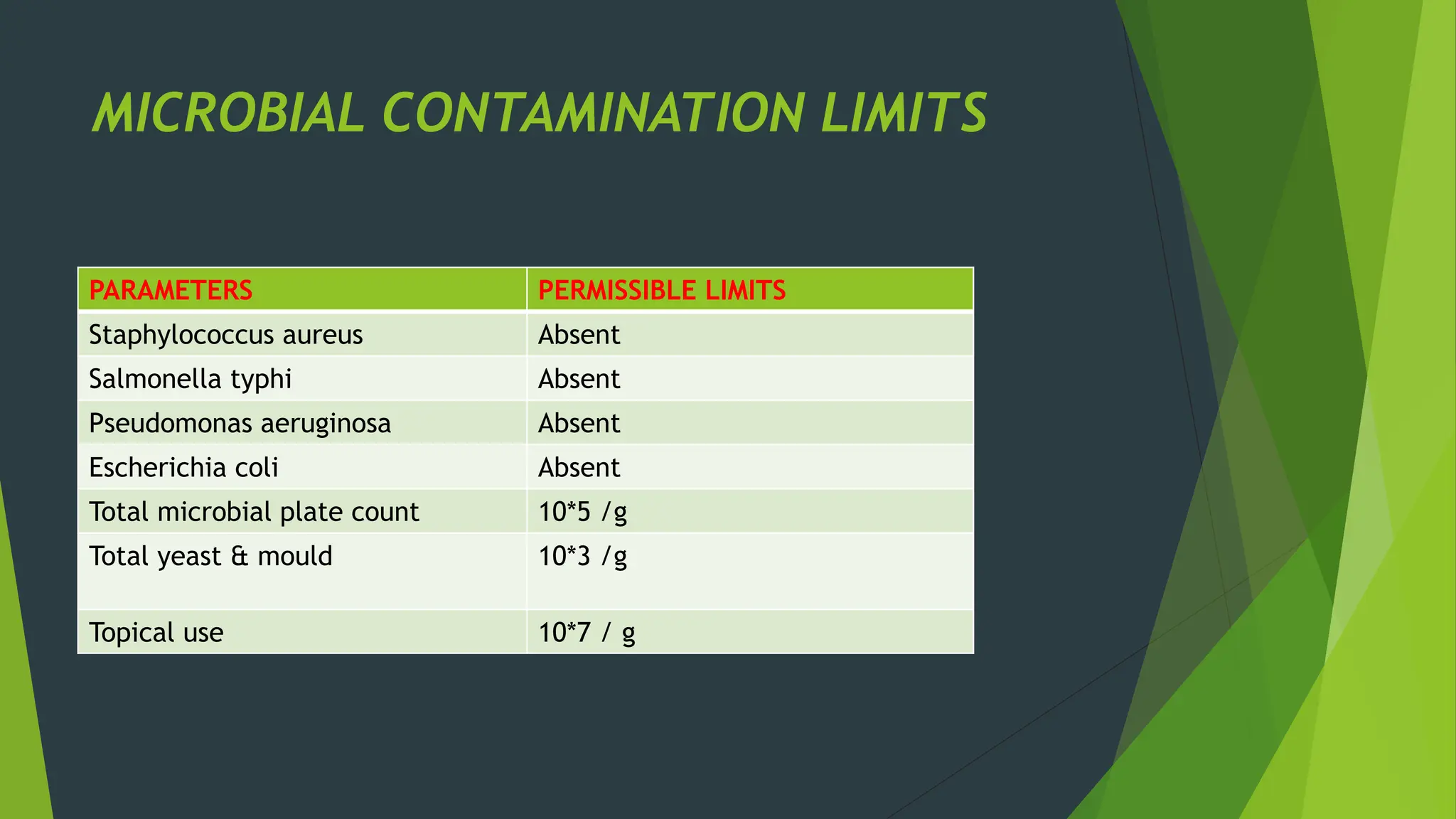
MICROBIAL CONTAMINATION LIMITS
PARAMETERS PERMISSIBLE LIMITS
Staphylococcus aureus Absent
Salmonella typhi Absent
Pseudomonas aeruginosa Absent
Escherichia coli Absent
Total microbial plate count 10*5 /g
Total yeast & mould 10*3 /g
Topical use 10*7 / g
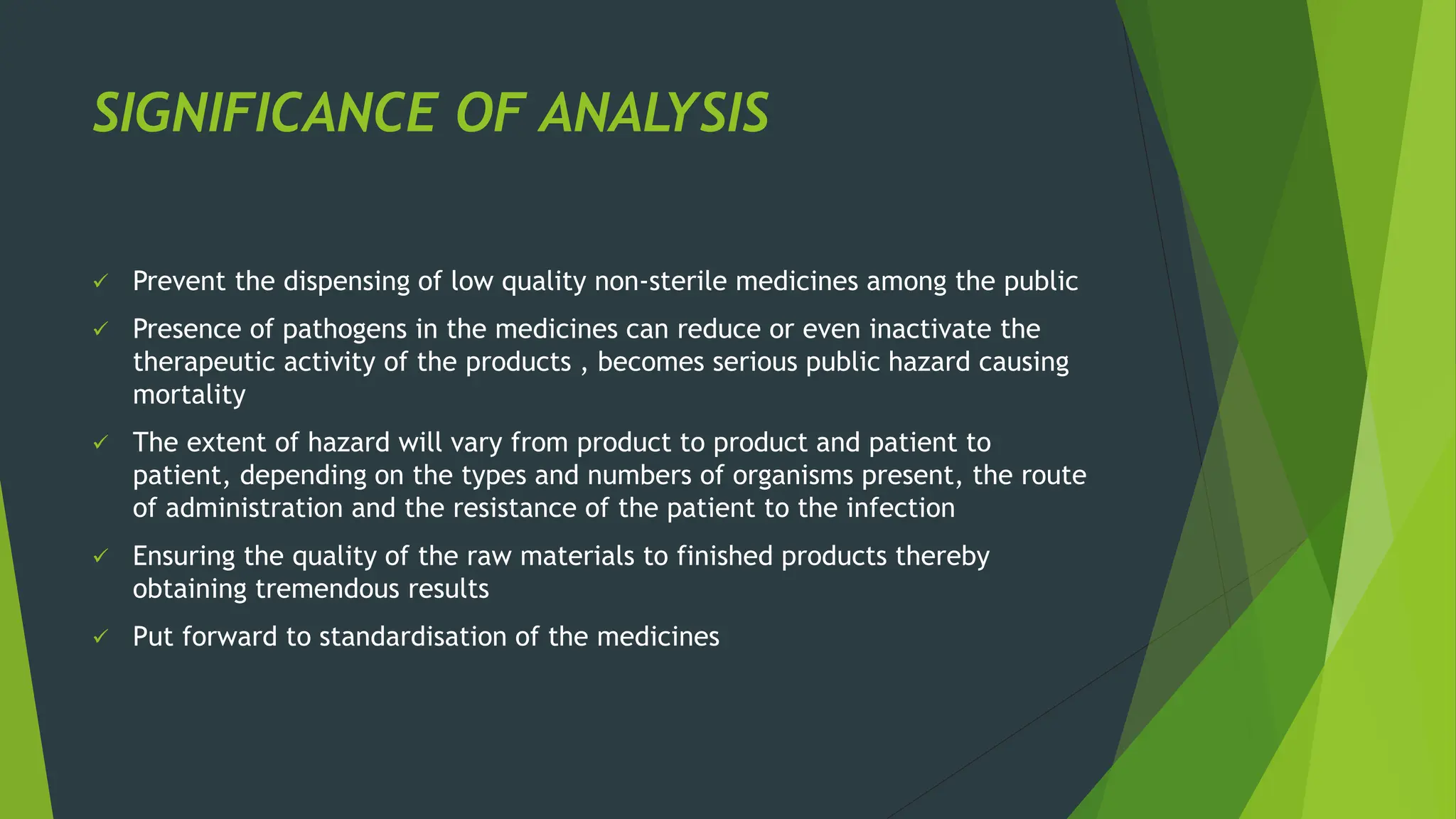
SIGNIFICANCE OF ANALYSIS
✓ Prevent the dispensing of low quality non-sterile medicines among the public
✓ Presence of pathogens in the medicines can reduce or even inactivate the
therapeutic activity of the products , becomes serious public hazard causing
mortality
✓ The extent of hazard will vary from product to product and patient to
patient, depending on the types and numbers of organisms present, the route
of administration and the resistance of the patient to the infection
✓ Ensuring the quality of the raw materials to finished products thereby
obtaining tremendous results
✓ Put forward to standardisation of the medicines
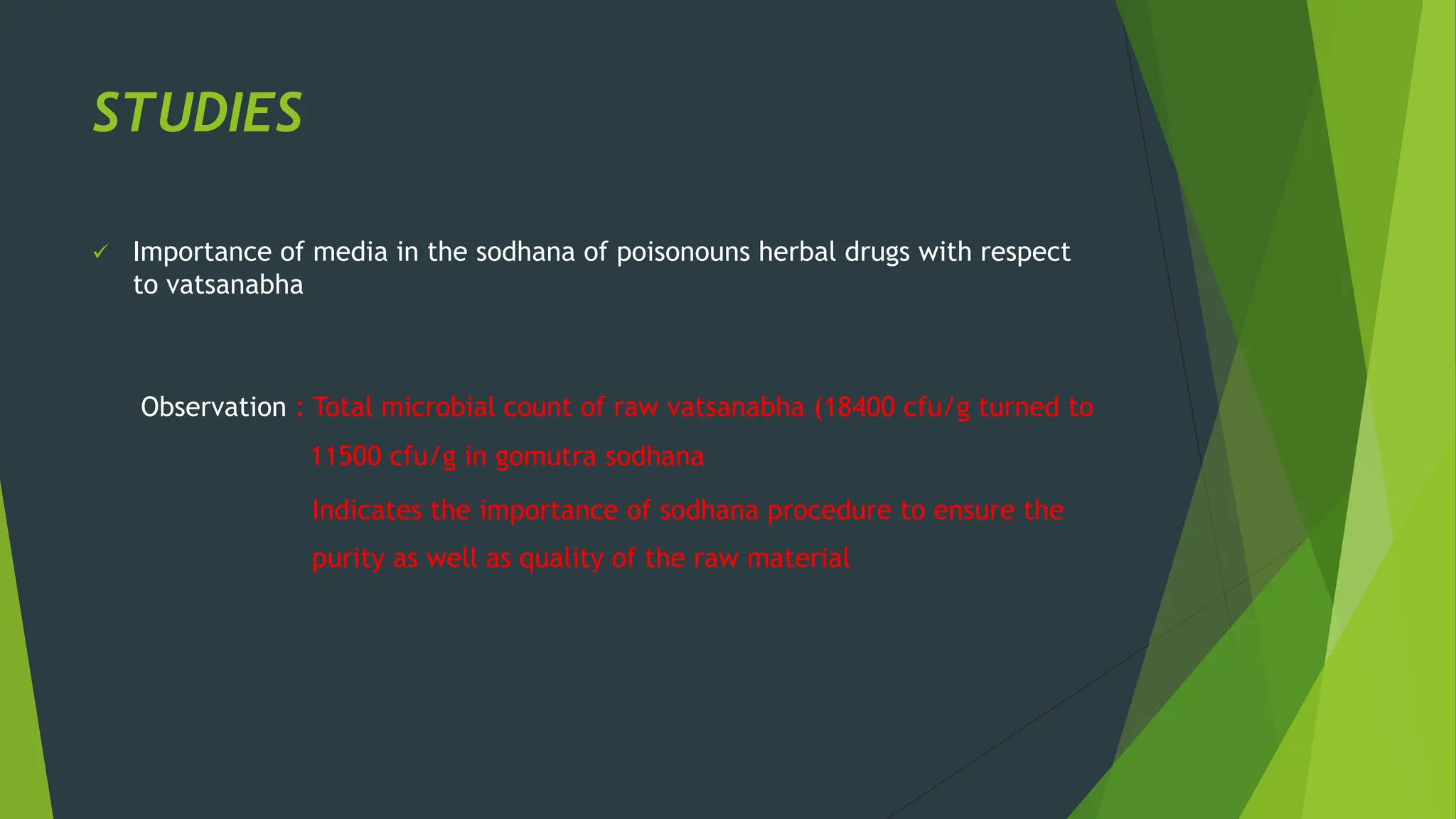
STUDIES
✓ Importance of media in the sodhana of poisonouns herbal drugs with respect
to vatsanabha
Observation : Total microbial count of raw vatsanabha (18400 cfu/g turned to
11500 cfu/g in gomutra sodhana
Indicates the importance of sodhana procedure to ensure the
purity as well as quality of the raw material
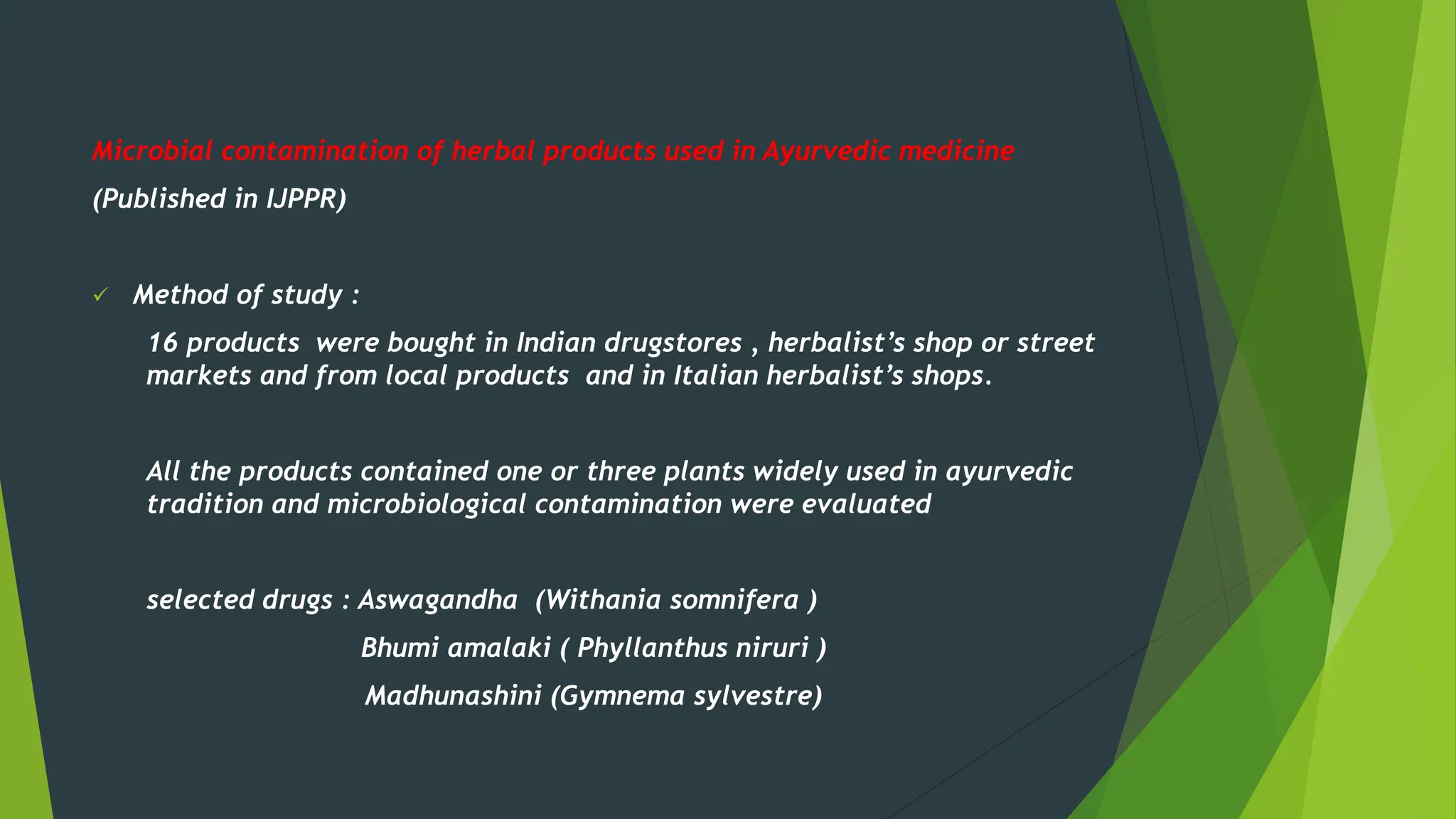
Microbial contamination of herbal products used in Ayurvedic medicine
(Published in IJPPR)
✓ Method of study :
16 products were bought in Indian drugstores , herbalist’s shop or street
markets and from local products and in Italian herbalist’s shops.
All the products contained one or three plants widely used in ayurvedic
tradition and microbiological contamination were evaluated
selected drugs : Aswagandha (Withania somnifera )
Bhumi amalaki ( Phyllanthus niruri )
Madhunashini (Gymnema sylvestre)
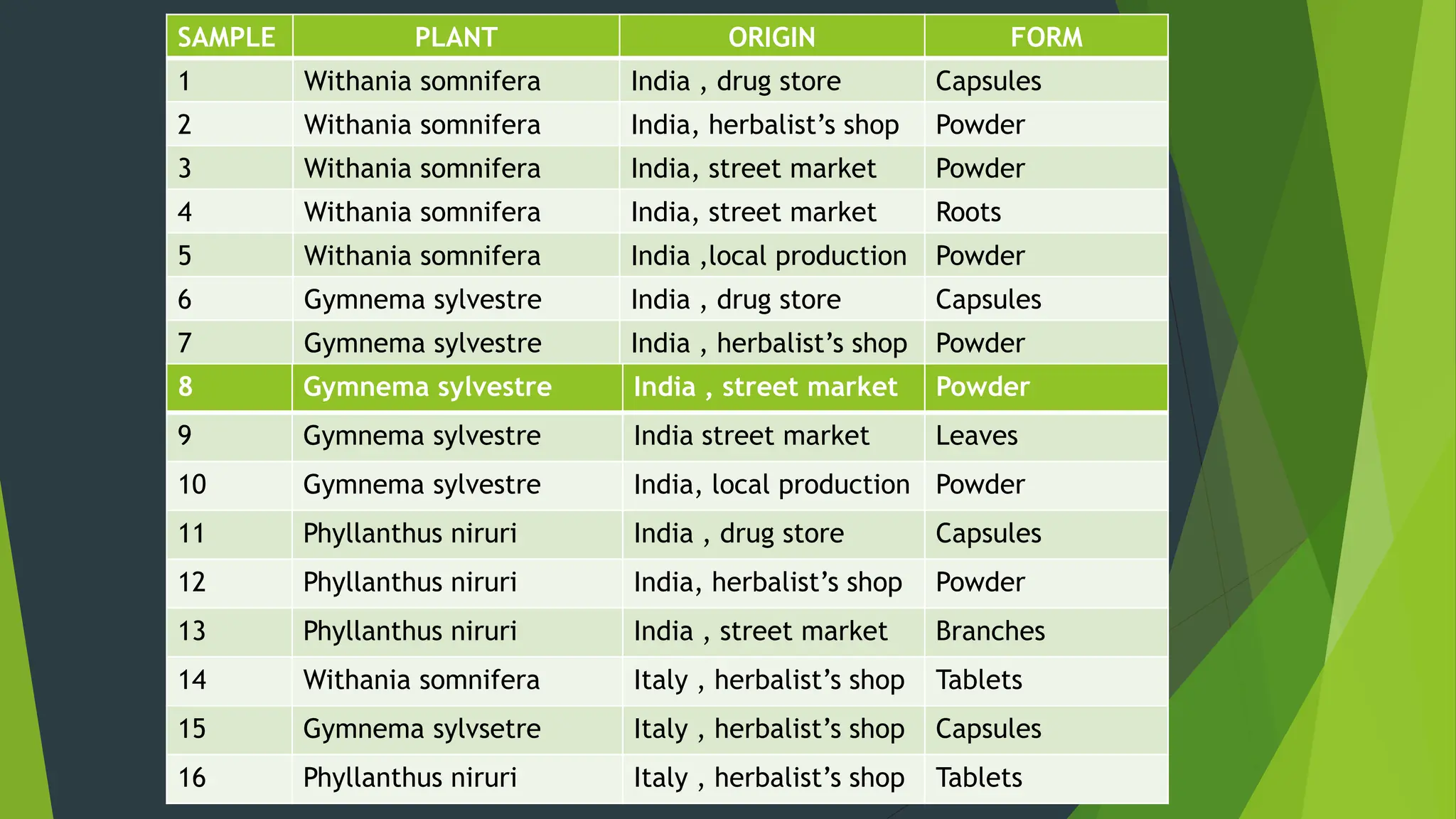
SAMPLE PLANT ORIGIN FORM
1 Withania somnifera India , drug store Capsules
2 Withania somnifera India, herbalist’s shop Powder
3 Withania somnifera India, street market Powder
4 Withania somnifera India, street market Roots
5 Withania somnifera India ,local production Powder
6 Gymnema sylvestre India , drug store Capsules
7 Gymnema sylvestre India , herbalist’s shop Powder
8 Gymnema sylvestre India , street market Powder
9 Gymnema sylvestre India street market Leaves
10 Gymnema sylvestre India, local production Powder
11 Phyllanthus niruri India , drug store Capsules
12 Phyllanthus niruri India, herbalist’s shop Powder
13 Phyllanthus niruri India , street market Branches
14 Withania somnifera Italy , herbalist’s shop Tablets
15 Gymnema sylvsetre Italy , herbalist’s shop Capsules
16 Phyllanthus niruri Italy , herbalist’s shop Tablets
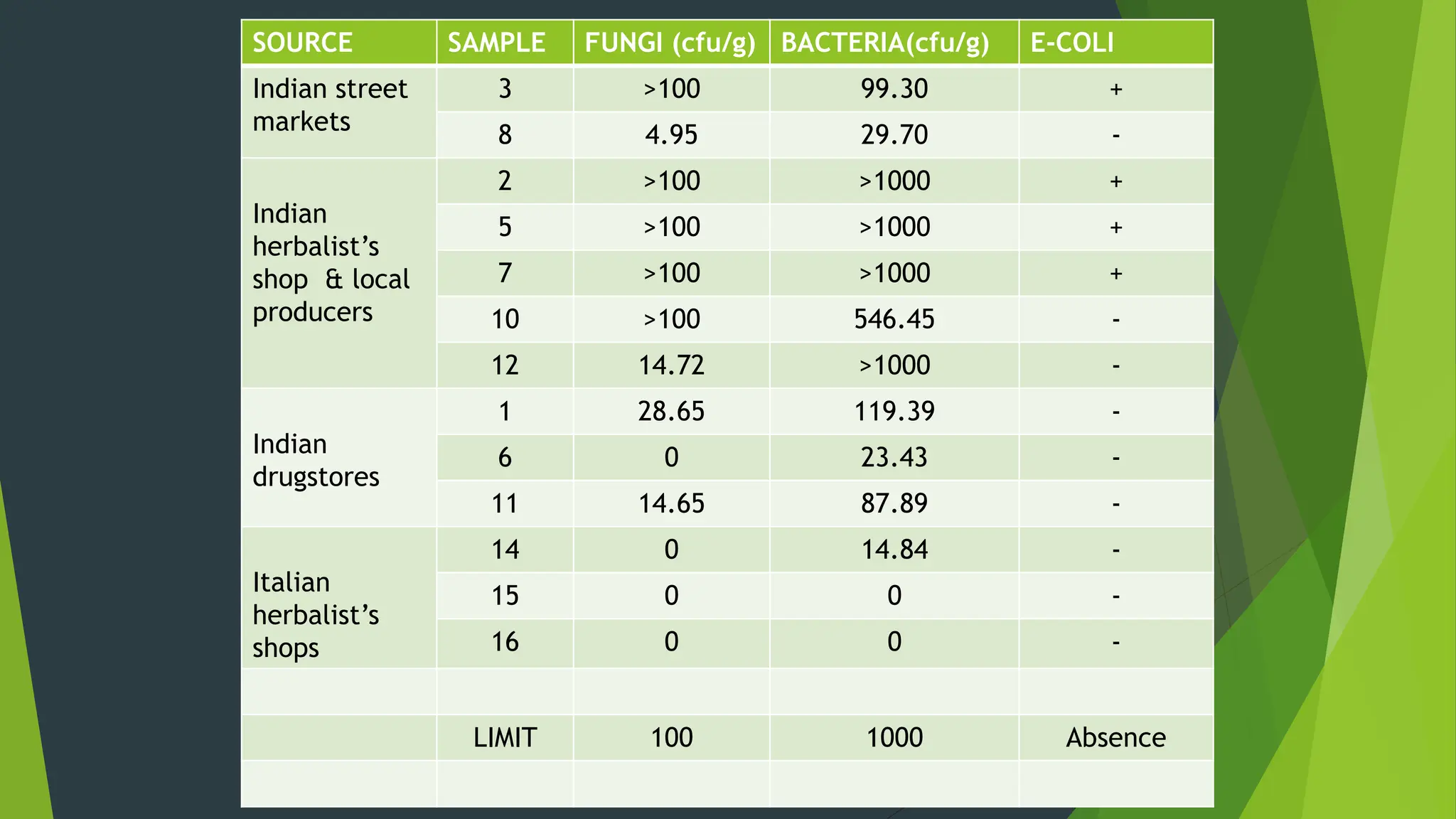
SOURCE SAMPLE FUNGI (cfu/g) BACTERIA(cfu/g) E-COLI
Indian street
markets
3 >100 99.30 +
8 4.95 29.70 -
Indian
herbalist’s
shop & local
producers
2 >100 >1000 +
5 >100 >1000 +
7 >100 >1000 +
10 >100 546.45 -
12 14.72 >1000 -
Indian
drugstores
1 28.65 119.39 -
6 0 23.43 -
11 14.65 87.89 -
Italian
herbalist’s
shops
14 0 14.84 -
15 0 0 -
16 0 0 -
LIMIT 100 1000 Absence
OBSERVATIONS
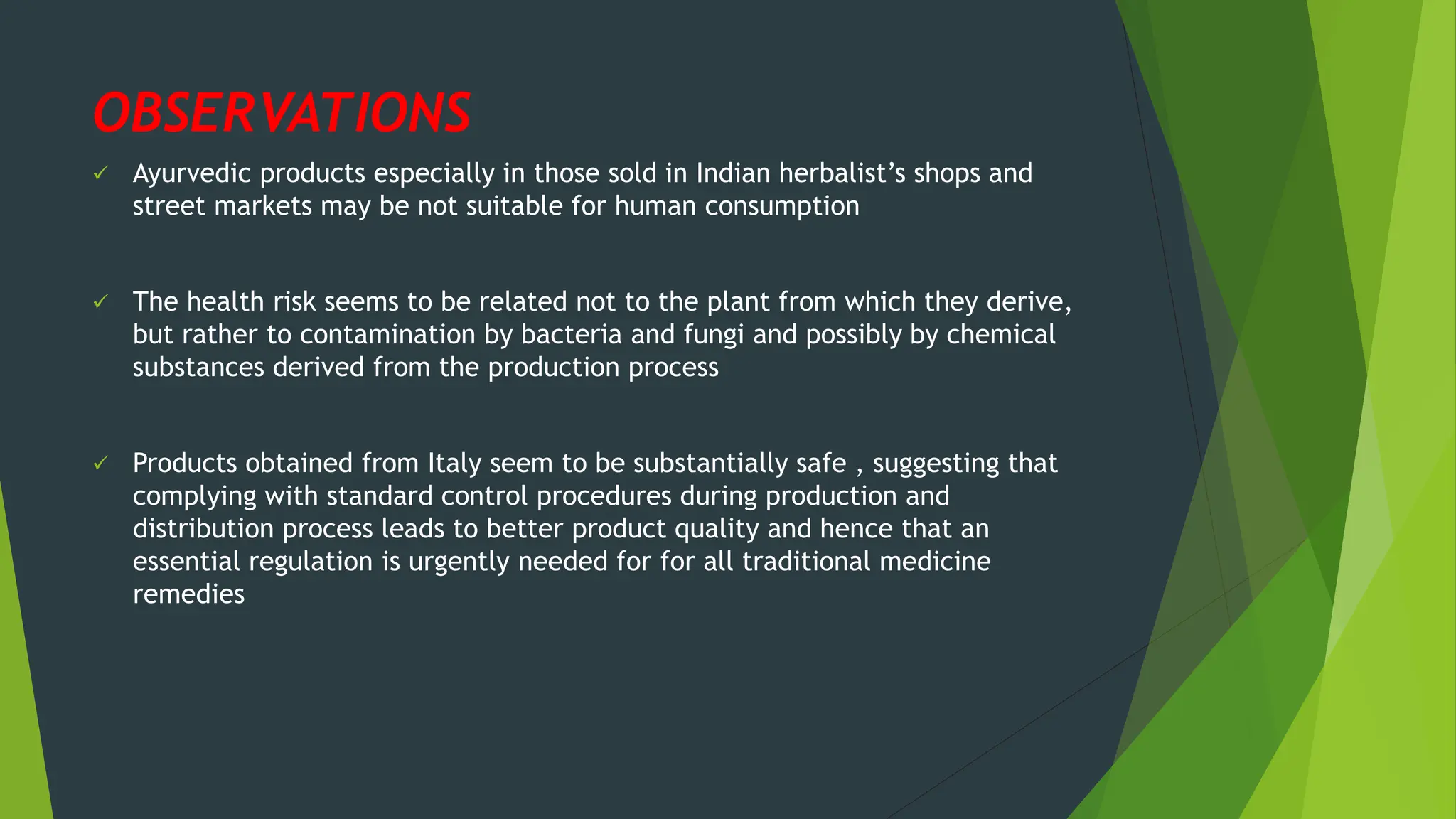
✓ Ayurvedic products especially in those sold in Indian herbalist’s shops and
street markets may be not suitable for human consumption
✓ The health risk seems to be related not to the plant from which they derive,
but rather to contamination by bacteria and fungi and possibly by chemical
substances derived from the production process
✓ Products obtained from Italy seem to be substantially safe , suggesting that
complying with standard control procedures during production and
distribution process leads to better product quality and hence that an
essential regulation is urgently needed for for all traditional medicine
remedies
CLASSICAL REFERECES
✓ Caraka samhitha kal 1st: अक्रिमिनि अपूनििी अजन्िु जग्धािी
✓ Susruta samhitha , Astanga hridaya : कृ मि विष शास्त्र दहि अिुपहिि्
IT’S BETTER TO BE
SAFETY CONSCIOUS THAN
UNSAFE AND UNCONSCIOUS
THANKYOU

MICROBIAL CONTAMINATION DETECTION METHODS & PERMISSIBLE LIMITS

  • 1.
  • 2.
    Non – intendedor accidental introduction of microbes such as bacteria, yeast, mould, fungi, virus, prions, protozoa or their toxins & byproducts GROWTH the presence & presumed proliferation of viable micro-organisms
  • 3.
  • 4.
    ✓ The rawmaterials including water from which the product is manufactured ✓ The manufacturing environment including the atmosphere, equipment and work surfaces ✓ Manufacturing personnel
  • 5.
  • 6.
    OBJECTIVES OF ANALYSIS ✓To determine the nature of microbial contamination of the herbal medicines ✓ To determine the extent of such contamination ✓ To perform limit tests for the total viable aerobic bacteria and fungi indicating the quality of herbal preparations
  • 7.
    ANALYTIC PARAMETERS ✓ Limitsof E-coli & molds ✓ Total viable aerobic count ✓ Total enterobacteria & their count ✓ Alatoxin analysis
  • 8.
    PROCEDURE ✓ Collect thesamples each containing 1gm of finished products in a sterile bottle ✓ Label the bottles based on the time interval between which the procedure has to be carried out ( eg. 2 , 4 , 5, 7days or 1 , 6 months ) ✓ Prepare the cultures of suspecting microbes in solid and liquid medias ✓ Medias have to be selected according to micro-organisms ( MacConkey agar medium, nutrient broth medium for bacteria, sabouraud dextrose agar medium for fungi ) ✓ Temperature should be regulated (incubation ) based on microbes ( bacteria - 30 to 35 ( 37) degree Celsius , fungi – 20 to 25 (room T or 26) degree Celsius ) ✓ After specific period of time (24 - 48 hrs to 5 days for bacteria , 4 – 5 days for fungi) examine the plate of cultured microbe microscopically and observations are noted
  • 9.
    MEDIAS USED FORANALYTICAL TESTING ✓ Baird – Parker agar medium ✓ Bismuth sulphite agar medium ✓ Brilliant green agar medium ✓ Buffered sodium chloride – peptone solution (PH 7.0) ✓ Casein soyabean digest agar medium ✓ Cetrimide agar medium ✓ Desoxycholate – citrate agar medium ✓ Fluid casein digest – soya lecithin – polysorbate 20 medium ✓ Fluid lactose medium ✓ Lactose broth medium ✓ Levin eosin – methylene blue agr medium ✓ MacConkey agar medium ✓ MacConkey broth medium ✓ Mannitol – salt agar medium ✓ Nutreint agar medium
  • 10.
    ✓ Nutreint brothmedium ✓ Pseudomonas agar medium for detection of Fluorescein ✓ Pseudomonas agar medium for detection of Pyocyanin ✓ Sabouraud dextrose agar medium ✓ Sabouraud dextrose agar medium with antibodies ✓ Selenite F broth ✓ Fluid selenite – cystine medium ✓ Tetrathionate broth medium ✓ Tetrathionate – bile – brilliant green broth medium ✓ Triple sugar – iron agar medium ✓ Urea broth medium ✓ Vogel – johnson agar medium ✓ Xylose – lysine – desoxycholate agar medium
  • 11.
    OBSERVATIONS OF SPECIFIED ORGANISMS ESCHERICHIACOLI MEDIUM DESCRIPTION OF COLONY Bismuth sulphite agar Black or green Brilliant green agar Small, transparent /colourless / opaque Pinkish / white Frequently surrounded by a pink or red zone Desoxycholate – citrate agar Colourless and opaque , with or without black centers Xylose – lysine – desoxycholate agar Red with or without black centers
  • 12.
    PSEUDOMONAS AERUGINOSA MEDIUM COLONIAL MORPHOLOGY FLUORESCENCE INUV LIGHT OXIDASE TEST GRAM STAIN Cetrimide agar Generally greenish Greenish Positive Negative rods Pseudomonas agar medium for detection of fluorescein Colourless to yellowish Yellowish Positive Negative rods Pseudomonas agar medium for detection of pyocyanin Greenish blue Positive Negative rods
  • 13.
    STAPHYLOCOCCUS AUREUS MEDIUM COLONIALMORPHOLOGY GRAM STAIN Vogel – Johnson agar Black surrounded by yellow zones Positive cocci ( in clusters) Mannitol – salt agar Yellow colonies with yellow zones Positive cocci ( in clusters) Baird – Parker agar Black, shiny, surrounded by clear zones of 2 – 5 mm Positive cocci ( in clusters)
  • 14.
  • 15.
  • 16.
    MICROBIAL CONTAMINATION LIMITS PARAMETERSPERMISSIBLE LIMITS Staphylococcus aureus Absent Salmonella typhi Absent Pseudomonas aeruginosa Absent Escherichia coli Absent Total microbial plate count 10*5 /g Total yeast & mould 10*3 /g Topical use 10*7 / g
  • 17.
    SIGNIFICANCE OF ANALYSIS ✓Prevent the dispensing of low quality non-sterile medicines among the public ✓ Presence of pathogens in the medicines can reduce or even inactivate the therapeutic activity of the products , becomes serious public hazard causing mortality ✓ The extent of hazard will vary from product to product and patient to patient, depending on the types and numbers of organisms present, the route of administration and the resistance of the patient to the infection ✓ Ensuring the quality of the raw materials to finished products thereby obtaining tremendous results ✓ Put forward to standardisation of the medicines
  • 18.
    STUDIES ✓ Importance ofmedia in the sodhana of poisonouns herbal drugs with respect to vatsanabha Observation : Total microbial count of raw vatsanabha (18400 cfu/g turned to 11500 cfu/g in gomutra sodhana Indicates the importance of sodhana procedure to ensure the purity as well as quality of the raw material
  • 19.
    Microbial contamination ofherbal products used in Ayurvedic medicine (Published in IJPPR) ✓ Method of study : 16 products were bought in Indian drugstores , herbalist’s shop or street markets and from local products and in Italian herbalist’s shops. All the products contained one or three plants widely used in ayurvedic tradition and microbiological contamination were evaluated selected drugs : Aswagandha (Withania somnifera ) Bhumi amalaki ( Phyllanthus niruri ) Madhunashini (Gymnema sylvestre)
  • 20.
    SAMPLE PLANT ORIGINFORM 1 Withania somnifera India , drug store Capsules 2 Withania somnifera India, herbalist’s shop Powder 3 Withania somnifera India, street market Powder 4 Withania somnifera India, street market Roots 5 Withania somnifera India ,local production Powder 6 Gymnema sylvestre India , drug store Capsules 7 Gymnema sylvestre India , herbalist’s shop Powder 8 Gymnema sylvestre India , street market Powder 9 Gymnema sylvestre India street market Leaves 10 Gymnema sylvestre India, local production Powder 11 Phyllanthus niruri India , drug store Capsules 12 Phyllanthus niruri India, herbalist’s shop Powder 13 Phyllanthus niruri India , street market Branches 14 Withania somnifera Italy , herbalist’s shop Tablets 15 Gymnema sylvsetre Italy , herbalist’s shop Capsules 16 Phyllanthus niruri Italy , herbalist’s shop Tablets
  • 21.
    SOURCE SAMPLE FUNGI(cfu/g) BACTERIA(cfu/g) E-COLI Indian street markets 3 >100 99.30 + 8 4.95 29.70 - Indian herbalist’s shop & local producers 2 >100 >1000 + 5 >100 >1000 + 7 >100 >1000 + 10 >100 546.45 - 12 14.72 >1000 - Indian drugstores 1 28.65 119.39 - 6 0 23.43 - 11 14.65 87.89 - Italian herbalist’s shops 14 0 14.84 - 15 0 0 - 16 0 0 - LIMIT 100 1000 Absence
  • 22.
    OBSERVATIONS ✓ Ayurvedic productsespecially in those sold in Indian herbalist’s shops and street markets may be not suitable for human consumption ✓ The health risk seems to be related not to the plant from which they derive, but rather to contamination by bacteria and fungi and possibly by chemical substances derived from the production process ✓ Products obtained from Italy seem to be substantially safe , suggesting that complying with standard control procedures during production and distribution process leads to better product quality and hence that an essential regulation is urgently needed for for all traditional medicine remedies
  • 23.
    CLASSICAL REFERECES ✓ Carakasamhitha kal 1st: अक्रिमिनि अपूनििी अजन्िु जग्धािी ✓ Susruta samhitha , Astanga hridaya : कृ मि विष शास्त्र दहि अिुपहिि्
  • 24.
    IT’S BETTER TOBE SAFETY CONSCIOUS THAN UNSAFE AND UNCONSCIOUS
  • 25.