


Mount Tabor
ekjijan@gmail.com
A SCHOOL TEACHER’S
CREEDI believe in boys and girls, the men and women of a great tomorrow;
that what so ever the boy sows the man shall reap.
I believe in the curse of ignorance, in the efficacy of schools, in the
dignity of teaching, and the joy of serving others.
I believe In wisdom as revealed in human lives, as well as the pages of
a printed book, in lesson taught, not so much by precepts as by
examples, in ability to work with hands as well as to think with head, in
everything that makes life large and lovely.
I believe in beauty in the school room, in daily life and in the out-of
doors. I believe in laughter in love, in faith, in all ideals and instant hopes
that lure us on.
I believe in the present and its opportunities, in the future and its
promises, and in the divine joy of living.
- Edwin Osgood Grover
Mount Tabor
ekjijan@gmail.com
Mount Tabor
ekjijan@gmail.com
Mount Tabor
ekjijan@gmail.com
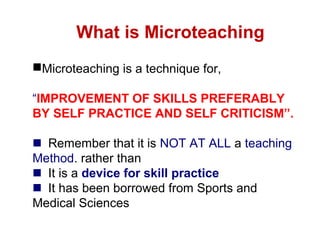
Microteaching is a technique for,
“IMPROVEMENT OF SKILLS PREFERABLY
BY SELF PRACTICE AND SELF CRITICISM”.
Remember that it is NOT AT ALL a teaching
Method. rather than
It is a device for skill practice
It has been borrowed from Sports and
Medical Sciences
What is Microteaching
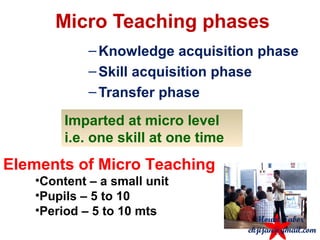
Micro Teaching phases
–Knowledge acquisition phase
–Skill acquisition phase
–Transfer phase
Elements of Micro Teaching
•Content – a small unit
•Pupils – 5 to 10
•Period – 5 to 10 mts
Mount Tabor
ekjijan@gmail.com
Imparted at micro level
i.e. one skill at one time
Define a particular skill in terms of
teacher behaviours
Demonstration – video tape or by
teacher
Plan a short lesson by student
teacher
Teaching by student teacher
Feedback
Re-plan, re-teach, re-feedbackMount Tabor
ekjijan@gmail.com
•Teaching – a complex act
consists of -
a number of acts/
teacher behaviours/
verbal & non-verbal activities
• Teaching skills
are specific teaching acts/ behaviours
which are measurable, observable,
demonstrable and can be developed
through training.
Mount Tabor
ekjijan@gmail.com
Allen D W and Ryan K A listed the following
teaching skills at Stanford University, U.S.A.
1. Stimulus Variation
2. Set induction
3. Closure
4. Teacher silence and non-verbal cues
5. Reinforcing pupil participation
6. Fluency in questioning
7. Probing questioning
8. Use of higher questions
9. Divergent questions
10. Recognizing and attending behaviour
11. Illustrating and use of examples
12. Lecturing
13. Planned repetition
14. Completeness of communication Mount Tabor
ekjijan@gmail.com
NCERT in its publication Core Teaching Skills (1982)
has laid stress on the following teaching skills…
• writing instructional objectives
• Organizing the content
• Creating set for introducing the lesson
• introducing a lesson
• Structuring classroom questions
• Question delivery and its distribution
• Response management
• explaining
• illustrating with examples
• Using teaching aids
• Stimulus variation
• Pacing of the lesson
• Promoting pupil participation
• Use of blackboard
• Achieving closure of the lesson
• Giving assignments
• Evaluating the pupil’s progress
• Diagnosing pupil learning difficulties and taking remedial measures
• Management of the class
Mount Tabor
ekjijan@gmail.com
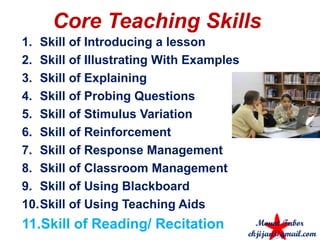
Core Teaching Skills
1. Skill of Introducing a lesson
2. Skill of Illustrating With Examples
3. Skill of Explaining
4. Skill of Probing Questions
5. Skill of Stimulus Variation
6. Skill of Reinforcement
7. Skill of Response Management
8. Skill of Classroom Management
9. Skill of Using Blackboard
10.Skill of Using Teaching Aids
11.Skill of Reading/ Recitation Mount Tabor
ekjijan@gmail.com
SKILL OF
INTRODUCINGGreeting & Accepting
Greeting
Securing Attention
Giving Instruction
Establishing Rapport
Ensuring facilities
Linking with past Experience
Link between Introduction &
main parts
Use of Appropriate
Techniques
Mount Tabor
ekjijan@gmail.com
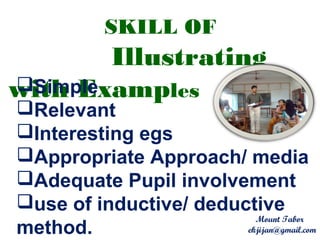
SKILL OF
Illustrating
with ExamplesSimple
Relevant
Interesting egs
Appropriate Approach/ media
Adequate Pupil involvement
use of inductive/ deductive
method.
Mount Tabor
ekjijan@gmail.com
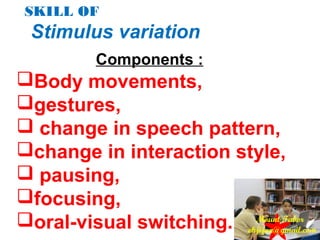
SKILL OF
Stimulus variation
Components :
Body movements,
gestures,
 change in speech pattern,
change in interaction style,
 pausing,
focusing,
oral-visual switching. Mount Tabor
ekjijan@gmail.com
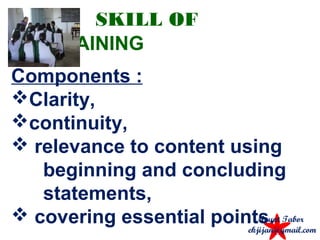
SKILL OF
EXPLAINING
Components :
Clarity,
continuity,
 relevance to content using
beginning and concluding
statements,
 covering essential points.Mount Tabor
ekjijan@gmail.com
SKILL OF Reinforcement
Components :
Use of praise words and statements,
 accepting and using pupils’ idea,
repeating and rephrasing,
extra verbal cues,
use of pleasant and approving
gestures and expressions,
 writing pupils’ answer on the
black board. Mount Tabor
ekjijan@gmail.com
SKILL OF
QuestioningClear & Specific
Precise and concise
Grammatic correction
Relevant to the content
Proper voice & pause
Proper speed & pitch
Well distribution of Questions
Unnecessary repetition of Qns
Fluency and flow
Construction of questions @
Different levels Mount Tabor
ekjijan@gmail.com
SKILL OF
Response Management
(Obtaining
Correct Response)Prompting
Re-direction
focusing,
Seeking further explanation
(how?, why?)
increasing critical awareness.Mount Tabor
ekjijan@gmail.com
Skill of Black
Board Writing
Components :
• legible and neat
• adequate with reference to
content covered
• systematic
Mount Tabor
ekjijan@gmail.com
SKILL OF
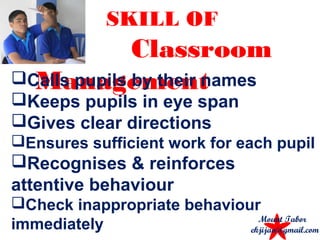
Classroom
ManagementCalls pupils by their names
Keeps pupils in eye span
Gives clear directions
Ensures sufficient work for each pupil
Recognises & reinforces
attentive behaviour
Check inappropriate behaviour
immediately Mount Tabor
ekjijan@gmail.com
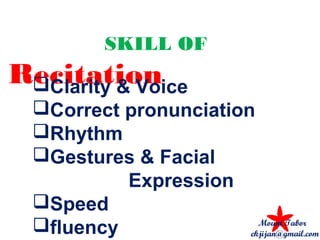
SKILL OF
RecitationClarity & Voice
Correct pronunciation
Rhythm
Gestures & Facial
Expression
Speed
fluency Mount Tabor
ekjijan@gmail.com
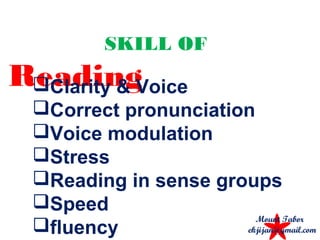
SKILL OF
ReadingClarity & Voice
Correct pronunciation
Voice modulation
Stress
Reading in sense groups
Speed
fluency
Mount Tabor
ekjijan@gmail.com
Mount Tabor
ekjijan@gmail.com
Mount Tabor
ekjijan@gmail.com
Mount Tabor
ekjijan@gmail.com
Make your Teaching
more Lively, Interesting
and Effective.
Mount Tabor
ekjijan@gmail.com

Micro tg. for flipped classroom

  • 1.
  • 2.
    A SCHOOL TEACHER’S CREEDIbelieve in boys and girls, the men and women of a great tomorrow; that what so ever the boy sows the man shall reap. I believe in the curse of ignorance, in the efficacy of schools, in the dignity of teaching, and the joy of serving others. I believe In wisdom as revealed in human lives, as well as the pages of a printed book, in lesson taught, not so much by precepts as by examples, in ability to work with hands as well as to think with head, in everything that makes life large and lovely. I believe in beauty in the school room, in daily life and in the out-of doors. I believe in laughter in love, in faith, in all ideals and instant hopes that lure us on. I believe in the present and its opportunities, in the future and its promises, and in the divine joy of living. - Edwin Osgood Grover Mount Tabor ekjijan@gmail.com
  • 3.
  • 4.
  • 5.
    Microteaching is atechnique for, “IMPROVEMENT OF SKILLS PREFERABLY BY SELF PRACTICE AND SELF CRITICISM”. Remember that it is NOT AT ALL a teaching Method. rather than It is a device for skill practice It has been borrowed from Sports and Medical Sciences What is Microteaching
  • 6.
    Micro Teaching phases –Knowledgeacquisition phase –Skill acquisition phase –Transfer phase Elements of Micro Teaching •Content – a small unit •Pupils – 5 to 10 •Period – 5 to 10 mts Mount Tabor ekjijan@gmail.com Imparted at micro level i.e. one skill at one time
  • 7.
    Define a particularskill in terms of teacher behaviours Demonstration – video tape or by teacher Plan a short lesson by student teacher Teaching by student teacher Feedback Re-plan, re-teach, re-feedbackMount Tabor ekjijan@gmail.com
  • 8.
    •Teaching – acomplex act consists of - a number of acts/ teacher behaviours/ verbal & non-verbal activities • Teaching skills are specific teaching acts/ behaviours which are measurable, observable, demonstrable and can be developed through training. Mount Tabor ekjijan@gmail.com
  • 9.
    Allen D Wand Ryan K A listed the following teaching skills at Stanford University, U.S.A. 1. Stimulus Variation 2. Set induction 3. Closure 4. Teacher silence and non-verbal cues 5. Reinforcing pupil participation 6. Fluency in questioning 7. Probing questioning 8. Use of higher questions 9. Divergent questions 10. Recognizing and attending behaviour 11. Illustrating and use of examples 12. Lecturing 13. Planned repetition 14. Completeness of communication Mount Tabor ekjijan@gmail.com
  • 10.
    NCERT in itspublication Core Teaching Skills (1982) has laid stress on the following teaching skills… • writing instructional objectives • Organizing the content • Creating set for introducing the lesson • introducing a lesson • Structuring classroom questions • Question delivery and its distribution • Response management • explaining • illustrating with examples • Using teaching aids • Stimulus variation • Pacing of the lesson • Promoting pupil participation • Use of blackboard • Achieving closure of the lesson • Giving assignments • Evaluating the pupil’s progress • Diagnosing pupil learning difficulties and taking remedial measures • Management of the class Mount Tabor ekjijan@gmail.com
  • 11.
    Core Teaching Skills 1.Skill of Introducing a lesson 2. Skill of Illustrating With Examples 3. Skill of Explaining 4. Skill of Probing Questions 5. Skill of Stimulus Variation 6. Skill of Reinforcement 7. Skill of Response Management 8. Skill of Classroom Management 9. Skill of Using Blackboard 10.Skill of Using Teaching Aids 11.Skill of Reading/ Recitation Mount Tabor ekjijan@gmail.com
  • 12.
    SKILL OF INTRODUCINGGreeting &Accepting Greeting Securing Attention Giving Instruction Establishing Rapport Ensuring facilities Linking with past Experience Link between Introduction & main parts Use of Appropriate Techniques Mount Tabor ekjijan@gmail.com
  • 13.
    SKILL OF Illustrating with ExamplesSimple Relevant Interestingegs Appropriate Approach/ media Adequate Pupil involvement use of inductive/ deductive method. Mount Tabor ekjijan@gmail.com
  • 14.
    SKILL OF Stimulus variation Components: Body movements, gestures,  change in speech pattern, change in interaction style,  pausing, focusing, oral-visual switching. Mount Tabor ekjijan@gmail.com
  • 15.
    SKILL OF EXPLAINING Components : Clarity, continuity, relevance to content using beginning and concluding statements,  covering essential points.Mount Tabor ekjijan@gmail.com
  • 16.
    SKILL OF Reinforcement Components: Use of praise words and statements,  accepting and using pupils’ idea, repeating and rephrasing, extra verbal cues, use of pleasant and approving gestures and expressions,  writing pupils’ answer on the black board. Mount Tabor ekjijan@gmail.com
  • 17.
    SKILL OF QuestioningClear &Specific Precise and concise Grammatic correction Relevant to the content Proper voice & pause Proper speed & pitch Well distribution of Questions Unnecessary repetition of Qns Fluency and flow Construction of questions @ Different levels Mount Tabor ekjijan@gmail.com
  • 18.
    SKILL OF Response Management (Obtaining CorrectResponse)Prompting Re-direction focusing, Seeking further explanation (how?, why?) increasing critical awareness.Mount Tabor ekjijan@gmail.com
  • 19.
    Skill of Black BoardWriting Components : • legible and neat • adequate with reference to content covered • systematic Mount Tabor ekjijan@gmail.com
  • 20.
    SKILL OF Classroom ManagementCalls pupilsby their names Keeps pupils in eye span Gives clear directions Ensures sufficient work for each pupil Recognises & reinforces attentive behaviour Check inappropriate behaviour immediately Mount Tabor ekjijan@gmail.com
  • 21.
    SKILL OF RecitationClarity &Voice Correct pronunciation Rhythm Gestures & Facial Expression Speed fluency Mount Tabor ekjijan@gmail.com
  • 22.
    SKILL OF ReadingClarity &Voice Correct pronunciation Voice modulation Stress Reading in sense groups Speed fluency Mount Tabor ekjijan@gmail.com
  • 23.
  • 24.
  • 25.
    Make your Teaching moreLively, Interesting and Effective. Mount Tabor ekjijan@gmail.com