







Service Architecture
www.craftsmans.lv
Eduards Sizovs
eduards.sizovs@gmail.com
www.linkedin.com/in/eduardsi
@eduardsi on Twitter
Who is broadcasting?
Agenda
• Anatomy of a micro service
• Micro service architecture by example
• The Good Parts of the solution
• Tooling
• Q&A
Anatomy of a micro service
Micro services are tiny apps talking
via uniform interface
installed as well-behaved OS
services.
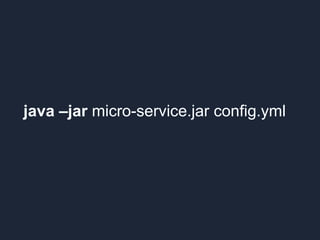
java –jar micro-service.jar config.yml
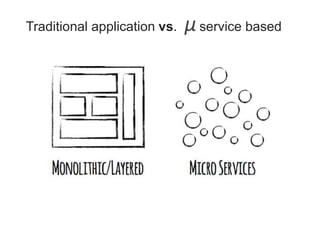
Traditional application vs. µservice based
Micro service architecture by example
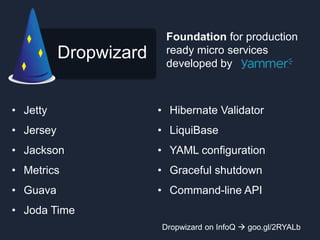
Dropwizard
• Jetty
• Jersey
• Jackson
• Metrics
• Guava
• Joda Time
• Hibernate Validator
• LiquiBase
• YAML configuration
• Graceful shutdown
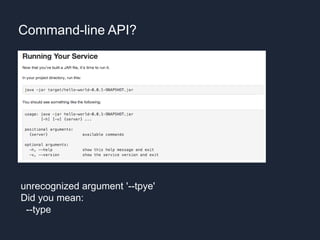
• Command-line API
Foundation for production
ready micro services
developed by
Dropwizard on InfoQ  goo.gl/2RYALb
Command-line API?
unrecognized argument '--tpye'
Did you mean:
--type
Internal Loan Underwriting System
Requirement №1
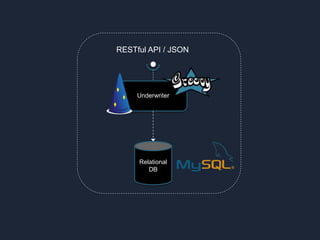
Perform underwriting according to rules specified
in DSL and store decisions in relational DB.
“…according to rules specified in DSL
DSL hero is…
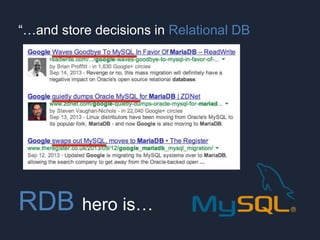
RDB hero is…
“…and store decisions in Relational DB
Underwriter
Relational
DB
RESTful API / JSON
Internal Loan Underwriting System
Requirement №2
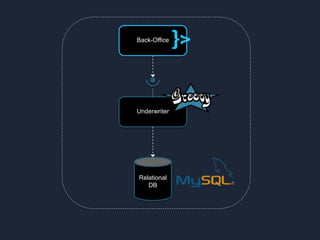
Fancy back-office application that allows users to perform
underwriting and look over decisions.
Why separate micro service?
• Back-office is a regular client. Many still to come.
• Back-office is stateful
• Back-office is server-centric, no JavaScript experience
• Independent coding, testing & deployment
“…fancy back-office application
Fancy UI hero is…
…because we’re close to Finland
Underwriter
Relational
DB
Back-Office
Internal Loan Underwriting System
Requirement №3
Collect credit history from various 3rd party providers in
parallel.
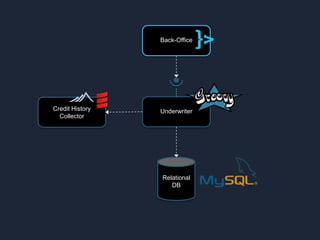
Why separate micro service?
• SRP!
• We have a team of Scala enthusiasts
• ... which never Bootstrapped apps from scratch
• Operations must self-heal in case of failure – Akka
Underwriter
Relational
DB
Back-Office
Credit History
Collector
Internal Loan Underwriting System
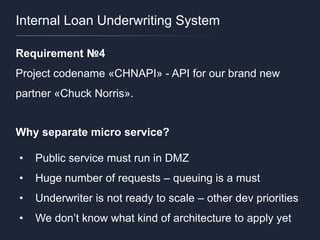
Requirement №4
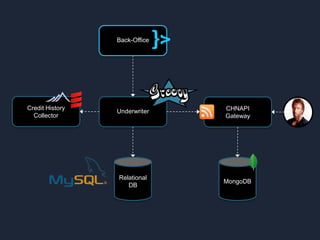
Project codename «CHNAPI» - API for our brand new
partner «Chuck Norris».
Why separate micro service?
• Public service must run in DMZ
• Huge number of requests – queuing is a must
• Underwriter is not ready to scale – other dev priorities
• We don’t know what kind of architecture to apply yet
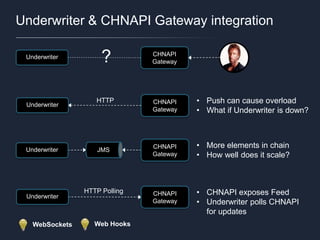
Underwriter & CHNAPI Gateway integration
• Push can cause overload
• What if Underwriter is down?
Underwriter CHNAPI
Gateway?
HTTP
Underwriter CHNAPI
Gateway
• More elements in chain
• How well does it scale?
JMSUnderwriter
CHNAPI
Gateway
• CHNAPI exposes Feed
• Underwriter polls CHNAPI
for updates
Underwriter CHNAPI
Gateway
HTTP Polling
WebSockets Web Hooks
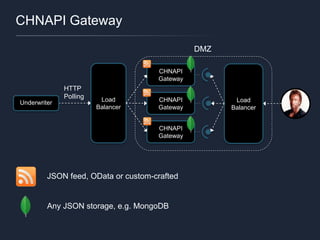
Underwriter CHNAPI
Gateway
HTTP
Polling
CHNAPI
Gateway
CHNAPI
Gateway
Load
Balancer
Load
Balancer
DMZ
CHNAPI Gateway
JSON feed, OData or custom-crafted
Any JSON storage, e.g. MongoDB
CHNAPI
Gateway
Underwriter
Relational
DB
Back-Office
Credit History
Collector
MongoDB
Internal Loan Underwriting System
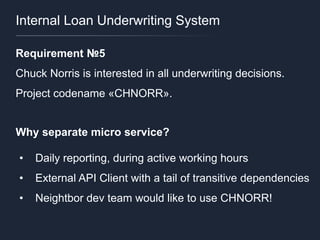
Requirement №5
Chuck Norris is interested in all underwriting decisions.
Project codename «CHNORR».
Why separate micro service?
• Daily reporting, during active working hours
• External API Client with a tail of transitive dependencies
• Neightbor dev team would like to use CHNORR!
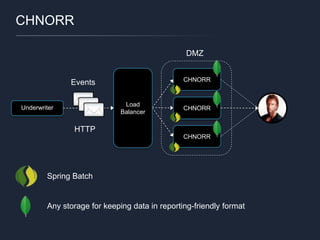
Underwriter CHNORR
CHNORR
CHNORR
DMZ
CHNORR
Load
Balancer
Events
Spring Batch
Any storage for keeping data in reporting-friendly format
HTTP
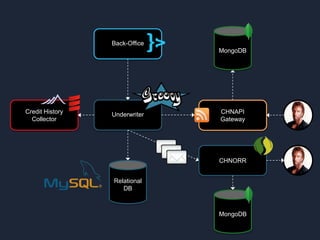
CHNAPI
Gateway
Underwriter
Relational
DB
Back-Office
Credit History
Collector
MongoDB
CHNORR
MongoDB
The Good Parts of the solution
Toolset unchained
• Architectural approaches
• Polyglot
• Storages
• Frameworks
Scalability
• HTTP stack
• Independent provisioning
• Fine tuning
• Elasticity
Independence
• Development
• Testing
• Deployment
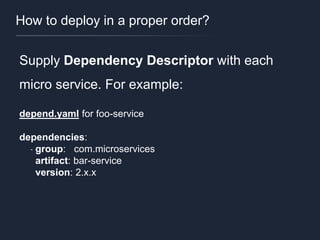
How to deploy in a proper order?
Supply Dependency Descriptor with each
micro service. For example:
depend.yaml for foo-service
dependencies:
group: com.microservices
artifact: bar-service
version: 2.x.x
-
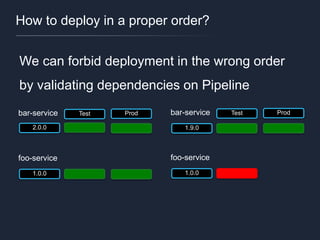
How to deploy in a proper order?
We can forbid deployment in the wrong order
by validating dependencies on Pipeline
2.0.0
Test Prodbar-service
1.0.0
foo-service
Test Prod
1.9.0
bar-service
1.0.0
foo-service
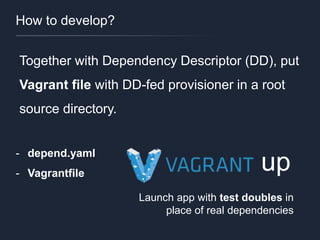
How to develop?
Together with Dependency Descriptor (DD), put
Vagrant file with DD-fed provisioner in a root
source directory.
- depend.yaml
- Vagrantfile
up
Launch app with test doubles in
place of real dependencies
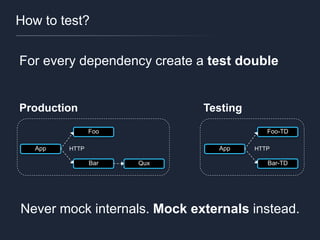
How to test?
For every dependency create a test double
App
Foo
Bar Qux
Production
HTTP App
Foo-TD
Bar-TD
Testing
HTTP
Never mock internals. Mock externals instead.
Tooling
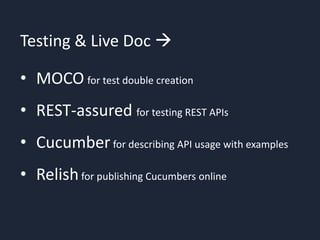
Testing & Live Doc 
• MOCO for test double creation
• REST-assured for testing REST APIs
• Cucumberfor describing API usage with examples
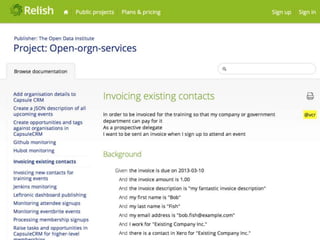
• Relishfor publishing Cucumbers online
A shipping container system for your apps
VM without an overhead of VM
Docker on InfoQ  http://goo.gl/ALnjYt
Why Docker? Why Not Chef?  goo.gl/iJ8Idl
Learn more 
• Micro Services by James Lewis  goo.gl/PS7BYK
• Micro Services by Fred George  goo.gl/dgd8Ya
http://goo.gl/khddl
Conclusion
The next morning, "we had this orgy of `one liners.' Everybody
had a one liner. Look at this, look at that. ...Everybody started
putting forth the UNIX philosophy. Write programs that do one
thing and do it well. Write programs to work together. Write
programs that handle text streams, because that is a
universal interface." Those ideas which add up to the tool
approach, were there in some unformed way before pipes, but
they really came together afterwards. Pipes became the
catalyst for this UNIX philosophy. "The tool thing has turned
out to be actually successful. With pipes, many programs
could work together, and they could work together at a
distance."
The Unix Philosophy
http://www.faqs.org/docs/artu/ch01s06.html
The next morning, "we had this orgy of `one liners.' Everybody
had a one liner. Look at this, look at that. ...Everybody started
putting forth the UNIX philosophy. Write programs that do one
thing and do it well. Write programs to work together. Write
programs that handle text streams, because that is a
universal interface." Those ideas which add up to the tool
approach, were there in some unformed way before pipes, but
they really came together afterwards. Pipes became the
catalyst for this UNIX philosophy. "The tool thing has turned
out to be actually successful. With pipes, many programs
could work together, and they could work together at a
distance."
The next morning, "we had this orgy of `one liners.' Everybody
had a one liner. Look at this, look at that. ...Everybody started
putting forth the UNIX philosophy. Write programs that do one
thing and do it well. Write programs to work together. Write
programs that handle text streams, because that is a
universal interface." Those ideas which add up to the tool
approach, were there in some unformed way before pipes, but
they really came together afterwards. Pipes became the
catalyst for this UNIX philosophy. "The tool thing has turned
out to be actually successful. With pipes, many programs
could work together, and they could work together at a
distance."
The next morning, "we had this orgy of `one liners.' Everybody
had a one liner. Look at this, look at that. ...Everybody started
putting forth the UNIX philosophy. Write programs that do one
thing and do it well. Write programs to work together. Write
programs that handle text streams, because that is a
universal interface." Those ideas which add up to the tool
approach, were there in some unformed way before pipes, but
they really came together afterwards. Pipes became the
catalyst for this UNIX philosophy. "The tool thing has turned
out to be actually successful. With pipes, many programs
could work together, and they could work together at a
distance."
The next morning, "we had this orgy of `one liners.' Everybody
had a one liner. Look at this, look at that. ...Everybody started
putting forth the UNIX philosophy. Write programs that do one
thing and do it well. Write programs to work together. Write
programs that handle text streams, because that is a
universal interface." Those ideas which add up to the tool
approach, were there in some unformed way before pipes, but
they really came together afterwards. Pipes became the
catalyst for this UNIX philosophy. "The tool thing has turned
out to be actually successful. With pipes, many programs
could work together, and they could work together at a
distance."
THANK YOU!

Eduards Sizovs - Micro Service Architecture

  • 2.
  • 3.
  • 4.
    Agenda • Anatomy ofa micro service • Micro service architecture by example • The Good Parts of the solution • Tooling • Q&A
  • 5.
    Anatomy of amicro service
  • 6.
    Micro services aretiny apps talking via uniform interface installed as well-behaved OS services.
  • 7.
  • 9.
  • 10.
  • 11.
    Dropwizard • Jetty • Jersey •Jackson • Metrics • Guava • Joda Time • Hibernate Validator • LiquiBase • YAML configuration • Graceful shutdown • Command-line API Foundation for production ready micro services developed by Dropwizard on InfoQ  goo.gl/2RYALb
  • 12.
    Command-line API? unrecognized argument'--tpye' Did you mean: --type
  • 13.
    Internal Loan UnderwritingSystem Requirement №1 Perform underwriting according to rules specified in DSL and store decisions in relational DB.
  • 14.
    “…according to rulesspecified in DSL DSL hero is…
  • 15.
    RDB hero is… “…andstore decisions in Relational DB
  • 16.
  • 17.
    Internal Loan UnderwritingSystem Requirement №2 Fancy back-office application that allows users to perform underwriting and look over decisions. Why separate micro service? • Back-office is a regular client. Many still to come. • Back-office is stateful • Back-office is server-centric, no JavaScript experience • Independent coding, testing & deployment
  • 18.
    “…fancy back-office application FancyUI hero is… …because we’re close to Finland
  • 19.
  • 20.
    Internal Loan UnderwritingSystem Requirement №3 Collect credit history from various 3rd party providers in parallel. Why separate micro service? • SRP! • We have a team of Scala enthusiasts • ... which never Bootstrapped apps from scratch • Operations must self-heal in case of failure – Akka
  • 21.
  • 22.
    Internal Loan UnderwritingSystem Requirement №4 Project codename «CHNAPI» - API for our brand new partner «Chuck Norris». Why separate micro service? • Public service must run in DMZ • Huge number of requests – queuing is a must • Underwriter is not ready to scale – other dev priorities • We don’t know what kind of architecture to apply yet
  • 23.
    Underwriter & CHNAPIGateway integration • Push can cause overload • What if Underwriter is down? Underwriter CHNAPI Gateway? HTTP Underwriter CHNAPI Gateway • More elements in chain • How well does it scale? JMSUnderwriter CHNAPI Gateway • CHNAPI exposes Feed • Underwriter polls CHNAPI for updates Underwriter CHNAPI Gateway HTTP Polling WebSockets Web Hooks
  • 24.
  • 25.
  • 26.
    Internal Loan UnderwritingSystem Requirement №5 Chuck Norris is interested in all underwriting decisions. Project codename «CHNORR». Why separate micro service? • Daily reporting, during active working hours • External API Client with a tail of transitive dependencies • Neightbor dev team would like to use CHNORR!
  • 27.
    Underwriter CHNORR CHNORR CHNORR DMZ CHNORR Load Balancer Events Spring Batch Anystorage for keeping data in reporting-friendly format HTTP
  • 28.
  • 29.
    The Good Partsof the solution
  • 30.
    Toolset unchained • Architecturalapproaches • Polyglot • Storages • Frameworks
  • 31.
    Scalability • HTTP stack •Independent provisioning • Fine tuning • Elasticity
  • 32.
  • 33.
    How to deployin a proper order? Supply Dependency Descriptor with each micro service. For example: depend.yaml for foo-service dependencies: group: com.microservices artifact: bar-service version: 2.x.x -
  • 34.
    How to deployin a proper order? We can forbid deployment in the wrong order by validating dependencies on Pipeline 2.0.0 Test Prodbar-service 1.0.0 foo-service Test Prod 1.9.0 bar-service 1.0.0 foo-service
  • 35.
    How to develop? Togetherwith Dependency Descriptor (DD), put Vagrant file with DD-fed provisioner in a root source directory. - depend.yaml - Vagrantfile up Launch app with test doubles in place of real dependencies
  • 36.
    How to test? Forevery dependency create a test double App Foo Bar Qux Production HTTP App Foo-TD Bar-TD Testing HTTP Never mock internals. Mock externals instead.
  • 38.
  • 39.
    Testing & LiveDoc  • MOCO for test double creation • REST-assured for testing REST APIs • Cucumberfor describing API usage with examples • Relishfor publishing Cucumbers online
  • 43.
    A shipping containersystem for your apps VM without an overhead of VM Docker on InfoQ  http://goo.gl/ALnjYt Why Docker? Why Not Chef?  goo.gl/iJ8Idl
  • 44.
    Learn more  •Micro Services by James Lewis  goo.gl/PS7BYK • Micro Services by Fred George  goo.gl/dgd8Ya
  • 45.
  • 46.
  • 47.
    The next morning,"we had this orgy of `one liners.' Everybody had a one liner. Look at this, look at that. ...Everybody started putting forth the UNIX philosophy. Write programs that do one thing and do it well. Write programs to work together. Write programs that handle text streams, because that is a universal interface." Those ideas which add up to the tool approach, were there in some unformed way before pipes, but they really came together afterwards. Pipes became the catalyst for this UNIX philosophy. "The tool thing has turned out to be actually successful. With pipes, many programs could work together, and they could work together at a distance." The Unix Philosophy http://www.faqs.org/docs/artu/ch01s06.html The next morning, "we had this orgy of `one liners.' Everybody had a one liner. Look at this, look at that. ...Everybody started putting forth the UNIX philosophy. Write programs that do one thing and do it well. Write programs to work together. Write programs that handle text streams, because that is a universal interface." Those ideas which add up to the tool approach, were there in some unformed way before pipes, but they really came together afterwards. Pipes became the catalyst for this UNIX philosophy. "The tool thing has turned out to be actually successful. With pipes, many programs could work together, and they could work together at a distance." The next morning, "we had this orgy of `one liners.' Everybody had a one liner. Look at this, look at that. ...Everybody started putting forth the UNIX philosophy. Write programs that do one thing and do it well. Write programs to work together. Write programs that handle text streams, because that is a universal interface." Those ideas which add up to the tool approach, were there in some unformed way before pipes, but they really came together afterwards. Pipes became the catalyst for this UNIX philosophy. "The tool thing has turned out to be actually successful. With pipes, many programs could work together, and they could work together at a distance." The next morning, "we had this orgy of `one liners.' Everybody had a one liner. Look at this, look at that. ...Everybody started putting forth the UNIX philosophy. Write programs that do one thing and do it well. Write programs to work together. Write programs that handle text streams, because that is a universal interface." Those ideas which add up to the tool approach, were there in some unformed way before pipes, but they really came together afterwards. Pipes became the catalyst for this UNIX philosophy. "The tool thing has turned out to be actually successful. With pipes, many programs could work together, and they could work together at a distance." The next morning, "we had this orgy of `one liners.' Everybody had a one liner. Look at this, look at that. ...Everybody started putting forth the UNIX philosophy. Write programs that do one thing and do it well. Write programs to work together. Write programs that handle text streams, because that is a universal interface." Those ideas which add up to the tool approach, were there in some unformed way before pipes, but they really came together afterwards. Pipes became the catalyst for this UNIX philosophy. "The tool thing has turned out to be actually successful. With pipes, many programs could work together, and they could work together at a distance."
  • 48.

Editor's Notes

  • #7 Who have heard about micro services? Tiny: lightweight, small footprint, follow SRP Uniform interface: RESTful. Decoupled, Scalable, Discoverable. OS services: self-contained, run with a single one-liner: “jar – jar”, grab port & listen. No more arcane app servers. Use existing OS process management tool
  • #9 A methodology for building software-as-a-service apps, comprises 12 rules you must learn after this presentation. Says a lot about configuration, logging, concurrency etc.
  • #10 Evident differences: A lot of moving parts working together to achieve app’s goal Small Simple internal structure Micro-service is SOA application put to Nth (entieich) degree.
  • #11 Build Internal Loan Underwriting System based on “micro-service architecture” step by step.
  • #14 Time to create the 1st micro service!
  • #16 Serious breakup – now MySQL is single, so let’s take the opportunity 
  • #23 --- Not sure what INTERNAL architecture to apply – to minimize risk of failure, let’s separate services!! Welcome CHNAPI Gateway: Implements Chuck Norris API Transforms external request to a format understood by Underwriter Scales according to Chuck Norris needs
  • #24 How well does it scale: Eventually I’ll have to scale both JMS and CHNAPI gateway
  • #28 - Time to unlock our data and publish events so others can benefit. Let’s do it via HTTP! - Now we have a simple business processes span 1+ system. Middleware/ESBs for Orchestration suck! Prefer choreography
  • #29 Challenges are defeated! For quite simple app we’ve built 5 independently deployable micro services.
  • #31 Frameworks: No jar hell. Downgrade CXF example. Summary: Developers can experiment & leverage their skillset better Less risk of failure (Disposable – rewrite over maintain)
  • #32 HTTP stack: LB, Cache, Sec… SPDY Independent provisioning: different set of servers per micro service Fine tuning: understand performance in isolation. Fine-tune VM, JVM Elasticity: auto-scale (run one more instance) based on TX exec time, queue depth.
  • #33 Development: Scale dev: less conflict. Work streams: skill, location, risk, preference. Applications can evolve in different pace. Responsibilities: whose pager should ring Deployment: no big-bang, less risk, rollbacks (re-spawn attempt), fast startup (crazy idea of app+config)
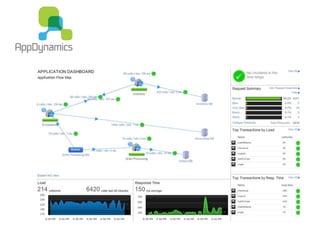
  • #42 AppDynamics - Usually workflow involves plenty of services. Woods instead of trees. Visualize TX flow, bottlenecks etc.
  • #48 Taking this philosophy and applying it to a SOA architecture would imply building services that focus on a single piece of functionality and communicate with other services to provide business value. Worth giving a try.