Shri Mahila Griha Udyog Lijjat Papad
        A cooperative established in 1959.
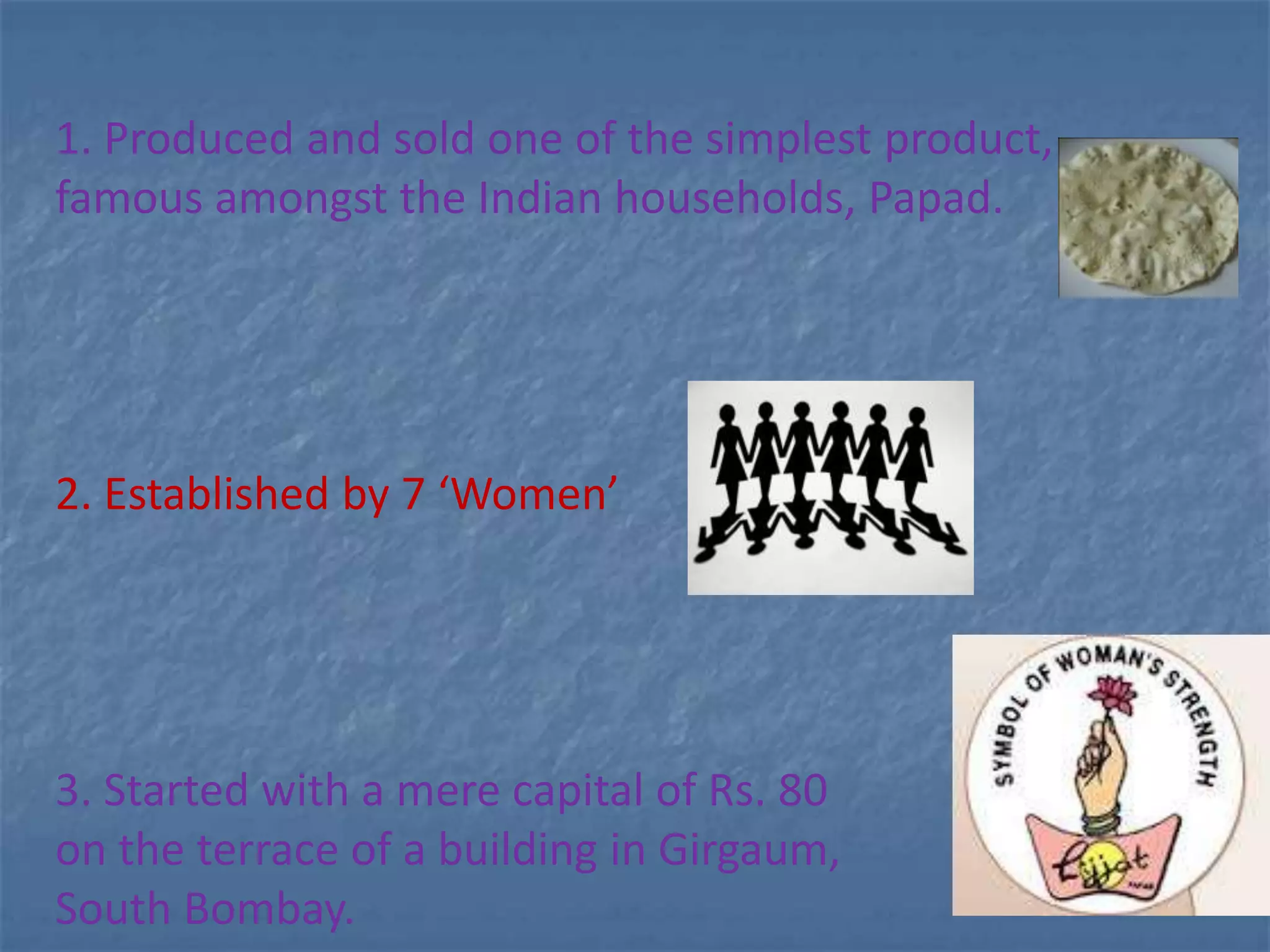
1. Produced and sold one of the simplest product,
famous amongst the Indian households, Papad.


2. Established by 7 ‘Women’


3. Started with a mere capital of Rs. 80
on the terrace of a building in Girgaum,
South Bombay.
The Entrepreneurs


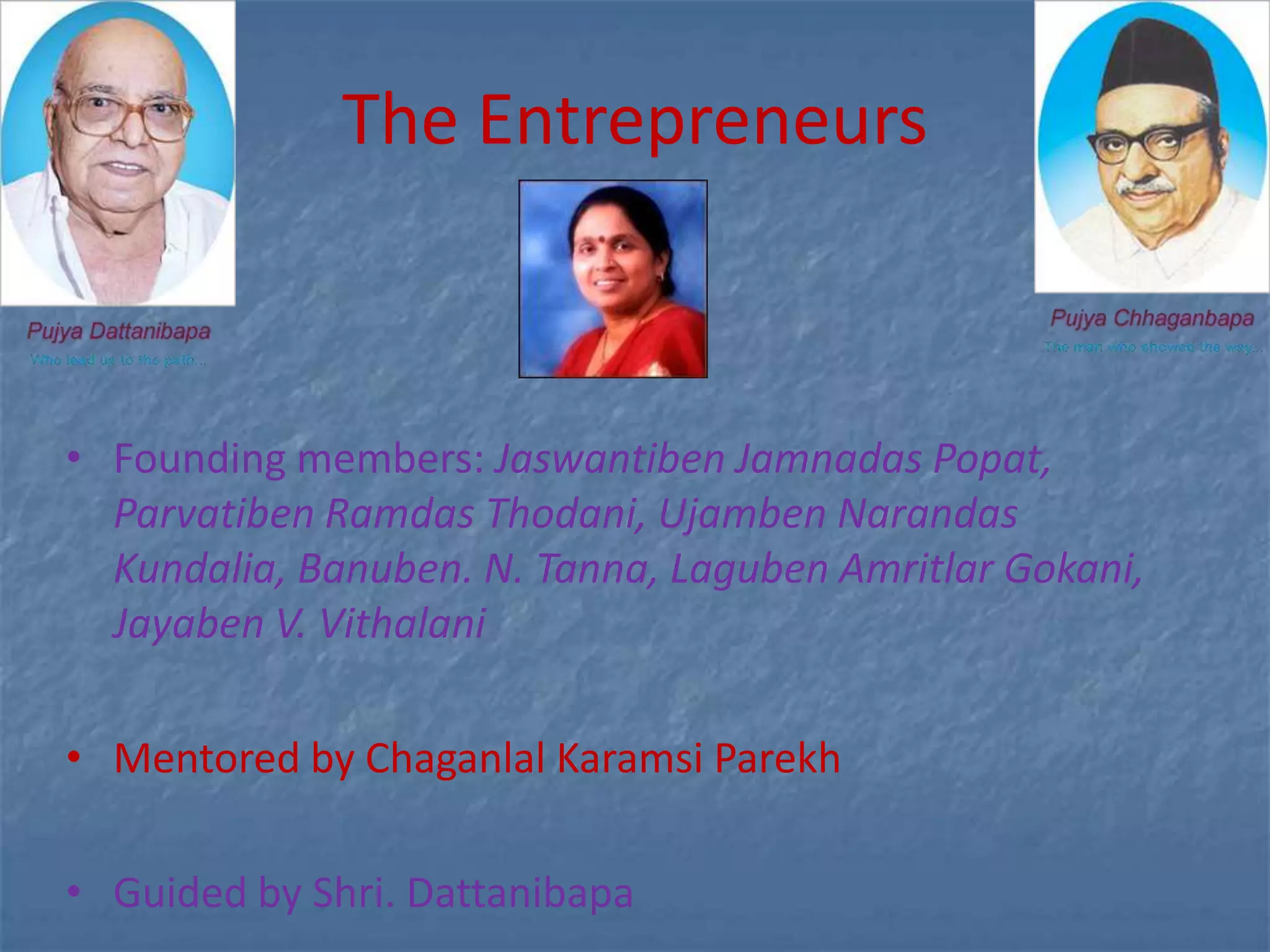
• Founding members: Jaswantiben Jamnadas Popat,
  Parvatiben Ramdas Thodani, Ujamben Narandas
  Kundalia, Banuben. N. Tanna, Laguben Amritlar Gokani,
  Jayaben V. Vithalani

• Mentored by Chaganlal Karamsi Parekh

• Guided by Shri. Dattanibapa
Current Leadership:
        Jyoti Naik (President)

Associated since 1971, started rolling papad
Deputed to packaging section
By 1973, started managing inventory
Sanchalika in 1981
VP in 1989
Then President: Earning equivalent to 30 kg of
 rolled papad in a day  attesting to the
 organizational values
Objectives of Lijjat
   Maximize employment opportunities for women.

   To get the work for the society.

   To get mutual understanding, self service and
    saving habit among the women.

   To increase the dealings power of women
    members.
ITS VALUES
Lijjat believes in the philosophy of sarvodaya
and collective ownership.


SMGULP never accepts charity or grants.


SMGULP is like a family

SMGULP is like a revered place of worship.
SMGULP is a combination of three
           concepts:

     The Business concept

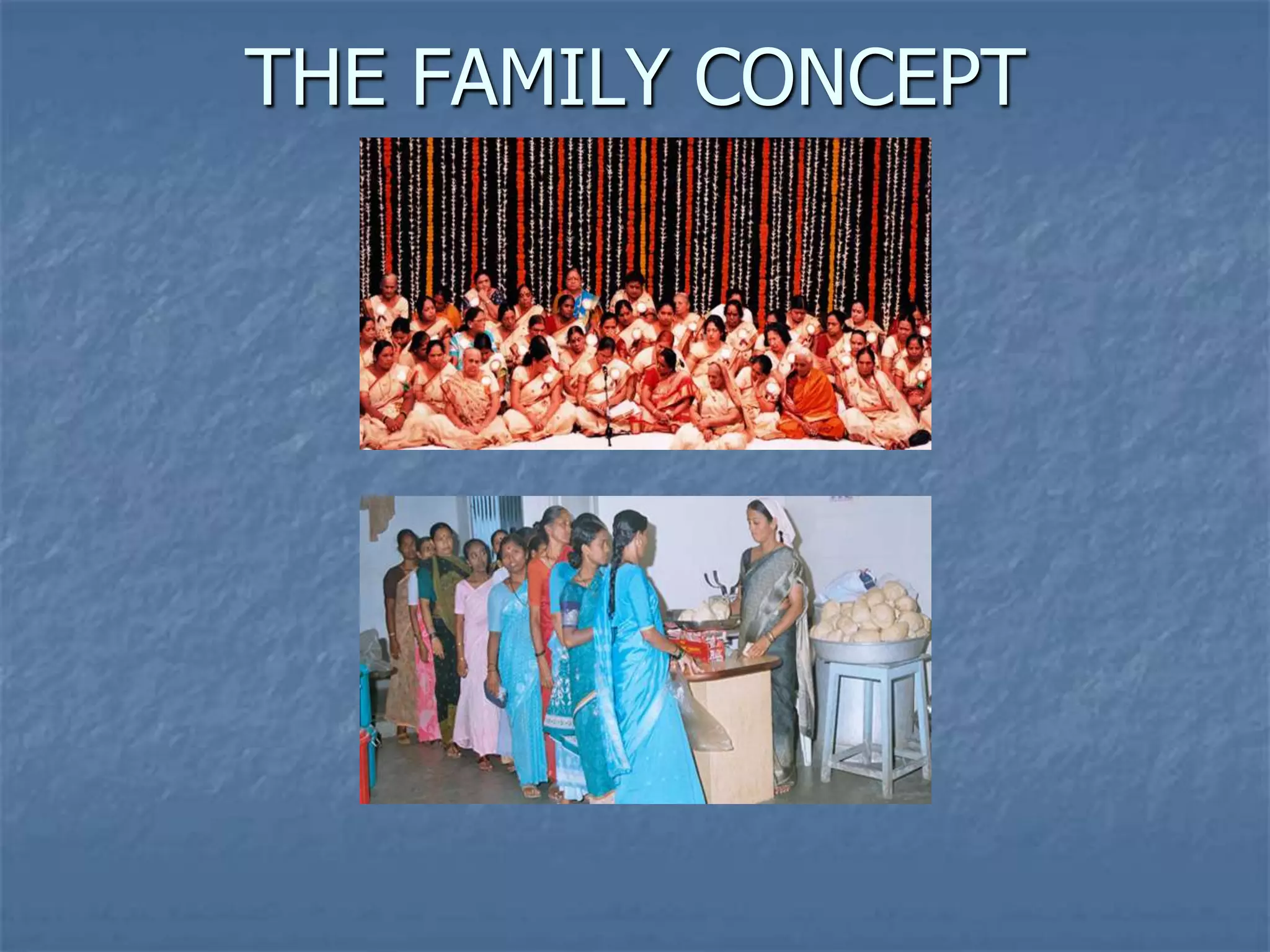
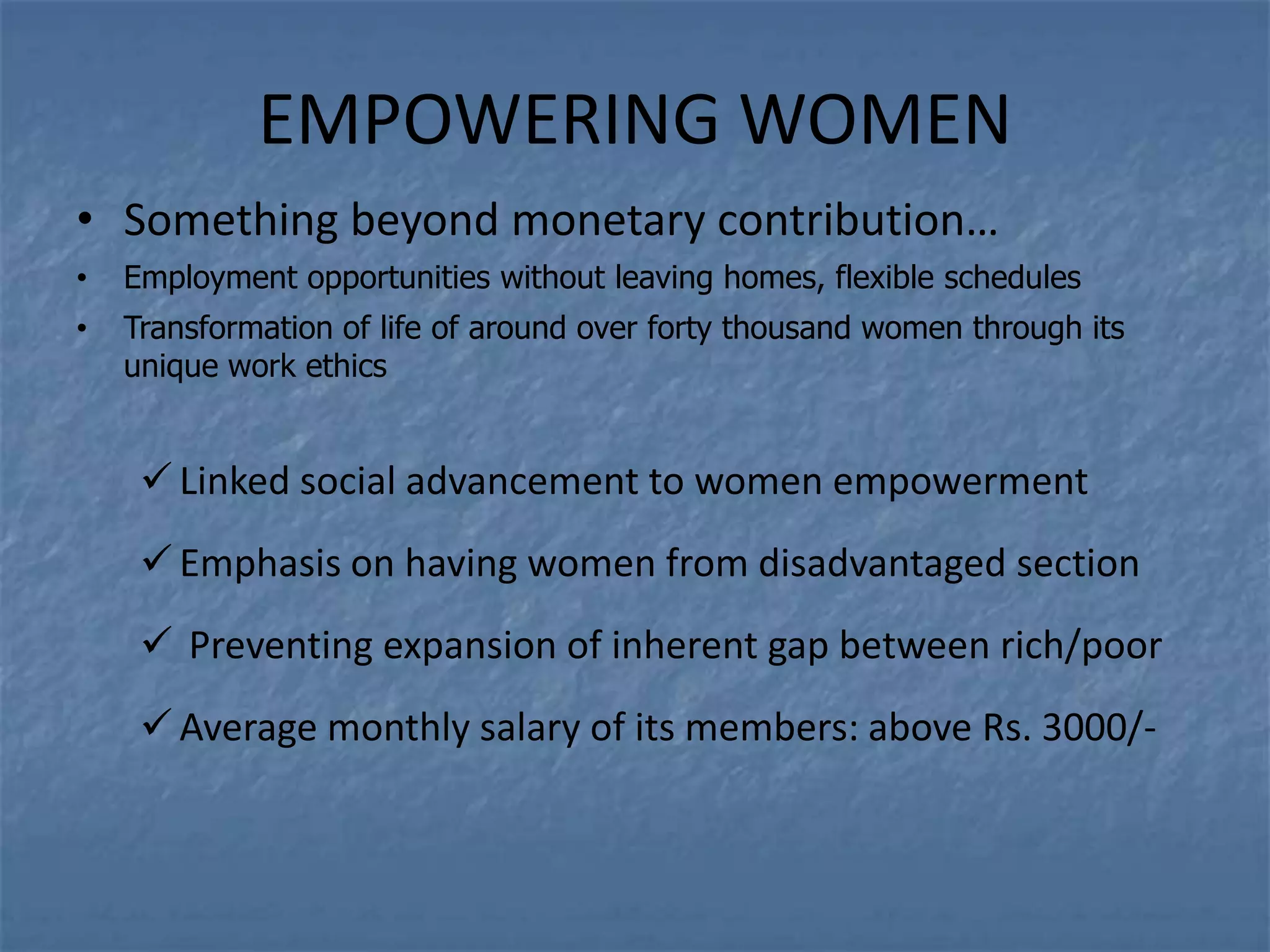
      The Family concept

     The Devotion Concept
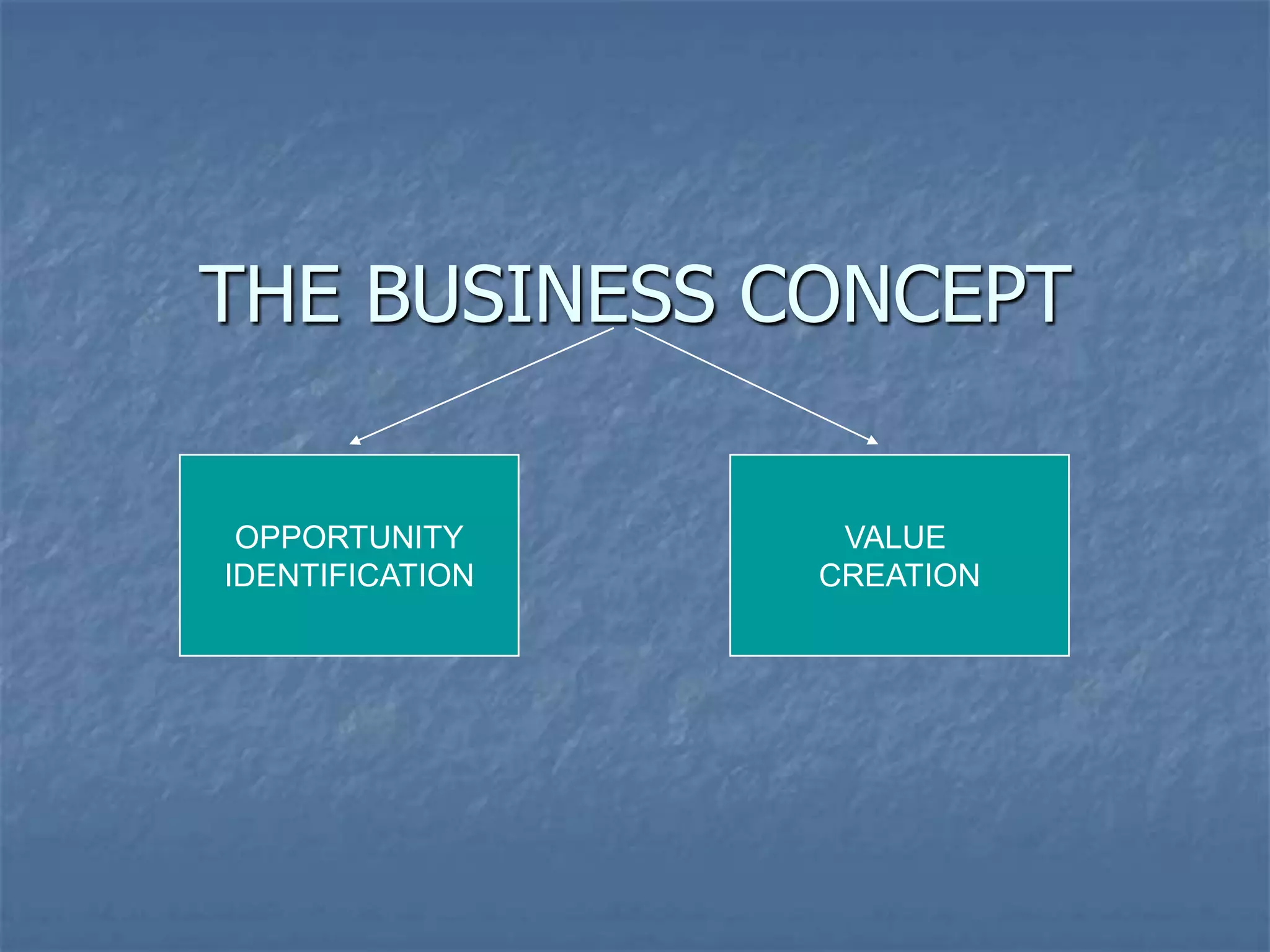
THE BUSINESS CONCEPT

 OPPORTUNITY      VALUE
IDENTIFICATION   CREATION
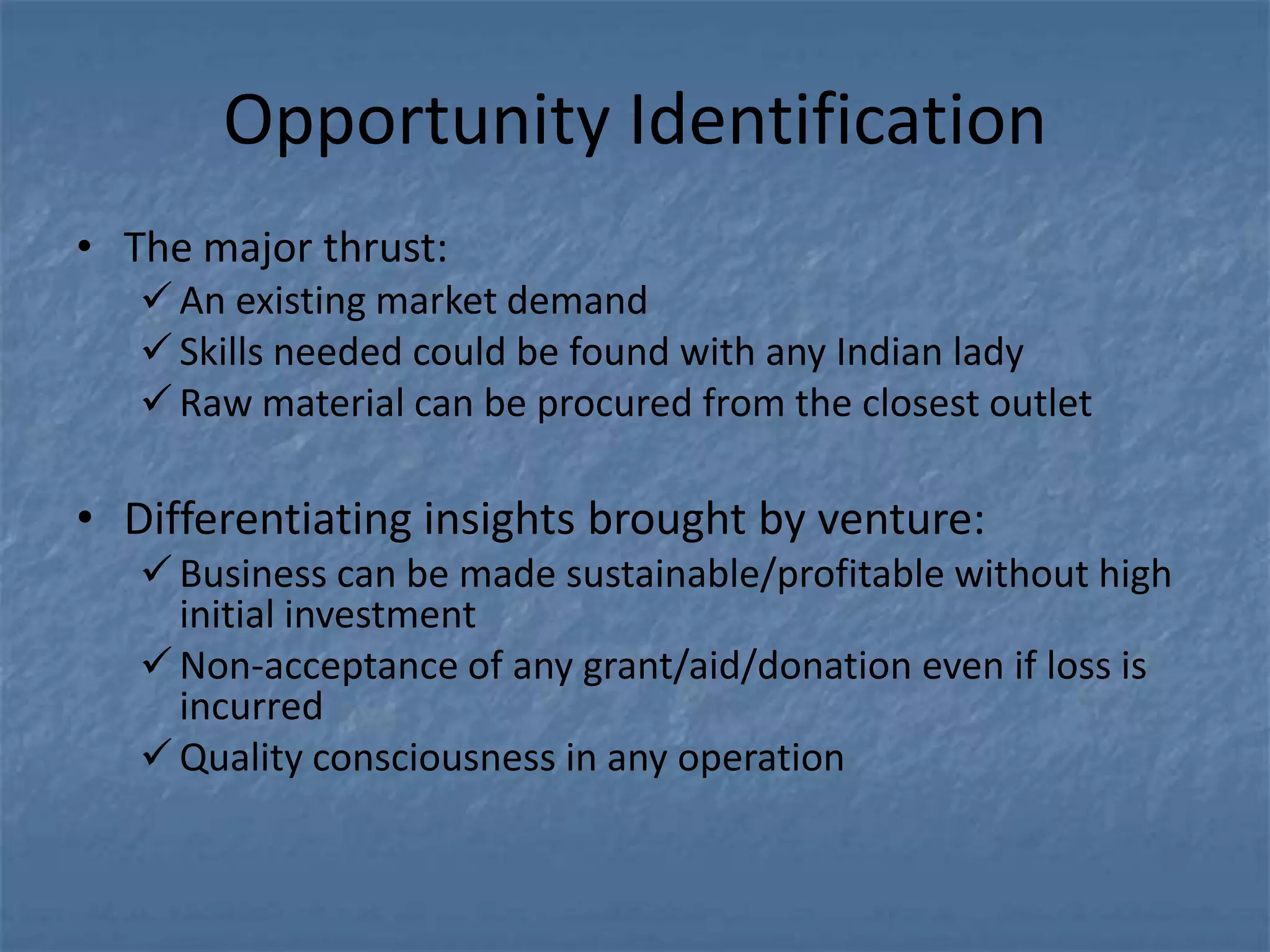
Opportunity Identification
• The major thrust:
    An existing market demand
    Skills needed could be found with any Indian lady
    Raw material can be procured from the closest outlet

• Differentiating insights brought by venture:
    Business can be made sustainable/profitable without high
     initial investment
    Non-acceptance of any grant/aid/donation even if loss is
     incurred
    Quality consciousness in any operation
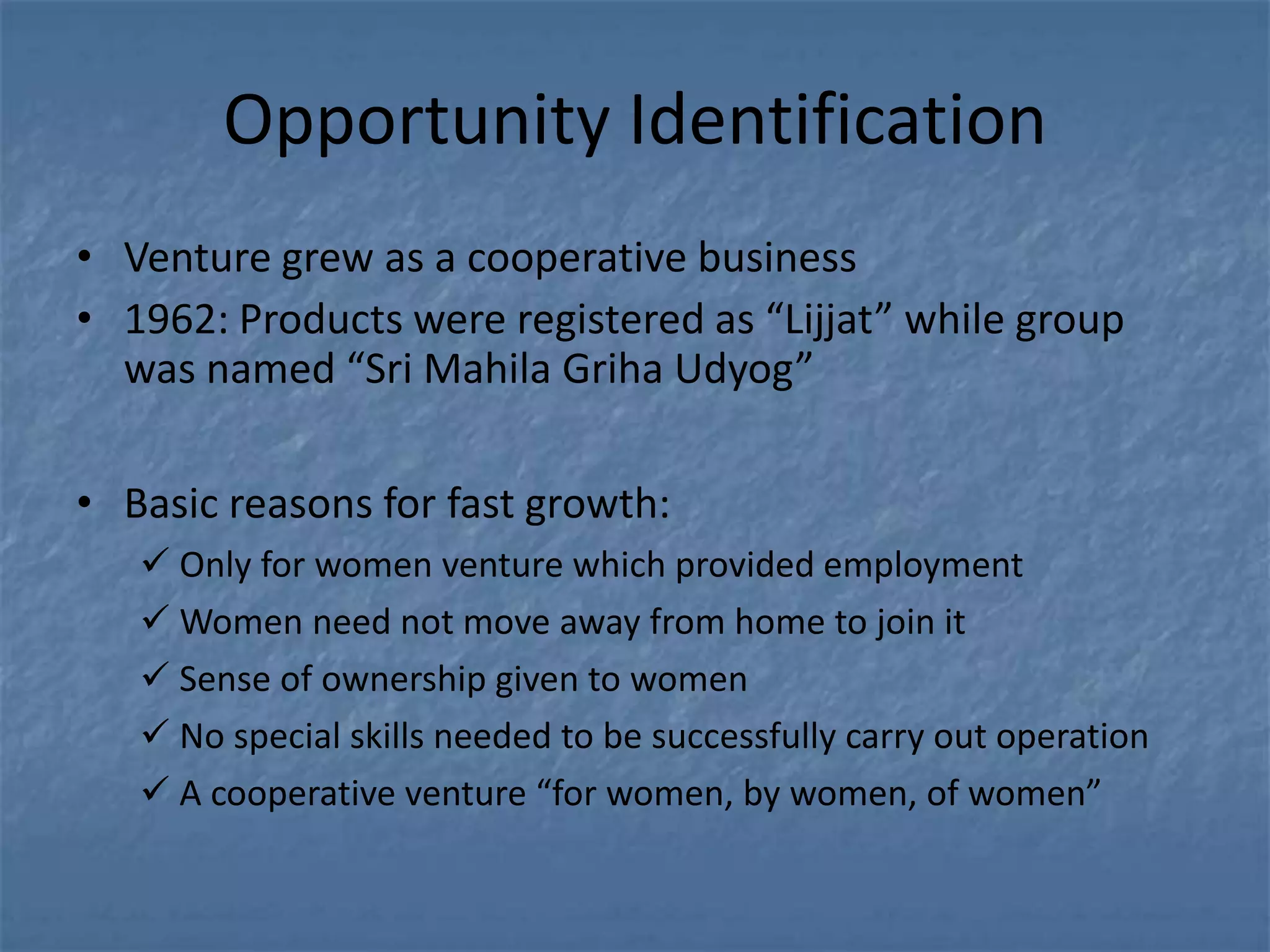
Opportunity Identification
• Venture grew as a cooperative business
• 1962: Products were registered as “Lijjat” while group
  was named “Sri Mahila Griha Udyog”

• Basic reasons for fast growth:
    Only for women venture which provided employment
    Women need not move away from home to join it
    Sense of ownership given to women
    No special skills needed to be successfully carry out operation
    A cooperative venture “for women, by women, of women”
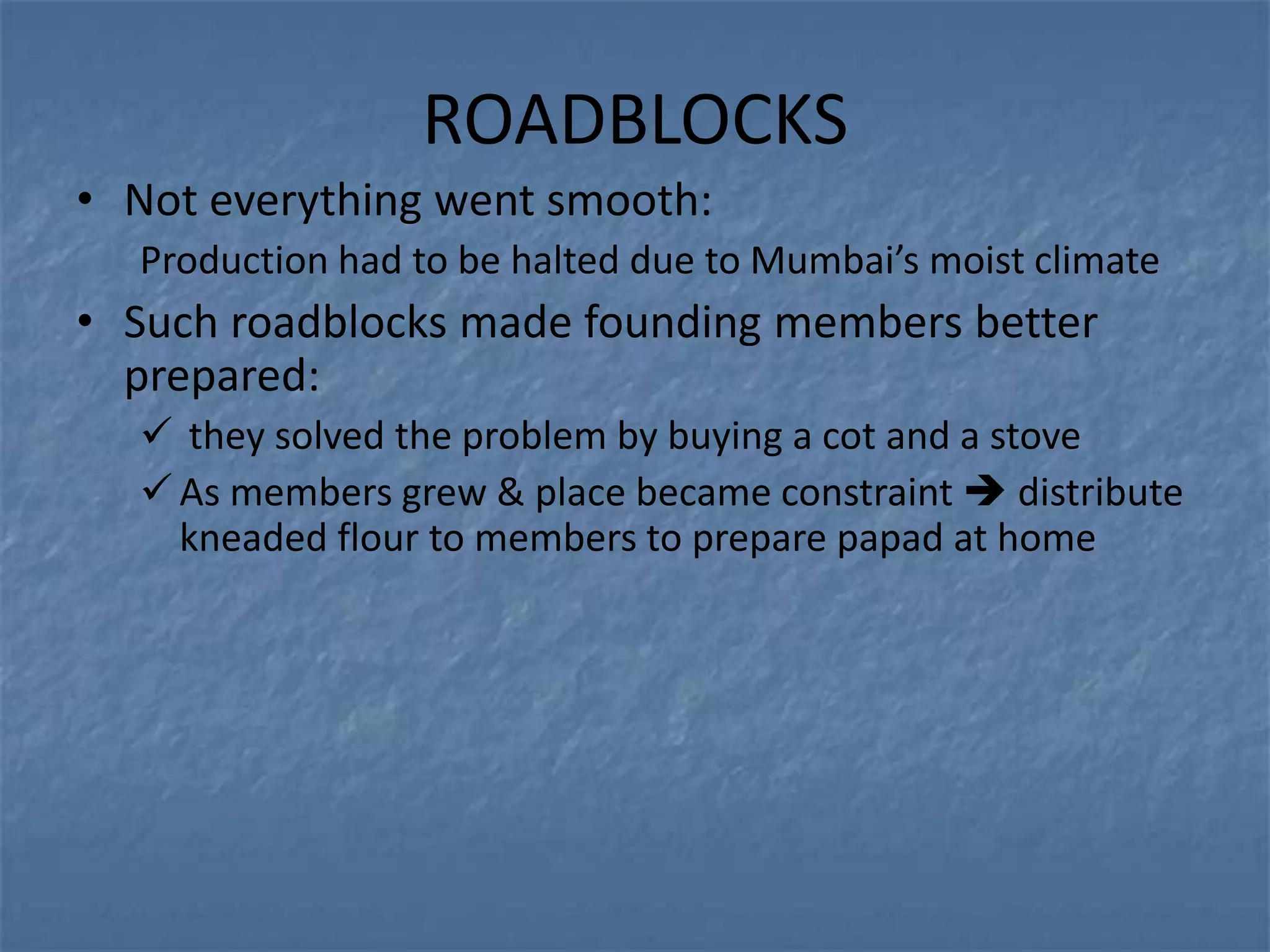
ROADBLOCKS
• Not everything went smooth:
  Production had to be halted due to Mumbai’s moist climate
• Such roadblocks made founding members better
  prepared:
   they solved the problem by buying a cot and a stove
   As members grew & place became constraint  distribute
    kneaded flour to members to prepare papad at home
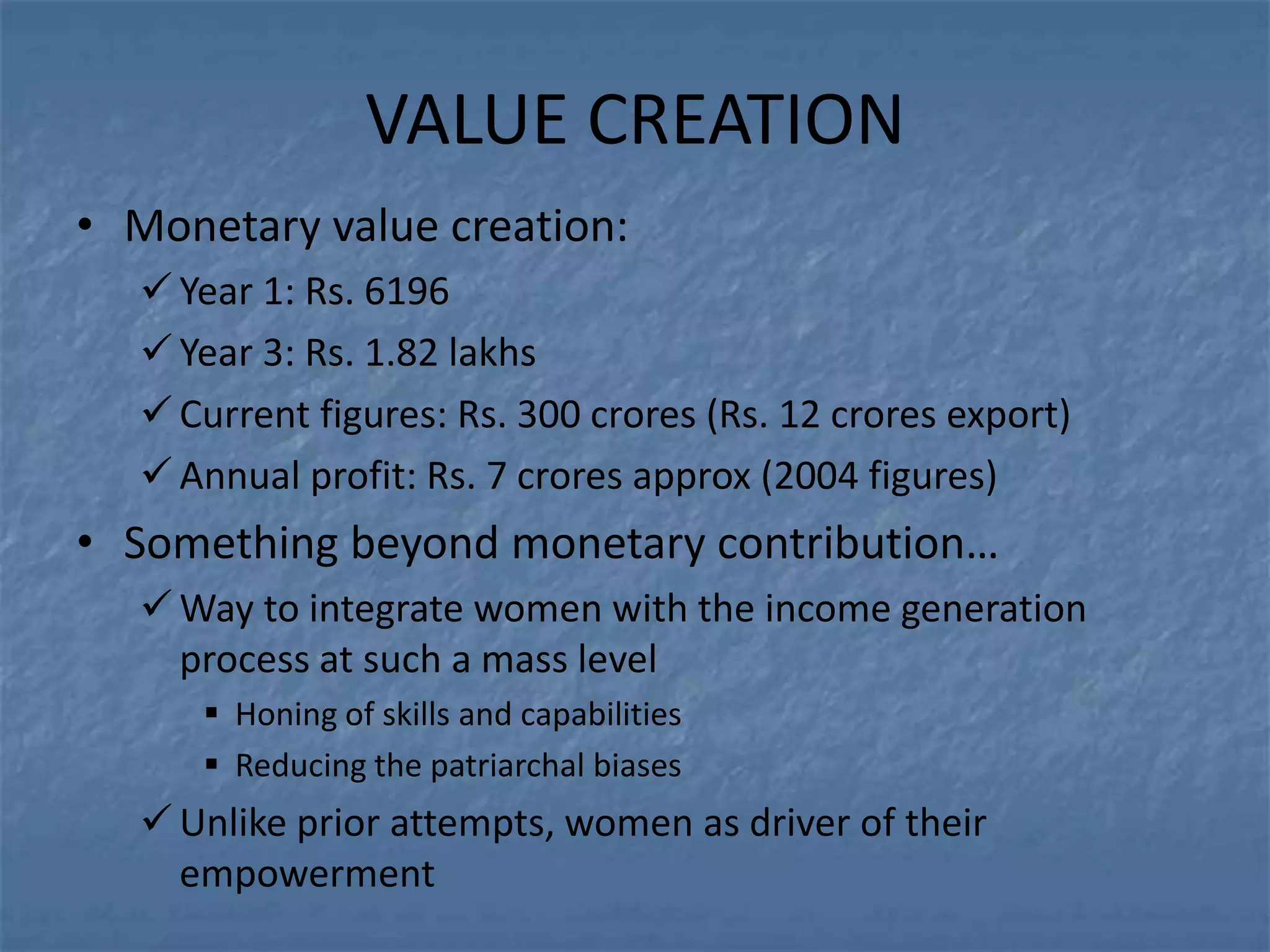
VALUE CREATION
• Monetary value creation:
   Year 1: Rs. 6196
   Year 3: Rs. 1.82 lakhs
   Current figures: Rs. 300 crores (Rs. 12 crores export)
   Annual profit: Rs. 7 crores approx (2004 figures)
• Something beyond monetary contribution…
   Way to integrate women with the income generation
    process at such a mass level
      Honing of skills and capabilities
      Reducing the patriarchal biases
   Unlike prior attempts, women as driver of their
    empowerment
THE FAMILY CONCEPT
EMPOWERING WOMEN
• Something beyond monetary contribution…
•   Employment opportunities without leaving homes, flexible schedules
•   Transformation of life of around over forty thousand women through its
    unique work ethics


      Linked social advancement to women empowerment
      Emphasis on having women from disadvantaged section
      Preventing expansion of inherent gap between rich/poor
      Average monthly salary of its members: above Rs. 3000/-
SOCIAL RESPONSIBILITY
• Since venture was based on sound principles,
  members contributed in many activities as:
     Increasing availability of health care for their families
     Providing scholarships to their children
     Cooperating in building homes of each other


INDIRECT IMPACT:
    Lijjat Products: Good quality affordable for masses
    Enhanced social/cultural harmony beyond work-place
    Active contribution to health, education & social service
SOCIAL RESPONSIBILITY
• Extending wealth acquired to social cause; few
  examples:
    1979: First ever tarred (pucca) road built with help of Lijjat
    Educational and Hobby centers set up to teach skills as:
     typing, cooking, sewing, knitting and toy making
    Rehabilitation work for earthquake affected in Chincholi
     (Jogan): Financed construction of 50 houses for them
    Again, provided Rs. 50 lakhs aid for Bhuj earthquake
     affected people
Assessing Impact & Effectiveness…

• Positions itself as: “A symbol of women’s strength”
• Created employment opportunities for over 40000
  women in last 49 years
• Not only employment, gave them opportunity to
  transform their way to live
• Equality and justice promoted by Profit-Contribution
  schemes
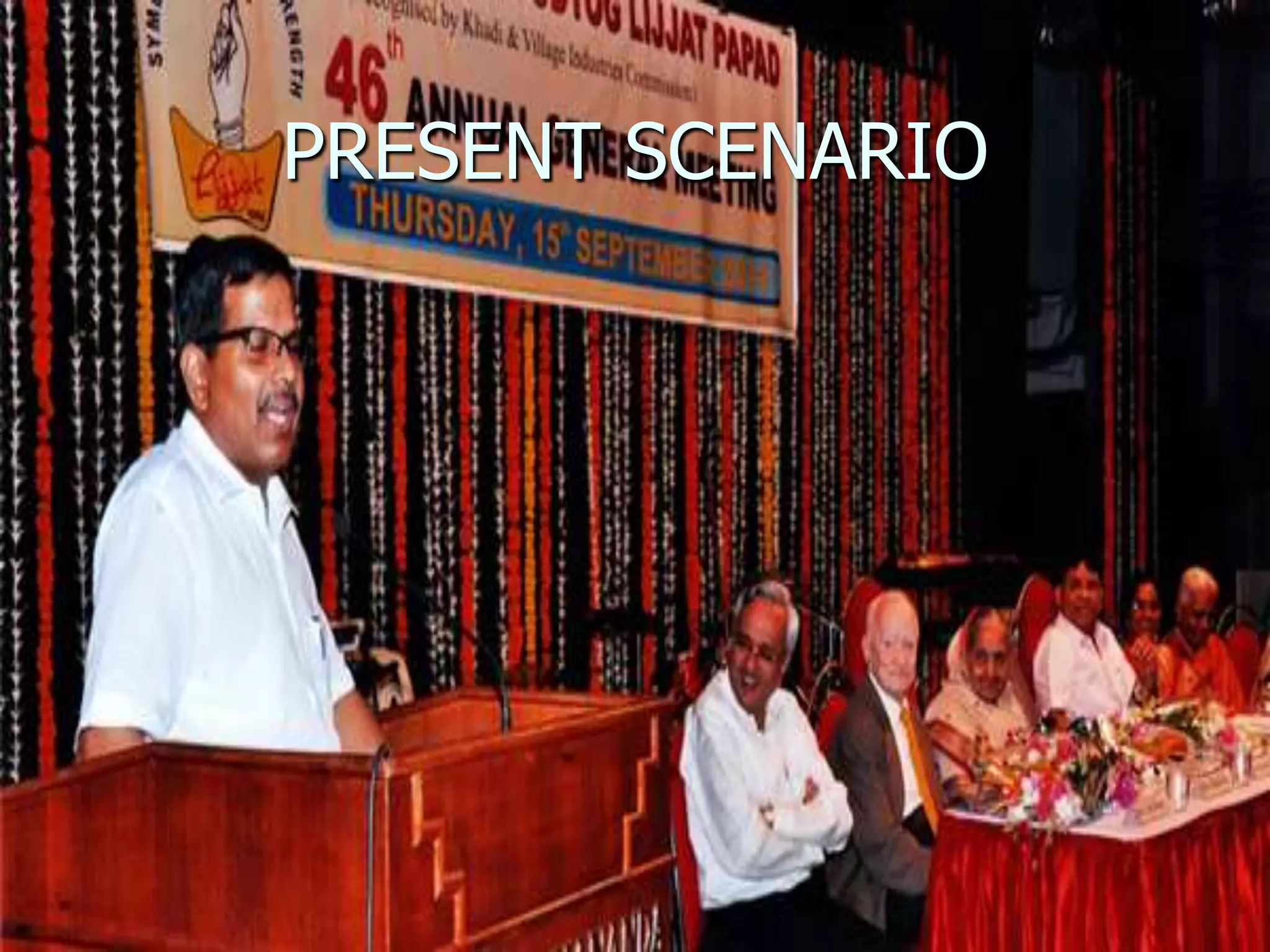
PRESENT SCENARIO
Assessing Impact & Effectiveness…

• Sustained for such a long period as a profitable
  venture itself proves a point for itself
• The most quantifiable assessor: Total sales of over
  Rs. 3 Bn
• Organic growth (slow but steady) in a holistic way:
    No. of employees
    Achieving economies of scale (without blind automation)
    Achieved economies of scope
    Vertical integration of various process
Assessing Impact & Effectiveness…

• Economies of scale (without following blind
  automation):
    Less emphasis on automation of processes
    Rather, achieved it through increased involvement of
     women members
    Allowed members to work from their own place
    Expansion in various cities/states: 67 branches and 35
     divisions
Assessing Impact & Effectiveness…

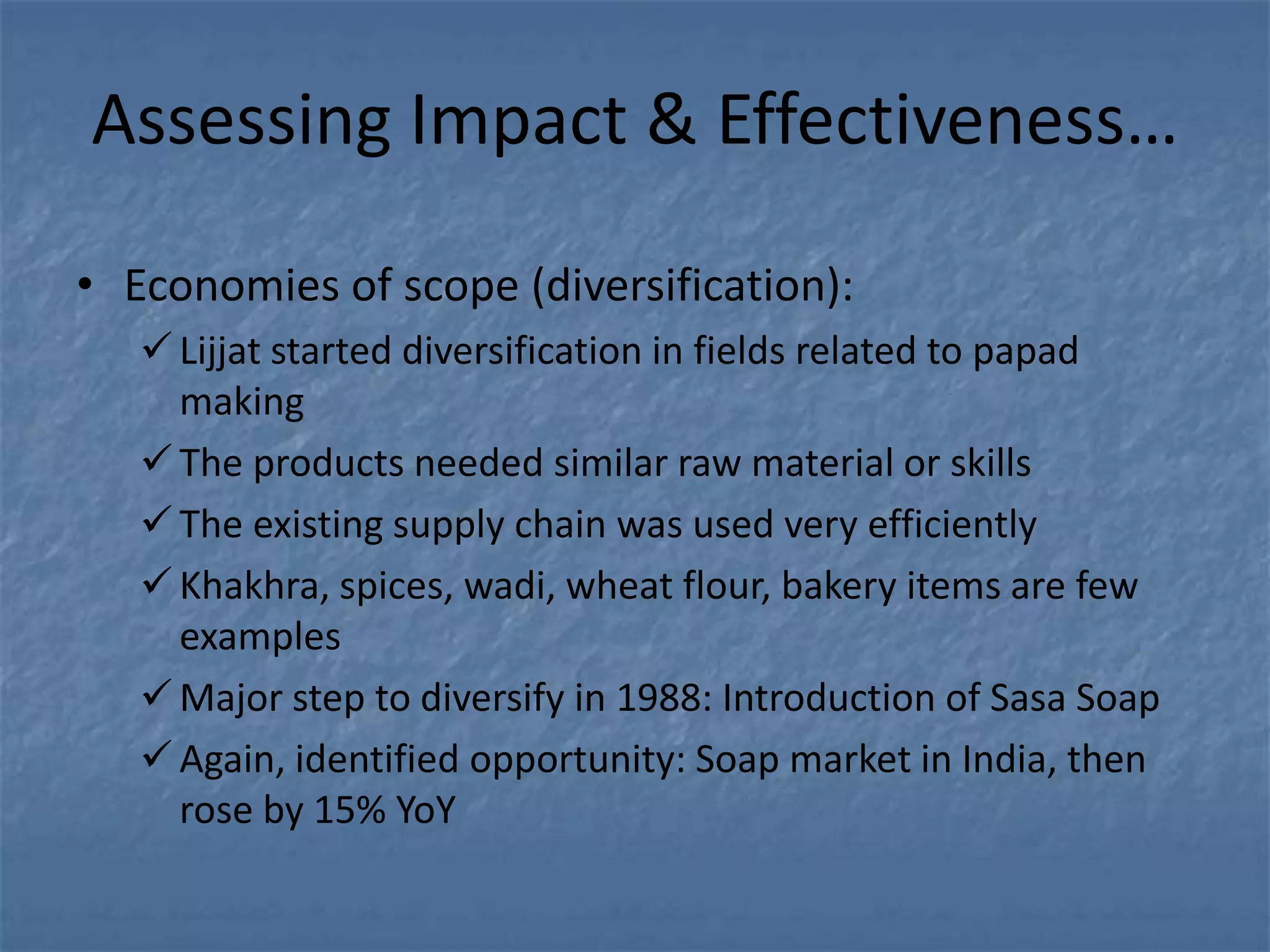
• Economies of scope (diversification):
    Lijjat started diversification in fields related to papad
     making
    The products needed similar raw material or skills
    The existing supply chain was used very efficiently
    Khakhra, spices, wadi, wheat flour, bakery items are few
     examples
    Major step to diversify in 1988: Introduction of Sasa Soap
    Again, identified opportunity: Soap market in India, then
     rose by 15% YoY
Assessing Impact & Effectiveness…

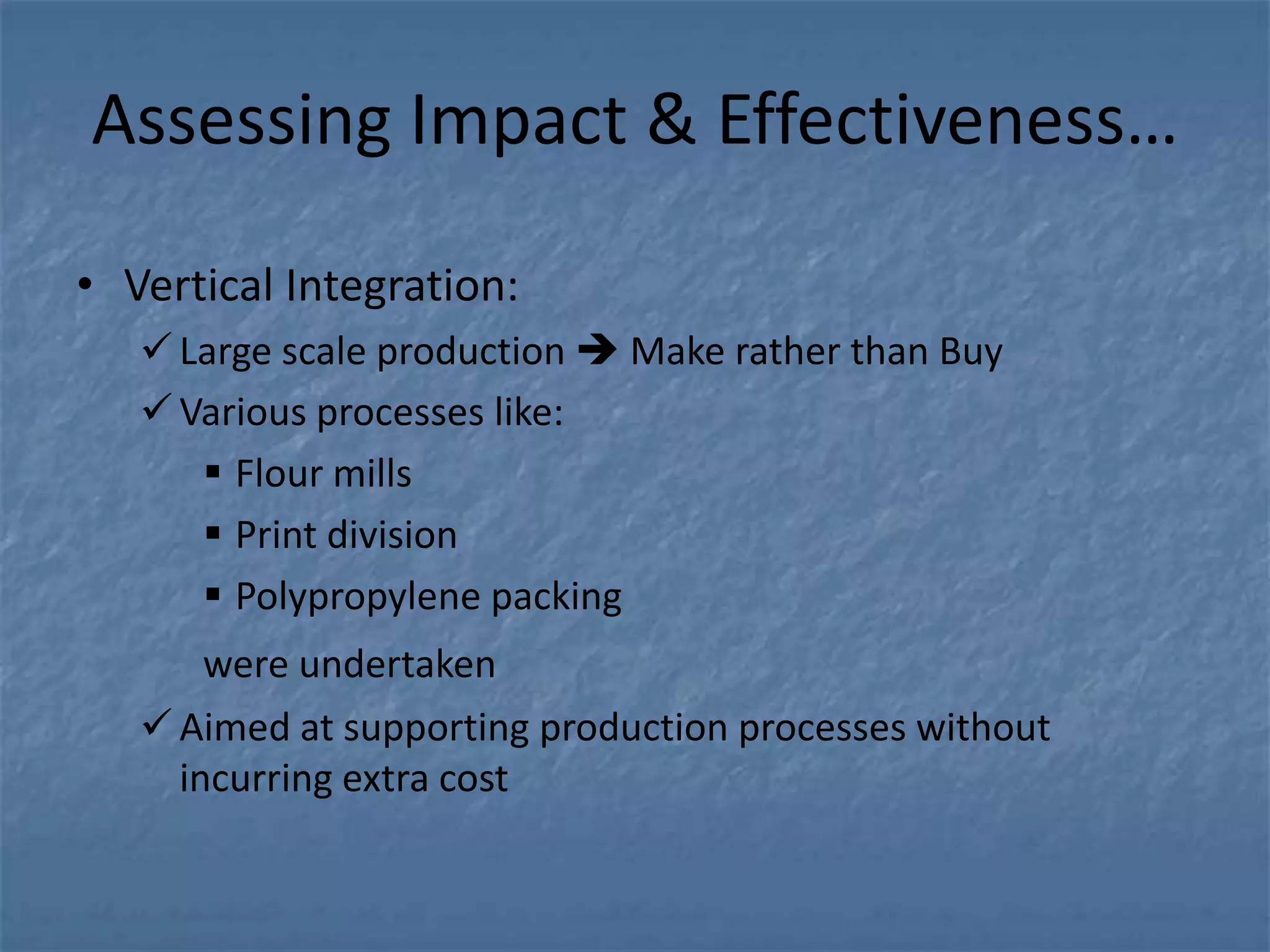
• Vertical Integration:
    Large scale production  Make rather than Buy
    Various processes like:
       Flour mills
       Print division
       Polypropylene packing
       were undertaken
    Aimed at supporting production processes without
     incurring extra cost
Assessing Impact & Effectiveness…
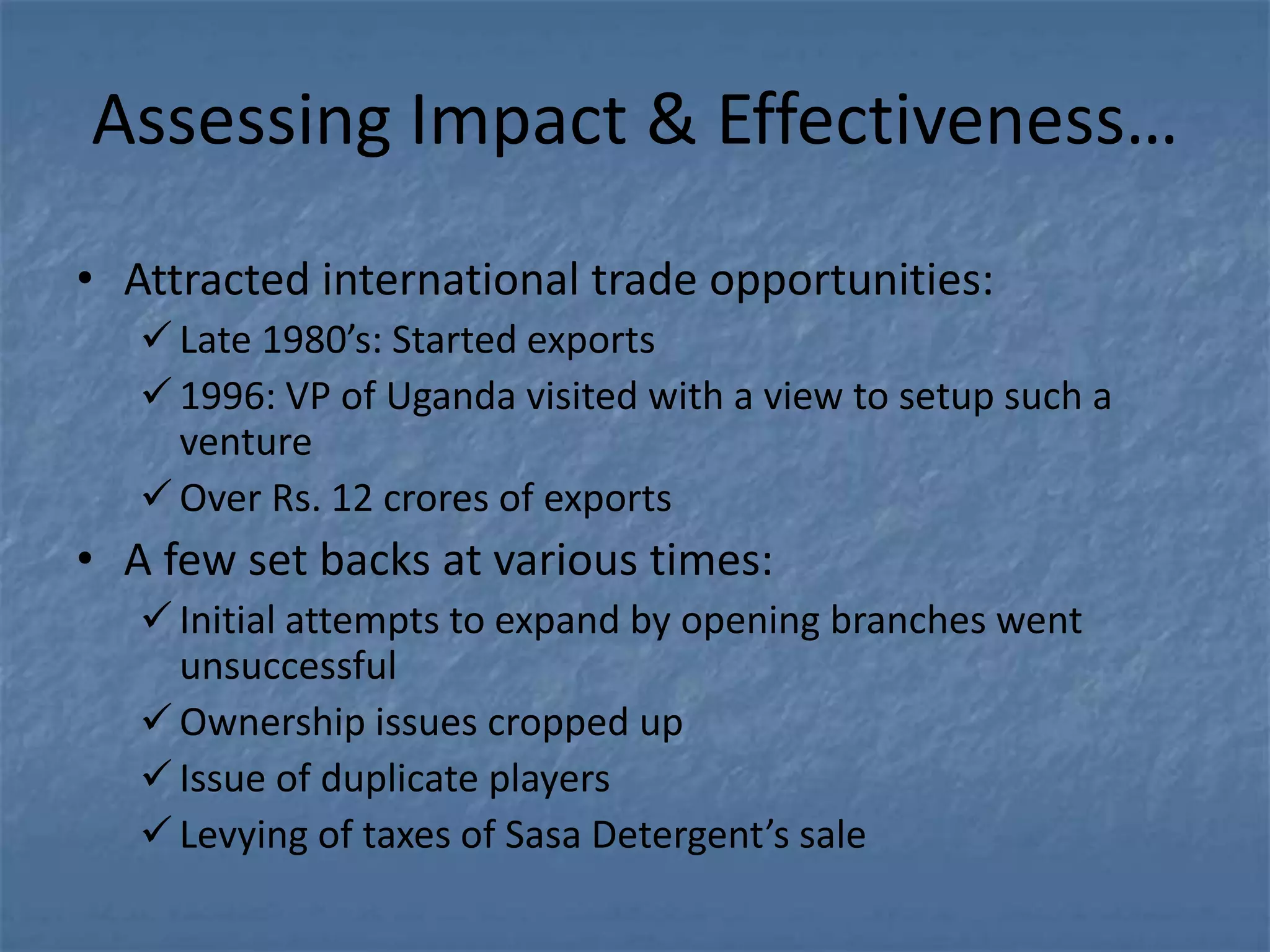
• Attracted international trade opportunities:
    Late 1980’s: Started exports
    1996: VP of Uganda visited with a view to setup such a
     venture
    Over Rs. 12 crores of exports
• A few set backs at various times:
    Initial attempts to expand by opening branches went
     unsuccessful
    Ownership issues cropped up
    Issue of duplicate players
    Levying of taxes of Sasa Detergent’s sale
Assessing Impact & Effectiveness…

• But, overall a venture that created high positive
  social impact

• Acknowledgement by various authorities:
    “Best Village Industries Institution“: from KVIC for period
     1998-99 to 2000-01
    Business Woman of the year in 2002
    PHDCCI Brand Equity Award in 2005
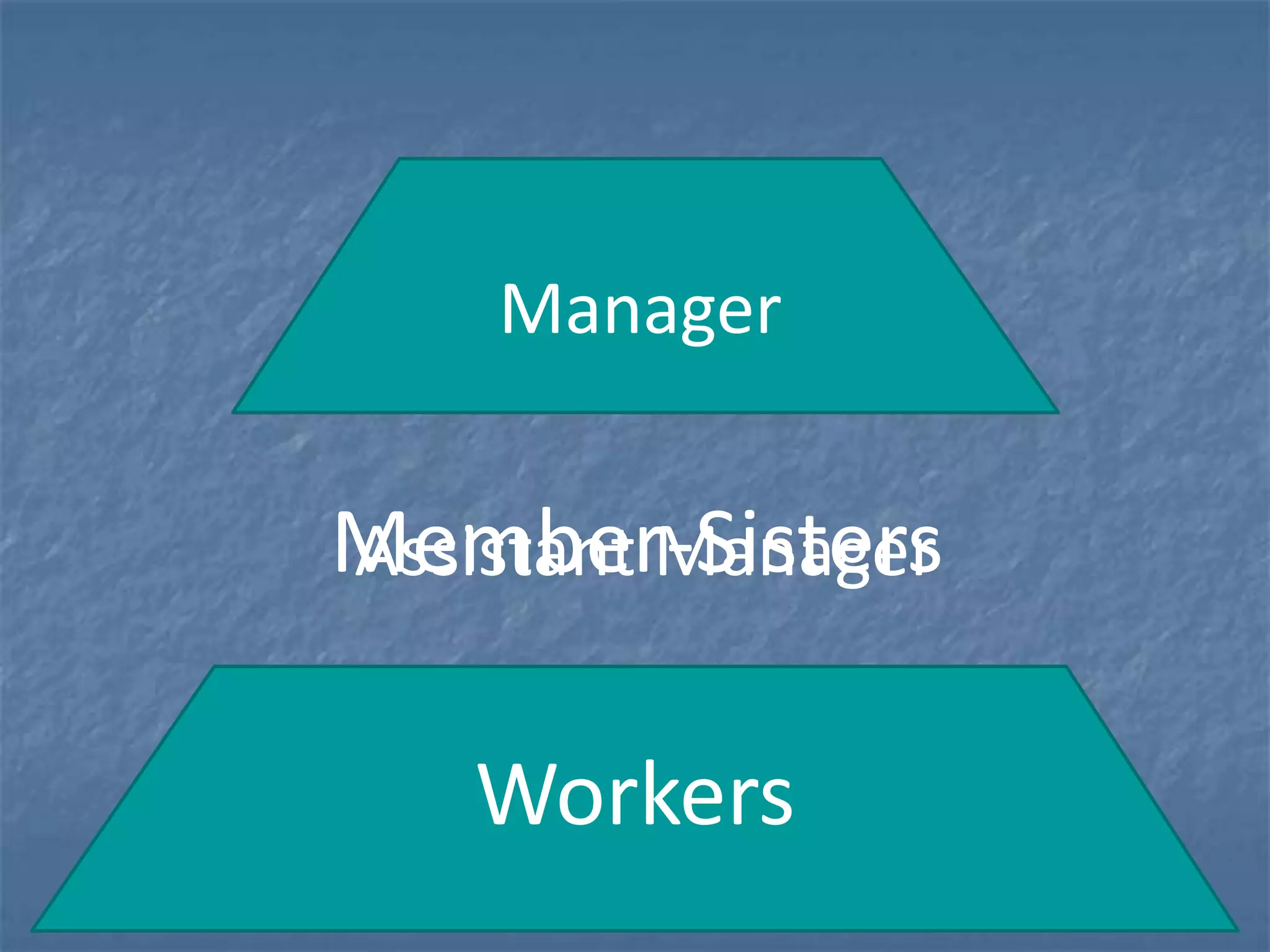
Manager


Member-Sisters
Assistant Manager


    Workers

Lijjat 1

  • 1.
    Shri Mahila GrihaUdyog Lijjat Papad A cooperative established in 1959.
  • 2.
    1. Produced andsold one of the simplest product, famous amongst the Indian households, Papad. 2. Established by 7 ‘Women’ 3. Started with a mere capital of Rs. 80 on the terrace of a building in Girgaum, South Bombay.
  • 3.
    The Entrepreneurs • Foundingmembers: Jaswantiben Jamnadas Popat, Parvatiben Ramdas Thodani, Ujamben Narandas Kundalia, Banuben. N. Tanna, Laguben Amritlar Gokani, Jayaben V. Vithalani • Mentored by Chaganlal Karamsi Parekh • Guided by Shri. Dattanibapa
  • 5.
    Current Leadership: Jyoti Naik (President) Associated since 1971, started rolling papad Deputed to packaging section By 1973, started managing inventory Sanchalika in 1981 VP in 1989 Then President: Earning equivalent to 30 kg of rolled papad in a day  attesting to the organizational values
  • 6.
    Objectives of Lijjat  Maximize employment opportunities for women.  To get the work for the society.  To get mutual understanding, self service and saving habit among the women.  To increase the dealings power of women members.
  • 7.
    ITS VALUES Lijjat believesin the philosophy of sarvodaya and collective ownership. SMGULP never accepts charity or grants. SMGULP is like a family SMGULP is like a revered place of worship.
  • 8.
    SMGULP is acombination of three concepts: The Business concept The Family concept The Devotion Concept
  • 9.
    THE BUSINESS CONCEPT OPPORTUNITY VALUE IDENTIFICATION CREATION
  • 10.
    Opportunity Identification • Themajor thrust:  An existing market demand  Skills needed could be found with any Indian lady  Raw material can be procured from the closest outlet • Differentiating insights brought by venture:  Business can be made sustainable/profitable without high initial investment  Non-acceptance of any grant/aid/donation even if loss is incurred  Quality consciousness in any operation
  • 11.
    Opportunity Identification • Venturegrew as a cooperative business • 1962: Products were registered as “Lijjat” while group was named “Sri Mahila Griha Udyog” • Basic reasons for fast growth:  Only for women venture which provided employment  Women need not move away from home to join it  Sense of ownership given to women  No special skills needed to be successfully carry out operation  A cooperative venture “for women, by women, of women”
  • 12.
    ROADBLOCKS • Not everythingwent smooth: Production had to be halted due to Mumbai’s moist climate • Such roadblocks made founding members better prepared:  they solved the problem by buying a cot and a stove  As members grew & place became constraint  distribute kneaded flour to members to prepare papad at home
  • 13.
    VALUE CREATION • Monetaryvalue creation:  Year 1: Rs. 6196  Year 3: Rs. 1.82 lakhs  Current figures: Rs. 300 crores (Rs. 12 crores export)  Annual profit: Rs. 7 crores approx (2004 figures) • Something beyond monetary contribution…  Way to integrate women with the income generation process at such a mass level  Honing of skills and capabilities  Reducing the patriarchal biases  Unlike prior attempts, women as driver of their empowerment
  • 14.
  • 15.
    EMPOWERING WOMEN • Somethingbeyond monetary contribution… • Employment opportunities without leaving homes, flexible schedules • Transformation of life of around over forty thousand women through its unique work ethics  Linked social advancement to women empowerment  Emphasis on having women from disadvantaged section  Preventing expansion of inherent gap between rich/poor  Average monthly salary of its members: above Rs. 3000/-
  • 16.
    SOCIAL RESPONSIBILITY • Sinceventure was based on sound principles, members contributed in many activities as:  Increasing availability of health care for their families  Providing scholarships to their children  Cooperating in building homes of each other INDIRECT IMPACT: Lijjat Products: Good quality affordable for masses Enhanced social/cultural harmony beyond work-place Active contribution to health, education & social service
  • 17.
    SOCIAL RESPONSIBILITY • Extendingwealth acquired to social cause; few examples:  1979: First ever tarred (pucca) road built with help of Lijjat  Educational and Hobby centers set up to teach skills as: typing, cooking, sewing, knitting and toy making  Rehabilitation work for earthquake affected in Chincholi (Jogan): Financed construction of 50 houses for them  Again, provided Rs. 50 lakhs aid for Bhuj earthquake affected people
  • 18.
    Assessing Impact &Effectiveness… • Positions itself as: “A symbol of women’s strength” • Created employment opportunities for over 40000 women in last 49 years • Not only employment, gave them opportunity to transform their way to live • Equality and justice promoted by Profit-Contribution schemes
  • 19.
  • 20.
    Assessing Impact &Effectiveness… • Sustained for such a long period as a profitable venture itself proves a point for itself • The most quantifiable assessor: Total sales of over Rs. 3 Bn • Organic growth (slow but steady) in a holistic way:  No. of employees  Achieving economies of scale (without blind automation)  Achieved economies of scope  Vertical integration of various process
  • 21.
    Assessing Impact &Effectiveness… • Economies of scale (without following blind automation):  Less emphasis on automation of processes  Rather, achieved it through increased involvement of women members  Allowed members to work from their own place  Expansion in various cities/states: 67 branches and 35 divisions
  • 22.
    Assessing Impact &Effectiveness… • Economies of scope (diversification):  Lijjat started diversification in fields related to papad making  The products needed similar raw material or skills  The existing supply chain was used very efficiently  Khakhra, spices, wadi, wheat flour, bakery items are few examples  Major step to diversify in 1988: Introduction of Sasa Soap  Again, identified opportunity: Soap market in India, then rose by 15% YoY
  • 23.
    Assessing Impact &Effectiveness… • Vertical Integration:  Large scale production  Make rather than Buy  Various processes like:  Flour mills  Print division  Polypropylene packing were undertaken  Aimed at supporting production processes without incurring extra cost
  • 24.
    Assessing Impact &Effectiveness… • Attracted international trade opportunities:  Late 1980’s: Started exports  1996: VP of Uganda visited with a view to setup such a venture  Over Rs. 12 crores of exports • A few set backs at various times:  Initial attempts to expand by opening branches went unsuccessful  Ownership issues cropped up  Issue of duplicate players  Levying of taxes of Sasa Detergent’s sale
  • 25.
    Assessing Impact &Effectiveness… • But, overall a venture that created high positive social impact • Acknowledgement by various authorities:  “Best Village Industries Institution“: from KVIC for period 1998-99 to 2000-01  Business Woman of the year in 2002  PHDCCI Brand Equity Award in 2005
  • 26.