AUTOMATION: 
LESSONS LEARNT FROM SESAR 
ALIAS Conference, 1-2 October 2014, Florence, Italy 
Michael Standar 
Chief Strategies & International Relations
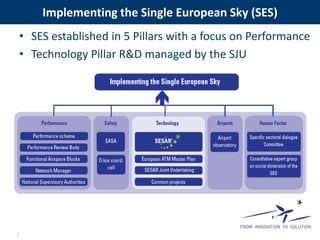
Implementing the Single European Sky (SES) 
• SES established in 5 Pillars with a focus on Performance 
• Technology Pillar R&D managed by the SJU 
2
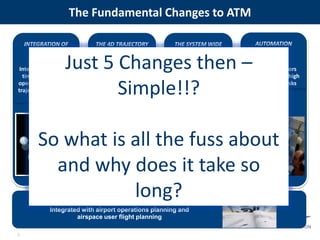
The Fundamental Changes to ATM 
3 
INTEGRATION OF 
AIRPORTS 
Just 5 Changes then – 
Integrating airports - 
time synchronised 
operations of surface 
trajectories and flight 
turn-around 
THE 4D TRAJECTORY 
PRINCIPLE 
Integrating airspace 
users flight systems to 
build predictable time 
synchronised flight 
Simple!!? 
precision 
AUTOMATION 
Human operators 
concentrate on high 
value-added tasks 
THE SYSTEM WIDE 
INFORMATION 
MANAGEMENT 
The Intranet 
for Air Traffic 
Management 
So what is all the fuss about 
and why does it take so 
long? 
COLLABORATIVE NETWORK PLANNING 
Integrated with airport operations planning and 
airspace user flight planning
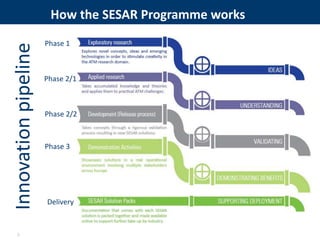
How the SESAR Programme works 
Innovation pipeline 
Phase 1 
Phase 2/1 
Phase 2/2 
Phase 3 
Delivery 
4
The Pipeline: Exploring the Possibilities 
• Low maturity research with Universities, SMEs & 
Research Centres 
– Theme 1: Towards Higher Levels of Automation in ATM 
– Theme 2: Mastering Complex Systems Safely 
– Theme 3: System Architecture and System Design 
– Theme 4: Information Management, Uncertainty and 
Optimization 
– Theme 5: Enabling Change in ATM 
• 40 Projects, 20 PhDs, 2 Networks, an annual event 
attracting around 200 researchers, specialised events, 
summer schools and a Young Scientist Award 
http://www.sesarju.eu/innovation-solution/ 
exploratory-research 
5
WP-E Lessons Learnt 
• In very early stages research V0 level (e.g. WP-E 
projects), transfer of research results is difficult into 
the SESAR main-stream program 
• Lack of clearly defined criteria that can be used for 
assessing maturity results at V0 level 
• Limited possibility to pass results at V0 or V1 into 
programme combined with low level of interest in 
long-term research and innovation from the majority 
of PPP industrial partners 
• Importance of Gate reviews and regular reporting on 
R&I results of projects at V0 level 
6
SESAR SC Committee 
• Scientific Committee specifically to provide guidance 
and support to the SJU on scientific matters 
• SC members recommendations on Human 
Performance Integration in the Safety Analysis of 
Complex systems 
- quantitative metrics – Agent Based Modelling 
- qualitative opinion could be valuable but limited 
due to subjectivity 
- Human Performance (HP) measurement in relation 
of safety of complex systems 
- HP can be integrated in quantitative safety 
assessment (e.g. Human behavior models, etc.) 
7
SESAR Validations/Verifications towards global interoperability 
8 
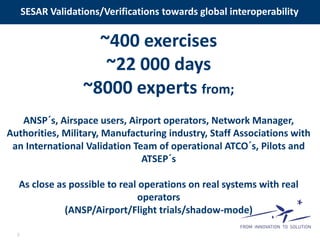
~400 exercises 
~22 000 days 
~8000 experts from; 
ANSP´s, Airspace users, Airport operators, Network Manager, 
Authorities, Military, Manufacturing industry, Staff Associations with 
an International Validation Team of operational ATCO´s, Pilots and 
ATSEP´s 
As close as possible to real operations on real systems with real 
operators 
(ANSP/Airport/Flight trials/shadow-mode)
The Pipeline: Demonstrating Benefits 
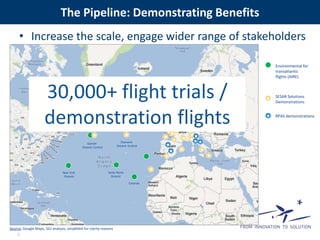
• Increase the scale, engage wider range of stakeholders 
9 
Environmental for 
transatlantic 
flights (AIRE) 
SESAR Solutions 
Demonstrations 
New York 
Oceanic 
Santa Maria 
Oceanic 
Source: Google Maps, SJU analysis, simplified for clarity reasons 
Shanwick 
Oceanic Control 
Gander 
Oceanic Control 
Canarias 
RPAS demonstrations 
30,000+ flight trials / 
demonstration flights
Demonstrating Integration: RPAS 
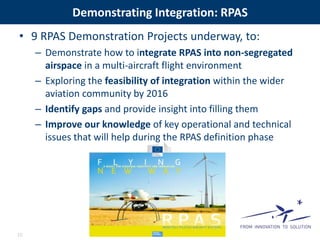
• 9 RPAS Demonstration Projects underway, to: 
– Demonstrate how to integrate RPAS into non-segregated 
airspace in a multi-aircraft flight environment 
– Exploring the feasibility of integration within the wider 
aviation community by 2016 
– Identify gaps and provide insight into filling them 
– Improve our knowledge of key operational and technical 
issues that will help during the RPAS definition phase 
10
2015 - Large scale demonstrations 
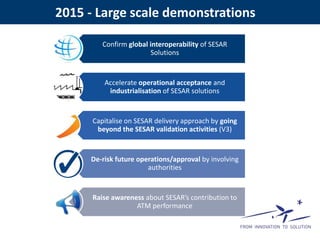
Confirm global interoperability of SESAR 
Solutions 
Accelerate operational acceptance and 
industrialisation of SESAR solutions 
Capitalise on SESAR delivery approach by going 
beyond the SESAR validation activities (V3) 
De-risk future operations/approval by involving 
authorities 
Raise awareness about SESAR’s contribution to 
ATM performance
12 
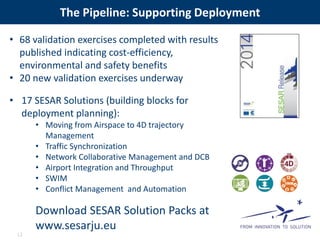
The Pipeline: Supporting Deployment 
• 68 validation exercises completed with results 
published indicating cost-efficiency, 
environmental and safety benefits 
• 20 new validation exercises underway 
• 17 SESAR Solutions (building blocks for 
deployment planning): 
• Moving from Airspace to 4D trajectory 
Management 
• Traffic Synchronization 
• Network Collaborative Management and DCB 
• Airport Integration and Throughput 
• SWIM 
• Conflict Management and Automation 
Download SESAR Solution Packs at 
www.sesarju.eu
Supporting Deployment: The PCP 
• The need for synchronised deployment and support 
for a sound business case 
• Scope of Pilot Common Project includes six ATM 
Functionalities 
AF1 – Extended AMAN & PBN in high density TMA 
AF2 – Airport Integration & Throughput 
AF3 – Flexible Airspace Management and Free Route 
AF4 – Network Collaborative Management 
AF5 – iSWIM functionality & Meteorology 
AF6 – Initial Trajectory Information Sharing (i4D – EPP) 
13
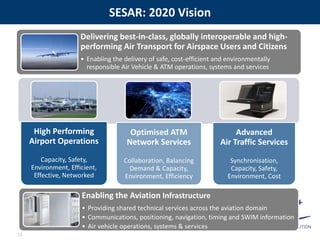
SESAR: 2020 Vision 
Delivering best-in-class, globally interoperable and high-performing 
• Enabling the delivery of safe, cost-efficient and environmentally 
responsible Air Vehicle & ATM operations, systems and services 
High Performing 
Airport Operations 
Capacity, Safety, 
Environment, Efficient, 
Effective, Networked 
Air Transport for Airspace Users and Citizens 
Advanced 
Air Traffic Services 
Synchronisation, 
Capacity, Safety, 
Environment, Cost 
Optimised ATM 
Network Services 
Collaboration, Balancing 
Demand & Capacity, 
Environment, Efficiency 
Enabling the Aviation Infrastructure 
• Providing shared technical services across the aviation domain 
• Communications, positioning, navigation, timing and SWIM information 
• Air vehicle operations, systems & services 
14
Three Research Phases of SESAR 2020 
• Exploratory Research 
– Concentrates on early maturity Excellent Science and initial 
applications to ATM. 
– Uses H2020 open calls. 
• Industrial Research & Validation (Applied Research & 
Pre-industrial Development) through partnership 
– Concentrates on maturing and validating through Applied 
Research, Pre-Industrial Development and Validation of high 
benefit applications for ATM. 
– Uses an industrial PPP with involvement of all stakeholders. 
• Very Large Scale Demonstration 
– Concentrates on taking the concepts and technology to a wider 
geographic and stakeholder application 
– The bridge to deployment through risk reduction 
– Uses a mixture of industrial PPP and open calls. 
15
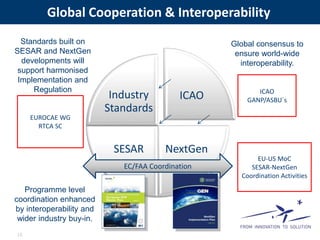
Global Cooperation & Interoperability 
ICAO 
Industry 
Standards 
SESAR NextGen 
EC/FAA Coordination 
Standards built on 
SESAR and NextGen 
developments will 
support harmonised 
Implementation and 
Regulation 
Programme level 
coordination enhanced 
by interoperability and 
wider industry buy-in. 
Global consensus to 
ensure world-wide 
interoperability. 
EU-US MoC 
SESAR-NextGen 
Coordination Activities 
EUROCAE WG 
RTCA SC 
ICAO 
GANP/ASBU´s 
16
Conclusions 
• Managing change 
– Connecting the ”Innovation pipeline” (scope and time) – covering the research gap between exploratory 
and industrial research 
– Understand the current and the evolution of business models 
• from infrastructure to services – changes to roles and responsibilities 
– Create trust 
• Focus on the transition problems towards a higher level of automation as the goals seems well 
understood 
– Key Performance areas and KPI´s (includes Safety) 
– Understand, agree and confirm the objectives early 
– The devil is in the detail – understand the problems of a particular area/domain in the overall context – 
avoid silos or ”magic fix” 
– Design decisions need to be understood and taken early and preferrably before the ”crossroad” 
– Focus on standards – regulatory actions if necessary (steer behaviours) 
• Automation is business and innovation driven 
– Find best practices and adapt Aviation and ATM needs of safety and security performance 
17
Thank you for your attention 
18

AUTOMATION: LESSONS LEARNT FROM SESAR by Michael Standar

  • 1.
    AUTOMATION: LESSONS LEARNTFROM SESAR ALIAS Conference, 1-2 October 2014, Florence, Italy Michael Standar Chief Strategies & International Relations
  • 2.
    Implementing the SingleEuropean Sky (SES) • SES established in 5 Pillars with a focus on Performance • Technology Pillar R&D managed by the SJU 2
  • 3.
    The Fundamental Changesto ATM 3 INTEGRATION OF AIRPORTS Just 5 Changes then – Integrating airports - time synchronised operations of surface trajectories and flight turn-around THE 4D TRAJECTORY PRINCIPLE Integrating airspace users flight systems to build predictable time synchronised flight Simple!!? precision AUTOMATION Human operators concentrate on high value-added tasks THE SYSTEM WIDE INFORMATION MANAGEMENT The Intranet for Air Traffic Management So what is all the fuss about and why does it take so long? COLLABORATIVE NETWORK PLANNING Integrated with airport operations planning and airspace user flight planning
  • 4.
    How the SESARProgramme works Innovation pipeline Phase 1 Phase 2/1 Phase 2/2 Phase 3 Delivery 4
  • 5.
    The Pipeline: Exploringthe Possibilities • Low maturity research with Universities, SMEs & Research Centres – Theme 1: Towards Higher Levels of Automation in ATM – Theme 2: Mastering Complex Systems Safely – Theme 3: System Architecture and System Design – Theme 4: Information Management, Uncertainty and Optimization – Theme 5: Enabling Change in ATM • 40 Projects, 20 PhDs, 2 Networks, an annual event attracting around 200 researchers, specialised events, summer schools and a Young Scientist Award http://www.sesarju.eu/innovation-solution/ exploratory-research 5
  • 6.
    WP-E Lessons Learnt • In very early stages research V0 level (e.g. WP-E projects), transfer of research results is difficult into the SESAR main-stream program • Lack of clearly defined criteria that can be used for assessing maturity results at V0 level • Limited possibility to pass results at V0 or V1 into programme combined with low level of interest in long-term research and innovation from the majority of PPP industrial partners • Importance of Gate reviews and regular reporting on R&I results of projects at V0 level 6
  • 7.
    SESAR SC Committee • Scientific Committee specifically to provide guidance and support to the SJU on scientific matters • SC members recommendations on Human Performance Integration in the Safety Analysis of Complex systems - quantitative metrics – Agent Based Modelling - qualitative opinion could be valuable but limited due to subjectivity - Human Performance (HP) measurement in relation of safety of complex systems - HP can be integrated in quantitative safety assessment (e.g. Human behavior models, etc.) 7
  • 8.
    SESAR Validations/Verifications towardsglobal interoperability 8 ~400 exercises ~22 000 days ~8000 experts from; ANSP´s, Airspace users, Airport operators, Network Manager, Authorities, Military, Manufacturing industry, Staff Associations with an International Validation Team of operational ATCO´s, Pilots and ATSEP´s As close as possible to real operations on real systems with real operators (ANSP/Airport/Flight trials/shadow-mode)
  • 9.
    The Pipeline: DemonstratingBenefits • Increase the scale, engage wider range of stakeholders 9 Environmental for transatlantic flights (AIRE) SESAR Solutions Demonstrations New York Oceanic Santa Maria Oceanic Source: Google Maps, SJU analysis, simplified for clarity reasons Shanwick Oceanic Control Gander Oceanic Control Canarias RPAS demonstrations 30,000+ flight trials / demonstration flights
  • 10.
    Demonstrating Integration: RPAS • 9 RPAS Demonstration Projects underway, to: – Demonstrate how to integrate RPAS into non-segregated airspace in a multi-aircraft flight environment – Exploring the feasibility of integration within the wider aviation community by 2016 – Identify gaps and provide insight into filling them – Improve our knowledge of key operational and technical issues that will help during the RPAS definition phase 10
  • 11.
    2015 - Largescale demonstrations Confirm global interoperability of SESAR Solutions Accelerate operational acceptance and industrialisation of SESAR solutions Capitalise on SESAR delivery approach by going beyond the SESAR validation activities (V3) De-risk future operations/approval by involving authorities Raise awareness about SESAR’s contribution to ATM performance
  • 12.
    12 The Pipeline:Supporting Deployment • 68 validation exercises completed with results published indicating cost-efficiency, environmental and safety benefits • 20 new validation exercises underway • 17 SESAR Solutions (building blocks for deployment planning): • Moving from Airspace to 4D trajectory Management • Traffic Synchronization • Network Collaborative Management and DCB • Airport Integration and Throughput • SWIM • Conflict Management and Automation Download SESAR Solution Packs at www.sesarju.eu
  • 13.
    Supporting Deployment: ThePCP • The need for synchronised deployment and support for a sound business case • Scope of Pilot Common Project includes six ATM Functionalities AF1 – Extended AMAN & PBN in high density TMA AF2 – Airport Integration & Throughput AF3 – Flexible Airspace Management and Free Route AF4 – Network Collaborative Management AF5 – iSWIM functionality & Meteorology AF6 – Initial Trajectory Information Sharing (i4D – EPP) 13
  • 14.
    SESAR: 2020 Vision Delivering best-in-class, globally interoperable and high-performing • Enabling the delivery of safe, cost-efficient and environmentally responsible Air Vehicle & ATM operations, systems and services High Performing Airport Operations Capacity, Safety, Environment, Efficient, Effective, Networked Air Transport for Airspace Users and Citizens Advanced Air Traffic Services Synchronisation, Capacity, Safety, Environment, Cost Optimised ATM Network Services Collaboration, Balancing Demand & Capacity, Environment, Efficiency Enabling the Aviation Infrastructure • Providing shared technical services across the aviation domain • Communications, positioning, navigation, timing and SWIM information • Air vehicle operations, systems & services 14
  • 15.
    Three Research Phasesof SESAR 2020 • Exploratory Research – Concentrates on early maturity Excellent Science and initial applications to ATM. – Uses H2020 open calls. • Industrial Research & Validation (Applied Research & Pre-industrial Development) through partnership – Concentrates on maturing and validating through Applied Research, Pre-Industrial Development and Validation of high benefit applications for ATM. – Uses an industrial PPP with involvement of all stakeholders. • Very Large Scale Demonstration – Concentrates on taking the concepts and technology to a wider geographic and stakeholder application – The bridge to deployment through risk reduction – Uses a mixture of industrial PPP and open calls. 15
  • 16.
    Global Cooperation &Interoperability ICAO Industry Standards SESAR NextGen EC/FAA Coordination Standards built on SESAR and NextGen developments will support harmonised Implementation and Regulation Programme level coordination enhanced by interoperability and wider industry buy-in. Global consensus to ensure world-wide interoperability. EU-US MoC SESAR-NextGen Coordination Activities EUROCAE WG RTCA SC ICAO GANP/ASBU´s 16
  • 17.
    Conclusions • Managingchange – Connecting the ”Innovation pipeline” (scope and time) – covering the research gap between exploratory and industrial research – Understand the current and the evolution of business models • from infrastructure to services – changes to roles and responsibilities – Create trust • Focus on the transition problems towards a higher level of automation as the goals seems well understood – Key Performance areas and KPI´s (includes Safety) – Understand, agree and confirm the objectives early – The devil is in the detail – understand the problems of a particular area/domain in the overall context – avoid silos or ”magic fix” – Design decisions need to be understood and taken early and preferrably before the ”crossroad” – Focus on standards – regulatory actions if necessary (steer behaviours) • Automation is business and innovation driven – Find best practices and adapt Aviation and ATM needs of safety and security performance 17
  • 18.
    Thank you foryour attention 18

Editor's Notes

  • #3 Existing programme runs to 31 December 2016; Clear set of deliverables to be achieved through validations and releases V3 results coupled to SESAR Deployment and the establishment of the Deployment Manager by the EC SJU to deliver scope of PCP ATM Functionalities in accordance with a shared roadmap and deliverable list Continue to provide support to EC on ATM issues, such as Datalink (VDL2) etc. In parallel SJU establishing Membership, preparation and launch of SESAR Programme 2020
  • #7 WP-E lessons learnt – difficulties WP-E results transfer, lack of interest from industrial partners, small projects of 300K work very well, co-funding too, del legal access too late for WP-E , ATM research much better than FP 7 ones, Gate Reviews work very well, need on regular reporting on WP-E results assessment, honesty/ transparency on reporting research results is essential in order to prevent others to repeat the same mistakes. Demonstrated the importance of transferring ER 2020 results to the SESAR mainstream program It is essential to realise the concept of a ‘pipeline to innovation’ described in the overall SESAR Programme 2020 document and the realisation of important benefits to the SJU stakeholders of transferring Exploratory Research results to the rest of SESAR 2020 program. SESAR 2020 - it is proposed to strengthen the link between the research community and the industry at project level through a maturity level assessment as well as through specific transversal activities.
  • #9 Execution 400 á 5 day´s = 2 000 day´s = 16 000 hrs (339 á 5 days = 1 695 days´s = 13 560 hrs) Preparation 400 á 60 days = 24 000 day´s = 192 000 hrs (339 á 60 day´s = 20 340 days = 162 720 hrs) 400 exercises à 20 expert´s = 8 000 experts
  • #17 Architecture RECAT ÌCAO and std roadmap Cyber security RPAS integration Remote Tower Services Datacom – avionics roadmap SWIM and TBO BUDSS SWIM demo global i4D trials